Learn the 7 essential steps to build an effective email marketing strategy that drives results. From list building to analytics, this guide covers the fundamentals.
Learn the 7 essential steps to build an effective email marketing strategy that drives results. From list building to analytics, this guide covers the fundamentals.
Email marketing delivers one of the highest returns in digital marketing, and the numbers prove it: businesses earn an average of $36 for every dollar spent on email marketing. Yet most teams still struggle to convert that potential into consistent revenue. The difference between campaigns that perform and ones that plateau almost always comes down to execution fundamentals. These 7 steps to successful email marketing give you a clear framework to fix the gaps, whether you're starting from scratch or optimizing an existing program.
Key Takeaways
For every $1 spent on email marketing, businesses see a return of $36, an email marketing ROI of 3,600%.
Email marketing campaigns with segmented contact lists increase revenue by 760%.
Despite representing only 2% of total email volume, automated emails drive 37 to 41% of all email-generated sales, yielding 320% higher revenue per message than broadcast campaigns.
Emails with personalized subject lines are 50% more likely to be opened.
Roughly one in six marketing emails fails to reach the recipient's inbox, making deliverability a top priority from day one.
Step 1: Define Clear Goals Before You Write a Single Email
Most email programs underperform because they lack a defined objective. "Send more emails" is not a strategy.
Before building any campaign, answer three questions:
Who are you sending to?
What specific action do you want them to take?
How will you measure success?
Your goals will shape everything from your list-building approach to your send cadence and content mix. A SaaS company running a free trial nurture sequence has different success metrics than an ecommerce brand running a post-purchase flow. Align your email goals to business outcomes, specifically revenue, qualified leads, or customer retention, rather than vanity metrics like raw subscriber count.
If you don't already have a documented plan, an email marketing strategy template gives you a structured starting point to map goals, audiences, and campaign types before you build anything.
Email marketing delivers one of the highest returns in digital marketing, and the numbers prove it: businesses earn an average of $36 for every dollar spent on email marketing. Yet most teams still struggle to convert that potential into consistent revenue. The difference between campaigns that perform and ones that plateau almost always comes down to execution fundamentals. These 7 steps to successful email marketing give you a clear framework to fix the gaps, whether you're starting from scratch or optimizing an existing program.
Key Takeaways
For every $1 spent on email marketing, businesses see a return of $36, an email marketing ROI of 3,600%.
Email marketing campaigns with segmented contact lists increase revenue by 760%.
Despite representing only 2% of total email volume, automated emails drive 37 to 41% of all email-generated sales, yielding 320% higher revenue per message than broadcast campaigns.
Emails with personalized subject lines are 50% more likely to be opened.
Roughly one in six marketing emails fails to reach the recipient's inbox, making deliverability a top priority from day one.
Step 1: Define Clear Goals Before You Write a Single Email
Most email programs underperform because they lack a defined objective. "Send more emails" is not a strategy.
Before building any campaign, answer three questions:
Who are you sending to?
What specific action do you want them to take?
How will you measure success?
Your goals will shape everything from your list-building approach to your send cadence and content mix. A SaaS company running a free trial nurture sequence has different success metrics than an ecommerce brand running a post-purchase flow. Align your email goals to business outcomes, specifically revenue, qualified leads, or customer retention, rather than vanity metrics like raw subscriber count.
If you don't already have a documented plan, an email marketing strategy template gives you a structured starting point to map goals, audiences, and campaign types before you build anything.
Step 2: Build and Maintain a High-Quality Email List
Your list is the foundation of everything. A large, disengaged list will consistently hurt your results. A smaller, opted-in, engaged list will outperform it every time.
Grow with intent
Focus on attracting subscribers who are genuinely interested in what you offer. Use lead magnets, gated content, and website opt-in forms aligned to your audience's actual needs. Nearly 4.5 billion people used email worldwide in 2025, and that number is expected to grow to over 4.8 billion by 2027, so the audience is there. The goal is capturing the right slice of it.
Keep your list clean
Email addresses decay at a rate of 20% annually, making regular verification critical. Sending to stale or invalid addresses drives up bounce rates, damages your sender reputation, and reduces deliverability. Remove hard bounces immediately and run re-engagement campaigns for subscribers who haven't opened in 90 days before removing them from your active list.
Research shows that 46% of unsubscribes result from irrelevant or non-personalized content reaching subscribers. List health is directly tied to how relevant your content is, which connects directly to the next step.
Batch-and-blast email marketing is a fast path to low engagement and high unsubscribe rates. 90% of email marketing professionals report that using subscriber segmentation to deliver targeted messages increases performance for marketing emails.
The revenue impact is substantial. Segmented campaigns drive a 760% increase in revenue. Segmented email campaigns receive 14.31% better open rate results and 101% more clicks than non-segmented ones.
Where to start with segmentation
Demographic data: job title, company size, location
Behavioral data: pages visited, content downloaded, purchase history
Engagement level: active openers vs. inactive subscribers
Lifecycle stage: new subscriber, active customer, lapsed buyer
Email segmentation divides your subscriber list into smaller groups based on shared characteristics like purchase history, browsing behavior, demographics, or engagement levels. You don't need perfect data to start. Even basic segmentation by engagement level, separating highly engaged subscribers from dormant ones, will improve your results immediately.
Step 2: Build and Maintain a High-Quality Email List
Your list is the foundation of everything. A large, disengaged list will consistently hurt your results. A smaller, opted-in, engaged list will outperform it every time.
Grow with intent
Focus on attracting subscribers who are genuinely interested in what you offer. Use lead magnets, gated content, and website opt-in forms aligned to your audience's actual needs. Nearly 4.5 billion people used email worldwide in 2025, and that number is expected to grow to over 4.8 billion by 2027, so the audience is there. The goal is capturing the right slice of it.
Keep your list clean
Email addresses decay at a rate of 20% annually, making regular verification critical. Sending to stale or invalid addresses drives up bounce rates, damages your sender reputation, and reduces deliverability. Remove hard bounces immediately and run re-engagement campaigns for subscribers who haven't opened in 90 days before removing them from your active list.
Research shows that 46% of unsubscribes result from irrelevant or non-personalized content reaching subscribers. List health is directly tied to how relevant your content is, which connects directly to the next step.
Batch-and-blast email marketing is a fast path to low engagement and high unsubscribe rates. 90% of email marketing professionals report that using subscriber segmentation to deliver targeted messages increases performance for marketing emails.
The revenue impact is substantial. Segmented campaigns drive a 760% increase in revenue. Segmented email campaigns receive 14.31% better open rate results and 101% more clicks than non-segmented ones.
Where to start with segmentation
Demographic data: job title, company size, location
Behavioral data: pages visited, content downloaded, purchase history
Engagement level: active openers vs. inactive subscribers
Lifecycle stage: new subscriber, active customer, lapsed buyer
Email segmentation divides your subscriber list into smaller groups based on shared characteristics like purchase history, browsing behavior, demographics, or engagement levels. You don't need perfect data to start. Even basic segmentation by engagement level, separating highly engaged subscribers from dormant ones, will improve your results immediately.
Your subject line is the single highest-leverage element in any email. Subject lines drive 47% of open decisions, making them your highest-impact lever.
A few principles with strong data behind them:
Personalization works. Personalized subject lines increase email open rates by 26%.
Length matters. Emails with 6 to 10 words in the subject line have the highest open rate at 21%.
Test before you scale. Brands that regularly A/B test their emails achieve 83% higher ROI than those that never test.
Curiosity, specificity, and relevance consistently outperform generic promotional language. Subject lines that reference the subscriber's behavior, interest, or situation will almost always outperform ones that don't.
For a detailed breakdown of what works, including tested formulas and data, see our post on email subject line best practices that boost open rates by 27%.
Step 5: Personalize Your Content
Personalization has moved well beyond using someone's first name in a subject line. Today, effective personalization means delivering content that matches a subscriber's behavior, preferences, and stage in the buying journey.
Personalized emails deliver six times higher transaction rates than non-personalized ones. Segmented and personalized emails generate 58% of all revenue.
The data on specific elements is equally compelling:
Personalized calls to action result in 42% higher conversion rates than regular CTAs.
Marketing emails sent in response to behavioral triggers generate 10 times greater revenue than other marketing email types.
63% of people say they never respond to non-personalized emails.
Personalization at scale requires good data and the right platform. Start with the signals you already have: what content a subscriber has engaged with, what product pages they've visited, and where they are in your funnel. Use that to adjust your messaging, offers, and CTAs dynamically.
Step 6: Build Automation Sequences
Automation is where email marketing compounds. Manually sending one-off campaigns is inherently limited by time and human capacity. Automated sequences work around the clock, triggered by subscriber behavior, without requiring ongoing effort per send.
Automated emails generate 320% more revenue than non-automated emails. Automated emails drove 37% of all email-generated sales in 2024 despite accounting for just 2% of total email volume.
Your subject line is the single highest-leverage element in any email. Subject lines drive 47% of open decisions, making them your highest-impact lever.
A few principles with strong data behind them:
Personalization works. Personalized subject lines increase email open rates by 26%.
Length matters. Emails with 6 to 10 words in the subject line have the highest open rate at 21%.
Test before you scale. Brands that regularly A/B test their emails achieve 83% higher ROI than those that never test.
Curiosity, specificity, and relevance consistently outperform generic promotional language. Subject lines that reference the subscriber's behavior, interest, or situation will almost always outperform ones that don't.
For a detailed breakdown of what works, including tested formulas and data, see our post on email subject line best practices that boost open rates by 27%.
Step 5: Personalize Your Content
Personalization has moved well beyond using someone's first name in a subject line. Today, effective personalization means delivering content that matches a subscriber's behavior, preferences, and stage in the buying journey.
Personalized emails deliver six times higher transaction rates than non-personalized ones. Segmented and personalized emails generate 58% of all revenue.
The data on specific elements is equally compelling:
Personalized calls to action result in 42% higher conversion rates than regular CTAs.
Marketing emails sent in response to behavioral triggers generate 10 times greater revenue than other marketing email types.
63% of people say they never respond to non-personalized emails.
Personalization at scale requires good data and the right platform. Start with the signals you already have: what content a subscriber has engaged with, what product pages they've visited, and where they are in your funnel. Use that to adjust your messaging, offers, and CTAs dynamically.
Step 6: Build Automation Sequences
Automation is where email marketing compounds. Manually sending one-off campaigns is inherently limited by time and human capacity. Automated sequences work around the clock, triggered by subscriber behavior, without requiring ongoing effort per send.
Automated emails generate 320% more revenue than non-automated emails. Automated emails drove 37% of all email-generated sales in 2024 despite accounting for just 2% of total email volume.
Core sequences every program needs
Welcome series: Welcome emails enjoy a high open rate, with more than 8 out of 10 people opening them, resulting in 4x as many opens and 10x more clicks than other email types. This is your highest-engagement window. Use it to introduce your brand, set expectations, and deliver value quickly.
Abandoned cart: Abandoned cart emails achieve an average open rate of 50.5%, a click rate of 6.25%, and a conversion rate of 3.33%, with top-performing brands reaching conversion rates of 7.69%.
Behavioral triggers: Behavioral triggers transform email performance by delivering messages when recipients are most engaged and receptive. These triggered sequences deliver 152% higher click-through rates, proving that timing and context matter more than creative alone.
Successful sequences typically contain 4 to 8 emails over 30 to 45 days, though this varies significantly by objective and audience. Start with your welcome sequence and one behavioral trigger, then build from there as you collect data.
For more on building a high-performing welcome flow, see our guide on welcome email sequence best practices.
Step 7: Protect Your Deliverability
None of the above matters if your emails don't reach the inbox. According to Validity's email deliverability report, the global inbox placement rate sits at 83.5%. Spam accounts for 6.7% of emails, and another 9.8% go missing entirely. That's roughly one in six marketing emails failing to reach the recipient's inbox.
The three pillars of deliverability
1. Technical authentication
Email authentication is non-negotiable in 2025. You need three key protocols: SPF, DKIM, and DMARC. These prove to inbox providers that your emails are legitimate and not being spoofed.
2. Sender reputation
ISPs look at sender behavior, subscriber behavior, and email list hygiene to determine your sender reputation score. Your email strategy doesn't just impact your subscribers; ISPs are watching too. Things like your email send volume and cadence can indicate spammy practices.
Keep spam complaint rates below 0.1% and hard bounce rates below 2%. Use free tools like Google Postmaster Tools for Gmail data, Microsoft SNDS for Outlook, and Validity's Sender Score to track your reputation directly from the source.
3. List hygiene
List hygiene is a cornerstone of email deliverability because sending to a clean list signals to ISPs that you are a responsible sender who prioritizes recipient engagement. A bloated list filled with hard bounces, spam traps, and disengaged subscribers actively damages your sender reputation. Every campaign sent to such a list results in negative signals, which tells ISPs that your content is unwanted.
Deliverability is not a one-time fix. It's an ongoing practice that requires consistent monitoring and proactive list management.
Welcome series: Welcome emails enjoy a high open rate, with more than 8 out of 10 people opening them, resulting in 4x as many opens and 10x more clicks than other email types. This is your highest-engagement window. Use it to introduce your brand, set expectations, and deliver value quickly.
Abandoned cart: Abandoned cart emails achieve an average open rate of 50.5%, a click rate of 6.25%, and a conversion rate of 3.33%, with top-performing brands reaching conversion rates of 7.69%.
Behavioral triggers: Behavioral triggers transform email performance by delivering messages when recipients are most engaged and receptive. These triggered sequences deliver 152% higher click-through rates, proving that timing and context matter more than creative alone.
Successful sequences typically contain 4 to 8 emails over 30 to 45 days, though this varies significantly by objective and audience. Start with your welcome sequence and one behavioral trigger, then build from there as you collect data.
For more on building a high-performing welcome flow, see our guide on welcome email sequence best practices.
Step 7: Protect Your Deliverability
None of the above matters if your emails don't reach the inbox. According to Validity's email deliverability report, the global inbox placement rate sits at 83.5%. Spam accounts for 6.7% of emails, and another 9.8% go missing entirely. That's roughly one in six marketing emails failing to reach the recipient's inbox.
The three pillars of deliverability
1. Technical authentication
Email authentication is non-negotiable in 2025. You need three key protocols: SPF, DKIM, and DMARC. These prove to inbox providers that your emails are legitimate and not being spoofed.
2. Sender reputation
ISPs look at sender behavior, subscriber behavior, and email list hygiene to determine your sender reputation score. Your email strategy doesn't just impact your subscribers; ISPs are watching too. Things like your email send volume and cadence can indicate spammy practices.
Keep spam complaint rates below 0.1% and hard bounce rates below 2%. Use free tools like Google Postmaster Tools for Gmail data, Microsoft SNDS for Outlook, and Validity's Sender Score to track your reputation directly from the source.
3. List hygiene
List hygiene is a cornerstone of email deliverability because sending to a clean list signals to ISPs that you are a responsible sender who prioritizes recipient engagement. A bloated list filled with hard bounces, spam traps, and disengaged subscribers actively damages your sender reputation. Every campaign sent to such a list results in negative signals, which tells ISPs that your content is unwanted.
Deliverability is not a one-time fix. It's an ongoing practice that requires consistent monitoring and proactive list management.
Measure, Test, and Improve
Following these 7 steps to successful email marketing gives you a strong foundation, but sustained results require ongoing measurement. Bot-driven phantom engagement has made open rates unreliable, pushing high-performing teams toward revenue per email, list churn, and lifetime value as the metrics that matter.
Track the metrics that connect directly to business outcomes: revenue per email, conversion rate by campaign type, and list growth rate net of unsubscribes. A/B test subject lines, send times, and CTAs consistently. Brands that regularly A/B test their emails achieve 83% higher ROI than those that never test. Companies that often test achieve an average ROI of 4,200%, compared to 2,300% for those that never test.
Review your email marketing analytics on a set cadence, ideally weekly for active campaigns and monthly for program-level trends.
Frequently Asked Questions
What are the 7 steps to successful email marketing?
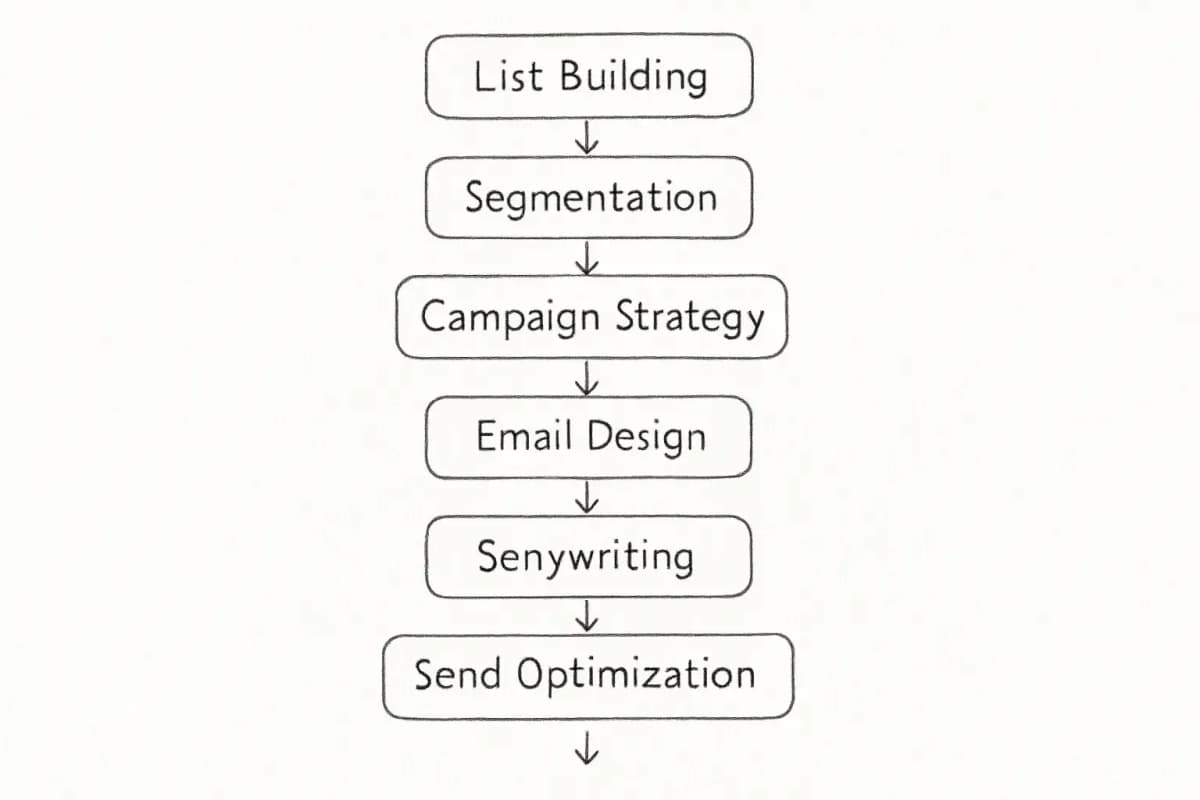
The seven steps are: (1) define clear goals, (2) build and maintain a quality list, (3) segment your audience, (4) write subject lines that earn opens, (5) personalize your content, (6) build automation sequences, and (7) protect your deliverability. Each step builds on the previous one. Skipping any of them creates gaps that limit your overall results.
How long does it take to see results from email marketing?
Basic campaigns can produce measurable results within weeks. Automated sequences like welcome flows and cart abandonment emails often show ROI within days of going live. Deliverability improvements and list quality gains take longer, typically 60 to 90 days, because they depend on building sender reputation over time.
What is a good email marketing ROI benchmark?
The average ROI for marketing emails in the US and UK is between 3,600% and 3,800%. The top 8% of programs, those hitting 45:1 ROI or more, most commonly send newsletters and onboarding emails, not promotions. Your industry, list quality, and program maturity all affect where you land.
How often should I send marketing emails?
Frequency depends on your audience, content type, and industry. Brands sending 9 to 16 emails monthly achieve average ROI of 4,600%, which represents a useful benchmark for businesses scaling their programs. The most important variable is not frequency but relevance. The top three reasons people unsubscribe from an email list are too many emails (59%), information is no longer relevant (43%), or they do not remember signing up (43%). Send as often as you can deliver genuine value to your subscribers.
What is the biggest mistake in email marketing?
Measure, Test, and Improve
Following these 7 steps to successful email marketing gives you a strong foundation, but sustained results require ongoing measurement. Bot-driven phantom engagement has made open rates unreliable, pushing high-performing teams toward revenue per email, list churn, and lifetime value as the metrics that matter.
Track the metrics that connect directly to business outcomes: revenue per email, conversion rate by campaign type, and list growth rate net of unsubscribes. A/B test subject lines, send times, and CTAs consistently. Brands that regularly A/B test their emails achieve 83% higher ROI than those that never test. Companies that often test achieve an average ROI of 4,200%, compared to 2,300% for those that never test.
Review your email marketing analytics on a set cadence, ideally weekly for active campaigns and monthly for program-level trends.
Frequently Asked Questions
What are the 7 steps to successful email marketing?
The seven steps are: (1) define clear goals, (2) build and maintain a quality list, (3) segment your audience, (4) write subject lines that earn opens, (5) personalize your content, (6) build automation sequences, and (7) protect your deliverability. Each step builds on the previous one. Skipping any of them creates gaps that limit your overall results.
How long does it take to see results from email marketing?
Basic campaigns can produce measurable results within weeks. Automated sequences like welcome flows and cart abandonment emails often show ROI within days of going live. Deliverability improvements and list quality gains take longer, typically 60 to 90 days, because they depend on building sender reputation over time.
What is a good email marketing ROI benchmark?
The average ROI for marketing emails in the US and UK is between 3,600% and 3,800%. The top 8% of programs, those hitting 45:1 ROI or more, most commonly send newsletters and onboarding emails, not promotions. Your industry, list quality, and program maturity all affect where you land.
How often should I send marketing emails?
Frequency depends on your audience, content type, and industry. Brands sending 9 to 16 emails monthly achieve average ROI of 4,600%, which represents a useful benchmark for businesses scaling their programs. The most important variable is not frequency but relevance. The top three reasons people unsubscribe from an email list are too many emails (59%), information is no longer relevant (43%), or they do not remember signing up (43%). Send as often as you can deliver genuine value to your subscribers.
What is the biggest mistake in email marketing?
Sending undifferentiated emails to your entire list without segmentation or personalization. Email marketing campaigns that are most effective include the strategies of segmentation (78%), message personalization (72%), and email automation (71%). Most programs that underperform are doing none or only one of these three consistently.
No comments yet. Be the first!
Sending undifferentiated emails to your entire list without segmentation or personalization. Email marketing campaigns that are most effective include the strategies of segmentation (78%), message personalization (72%), and email automation (71%). Most programs that underperform are doing none or only one of these three consistently.