Automotive Email Marketing: Drive Sales and Loyalty
Learn how to build automotive email marketing campaigns that boost service bookings, increase customer retention, and grow revenue for repair shops and dealerships.
Automotive Email Marketing: Drive Sales and Loyalty
Learn how to build automotive email marketing campaigns that boost service bookings, increase customer retention, and grow revenue for repair shops and dealerships.
Automotive email marketing is one of the highest-returning digital channels in the industry, and the data proves it. Email marketing generates $40 to $44 in ROI per dollar spent in automotive, making it the highest-performing digital channel in the sector, surpassing paid search, social media, and display advertising combined. For dealerships, repair shops, and parts retailers, that return comes from doing a few things consistently well: segmenting lists, automating behavioral triggers, and personalizing every touchpoint based on real customer data.
This guide covers how automotive businesses at every level, from multi-location dealerships to independent repair shops, can build email programs that drive sales and earn long-term loyalty.
Key Takeaways
Automotive gets the highest revenues per email recipient of any industry, with standard campaigns earning $0.16 per recipient while automations return $5.47 on average.
Automated campaigns generate $5.47 per recipient versus $0.16 for manual sends, a 34x performance multiplier that transforms marketing efficiency.
Properly segmented campaigns drive 760% revenue increases; effective segmentation goes beyond demographics to include behavioral, transactional, and lifecycle criteria, such as customers with vehicles over 30,000 miles or prospects who viewed SUV inventory.
74% of vehicle shoppers willingly share data for personalized communications, giving automotive marketers a strong foundation for first-party data strategy.
The automotive industry averages just 12.6% email open rates across all campaigns, a figure that represents generic, non-automated efforts lacking personalization and strategic segmentation. There is a wide gap between average programs and high-performing ones.
Why Automotive Email Marketing Outperforms Other Channels
The car-buying and car-servicing lifecycle creates natural email marketing opportunities that few other industries enjoy. Customers have predictable maintenance schedules, seasonal needs, and vehicle-specific behaviors that can trigger timely, relevant messages.
88% of potential car buyers conduct online research before purchases, creating multiple opportunities to capture email addresses and build relationships before customers even visit a dealership. Combined with the channel's economics, email is where automotive brands should anchor their retention strategy.
Automotive email marketing is one of the highest-returning digital channels in the industry, and the data proves it. Email marketing generates $40 to $44 in ROI per dollar spent in automotive, making it the highest-performing digital channel in the sector, surpassing paid search, social media, and display advertising combined. For dealerships, repair shops, and parts retailers, that return comes from doing a few things consistently well: segmenting lists, automating behavioral triggers, and personalizing every touchpoint based on real customer data.
This guide covers how automotive businesses at every level, from multi-location dealerships to independent repair shops, can build email programs that drive sales and earn long-term loyalty.
Key Takeaways
Automotive gets the highest revenues per email recipient of any industry, with standard campaigns earning $0.16 per recipient while automations return $5.47 on average.
Automated campaigns generate $5.47 per recipient versus $0.16 for manual sends, a 34x performance multiplier that transforms marketing efficiency.
Properly segmented campaigns drive 760% revenue increases; effective segmentation goes beyond demographics to include behavioral, transactional, and lifecycle criteria, such as customers with vehicles over 30,000 miles or prospects who viewed SUV inventory.
74% of vehicle shoppers willingly share data for personalized communications, giving automotive marketers a strong foundation for first-party data strategy.
The automotive industry averages just 12.6% email open rates across all campaigns, a figure that represents generic, non-automated efforts lacking personalization and strategic segmentation. There is a wide gap between average programs and high-performing ones.
Why Automotive Email Marketing Outperforms Other Channels
The car-buying and car-servicing lifecycle creates natural email marketing opportunities that few other industries enjoy. Customers have predictable maintenance schedules, seasonal needs, and vehicle-specific behaviors that can trigger timely, relevant messages.
88% of potential car buyers conduct online research before purchases, creating multiple opportunities to capture email addresses and build relationships before customers even visit a dealership. Combined with the channel's economics, email is where automotive brands should anchor their retention strategy.
60% of consumers have completed a purchase after receiving a marketing message by email, and 59% say that email marketing influences their purchase decisions.
The automotive repair industry faces unique customer retention challenges: most vehicle owners have no inherent loyalty to a specific shop, making consistent communication essential. Without regular touchpoints, customers easily drift to competitors who actively engage them.
Email closes that gap at a cost no other channel can match.
Segmentation: The Single Biggest Lever in Automotive Email
Most automotive email programs underperform not because of bad creative or weak offers, but because of poor list segmentation. 73% of dealerships reported not segmenting their lists in any way, representing the single largest missed opportunity in automotive email marketing.
77% of email ROI comes from segmented, targeted, and triggered campaigns, meaning the overwhelming majority of email value derives from sophisticated approaches rather than broadcast messaging.
For automotive businesses, effective segments include:
Vehicle ownership stage: new buyer, lease-end approaching, long-term owner
Service history: overdue for oil change, last visit over 12 months ago, recently completed repair
Purchase intent signals: browsed specific inventory pages, submitted a finance inquiry
Geographic proximity: customers within a set radius for local service offers
Vehicle make and model: critical for parts promotions and recall notices
One of the most effective ways to maximize the impact of email marketing is through audience segmentation, which allows you to tailor messages to specific groups. Start by segmenting based on factors like vehicle make and model, last service date, average repair order, and customer preferences.
Personalized emails achieve 44.30% open rates versus 39.28% for generic messages in automotive. That 5-point advantage represents thousands of additional engaged customers per campaign, demonstrating that even basic personalization elements like name insertion and vehicle-specific content significantly impact engagement.
But surface-level personalization is not enough. Personalization extends beyond simply including the customer's name: it involves tailoring content based on vehicle ownership, service history, browsing behavior, and purchase intent.
60% of consumers have completed a purchase after receiving a marketing message by email, and 59% say that email marketing influences their purchase decisions.
The automotive repair industry faces unique customer retention challenges: most vehicle owners have no inherent loyalty to a specific shop, making consistent communication essential. Without regular touchpoints, customers easily drift to competitors who actively engage them.
Email closes that gap at a cost no other channel can match.
Segmentation: The Single Biggest Lever in Automotive Email
Most automotive email programs underperform not because of bad creative or weak offers, but because of poor list segmentation. 73% of dealerships reported not segmenting their lists in any way, representing the single largest missed opportunity in automotive email marketing.
77% of email ROI comes from segmented, targeted, and triggered campaigns, meaning the overwhelming majority of email value derives from sophisticated approaches rather than broadcast messaging.
For automotive businesses, effective segments include:
Vehicle ownership stage: new buyer, lease-end approaching, long-term owner
Service history: overdue for oil change, last visit over 12 months ago, recently completed repair
Purchase intent signals: browsed specific inventory pages, submitted a finance inquiry
Geographic proximity: customers within a set radius for local service offers
Vehicle make and model: critical for parts promotions and recall notices
One of the most effective ways to maximize the impact of email marketing is through audience segmentation, which allows you to tailor messages to specific groups. Start by segmenting based on factors like vehicle make and model, last service date, average repair order, and customer preferences.
Personalized emails achieve 44.30% open rates versus 39.28% for generic messages in automotive. That 5-point advantage represents thousands of additional engaged customers per campaign, demonstrating that even basic personalization elements like name insertion and vehicle-specific content significantly impact engagement.
But surface-level personalization is not enough. Personalization extends beyond simply including the customer's name: it involves tailoring content based on vehicle ownership, service history, browsing behavior, and purchase intent.
Personalized emails that use a first name in the subject line are 20% more likely to be opened, according to Forbes. Pair that tactic with vehicle-specific content and you compound the effect further.
Reference the customer's specific vehicle make, model, and year in the subject line
Trigger emails based on mileage milestones (e.g., approaching 30,000 miles)
Send seasonal service reminders tied to the customer's actual location and vehicle type
Use purchase anniversaries to introduce trade-in or upgrade offers
Follow up on abandoned service appointment bookings within 24 hours
"We Want Your Car" trade-in campaigns achieve 83% open rates with 24% click-through rates, representing the highest-performing email type in automotive, with open rates 6.5x higher than industry averages.
Automation: Where Automotive Email ROI Compounds
Manual email campaigns in automotive return $0.16 per recipient on average. Automation changes that picture dramatically.
Email automations earn an average of $5.47 per recipient in the automotive sector. The reason is simple: automated messages fire at the exact moment a customer's behavior or vehicle status makes them most likely to act.
Dealerships are increasingly adopting marketing automation tools to automate and personalize communications with prospects. For example, if a website visitor fills out a form expressing interest in a vehicle, an automated email can trigger with information about that vehicle. Dealers using marketing automation are 2x more likely to see a higher marketing ROI than those who do not.
Key automation workflows for automotive businesses:
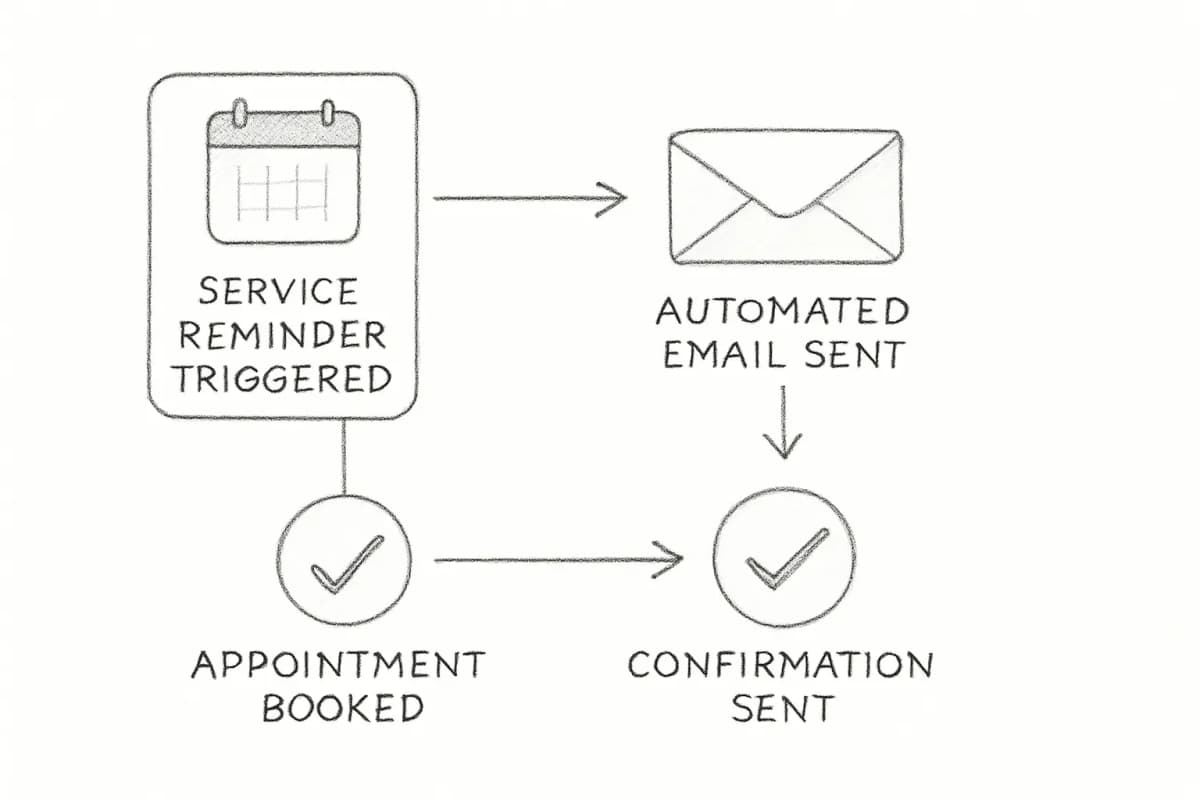
Service reminder sequences: trigger 30, 14, and 3 days before estimated maintenance due date
Post-delivery welcome series: post-delivery emails reach 80% open rates in Q3 2025, confirming that new vehicle owners are highly receptive to follow-up communication as an ideal window for building service department loyalty.
Enquiry follow-up: enquiry follow-up emails achieve a 61% open rate because prospects who have already expressed interest show high receptivity to follow-up communication, making automated response sequences essential for conversion.
Re-engagement campaigns: re-engagement sequences for customers who have not visited in 6 or more months can recover many "lost" customers through carefully crafted sequences that remind them of positive past experiences and offer return incentives.
Personalized emails that use a first name in the subject line are 20% more likely to be opened, according to Forbes. Pair that tactic with vehicle-specific content and you compound the effect further.
Reference the customer's specific vehicle make, model, and year in the subject line
Trigger emails based on mileage milestones (e.g., approaching 30,000 miles)
Send seasonal service reminders tied to the customer's actual location and vehicle type
Use purchase anniversaries to introduce trade-in or upgrade offers
Follow up on abandoned service appointment bookings within 24 hours
"We Want Your Car" trade-in campaigns achieve 83% open rates with 24% click-through rates, representing the highest-performing email type in automotive, with open rates 6.5x higher than industry averages.
Automation: Where Automotive Email ROI Compounds
Manual email campaigns in automotive return $0.16 per recipient on average. Automation changes that picture dramatically.
Email automations earn an average of $5.47 per recipient in the automotive sector. The reason is simple: automated messages fire at the exact moment a customer's behavior or vehicle status makes them most likely to act.
Dealerships are increasingly adopting marketing automation tools to automate and personalize communications with prospects. For example, if a website visitor fills out a form expressing interest in a vehicle, an automated email can trigger with information about that vehicle. Dealers using marketing automation are 2x more likely to see a higher marketing ROI than those who do not.
Key automation workflows for automotive businesses:
Service reminder sequences: trigger 30, 14, and 3 days before estimated maintenance due date
Post-delivery welcome series: post-delivery emails reach 80% open rates in Q3 2025, confirming that new vehicle owners are highly receptive to follow-up communication as an ideal window for building service department loyalty.
Enquiry follow-up: enquiry follow-up emails achieve a 61% open rate because prospects who have already expressed interest show high receptivity to follow-up communication, making automated response sequences essential for conversion.
Re-engagement campaigns: re-engagement sequences for customers who have not visited in 6 or more months can recover many "lost" customers through carefully crafted sequences that remind them of positive past experiences and offer return incentives.
Research shows dealers often miss responding to nearly 25% of email leads, and of those who do respond, 30% never follow up. This means thousands of dollars in lost sales opportunities that automation can help recover.
Auto Repair Shop Email Marketing: A Practical Framework
For independent repair shops, auto repair email marketing solves a specific problem: keeping bays full during slow weeks without spending on expensive paid ads.
Email marketing remains one of the most cost-effective and direct ways to connect with customers in the auto repair industry, where regular engagement builds trust and drives repeat business. For auto repair shops, a targeted strategy can increase customer retention, improve brand loyalty, and keep services top of mind.
A practical monthly cadence for repair shops:
Monthly newsletter: seasonal maintenance tips relevant to local conditions, staff spotlights, and one promotional offer
Service reminders: automated, triggered by last visit date or vehicle mileage
Post-visit follow-up: send 2 to 3 days after service to ask for a review and confirm satisfaction
Win-back campaigns: target customers with no visits in 6 to 12 months with a value-focused incentive
Start with 1 to 2 emails per month. Too many can annoy your list, while too few can cause your audience to overlook you. Adjust frequency based on engagement: if open and click rates drop, scale back; if they are strong, consider segmenting and sending targeted messages more frequently.
Unlike general retail businesses, auto repair shops have a unique advantage with email: customers' vehicles need regular, predictable maintenance, seasonal services, and when something breaks, you want to be the first shop they think of. The cyclical nature of automotive maintenance creates perfect opportunities for timely, relevant communication.
Choosing Automotive Email Marketing Companies and Tools
The right platform makes execution far easier. Email marketing for automotive businesses is a digital communication strategy that enables dealerships, repair shops, and automotive service centers to nurture customer relationships through targeted campaigns. The top platforms are specifically suited to automotive needs, including service reminder automation, vehicle-based segmentation, CRM integration, and long-term customer relationship management.
Dealerships, repair shops, and automotive service centers face challenges that differ significantly from other sectors: managing long sales cycles that span months, coordinating service appointment reminders based on mileage and time intervals, and maintaining customer relationships that generate repeat business over decades. Email marketing tools solve these challenges by automating reminders, segmenting customers by vehicle type and purchase history, scoring leads based on engagement, and integrating with dealership management systems.
What to look for when evaluating automotive email marketing companies:
Research shows dealers often miss responding to nearly 25% of email leads, and of those who do respond, 30% never follow up. This means thousands of dollars in lost sales opportunities that automation can help recover.
Auto Repair Shop Email Marketing: A Practical Framework
For independent repair shops, auto repair email marketing solves a specific problem: keeping bays full during slow weeks without spending on expensive paid ads.
Email marketing remains one of the most cost-effective and direct ways to connect with customers in the auto repair industry, where regular engagement builds trust and drives repeat business. For auto repair shops, a targeted strategy can increase customer retention, improve brand loyalty, and keep services top of mind.
A practical monthly cadence for repair shops:
Monthly newsletter: seasonal maintenance tips relevant to local conditions, staff spotlights, and one promotional offer
Service reminders: automated, triggered by last visit date or vehicle mileage
Post-visit follow-up: send 2 to 3 days after service to ask for a review and confirm satisfaction
Win-back campaigns: target customers with no visits in 6 to 12 months with a value-focused incentive
Start with 1 to 2 emails per month. Too many can annoy your list, while too few can cause your audience to overlook you. Adjust frequency based on engagement: if open and click rates drop, scale back; if they are strong, consider segmenting and sending targeted messages more frequently.
Unlike general retail businesses, auto repair shops have a unique advantage with email: customers' vehicles need regular, predictable maintenance, seasonal services, and when something breaks, you want to be the first shop they think of. The cyclical nature of automotive maintenance creates perfect opportunities for timely, relevant communication.
Choosing Automotive Email Marketing Companies and Tools
The right platform makes execution far easier. Email marketing for automotive businesses is a digital communication strategy that enables dealerships, repair shops, and automotive service centers to nurture customer relationships through targeted campaigns. The top platforms are specifically suited to automotive needs, including service reminder automation, vehicle-based segmentation, CRM integration, and long-term customer relationship management.
Dealerships, repair shops, and automotive service centers face challenges that differ significantly from other sectors: managing long sales cycles that span months, coordinating service appointment reminders based on mileage and time intervals, and maintaining customer relationships that generate repeat business over decades. Email marketing tools solve these challenges by automating reminders, segmenting customers by vehicle type and purchase history, scoring leads based on engagement, and integrating with dealership management systems.
What to look for when evaluating automotive email marketing companies:
DMS and CRM integration: the platform should pull real customer and vehicle data automatically
Vehicle-based segmentation: ability to filter by make, model, year, mileage, and service history
Behavioral triggers: automated sends based on actions like form submissions, page visits, or appointment status
Mobile-responsive templates: over 60% of automotive brands' marketing emails are opened on mobile devices, making fully responsive templates and tappable CTAs non-negotiable.
Revenue attribution: the ability to connect email campaigns directly to service bookings and vehicle sales
General platforms like HubSpot, Klaviyo, and Campaign Monitor work well for dealerships and shops that need flexible automation and CRM integration. Automotive-specific tools such as AutoSweet, BayIQ, and DealerSocket are built around DMS data and dealership workflows.
For guidance on getting your subject lines right across any platform, our email subject line best practices guide covers the fundamentals that apply directly to automotive campaigns.
Measuring Automotive Email Performance
Tracking open rates and click-through rates is useful, but revenue-level metrics tell the real story.
The automotive industry averages a 39.69% open rate and a 5.76% click-through rate across benchmark data, giving you a baseline to measure against.
Metrics worth tracking for every automotive email program:
Revenue per recipient (RPR): measures actual dollars generated per email sent
Service booking rate: percentage of service reminder emails that result in a scheduled appointment
Re-activation rate: how many dormant customers return after a win-back campaign
Unsubscribe rate by segment: flags irrelevant content before it damages your sender reputation
Email-attributed sales: requires DMS or CRM integration to track offline conversions
List hygiene is crucial for deliverability and engagement. Sending to inactive subscribers damages your sender reputation and wastes your marketing budget. Implement a sunset policy to remove subscribers who have not opened or clicked in 6 to 9 months to reduce costs and prevent spam complaints.
For a complete breakdown of the metrics that matter, the email marketing analytics best practices guide walks through how to build a reporting framework that ties email activity to revenue.
Frequently Asked Questions
What is automotive email marketing?
DMS and CRM integration: the platform should pull real customer and vehicle data automatically
Vehicle-based segmentation: ability to filter by make, model, year, mileage, and service history
Behavioral triggers: automated sends based on actions like form submissions, page visits, or appointment status
Mobile-responsive templates: over 60% of automotive brands' marketing emails are opened on mobile devices, making fully responsive templates and tappable CTAs non-negotiable.
Revenue attribution: the ability to connect email campaigns directly to service bookings and vehicle sales
General platforms like HubSpot, Klaviyo, and Campaign Monitor work well for dealerships and shops that need flexible automation and CRM integration. Automotive-specific tools such as AutoSweet, BayIQ, and DealerSocket are built around DMS data and dealership workflows.
For guidance on getting your subject lines right across any platform, our email subject line best practices guide covers the fundamentals that apply directly to automotive campaigns.
Measuring Automotive Email Performance
Tracking open rates and click-through rates is useful, but revenue-level metrics tell the real story.
The automotive industry averages a 39.69% open rate and a 5.76% click-through rate across benchmark data, giving you a baseline to measure against.
Metrics worth tracking for every automotive email program:
Revenue per recipient (RPR): measures actual dollars generated per email sent
Service booking rate: percentage of service reminder emails that result in a scheduled appointment
Re-activation rate: how many dormant customers return after a win-back campaign
Unsubscribe rate by segment: flags irrelevant content before it damages your sender reputation
Email-attributed sales: requires DMS or CRM integration to track offline conversions
List hygiene is crucial for deliverability and engagement. Sending to inactive subscribers damages your sender reputation and wastes your marketing budget. Implement a sunset policy to remove subscribers who have not opened or clicked in 6 to 9 months to reduce costs and prevent spam complaints.
For a complete breakdown of the metrics that matter, the email marketing analytics best practices guide walks through how to build a reporting framework that ties email activity to revenue.
Frequently Asked Questions
What is automotive email marketing?
Automotive email marketing is a digital communication strategy that enables dealerships, repair shops, and automotive service centers to nurture customer relationships through targeted campaigns. Automotive companies use it to send service reminders, promote vehicle inventory, announce special offers, and maintain customer engagement throughout the customer lifecycle.
What ROI can automotive businesses expect from email marketing?
Email marketing generates $40 to $44 in ROI per dollar spent in automotive, making it the highest-performing digital channel in the sector, surpassing paid search, social media, and display advertising combined. Results vary depending on segmentation quality, automation maturity, and list health.
How often should auto repair shops send marketing emails?
Finding the right communication frequency is crucial. Auto repair shop customers appreciate regular updates, but excessive emails lead to unsubscribes. Sending one to two emails per month generally strikes a good balance. It is also important to follow up a few days after a customer has their vehicle serviced. When determining your cadence, analyze customer engagement metrics and adjust frequency accordingly.
What types of automotive emails get the highest open rates?
Among campaign types, "We Want Your Car" trade-in campaigns achieve 83% open rates, service reminders convert 34.5% to bookings, and abandoned appointment emails achieve 18.64% conversion rates. The common thread is relevance: messages that address a specific, timely customer need consistently outperform general promotions. Post-delivery emails and enquiry follow-ups also perform well because the customer has high intent at the moment they receive them.
Do I need a specialized platform for automotive email marketing?
Not necessarily, but CRM and DMS integration is critical. Automotive businesses face challenges including long sales cycles spanning months and service appointment coordination based on mileage intervals. Email marketing tools solve these by automating reminders, segmenting customers by vehicle type and purchase history, and integrating with dealership management systems. A general platform with strong API connectivity can work well if it connects to your customer data. An automotive-specific tool reduces setup complexity significantly.
No comments yet. Be the first!
Automotive email marketing is a digital communication strategy that enables dealerships, repair shops, and automotive service centers to nurture customer relationships through targeted campaigns. Automotive companies use it to send service reminders, promote vehicle inventory, announce special offers, and maintain customer engagement throughout the customer lifecycle.
What ROI can automotive businesses expect from email marketing?
Email marketing generates $40 to $44 in ROI per dollar spent in automotive, making it the highest-performing digital channel in the sector, surpassing paid search, social media, and display advertising combined. Results vary depending on segmentation quality, automation maturity, and list health.
How often should auto repair shops send marketing emails?
Finding the right communication frequency is crucial. Auto repair shop customers appreciate regular updates, but excessive emails lead to unsubscribes. Sending one to two emails per month generally strikes a good balance. It is also important to follow up a few days after a customer has their vehicle serviced. When determining your cadence, analyze customer engagement metrics and adjust frequency accordingly.
What types of automotive emails get the highest open rates?
Among campaign types, "We Want Your Car" trade-in campaigns achieve 83% open rates, service reminders convert 34.5% to bookings, and abandoned appointment emails achieve 18.64% conversion rates. The common thread is relevance: messages that address a specific, timely customer need consistently outperform general promotions. Post-delivery emails and enquiry follow-ups also perform well because the customer has high intent at the moment they receive them.
Do I need a specialized platform for automotive email marketing?
Not necessarily, but CRM and DMS integration is critical. Automotive businesses face challenges including long sales cycles spanning months and service appointment coordination based on mileage intervals. Email marketing tools solve these by automating reminders, segmenting customers by vehicle type and purchase history, and integrating with dealership management systems. A general platform with strong API connectivity can work well if it connects to your customer data. An automotive-specific tool reduces setup complexity significantly.