B2B email marketing is one of the highest-ROI channels available to growth-focused teams, yet most B2B companies underuse it. On average, B2B companies send out just one email marketing campaign every 25 days, and 59% of B2B marketers do not use email marketing at all, despite overwhelming evidence that it works. For every $1 spent on email marketing, $36 is made in return, a 3600% ROI. If you're looking for b2b email marketing ideas that actually generate pipeline and close deals, this guide covers the strategies, formats, and tactics that move the needle.
Key Takeaways
73% of B2B buyers prefer that sellers contact them via email, making it the most welcome communication channel for professional relationships.
Segmented campaigns can boost open rates by 14% and click rates by 28% compared to non-segmented sends; automated behavioral emails account for 46.9% of email sales while comprising only 2.6% of sends.
Triggered emails, such as post-demo or form-fill responses, outperform batch-and-blast emails by 43% in click rate.
Nurtured leads make 47% larger purchases than non-nurtured leads on average.
Top-quartile B2B email programs achieve 50%+ open rates and 10%+ CTR through rigorous segmentation, AI-powered personalization, and deliverability optimization.
1. Start with Segmentation, Not a Broadcast
The single most impactful thing you can do before writing a single email is split your list. Sending the same message to your entire database is how B2B email goes unread.
Detailed segmentation can drive 30% more opens and 50% more clicks than unsegmented campaigns. The most effective B2B segmentation frameworks group contacts by:
Firmographics: industry, company size, revenue band
Role and seniority: VP of Sales vs. IT Manager vs. CFO need different messages
Funnel stage: cold prospect, warm lead, trial user, or current customer
Industry-specific campaigns outperform generic content by 47% in engagement. A healthcare prospect and a fintech buyer have different challenges, different language, and different decision timelines. One message does not serve both.
B2B email marketing is one of the highest-ROI channels available to growth-focused teams, yet most B2B companies underuse it. On average, B2B companies send out just one email marketing campaign every 25 days, and 59% of B2B marketers do not use email marketing at all, despite overwhelming evidence that it works. For every $1 spent on email marketing, $36 is made in return, a 3600% ROI. If you're looking for b2b email marketing ideas that actually generate pipeline and close deals, this guide covers the strategies, formats, and tactics that move the needle.
Key Takeaways
73% of B2B buyers prefer that sellers contact them via email, making it the most welcome communication channel for professional relationships.
Segmented campaigns can boost open rates by 14% and click rates by 28% compared to non-segmented sends; automated behavioral emails account for 46.9% of email sales while comprising only 2.6% of sends.
Triggered emails, such as post-demo or form-fill responses, outperform batch-and-blast emails by 43% in click rate.
Nurtured leads make 47% larger purchases than non-nurtured leads on average.
Top-quartile B2B email programs achieve 50%+ open rates and 10%+ CTR through rigorous segmentation, AI-powered personalization, and deliverability optimization.
1. Start with Segmentation, Not a Broadcast
The single most impactful thing you can do before writing a single email is split your list. Sending the same message to your entire database is how B2B email goes unread.
Detailed segmentation can drive 30% more opens and 50% more clicks than unsegmented campaigns. The most effective B2B segmentation frameworks group contacts by:
Firmographics: industry, company size, revenue band
Role and seniority: VP of Sales vs. IT Manager vs. CFO need different messages
Funnel stage: cold prospect, warm lead, trial user, or current customer
Industry-specific campaigns outperform generic content by 47% in engagement. A healthcare prospect and a fintech buyer have different challenges, different language, and different decision timelines. One message does not serve both.
2. Build Automated Nurture Sequences Around the Buyer Journey
Unlike B2C email marketing, which often drives quick purchases, B2B campaigns focus on education, trust-building, ROI justification, and multi-touch engagement. B2B sales cycles are long, often stretching six to twelve months, so a single email cannot carry the full weight of conversion.
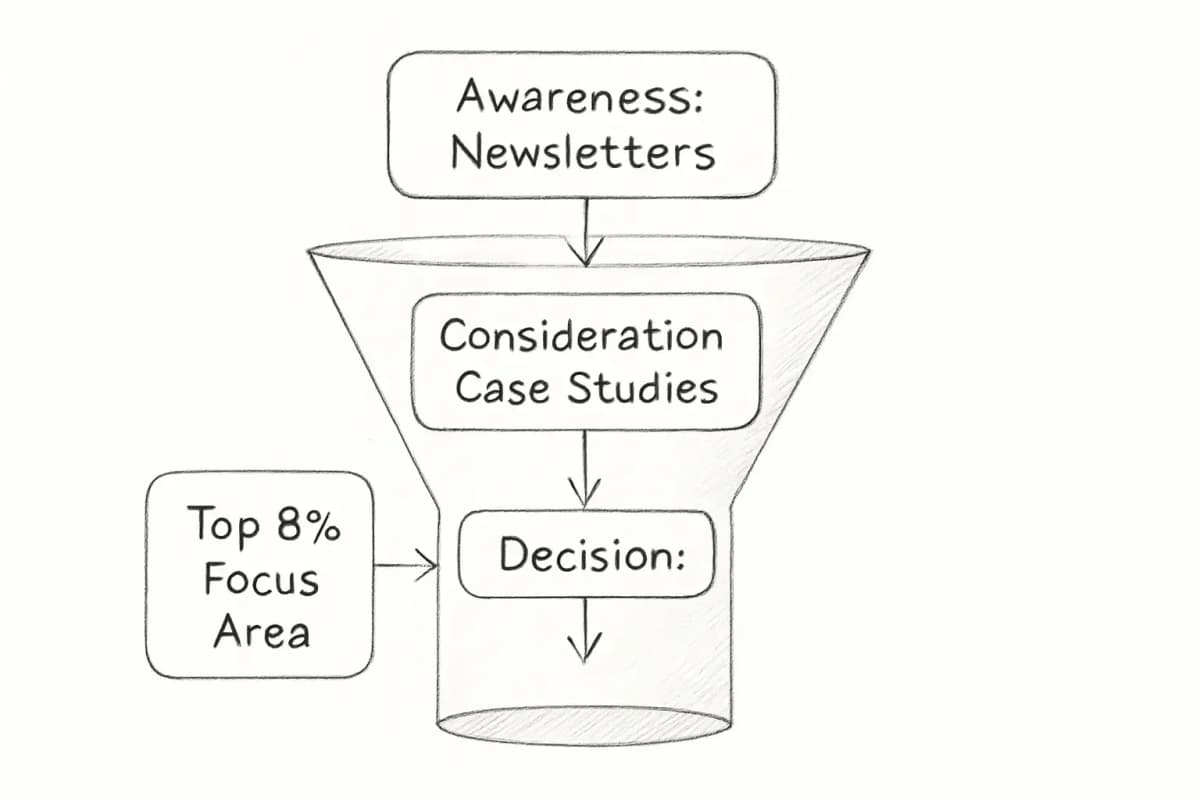
Automated drip sequences solve this. Drip campaigns in 2025 average a 3.5x engagement rate compared to single-email efforts. The key is mapping content to funnel stage:
Early stage (awareness): Educational content, trend reports, industry benchmarks
Mid-funnel (consideration): Case studies, comparison guides, ROI calculators
Late stage (decision): Demo invites, testimonials, pricing breakdowns, implementation timelines
Drip emails see 119% higher click-through rates than standard marketing emails, and nurtured leads make 47% larger purchases than non-nurtured leads.
B2B brands with automated onboarding sequences see a 57% increase in lead engagement, and automation tools that integrate with CRMs yield a 23% improvement in MQL-to-SQL conversion.
3. Prioritize Personalization Beyond the First Name
Name personalization is the floor, not the ceiling. Subject line personalization can drive about a 9% uplift in opens, while sender-name personalization (using a real person vs. a generic brand name) can lift opens by around 27%.
At the content level, the gains are more significant. Marketers implementing AI-powered personalization report revenue increasing by 41% and click-through rates rising 13.44% compared to non-personalized campaigns.
Practical personalization ideas for B2B:
Reference the recipient's industry with specific statistics or challenges relevant to their vertical
Use dynamic content blocks that change based on company size or role
Trigger emails based on behavior (demo viewed, pricing page visited, free trial started)
Mention a specific product or feature the contact has engaged with
Customize the CTA based on where the prospect sits in the sales funnel
Emails triggered by real-time user behavior, such as site visits or demo views, convert at 3x the normal rate.
For more practical examples, our 7 Email Personalization Techniques That Boost Conversions 47% covers this in detail.
2. Build Automated Nurture Sequences Around the Buyer Journey
Unlike B2C email marketing, which often drives quick purchases, B2B campaigns focus on education, trust-building, ROI justification, and multi-touch engagement. B2B sales cycles are long, often stretching six to twelve months, so a single email cannot carry the full weight of conversion.
Automated drip sequences solve this. Drip campaigns in 2025 average a 3.5x engagement rate compared to single-email efforts. The key is mapping content to funnel stage:
Early stage (awareness): Educational content, trend reports, industry benchmarks
Mid-funnel (consideration): Case studies, comparison guides, ROI calculators
Late stage (decision): Demo invites, testimonials, pricing breakdowns, implementation timelines
Drip emails see 119% higher click-through rates than standard marketing emails, and nurtured leads make 47% larger purchases than non-nurtured leads.
B2B brands with automated onboarding sequences see a 57% increase in lead engagement, and automation tools that integrate with CRMs yield a 23% improvement in MQL-to-SQL conversion.
3. Prioritize Personalization Beyond the First Name
Name personalization is the floor, not the ceiling. Subject line personalization can drive about a 9% uplift in opens, while sender-name personalization (using a real person vs. a generic brand name) can lift opens by around 27%.
At the content level, the gains are more significant. Marketers implementing AI-powered personalization report revenue increasing by 41% and click-through rates rising 13.44% compared to non-personalized campaigns.
Practical personalization ideas for B2B:
Reference the recipient's industry with specific statistics or challenges relevant to their vertical
Use dynamic content blocks that change based on company size or role
Trigger emails based on behavior (demo viewed, pricing page visited, free trial started)
Mention a specific product or feature the contact has engaged with
Customize the CTA based on where the prospect sits in the sales funnel
Emails triggered by real-time user behavior, such as site visits or demo views, convert at 3x the normal rate.
For more practical examples, our 7 Email Personalization Techniques That Boost Conversions 47% covers this in detail.
4. Use High-Value Content as the Engine
B2B emails perform better when they focus on providing information and resources. Educational content like trend reports, industry benchmarks, how-to guides, and webinar recordings helps prove your brand's value to a B2B subscriber.
The content formats that consistently perform well in B2B email campaigns include:
Original research and benchmarks: Proprietary data positions your brand as a category authority
Case studies: Show outcomes with specific numbers, not just stories
Webinar invitations and recordings: About 71% of B2B marketers used email newsletters to nurture leads in 2024.
Curated roundups: Aggregate the most relevant industry news so subscribers don't have to
Interactive tools: ROI calculators, assessments, and maturity frameworks that help prospects self-qualify
The top 8% of email programs, those hitting 45:1+ ROI, most commonly send newsletters and onboarding emails, not promotions. Relationship-building content outlasts promotional blasts by a wide margin.
5. Apply Account-Based Marketing (ABM) Logic to Email
Not all accounts are equal. For your highest-value targets, generic campaigns are not enough. Account-based marketing campaigns focus on high-value targets. Coordinating with sales to deliver personalized content addressing specific account needs, these campaigns require more effort but yield higher returns.
ABM email tactics worth executing:
Research the account before writing: review their recent press releases, earnings calls, or job postings for context
Tailor the subject line to their company name, industry, or a current initiative
Reference a specific pain point relevant to their company size or growth stage
Coordinate with sales: align email sequences with outbound calls and LinkedIn outreach so touchpoints feel cohesive, not random
Loop in buying committee members: in B2B, the decision rarely rests with one person
4. Use High-Value Content as the Engine
B2B emails perform better when they focus on providing information and resources. Educational content like trend reports, industry benchmarks, how-to guides, and webinar recordings helps prove your brand's value to a B2B subscriber.
The content formats that consistently perform well in B2B email campaigns include:
Original research and benchmarks: Proprietary data positions your brand as a category authority
Case studies: Show outcomes with specific numbers, not just stories
Webinar invitations and recordings: About 71% of B2B marketers used email newsletters to nurture leads in 2024.
Curated roundups: Aggregate the most relevant industry news so subscribers don't have to
Interactive tools: ROI calculators, assessments, and maturity frameworks that help prospects self-qualify
The top 8% of email programs, those hitting 45:1+ ROI, most commonly send newsletters and onboarding emails, not promotions. Relationship-building content outlasts promotional blasts by a wide margin.
5. Apply Account-Based Marketing (ABM) Logic to Email
Not all accounts are equal. For your highest-value targets, generic campaigns are not enough. Account-based marketing campaigns focus on high-value targets. Coordinating with sales to deliver personalized content addressing specific account needs, these campaigns require more effort but yield higher returns.
ABM email tactics worth executing:
Research the account before writing: review their recent press releases, earnings calls, or job postings for context
Tailor the subject line to their company name, industry, or a current initiative
Reference a specific pain point relevant to their company size or growth stage
Coordinate with sales: align email sequences with outbound calls and LinkedIn outreach so touchpoints feel cohesive, not random
Loop in buying committee members: in B2B, the decision rarely rests with one person
Companies excelling at lead scoring generate 50% more sales-ready leads while achieving 33% lower cost per lead, with improvements stemming from sales teams focusing energy on prospects demonstrating genuine purchase intent.
6. Write Subject Lines That Get Opened
Research shows that 64% of people open an email campaign based on the subject line alone. In B2B, subject lines need to communicate value or relevance immediately, without sounding like marketing copy.
What works in B2B subject lines:
Short subject lines under 45 characters perform better, averaging 38% open rates.
Emails sent from named individuals rather than generic company names see a 27% higher open rate.
Follow-up emails within 48 hours of the first touch see an 18% boost in open rates.
Questions and specificity outperform vague claims ("How Company X cut onboarding time by 40%" beats "Improve your onboarding")
Avoid subject lines that trigger spam filters or read as mass outreach. Plain-text style subject lines often outperform heavily formatted ones in direct B2B prospecting.
See the full breakdown in Email Subject Line Best Practices That Boost Open Rates by 27%.
7. Set Up Behavioral Trigger Emails
Most B2B teams send scheduled campaigns on a calendar. Top performers also send triggered emails based on what contacts do, not just when a scheduled send goes out.
At its core, email automation runs on four components: a trigger (prospect takes an action such as a form fill, page visit, or email click), a condition (the system checks predefined rules), an action (the system executes the appropriate email response), and an outcome (the system tracks what happens next and adjusts accordingly).
High-impact trigger email types for B2B:
Post-demo follow-up: Send within 24 hours with a recap, relevant case study, and a clear next step
Content download follow-up: When a prospect downloads a whitepaper, send a related resource two days later
Re-engagement sequence: Target contacts who haven't opened or clicked in 90+ days
Trial expiration: If you run a SaaS product, a conversion sequence in the final week of a trial is critical
Milestone-based: Congratulate a customer on a usage milestone or company anniversary
Companies using multi-step automation workflows report 1.9x higher campaign ROI.
8. Measure What Actually Drives Revenue
Most B2B email programs track opens and clicks. The best ones track pipeline influence, deal velocity, and revenue per email sent.
Bot-driven phantom engagement has made open rates unreliable, pushing high-performing teams toward revenue per email, list churn, and lifetime value as the metrics that matter.
Core B2B email metrics to track:
Companies excelling at lead scoring generate 50% more sales-ready leads while achieving 33% lower cost per lead, with improvements stemming from sales teams focusing energy on prospects demonstrating genuine purchase intent.
6. Write Subject Lines That Get Opened
Research shows that 64% of people open an email campaign based on the subject line alone. In B2B, subject lines need to communicate value or relevance immediately, without sounding like marketing copy.
What works in B2B subject lines:
Short subject lines under 45 characters perform better, averaging 38% open rates.
Emails sent from named individuals rather than generic company names see a 27% higher open rate.
Follow-up emails within 48 hours of the first touch see an 18% boost in open rates.
Questions and specificity outperform vague claims ("How Company X cut onboarding time by 40%" beats "Improve your onboarding")
Avoid subject lines that trigger spam filters or read as mass outreach. Plain-text style subject lines often outperform heavily formatted ones in direct B2B prospecting.
See the full breakdown in Email Subject Line Best Practices That Boost Open Rates by 27%.
7. Set Up Behavioral Trigger Emails
Most B2B teams send scheduled campaigns on a calendar. Top performers also send triggered emails based on what contacts do, not just when a scheduled send goes out.
At its core, email automation runs on four components: a trigger (prospect takes an action such as a form fill, page visit, or email click), a condition (the system checks predefined rules), an action (the system executes the appropriate email response), and an outcome (the system tracks what happens next and adjusts accordingly).
High-impact trigger email types for B2B:
Post-demo follow-up: Send within 24 hours with a recap, relevant case study, and a clear next step
Content download follow-up: When a prospect downloads a whitepaper, send a related resource two days later
Re-engagement sequence: Target contacts who haven't opened or clicked in 90+ days
Trial expiration: If you run a SaaS product, a conversion sequence in the final week of a trial is critical
Milestone-based: Congratulate a customer on a usage milestone or company anniversary
Companies using multi-step automation workflows report 1.9x higher campaign ROI.
8. Measure What Actually Drives Revenue
Most B2B email programs track opens and clicks. The best ones track pipeline influence, deal velocity, and revenue per email sent.
Bot-driven phantom engagement has made open rates unreliable, pushing high-performing teams toward revenue per email, list churn, and lifetime value as the metrics that matter.
Core B2B email metrics to track:
Click-to-open rate (CTOR): Measures content relevance for those who actually opened
Reply rate: The clearest signal of genuine engagement, especially for cold outreach
Pipeline influenced: Which deals had at least one email touchpoint in the 90 days before closing
MQL-to-SQL conversion rate from email: Tracks how many email-sourced leads become sales-qualified
Revenue per email sent: Ties email activity to bottom-line outcomes
Multi-channel attribution and MQLs jumped 22% year-over-year as email campaign reporting moves away from engagement proxies toward revenue accountability.
Combine these metrics with regular A/B testing. Marketers who A/B test their emails often increase email ROI by 86% compared to those who never do.
What types of emails work best in B2B email marketing?
B2B emails tend to perform better when they focus on providing information and resources. Educational content like trend reports, industry benchmarks, how-to guides, and webinar recordings helps prove your brand's value. Relationship-building formats like newsletters, onboarding sequences, and triggered follow-ups consistently outperform one-off promotional blasts. Case studies, original research, and event invitations are also high performers across most B2B industries.
How often should B2B companies send marketing emails?
Top performers send 30 to 50% fewer emails than average programs but achieve 2 to 3x the engagement and revenue. The consensus framework for cold outreach is 3 to 5 touches, 2 to 4 days apart; every additional touch beyond the fifth generates diminishing reply rates. For warm opted-in lists, a consistent cadence of one to two emails per week with genuinely useful content is a strong baseline.
Why is segmentation critical in B2B email marketing?
Segmented B2B campaigns record 74% higher click rates than non-segmented ones. B2B buyers have distinct roles, challenges, and stages in the purchase process. A CFO evaluating a $200k software contract needs different content than an IT manager evaluating a free trial. Segmenting by role, industry, funnel stage, and behavior ensures your messages speak directly to what each contact actually cares about, which improves every downstream metric.
What is the average ROI for B2B email marketing?
The average ROI for B2B email marketing is now $46 for every $1 spent. Programs that invest in personalization, segmentation, and automation consistently outperform that average. Some high-performing implementations report ROI exceeding $70:1, particularly when combining automation, segmentation, and behavioral personalization. The gap between median and top-quartile performance is driven almost entirely by execution quality, not budget.
Click-to-open rate (CTOR): Measures content relevance for those who actually opened
Reply rate: The clearest signal of genuine engagement, especially for cold outreach
Pipeline influenced: Which deals had at least one email touchpoint in the 90 days before closing
MQL-to-SQL conversion rate from email: Tracks how many email-sourced leads become sales-qualified
Revenue per email sent: Ties email activity to bottom-line outcomes
Multi-channel attribution and MQLs jumped 22% year-over-year as email campaign reporting moves away from engagement proxies toward revenue accountability.
Combine these metrics with regular A/B testing. Marketers who A/B test their emails often increase email ROI by 86% compared to those who never do.
What types of emails work best in B2B email marketing?
B2B emails tend to perform better when they focus on providing information and resources. Educational content like trend reports, industry benchmarks, how-to guides, and webinar recordings helps prove your brand's value. Relationship-building formats like newsletters, onboarding sequences, and triggered follow-ups consistently outperform one-off promotional blasts. Case studies, original research, and event invitations are also high performers across most B2B industries.
How often should B2B companies send marketing emails?
Top performers send 30 to 50% fewer emails than average programs but achieve 2 to 3x the engagement and revenue. The consensus framework for cold outreach is 3 to 5 touches, 2 to 4 days apart; every additional touch beyond the fifth generates diminishing reply rates. For warm opted-in lists, a consistent cadence of one to two emails per week with genuinely useful content is a strong baseline.
Why is segmentation critical in B2B email marketing?
Segmented B2B campaigns record 74% higher click rates than non-segmented ones. B2B buyers have distinct roles, challenges, and stages in the purchase process. A CFO evaluating a $200k software contract needs different content than an IT manager evaluating a free trial. Segmenting by role, industry, funnel stage, and behavior ensures your messages speak directly to what each contact actually cares about, which improves every downstream metric.
What is the average ROI for B2B email marketing?
The average ROI for B2B email marketing is now $46 for every $1 spent. Programs that invest in personalization, segmentation, and automation consistently outperform that average. Some high-performing implementations report ROI exceeding $70:1, particularly when combining automation, segmentation, and behavioral personalization. The gap between median and top-quartile performance is driven almost entirely by execution quality, not budget.