Master B2C email marketing with proven strategies for higher open rates, conversions, and ROI. Learn segmentation, personalization, and timing tactics that work.
Master B2C email marketing with proven strategies for higher open rates, conversions, and ROI. Learn segmentation, personalization, and timing tactics that work.
B2C email marketing is one of the most direct, measurable ways to drive consumer purchases, and the numbers back that up. 59% of consumers say marketing emails influence their purchase decisions, with over 50% saying they purchase from an email at least once a month. Yet most brands leave serious money on the table by ignoring the fundamentals. This guide covers the B2C email marketing best practices that actually move revenue in 2024, from list segmentation and personalization to deliverability and automation.
Key Takeaways
Email marketing returns $36 for every $1 spent, a 3600% ROI, making it the highest-performing digital channel available.
Automated emails generate 320% more revenue than standard campaigns, and welcome sequences achieve 68.6% open rates.
An estimated 50-60% of email opens come from mobile devices in 2024. Non-optimized emails get deleted immediately.
As of February 2024, Google and Yahoo require bulk senders to authenticate with SPF and DKIM, publish a DMARC record, and maintain low spam complaint rates.
Segmented campaigns generate 760% more revenue than non-segmented sends.
1. Build a Permission-Based List You Actually Own
Every B2C email marketing strategy starts with list quality. A large list with poor engagement hurts deliverability and ROI. A smaller, permission-based list of genuinely interested subscribers outperforms it every time.
According to 2024 research by Emarsys, 69% of consumers agree that email is the best way for brands to communicate with them. That preference is built on trust, and trust begins at signup. Use double opt-in forms, clear value propositions, and transparent frequency expectations to attract subscribers who actually want your emails.
Avoid purchased lists entirely. A sender who follows best practices, such as sending high-quality, personalized emails to an opt-in list and performing regular list hygiene, will typically see higher deliverability when using email authentication.
Practical list-building tactics for B2C brands:
Pop-up offers tied to real value (discounts, guides, early access)
Checkout opt-ins with explicit consent
Gated content on high-traffic landing pages
B2C email marketing is one of the most direct, measurable ways to drive consumer purchases, and the numbers back that up. 59% of consumers say marketing emails influence their purchase decisions, with over 50% saying they purchase from an email at least once a month. Yet most brands leave serious money on the table by ignoring the fundamentals. This guide covers the B2C email marketing best practices that actually move revenue in 2024, from list segmentation and personalization to deliverability and automation.
Key Takeaways
Email marketing returns $36 for every $1 spent, a 3600% ROI, making it the highest-performing digital channel available.
Automated emails generate 320% more revenue than standard campaigns, and welcome sequences achieve 68.6% open rates.
An estimated 50-60% of email opens come from mobile devices in 2024. Non-optimized emails get deleted immediately.
As of February 2024, Google and Yahoo require bulk senders to authenticate with SPF and DKIM, publish a DMARC record, and maintain low spam complaint rates.
Segmented campaigns generate 760% more revenue than non-segmented sends.
1. Build a Permission-Based List You Actually Own
Every B2C email marketing strategy starts with list quality. A large list with poor engagement hurts deliverability and ROI. A smaller, permission-based list of genuinely interested subscribers outperforms it every time.
According to 2024 research by Emarsys, 69% of consumers agree that email is the best way for brands to communicate with them. That preference is built on trust, and trust begins at signup. Use double opt-in forms, clear value propositions, and transparent frequency expectations to attract subscribers who actually want your emails.
Avoid purchased lists entirely. A sender who follows best practices, such as sending high-quality, personalized emails to an opt-in list and performing regular list hygiene, will typically see higher deliverability when using email authentication.
Practical list-building tactics for B2C brands:
Pop-up offers tied to real value (discounts, guides, early access)
2. Segment Your Audience to Match Relevance to Intent
Sending the same email to everyone is the fastest way to erode engagement. Segmentation groups subscribers based on shared characteristics, while personalization tailors content for individuals within those groups. Used together, they create more relevant and higher-converting campaigns.
For B2C brands, the most effective segmentation approaches include:
Purchase history: Separate first-time buyers from repeat customers and lapsed subscribers
Browse behavior: Target subscribers who viewed specific product categories but did not convert
Lifecycle stage: New subscribers need onboarding; loyal customers respond to exclusivity and rewards
Demographics: Use demographic data to send targeted promo emails featuring relevant products to specific age or gender segments, then layer in behavioral data, sending different subject lines and product highlights based on shopping patterns.
Email segmentation directly impacts revenue by aligning messages with subscriber intent. When campaigns reflect where someone is in their journey, performance improves across every key metric.
For a deeper look at how to structure your segments, our guide on email list segmentation strategies covers proven approaches that have been shown to dramatically lift ROI.
3. Personalize Beyond First Names
Personalization is now table stakes. 71% of consumers expect personalized interactions from brands, and 76% get frustrated when their brand interactions are not personalized to their interests.
The impact on performance is real. Personalized emails achieve an open rate of 29% and a click-through rate of 41%. Personalized emails also deliver six times higher transactional rates.
2. Segment Your Audience to Match Relevance to Intent
Sending the same email to everyone is the fastest way to erode engagement. Segmentation groups subscribers based on shared characteristics, while personalization tailors content for individuals within those groups. Used together, they create more relevant and higher-converting campaigns.
For B2C brands, the most effective segmentation approaches include:
Purchase history: Separate first-time buyers from repeat customers and lapsed subscribers
Browse behavior: Target subscribers who viewed specific product categories but did not convert
Lifecycle stage: New subscribers need onboarding; loyal customers respond to exclusivity and rewards
Demographics: Use demographic data to send targeted promo emails featuring relevant products to specific age or gender segments, then layer in behavioral data, sending different subject lines and product highlights based on shopping patterns.
Email segmentation directly impacts revenue by aligning messages with subscriber intent. When campaigns reflect where someone is in their journey, performance improves across every key metric.
For a deeper look at how to structure your segments, our guide on email list segmentation strategies covers proven approaches that have been shown to dramatically lift ROI.
3. Personalize Beyond First Names
Personalization is now table stakes. 71% of consumers expect personalized interactions from brands, and 76% get frustrated when their brand interactions are not personalized to their interests.
The impact on performance is real. Personalized emails achieve an open rate of 29% and a click-through rate of 41%. Personalized emails also deliver six times higher transactional rates.
Effective B2C personalization tactics include:
Dynamic product recommendations based on past purchases or browse data
Personalized subject lines that reference a recent interaction or purchase category
Behavioral triggers that fire emails when a subscriber completes or abandons a specific action
Send-time optimization based on when individual subscribers historically open
65% of email marketers say dynamic content is their most effective personalization tactic. If you are not using dynamic content blocks yet, that is the highest-leverage starting point.
For specific techniques with real campaign examples, see our article on email personalization techniques that boost conversions.
4. Prioritize Your Subject Lines and Preview Text
Your subject line determines whether your email gets opened or ignored. Personalized subject lines can increase open rates by 50%.
Mobile adds another constraint. The average mobile device displays only 30 characters of a subject line. Subject lines exceeding this threshold get truncated, potentially cutting off your most compelling messaging, which demands concise, front-loaded copy.
Subject line best practices for B2C:
Put the value or the urgency in the first 30-40 characters
Avoid spam triggers like "FREE!!!" or excessive punctuation
Test curiosity-driven versus direct benefit-driven subject lines
Use numbers and specifics ("Save 25% today" beats "Big sale on now")
A/B test every campaign and build a winning pattern from actual data
Preview text, the short line visible below the subject line in most email clients, is often left blank by B2C senders. That is a wasted opportunity. Use it to extend the subject line's message or add a secondary hook.
For a structured breakdown of what drives open rates, check out our guide on email subject line best practices.
5. Set Up the Core Automation Flows First
Automation is where B2C email marketing earns its reputation as a high-ROI channel. Automated and triggered emails generate 30 times more revenue per recipient.
These three flows deliver the highest returns for most B2C brands:
Welcome Sequence
More than 8 out of 10 people will open a welcome email, generating four times as many opens and ten times as many clicks as other email types. A well-structured welcome sequence sets subscriber expectations, introduces your brand story, and ideally converts new signups into first buyers.
Target a 3 to 5 email sequence delivered over the first 7 to 10 days. Include a first-purchase incentive, social proof, and a clear call to action in each email. For a complete playbook on this, see our welcome email sequence best practices.
Abandoned Cart Recovery
In 2025, the global shopping cart abandonment rate was 75.38%. That is not lost revenue, it is a recoverable opportunity. Abandoned cart flows drive the highest average revenue per recipient ($3.65) and the highest average conversion rate (3.33%) of all automated flows.
Send the first abandoned cart email within one hour of abandonment. Follow up at 24 hours with social proof or a FAQ, and consider a third send at 48-72 hours with a limited incentive.
Post-Purchase Sequence
Dynamic product recommendations based on past purchases or browse data
Personalized subject lines that reference a recent interaction or purchase category
Behavioral triggers that fire emails when a subscriber completes or abandons a specific action
Send-time optimization based on when individual subscribers historically open
65% of email marketers say dynamic content is their most effective personalization tactic. If you are not using dynamic content blocks yet, that is the highest-leverage starting point.
For specific techniques with real campaign examples, see our article on email personalization techniques that boost conversions.
4. Prioritize Your Subject Lines and Preview Text
Your subject line determines whether your email gets opened or ignored. Personalized subject lines can increase open rates by 50%.
Mobile adds another constraint. The average mobile device displays only 30 characters of a subject line. Subject lines exceeding this threshold get truncated, potentially cutting off your most compelling messaging, which demands concise, front-loaded copy.
Subject line best practices for B2C:
Put the value or the urgency in the first 30-40 characters
Avoid spam triggers like "FREE!!!" or excessive punctuation
Test curiosity-driven versus direct benefit-driven subject lines
Use numbers and specifics ("Save 25% today" beats "Big sale on now")
A/B test every campaign and build a winning pattern from actual data
Preview text, the short line visible below the subject line in most email clients, is often left blank by B2C senders. That is a wasted opportunity. Use it to extend the subject line's message or add a secondary hook.
For a structured breakdown of what drives open rates, check out our guide on email subject line best practices.
5. Set Up the Core Automation Flows First
Automation is where B2C email marketing earns its reputation as a high-ROI channel. Automated and triggered emails generate 30 times more revenue per recipient.
These three flows deliver the highest returns for most B2C brands:
Welcome Sequence
More than 8 out of 10 people will open a welcome email, generating four times as many opens and ten times as many clicks as other email types. A well-structured welcome sequence sets subscriber expectations, introduces your brand story, and ideally converts new signups into first buyers.
Target a 3 to 5 email sequence delivered over the first 7 to 10 days. Include a first-purchase incentive, social proof, and a clear call to action in each email. For a complete playbook on this, see our welcome email sequence best practices.
Abandoned Cart Recovery
In 2025, the global shopping cart abandonment rate was 75.38%. That is not lost revenue, it is a recoverable opportunity. Abandoned cart flows drive the highest average revenue per recipient ($3.65) and the highest average conversion rate (3.33%) of all automated flows.
Send the first abandoned cart email within one hour of abandonment. Follow up at 24 hours with social proof or a FAQ, and consider a third send at 48-72 hours with a limited incentive.
Post-Purchase Sequence
Post-purchase emails build loyalty and drive repeat orders. A three-email post-purchase flow covering order confirmation, delivery update, and a product use or review request creates a strong customer experience and sets up cross-sell opportunities.
6. Optimize Every Email for Mobile
An estimated 50-60% of email opens come from mobile devices in 2024. For B2C brands especially, B2C emails see 48% more opens on mobile than B2B emails.
The cost of ignoring this is immediate. 50% of subscribers delete emails that are not optimized for mobile viewing. That means your message never gets read, regardless of how compelling your offer might be.
Mobile optimization checklist:
Use a single-column layout that stacks cleanly on small screens
Set minimum font size to 16px for body copy
Keep CTA buttons large enough to tap easily (44x44 pixels minimum)
Keep subject lines under 40 characters for mobile truncation
Compress images to reduce load time
Test across Apple Mail, Gmail (iOS and Android), and Outlook before sending
Businesses see a 15% increase in mobile clicks when using a mobile-responsive email design. That lift costs nothing beyond proper setup.
7. Lock Down Deliverability Before You Scale
You can build the best email in the world and it will not matter if it lands in spam. According to Validity's 2025 Email Deliverability Benchmark Report, one in six legitimate marketing emails now fails to reach the inbox, with global inbox placement rates declining to 83.5% in 2024.
The technical foundation every B2C sender must have in place:
Email Authentication. As of February 2024, Google and Yahoo require bulk senders to authenticate with SPF and DKIM, publish a DMARC record (at least p=none), and maintain low spam complaint rates, with Gmail recommending complaints stay below 0.1%. Following Google and Yahoo's 2024 rollout, Microsoft also introduced its own email authentication rules for high-volume senders targeting Outlook.com domains, effective May 2025, requiring compliance for businesses sending more than 5,000 emails per day.
One-Click Unsubscribe. Marketing and subscribed messages must support one-click unsubscribe and include a clearly visible unsubscribe link in the message body. Making it hard to unsubscribe drives spam complaints, which damage your domain reputation far more than losing a subscriber.
List Hygiene. Clean your list regularly. Remove hard bounces immediately, suppress unengaged subscribers after 90 to 180 days, and run a re-engagement campaign before removing dormant contacts entirely.
Spam Complaint Rate. Keep spam rates reported in Postmaster Tools below 0.3%. The practical target is under 0.1% to maintain strong inbox placement.
8. Measure What Actually Drives Revenue
Open rates and click-through rates tell you about engagement. Revenue metrics tell you what is working.
Post-purchase emails build loyalty and drive repeat orders. A three-email post-purchase flow covering order confirmation, delivery update, and a product use or review request creates a strong customer experience and sets up cross-sell opportunities.
6. Optimize Every Email for Mobile
An estimated 50-60% of email opens come from mobile devices in 2024. For B2C brands especially, B2C emails see 48% more opens on mobile than B2B emails.
The cost of ignoring this is immediate. 50% of subscribers delete emails that are not optimized for mobile viewing. That means your message never gets read, regardless of how compelling your offer might be.
Mobile optimization checklist:
Use a single-column layout that stacks cleanly on small screens
Set minimum font size to 16px for body copy
Keep CTA buttons large enough to tap easily (44x44 pixels minimum)
Keep subject lines under 40 characters for mobile truncation
Compress images to reduce load time
Test across Apple Mail, Gmail (iOS and Android), and Outlook before sending
Businesses see a 15% increase in mobile clicks when using a mobile-responsive email design. That lift costs nothing beyond proper setup.
7. Lock Down Deliverability Before You Scale
You can build the best email in the world and it will not matter if it lands in spam. According to Validity's 2025 Email Deliverability Benchmark Report, one in six legitimate marketing emails now fails to reach the inbox, with global inbox placement rates declining to 83.5% in 2024.
The technical foundation every B2C sender must have in place:
Email Authentication. As of February 2024, Google and Yahoo require bulk senders to authenticate with SPF and DKIM, publish a DMARC record (at least p=none), and maintain low spam complaint rates, with Gmail recommending complaints stay below 0.1%. Following Google and Yahoo's 2024 rollout, Microsoft also introduced its own email authentication rules for high-volume senders targeting Outlook.com domains, effective May 2025, requiring compliance for businesses sending more than 5,000 emails per day.
One-Click Unsubscribe. Marketing and subscribed messages must support one-click unsubscribe and include a clearly visible unsubscribe link in the message body. Making it hard to unsubscribe drives spam complaints, which damage your domain reputation far more than losing a subscriber.
List Hygiene. Clean your list regularly. Remove hard bounces immediately, suppress unengaged subscribers after 90 to 180 days, and run a re-engagement campaign before removing dormant contacts entirely.
Spam Complaint Rate. Keep spam rates reported in Postmaster Tools below 0.3%. The practical target is under 0.1% to maintain strong inbox placement.
8. Measure What Actually Drives Revenue
Open rates and click-through rates tell you about engagement. Revenue metrics tell you what is working.
Email marketing is one of the most effective channels for driving conversions, with a 2.8% conversion rate for B2C brands. Track performance at the campaign level and at the flow level separately. Automated flows consistently outperform broadcast campaigns on a per-recipient basis.
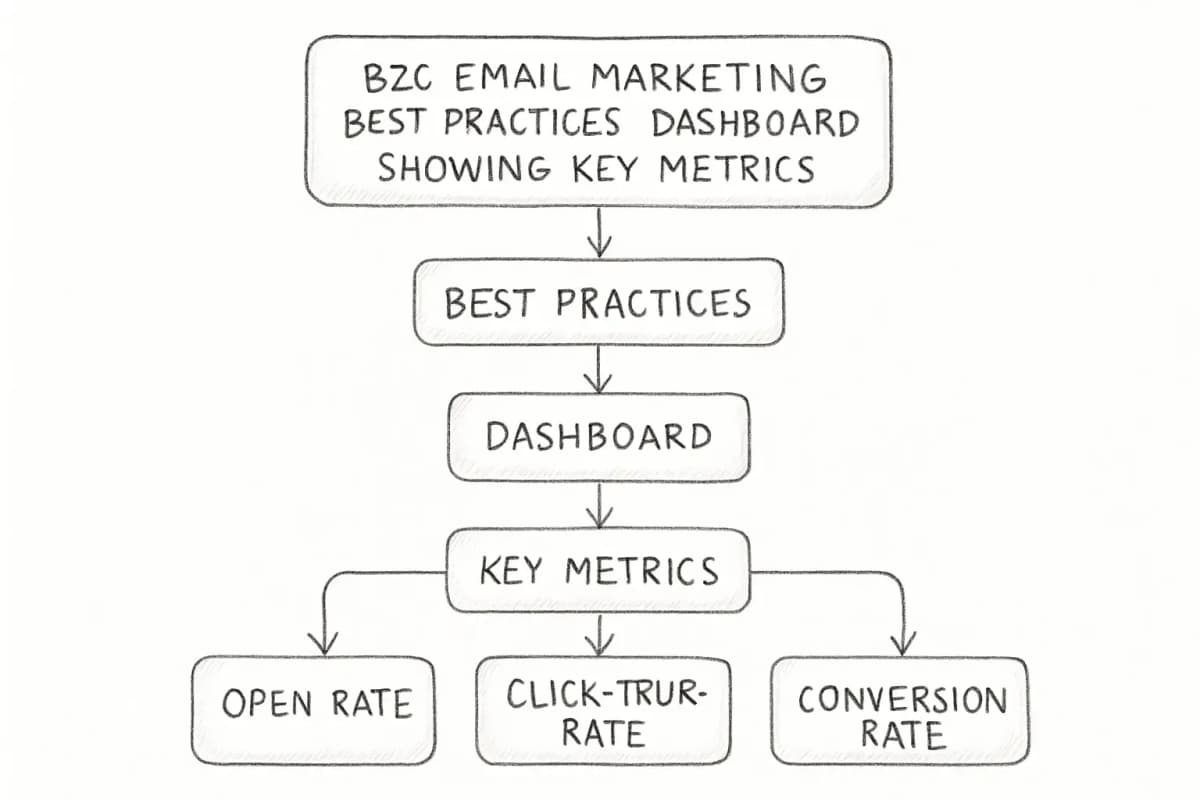
Key metrics to track for B2C email marketing:
Revenue per recipient (RPR): The best signal of campaign profitability
Conversion rate: Clicks that result in purchases
Click-to-open rate (CTOR): Measures content relevance for subscribers who opened
Unsubscribe rate: A spike signals list fatigue or mismatched content
Spam complaint rate: A non-negotiable deliverability metric
44% of marketers analyze campaign performance weekly. Weekly reviews let you catch deliverability issues, underperforming segments, and content patterns before they compound into bigger problems.
What is the most important B2C email marketing best practice in 2024?
Deliverability is the foundation. No other optimization matters if your emails land in spam. Set up SPF, DKIM, and DMARC authentication, keep spam complaint rates below 0.1%, and practice regular list hygiene. Once your emails reliably reach the inbox, personalization and automation compound returns significantly.
How often should B2C brands send marketing emails?
There is no single correct frequency. The regularity of emails can vary depending on the industry and audience. B2C emails might come weekly or sometimes daily, while over-sending quickly drives unsubscribes. Start at one to two emails per week, monitor unsubscribe and complaint rates, and adjust based on engagement data by segment. High-intent segments, such as recent purchasers, can handle more frequent contact than cold or lapsed subscribers.
How do segmented emails compare to broadcast emails for B2C?
Segmented campaigns generate 760% more revenue than non-segmented sends. The performance gap is significant because segmentation aligns message content with subscriber intent, which lifts open rates, click-through rates, and conversion rates across the board.
What B2C email automation should I set up first?
Email marketing is one of the most effective channels for driving conversions, with a 2.8% conversion rate for B2C brands. Track performance at the campaign level and at the flow level separately. Automated flows consistently outperform broadcast campaigns on a per-recipient basis.
Key metrics to track for B2C email marketing:
Revenue per recipient (RPR): The best signal of campaign profitability
Conversion rate: Clicks that result in purchases
Click-to-open rate (CTOR): Measures content relevance for subscribers who opened
Unsubscribe rate: A spike signals list fatigue or mismatched content
Spam complaint rate: A non-negotiable deliverability metric
44% of marketers analyze campaign performance weekly. Weekly reviews let you catch deliverability issues, underperforming segments, and content patterns before they compound into bigger problems.
What is the most important B2C email marketing best practice in 2024?
Deliverability is the foundation. No other optimization matters if your emails land in spam. Set up SPF, DKIM, and DMARC authentication, keep spam complaint rates below 0.1%, and practice regular list hygiene. Once your emails reliably reach the inbox, personalization and automation compound returns significantly.
How often should B2C brands send marketing emails?
There is no single correct frequency. The regularity of emails can vary depending on the industry and audience. B2C emails might come weekly or sometimes daily, while over-sending quickly drives unsubscribes. Start at one to two emails per week, monitor unsubscribe and complaint rates, and adjust based on engagement data by segment. High-intent segments, such as recent purchasers, can handle more frequent contact than cold or lapsed subscribers.
How do segmented emails compare to broadcast emails for B2C?
Segmented campaigns generate 760% more revenue than non-segmented sends. The performance gap is significant because segmentation aligns message content with subscriber intent, which lifts open rates, click-through rates, and conversion rates across the board.
What B2C email automation should I set up first?
Start with the abandoned cart flow. Abandoned cart flows drive the highest average revenue per recipient ($3.65) and the highest conversion rate (3.33%) of all automated flows. It targets the highest-intent subscribers at the moment they are most likely to convert, and it runs without manual work once it is live. Follow with a welcome sequence and post-purchase flow once the cart recovery flow is stable.
No comments yet. Be the first!
Start with the abandoned cart flow. Abandoned cart flows drive the highest average revenue per recipient ($3.65) and the highest conversion rate (3.33%) of all automated flows. It targets the highest-intent subscribers at the moment they are most likely to convert, and it runs without manual work once it is live. Follow with a welcome sequence and post-purchase flow once the cart recovery flow is stable.