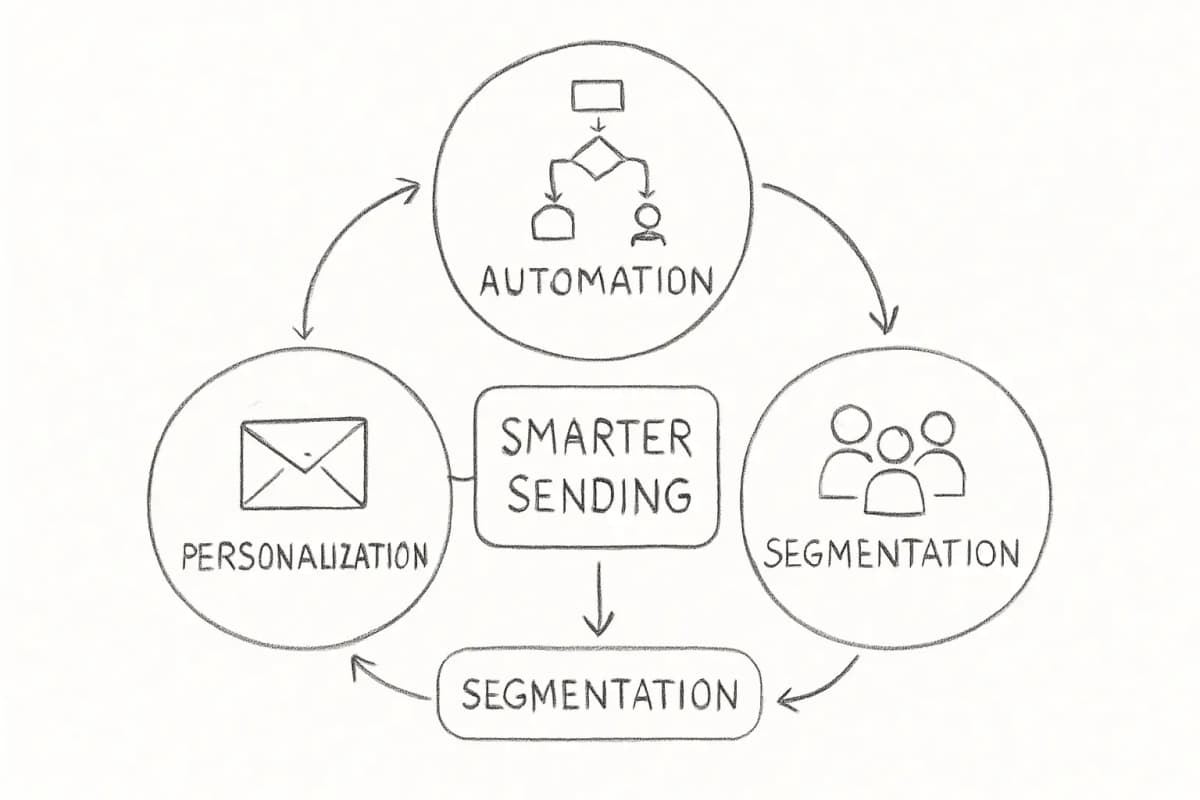
Email marketing remains one of the most cost-efficient channels available to businesses of any size. Campaigns have an average ROI of 36 times, meaning businesses earn $36 for every dollar they spend. Yet most teams leave that return on the table by running the same batch-and-blast approach they used five years ago. The best email marketing ideas working today are not about sending more. They are about sending smarter: sharper segmentation, tighter automation, better subject lines, and content that actually reflects what a subscriber wants.
This guide covers the ideas that move the needle, backed by data from across the industry.
Segmented email campaigns drive 30% more opens and 50% more click-throughs than unsegmented ones.
Personalized subject lines increase email open rates by 26%.
The top 8% of email programs, those hitting 45:1 or higher ROI, most commonly send newsletters and onboarding emails, not promotions.
Brands that regularly A/B test their emails achieve 83% higher ROI than those that never test.
1. Segment Your List Before You Write a Single Word
Sending the same email to your entire list is the fastest way to train subscribers to ignore you. Segmentation fixes that by putting the right message in front of the right person.
Segmentation plays a crucial role in deciding the success of email marketing campaigns. Segmented email campaigns drive 30% more opens and 50% more click-throughs than unsegmented ones. These are not marginal gains. A 50% lift in click-throughs compounds across every campaign you send.
Effective segments to build first:
Purchase history (buyers vs. non-buyers, product category, order value)
Lifecycle stage (new subscriber, first-time buyer, loyal customer)
Geographic location (especially useful for timing and regional offers)
78% of marketers state that subscriber segmentation is the most effective strategy for email marketing campaigns. If you are only running one improvement this quarter, start here.
Email marketing remains one of the most cost-efficient channels available to businesses of any size. Campaigns have an average ROI of 36 times, meaning businesses earn $36 for every dollar they spend. Yet most teams leave that return on the table by running the same batch-and-blast approach they used five years ago. The best email marketing ideas working today are not about sending more. They are about sending smarter: sharper segmentation, tighter automation, better subject lines, and content that actually reflects what a subscriber wants.
This guide covers the ideas that move the needle, backed by data from across the industry.
Segmented email campaigns drive 30% more opens and 50% more click-throughs than unsegmented ones.
Personalized subject lines increase email open rates by 26%.
The top 8% of email programs, those hitting 45:1 or higher ROI, most commonly send newsletters and onboarding emails, not promotions.
Brands that regularly A/B test their emails achieve 83% higher ROI than those that never test.
1. Segment Your List Before You Write a Single Word
Sending the same email to your entire list is the fastest way to train subscribers to ignore you. Segmentation fixes that by putting the right message in front of the right person.
Segmentation plays a crucial role in deciding the success of email marketing campaigns. Segmented email campaigns drive 30% more opens and 50% more click-throughs than unsegmented ones. These are not marginal gains. A 50% lift in click-throughs compounds across every campaign you send.
Effective segments to build first:
Purchase history (buyers vs. non-buyers, product category, order value)
Lifecycle stage (new subscriber, first-time buyer, loyal customer)
Geographic location (especially useful for timing and regional offers)
78% of marketers state that subscriber segmentation is the most effective strategy for email marketing campaigns. If you are only running one improvement this quarter, start here.
Personalization is more than a {first_name} merge tag in your greeting. The most effective version of it aligns content, offers, and timing with each subscriber's actual behavior.
Personalized emails have been shown to deliver six times more transactions than generic, non-personalized ones. And the stakes are real for brands that skip it: over 60% of consumers say they will stop buying from companies that do not effectively use personalization strategies.
At a practical level, this means:
Triggering emails based on pages visited or products browsed
Recommending products based on purchase history
Adjusting send timing to match when an individual typically opens
Using dynamic content blocks that change by segment
93% of marketers report that personalization improves leads or purchases. Yet only about 13% of teams use advanced personalization techniques. That gap is an opportunity.
For hands-on tactics, read 7 Email Personalization Techniques That Boost Conversions 47%.
3. Build a Welcome Sequence That Earns Trust Fast
Your welcome email is the highest-engagement moment in a subscriber's lifecycle. When it comes to welcome emails, open rates are 83.63%. Nothing you send later will come close to that level of attention, which makes your welcome sequence the most important automation you will ever set up.
A strong welcome series should:
Confirm the subscription and deliver the lead magnet or promised content immediately
Share your brand story and what makes you worth reading
Set expectations for what subscribers will receive and how often
Make a soft offer or direct subscribers toward your most useful content
Ask a question or invite a reply to start the relationship as a conversation
Welcome email flows generate $2.35 per recipient on average across Klaviyo accounts. That makes a three to five-email welcome series one of the highest-leverage automations you can build.
See Welcome Email Sequence Best Practices: 7 Proven Strategies for detailed guidance on building this sequence.
Personalization is more than a {first_name} merge tag in your greeting. The most effective version of it aligns content, offers, and timing with each subscriber's actual behavior.
Personalized emails have been shown to deliver six times more transactions than generic, non-personalized ones. And the stakes are real for brands that skip it: over 60% of consumers say they will stop buying from companies that do not effectively use personalization strategies.
At a practical level, this means:
Triggering emails based on pages visited or products browsed
Recommending products based on purchase history
Adjusting send timing to match when an individual typically opens
Using dynamic content blocks that change by segment
93% of marketers report that personalization improves leads or purchases. Yet only about 13% of teams use advanced personalization techniques. That gap is an opportunity.
For hands-on tactics, read 7 Email Personalization Techniques That Boost Conversions 47%.
3. Build a Welcome Sequence That Earns Trust Fast
Your welcome email is the highest-engagement moment in a subscriber's lifecycle. When it comes to welcome emails, open rates are 83.63%. Nothing you send later will come close to that level of attention, which makes your welcome sequence the most important automation you will ever set up.
A strong welcome series should:
Confirm the subscription and deliver the lead magnet or promised content immediately
Share your brand story and what makes you worth reading
Set expectations for what subscribers will receive and how often
Make a soft offer or direct subscribers toward your most useful content
Ask a question or invite a reply to start the relationship as a conversation
Welcome email flows generate $2.35 per recipient on average across Klaviyo accounts. That makes a three to five-email welcome series one of the highest-leverage automations you can build.
See Welcome Email Sequence Best Practices: 7 Proven Strategies for detailed guidance on building this sequence.
4. Set Up Automation for High-Intent Moments
Automation is where the best email marketing ideas produce outsized results with minimal ongoing effort. Automated emails drove 37% of all email-generated sales in 2024 while accounting for just 2% of total email volume.
The reason is simple: automated emails reach people at moments of maximum relevance. A welcome email lands when someone is most curious about your brand. A cart abandonment email arrives when someone already selected a product but hesitated at checkout.
Abandoned cart flows drive the highest average revenue per recipient at $3.65 and the highest average placed order rate, or conversion rate at 3.33%, of all flows. Campaigns utilizing three cart abandonment emails generate significantly higher revenue, totaling $24.9 million, compared to $3.8 million from campaigns with only one email.
Key automations to build, in order of priority:
Welcome series (days 0 to 7 after signup)
Abandoned cart (triggered within 1 to 4 hours of abandonment)
Browse abandonment (for visitors who view products but do not add to cart)
Post-purchase (thank you, product tips, upsell or cross-sell)
Win-back or re-engagement (subscribers inactive for 60 to 90 days)
Automated emails have 52% higher open rates, 332% higher click rates, and significantly better conversion rates compared to regular scheduled campaigns, based on Omnisend's primary research.
5. Write Subject Lines That Earn the Open
47% of recipients open emails based on the subject line alone. Your subject line is not a label for your email. It is the reason someone opens it, or does not.
A few data-backed principles:
Personalize when it is natural. Personalized subject lines increase email open rates by 26%. Adding a name works best when the rest of the email follows through on that personal tone.
Keep length mobile-friendly. Character count directly impacts open rate performance. Subject lines under 70 characters achieve the highest open rates, likely due to better mobile display and faster comprehension.
Use urgency with restraint. Subject lines featuring urgent language like "limited time" or "act now" can boost open rates by 22%. Overusing urgency trains subscribers to ignore it.
Add numbers when they fit. Adding numbers to subject lines boosts open rates by 57%. Numbers set clear expectations about what is inside.
Avoid spam-trigger language. A striking 69% of recipients mark emails as spam based on the subject line alone, creating a feedback loop that damages sender reputation and future deliverability.
For a full breakdown of what works, see Email Subject Line Best Practices That Boost Open Rates by 27%.
6. Build Relationship-Focused Newsletters (Not Just Promotions)
Most brands default to promotional emails because they are easy to measure. But the programs with the best long-term ROI invest in content that builds loyalty before asking for a purchase.
Automation is where the best email marketing ideas produce outsized results with minimal ongoing effort. Automated emails drove 37% of all email-generated sales in 2024 while accounting for just 2% of total email volume.
The reason is simple: automated emails reach people at moments of maximum relevance. A welcome email lands when someone is most curious about your brand. A cart abandonment email arrives when someone already selected a product but hesitated at checkout.
Abandoned cart flows drive the highest average revenue per recipient at $3.65 and the highest average placed order rate, or conversion rate at 3.33%, of all flows. Campaigns utilizing three cart abandonment emails generate significantly higher revenue, totaling $24.9 million, compared to $3.8 million from campaigns with only one email.
Key automations to build, in order of priority:
Welcome series (days 0 to 7 after signup)
Abandoned cart (triggered within 1 to 4 hours of abandonment)
Browse abandonment (for visitors who view products but do not add to cart)
Post-purchase (thank you, product tips, upsell or cross-sell)
Win-back or re-engagement (subscribers inactive for 60 to 90 days)
Automated emails have 52% higher open rates, 332% higher click rates, and significantly better conversion rates compared to regular scheduled campaigns, based on Omnisend's primary research.
5. Write Subject Lines That Earn the Open
47% of recipients open emails based on the subject line alone. Your subject line is not a label for your email. It is the reason someone opens it, or does not.
A few data-backed principles:
Personalize when it is natural. Personalized subject lines increase email open rates by 26%. Adding a name works best when the rest of the email follows through on that personal tone.
Keep length mobile-friendly. Character count directly impacts open rate performance. Subject lines under 70 characters achieve the highest open rates, likely due to better mobile display and faster comprehension.
Use urgency with restraint. Subject lines featuring urgent language like "limited time" or "act now" can boost open rates by 22%. Overusing urgency trains subscribers to ignore it.
Add numbers when they fit. Adding numbers to subject lines boosts open rates by 57%. Numbers set clear expectations about what is inside.
Avoid spam-trigger language. A striking 69% of recipients mark emails as spam based on the subject line alone, creating a feedback loop that damages sender reputation and future deliverability.
For a full breakdown of what works, see Email Subject Line Best Practices That Boost Open Rates by 27%.
6. Build Relationship-Focused Newsletters (Not Just Promotions)
Most brands default to promotional emails because they are easy to measure. But the programs with the best long-term ROI invest in content that builds loyalty before asking for a purchase.
The top 8% of programs hitting 45:1 or higher ROI most commonly send newsletters and onboarding emails, not promotions. These teams reflect a deliberate shift from broadcasting to relationship-building, with newsletters up 12% from 2025.
A newsletter that earns its place in the inbox:
Shares a clear perspective, not just a collection of links
Addresses a real challenge your subscriber is facing right now
Delivers something useful before making any ask
Maintains a consistent schedule so subscribers know when to expect it
Reflects a human voice, not a corporate announcement
59% of consumers say marketing emails influence their purchase decisions, with over 50% saying they purchase from an email at least once a month. That influence is built over time through consistent, relevant content, not one-off blasts.
7. A/B Test Systematically, Not Randomly
A/B testing is one of the highest-leverage habits in email marketing, and most teams do it too infrequently or too randomly to benefit.
Brands that regularly A/B test their emails achieve 83% higher ROI than those that never test. Companies that never test report average ROI of 2,300%, while those that often test achieve 4,200%.
Test one variable at a time, with enough list volume to reach statistical significance. Start with:
Subject line (the variable with the largest impact on open rate)
Send time (test morning vs. afternoon, weekday vs. weekend)
Call-to-action copy (action-oriented vs. benefit-oriented)
Email length (short single-focus vs. longer multi-section)
Offer type (discount vs. free shipping vs. bonus gift)
Document results in a single tracker. Winning variations should become your default, then get tested again against new challengers. Each iteration compounds.
8. Track the Metrics That Reflect Revenue, Not Vanity
Open rate inflation from Apple's Mail Privacy Protection has made that metric increasingly unreliable as a performance indicator. Bot-driven phantom engagement has made open rates unreliable, pushing high-performing teams toward revenue per email, list churn, and lifetime value as the metrics that matter.
The metrics worth tracking closely:
Revenue per email (RPE): Total email-attributed revenue divided by emails sent
Click-to-conversion rate: How many clickers actually complete a purchase
List growth rate: New subscribers minus unsubscribes as a percentage of total list
Unsubscribe rate: A spike signals content-audience mismatch
Deliverability and inbox placement: Where your emails actually land
The top 8% of programs hitting 45:1 or higher ROI most commonly send newsletters and onboarding emails, not promotions. These teams reflect a deliberate shift from broadcasting to relationship-building, with newsletters up 12% from 2025.
A newsletter that earns its place in the inbox:
Shares a clear perspective, not just a collection of links
Addresses a real challenge your subscriber is facing right now
Delivers something useful before making any ask
Maintains a consistent schedule so subscribers know when to expect it
Reflects a human voice, not a corporate announcement
59% of consumers say marketing emails influence their purchase decisions, with over 50% saying they purchase from an email at least once a month. That influence is built over time through consistent, relevant content, not one-off blasts.
7. A/B Test Systematically, Not Randomly
A/B testing is one of the highest-leverage habits in email marketing, and most teams do it too infrequently or too randomly to benefit.
Brands that regularly A/B test their emails achieve 83% higher ROI than those that never test. Companies that never test report average ROI of 2,300%, while those that often test achieve 4,200%.
Test one variable at a time, with enough list volume to reach statistical significance. Start with:
Subject line (the variable with the largest impact on open rate)
Send time (test morning vs. afternoon, weekday vs. weekend)
Call-to-action copy (action-oriented vs. benefit-oriented)
Email length (short single-focus vs. longer multi-section)
Offer type (discount vs. free shipping vs. bonus gift)
Document results in a single tracker. Winning variations should become your default, then get tested again against new challengers. Each iteration compounds.
8. Track the Metrics That Reflect Revenue, Not Vanity
Open rate inflation from Apple's Mail Privacy Protection has made that metric increasingly unreliable as a performance indicator. Bot-driven phantom engagement has made open rates unreliable, pushing high-performing teams toward revenue per email, list churn, and lifetime value as the metrics that matter.
The metrics worth tracking closely:
Revenue per email (RPE): Total email-attributed revenue divided by emails sent
Click-to-conversion rate: How many clickers actually complete a purchase
List growth rate: New subscribers minus unsubscribes as a percentage of total list
Unsubscribe rate: A spike signals content-audience mismatch
Deliverability and inbox placement: Where your emails actually land
Multi-channel attribution and MQLs jumped 22% year-over-year as email campaign reporting moves away from engagement proxies toward revenue accountability. Align your reporting with what stakeholders care about: revenue, retention, and growth.
What are the most effective email marketing ideas for small businesses?
For small businesses, the highest-impact ideas are a structured welcome sequence, basic list segmentation (at minimum buyers vs. non-buyers), and a consistent newsletter cadence. These three practices alone can significantly increase engagement without requiring a large team or complex software. For every $1 spent on email marketing, businesses see a return of $36, which is an email marketing ROI of 3600%. That return is accessible even with a small list, as long as you focus on relevance.
How often should you send marketing emails?
Frequency depends on your industry and your audience's expectations. Brands sending 9 to 16 emails monthly achieve average ROI of 4,600%, the highest of any frequency bracket. For most B2B programs, two to four emails per month is a reasonable starting point. Monitor unsubscribe rates and engagement trends. If unsubscribes spike after increasing frequency, scale back.
What is the single best email idea to increase revenue quickly?
If you are only setting up one thing, make it an abandoned cart automation. Abandoned cart flows drive the highest average revenue per recipient at $3.65 and the highest average conversion rate at 3.33% of all flows. It requires a one-time setup and continues generating revenue without additional effort.
How do you improve email deliverability to make sure emails reach the inbox?
Deliverability is foundational. Focus on these core practices: authenticate your sending domain with SPF, DKIM, and DMARC records; regularly clean inactive subscribers from your list; avoid spam-trigger words in subject lines; and maintain a consistent sending volume rather than large sudden spikes. Deliverability testing increases returns by 39% by ensuring emails avoid spam folders and reach intended destinations. No amount of creative optimization matters if your email never reaches the inbox.
Multi-channel attribution and MQLs jumped 22% year-over-year as email campaign reporting moves away from engagement proxies toward revenue accountability. Align your reporting with what stakeholders care about: revenue, retention, and growth.
What are the most effective email marketing ideas for small businesses?
For small businesses, the highest-impact ideas are a structured welcome sequence, basic list segmentation (at minimum buyers vs. non-buyers), and a consistent newsletter cadence. These three practices alone can significantly increase engagement without requiring a large team or complex software. For every $1 spent on email marketing, businesses see a return of $36, which is an email marketing ROI of 3600%. That return is accessible even with a small list, as long as you focus on relevance.
How often should you send marketing emails?
Frequency depends on your industry and your audience's expectations. Brands sending 9 to 16 emails monthly achieve average ROI of 4,600%, the highest of any frequency bracket. For most B2B programs, two to four emails per month is a reasonable starting point. Monitor unsubscribe rates and engagement trends. If unsubscribes spike after increasing frequency, scale back.
What is the single best email idea to increase revenue quickly?
If you are only setting up one thing, make it an abandoned cart automation. Abandoned cart flows drive the highest average revenue per recipient at $3.65 and the highest average conversion rate at 3.33% of all flows. It requires a one-time setup and continues generating revenue without additional effort.
How do you improve email deliverability to make sure emails reach the inbox?
Deliverability is foundational. Focus on these core practices: authenticate your sending domain with SPF, DKIM, and DMARC records; regularly clean inactive subscribers from your list; avoid spam-trigger words in subject lines; and maintain a consistent sending volume rather than large sudden spikes. Deliverability testing increases returns by 39% by ensuring emails avoid spam folders and reach intended destinations. No amount of creative optimization matters if your email never reaches the inbox.