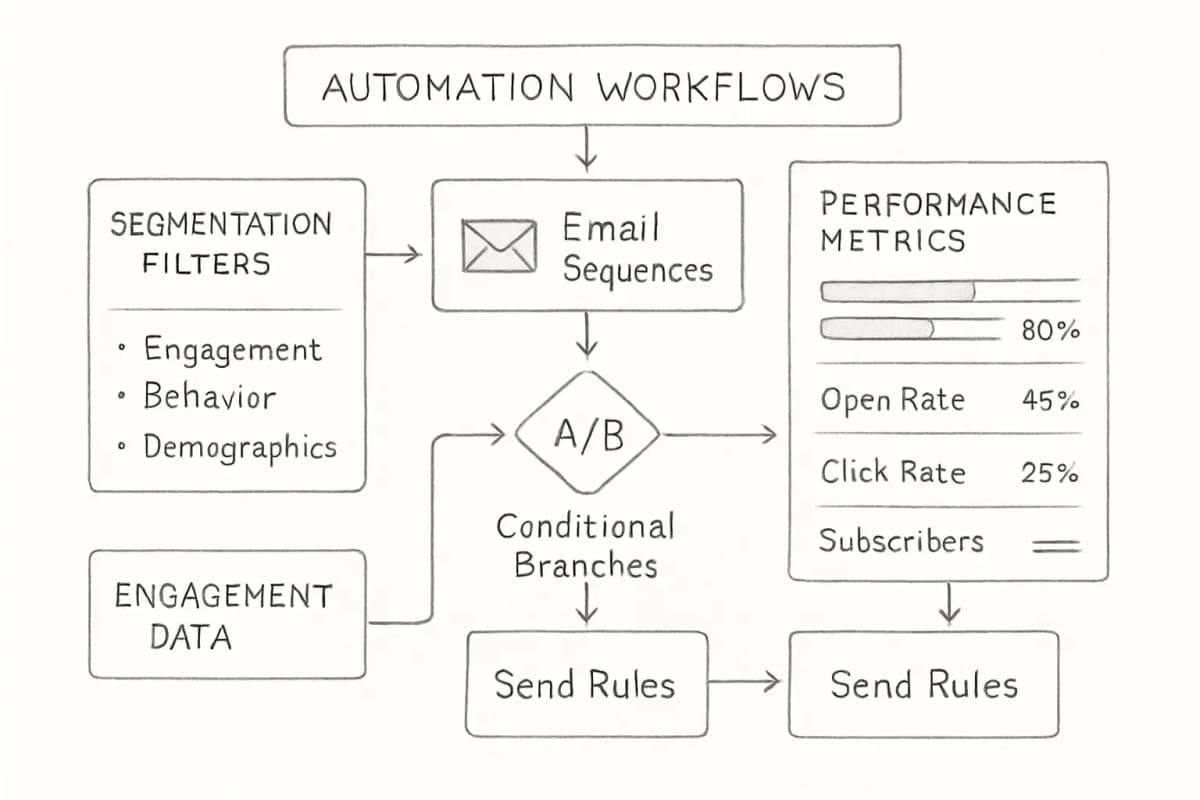
Email marketing delivers a return that no other digital channel consistently matches. According to Statista, the average ROI for email marketing is $36 for every dollar spent. But that number assumes you are using the right software and strategy. Most businesses that fall short of that benchmark are not failing at content; they are using the wrong tools, ignoring segmentation, or skipping automation altogether.
This guide covers how to choose and use email marketing software the right way, from the features that actually drive results to the setup decisions that protect your deliverability and grow your ROI.
Key Takeaways
42% of marketers say email is their most effective channel, far ahead of social media and paid search, which both sit at just 16%.
Despite representing only 2% of volume, automated messages generated 37% of all email-attributed sales in 2024.
Segmented email campaigns receive 100.95% higher click rates than non-segmented ones, and this tactic is linked with a 760% increase in email revenue.
Brands that regularly A/B test their emails achieve 83% higher ROI than those that never test.
Choosing software that aligns with your business size, workflow, and list complexity is the single biggest lever you have on long-term email performance.
Why the Software You Choose Matters More Than You Think
Picking email marketing software is not just a technical decision. It shapes every part of your program: how you build campaigns, how well your emails reach inboxes, and how easily you can act on performance data.
Marketing automation has become an essential feature in email marketers' toolboxes. By implementing the right systems, marketing professionals can collect and analyze user data, send the right emails at the right time, and ultimately maximize campaign effectiveness.
The best way to use email marketing software is to match the tool to your actual workflow, not the one you plan to have. Teams that start with overly complex platforms often under-use them. Teams that start too simple hit walls fast as their list and strategy grow.
Most businesses need a platform that can create attractive HTML emails without code, automate campaigns, and handle segmentation and targeting. All good email marketing services aim to tick these boxes.
Email marketing delivers a return that no other digital channel consistently matches. According to Statista, the average ROI for email marketing is $36 for every dollar spent. But that number assumes you are using the right software and strategy. Most businesses that fall short of that benchmark are not failing at content; they are using the wrong tools, ignoring segmentation, or skipping automation altogether.
This guide covers how to choose and use email marketing software the right way, from the features that actually drive results to the setup decisions that protect your deliverability and grow your ROI.
Key Takeaways
42% of marketers say email is their most effective channel, far ahead of social media and paid search, which both sit at just 16%.
Despite representing only 2% of volume, automated messages generated 37% of all email-attributed sales in 2024.
Segmented email campaigns receive 100.95% higher click rates than non-segmented ones, and this tactic is linked with a 760% increase in email revenue.
Brands that regularly A/B test their emails achieve 83% higher ROI than those that never test.
Choosing software that aligns with your business size, workflow, and list complexity is the single biggest lever you have on long-term email performance.
Why the Software You Choose Matters More Than You Think
Picking email marketing software is not just a technical decision. It shapes every part of your program: how you build campaigns, how well your emails reach inboxes, and how easily you can act on performance data.
Marketing automation has become an essential feature in email marketers' toolboxes. By implementing the right systems, marketing professionals can collect and analyze user data, send the right emails at the right time, and ultimately maximize campaign effectiveness.
The best way to use email marketing software is to match the tool to your actual workflow, not the one you plan to have. Teams that start with overly complex platforms often under-use them. Teams that start too simple hit walls fast as their list and strategy grow.
Most businesses need a platform that can create attractive HTML emails without code, automate campaigns, and handle segmentation and targeting. All good email marketing services aim to tick these boxes.
The Core Features That Actually Drive Results
Not all features carry equal weight. When evaluating email marketing software, these are the ones that have a direct impact on revenue and deliverability.
Automation
Email automations deliver 30 times more revenue per recipient than one-off promotional campaigns. The average return per recipient for campaigns sits at $0.11, while automated flows earn $1.94 per recipient.
Look for a platform with visual workflow builders, behavior-based triggers, and enough flexibility to handle welcome sequences, cart abandonment flows, re-engagement campaigns, and post-purchase follow-ups.
Segmentation
Automated email segmentation is the process of using dynamic rules and real-time data to organize email contacts into targeted groups automatically. Unlike static lists that require constant manual updates, automated segmentation continuously adjusts audience membership based on changing customer behaviors, preferences, and lifecycle stages.
Your software should make this process invisible. If you are manually moving contacts between lists, the tool is working against you.
Platforms that prioritize deliverability offer features like email authentication (DKIM, SPF, DMARC) to verify trusted sources, and bounce and spam complaint monitoring to protect your sender reputation.
A beautiful campaign that lands in spam is a wasted campaign. Deliverability should be a non-negotiable criterion when comparing tools.
Personalization
65% of email marketers identify dynamic content as their most effective personalization tactic. Emails with personalization reach 29% open rates compared to the industry average of 21.33%, and click-through rates hit 41% for personalized messages.
Your software needs to support dynamic content blocks, not just first-name merge tags.
Analytics and Reporting
Bot-driven phantom engagement has made open rates unreliable, pushing high-performing teams toward revenue per email, list churn, and lifetime value as the metrics that matter.
The Core Features That Actually Drive Results
Not all features carry equal weight. When evaluating email marketing software, these are the ones that have a direct impact on revenue and deliverability.
Automation
Email automations deliver 30 times more revenue per recipient than one-off promotional campaigns. The average return per recipient for campaigns sits at $0.11, while automated flows earn $1.94 per recipient.
Look for a platform with visual workflow builders, behavior-based triggers, and enough flexibility to handle welcome sequences, cart abandonment flows, re-engagement campaigns, and post-purchase follow-ups.
Segmentation
Automated email segmentation is the process of using dynamic rules and real-time data to organize email contacts into targeted groups automatically. Unlike static lists that require constant manual updates, automated segmentation continuously adjusts audience membership based on changing customer behaviors, preferences, and lifecycle stages.
Your software should make this process invisible. If you are manually moving contacts between lists, the tool is working against you.
Platforms that prioritize deliverability offer features like email authentication (DKIM, SPF, DMARC) to verify trusted sources, and bounce and spam complaint monitoring to protect your sender reputation.
A beautiful campaign that lands in spam is a wasted campaign. Deliverability should be a non-negotiable criterion when comparing tools.
Personalization
65% of email marketers identify dynamic content as their most effective personalization tactic. Emails with personalization reach 29% open rates compared to the industry average of 21.33%, and click-through rates hit 41% for personalized messages.
Your software needs to support dynamic content blocks, not just first-name merge tags.
Analytics and Reporting
Bot-driven phantom engagement has made open rates unreliable, pushing high-performing teams toward revenue per email, list churn, and lifetime value as the metrics that matter.
Choose a platform that tracks conversions and revenue, not just opens and clicks. For guidance on which metrics to track and how to read them, see email marketing analytics best practices.
How to Match Software to Your Business Type
There is no single best platform for every business. The right choice depends on your list size, technical resources, and the type of email program you run.
For ecommerce brands: Klaviyo and Omnisend are built for product-based businesses. Klaviyo allows businesses to send targeted emails, automate email flows, and analyze customer behavior, with a predictive segmentation tool that online sellers can use by sending messages to people the tool thinks are most ready to buy.
For B2B and SaaS teams: ActiveCampaign and HubSpot handle CRM integration and lead scoring well. ActiveCampaign is considered the best email marketing software for teams serious about automation. Its visual workflow builder remains one of the most capable in the industry, and with its AI feature that learns from campaigns, it offers strong contextual intelligence.
For small businesses and creators: MailerLite stands out for being easy to use, offering strong automation features, and maintaining a clear focus on email marketing without adding unnecessary extras.
For multi-channel marketers: Brevo goes beyond email marketing and offers additional tools like WhatsApp marketing, SMS marketing, live chat, and chatbots. Its pricing is based on email volume rather than contact count, which works well for businesses with large lists but lower send frequency.
The Right Way to Set Up Your Email Program
Getting the software right is only part of the equation. How you configure it from day one determines your long-term results.
1. Authenticate your sending domain
Set up SPF, DKIM, and DMARC records before sending a single campaign. Without authentication, your emails are more likely to be flagged as spam, and your sender reputation starts in a hole.
2. Build segments before you send
Start with 3 to 5 core segments to build a strong foundation before adding complexity. You can always refine later as you learn more about your audience.
Common starting segments include new subscribers, active buyers, inactive subscribers (30 to 90 days), and people who abandoned carts.
3. Launch a welcome sequence immediately
Welcome emails have an average open rate of 82% and an average click-through rate of 27%. This is your highest-engagement window with a new subscriber. Use it to set expectations, deliver value, and move people toward their first conversion.
For a proven framework, read our guide on welcome email sequence best practices.
4. Schedule regular A/B tests
Brands that regularly A/B test their emails achieve 83% higher ROI than those that never test. Companies that never test report average ROI of 2,300%, while those that often test achieve 4,200%.
Test one variable at a time: subject lines, send times, call-to-action copy, or content length.
5. Monitor and act on deliverability signals
Watch your bounce rate, spam complaint rate, and unsubscribe rate as leading indicators. A spike in any of these is a signal to clean your list, adjust your frequency, or review your content quality before inbox placement suffers.
Choose a platform that tracks conversions and revenue, not just opens and clicks. For guidance on which metrics to track and how to read them, see email marketing analytics best practices.
How to Match Software to Your Business Type
There is no single best platform for every business. The right choice depends on your list size, technical resources, and the type of email program you run.
For ecommerce brands: Klaviyo and Omnisend are built for product-based businesses. Klaviyo allows businesses to send targeted emails, automate email flows, and analyze customer behavior, with a predictive segmentation tool that online sellers can use by sending messages to people the tool thinks are most ready to buy.
For B2B and SaaS teams: ActiveCampaign and HubSpot handle CRM integration and lead scoring well. ActiveCampaign is considered the best email marketing software for teams serious about automation. Its visual workflow builder remains one of the most capable in the industry, and with its AI feature that learns from campaigns, it offers strong contextual intelligence.
For small businesses and creators: MailerLite stands out for being easy to use, offering strong automation features, and maintaining a clear focus on email marketing without adding unnecessary extras.
For multi-channel marketers: Brevo goes beyond email marketing and offers additional tools like WhatsApp marketing, SMS marketing, live chat, and chatbots. Its pricing is based on email volume rather than contact count, which works well for businesses with large lists but lower send frequency.
The Right Way to Set Up Your Email Program
Getting the software right is only part of the equation. How you configure it from day one determines your long-term results.
1. Authenticate your sending domain
Set up SPF, DKIM, and DMARC records before sending a single campaign. Without authentication, your emails are more likely to be flagged as spam, and your sender reputation starts in a hole.
2. Build segments before you send
Start with 3 to 5 core segments to build a strong foundation before adding complexity. You can always refine later as you learn more about your audience.
Common starting segments include new subscribers, active buyers, inactive subscribers (30 to 90 days), and people who abandoned carts.
3. Launch a welcome sequence immediately
Welcome emails have an average open rate of 82% and an average click-through rate of 27%. This is your highest-engagement window with a new subscriber. Use it to set expectations, deliver value, and move people toward their first conversion.
For a proven framework, read our guide on welcome email sequence best practices.
4. Schedule regular A/B tests
Brands that regularly A/B test their emails achieve 83% higher ROI than those that never test. Companies that never test report average ROI of 2,300%, while those that often test achieve 4,200%.
Test one variable at a time: subject lines, send times, call-to-action copy, or content length.
5. Monitor and act on deliverability signals
Watch your bounce rate, spam complaint rate, and unsubscribe rate as leading indicators. A spike in any of these is a signal to clean your list, adjust your frequency, or review your content quality before inbox placement suffers.
Common Mistakes That Kill Email Marketing ROI
Even with good software, these mistakes consistently undermine results.
Sending to your full list every time. Generic batch-and-blast emails depress engagement rates and train inbox algorithms to deprioritize your messages.
Ignoring mobile rendering. It is vital that your email marketing software can optimize your message to be viewed on both desktop and mobile device screens.
Measuring only open rates. Multi-channel attribution and MQLs jumped 22% year-over-year as email campaign reporting moves away from engagement proxies toward revenue accountability.
Skipping list hygiene. Sending to invalid or disengaged addresses damages your sender reputation. Most platforms include suppression and cleaning tools; use them.
Over-automating without testing. Automated flows still need regular review. An abandoned cart email that was performing well in Q1 may need a refresh by Q3.
Pricing: What to Expect and How to Evaluate It
Most platforms price based on the number of contacts or the number of emails sent per month. Cost is always a consideration when choosing any platform. The key is getting the features you need at a price you can afford. The best email marketing services start their pricing low and have the flexibility to grow.
Watch out for:
Contacts that count toward your billing limit even when unsubscribed
Features locked behind expensive tiers (like A/B testing or advanced automation)
Price jumps when crossing subscriber thresholds
Brevo's pricing model is unique because it is based on the number of emails you send, not the number of contacts you have. This approach can be a big advantage for certain businesses. If you have a large but infrequently-mailed list, this structure saves money.
Start by testing two or three platforms on a small segment of your list. The interface, automation builder, and reporting all feel different in practice than they look in demos.
Frequently Asked Questions
Common Mistakes That Kill Email Marketing ROI
Even with good software, these mistakes consistently undermine results.
Sending to your full list every time. Generic batch-and-blast emails depress engagement rates and train inbox algorithms to deprioritize your messages.
Ignoring mobile rendering. It is vital that your email marketing software can optimize your message to be viewed on both desktop and mobile device screens.
Measuring only open rates. Multi-channel attribution and MQLs jumped 22% year-over-year as email campaign reporting moves away from engagement proxies toward revenue accountability.
Skipping list hygiene. Sending to invalid or disengaged addresses damages your sender reputation. Most platforms include suppression and cleaning tools; use them.
Over-automating without testing. Automated flows still need regular review. An abandoned cart email that was performing well in Q1 may need a refresh by Q3.
Pricing: What to Expect and How to Evaluate It
Most platforms price based on the number of contacts or the number of emails sent per month. Cost is always a consideration when choosing any platform. The key is getting the features you need at a price you can afford. The best email marketing services start their pricing low and have the flexibility to grow.
Watch out for:
Contacts that count toward your billing limit even when unsubscribed
Features locked behind expensive tiers (like A/B testing or advanced automation)
Price jumps when crossing subscriber thresholds
Brevo's pricing model is unique because it is based on the number of emails you send, not the number of contacts you have. This approach can be a big advantage for certain businesses. If you have a large but infrequently-mailed list, this structure saves money.
Start by testing two or three platforms on a small segment of your list. The interface, automation builder, and reporting all feel different in practice than they look in demos.
Frequently Asked Questions
What is the best way to use email marketing software for a small business?
Start with a platform that matches your technical comfort level and list size. Focus first on a solid welcome sequence, basic segmentation by purchase history or signup source, and one or two automated flows (welcome and re-engagement). 80% of small and midsized businesses say that email marketing is their most important online tool for customer retention. The goal is consistent, relevant communication, not complex automation from day one.
How does email marketing software affect deliverability?
Your platform directly affects deliverability through its shared or dedicated IP infrastructure, spam monitoring tools, and authentication support. Staying off email spam lists requires working with a reputable email software platform and ensuring every person on your email list signs up and wants to receive your messages. Choose a platform that offers DKIM and SPF support, proactive bounce monitoring, and clear guidance on list hygiene.
How often should I send emails to my list?
Brands sending 9 to 16 emails monthly achieve the highest average ROI, at 4,600%. This sweet spot balances subscriber engagement with list fatigue. That said, the right frequency depends on your industry, audience expectations, and content quality. Consistent sends with relevant content outperform irregular blasts every time.
What metrics should I track in my email marketing software?
Move beyond open rates. According to the DMA, the four most important email marketing metrics as identified by advertisers are click-through rate, conversion rate, open rate, and ROI. Revenue per email, list growth rate, and unsubscribe rate are also worth tracking closely as they reflect real business impact rather than just engagement signals.
No comments yet. Be the first!
What is the best way to use email marketing software for a small business?
Start with a platform that matches your technical comfort level and list size. Focus first on a solid welcome sequence, basic segmentation by purchase history or signup source, and one or two automated flows (welcome and re-engagement). 80% of small and midsized businesses say that email marketing is their most important online tool for customer retention. The goal is consistent, relevant communication, not complex automation from day one.
How does email marketing software affect deliverability?
Your platform directly affects deliverability through its shared or dedicated IP infrastructure, spam monitoring tools, and authentication support. Staying off email spam lists requires working with a reputable email software platform and ensuring every person on your email list signs up and wants to receive your messages. Choose a platform that offers DKIM and SPF support, proactive bounce monitoring, and clear guidance on list hygiene.
How often should I send emails to my list?
Brands sending 9 to 16 emails monthly achieve the highest average ROI, at 4,600%. This sweet spot balances subscriber engagement with list fatigue. That said, the right frequency depends on your industry, audience expectations, and content quality. Consistent sends with relevant content outperform irregular blasts every time.
What metrics should I track in my email marketing software?
Move beyond open rates. According to the DMA, the four most important email marketing metrics as identified by advertisers are click-through rate, conversion rate, open rate, and ROI. Revenue per email, list growth rate, and unsubscribe rate are also worth tracking closely as they reflect real business impact rather than just engagement signals.