Church Email Marketing: Grow Engagement and Giving
Learn how to build effective email campaigns for your church. Increase member engagement, boost giving, and strengthen community connections with proven strategies.
Church Email Marketing: Grow Engagement and Giving
Learn how to build effective email campaigns for your church. Increase member engagement, boost giving, and strengthen community connections with proven strategies.
Churches that treat email as a broadcast tool typically see flat engagement. Those that treat it as a relationship channel see their giving grow, their attendance stabilize, and their members stay connected between Sundays. The data backs this up: 33% of donors say email is the tool that most inspires them to give, outperforming social media at 29%, websites at 17%, and print at 9%. For any church serious about growing both engagement and generosity, church email marketing is not optional. It is foundational.
Key Takeaways
The average email open rate for religious organizations is 31%, according to Constant Contact data, which outperforms many commercial industries.
Email delivers an average return of $36 for every $1 spent, making it one of the most cost-efficient communication channels available to churches of any size.
Emails with personalized subject lines are 26% more likely to be opened, a quick win that any church can apply without expensive tools.
53% of email is opened on a mobile device, and if an email is not designed for mobile, it is likely to be deleted in under three seconds.
Email remains one of the most effective communication channels for churches because it is direct, personal, and not controlled by social media algorithms, consistently driving higher engagement for announcements, discipleship content, and giving opportunities.
Why Email Works Differently for Churches
Most marketing channels compete for attention. Email earns it, because your congregation opted in.
Unlike social media algorithms that limit your reach, email gives you direct access to communicate with your community. A post on your church Facebook page might reach 5% of your followers. An email lands in every subscriber's inbox.
Building an email list also creates a lasting church asset. Unlike social media followers that platforms control, your email list belongs to your church. This gives you a reliable way to reach your community regardless of changes in social media algorithms or platforms.
The financial case is equally strong. Church partners using digital tools experienced an average increase of 17% in overall donations over the prior year, with many seeing double-digit growth, a trend observable across churches all over the country. Email is central to that shift.
Churches that treat email as a broadcast tool typically see flat engagement. Those that treat it as a relationship channel see their giving grow, their attendance stabilize, and their members stay connected between Sundays. The data backs this up: 33% of donors say email is the tool that most inspires them to give, outperforming social media at 29%, websites at 17%, and print at 9%. For any church serious about growing both engagement and generosity, church email marketing is not optional. It is foundational.
Key Takeaways
The average email open rate for religious organizations is 31%, according to Constant Contact data, which outperforms many commercial industries.
Email delivers an average return of $36 for every $1 spent, making it one of the most cost-efficient communication channels available to churches of any size.
Emails with personalized subject lines are 26% more likely to be opened, a quick win that any church can apply without expensive tools.
53% of email is opened on a mobile device, and if an email is not designed for mobile, it is likely to be deleted in under three seconds.
Email remains one of the most effective communication channels for churches because it is direct, personal, and not controlled by social media algorithms, consistently driving higher engagement for announcements, discipleship content, and giving opportunities.
Why Email Works Differently for Churches
Most marketing channels compete for attention. Email earns it, because your congregation opted in.
Unlike social media algorithms that limit your reach, email gives you direct access to communicate with your community. A post on your church Facebook page might reach 5% of your followers. An email lands in every subscriber's inbox.
Building an email list also creates a lasting church asset. Unlike social media followers that platforms control, your email list belongs to your church. This gives you a reliable way to reach your community regardless of changes in social media algorithms or platforms.
The financial case is equally strong. Church partners using digital tools experienced an average increase of 17% in overall donations over the prior year, with many seeing double-digit growth, a trend observable across churches all over the country. Email is central to that shift.
There is also a generational reality worth understanding. According to the Philanthropy Chronicles, Boomers continue to be the most generous, giving approximately $3,256 annually to charity in 2024. Millennials are next at $1,616 annually, Gen X at $1,371, and Gen Z at $867 annually. All four groups use email regularly, which means a well-structured email program reaches your entire giving base.
Build a List Worth Sending To
A church email list is only as useful as its quality. Size matters less than engagement.
Give subscribers choices at opt-in. Ask if they want to receive the church newsletter, prayer requests, event reminders, emergency messages, or all of the above. This goes a long way toward ensuring that those who receive the messages actually open and read them.
Equally important: never purchase lists. Buying or selling email lists can harm your church's reputation and lead to low engagement rates.
Practical list-building tactics that work for churches:
Place a signup form on every page of your church website
Display a QR code during services that links directly to a signup form
During services, display a QR code on the screen or print it on connection cards
Collect emails at events, volunteer orientations, and newcomer welcome sessions
Offer a clear value exchange: weekly devotionals, sermon notes, or event previews
Clean your list regularly. Inactive subscribers drag down open rates and increase spam risk. A list of 800 engaged members outperforms a list of 3,000 ghost contacts every time.
Segment Your Congregation for Better Results
Sending the same email to everyone on your list is the fastest way to generate unsubscribes. Your congregation includes new visitors, long-term members, small group leaders, parents of teens, and regular givers. They do not all need the same message.
Email marketing software allows churches to segment their email lists based on various criteria, such as age groups, ministry involvement, or attendance patterns. This segmentation enables churches to send personalized messages that are relevant to different groups of church members.
Common church segments to build:
New visitors (arrived in the last 30 days)
Regular attenders (consistent Sunday presence)
Givers (active in online or in-person giving)
Volunteers (serving in a ministry role)
Small group members (enrolled in a specific group)
Lapsed attendees (not seen in 60 or more days)
Segmentation enables churches to send personalized messages relevant to different groups. For example, youth group updates can be sent specifically to teenagers and their parents, while volunteer opportunities can be targeted at active members who have shown interest in serving.
There is also a generational reality worth understanding. According to the Philanthropy Chronicles, Boomers continue to be the most generous, giving approximately $3,256 annually to charity in 2024. Millennials are next at $1,616 annually, Gen X at $1,371, and Gen Z at $867 annually. All four groups use email regularly, which means a well-structured email program reaches your entire giving base.
Build a List Worth Sending To
A church email list is only as useful as its quality. Size matters less than engagement.
Give subscribers choices at opt-in. Ask if they want to receive the church newsletter, prayer requests, event reminders, emergency messages, or all of the above. This goes a long way toward ensuring that those who receive the messages actually open and read them.
Equally important: never purchase lists. Buying or selling email lists can harm your church's reputation and lead to low engagement rates.
Practical list-building tactics that work for churches:
Place a signup form on every page of your church website
Display a QR code during services that links directly to a signup form
During services, display a QR code on the screen or print it on connection cards
Collect emails at events, volunteer orientations, and newcomer welcome sessions
Offer a clear value exchange: weekly devotionals, sermon notes, or event previews
Clean your list regularly. Inactive subscribers drag down open rates and increase spam risk. A list of 800 engaged members outperforms a list of 3,000 ghost contacts every time.
Segment Your Congregation for Better Results
Sending the same email to everyone on your list is the fastest way to generate unsubscribes. Your congregation includes new visitors, long-term members, small group leaders, parents of teens, and regular givers. They do not all need the same message.
Email marketing software allows churches to segment their email lists based on various criteria, such as age groups, ministry involvement, or attendance patterns. This segmentation enables churches to send personalized messages that are relevant to different groups of church members.
Common church segments to build:
New visitors (arrived in the last 30 days)
Regular attenders (consistent Sunday presence)
Givers (active in online or in-person giving)
Volunteers (serving in a ministry role)
Small group members (enrolled in a specific group)
Lapsed attendees (not seen in 60 or more days)
Segmentation enables churches to send personalized messages relevant to different groups. For example, youth group updates can be sent specifically to teenagers and their parents, while volunteer opportunities can be targeted at active members who have shown interest in serving.
First impressions in person happen on Sunday. First impressions by email happen the moment someone fills out a connect card or signs up on your website. That moment is your best chance to deepen the relationship before it fades.
A welcome series for new members is an essential email marketing campaign that helps integrate newcomers into the church community. When someone joins the church, they can receive a series of automated emails designed to make them feel welcomed and informed. This series can include a warm welcome message from the pastor, information about the church's mission and values, and details on upcoming events and programs.
A simple, effective welcome sequence for churches looks like this:
Day 1: A warm welcome from the pastor, with a clear next step (Sunday times, small groups page)
Day 4: An introduction to your mission and core values
Day 8: Highlight a ministry or serving opportunity relevant to their stage of life
Day 14: A personal invite to a newcomer event, small group, or coffee chat
Day 21: A soft giving message that shows how generosity connects to impact
The first email might thank the new member for joining and introduce them to key church leaders. Subsequent emails can highlight different ministries, small groups, and volunteer opportunities, helping new members find ways to get involved.
Automation handles delivery without manual effort. For detailed guidance on building this kind of sequence, our welcome email sequence best practices guide covers the full framework.
Write Subject Lines That Get Opened
Your congregation receives dozens of emails every day. Your subject line decides whether yours gets opened or ignored.
According to Constant Contact data, the average open rate for religious organizations is 31%, but the variance between churches is significant. The difference between a 20% and a 45% open rate often comes down to the subject line alone.
First impressions in person happen on Sunday. First impressions by email happen the moment someone fills out a connect card or signs up on your website. That moment is your best chance to deepen the relationship before it fades.
A welcome series for new members is an essential email marketing campaign that helps integrate newcomers into the church community. When someone joins the church, they can receive a series of automated emails designed to make them feel welcomed and informed. This series can include a warm welcome message from the pastor, information about the church's mission and values, and details on upcoming events and programs.
A simple, effective welcome sequence for churches looks like this:
Day 1: A warm welcome from the pastor, with a clear next step (Sunday times, small groups page)
Day 4: An introduction to your mission and core values
Day 8: Highlight a ministry or serving opportunity relevant to their stage of life
Day 14: A personal invite to a newcomer event, small group, or coffee chat
Day 21: A soft giving message that shows how generosity connects to impact
The first email might thank the new member for joining and introduce them to key church leaders. Subsequent emails can highlight different ministries, small groups, and volunteer opportunities, helping new members find ways to get involved.
Automation handles delivery without manual effort. For detailed guidance on building this kind of sequence, our welcome email sequence best practices guide covers the full framework.
Write Subject Lines That Get Opened
Your congregation receives dozens of emails every day. Your subject line decides whether yours gets opened or ignored.
According to Constant Contact data, the average open rate for religious organizations is 31%, but the variance between churches is significant. The difference between a 20% and a 45% open rate often comes down to the subject line alone.
What works:
Keep it short. Short subject lines perform better than long ones. If your subject lines are long and drawn out, people will assume the body of the email will be even worse. As a general rule, the fewer words, the better, and most phones will only allow for about 30 characters in a subject line.
Use curiosity or specificity. "What Jesus said about worry" outperforms "This Week's Church Newsletter."
Personalize when possible. Emails with personalized subject lines are 26% more likely to be opened.
Create urgency for time-sensitive events. When possible, give subject lines expiration dates. Terms like "Last Chance to..." or "Registration Closes at Midnight" will increase open rates and help more people see your emails.
Avoid the word "newsletter." Some studies have found that the word "newsletter" can actually reduce open rates, and it also says absolutely nothing about the content inside.
For more tested subject line frameworks, the email subject line best practices guide covers techniques shown to boost open rates by 27%.
Use Automation to Stay Consistent Without Burnout
Consistency is the single biggest challenge in church communications. Staff capacity fluctuates, volunteers come and go, and a missed week of emails quietly erodes trust with your congregation. Automation solves this.
By automating routine tasks such as sending newsletters, event reminders, and personalized messages, churches can save time and ensure consistent, timely communication with their members. This technology helps in keeping the church informed and builds a sense of belonging by delivering relevant content based on individual preferences and involvement.
Key automated workflows every church should run:
New visitor welcome series (detailed above)
Event reminder sequence (3 days before, 1 day before, day-of)
Post-event follow-up (thank attendance, share resources, invite next step)
Giving acknowledgment (automated thank-you within 24 hours of a donation)
Re-engagement campaign for members who have gone quiet for 60 or more days
Keep it short. Short subject lines perform better than long ones. If your subject lines are long and drawn out, people will assume the body of the email will be even worse. As a general rule, the fewer words, the better, and most phones will only allow for about 30 characters in a subject line.
Use curiosity or specificity. "What Jesus said about worry" outperforms "This Week's Church Newsletter."
Personalize when possible. Emails with personalized subject lines are 26% more likely to be opened.
Create urgency for time-sensitive events. When possible, give subject lines expiration dates. Terms like "Last Chance to..." or "Registration Closes at Midnight" will increase open rates and help more people see your emails.
Avoid the word "newsletter." Some studies have found that the word "newsletter" can actually reduce open rates, and it also says absolutely nothing about the content inside.
For more tested subject line frameworks, the email subject line best practices guide covers techniques shown to boost open rates by 27%.
Use Automation to Stay Consistent Without Burnout
Consistency is the single biggest challenge in church communications. Staff capacity fluctuates, volunteers come and go, and a missed week of emails quietly erodes trust with your congregation. Automation solves this.
By automating routine tasks such as sending newsletters, event reminders, and personalized messages, churches can save time and ensure consistent, timely communication with their members. This technology helps in keeping the church informed and builds a sense of belonging by delivering relevant content based on individual preferences and involvement.
Key automated workflows every church should run:
New visitor welcome series (detailed above)
Event reminder sequence (3 days before, 1 day before, day-of)
Post-event follow-up (thank attendance, share resources, invite next step)
Giving acknowledgment (automated thank-you within 24 hours of a donation)
Re-engagement campaign for members who have gone quiet for 60 or more days
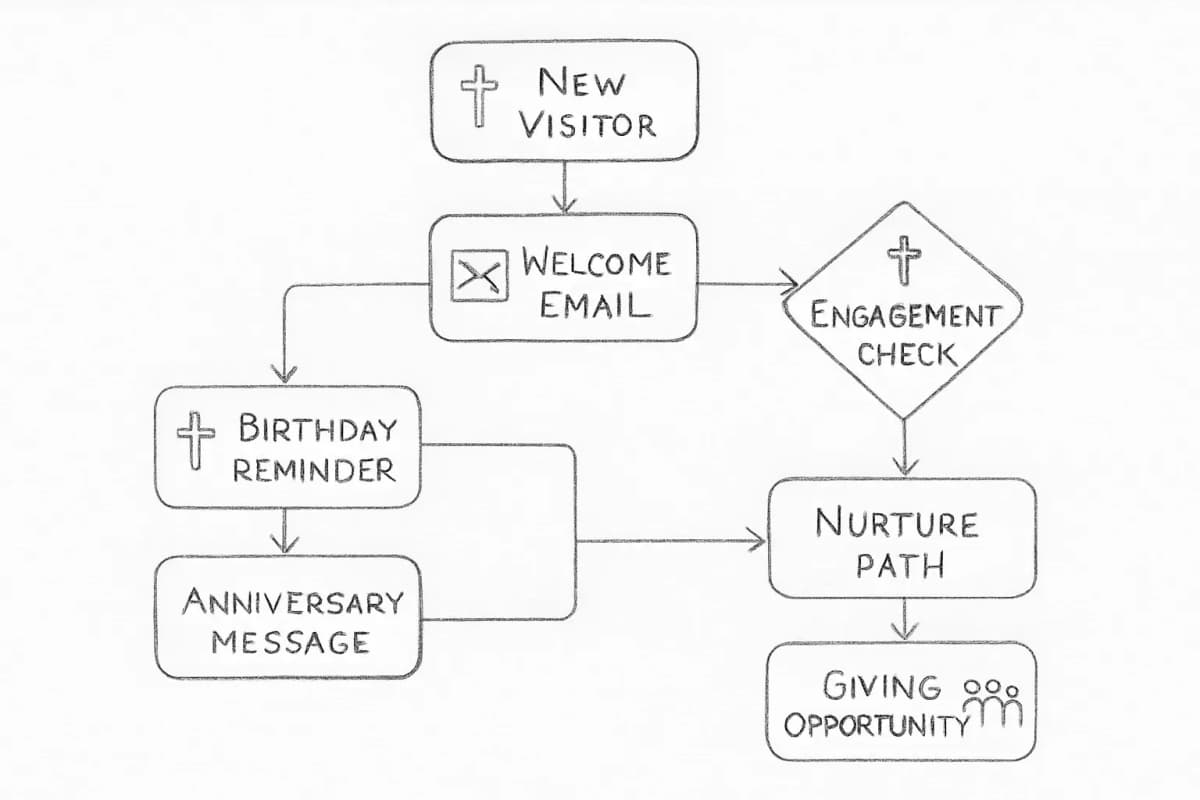
Email automation saves time while nurturing relationships. You can set up automatic welcome messages for new visitors, birthday greetings, and anniversary remembrances. These personal touches help people feel valued and connected to your church family without requiring manual effort for each message.
Email automation saves time while nurturing relationships. You can set up automatic welcome messages for new visitors, birthday greetings, and anniversary remembrances. These personal touches help people feel valued and connected to your church family without requiring manual effort for each message.
Connect Email to Your Giving Strategy
Email is your most reliable tool for moving members from occasional giving to consistent generosity. The key is connecting every campaign to a clear story and a direct call to action.
In the body of your giving email, include one story, one ask, and one button. Competing links and multiple calls to action dilute the impact.
What drives giving through email:
Storytelling. Including personal stories and testimonials from current givers can be a great way to encourage new givers to take the leap. People are more likely to give when they see how their donations are making a difference in real people's lives.
Transparency. Keep your congregants informed by sharing financial reports and updates. This transparency fosters trust and encourages more people to contribute.
Mobile-first design. Your emails should be designed for mobile devices first. Use high-contrast buttons, short paragraphs, and scannable headers.
Recurring giving prompts. Dedicated emails explaining how to set up automatic giving consistently increase average annual giving per household.
Impact reports. Quarterly emails that show what tithes and offerings have accomplished make giving feel tangible and meaningful.
Donor retention increases by 29% for offline donors when you have their email address, which underscores why capturing emails at every point of contact is worth the effort.
For nonprofits and ministry organizations that want a broader strategic framework, the best email marketing services for nonprofits guide covers platforms and approaches purpose-built for mission-driven organizations.
Track the Metrics That Actually Matter
Without data, you are guessing. With it, you can improve every send.
Monitoring metrics such as open rates and click-through rates helps in assessing and optimizing email campaign effectiveness. Click-through rates tell you if your links are getting any love, whether for an upcoming event, a sermon video, or a volunteer recruitment campaign. Conversion rates take it a step further, showing how many people take action after reading your email.
Benchmark your performance against these figures:
Connect Email to Your Giving Strategy
Email is your most reliable tool for moving members from occasional giving to consistent generosity. The key is connecting every campaign to a clear story and a direct call to action.
In the body of your giving email, include one story, one ask, and one button. Competing links and multiple calls to action dilute the impact.
What drives giving through email:
Storytelling. Including personal stories and testimonials from current givers can be a great way to encourage new givers to take the leap. People are more likely to give when they see how their donations are making a difference in real people's lives.
Transparency. Keep your congregants informed by sharing financial reports and updates. This transparency fosters trust and encourages more people to contribute.
Mobile-first design. Your emails should be designed for mobile devices first. Use high-contrast buttons, short paragraphs, and scannable headers.
Recurring giving prompts. Dedicated emails explaining how to set up automatic giving consistently increase average annual giving per household.
Impact reports. Quarterly emails that show what tithes and offerings have accomplished make giving feel tangible and meaningful.
Donor retention increases by 29% for offline donors when you have their email address, which underscores why capturing emails at every point of contact is worth the effort.
For nonprofits and ministry organizations that want a broader strategic framework, the best email marketing services for nonprofits guide covers platforms and approaches purpose-built for mission-driven organizations.
Track the Metrics That Actually Matter
Without data, you are guessing. With it, you can improve every send.
Monitoring metrics such as open rates and click-through rates helps in assessing and optimizing email campaign effectiveness. Click-through rates tell you if your links are getting any love, whether for an upcoming event, a sermon video, or a volunteer recruitment campaign. Conversion rates take it a step further, showing how many people take action after reading your email.
Benchmark your performance against these figures:
Metric
Religious Org Average
Open Rate
31% (Constant Contact)
Click-Through Rate
~20% (church-specific research)
Bounce Rate
1.72% (nonprofit average)
Research analyzing 91,632 church-based emails found the average church click-through rate was 20.12%, which significantly outperforms general commercial email benchmarks. If your click-through rate falls below 10%, examine your calls to action, your email design, and whether your content matches what each segment actually needs.
Creating an email content calendar helps you strategically space out your communication and makes it easier for your church members to know when to expect an email. An email schedule also aligns messages with your church's activities such as sermon series, events, and fundraising campaigns so every email fits into your overall communication plan.
Frequently Asked Questions
How often should a church send emails?
Most churches see the best engagement by sending one to two emails per week. The key is not frequency but relevance. A daily email with thin content will accelerate unsubscribes. A weekly email that delivers a devotional, an event update, and a clear call to action earns consistent opens.
What email platforms work best for churches?
As of 2025, the best email service platforms for churches include Encharge, Mailchimp, Constant Contact, and several others. Mailchimp suits smaller congregations starting out. Constant Contact is known for being beginner-friendly, offering templates, list segmentation, and RSVP tracking for event-related emails. Larger churches with complex workflows benefit from platforms with deeper automation and church management software integration.
How do we grow our church email list?
Start with what you already have: attendance records, volunteer sign-ups, and event registrations. Then build forward. Add a signup form to every page of your church website, collect emails at weekend services through connect cards or QR codes, and set up a list at your welcome desk for first-time visitors. Always ask for permission explicitly, and always deliver something valuable in return for the subscription.
What email content drives the most giving?
Email is the most inspiring channel for 33% of donors, surpassing social media and websites. Content that converts best combines one personal impact story, one specific financial need or opportunity, and one direct link to your giving page. Avoid multiple asks in a single email. Segment your giving campaigns so regular givers receive stewardship content while newer members receive introduction-to-generosity messaging.
No comments yet. Be the first!
Metric
Religious Org Average
Open Rate
31% (Constant Contact)
Click-Through Rate
~20% (church-specific research)
Bounce Rate
1.72% (nonprofit average)
Research analyzing 91,632 church-based emails found the average church click-through rate was 20.12%, which significantly outperforms general commercial email benchmarks. If your click-through rate falls below 10%, examine your calls to action, your email design, and whether your content matches what each segment actually needs.
Creating an email content calendar helps you strategically space out your communication and makes it easier for your church members to know when to expect an email. An email schedule also aligns messages with your church's activities such as sermon series, events, and fundraising campaigns so every email fits into your overall communication plan.
Frequently Asked Questions
How often should a church send emails?
Most churches see the best engagement by sending one to two emails per week. The key is not frequency but relevance. A daily email with thin content will accelerate unsubscribes. A weekly email that delivers a devotional, an event update, and a clear call to action earns consistent opens.
What email platforms work best for churches?
As of 2025, the best email service platforms for churches include Encharge, Mailchimp, Constant Contact, and several others. Mailchimp suits smaller congregations starting out. Constant Contact is known for being beginner-friendly, offering templates, list segmentation, and RSVP tracking for event-related emails. Larger churches with complex workflows benefit from platforms with deeper automation and church management software integration.
How do we grow our church email list?
Start with what you already have: attendance records, volunteer sign-ups, and event registrations. Then build forward. Add a signup form to every page of your church website, collect emails at weekend services through connect cards or QR codes, and set up a list at your welcome desk for first-time visitors. Always ask for permission explicitly, and always deliver something valuable in return for the subscription.
What email content drives the most giving?
Email is the most inspiring channel for 33% of donors, surpassing social media and websites. Content that converts best combines one personal impact story, one specific financial need or opportunity, and one direct link to your giving page. Avoid multiple asks in a single email. Segment your giving campaigns so regular givers receive stewardship content while newer members receive introduction-to-generosity messaging.