Cold Email Marketing Best Practices That Actually Work
Learn proven cold email tactics to boost open rates and conversions. Research-backed strategies for crafting, sending, and following up without spam filters.
Cold Email Marketing Best Practices That Actually Work
Learn proven cold email tactics to boost open rates and conversions. Research-backed strategies for crafting, sending, and following up without spam filters.
Cold email remains one of the most direct ways to build pipeline, but the numbers make the challenge clear. Average cold email response rates have declined from 8.5% in 2019 to around 3.43% in 2026, according to Instantly's cold email benchmark report. Meanwhile, response rates keep dropping because of inbox saturation, sophisticated spam filters, and low-effort AI-generated outreach.
That does not mean cold email is broken. It means the gap between teams that follow cold email marketing best practices and those that don't is larger than ever. Average B2B cold email reply rates range from 3 to 5.1% across 2024 and 2025, but top-quartile performers routinely achieve 15 to 25% through hook optimization, tight ICP targeting, and strategic follow-up sequencing.
This guide covers what actually moves the needle, with data behind every recommendation.
Key Takeaways
Properly configuring SPF, DKIM, and DMARC authentication reduces spam flags by 50%. Fix deliverability before anything else.
Personalized emails increase response rates by approximately 32%, while subject lines tailored to the recipient can boost open rates by 50%.
The optimal cold email length is 50 to 125 words, with 75 to 100 words being the peak performer. Use 3 to 5 sentences, break into 2 to 3 short paragraphs, and make one clear ask.
Sending two to three follow-up emails, starting three days after your initial message, can increase response rates by up to 65.8%.
Companies that excel at email outreach generate 50% more sales-ready leads while cutting costs by one-third. Email delivers up to $42 earned for every $1 spent when highly targeted.
1. Fix Deliverability First
No subject line or personalization trick matters if your email lands in spam. With over 160 billion spam emails sent daily, filters now divert nearly 1 in 5 emails straight to spam folders. About 17% of cold outreach emails never reach any inbox at all, vanishing due to bounces, spam filtering, or authentication failures.
The technical foundation is non-negotiable:
SPF, DKIM, and DMARC authentication must be in place, spam complaint rates must stay below 0.1%, and one-click unsubscribe must be supported.
Cold email remains one of the most direct ways to build pipeline, but the numbers make the challenge clear. Average cold email response rates have declined from 8.5% in 2019 to around 3.43% in 2026, according to Instantly's cold email benchmark report. Meanwhile, response rates keep dropping because of inbox saturation, sophisticated spam filters, and low-effort AI-generated outreach.
That does not mean cold email is broken. It means the gap between teams that follow cold email marketing best practices and those that don't is larger than ever. Average B2B cold email reply rates range from 3 to 5.1% across 2024 and 2025, but top-quartile performers routinely achieve 15 to 25% through hook optimization, tight ICP targeting, and strategic follow-up sequencing.
This guide covers what actually moves the needle, with data behind every recommendation.
Key Takeaways
Properly configuring SPF, DKIM, and DMARC authentication reduces spam flags by 50%. Fix deliverability before anything else.
Personalized emails increase response rates by approximately 32%, while subject lines tailored to the recipient can boost open rates by 50%.
The optimal cold email length is 50 to 125 words, with 75 to 100 words being the peak performer. Use 3 to 5 sentences, break into 2 to 3 short paragraphs, and make one clear ask.
Sending two to three follow-up emails, starting three days after your initial message, can increase response rates by up to 65.8%.
Companies that excel at email outreach generate 50% more sales-ready leads while cutting costs by one-third. Email delivers up to $42 earned for every $1 spent when highly targeted.
1. Fix Deliverability First
No subject line or personalization trick matters if your email lands in spam. With over 160 billion spam emails sent daily, filters now divert nearly 1 in 5 emails straight to spam folders. About 17% of cold outreach emails never reach any inbox at all, vanishing due to bounces, spam filtering, or authentication failures.
The technical foundation is non-negotiable:
SPF, DKIM, and DMARC authentication must be in place, spam complaint rates must stay below 0.1%, and one-click unsubscribe must be supported.
In February 2024, Google and Yahoo began enforcing mandatory bulk sender requirements. Microsoft followed with equivalent rules in May 2025.
Gmail now enforces a 0.1% spam complaint threshold, and engagement signals like replies and time spent reading directly shape inbox placement.
Campaigns using email tracking pixels show a 10% to 15% reply rate correlation drop, likely due to increased spam filtering sensitivity to tracking tags.
On domain setup: custom domain plus Outlook with SPF/DKIM produces a 5.9% average reply rate, compared to 3.5% for Gmail-authenticated custom domains and only 1.2 to 2.1% for free webmail addresses.
Keep your bounce rate in check. If more than 2% of your emails bounce, you're already on thin ice. Verify your list before sending, not after.
2. Build a Precise Ideal Customer Profile (ICP)
Most cold emails fail before the subject line is even read, because the list is wrong. Reply rates drop significantly when your segmented list exceeds 100 people, indicating that overly broad lists dilute personalization impact.
Smaller, targeted campaigns of 50 recipients or fewer average a 5.8% response rate, compared to 2.1% for larger lists. The math favors precision over volume.
Build your ICP around firmographic and behavioral data: company size, revenue range, tech stack, hiring signals, funding announcements, and recent content activity. These signals tell you who is likely to have the problem you solve right now, not just in theory.
Finance tends to get slightly higher reply rates (around 4% of opens) than SaaS (around 3%), so industry-specific targeting and expectations matter. Check industry benchmarks for your vertical before setting campaign goals.
The subject line is the first filter. A significant 70% of email recipients mark emails as spam based solely on the subject line. Get it wrong and nothing else you write matters.
Length: Belkins analyzed 5.5 million cold emails sent throughout 2024. The results are unambiguous: 2 to 4 word subject lines hit a 46% open rate. A Backlinko study found that subject lines between 36 and 50 characters generated 32.7% more replies than short subject lines of 1 to 15 characters. The two findings are compatible: short subject lines that use those characters efficiently outperform everything else.
Personalization: Personalization mattered even more than length. Personalized subject lines pulled 46% opens versus 35% without, and reply rates jumped from 3% to 7%.
In February 2024, Google and Yahoo began enforcing mandatory bulk sender requirements. Microsoft followed with equivalent rules in May 2025.
Gmail now enforces a 0.1% spam complaint threshold, and engagement signals like replies and time spent reading directly shape inbox placement.
Campaigns using email tracking pixels show a 10% to 15% reply rate correlation drop, likely due to increased spam filtering sensitivity to tracking tags.
On domain setup: custom domain plus Outlook with SPF/DKIM produces a 5.9% average reply rate, compared to 3.5% for Gmail-authenticated custom domains and only 1.2 to 2.1% for free webmail addresses.
Keep your bounce rate in check. If more than 2% of your emails bounce, you're already on thin ice. Verify your list before sending, not after.
2. Build a Precise Ideal Customer Profile (ICP)
Most cold emails fail before the subject line is even read, because the list is wrong. Reply rates drop significantly when your segmented list exceeds 100 people, indicating that overly broad lists dilute personalization impact.
Smaller, targeted campaigns of 50 recipients or fewer average a 5.8% response rate, compared to 2.1% for larger lists. The math favors precision over volume.
Build your ICP around firmographic and behavioral data: company size, revenue range, tech stack, hiring signals, funding announcements, and recent content activity. These signals tell you who is likely to have the problem you solve right now, not just in theory.
Finance tends to get slightly higher reply rates (around 4% of opens) than SaaS (around 3%), so industry-specific targeting and expectations matter. Check industry benchmarks for your vertical before setting campaign goals.
The subject line is the first filter. A significant 70% of email recipients mark emails as spam based solely on the subject line. Get it wrong and nothing else you write matters.
Length: Belkins analyzed 5.5 million cold emails sent throughout 2024. The results are unambiguous: 2 to 4 word subject lines hit a 46% open rate. A Backlinko study found that subject lines between 36 and 50 characters generated 32.7% more replies than short subject lines of 1 to 15 characters. The two findings are compatible: short subject lines that use those characters efficiently outperform everything else.
Personalization: Personalization mattered even more than length. Personalized subject lines pulled 46% opens versus 35% without, and reply rates jumped from 3% to 7%.
Questions: Questions in subject lines produce a 21% increase in cold email open rates, according to Yesware.
Numbers: Subject lines incorporating numbers can more than double open rates, showing a 113% improvement.
What to avoid: spam trigger words like "free," "urgent," and "act now." A/B testing subject lines increases open rates by up to 20% over time.
For deeper subject line strategy, the email subject line best practices that boost open rates by 27% covers testing frameworks and examples across industries.
4. Personalize Beyond First Name
Inserting {{firstName}} is entry-level. Decision-makers see it hundreds of times a week and have learned to ignore it.
Generic cold emails see roughly 9% response rates, whereas those with advanced personalization tailored to the recipient's context see about 18%. One study found highly personalized campaigns using multiple custom fields boosted replies by 142% compared to non-personalized blasts.
Only 5% of senders personalize every email, and those who do get 2 to 3 times better results, according to Mailshake's 2025 report.
Real personalization is context-driven. Reference something specific:
A recent company announcement or funding round
A LinkedIn post or podcast they were featured in
A new role they're hiring for (signals growth pain points)
A product launch or pricing change
Research shows that 78% of decision-makers are more likely to respond to emails that showcase a deep understanding of their business.
Keep personalization genuine. Deep personalization using non-authentic AI content increases unsubscribe rates. Authentic personalization with real research maintains baseline unsubscribe rates of around 0.17%.
5. Write Emails That Are Short, Clear, and Focused
The optimal cold email length is 50 to 125 words. Emails in this range achieve a 2.4x higher reply rate than emails over 200 words, and a 1.6x higher reply rate than emails under 50 words.
The best cold emails use 4 sentences: a personalized opener, a value proposition, social proof or credibility, and a CTA. Each sentence serves a specific purpose, and adding more dilutes the message.
Structure your email in 2 to 3 short paragraphs, not one block of text. Single-block emails underperform emails broken into 2 to 3 short paragraphs, even at the same word count. Three short paragraphs creates visual whitespace that makes the email feel less dense and more scannable, which is critical for mobile reading.
Mobile devices account for 61% of email opens, making mobile-friendly design non-negotiable.
One CTA per email. Go for clarity and speed: one point, one CTA, one reason to reply. Asking for a quick "yes or no" or a low-commitment question consistently outperforms "let's schedule a 30-minute call."
6. Use the Right Hook Type
Most cold emails open with a variation of "Are you struggling with X?" That pattern is exhausted.
Questions: Questions in subject lines produce a 21% increase in cold email open rates, according to Yesware.
Numbers: Subject lines incorporating numbers can more than double open rates, showing a 113% improvement.
What to avoid: spam trigger words like "free," "urgent," and "act now." A/B testing subject lines increases open rates by up to 20% over time.
For deeper subject line strategy, the email subject line best practices that boost open rates by 27% covers testing frameworks and examples across industries.
4. Personalize Beyond First Name
Inserting {{firstName}} is entry-level. Decision-makers see it hundreds of times a week and have learned to ignore it.
Generic cold emails see roughly 9% response rates, whereas those with advanced personalization tailored to the recipient's context see about 18%. One study found highly personalized campaigns using multiple custom fields boosted replies by 142% compared to non-personalized blasts.
Only 5% of senders personalize every email, and those who do get 2 to 3 times better results, according to Mailshake's 2025 report.
Real personalization is context-driven. Reference something specific:
A recent company announcement or funding round
A LinkedIn post or podcast they were featured in
A new role they're hiring for (signals growth pain points)
A product launch or pricing change
Research shows that 78% of decision-makers are more likely to respond to emails that showcase a deep understanding of their business.
Keep personalization genuine. Deep personalization using non-authentic AI content increases unsubscribe rates. Authentic personalization with real research maintains baseline unsubscribe rates of around 0.17%.
5. Write Emails That Are Short, Clear, and Focused
The optimal cold email length is 50 to 125 words. Emails in this range achieve a 2.4x higher reply rate than emails over 200 words, and a 1.6x higher reply rate than emails under 50 words.
The best cold emails use 4 sentences: a personalized opener, a value proposition, social proof or credibility, and a CTA. Each sentence serves a specific purpose, and adding more dilutes the message.
Structure your email in 2 to 3 short paragraphs, not one block of text. Single-block emails underperform emails broken into 2 to 3 short paragraphs, even at the same word count. Three short paragraphs creates visual whitespace that makes the email feel less dense and more scannable, which is critical for mobile reading.
Mobile devices account for 61% of email opens, making mobile-friendly design non-negotiable.
One CTA per email. Go for clarity and speed: one point, one CTA, one reason to reply. Asking for a quick "yes or no" or a low-commitment question consistently outperforms "let's schedule a 30-minute call."
6. Use the Right Hook Type
Most cold emails open with a variation of "Are you struggling with X?" That pattern is exhausted.
Reply rates vary significantly by hook type, with timeline hooks achieving the highest performance (9.91 to 10.67%) across all industries. The timeline hook, structured around a compressed, week-by-week or milestone-based sequence of results, emerged as the strongest performer, achieving 10.01% average reply rate, 65.36% positive reply rate, and 2.34% meeting rate.
The problem hook, identifying a pain point and asking if the prospect faces it, achieved just 4.39% average reply rate and 0.69% meeting rate. Despite being the most common cold email opening, problem hooks are functionally the least effective at driving replies or meetings. Decision-makers receive dozens of emails daily, nearly all of which open with a variant of "Are you struggling with X?"
The takeaway: lead with outcomes and timelines ("here's what we accomplished in 60 days for a company like yours") rather than assumed pain points.
Emails referencing a warm connection achieve a 42% open rate, while case studies from known brands increase engagement by 26%. However, generic social proof like "We work with 500+ companies" underperforms compared to specific, detailed case studies.
7. Build a Follow-Up Sequence That Adds Value
Most replies do not come from the first email. Roughly 60% of replies in cold campaigns come after the first follow-up.
The 3-7-7 follow-up cadence, sending messages on Day 0, Day 3, Day 10, and Day 17, captures 93% of total replies by Day 10. Sending follow-ups beyond this point typically yields marginal or negative returns.
Each follow-up needs a new angle and new value. Do not send "just bumping this up." Follow-ups with new value outperform generic check-ins by about 30%.
Consider the "break-up" email as your final touchpoint. "Break-up" emails, a final message acknowledging you won't follow up again, generate a 33% response rate due to FOMO, according to HubSpot.
What to avoid: saying "I never heard back" can reduce meeting booking rates by 14%, according to Gong data. Keep follow-ups pressure-free.
8. Time Your Sends and Track the Right Metrics
Timing: Optimize send times by mapping campaigns to the recipient's local time zone. Tuesday through Thursday, 8 to 11 AM or 2 to 4 PM, consistently delivers the strongest engagement across 2025 to 2026 platform data.
Primary metric: Track reply rate, not open rate. Open rate spikes in 2022 to 2023 reflected Apple Mail Privacy Protection inflating tracking data, not genuine engagement. Reply rate is the more reliable trend indicator.
Treat reply rate as a lagging indicator; focus on positive-reply rate and meeting rate as the true drivers of sales pipeline impact. A 10% reply rate with 50% positive replies yields fewer meetings than a 5% reply rate with 70% positive replies.
Other metrics to monitor:
Bounce rate: Keep it below 2%
Spam complaint rate: Stay below 0.1% to protect inbox placement
Meeting rate: The clearest signal of campaign quality
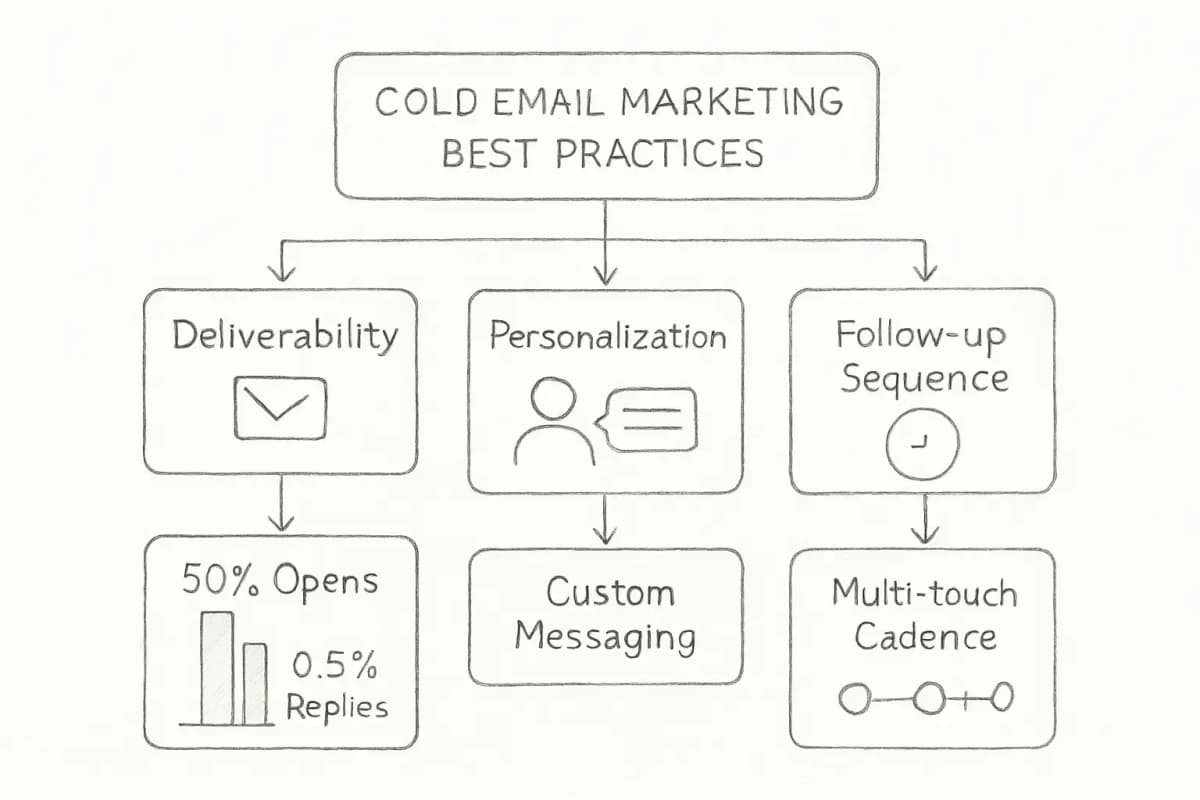
Track these consistently and use them to diagnose problems. A 50% open rate but 0.5% reply rate means your subject lines are good, but your message or call-to-action needs work.
Reply rates vary significantly by hook type, with timeline hooks achieving the highest performance (9.91 to 10.67%) across all industries. The timeline hook, structured around a compressed, week-by-week or milestone-based sequence of results, emerged as the strongest performer, achieving 10.01% average reply rate, 65.36% positive reply rate, and 2.34% meeting rate.
The problem hook, identifying a pain point and asking if the prospect faces it, achieved just 4.39% average reply rate and 0.69% meeting rate. Despite being the most common cold email opening, problem hooks are functionally the least effective at driving replies or meetings. Decision-makers receive dozens of emails daily, nearly all of which open with a variant of "Are you struggling with X?"
The takeaway: lead with outcomes and timelines ("here's what we accomplished in 60 days for a company like yours") rather than assumed pain points.
Emails referencing a warm connection achieve a 42% open rate, while case studies from known brands increase engagement by 26%. However, generic social proof like "We work with 500+ companies" underperforms compared to specific, detailed case studies.
7. Build a Follow-Up Sequence That Adds Value
Most replies do not come from the first email. Roughly 60% of replies in cold campaigns come after the first follow-up.
The 3-7-7 follow-up cadence, sending messages on Day 0, Day 3, Day 10, and Day 17, captures 93% of total replies by Day 10. Sending follow-ups beyond this point typically yields marginal or negative returns.
Each follow-up needs a new angle and new value. Do not send "just bumping this up." Follow-ups with new value outperform generic check-ins by about 30%.
Consider the "break-up" email as your final touchpoint. "Break-up" emails, a final message acknowledging you won't follow up again, generate a 33% response rate due to FOMO, according to HubSpot.
What to avoid: saying "I never heard back" can reduce meeting booking rates by 14%, according to Gong data. Keep follow-ups pressure-free.
8. Time Your Sends and Track the Right Metrics
Timing: Optimize send times by mapping campaigns to the recipient's local time zone. Tuesday through Thursday, 8 to 11 AM or 2 to 4 PM, consistently delivers the strongest engagement across 2025 to 2026 platform data.
Primary metric: Track reply rate, not open rate. Open rate spikes in 2022 to 2023 reflected Apple Mail Privacy Protection inflating tracking data, not genuine engagement. Reply rate is the more reliable trend indicator.
Treat reply rate as a lagging indicator; focus on positive-reply rate and meeting rate as the true drivers of sales pipeline impact. A 10% reply rate with 50% positive replies yields fewer meetings than a 5% reply rate with 70% positive replies.
Other metrics to monitor:
Bounce rate: Keep it below 2%
Spam complaint rate: Stay below 0.1% to protect inbox placement
Meeting rate: The clearest signal of campaign quality
Track these consistently and use them to diagnose problems. A 50% open rate but 0.5% reply rate means your subject lines are good, but your message or call-to-action needs work.
Instantly's Benchmark Report, analyzing billions of cold email interactions, puts the platform-wide average at 3.43%, with top performers exceeding 10%. B2B outbound sales teams confirm that a "good" reply rate today is anything above 5%, and hitting 10%+ is an excellent result in most industries.
How many follow-up emails should I send in a cold sequence?
Three to four follow-ups is the maximum for most cold sequences. After that, you risk hurting your sender reputation. Each follow-up should introduce a new angle or piece of value rather than repeating the original pitch.
How long should a cold email be?
Email length is one of the few cold email variables where the data is unambiguous. The optimal length is 50 to 125 words, with 75 to 100 words being the peak performer. Keep it to 3 to 5 sentences with one clear ask at the end.
Is cold email legal under GDPR and CAN-SPAM?
Cold emailing is not illegal as long as it complies with applicable laws like the CAN-SPAM Act, which regulates email marketing and cold email campaigns. Cold emailing in Europe is legal but must adhere to GDPR, which requires clear consent and transparency about how recipient data is handled. Cold emailing is not inherently against GDPR provided that emails comply with consent requirements, offer clear opt-out options, and respect privacy norms. Always include an easy unsubscribe option and honor opt-outs promptly.
Instantly's Benchmark Report, analyzing billions of cold email interactions, puts the platform-wide average at 3.43%, with top performers exceeding 10%. B2B outbound sales teams confirm that a "good" reply rate today is anything above 5%, and hitting 10%+ is an excellent result in most industries.
How many follow-up emails should I send in a cold sequence?
Three to four follow-ups is the maximum for most cold sequences. After that, you risk hurting your sender reputation. Each follow-up should introduce a new angle or piece of value rather than repeating the original pitch.
How long should a cold email be?
Email length is one of the few cold email variables where the data is unambiguous. The optimal length is 50 to 125 words, with 75 to 100 words being the peak performer. Keep it to 3 to 5 sentences with one clear ask at the end.
Is cold email legal under GDPR and CAN-SPAM?
Cold emailing is not illegal as long as it complies with applicable laws like the CAN-SPAM Act, which regulates email marketing and cold email campaigns. Cold emailing in Europe is legal but must adhere to GDPR, which requires clear consent and transparency about how recipient data is handled. Cold emailing is not inherently against GDPR provided that emails comply with consent requirements, offer clear opt-out options, and respect privacy norms. Always include an easy unsubscribe option and honor opt-outs promptly.