Email marketing is one of the highest-ROI channels available to ecommerce brands. It generates between $36 and $40 for every dollar spent, translating to a 3,600% to 4,000% return on investment and outperforming most other marketing channels by a significant margin. Yet many online stores never come close to those numbers. The gap between what email marketing can deliver and what most ecommerce brands actually get almost always comes down to a set of repeatable, fixable mistakes.
If your campaigns are underperforming, this guide covers the most damaging common mistakes in ecommerce email marketing, with the data to show you exactly how much each one is costing you.
Key Takeaways
Skipping list segmentation is one of the most costly mistakes. Segmented campaigns can drive up to a 760% increase in email revenue.
Neglecting abandoned cart sequences leaves recoverable revenue on the table. The global cart abandonment rate is 70.22%, and well-timed email sequences can recover a meaningful share of it.
Poor mobile optimization causes 50% of recipients to delete emails outright, according to Campaign Monitor.
Ignoring deliverability means roughly one in six emails your store sends never reaches the inbox.
Sending no welcome sequence at sign-up forfeits your highest-engagement window. Welcome emails generate 320% more revenue per email than standard promotional messages.
1. Sending the Same Email to Everyone
The simplest and most widespread mistake in ecommerce email marketing is treating your entire subscriber list as a single audience. Poor segmentation is one of the mistakes that consistently derails even the best email marketing efforts. Sending the same message to everyone means you're not speaking directly to anyone. Campaigns need to be tailored to customer behavior and interests, such as sending unique content to new customers versus repeat buyers.
Email marketing is one of the highest-ROI channels available to ecommerce brands. It generates between $36 and $40 for every dollar spent, translating to a 3,600% to 4,000% return on investment and outperforming most other marketing channels by a significant margin. Yet many online stores never come close to those numbers. The gap between what email marketing can deliver and what most ecommerce brands actually get almost always comes down to a set of repeatable, fixable mistakes.
If your campaigns are underperforming, this guide covers the most damaging common mistakes in ecommerce email marketing, with the data to show you exactly how much each one is costing you.
Key Takeaways
Skipping list segmentation is one of the most costly mistakes. Segmented campaigns can drive up to a 760% increase in email revenue.
Neglecting abandoned cart sequences leaves recoverable revenue on the table. The global cart abandonment rate is 70.22%, and well-timed email sequences can recover a meaningful share of it.
Poor mobile optimization causes 50% of recipients to delete emails outright, according to Campaign Monitor.
Ignoring deliverability means roughly one in six emails your store sends never reaches the inbox.
Sending no welcome sequence at sign-up forfeits your highest-engagement window. Welcome emails generate 320% more revenue per email than standard promotional messages.
1. Sending the Same Email to Everyone
The simplest and most widespread mistake in ecommerce email marketing is treating your entire subscriber list as a single audience. Poor segmentation is one of the mistakes that consistently derails even the best email marketing efforts. Sending the same message to everyone means you're not speaking directly to anyone. Campaigns need to be tailored to customer behavior and interests, such as sending unique content to new customers versus repeat buyers.
The cost is quantifiable. Using segmented email campaigns can lead to a 760% increase in revenue, as segmented campaigns significantly boost engagement, conversions, and overall revenue by addressing specific audience needs and preferences.
Despite this, the practice remains common. Just 31% of businesses use basic segmentation to send out emails.
For an ecommerce store, the starting point is behavioral segmentation: first-time buyers, repeat customers, cart abandoners, and lapsed subscribers each warrant a distinct message. The way you segment your email list largely depends on your business type. An ecommerce brand can define segments like first-time shoppers, repeat buyers, and VIP customers, while SaaS businesses need to divide users by engagement levels, job titles, and subscription plans.
Fix it: Build at minimum four core segments based on purchase history and engagement recency. Use behavioral triggers rather than calendar-based sends wherever possible. See our guide on email list segmentation strategies for a full implementation framework.
2. Skipping the Welcome Sequence
A new subscriber is the most engaged they will ever be at the moment they join your list. Brands that fail to capitalize on this window with an automated welcome sequence leave a disproportionate amount of revenue unclaimed.
Skipping the welcome email is a critical oversight. Studies show that welcome emails generate 320% more revenue per email than other promotional emails, emphasizing their importance in a successful email strategy. Welcome emails achieve an average open rate of 83.6%, making them one of the highest-performing automated email types.
The mistake is often one of timing. One of the most frequent errors is waiting too long to send the first email. When a person signs up, their interest in your brand is at its peak. If you wait 24 hours to send a confirmation or welcome message, that initial engagement has likely cooled down.
A single welcome email is also a missed opportunity. A sequence of two to three emails covering your brand story, bestsellers, and a first-order incentive outperforms a single message significantly.
Fix it: Automate your first welcome email to send within five minutes of sign-up. Follow up at 24 hours and 72 hours with supporting content. Review our breakdown of welcome email sequence best practices for a proven structure.
3. Not Running Abandoned Cart Flows
Cart abandonment is the largest controllable revenue leak in ecommerce. The global average cart abandonment rate is 70.22%, meaning more than 7 out of 10 shoppers who add products to their cart still leave without completing their purchase. The collective cost of abandoned carts reaches $18 billion in lost sales each year.
The cost is quantifiable. Using segmented email campaigns can lead to a 760% increase in revenue, as segmented campaigns significantly boost engagement, conversions, and overall revenue by addressing specific audience needs and preferences.
Despite this, the practice remains common. Just 31% of businesses use basic segmentation to send out emails.
For an ecommerce store, the starting point is behavioral segmentation: first-time buyers, repeat customers, cart abandoners, and lapsed subscribers each warrant a distinct message. The way you segment your email list largely depends on your business type. An ecommerce brand can define segments like first-time shoppers, repeat buyers, and VIP customers, while SaaS businesses need to divide users by engagement levels, job titles, and subscription plans.
Fix it: Build at minimum four core segments based on purchase history and engagement recency. Use behavioral triggers rather than calendar-based sends wherever possible. See our guide on email list segmentation strategies for a full implementation framework.
2. Skipping the Welcome Sequence
A new subscriber is the most engaged they will ever be at the moment they join your list. Brands that fail to capitalize on this window with an automated welcome sequence leave a disproportionate amount of revenue unclaimed.
Skipping the welcome email is a critical oversight. Studies show that welcome emails generate 320% more revenue per email than other promotional emails, emphasizing their importance in a successful email strategy. Welcome emails achieve an average open rate of 83.6%, making them one of the highest-performing automated email types.
The mistake is often one of timing. One of the most frequent errors is waiting too long to send the first email. When a person signs up, their interest in your brand is at its peak. If you wait 24 hours to send a confirmation or welcome message, that initial engagement has likely cooled down.
A single welcome email is also a missed opportunity. A sequence of two to three emails covering your brand story, bestsellers, and a first-order incentive outperforms a single message significantly.
Fix it: Automate your first welcome email to send within five minutes of sign-up. Follow up at 24 hours and 72 hours with supporting content. Review our breakdown of welcome email sequence best practices for a proven structure.
3. Not Running Abandoned Cart Flows
Cart abandonment is the largest controllable revenue leak in ecommerce. The global average cart abandonment rate is 70.22%, meaning more than 7 out of 10 shoppers who add products to their cart still leave without completing their purchase. The collective cost of abandoned carts reaches $18 billion in lost sales each year.
Abandoned cart emails are purpose-built to recover this revenue, and they perform exceptionally well. Abandoned cart emails recover 3 to 5% of lost sales on average, achieving an open rate of 50.5%, a click rate of 6.25%, and a conversion rate of 3.33%, with top-performing brands reaching conversion rates of 7.69%.
The most common tactical mistake is sending a single email and stopping. The biggest mistake DTC brands make is sending one abandoned cart email and calling it done. Three-email sequences sent over 48 to 72 hours generated $24.9 million in revenue compared to $3.8 million for single emails, a 6.5x difference in revenue from simply adding two more emails to the flow.
Fix it: Build a minimum three-email abandoned cart sequence. Send the first within one hour of abandonment while purchase intent is highest, follow up at 24 hours, and close with a final nudge or incentive at 48 to 72 hours.
4. Neglecting Deliverability and List Hygiene
You can write a perfect email, but if it lands in spam or bounces, none of the rest of your work matters. 65% of email marketing professionals say email deliverability is becoming more difficult. In 2023, 86% of emails arrived in inboxes, 7% went to spam, and 7% went missing.
For ecommerce brands specifically, according to Validity's 2025 benchmark, only 83.5% of emails worldwide reach the inbox, meaning roughly one in six emails your store sends never gets seen.
The most common deliverability errors are:
Sending to stale or purchased lists. Sending to invalid, outdated, or purchased addresses inflates your bounce rate and signals poor list hygiene. Inbox providers use this as a trust indicator. A clean email list with verified, permission-based contacts is one of the most reliable ways to ensure deliverability.
Missing authentication. In 2024, Gmail and Yahoo announced stricter standards for bulk senders, enforcing SPF, DKIM, and at least some form of DMARC authentication. Authenticated emails are more likely to land in primary inboxes and win recipients' trust.
Keeping inactive subscribers. Sending emails to inactive contacts hurts your sender reputation and skews your campaign metrics. A high number of unopened emails lowers your deliverability, affecting inbox placement even for the people who genuinely want to receive your emails.
Fix it: Set up SPF, DKIM, and DMARC on your sending domain. Run a list cleaning every 90 days. Suppress subscribers who have not engaged in 120 days or run a re-engagement sequence before removing them. Keep your spam complaint rate below 0.1%, as Gmail and Yahoo set their threshold at 0.3% but penalization risk grows well before that point.
5. Ignoring Mobile Optimization
More than half of all email opens happen on mobile devices, and ecommerce brands that send desktop-first emails pay for it immediately. With over 55% of emails opened on mobile and 75% of users deleting non-optimized messages, mobile-first email design is now a non-negotiable driver of engagement, clicks, and ROI.
50% of email users worldwide delete emails that are not mobile-optimized. In ecommerce, where cart abandonment on mobile already runs higher than desktop, receiving a broken email only widens the gap.
Mobile optimization issues most damaging to ecommerce campaigns include:
Abandoned cart emails are purpose-built to recover this revenue, and they perform exceptionally well. Abandoned cart emails recover 3 to 5% of lost sales on average, achieving an open rate of 50.5%, a click rate of 6.25%, and a conversion rate of 3.33%, with top-performing brands reaching conversion rates of 7.69%.
The most common tactical mistake is sending a single email and stopping. The biggest mistake DTC brands make is sending one abandoned cart email and calling it done. Three-email sequences sent over 48 to 72 hours generated $24.9 million in revenue compared to $3.8 million for single emails, a 6.5x difference in revenue from simply adding two more emails to the flow.
Fix it: Build a minimum three-email abandoned cart sequence. Send the first within one hour of abandonment while purchase intent is highest, follow up at 24 hours, and close with a final nudge or incentive at 48 to 72 hours.
4. Neglecting Deliverability and List Hygiene
You can write a perfect email, but if it lands in spam or bounces, none of the rest of your work matters. 65% of email marketing professionals say email deliverability is becoming more difficult. In 2023, 86% of emails arrived in inboxes, 7% went to spam, and 7% went missing.
For ecommerce brands specifically, according to Validity's 2025 benchmark, only 83.5% of emails worldwide reach the inbox, meaning roughly one in six emails your store sends never gets seen.
The most common deliverability errors are:
Sending to stale or purchased lists. Sending to invalid, outdated, or purchased addresses inflates your bounce rate and signals poor list hygiene. Inbox providers use this as a trust indicator. A clean email list with verified, permission-based contacts is one of the most reliable ways to ensure deliverability.
Missing authentication. In 2024, Gmail and Yahoo announced stricter standards for bulk senders, enforcing SPF, DKIM, and at least some form of DMARC authentication. Authenticated emails are more likely to land in primary inboxes and win recipients' trust.
Keeping inactive subscribers. Sending emails to inactive contacts hurts your sender reputation and skews your campaign metrics. A high number of unopened emails lowers your deliverability, affecting inbox placement even for the people who genuinely want to receive your emails.
Fix it: Set up SPF, DKIM, and DMARC on your sending domain. Run a list cleaning every 90 days. Suppress subscribers who have not engaged in 120 days or run a re-engagement sequence before removing them. Keep your spam complaint rate below 0.1%, as Gmail and Yahoo set their threshold at 0.3% but penalization risk grows well before that point.
5. Ignoring Mobile Optimization
More than half of all email opens happen on mobile devices, and ecommerce brands that send desktop-first emails pay for it immediately. With over 55% of emails opened on mobile and 75% of users deleting non-optimized messages, mobile-first email design is now a non-negotiable driver of engagement, clicks, and ROI.
50% of email users worldwide delete emails that are not mobile-optimized. In ecommerce, where cart abandonment on mobile already runs higher than desktop, receiving a broken email only widens the gap.
Mobile optimization issues most damaging to ecommerce campaigns include:
Multi-column layouts that collapse poorly on small screens
Call-to-action buttons too small to tap reliably
Large image files that slow load times on mobile connections
Subject lines truncated below 40 characters
Businesses see a 15% increase in mobile clicks when creating a mobile-responsive email design.
Fix it: Design for single-column layouts by default. Use a minimum tap target size of 44px for CTA buttons. Test every campaign in at least two mobile email clients before sending. Keep subject lines under 45 characters so they display fully on most devices.
6. Weak Subject Lines That Kill Open Rates
Your subject line is the entire first impression for most subscribers. 47% of people open emails based on the subject line alone. An uninspired or misleading subject line does not just hurt open rates on that campaign; it trains subscribers to disengage from future messages too.
The most common subject line mistakes in ecommerce include:
Generic promotional copy with no specificity ("Big Sale This Week")
Clickbait language that misrepresents the email content
Over-reliance on discount framing that conditions subscribers to wait for deals
No personalization, despite data showing the impact it has
Personalized subject lines can increase open rates by 20 to 26%. 69% of users report an email as spam based solely on the subject line, so misleading copy does not just reduce opens, it actively damages your sender reputation.
Marketers who A/B test their emails often increase email ROI by 86% compared to those who never do, and subject lines are the highest-leverage element to test first.
Fix it: A/B test subject lines on every significant campaign. Write at least three variations before choosing one. Refer to email subject line best practices for tested formulas that reliably lift open rates.
7. Relying Only on Promotional Blasts and Ignoring Automation
Many ecommerce brands build their email program almost entirely around one-off promotional campaigns: a sale email, a new arrival email, a seasonal push. While these have their place, over-reliance on them leaves the highest-performing email types unused.
Open rates rose for the fifth consecutive year. Automations accounted for just 2% of email sends, but drove 30% of revenue, earning 16 times more per send than scheduled campaigns.
The three automation flows with the highest impact for ecommerce are:
Welcome sequence (set purchase intent while engagement is highest)
Abandoned cart flow (recover the 70% of shoppers who leave without buying)
Post-purchase sequence (build repeat purchase behavior and reduce churn)
E-commerce brands sending automated campaigns (welcome, cart recovery, post-purchase) see up to 30% more revenue per email compared to one-off promotional newsletters.
Multi-column layouts that collapse poorly on small screens
Call-to-action buttons too small to tap reliably
Large image files that slow load times on mobile connections
Subject lines truncated below 40 characters
Businesses see a 15% increase in mobile clicks when creating a mobile-responsive email design.
Fix it: Design for single-column layouts by default. Use a minimum tap target size of 44px for CTA buttons. Test every campaign in at least two mobile email clients before sending. Keep subject lines under 45 characters so they display fully on most devices.
6. Weak Subject Lines That Kill Open Rates
Your subject line is the entire first impression for most subscribers. 47% of people open emails based on the subject line alone. An uninspired or misleading subject line does not just hurt open rates on that campaign; it trains subscribers to disengage from future messages too.
The most common subject line mistakes in ecommerce include:
Generic promotional copy with no specificity ("Big Sale This Week")
Clickbait language that misrepresents the email content
Over-reliance on discount framing that conditions subscribers to wait for deals
No personalization, despite data showing the impact it has
Personalized subject lines can increase open rates by 20 to 26%. 69% of users report an email as spam based solely on the subject line, so misleading copy does not just reduce opens, it actively damages your sender reputation.
Marketers who A/B test their emails often increase email ROI by 86% compared to those who never do, and subject lines are the highest-leverage element to test first.
Fix it: A/B test subject lines on every significant campaign. Write at least three variations before choosing one. Refer to email subject line best practices for tested formulas that reliably lift open rates.
7. Relying Only on Promotional Blasts and Ignoring Automation
Many ecommerce brands build their email program almost entirely around one-off promotional campaigns: a sale email, a new arrival email, a seasonal push. While these have their place, over-reliance on them leaves the highest-performing email types unused.
Open rates rose for the fifth consecutive year. Automations accounted for just 2% of email sends, but drove 30% of revenue, earning 16 times more per send than scheduled campaigns.
The three automation flows with the highest impact for ecommerce are:
Welcome sequence (set purchase intent while engagement is highest)
Abandoned cart flow (recover the 70% of shoppers who leave without buying)
Post-purchase sequence (build repeat purchase behavior and reduce churn)
E-commerce brands sending automated campaigns (welcome, cart recovery, post-purchase) see up to 30% more revenue per email compared to one-off promotional newsletters.
Fix it: Before adding another promotional campaign to your calendar, audit whether your three core automation flows are live and optimized. Then layer in browse abandonment and win-back sequences. Promotional emails should supplement a working automation foundation, not substitute for one.
8. Failing to Measure the Right Metrics
Many ecommerce email teams track open rates and click-through rates but stop there. The problem is that these engagement metrics do not tell you whether email is actually driving revenue. Apple Mail Privacy Protection now affects roughly 50 to 60% of recorded email opens, inflating open rate data and making open rate a less reliable engagement metric. As a result, many marketers now rely more heavily on clicks, replies, and conversions when evaluating campaign performance.
The metrics that actually connect to ecommerce revenue:
Revenue per email (RPE): Total email-attributed revenue divided by emails delivered
Conversion rate: Percentage of recipients who complete a purchase
Revenue per recipient (RPR): Especially critical for abandoned cart and automation flows
List growth rate: Net subscriber growth after unsubscribes and bounces
Without tracking these numbers, you cannot identify which campaigns and segments are underperforming, and you cannot improve what you do not measure. Check out our email marketing analytics best practices guide for a complete measurement framework.
Fix it: Build a simple weekly dashboard tracking RPE, conversion rate, and list health alongside open and click rates. Review automation performance monthly and benchmark against your own historical data, not just industry averages.
How These Mistakes Connect
Fix it: Before adding another promotional campaign to your calendar, audit whether your three core automation flows are live and optimized. Then layer in browse abandonment and win-back sequences. Promotional emails should supplement a working automation foundation, not substitute for one.
8. Failing to Measure the Right Metrics
Many ecommerce email teams track open rates and click-through rates but stop there. The problem is that these engagement metrics do not tell you whether email is actually driving revenue. Apple Mail Privacy Protection now affects roughly 50 to 60% of recorded email opens, inflating open rate data and making open rate a less reliable engagement metric. As a result, many marketers now rely more heavily on clicks, replies, and conversions when evaluating campaign performance.
The metrics that actually connect to ecommerce revenue:
Revenue per email (RPE): Total email-attributed revenue divided by emails delivered
Conversion rate: Percentage of recipients who complete a purchase
Revenue per recipient (RPR): Especially critical for abandoned cart and automation flows
List growth rate: Net subscriber growth after unsubscribes and bounces
Without tracking these numbers, you cannot identify which campaigns and segments are underperforming, and you cannot improve what you do not measure. Check out our email marketing analytics best practices guide for a complete measurement framework.
Fix it: Build a simple weekly dashboard tracking RPE, conversion rate, and list health alongside open and click rates. Review automation performance monthly and benchmark against your own historical data, not just industry averages.
How These Mistakes Connect
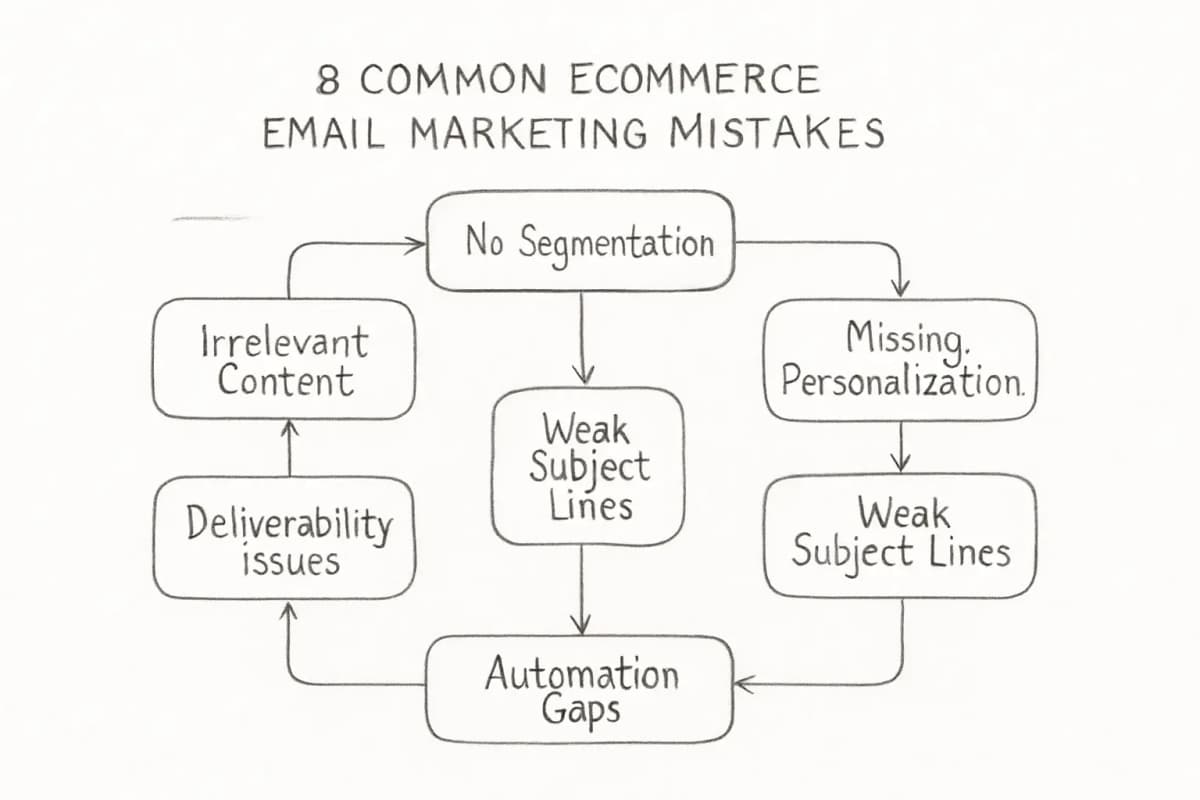
Most common mistakes in ecommerce email marketing compound each other. A brand with no segmentation sends the same promotional blast to its entire list. The irrelevant content drives up spam complaints and unsubscribes, which degrades deliverability. More emails miss the inbox. The ones that do arrive are not optimized for mobile, so half the recipients delete them. There is no welcome sequence to engage new subscribers and no abandoned cart flow to recover lost sales. And without proper analytics tracking, the brand never identifies any of this.
Each mistake you fix compounds your results in the opposite direction.
Frequently Asked Questions
What is the most common mistake in ecommerce email marketing?
The most common and costly mistake is not segmenting your list. Segmented campaigns generate 760% more revenue than non-segmented ones. Sending identical messages to every subscriber guarantees that large portions of your list receive irrelevant content, leading to lower engagement, higher unsubscribes, and suppressed revenue.
How often should ecommerce brands send marketing emails?
There is no universal answer, but 69% of people unsubscribe because of too many emails from one sender. Most ecommerce brands find one to three campaigns per week effective for engaged segments, with frequency decreasing for less-engaged subscribers. Monitor your unsubscribe and spam complaint rates as your primary signals for frequency calibration.
Does mobile optimization really matter that much for email marketing?
Yes. Over 50% of users delete an email if it is not optimized for mobile, and mobile email usage accounts for over 50% of all email opens in 2025. For ecommerce specifically, where purchase decisions happen on mobile at high rates, a broken mobile email does not just reduce clicks, it actively damages the customer relationship.
What is a good benchmark for abandoned cart email performance?
Abandoned cart emails recover 3 to 5% of lost sales on average, with an open rate of 50.5%, a click rate of 6.25%, and a conversion rate of 3.33% across Klaviyo's dataset. Top-performing brands reach conversion rates of 7.69%. If your abandoned cart sequence is performing below these benchmarks, test your send timing, subject line, and incentive structure before adding more emails to the sequence.
Most common mistakes in ecommerce email marketing compound each other. A brand with no segmentation sends the same promotional blast to its entire list. The irrelevant content drives up spam complaints and unsubscribes, which degrades deliverability. More emails miss the inbox. The ones that do arrive are not optimized for mobile, so half the recipients delete them. There is no welcome sequence to engage new subscribers and no abandoned cart flow to recover lost sales. And without proper analytics tracking, the brand never identifies any of this.
Each mistake you fix compounds your results in the opposite direction.
Frequently Asked Questions
What is the most common mistake in ecommerce email marketing?
The most common and costly mistake is not segmenting your list. Segmented campaigns generate 760% more revenue than non-segmented ones. Sending identical messages to every subscriber guarantees that large portions of your list receive irrelevant content, leading to lower engagement, higher unsubscribes, and suppressed revenue.
How often should ecommerce brands send marketing emails?
There is no universal answer, but 69% of people unsubscribe because of too many emails from one sender. Most ecommerce brands find one to three campaigns per week effective for engaged segments, with frequency decreasing for less-engaged subscribers. Monitor your unsubscribe and spam complaint rates as your primary signals for frequency calibration.
Does mobile optimization really matter that much for email marketing?
Yes. Over 50% of users delete an email if it is not optimized for mobile, and mobile email usage accounts for over 50% of all email opens in 2025. For ecommerce specifically, where purchase decisions happen on mobile at high rates, a broken mobile email does not just reduce clicks, it actively damages the customer relationship.
What is a good benchmark for abandoned cart email performance?
Abandoned cart emails recover 3 to 5% of lost sales on average, with an open rate of 50.5%, a click rate of 6.25%, and a conversion rate of 3.33% across Klaviyo's dataset. Top-performing brands reach conversion rates of 7.69%. If your abandoned cart sequence is performing below these benchmarks, test your send timing, subject line, and incentive structure before adding more emails to the sequence.