Ecommerce Email Marketing Tips: 8 Strategies for Higher ROI
Boost ecommerce sales with proven email marketing tips. Learn segmentation, automation, and conversion tactics that drive revenue for online retailers.
Ecommerce Email Marketing Tips: 8 Strategies for Higher ROI
Boost ecommerce sales with proven email marketing tips. Learn segmentation, automation, and conversion tactics that drive revenue for online retailers.
Email is the highest-ROI channel in ecommerce, and the gap between brands that treat it seriously and those that treat it as an afterthought is growing. The average email marketing ROI sits at $36 for every dollar spent, but retail, ecommerce, and consumer goods businesses do even better, reaching a $45 return per dollar. If your email program is generating anything less, the strategies below will show you where the revenue is being left on the table.
These ecommerce email marketing tips are grounded in current data, not theory. Whether you are running a Shopify store, managing a mid-market retail brand, or building a growth team's email strategy from scratch, each tip maps to a measurable outcome.
Key Takeaways
Automated emails drove 37% of all email-generated sales in 2024 despite accounting for just 2% of total email volume.
Segmented campaigns generate 760% more revenue than unsegmented campaigns, and personalized emails deliver 6x higher transaction rates than generic ones.
Abandoned cart flows drive the highest average revenue per recipient ($3.65) and the highest conversion rate (3.33%) of all automated flows.
50% of people will delete an email that is not optimized for mobile, making responsive design a revenue-critical decision, not a design preference.
A/B testing can increase your email marketing ROI by as much as 37%.
1. Build Automated Lifecycle Flows Before Anything Else
Most ecommerce brands spend the majority of their time on one-off campaign sends. That is the wrong order of priorities.
Omnisend's data for Q1 through Q3 2025 shows that automated emails generated nearly 40% of all email-attributed revenue while accounting for only 3% of total send volume. Automated flows produce 30x more revenue per recipient than one-off campaigns.
The core flows every ecommerce brand needs in place:
Welcome series: First impressions drive first purchases. Welcome emails achieve an 83.63% average open rate, making them the highest-performing automated email type and crucial for strong first impressions.
Abandoned cart flow: The single highest-revenue automation you can build (covered in detail below).
Email is the highest-ROI channel in ecommerce, and the gap between brands that treat it seriously and those that treat it as an afterthought is growing. The average email marketing ROI sits at $36 for every dollar spent, but retail, ecommerce, and consumer goods businesses do even better, reaching a $45 return per dollar. If your email program is generating anything less, the strategies below will show you where the revenue is being left on the table.
These ecommerce email marketing tips are grounded in current data, not theory. Whether you are running a Shopify store, managing a mid-market retail brand, or building a growth team's email strategy from scratch, each tip maps to a measurable outcome.
Key Takeaways
Automated emails drove 37% of all email-generated sales in 2024 despite accounting for just 2% of total email volume.
Segmented campaigns generate 760% more revenue than unsegmented campaigns, and personalized emails deliver 6x higher transaction rates than generic ones.
Abandoned cart flows drive the highest average revenue per recipient ($3.65) and the highest conversion rate (3.33%) of all automated flows.
50% of people will delete an email that is not optimized for mobile, making responsive design a revenue-critical decision, not a design preference.
A/B testing can increase your email marketing ROI by as much as 37%.
1. Build Automated Lifecycle Flows Before Anything Else
Most ecommerce brands spend the majority of their time on one-off campaign sends. That is the wrong order of priorities.
Omnisend's data for Q1 through Q3 2025 shows that automated emails generated nearly 40% of all email-attributed revenue while accounting for only 3% of total send volume. Automated flows produce 30x more revenue per recipient than one-off campaigns.
The core flows every ecommerce brand needs in place:
Welcome series: First impressions drive first purchases. Welcome emails achieve an 83.63% average open rate, making them the highest-performing automated email type and crucial for strong first impressions.
Abandoned cart flow: The single highest-revenue automation you can build (covered in detail below).
Post-purchase sequence: The post-purchase sequence is the highest-ROI underused flow in ecommerce, because it targets people who have already demonstrated the most important buying signal: they have paid you before. It serves three functions simultaneously: reducing buyer's remorse, encouraging repeat purchase, and generating reviews and social proof.
Win-back flow: Automated win-back emails see an average open rate of 42.51%, a click-through rate of 18.27%, and a conversion rate of 10.34%.
2. Recover Abandoned Carts with a Multi-Email Sequence
Cart abandonment is the most predictable revenue leak in ecommerce. According to Statista, the online shopping cart abandonment rate in 2024 is around 70%. That means roughly seven out of every ten shoppers who add something to their cart leave without buying.
The good news: abandoned cart emails work better than almost any other email type.
Abandoned cart emails achieve an average open rate of 50.5%, a click rate of 6.25%, and a conversion rate of 3.33%, with top-performing brands reaching conversion rates of 7.69%.
Sequence structure matters as much as the individual emails:
Klaviyo analysis revealed three-email sequences produced $24.9 million compared to just $3.8 million from single emails, a 6.5x revenue difference.
Timing for the sequence:
Email 1 (within 1 hour): A plain reminder showing the exact cart contents. No discount yet. Sending the first email within an hour of cart abandonment yields a 16% conversion rate.
Email 2 (24 hours later): Add social proof, reviews, or a low-friction incentive like free shipping.
Email 3 (48 to 72 hours later): A time-limited offer if the previous two emails did not convert.
The first emails sent within 30 to 60 minutes of cart abandonment are the most effective at recovering lost revenue.
3. Segment Your List by Behavior, Not Just Demographics
Demographic segmentation (age, location, gender) is a starting point, not a strategy. The retailers generating outsized returns are segmenting by purchase behavior, browsing history, lifecycle stage, and engagement level.
Segmented campaigns generate 760% more revenue, and personalized emails deliver 6x higher transaction rates than generic emails.
The most impactful segments for email marketing for ecommerce brands:
Post-purchase sequence: The post-purchase sequence is the highest-ROI underused flow in ecommerce, because it targets people who have already demonstrated the most important buying signal: they have paid you before. It serves three functions simultaneously: reducing buyer's remorse, encouraging repeat purchase, and generating reviews and social proof.
Win-back flow: Automated win-back emails see an average open rate of 42.51%, a click-through rate of 18.27%, and a conversion rate of 10.34%.
2. Recover Abandoned Carts with a Multi-Email Sequence
Cart abandonment is the most predictable revenue leak in ecommerce. According to Statista, the online shopping cart abandonment rate in 2024 is around 70%. That means roughly seven out of every ten shoppers who add something to their cart leave without buying.
The good news: abandoned cart emails work better than almost any other email type.
Abandoned cart emails achieve an average open rate of 50.5%, a click rate of 6.25%, and a conversion rate of 3.33%, with top-performing brands reaching conversion rates of 7.69%.
Sequence structure matters as much as the individual emails:
Klaviyo analysis revealed three-email sequences produced $24.9 million compared to just $3.8 million from single emails, a 6.5x revenue difference.
Timing for the sequence:
Email 1 (within 1 hour): A plain reminder showing the exact cart contents. No discount yet. Sending the first email within an hour of cart abandonment yields a 16% conversion rate.
Email 2 (24 hours later): Add social proof, reviews, or a low-friction incentive like free shipping.
Email 3 (48 to 72 hours later): A time-limited offer if the previous two emails did not convert.
The first emails sent within 30 to 60 minutes of cart abandonment are the most effective at recovering lost revenue.
3. Segment Your List by Behavior, Not Just Demographics
Demographic segmentation (age, location, gender) is a starting point, not a strategy. The retailers generating outsized returns are segmenting by purchase behavior, browsing history, lifecycle stage, and engagement level.
Segmented campaigns generate 760% more revenue, and personalized emails deliver 6x higher transaction rates than generic emails.
The most impactful segments for email marketing for ecommerce brands:
First-time buyers: Need reassurance and a reason to come back.
Repeat customers: Ready for cross-sells, loyalty incentives, and VIP treatment.
High-intent browsers: People who visited product pages without buying are close to converting.
Lapsed customers: Lifecycle segmentation groups customers by where they are in their journey: new subscriber, first-time buyer, repeat customer, VIP, and lapsed. Each stage has a distinct communication goal.
90% of marketers confirm that subscriber segmentation boosts performance, yet most ecommerce brands still send the same emails to their entire list.
Using a subscriber's first name is the floor, not the ceiling. True personalization in e-commerce email marketing means using behavioral data to deliver the right product, offer, and message at the right time.
Segmented and personalized emails generate 58% of all revenue. Personalized emails deliver six times higher transaction rates than non-personalized ones.
The personalization tactics that move revenue in ecommerce:
Product recommendations based on purchase history. Emails with personalized product recommendations see 29% higher unique open rates.
Dynamic content blocks that change based on segment. Dynamic content emails generate 18x more revenue than generic emails.
Personalized subject lines. Personalized subject lines alone increase open rates by 26%.
Behavioral triggers. Behavior-based emails generate roughly 3x higher engagement than scheduled campaigns, as they are triggered by specific user actions.
71% of consumers expect personalized interactions from brands, and 76% get frustrated when their brand interactions are not personalized. Personalization has shifted from a differentiator to a baseline expectation.
For a complete tactical breakdown, our article on email personalization techniques covers seven proven approaches with specific conversion data.
5. Write Subject Lines That Earn the Open
First-time buyers: Need reassurance and a reason to come back.
Repeat customers: Ready for cross-sells, loyalty incentives, and VIP treatment.
High-intent browsers: People who visited product pages without buying are close to converting.
Lapsed customers: Lifecycle segmentation groups customers by where they are in their journey: new subscriber, first-time buyer, repeat customer, VIP, and lapsed. Each stage has a distinct communication goal.
90% of marketers confirm that subscriber segmentation boosts performance, yet most ecommerce brands still send the same emails to their entire list.
Using a subscriber's first name is the floor, not the ceiling. True personalization in e-commerce email marketing means using behavioral data to deliver the right product, offer, and message at the right time.
Segmented and personalized emails generate 58% of all revenue. Personalized emails deliver six times higher transaction rates than non-personalized ones.
The personalization tactics that move revenue in ecommerce:
Product recommendations based on purchase history. Emails with personalized product recommendations see 29% higher unique open rates.
Dynamic content blocks that change based on segment. Dynamic content emails generate 18x more revenue than generic emails.
Personalized subject lines. Personalized subject lines alone increase open rates by 26%.
Behavioral triggers. Behavior-based emails generate roughly 3x higher engagement than scheduled campaigns, as they are triggered by specific user actions.
71% of consumers expect personalized interactions from brands, and 76% get frustrated when their brand interactions are not personalized. Personalization has shifted from a differentiator to a baseline expectation.
For a complete tactical breakdown, our article on email personalization techniques covers seven proven approaches with specific conversion data.
5. Write Subject Lines That Earn the Open
No open means no revenue. Your subject line is the single variable with the highest leverage on campaign performance, and it takes the least time to improve.
Email campaigns see the highest open rates shortly after sending: 21.2% of all email opens happen within the first hour. That means your subject line has to work immediately, in a crowded inbox, on a small screen.
What actually moves open rates:
Personalization. Personalized subject lines are 26% more likely to be opened.
Clarity over cleverness. Inboxes are not the place for puns that require explanation. State the value or the outcome directly.
Specificity. "Save 20% today only" outperforms "Big savings inside" because the reader knows exactly what they are getting.
Testing. A/B testing can increase email marketing ROI by as much as 37%. Subject lines should be the first thing you test in every campaign.
64% of emails are now opened on mobile devices globally. If your emails are not designed for a small screen, you are degrading the experience for the majority of your audience.
50% of people will delete an email if it is not optimized for mobile. That is not a preference issue; it is a revenue issue.
Mobile optimization checklist for email marketing for retailers:
Single-column layout that renders cleanly on any screen width
Minimum 16px font for body text, 22px for headlines
Tap-friendly CTA buttons (at least 44px tall)
Compressed images that load quickly on cellular connections
Preview text that extends your subject line instead of repeating it
Mobile-responsive email design can increase unique mobile clicks by 15%.
Statista reported that 79% of millennials and 57% of Gen Z members prefer being contacted by brands via email. Both groups are predominantly mobile users. If your emails do not render well on mobile, you are underperforming with your highest-LTV demographic.
7. Protect Your Deliverability as Aggressively as You Protect Your List
You can write the best email in your brand's history. If it lands in spam, it earns nothing. Deliverability is the infrastructure beneath every other ecommerce email marketing tip on this list.
1 in 6 marketing emails never reaches the inbox, getting filtered to spam or blocked outright.
The non-negotiable deliverability practices:
No open means no revenue. Your subject line is the single variable with the highest leverage on campaign performance, and it takes the least time to improve.
Email campaigns see the highest open rates shortly after sending: 21.2% of all email opens happen within the first hour. That means your subject line has to work immediately, in a crowded inbox, on a small screen.
What actually moves open rates:
Personalization. Personalized subject lines are 26% more likely to be opened.
Clarity over cleverness. Inboxes are not the place for puns that require explanation. State the value or the outcome directly.
Specificity. "Save 20% today only" outperforms "Big savings inside" because the reader knows exactly what they are getting.
Testing. A/B testing can increase email marketing ROI by as much as 37%. Subject lines should be the first thing you test in every campaign.
64% of emails are now opened on mobile devices globally. If your emails are not designed for a small screen, you are degrading the experience for the majority of your audience.
50% of people will delete an email if it is not optimized for mobile. That is not a preference issue; it is a revenue issue.
Mobile optimization checklist for email marketing for retailers:
Single-column layout that renders cleanly on any screen width
Minimum 16px font for body text, 22px for headlines
Tap-friendly CTA buttons (at least 44px tall)
Compressed images that load quickly on cellular connections
Preview text that extends your subject line instead of repeating it
Mobile-responsive email design can increase unique mobile clicks by 15%.
Statista reported that 79% of millennials and 57% of Gen Z members prefer being contacted by brands via email. Both groups are predominantly mobile users. If your emails do not render well on mobile, you are underperforming with your highest-LTV demographic.
7. Protect Your Deliverability as Aggressively as You Protect Your List
You can write the best email in your brand's history. If it lands in spam, it earns nothing. Deliverability is the infrastructure beneath every other ecommerce email marketing tip on this list.
1 in 6 marketing emails never reaches the inbox, getting filtered to spam or blocked outright.
The non-negotiable deliverability practices:
Authentication: Set up SPF, DKIM, and DMARC records on your sending domain. Google and Yahoo's 2024 sender requirements made DMARC configuration mandatory for bulk senders. Any business sending more than 5,000 emails per day to Gmail addresses without a valid DMARC record faces automatic routing to spam.
List hygiene: Remove unengaged subscribers on a regular cadence. Sending to large inactive segments trains inbox providers to deprioritize your domain.
Engagement-based suppression: Inbox providers use recipient engagement signals, including opens, clicks, replies, and spam moves, as the primary filter for inbox versus spam routing. Sending regularly to large segments of unengaged subscribers trains inbox providers to treat your emails as low-priority.
One-click unsubscribe: Offering an easy, single-click unsubscribe option is now non-negotiable for bulk senders.
8. Test Continuously and Track the Metrics That Connect to Revenue
Open rates are not the most useful metric for ecommerce. Open rates and click rates are incomplete signals, as security filters pre-scan emails and inflate click data by as much as 20 to 60%. These numbers can look healthy while revenue stays flat.
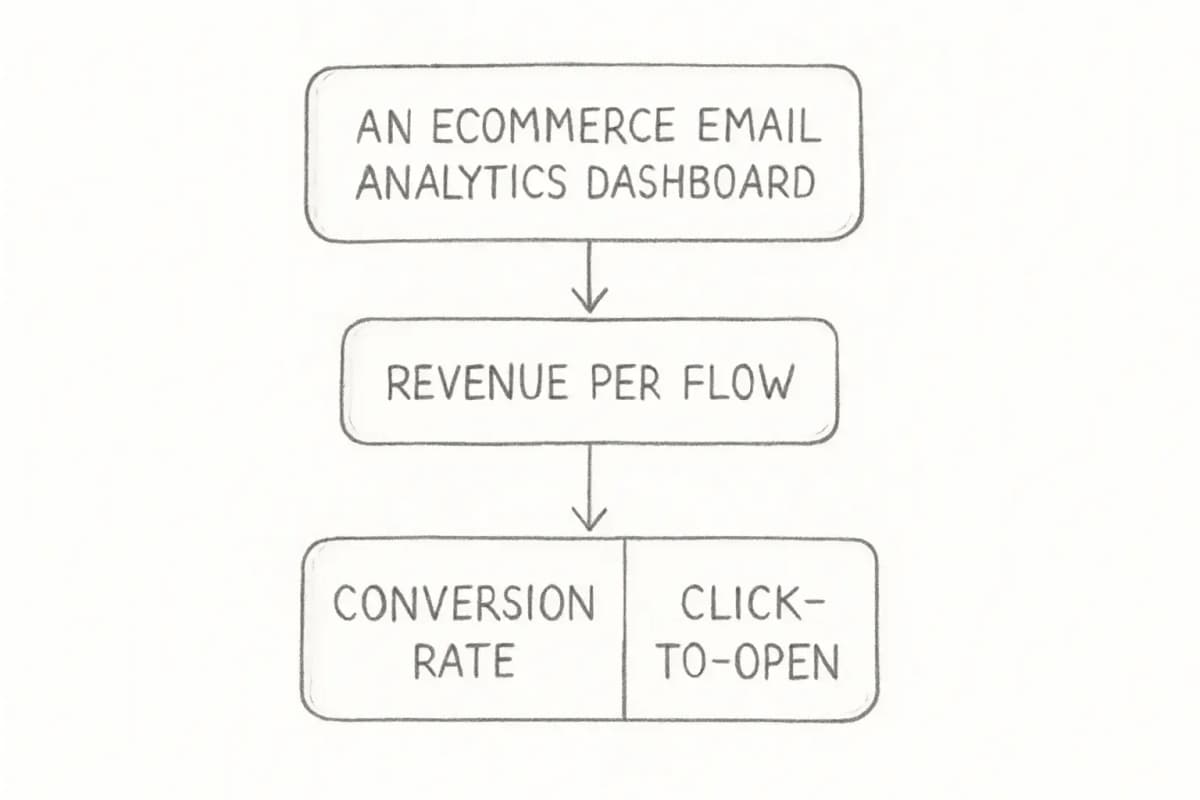
The metrics that matter for email marketing for ecommerce:
Revenue per email (RPE): The clearest signal of campaign value.
Conversion rate per flow: How many subscribers who entered a flow completed a purchase.
Revenue per segment: Which audience groups generate the most return per send.
Click-to-open rate (CTOR): Filters out privacy-protection noise and tells you whether the people who genuinely opened found the content compelling enough to act.
A/B testing increases email ROI by 37% compared to brands that never test. Test one variable at a time: subject line, send time, CTA copy, offer type, or email length. Run each test until you have statistical significance before applying the result to future sends.
Target mid-week sends: aim to send your most important emails Tuesday through Thursday for maximum engagement, with Tuesday having a slight advantage. Schedule emails to land in inboxes early in the morning, around 9 to 10 AM, to catch the first engagement wave of the day. Use these as starting points and validate them against your own list's behavior.
Frequently Asked Questions
What is a good ROI for ecommerce email marketing?
Authentication: Set up SPF, DKIM, and DMARC records on your sending domain. Google and Yahoo's 2024 sender requirements made DMARC configuration mandatory for bulk senders. Any business sending more than 5,000 emails per day to Gmail addresses without a valid DMARC record faces automatic routing to spam.
List hygiene: Remove unengaged subscribers on a regular cadence. Sending to large inactive segments trains inbox providers to deprioritize your domain.
Engagement-based suppression: Inbox providers use recipient engagement signals, including opens, clicks, replies, and spam moves, as the primary filter for inbox versus spam routing. Sending regularly to large segments of unengaged subscribers trains inbox providers to treat your emails as low-priority.
One-click unsubscribe: Offering an easy, single-click unsubscribe option is now non-negotiable for bulk senders.
8. Test Continuously and Track the Metrics That Connect to Revenue
Open rates are not the most useful metric for ecommerce. Open rates and click rates are incomplete signals, as security filters pre-scan emails and inflate click data by as much as 20 to 60%. These numbers can look healthy while revenue stays flat.
The metrics that matter for email marketing for ecommerce:
Revenue per email (RPE): The clearest signal of campaign value.
Conversion rate per flow: How many subscribers who entered a flow completed a purchase.
Revenue per segment: Which audience groups generate the most return per send.
Click-to-open rate (CTOR): Filters out privacy-protection noise and tells you whether the people who genuinely opened found the content compelling enough to act.
A/B testing increases email ROI by 37% compared to brands that never test. Test one variable at a time: subject line, send time, CTA copy, offer type, or email length. Run each test until you have statistical significance before applying the result to future sends.
Target mid-week sends: aim to send your most important emails Tuesday through Thursday for maximum engagement, with Tuesday having a slight advantage. Schedule emails to land in inboxes early in the morning, around 9 to 10 AM, to catch the first engagement wave of the day. Use these as starting points and validate them against your own list's behavior.
Frequently Asked Questions
What is a good ROI for ecommerce email marketing?
Ecommerce businesses get an average ROI of up to $45 per dollar spent on email marketing, which is higher than the cross-industry average. If your program is generating less than $20 per dollar, review your segmentation, automation coverage, and deliverability before increasing send volume.
How many emails should an ecommerce store send per week?
There is no universal answer, but the data provides useful guardrails. Email marketing newsletter click-through rates and open rates are highest for newsletters with a weekly cadence. The more important variable is relevance: behavioral and lifecycle emails can send more frequently than broadcast campaigns because they are triggered by what the subscriber actually did.
Which automated email flow generates the most revenue for ecommerce?
Abandoned cart flows make more money than any other automated flow. Klaviyo's product analytics team discovered this after analyzing over 143,000 abandoned cart flows. Welcome series and post-purchase sequences are the next highest contributors. Building all three before adding any other flows is the most efficient path to automated revenue growth.
How do I improve email open rates for my ecommerce store?
Focus on three areas: subject line quality, list segmentation, and deliverability. Open rates rose for the fifth consecutive year, increasing from 26.6% in 2024 to 30.7% in 2025, which means the category average is moving in the right direction. If your open rates are declining while industry benchmarks are rising, the problem is usually list hygiene or sender reputation, not content.
No comments yet. Be the first!
Ecommerce businesses get an average ROI of up to $45 per dollar spent on email marketing, which is higher than the cross-industry average. If your program is generating less than $20 per dollar, review your segmentation, automation coverage, and deliverability before increasing send volume.
How many emails should an ecommerce store send per week?
There is no universal answer, but the data provides useful guardrails. Email marketing newsletter click-through rates and open rates are highest for newsletters with a weekly cadence. The more important variable is relevance: behavioral and lifecycle emails can send more frequently than broadcast campaigns because they are triggered by what the subscriber actually did.
Which automated email flow generates the most revenue for ecommerce?
Abandoned cart flows make more money than any other automated flow. Klaviyo's product analytics team discovered this after analyzing over 143,000 abandoned cart flows. Welcome series and post-purchase sequences are the next highest contributors. Building all three before adding any other flows is the most efficient path to automated revenue growth.
How do I improve email open rates for my ecommerce store?
Focus on three areas: subject line quality, list segmentation, and deliverability. Open rates rose for the fifth consecutive year, increasing from 26.6% in 2024 to 30.7% in 2025, which means the category average is moving in the right direction. If your open rates are declining while industry benchmarks are rising, the problem is usually list hygiene or sender reputation, not content.