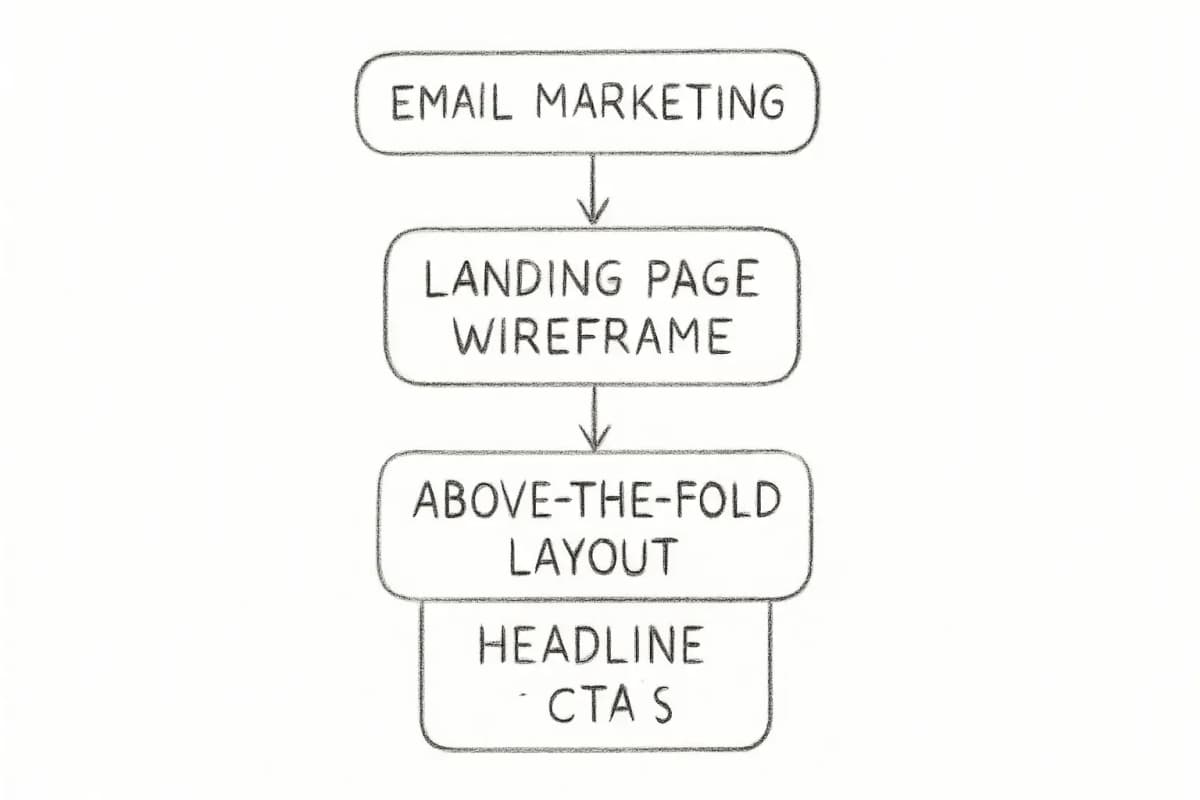
Your email click drives a subscriber straight to your email marketing landing page, and that moment is where most campaigns either convert or collapse. Getting the email right matters, but if the page it points to is mismatched, cluttered, or slow, the click means nothing.
The good news: email traffic is the highest-converting traffic source available. Visitors driven to landing pages by email have the highest average conversion rate at 19.3%, according to Unbounce's analysis of more than 57 million conversions across 41,000 pages. That number dwarfs paid search, social, and direct traffic. The challenge is building a page that actually captures it.
This guide covers exactly how to do that: what makes an email marketing landing page convert, how to design it, and which elements to test first.
Key Takeaways
Users who visit landing pages via email convert 77.06% more than visitors from paid search, making email the most valuable traffic source for landing page campaigns.
Landing pages written at a 5th to 7th grade level convert at 11.1%, more than 2x higher than professional-level writing, which converts at 5.3%.
Landing pages with 5 or fewer form fields convert 120% better than those with longer forms.
A 1-second delay in page load time can reduce landing page conversions by 7%, making speed a direct revenue lever.
A/B testing improves landing page conversions by 49% on average, yet only 44% of companies regularly test their landing pages.
What Is an Email Marketing Landing Page?
An email campaign landing page is a standalone page designed specifically for traffic coming from an email. Unlike a homepage or blog post, it is built to continue the message from the email and drive one specific action: purchase, register, download, or upgrade.
This distinction matters. Your homepage is designed for multiple audiences with multiple goals. An email marketing landing page serves one audience segment, coming from one email, with one goal. That focus is what makes it convert.
A compelling email grabs attention and drives traffic, while a focused landing page takes that momentum and converts it into action. They are not separate tactics. They are one system.
Your email click drives a subscriber straight to your email marketing landing page, and that moment is where most campaigns either convert or collapse. Getting the email right matters, but if the page it points to is mismatched, cluttered, or slow, the click means nothing.
The good news: email traffic is the highest-converting traffic source available. Visitors driven to landing pages by email have the highest average conversion rate at 19.3%, according to Unbounce's analysis of more than 57 million conversions across 41,000 pages. That number dwarfs paid search, social, and direct traffic. The challenge is building a page that actually captures it.
This guide covers exactly how to do that: what makes an email marketing landing page convert, how to design it, and which elements to test first.
Key Takeaways
Users who visit landing pages via email convert 77.06% more than visitors from paid search, making email the most valuable traffic source for landing page campaigns.
Landing pages written at a 5th to 7th grade level convert at 11.1%, more than 2x higher than professional-level writing, which converts at 5.3%.
Landing pages with 5 or fewer form fields convert 120% better than those with longer forms.
A 1-second delay in page load time can reduce landing page conversions by 7%, making speed a direct revenue lever.
A/B testing improves landing page conversions by 49% on average, yet only 44% of companies regularly test their landing pages.
What Is an Email Marketing Landing Page?
An email campaign landing page is a standalone page designed specifically for traffic coming from an email. Unlike a homepage or blog post, it is built to continue the message from the email and drive one specific action: purchase, register, download, or upgrade.
This distinction matters. Your homepage is designed for multiple audiences with multiple goals. An email marketing landing page serves one audience segment, coming from one email, with one goal. That focus is what makes it convert.
A compelling email grabs attention and drives traffic, while a focused landing page takes that momentum and converts it into action. They are not separate tactics. They are one system.
Email is an effective way to drive qualified traffic to key landing pages because emails get delivered to people who are already familiar with your brand and have raised their hands to say they want to hear from you. That prior relationship is your conversion advantage, and the landing page needs to honor it.
The Message Match Principle: Why Most Pages Fail
The most common reason a high-click-rate email produces a low-converting page is message mismatch. When writing and designing emails and landing pages, consistency is key. It can be confusing and jarring to go from a promotional email to a landing page that looks completely different or seems to be about an unrelated topic.
Message match means the headline, offer, visuals, and tone on your landing page directly reflect what was promised in the email. If your email promotes a free audit, the landing page headline should say "Get Your Free Audit," not "Grow Your Business."
When the message in your email mirrors the landing page, including the same offer, visuals, and tone, the user experience feels natural and trustworthy. Trust is the conversion driver that no design trick can replace.
Segmented campaigns make this easier. If you're already using email list segmentation strategies, pair each segment with its own dedicated landing page. The more relevant the page feels to the reader, the higher it converts.
6 Design Principles That Drive Conversions
1. Write a Headline That Earns the Click
A landing page headline communicates clear, concise value. With the average visitor bouncing off within seconds of arriving, your headline's chief objective is to convince people that staying is worth their time.
Keep it specific. Vague headlines like "Transform Your Business" do not give visitors a reason to stay. "Get 30 More Leads Per Month Using Email Automation" tells them exactly what they are signing up for.
With 94% of first impressions being influenced by design, it is crucial that your landing pages are crafted to be user-friendly and help guide and engage the reader without being overly complex.
2. Simplify Your Copy
Reading level correlates directly with conversion rate. Lower reading difficulty is correlated with more conversions. Landing pages with copy at a fifth-to-seventh grade reading level have an 11.1% median conversion rate, whereas pages with copy at a college reading level have a 5.3% median conversion rate.
Write shorter sentences. Use common words. Cut adjectives that do not inform. Pages with concise, minimal text and clear CTAs convert 34% better than text-heavy pages, as visitors prefer skimming content.
3. Use One CTA (and Make It Specific)
Email is an effective way to drive qualified traffic to key landing pages because emails get delivered to people who are already familiar with your brand and have raised their hands to say they want to hear from you. That prior relationship is your conversion advantage, and the landing page needs to honor it.
The Message Match Principle: Why Most Pages Fail
The most common reason a high-click-rate email produces a low-converting page is message mismatch. When writing and designing emails and landing pages, consistency is key. It can be confusing and jarring to go from a promotional email to a landing page that looks completely different or seems to be about an unrelated topic.
Message match means the headline, offer, visuals, and tone on your landing page directly reflect what was promised in the email. If your email promotes a free audit, the landing page headline should say "Get Your Free Audit," not "Grow Your Business."
When the message in your email mirrors the landing page, including the same offer, visuals, and tone, the user experience feels natural and trustworthy. Trust is the conversion driver that no design trick can replace.
Segmented campaigns make this easier. If you're already using email list segmentation strategies, pair each segment with its own dedicated landing page. The more relevant the page feels to the reader, the higher it converts.
6 Design Principles That Drive Conversions
1. Write a Headline That Earns the Click
A landing page headline communicates clear, concise value. With the average visitor bouncing off within seconds of arriving, your headline's chief objective is to convince people that staying is worth their time.
Keep it specific. Vague headlines like "Transform Your Business" do not give visitors a reason to stay. "Get 30 More Leads Per Month Using Email Automation" tells them exactly what they are signing up for.
With 94% of first impressions being influenced by design, it is crucial that your landing pages are crafted to be user-friendly and help guide and engage the reader without being overly complex.
2. Simplify Your Copy
Reading level correlates directly with conversion rate. Lower reading difficulty is correlated with more conversions. Landing pages with copy at a fifth-to-seventh grade reading level have an 11.1% median conversion rate, whereas pages with copy at a college reading level have a 5.3% median conversion rate.
Write shorter sentences. Use common words. Cut adjectives that do not inform. Pages with concise, minimal text and clear CTAs convert 34% better than text-heavy pages, as visitors prefer skimming content.
3. Use One CTA (and Make It Specific)
When you craft your email landing page, use only one CTA. If you have more than one CTA, you risk confusing your audience or leaving them with decision paralysis. Having one CTA button is best for promoting conversions.
The button text matters too. Use active, benefit-driven button text. "Get My Guide" or "Send Me the Checklist" beats "Submit" every time.
4. Reduce Form Friction
Forms are where conversions die. Landing pages with 5 or fewer form fields convert 120% better. Each additional field beyond 5 represents a 20-30% conversion penalty.
For most campaigns, name and email is enough. Reducing form fields from 11 to 4 increases conversions by 160%. Each eliminated field removes a decision point and reduces perceived effort.
5. Add Social Proof
92% of consumers read testimonials when considering purchases. This behavior transcends demographics, making testimonials essential rather than optional.
Place testimonials, review ratings, or trust badges near your CTA, not in the footer. Visitors are unlikely to share their personal information or make a purchase without proof that the business delivers what it promises. It is psychological to look for results and reviews from peers before investing time and money.
6. Use Visuals Strategically
Landing pages offer a world of possibility, from video to oversized graphics. Customers are 80% more likely to read marketing content when it is interspersed with colorful graphics.
However, visuals must not slow the page down. Bounce rates decrease 32% when load time drops from 3 to 1 second, so prioritize speed and simplicity over elaborate design.
Page Speed: The Conversion Factor Most Teams Ignore
Speed is a design element, not a technical afterthought. Just a 1-second delay in page load time can reduce landing page conversions by 7%, emphasizing the importance of speed.
Landing pages that load in under 2 seconds enjoy a 30% higher conversion rate compared to slower pages, where visitors tend to bounce.
Mobile compounds this problem. 53% of mobile users will abandon a page if it takes more than 3 seconds to load, reflecting the critical need for fast, mobile-friendly landing pages. Since most subscribers open email on mobile, a slow page erases your entire campaign effort before it starts.
To improve speed: compress images, eliminate unnecessary scripts, use a CDN, and defer non-critical JavaScript. These are not glamorous changes, but they have a measurable and direct effect on conversion rate.
Segmentation and Personalization: The Next Level
Generic landing pages leave conversion on the table. The email marketing landing page should speak directly to the targeted audience segment. Generic messaging dilutes the efforts put into driving the niche audience from the email to the page.
The fix is pairing each email segment with a dedicated landing page. Segmented emails can even lead to unique landing pages designed for each audience, ensuring relevance at every step.
When you craft your email landing page, use only one CTA. If you have more than one CTA, you risk confusing your audience or leaving them with decision paralysis. Having one CTA button is best for promoting conversions.
The button text matters too. Use active, benefit-driven button text. "Get My Guide" or "Send Me the Checklist" beats "Submit" every time.
4. Reduce Form Friction
Forms are where conversions die. Landing pages with 5 or fewer form fields convert 120% better. Each additional field beyond 5 represents a 20-30% conversion penalty.
For most campaigns, name and email is enough. Reducing form fields from 11 to 4 increases conversions by 160%. Each eliminated field removes a decision point and reduces perceived effort.
5. Add Social Proof
92% of consumers read testimonials when considering purchases. This behavior transcends demographics, making testimonials essential rather than optional.
Place testimonials, review ratings, or trust badges near your CTA, not in the footer. Visitors are unlikely to share their personal information or make a purchase without proof that the business delivers what it promises. It is psychological to look for results and reviews from peers before investing time and money.
6. Use Visuals Strategically
Landing pages offer a world of possibility, from video to oversized graphics. Customers are 80% more likely to read marketing content when it is interspersed with colorful graphics.
However, visuals must not slow the page down. Bounce rates decrease 32% when load time drops from 3 to 1 second, so prioritize speed and simplicity over elaborate design.
Page Speed: The Conversion Factor Most Teams Ignore
Speed is a design element, not a technical afterthought. Just a 1-second delay in page load time can reduce landing page conversions by 7%, emphasizing the importance of speed.
Landing pages that load in under 2 seconds enjoy a 30% higher conversion rate compared to slower pages, where visitors tend to bounce.
Mobile compounds this problem. 53% of mobile users will abandon a page if it takes more than 3 seconds to load, reflecting the critical need for fast, mobile-friendly landing pages. Since most subscribers open email on mobile, a slow page erases your entire campaign effort before it starts.
To improve speed: compress images, eliminate unnecessary scripts, use a CDN, and defer non-critical JavaScript. These are not glamorous changes, but they have a measurable and direct effect on conversion rate.
Segmentation and Personalization: The Next Level
Generic landing pages leave conversion on the table. The email marketing landing page should speak directly to the targeted audience segment. Generic messaging dilutes the efforts put into driving the niche audience from the email to the page.
The fix is pairing each email segment with a dedicated landing page. Segmented emails can even lead to unique landing pages designed for each audience, ensuring relevance at every step.
Personalization goes further. Research from Salesforce found that 99% of marketers planned to maintain or increase their personalization budget. But while 95% are personalizing emails, only 50% are personalizing the website. Just like emails, landing pages can also be personalized.
Personalized CTAs are especially effective. Personalized CTAs based on user data, location, or behavior convert 202% better than static, one-size-fits-all buttons.
If you want to go deeper on personalization within the email itself, the guide on email personalization techniques that boost conversions covers several approaches that translate directly to landing page strategy.
How to A/B Test Your Email Landing Page
Testing and targeting can increase landing page conversion rates by up to 300%. Despite this, most teams do not test consistently.
Start with the elements that most directly affect behavior: headline, CTA text, hero image, and form length. Test one variable at a time. Wait for statistical significance before drawing conclusions.
Together, email and landing pages provide valuable data for optimization. You can A/B test landing page headlines, track click-through rates, adjust CTAs, monitor subject line performance, and refine your email sequencing based on results. Over time, this feedback loop improves both channels and compounds ROI.
Use UTM parameters on every email link so you can track which emails, subject lines, and segments drive the most landing page conversions. For a closer look at the metrics side of this, see email marketing analytics best practices.
One practical test: run two versions of your CTA button text against each other. Keep everything else the same. Even small wording changes can produce measurable differences in conversion rate. Start simple, build a testing habit, and compound the gains over time.
Frequently Asked Questions
What is the average conversion rate for an email marketing landing page?
The average conversion rate for a landing page is around 6.6% across all industries as of Q4 2024. However, email traffic converts significantly above this baseline. Top performers in optimal conditions reach 15 to 20%, particularly with warm email traffic or highly targeted campaigns.
How many form fields should an email landing page have?
Landing pages with 5 or fewer form fields convert 120% better. For most lead generation campaigns, asking for a name and email address is sufficient. Only request additional fields when you have a specific reason and the value of the offer justifies the friction.
Should my landing page match my email design?
Yes. Consistency between email and landing page is one of the strongest conversion levers available. Email campaigns help set the tone and user expectations, while landing pages reinforce your brand's value proposition and encourage users to take action. Mismatched design or messaging creates doubt and increases bounce rate.
How do I track landing page performance from email campaigns?
Personalization goes further. Research from Salesforce found that 99% of marketers planned to maintain or increase their personalization budget. But while 95% are personalizing emails, only 50% are personalizing the website. Just like emails, landing pages can also be personalized.
Personalized CTAs are especially effective. Personalized CTAs based on user data, location, or behavior convert 202% better than static, one-size-fits-all buttons.
If you want to go deeper on personalization within the email itself, the guide on email personalization techniques that boost conversions covers several approaches that translate directly to landing page strategy.
How to A/B Test Your Email Landing Page
Testing and targeting can increase landing page conversion rates by up to 300%. Despite this, most teams do not test consistently.
Start with the elements that most directly affect behavior: headline, CTA text, hero image, and form length. Test one variable at a time. Wait for statistical significance before drawing conclusions.
Together, email and landing pages provide valuable data for optimization. You can A/B test landing page headlines, track click-through rates, adjust CTAs, monitor subject line performance, and refine your email sequencing based on results. Over time, this feedback loop improves both channels and compounds ROI.
Use UTM parameters on every email link so you can track which emails, subject lines, and segments drive the most landing page conversions. For a closer look at the metrics side of this, see email marketing analytics best practices.
One practical test: run two versions of your CTA button text against each other. Keep everything else the same. Even small wording changes can produce measurable differences in conversion rate. Start simple, build a testing habit, and compound the gains over time.
Frequently Asked Questions
What is the average conversion rate for an email marketing landing page?
The average conversion rate for a landing page is around 6.6% across all industries as of Q4 2024. However, email traffic converts significantly above this baseline. Top performers in optimal conditions reach 15 to 20%, particularly with warm email traffic or highly targeted campaigns.
How many form fields should an email landing page have?
Landing pages with 5 or fewer form fields convert 120% better. For most lead generation campaigns, asking for a name and email address is sufficient. Only request additional fields when you have a specific reason and the value of the offer justifies the friction.
Should my landing page match my email design?
Yes. Consistency between email and landing page is one of the strongest conversion levers available. Email campaigns help set the tone and user expectations, while landing pages reinforce your brand's value proposition and encourage users to take action. Mismatched design or messaging creates doubt and increases bounce rate.
How do I track landing page performance from email campaigns?
Add UTM parameters to your link to track performance inside tools like Google Analytics or your ESP's built-in analytics. If you are segmenting your list, create unique landing pages or custom content blocks for each segment to personalize the experience. Use conversion tracking through Google Tag Manager or your ESP's built-in metrics to see which emails and landing pages are performing best.
No comments yet. Be the first!
Add UTM parameters to your link to track performance inside tools like Google Analytics or your ESP's built-in analytics. If you are segmenting your list, create unique landing pages or custom content blocks for each segment to personalize the experience. Use conversion tracking through Google Tag Manager or your ESP's built-in metrics to see which emails and landing pages are performing best.