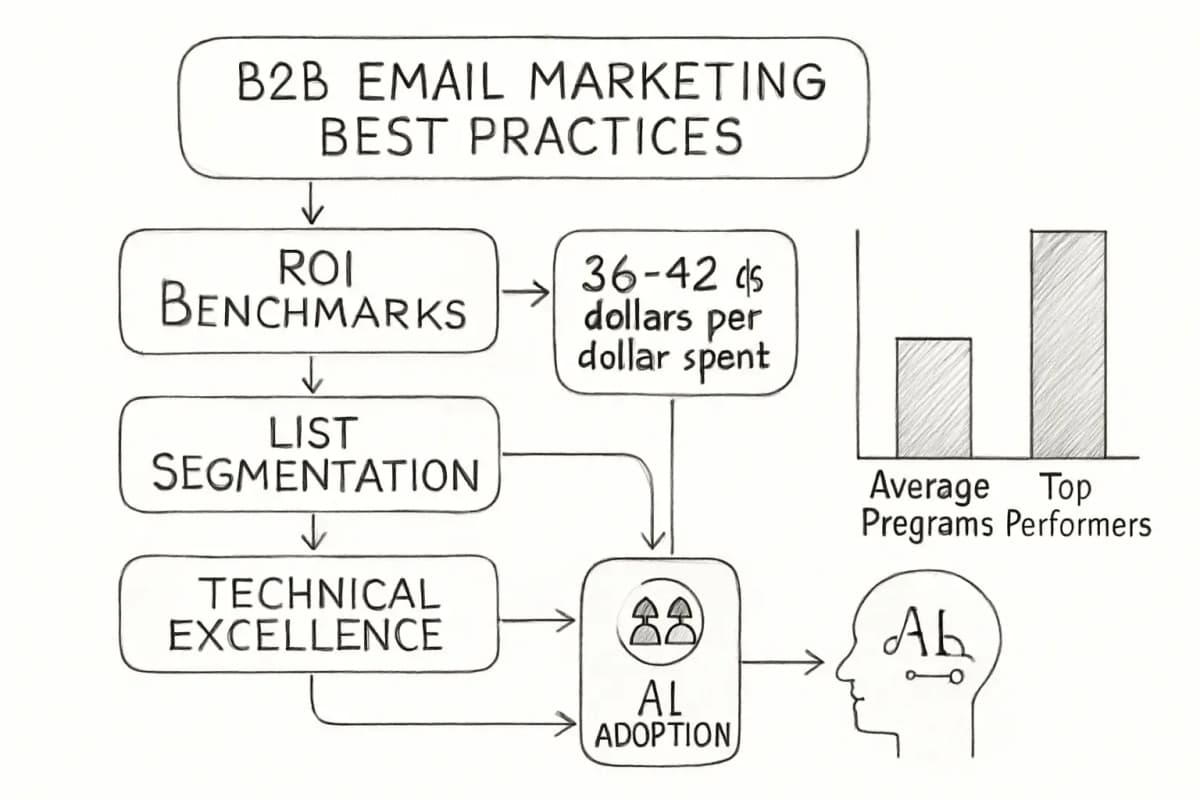
B2B email marketing remains the highest-ROI channel available to most marketing teams, but the gap between average and top-performing programs is widening. Success increasingly depends on technical excellence, strategic sophistication, and AI adoption. Organizations treating email as a precision instrument rather than a broadcast medium will capture disproportionate returns. If your current campaigns feel like they're underperforming, these evidence-backed email marketing best practices for B2B will show you exactly where to focus.
Key Takeaways
59% of B2B marketers rate email as their most effective channel for revenue prospecting.
B2B marketing emails see an average open rate of 15.14% and a click rate of 3.18%, which outpaces B2C click rates of 2.09%.
Segmented email campaigns can generate up to 760% more revenue than non-segmented blasts.
Automated emails drove 37% of all email-generated sales in 2024, despite representing just 2% of total email volume.
Skipping SPF, DKIM, and DMARC authentication means your domain can be flagged under new 2024-2025 bulk sender rules, sending even good campaigns straight to spam.
1. Understand What Makes B2B Email Different
B2B email does not work like B2C. The buying cycle is longer, the decision-making unit is larger, and the content expectations are higher.
60% of the B2B buyer's journey happens before a prospect ever talks to a sales rep. Email sequences give you a way to engage prospects throughout that journey in an automated, scalable way.
On won deals, customer journeys take an average of 218 days from the first email click to close. This reiterates the longevity of B2B customer journeys and how email marketing campaigns need to be tailored toward that reality. Expecting a deal to close as a result of a first email is unrealistic; they form part of a multi-touch, multi-channel journey.
This means your email program needs to be built for sustained nurture, not single-touch conversion. Every campaign should move a prospect one step forward, not push them to buy immediately.
2. Nail List Segmentation Before Anything Else
Segmentation is the foundation every other email marketing best practice for B2B rests on. Without it, personalization is guesswork and automation is noise.
B2B email marketing remains the highest-ROI channel available to most marketing teams, but the gap between average and top-performing programs is widening. Success increasingly depends on technical excellence, strategic sophistication, and AI adoption. Organizations treating email as a precision instrument rather than a broadcast medium will capture disproportionate returns. If your current campaigns feel like they're underperforming, these evidence-backed email marketing best practices for B2B will show you exactly where to focus.
Key Takeaways
59% of B2B marketers rate email as their most effective channel for revenue prospecting.
B2B marketing emails see an average open rate of 15.14% and a click rate of 3.18%, which outpaces B2C click rates of 2.09%.
Segmented email campaigns can generate up to 760% more revenue than non-segmented blasts.
Automated emails drove 37% of all email-generated sales in 2024, despite representing just 2% of total email volume.
Skipping SPF, DKIM, and DMARC authentication means your domain can be flagged under new 2024-2025 bulk sender rules, sending even good campaigns straight to spam.
1. Understand What Makes B2B Email Different
B2B email does not work like B2C. The buying cycle is longer, the decision-making unit is larger, and the content expectations are higher.
60% of the B2B buyer's journey happens before a prospect ever talks to a sales rep. Email sequences give you a way to engage prospects throughout that journey in an automated, scalable way.
On won deals, customer journeys take an average of 218 days from the first email click to close. This reiterates the longevity of B2B customer journeys and how email marketing campaigns need to be tailored toward that reality. Expecting a deal to close as a result of a first email is unrealistic; they form part of a multi-touch, multi-channel journey.
This means your email program needs to be built for sustained nurture, not single-touch conversion. Every campaign should move a prospect one step forward, not push them to buy immediately.
2. Nail List Segmentation Before Anything Else
Segmentation is the foundation every other email marketing best practice for B2B rests on. Without it, personalization is guesswork and automation is noise.
The four main types of B2B email segmentation are demographic, behavioral, firmographic, and psychographic. In practice, the most effective B2B programs layer multiple segment types together.
Segment by industry, role, company size, or trigger events and write specific hooks and value propositions for each segment. Smaller, highly targeted sends consistently produce more meetings and fewer complaints.
The revenue impact is significant. Strategic Vantage reports that marketers who use segmented campaigns note as much as a 760% increase in revenue. By stripping away irrelevant offers, you reduce the friction between the prospect and conversion.
Past content engagement (webinar attendees, whitepaper downloads)
Account-based marketing (ABM) tier
3. Personalize Beyond First Name
B2B personalization goes far beyond inserting first names in subject lines. Effective personalization demonstrates genuine understanding of the recipient's business context and challenges.
According to McKinsey research, personalized B2B experiences, including email, deliver 40% more revenue than non-personalized approaches.
Subject line personalization is a good starting point. Emails with personalized subject lines are 26% more likely to be opened. But real B2B personalization extends into the body: referencing the recipient's industry challenges, mentioning their company size or tech stack, and connecting your offer to a specific pain point they are actively experiencing.
Using personalization in an email may lead to a 28.57% increase in click-throughs, with tailored content generating a 2.7% click rate versus 2.1% without it.
Sophisticated B2B email programs implement preference centers allowing subscribers to select topics of interest, choose communication frequency, and specify preferred content formats. These options significantly reduce unsubscribes by giving recipients control over their experience while providing valuable segmentation data.
Our post on email personalization techniques that boost conversions covers seven advanced tactics you can implement immediately.
4. Build Automated Nurture Sequences
Automation is where B2B email programs generate outsized returns with minimal ongoing effort.
The four main types of B2B email segmentation are demographic, behavioral, firmographic, and psychographic. In practice, the most effective B2B programs layer multiple segment types together.
Segment by industry, role, company size, or trigger events and write specific hooks and value propositions for each segment. Smaller, highly targeted sends consistently produce more meetings and fewer complaints.
The revenue impact is significant. Strategic Vantage reports that marketers who use segmented campaigns note as much as a 760% increase in revenue. By stripping away irrelevant offers, you reduce the friction between the prospect and conversion.
Past content engagement (webinar attendees, whitepaper downloads)
Account-based marketing (ABM) tier
3. Personalize Beyond First Name
B2B personalization goes far beyond inserting first names in subject lines. Effective personalization demonstrates genuine understanding of the recipient's business context and challenges.
According to McKinsey research, personalized B2B experiences, including email, deliver 40% more revenue than non-personalized approaches.
Subject line personalization is a good starting point. Emails with personalized subject lines are 26% more likely to be opened. But real B2B personalization extends into the body: referencing the recipient's industry challenges, mentioning their company size or tech stack, and connecting your offer to a specific pain point they are actively experiencing.
Using personalization in an email may lead to a 28.57% increase in click-throughs, with tailored content generating a 2.7% click rate versus 2.1% without it.
Sophisticated B2B email programs implement preference centers allowing subscribers to select topics of interest, choose communication frequency, and specify preferred content formats. These options significantly reduce unsubscribes by giving recipients control over their experience while providing valuable segmentation data.
Our post on email personalization techniques that boost conversions covers seven advanced tactics you can implement immediately.
4. Build Automated Nurture Sequences
Automation is where B2B email programs generate outsized returns with minimal ongoing effort.
Automated workflows generate 30x higher returns compared to one-off email campaigns. That number alone justifies the investment in building proper sequences.
Automated email sequences are highly effective for B2B lead nurturing. B2B nurture sequences typically run longer, with 4-8 emails over 2-6 weeks, because B2B sales cycles are longer. Focus on educational content, case studies, and industry insights.
Nurture sequences bridge the gap between problem awareness, solution evaluation, and product consideration by delivering targeted content triggered by specific engagement points like form fills, content downloads, or page visits. A lead nurture sequence typically includes an acknowledgment email, a solution-positioning email, a demo offer, and a social proof email.
A proven content ratio for B2B nurture: follow the 80/20 rule. Make 80% of your nurture emails educational and 20% promotional. This ratio builds trust without overwhelming prospects with sales messages.
No engagement after 30 days (re-engagement branch)
Nurtured leads make purchases up to 23% faster. Companies that excel at lead nurturing generate 50% more sales-ready leads at over 30% lower cost.
5. Prioritize Deliverability as a Strategic Asset
You cannot convert emails that land in the spam folder. Deliverability is no longer a technical afterthought; it is a core business priority.
Gmail and Yahoo tightened bulk sender expectations starting in 2024, and Microsoft is increasingly aligned with the same direction. Non-compliance puts your entire sending domain at risk.
Work with IT or a deliverability partner to configure SPF, DKIM, and DMARC, set up dedicated sending domains, and maintain complaint rates well under 0.3%.
The B2B average spam complaint rate benchmark is 0.04% to 0.06%, with a critical threshold above 0.3%. Gmail, Microsoft, and Yahoo all enforce strict thresholds. One spam complaint matters more than 100 opens because ISPs interpret complaints as explicit user rejection, triggering domain-wide reputation damage affecting all future sends.
Bounce rate measures the percentage of emails not successfully delivered. Keeping bounce rates below 2% protects your sender reputation and improves overall email deliverability.
Deliverability fundamentals checklist:
Configure SPF, DKIM, and DMARC authentication records
Set up a dedicated sending subdomain (e.g., mail.yourdomain.com)
Verify and clean your list regularly; remove hard bounces immediately
Use a double opt-in process to confirm subscriber intent
Include one-click unsubscribe in every campaign
Monitor spam complaint rates weekly
6. Write Subject Lines That Earn the Open
Your subject line is the single highest-leverage element of any B2B email. If it does not earn the open, nothing else matters.
Automated workflows generate 30x higher returns compared to one-off email campaigns. That number alone justifies the investment in building proper sequences.
Automated email sequences are highly effective for B2B lead nurturing. B2B nurture sequences typically run longer, with 4-8 emails over 2-6 weeks, because B2B sales cycles are longer. Focus on educational content, case studies, and industry insights.
Nurture sequences bridge the gap between problem awareness, solution evaluation, and product consideration by delivering targeted content triggered by specific engagement points like form fills, content downloads, or page visits. A lead nurture sequence typically includes an acknowledgment email, a solution-positioning email, a demo offer, and a social proof email.
A proven content ratio for B2B nurture: follow the 80/20 rule. Make 80% of your nurture emails educational and 20% promotional. This ratio builds trust without overwhelming prospects with sales messages.
No engagement after 30 days (re-engagement branch)
Nurtured leads make purchases up to 23% faster. Companies that excel at lead nurturing generate 50% more sales-ready leads at over 30% lower cost.
5. Prioritize Deliverability as a Strategic Asset
You cannot convert emails that land in the spam folder. Deliverability is no longer a technical afterthought; it is a core business priority.
Gmail and Yahoo tightened bulk sender expectations starting in 2024, and Microsoft is increasingly aligned with the same direction. Non-compliance puts your entire sending domain at risk.
Work with IT or a deliverability partner to configure SPF, DKIM, and DMARC, set up dedicated sending domains, and maintain complaint rates well under 0.3%.
The B2B average spam complaint rate benchmark is 0.04% to 0.06%, with a critical threshold above 0.3%. Gmail, Microsoft, and Yahoo all enforce strict thresholds. One spam complaint matters more than 100 opens because ISPs interpret complaints as explicit user rejection, triggering domain-wide reputation damage affecting all future sends.
Bounce rate measures the percentage of emails not successfully delivered. Keeping bounce rates below 2% protects your sender reputation and improves overall email deliverability.
Deliverability fundamentals checklist:
Configure SPF, DKIM, and DMARC authentication records
Set up a dedicated sending subdomain (e.g., mail.yourdomain.com)
Verify and clean your list regularly; remove hard bounces immediately
Use a double opt-in process to confirm subscriber intent
Include one-click unsubscribe in every campaign
Monitor spam complaint rates weekly
6. Write Subject Lines That Earn the Open
Your subject line is the single highest-leverage element of any B2B email. If it does not earn the open, nothing else matters.
Shorter subject lines under 70 characters have the highest open rates. Six-word subject lines are optimal, but 2 to 4-word subject lines perform the best.
Avoid spam trigger language. Email spam filters have become increasingly sophisticated at detecting promotional language and pressure tactics. Even ALL CAPS subject lines or multiple exclamation marks can lower sender reputation over time. A conversational, helpful approach performs better than aggressive sales language.
A/B split testing and spam testing email campaigns before distribution leads to a 28% higher return.
For a full breakdown of what works by industry and email type, see our dedicated guide on email subject line best practices that boost open rates.
7. Optimize Send Frequency and Timing
Sending too often damages your reputation and inflates unsubscribes. Sending too rarely means prospects forget you exist.
For B2B communications, most companies find emailing twice a month optimal. Increasing frequency to more than once a week significantly boosts the unsubscribe rate.
Sending 5-8 emails per month shows the highest ROI of about $48 per dollar spent. This applies broadly, but your specific audience may differ. Monitor unsubscribe rates as the clearest signal your frequency is off.
Emails sent early in the morning (4-6 AM) and late in the afternoon (5-7 PM) have higher engagement. For cold B2B outreach, multiple sources confirm Wednesday as the peak engagement day, as prospects have settled into the week but have not yet started winding down.
Practical send frequency guidance by email type:
Cold outreach sequences: 3-5 touches over 2-3 weeks
Active lead nurture: 1-2 emails per week
Newsletter or thought leadership: 2-4 times per month
Re-engagement campaigns: 7-10 days between sends
8. Measure What Moves Pipeline, Not Just Vanity Metrics
Open rates have become a signal of deliverability, not engagement. Clicks remain the clearest measure of intent, and conversion or reply rates are where true performance lives.
Apple's Mail Privacy Protection (MPP) inflates open rates by pre-loading email content automatically. Litmus reported that Apple Mail Privacy Protection accounted for roughly 52.6% of observed opens soon after launch, meaning more than half of tracked opens can be privacy-inflated in some lists.
Set KPIs around reply rate, positive reply rate, meetings booked, and opportunity value. For teams running nurture programs, also track pipeline velocity: are emailed prospects converting faster than non-emailed ones?
B2B email KPIs worth tracking:
Click-through rate (CTR) by campaign type
Reply rate for outbound sequences
Meetings booked or demos requested per campaign
Cost per marketing-qualified lead (MQL)
Pipeline influenced by email campaigns
Unsubscribe and spam complaint rates (health indicators)
Shorter subject lines under 70 characters have the highest open rates. Six-word subject lines are optimal, but 2 to 4-word subject lines perform the best.
Avoid spam trigger language. Email spam filters have become increasingly sophisticated at detecting promotional language and pressure tactics. Even ALL CAPS subject lines or multiple exclamation marks can lower sender reputation over time. A conversational, helpful approach performs better than aggressive sales language.
A/B split testing and spam testing email campaigns before distribution leads to a 28% higher return.
For a full breakdown of what works by industry and email type, see our dedicated guide on email subject line best practices that boost open rates.
7. Optimize Send Frequency and Timing
Sending too often damages your reputation and inflates unsubscribes. Sending too rarely means prospects forget you exist.
For B2B communications, most companies find emailing twice a month optimal. Increasing frequency to more than once a week significantly boosts the unsubscribe rate.
Sending 5-8 emails per month shows the highest ROI of about $48 per dollar spent. This applies broadly, but your specific audience may differ. Monitor unsubscribe rates as the clearest signal your frequency is off.
Emails sent early in the morning (4-6 AM) and late in the afternoon (5-7 PM) have higher engagement. For cold B2B outreach, multiple sources confirm Wednesday as the peak engagement day, as prospects have settled into the week but have not yet started winding down.
Practical send frequency guidance by email type:
Cold outreach sequences: 3-5 touches over 2-3 weeks
Active lead nurture: 1-2 emails per week
Newsletter or thought leadership: 2-4 times per month
Re-engagement campaigns: 7-10 days between sends
8. Measure What Moves Pipeline, Not Just Vanity Metrics
Open rates have become a signal of deliverability, not engagement. Clicks remain the clearest measure of intent, and conversion or reply rates are where true performance lives.
Apple's Mail Privacy Protection (MPP) inflates open rates by pre-loading email content automatically. Litmus reported that Apple Mail Privacy Protection accounted for roughly 52.6% of observed opens soon after launch, meaning more than half of tracked opens can be privacy-inflated in some lists.
Set KPIs around reply rate, positive reply rate, meetings booked, and opportunity value. For teams running nurture programs, also track pipeline velocity: are emailed prospects converting faster than non-emailed ones?
B2B email KPIs worth tracking:
Click-through rate (CTR) by campaign type
Reply rate for outbound sequences
Meetings booked or demos requested per campaign
Cost per marketing-qualified lead (MQL)
Pipeline influenced by email campaigns
Unsubscribe and spam complaint rates (health indicators)
About 21% of marketing leaders still don't measure email ROI, which limits their ability to evaluate performance. Don't be in that group. Even a basic attribution setup using UTM parameters and CRM integration will give you visibility that most competitors lack.
About 21% of marketing leaders still don't measure email ROI, which limits their ability to evaluate performance. Don't be in that group. Even a basic attribution setup using UTM parameters and CRM integration will give you visibility that most competitors lack.
Email continues delivering $36 to $42 per dollar spent, outperforming all digital channels by 4 to 5 times. Results vary by list quality, segmentation depth, and program maturity, but B2B email consistently ranks as one of the highest-ROI digital channels available.
How often should B2B companies send marketing emails?
For B2B communications, most companies find emailing twice a month optimal, as increasing frequency to more than once a week significantly boosts the unsubscribe rate. Test your own audience's tolerance by monitoring unsubscribe and engagement rates closely after any frequency change.
What B2B email metrics actually matter beyond open rates?
Open rates are unreliable as a performance indicator due to Apple MPP. Stop obsessing over open rates and start optimizing for replies, meetings booked, and pipeline created. That's where B2B email marketing actually pays off. Track CTR, reply rate, conversion rate, and pipeline influence as your primary indicators.
How important is email authentication for B2B senders?
It is non-negotiable. Starting in 2024, Gmail and Yahoo treat senders sending roughly 5,000 or more daily emails as bulk senders, requiring SPF, DKIM, DMARC, and one-click unsubscribe. Non-compliance leads directly to spam filtering or blocking. Even lower-volume senders benefit from authentication because it protects sender reputation across all campaigns.
No comments yet. Be the first!
Frequently Asked Questions
What is the average ROI for B2B email marketing?
Email continues delivering $36 to $42 per dollar spent, outperforming all digital channels by 4 to 5 times. Results vary by list quality, segmentation depth, and program maturity, but B2B email consistently ranks as one of the highest-ROI digital channels available.
How often should B2B companies send marketing emails?
For B2B communications, most companies find emailing twice a month optimal, as increasing frequency to more than once a week significantly boosts the unsubscribe rate. Test your own audience's tolerance by monitoring unsubscribe and engagement rates closely after any frequency change.
What B2B email metrics actually matter beyond open rates?
Open rates are unreliable as a performance indicator due to Apple MPP. Stop obsessing over open rates and start optimizing for replies, meetings booked, and pipeline created. That's where B2B email marketing actually pays off. Track CTR, reply rate, conversion rate, and pipeline influence as your primary indicators.
How important is email authentication for B2B senders?
It is non-negotiable. Starting in 2024, Gmail and Yahoo treat senders sending roughly 5,000 or more daily emails as bulk senders, requiring SPF, DKIM, DMARC, and one-click unsubscribe. Non-compliance leads directly to spam filtering or blocking. Even lower-volume senders benefit from authentication because it protects sender reputation across all campaigns.