Discover proven email marketing campaign ideas to boost engagement and ROI. Learn tactics from subject lines to segmentation that convert subscribers into customers.
Discover proven email marketing campaign ideas to boost engagement and ROI. Learn tactics from subject lines to segmentation that convert subscribers into customers.
Most of the data needed is now gathered. Let me write the article now.
Most marketers know email marketing delivers strong returns. Fewer know which specific campaign types and ideas are responsible for the majority of those returns. The average email marketing ROI sits at $36 to $38 for every $1 spent, but A/B testing alone can increase email marketing ROI by 83%, with businesses that consistently test reporting average returns of 4,200% versus 2,300% for those that never test. The difference between average and exceptional results almost always comes down to campaign type, execution, and timing.
This guide covers the email marketing campaign ideas with the strongest track records, the data behind each one, and exactly how to make them work.
Key Takeaways
Email marketing campaigns average an ROI of 36x, meaning businesses earn $36 for every dollar they spend.
Automated emails drove 37% of all email-generated sales in 2024 despite making up only 2% of total sends.
Welcome emails reach average open rates of 83.63%, while abandoned cart campaigns average 50.50%, making both essential to any solid automation strategy.
Marketers who advance their segmentation strategies report a 760% increase in revenue.
Regular re-engagement campaigns can improve open rates from 14% to 45%, with 71% of marketers agreeing that re-engagement efforts are effective in reigniting inactive subscribers.
1. Welcome Email Sequences
The welcome email is the highest-performing campaign type available to any marketer. Welcome emails reach an average open rate of 83.63%, representing the highest engagement window in the customer lifecycle. This exceptional performance reflects subscriber intentionality immediately following signup.
A single welcome email is a missed opportunity. A welcome sequence introduces your brand, sets expectations, and moves new subscribers toward their first conversion while engagement is at its peak.
What an effective welcome sequence includes:
Email 1 (immediately): Deliver what you promised at signup, whether that is a discount, a lead magnet, or simply a warm introduction.
Email 2 (day 2 or 3): Introduce your core value proposition and key products or content.
Most of the data needed is now gathered. Let me write the article now.
Most marketers know email marketing delivers strong returns. Fewer know which specific campaign types and ideas are responsible for the majority of those returns. The average email marketing ROI sits at $36 to $38 for every $1 spent, but A/B testing alone can increase email marketing ROI by 83%, with businesses that consistently test reporting average returns of 4,200% versus 2,300% for those that never test. The difference between average and exceptional results almost always comes down to campaign type, execution, and timing.
This guide covers the email marketing campaign ideas with the strongest track records, the data behind each one, and exactly how to make them work.
Key Takeaways
Email marketing campaigns average an ROI of 36x, meaning businesses earn $36 for every dollar they spend.
Automated emails drove 37% of all email-generated sales in 2024 despite making up only 2% of total sends.
Welcome emails reach average open rates of 83.63%, while abandoned cart campaigns average 50.50%, making both essential to any solid automation strategy.
Marketers who advance their segmentation strategies report a 760% increase in revenue.
Regular re-engagement campaigns can improve open rates from 14% to 45%, with 71% of marketers agreeing that re-engagement efforts are effective in reigniting inactive subscribers.
1. Welcome Email Sequences
The welcome email is the highest-performing campaign type available to any marketer. Welcome emails reach an average open rate of 83.63%, representing the highest engagement window in the customer lifecycle. This exceptional performance reflects subscriber intentionality immediately following signup.
A single welcome email is a missed opportunity. A welcome sequence introduces your brand, sets expectations, and moves new subscribers toward their first conversion while engagement is at its peak.
What an effective welcome sequence includes:
Email 1 (immediately): Deliver what you promised at signup, whether that is a discount, a lead magnet, or simply a warm introduction.
Email 2 (day 2 or 3): Introduce your core value proposition and key products or content.
Email 3 (day 5 to 7): Share social proof, a case study, or a popular piece of content.
Email 4 (day 10): Make a soft offer with a clear call to action.
Welcome flows offer the second-best returns of any automated sequence, with an average revenue per recipient of $2.65 and top 10% returns of $21.18 per recipient. That kind of return from a single automated sequence justifies significant investment in getting it right. For a deeper guide on structuring this sequence, see our Welcome Email Sequence Best Practices.
2. Abandoned Cart Recovery Campaigns
Abandoned cart emails are the highest-revenue automated flow available to ecommerce teams. Cart abandonment represents the largest controllable revenue leak in ecommerce, with 70.22% of shopping carts abandoned before purchase completion.
Abandoned cart flows drive the highest average revenue per recipient ($3.65) and the highest average placed order rate of all automated flows, at 3.33%. Top-performing brands push that much further: for the abandoned cart flow, the top 10% revenue per recipient reaches $28.89.
Sequences outperform single emails by a substantial margin. Klaviyo analysis revealed that three-email sequences produced $24.9 million compared to just $3.8 million from single emails, a 6.5x revenue difference.
A proven three-email abandoned cart structure:
Email 1 (1 to 2 hours after abandonment): Simple reminder, show the exact product left behind, no discount yet.
Email 2 (24 hours later): Add a time-limited incentive such as free shipping or a small discount.
Email 3 (48 to 72 hours later): Final nudge with a stronger offer or alternative product recommendations.
Adding personalization to your abandoned cart emails can improve open rates by 26%, simply by making the subject line more personal, such as by mentioning the recipient's name.
3. Segmented Promotional Campaigns
Sending the same promotional email to your entire list is the fastest way to generate unsubscribes and declining engagement. Segmentation is one of the simplest and most effective ways to personalize your email marketing campaigns, with more than 90% of marketers who responded to Litmus's State of Email survey reporting that segmentation boosts email performance.
The business case for segmentation is hard to ignore. Marketers who advanced their segmentation strategies report a 760% increase in revenue (Campaign Monitor). For a complete breakdown of how to structure this, see our guide to Email List Segmentation Strategies That Boost ROI by 760%.
Segmentation approaches that move the needle:
Email 3 (day 5 to 7): Share social proof, a case study, or a popular piece of content.
Email 4 (day 10): Make a soft offer with a clear call to action.
Welcome flows offer the second-best returns of any automated sequence, with an average revenue per recipient of $2.65 and top 10% returns of $21.18 per recipient. That kind of return from a single automated sequence justifies significant investment in getting it right. For a deeper guide on structuring this sequence, see our Welcome Email Sequence Best Practices.
2. Abandoned Cart Recovery Campaigns
Abandoned cart emails are the highest-revenue automated flow available to ecommerce teams. Cart abandonment represents the largest controllable revenue leak in ecommerce, with 70.22% of shopping carts abandoned before purchase completion.
Abandoned cart flows drive the highest average revenue per recipient ($3.65) and the highest average placed order rate of all automated flows, at 3.33%. Top-performing brands push that much further: for the abandoned cart flow, the top 10% revenue per recipient reaches $28.89.
Sequences outperform single emails by a substantial margin. Klaviyo analysis revealed that three-email sequences produced $24.9 million compared to just $3.8 million from single emails, a 6.5x revenue difference.
A proven three-email abandoned cart structure:
Email 1 (1 to 2 hours after abandonment): Simple reminder, show the exact product left behind, no discount yet.
Email 2 (24 hours later): Add a time-limited incentive such as free shipping or a small discount.
Email 3 (48 to 72 hours later): Final nudge with a stronger offer or alternative product recommendations.
Adding personalization to your abandoned cart emails can improve open rates by 26%, simply by making the subject line more personal, such as by mentioning the recipient's name.
3. Segmented Promotional Campaigns
Sending the same promotional email to your entire list is the fastest way to generate unsubscribes and declining engagement. Segmentation is one of the simplest and most effective ways to personalize your email marketing campaigns, with more than 90% of marketers who responded to Litmus's State of Email survey reporting that segmentation boosts email performance.
The business case for segmentation is hard to ignore. Marketers who advanced their segmentation strategies report a 760% increase in revenue (Campaign Monitor). For a complete breakdown of how to structure this, see our guide to Email List Segmentation Strategies That Boost ROI by 760%.
Segmentation approaches that move the needle:
Behavioral segmentation: Group subscribers by purchase history, browsing patterns, and email engagement.
Demographic segmentation: Dividing customers based on demographics such as age, family status, or income enables more personalized experiences.
Funnel stage segmentation: Segment lists based on the stages of your sales funnel to craft personalized campaigns, for example, sharing social proof with subscribers who are at the decision stage.
Purchase value segmentation: Treat high-value customers differently, with exclusive access, early announcements, or loyalty rewards.
Segmented email campaigns generate 30% more opens and 50% more click-throughs than non-segmented campaigns.
4. Personalized Email Campaigns
Personalization goes well beyond using a subscriber's first name. 71% of consumers expect personalized interactions from brands, and 76% get frustrated when their brand interactions are not personalized to their interests.
Personalized email marketing campaigns see 41% higher click-through rates than generic ones. When you pair personalization with segmentation, the impact compounds.
High-impact personalization ideas:
Dynamic content blocks: Display different product recommendations based on browsing history, show location-specific offers or store information, and change content based on where subscribers are in the customer journey.
Birthday and anniversary campaigns: Personalized birthday offers make customers feel valued and special, while anniversary campaigns celebrate customer milestones like signup anniversaries or first purchases.
Product recommendation emails: Use purchase history and browsing data to recommend relevant products, not just bestsellers from your catalog.
Behavioral trigger emails: Deploy behavioral triggers that respond instantly to customer actions with highly relevant, timely messages.
Brands that use personalization increase email ROI by nearly 260% compared to brands that never or rarely personalize. That is not a marginal gain. For specific tactics with proven results, explore 7 Email Personalization Techniques That Boost Conversions 47%.
5. Newsletters and Value-Driven Content Campaigns
Newsletters are often dismissed as a soft marketing tool, but the data says otherwise. The top 8% of email programs, those hitting 45:1 or higher ROI, most commonly send newsletters and onboarding emails rather than promotions.
71% of B2B marketers use an email newsletter as part of their content marketing strategy, according to a 2025 report from the Content Marketing Institute. On the consumer side, newsletters with a weekly cadence see a 48.31% open rate and a 5.71% CTR on average.
What makes a newsletter work as a revenue driver:
Behavioral segmentation: Group subscribers by purchase history, browsing patterns, and email engagement.
Demographic segmentation: Dividing customers based on demographics such as age, family status, or income enables more personalized experiences.
Funnel stage segmentation: Segment lists based on the stages of your sales funnel to craft personalized campaigns, for example, sharing social proof with subscribers who are at the decision stage.
Purchase value segmentation: Treat high-value customers differently, with exclusive access, early announcements, or loyalty rewards.
Segmented email campaigns generate 30% more opens and 50% more click-throughs than non-segmented campaigns.
4. Personalized Email Campaigns
Personalization goes well beyond using a subscriber's first name. 71% of consumers expect personalized interactions from brands, and 76% get frustrated when their brand interactions are not personalized to their interests.
Personalized email marketing campaigns see 41% higher click-through rates than generic ones. When you pair personalization with segmentation, the impact compounds.
High-impact personalization ideas:
Dynamic content blocks: Display different product recommendations based on browsing history, show location-specific offers or store information, and change content based on where subscribers are in the customer journey.
Birthday and anniversary campaigns: Personalized birthday offers make customers feel valued and special, while anniversary campaigns celebrate customer milestones like signup anniversaries or first purchases.
Product recommendation emails: Use purchase history and browsing data to recommend relevant products, not just bestsellers from your catalog.
Behavioral trigger emails: Deploy behavioral triggers that respond instantly to customer actions with highly relevant, timely messages.
Brands that use personalization increase email ROI by nearly 260% compared to brands that never or rarely personalize. That is not a marginal gain. For specific tactics with proven results, explore 7 Email Personalization Techniques That Boost Conversions 47%.
5. Newsletters and Value-Driven Content Campaigns
Newsletters are often dismissed as a soft marketing tool, but the data says otherwise. The top 8% of email programs, those hitting 45:1 or higher ROI, most commonly send newsletters and onboarding emails rather than promotions.
71% of B2B marketers use an email newsletter as part of their content marketing strategy, according to a 2025 report from the Content Marketing Institute. On the consumer side, newsletters with a weekly cadence see a 48.31% open rate and a 5.71% CTR on average.
What makes a newsletter work as a revenue driver:
Lead with one specific insight or piece of actionable information, not a summary of everything you published.
Keep the primary CTA singular and clear. Multiple competing links dilute click rates.
Maintain a consistent send schedule. Frequency predictability builds habit and trust.
58% of marketers include newsletters as part of their email strategy, up from 46% in 2024. With retention being a top priority for marketers, newsletters are a powerful way to deliver valuable email content and keep your audience coming back.
Using dynamic email content is not just a nice touch; it can boost revenue by up to 22%. From personalized product recommendations to location-based offers, dynamic elements make email marketing campaigns more relevant and more effective.
6. Re-Engagement and Win-Back Campaigns
With 22.5% of your email list dying off each year, improving the quality of your email marketing lists is essential. Dormant subscribers hurt your deliverability, inflate your costs, and skew your analytics. Before removing them, run a structured win-back campaign.
A well-structured re-engagement email campaign can recover 5 to 12% of dormant contacts as active buyers. The math is straightforward: acquiring a new subscriber costs five to seven times more than reactivating an existing one.
The conversion rate for well-executed automated win-back sequences reaches 10.34%, demonstrating the revenue potential of re-engaging dormant customers.
Win-back campaign structure that works:
Identify subscribers inactive for 60 to 90 days using last-open and last-click dates.
Send a value-first email reminding them why they subscribed.
Follow up with a specific incentive if they do not respond.
Remove non-responders after the sequence to protect sender reputation and keep deliverability metrics healthy for your entire list.
Adding urgency elements to win-back campaigns drives 14% higher click-through rates than standard re-engagement emails. Time-limited offers create the motivation needed to break through customer inertia.
7. Post-Purchase and Lifecycle Campaigns
The transaction is not the end of the conversation. Post-purchase campaigns are among the most underleveraged email marketing campaign ideas available to both ecommerce and service businesses.
An email dispatched post-purchase can serve as a potent tool for building loyalty and incentivizing subsequent transactions. Statistics show that open rates for post-purchase emails are 40 to 50% higher than those for cold marketing campaigns.
A solid post-purchase sequence typically includes:
Lead with one specific insight or piece of actionable information, not a summary of everything you published.
Keep the primary CTA singular and clear. Multiple competing links dilute click rates.
Maintain a consistent send schedule. Frequency predictability builds habit and trust.
58% of marketers include newsletters as part of their email strategy, up from 46% in 2024. With retention being a top priority for marketers, newsletters are a powerful way to deliver valuable email content and keep your audience coming back.
Using dynamic email content is not just a nice touch; it can boost revenue by up to 22%. From personalized product recommendations to location-based offers, dynamic elements make email marketing campaigns more relevant and more effective.
6. Re-Engagement and Win-Back Campaigns
With 22.5% of your email list dying off each year, improving the quality of your email marketing lists is essential. Dormant subscribers hurt your deliverability, inflate your costs, and skew your analytics. Before removing them, run a structured win-back campaign.
A well-structured re-engagement email campaign can recover 5 to 12% of dormant contacts as active buyers. The math is straightforward: acquiring a new subscriber costs five to seven times more than reactivating an existing one.
The conversion rate for well-executed automated win-back sequences reaches 10.34%, demonstrating the revenue potential of re-engaging dormant customers.
Win-back campaign structure that works:
Identify subscribers inactive for 60 to 90 days using last-open and last-click dates.
Send a value-first email reminding them why they subscribed.
Follow up with a specific incentive if they do not respond.
Remove non-responders after the sequence to protect sender reputation and keep deliverability metrics healthy for your entire list.
Adding urgency elements to win-back campaigns drives 14% higher click-through rates than standard re-engagement emails. Time-limited offers create the motivation needed to break through customer inertia.
7. Post-Purchase and Lifecycle Campaigns
The transaction is not the end of the conversation. Post-purchase campaigns are among the most underleveraged email marketing campaign ideas available to both ecommerce and service businesses.
An email dispatched post-purchase can serve as a potent tool for building loyalty and incentivizing subsequent transactions. Statistics show that open rates for post-purchase emails are 40 to 50% higher than those for cold marketing campaigns.
A solid post-purchase sequence typically includes:
Order confirmation and receipt: Transactional, expected, and trusted. Transactional emails have 8x higher opens and clicks compared to regular marketing emails.
Shipping update: Builds trust and opens the door for related product recommendations.
Review request (7 to 10 days post-delivery): Social proof that feeds future campaigns and SEO.
Replenishment or upsell email (30 to 60 days out): Based on average purchase cycle for your product category.
Loyalty milestone email: Recognize customers who hit spend thresholds or repeat purchase milestones.
Repeat customers represent 21% of customers but drive approximately 44% of revenue and 46% of orders, according to Gorgias data across 12,000 ecommerce merchants. Post-purchase email sequences are a direct investment in that segment.
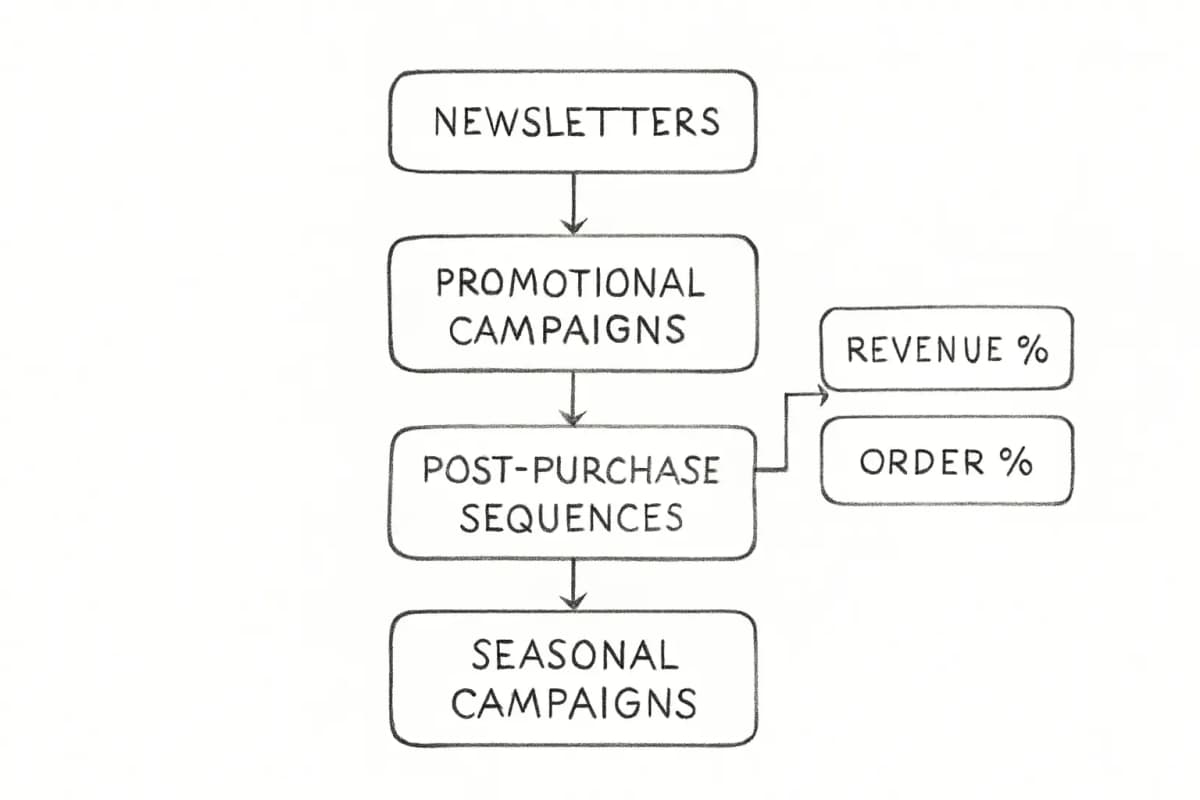
8. Seasonal and Promotional Campaigns
Seasonal campaigns remain the most common type of email marketers send. In a survey of B2B and B2C marketers, 16.8% sent newsletters as part of their email marketing campaign, with 15.3% sending promotional email campaigns.
The risk with seasonal campaigns is inbox saturation. During peak periods like Black Friday, your email competes with hundreds of others for attention. A few approaches consistently improve performance:
Build a pre-launch segment: Identify subscribers who opened your last two seasonal campaigns. Send them an early-access offer before the main send.
Use a teaser sequence: Build anticipation in the three to five days before the sale opens.
Segment by purchase history: Customers who bought from a previous holiday campaign are your warmest segment. Send them a more exclusive version of the offer.
Time your sends carefully: Email campaigns see the highest open rates shortly after they are sent, with 21.2% of all email opens happening within the first hour. Timing matters more during competitive send windows.
For tracking what actually works across all your campaigns, make sure your analytics setup captures the right signals. Our Email Marketing Analytics Best Practices guide covers the metrics that matter most.
Frequently Asked Questions
What are the most effective email marketing campaign ideas for small businesses?
Order confirmation and receipt: Transactional, expected, and trusted. Transactional emails have 8x higher opens and clicks compared to regular marketing emails.
Shipping update: Builds trust and opens the door for related product recommendations.
Review request (7 to 10 days post-delivery): Social proof that feeds future campaigns and SEO.
Replenishment or upsell email (30 to 60 days out): Based on average purchase cycle for your product category.
Loyalty milestone email: Recognize customers who hit spend thresholds or repeat purchase milestones.
Repeat customers represent 21% of customers but drive approximately 44% of revenue and 46% of orders, according to Gorgias data across 12,000 ecommerce merchants. Post-purchase email sequences are a direct investment in that segment.
8. Seasonal and Promotional Campaigns
Seasonal campaigns remain the most common type of email marketers send. In a survey of B2B and B2C marketers, 16.8% sent newsletters as part of their email marketing campaign, with 15.3% sending promotional email campaigns.
The risk with seasonal campaigns is inbox saturation. During peak periods like Black Friday, your email competes with hundreds of others for attention. A few approaches consistently improve performance:
Build a pre-launch segment: Identify subscribers who opened your last two seasonal campaigns. Send them an early-access offer before the main send.
Use a teaser sequence: Build anticipation in the three to five days before the sale opens.
Segment by purchase history: Customers who bought from a previous holiday campaign are your warmest segment. Send them a more exclusive version of the offer.
Time your sends carefully: Email campaigns see the highest open rates shortly after they are sent, with 21.2% of all email opens happening within the first hour. Timing matters more during competitive send windows.
For tracking what actually works across all your campaigns, make sure your analytics setup captures the right signals. Our Email Marketing Analytics Best Practices guide covers the metrics that matter most.
Frequently Asked Questions
What are the most effective email marketing campaign ideas for small businesses?
For small businesses with limited resources, the highest-ROI options are welcome sequences, abandoned cart emails (if you sell products online), and segmented promotional campaigns. 81% of small and medium business professionals believe that email marketing increases customer retention and helps acquire customers. Start with automation first: a three-email welcome sequence and an abandoned cart flow will generate consistent returns without requiring ongoing manual work.
How often should I send email marketing campaigns?
The sweet spot for sending frequency is 9 to 16 emails per month, which gives an average ROI of 4,600%. For newsletters specifically, a weekly cadence produces the highest open rates at 48.31% and a 5.71% CTR on average. That said, frequency should align with your content quality. Sending more with lower quality will accelerate list decay faster than sending less with higher value.
How do I measure whether my email marketing campaigns are driving results?
Track revenue per recipient, click-through rate, and conversion rate as your primary signals rather than open rate alone. Bot-driven phantom engagement has made open rates unreliable, pushing high-performing teams toward revenue per email, list churn, and lifetime value as the metrics that matter. Connect your email platform to your CRM or ecommerce data so you can attribute revenue accurately to specific campaigns and flows.
What is the difference between a campaign and an automated email flow?
A campaign is a one-time send scheduled to a list, such as a promotional email or a newsletter. An automated flow is triggered by subscriber behavior, such as signing up, abandoning a cart, or becoming inactive. Automated workflows generate 30x higher returns compared to one-off email campaigns, which is why building flows should take priority over optimizing one-off sends.
No comments yet. Be the first!
For small businesses with limited resources, the highest-ROI options are welcome sequences, abandoned cart emails (if you sell products online), and segmented promotional campaigns. 81% of small and medium business professionals believe that email marketing increases customer retention and helps acquire customers. Start with automation first: a three-email welcome sequence and an abandoned cart flow will generate consistent returns without requiring ongoing manual work.
How often should I send email marketing campaigns?
The sweet spot for sending frequency is 9 to 16 emails per month, which gives an average ROI of 4,600%. For newsletters specifically, a weekly cadence produces the highest open rates at 48.31% and a 5.71% CTR on average. That said, frequency should align with your content quality. Sending more with lower quality will accelerate list decay faster than sending less with higher value.
How do I measure whether my email marketing campaigns are driving results?
Track revenue per recipient, click-through rate, and conversion rate as your primary signals rather than open rate alone. Bot-driven phantom engagement has made open rates unreliable, pushing high-performing teams toward revenue per email, list churn, and lifetime value as the metrics that matter. Connect your email platform to your CRM or ecommerce data so you can attribute revenue accurately to specific campaigns and flows.
What is the difference between a campaign and an automated email flow?
A campaign is a one-time send scheduled to a list, such as a promotional email or a newsletter. An automated flow is triggered by subscriber behavior, such as signing up, abandoning a cart, or becoming inactive. Automated workflows generate 30x higher returns compared to one-off email campaigns, which is why building flows should take priority over optimizing one-off sends.