Most of your follow-up emails are getting ignored. Not because your offer is wrong, but because most marketers either skip the follow-up entirely or repeat the same message until someone unsubscribes. The data tells a clear story: follow-up emails collectively generate 42% of all campaign replies, yet 48% of reps never send a second message, abandoning nearly half of all possible responses.
That gap between knowing follow-ups matter and actually executing them well is where revenue gets left behind. This guide covers the email marketing follow up best practices that consistently move the needle, grounded in current data and built for teams that want results, not just more sends.
Key Takeaways
Research shows 80% of sales require a minimum of five follow-up emails or other forms of contact, yet most senders stop far too early.
Strategic follow-ups significantly enhance cold email performance. The first follow-up email alone can boost response rates by up to 50%.
Sending two to three follow-up emails, starting three days after your initial message, can increase response rates by up to 65.8%.
A Woodpecker study found that highly personalized cold emails with personalized messages and subject lines can increase reply rates up to 142%.
Sending four or more emails in a sequence more than triples unsubscribe and spam complaint rates. Precision beats volume.
Why Most Follow-Up Sequences Fail Before They Start
The failure usually happens before the first follow-up is even sent. A substantial 70% of initial cold emails are never followed up, missing the opportunity for further engagement. That's not a copywriting problem. It's a process problem.
The other common mistake is treating follow-up as a nudge rather than a new message. One of the biggest mistakes in follow-up emails is sending messages that do nothing but ask the prospect for something, without offering anything in return. You've probably seen emails that say, "Just checking in to see if you had a chance to look at my last email?" While the intent is to remind the prospect, that email doesn't give them a compelling reason to respond.
The good news: fixing these two errors alone will put you ahead of most senders.
Strategy 1: Nail Your Follow-Up Timing and Cadence
Most of your follow-up emails are getting ignored. Not because your offer is wrong, but because most marketers either skip the follow-up entirely or repeat the same message until someone unsubscribes. The data tells a clear story: follow-up emails collectively generate 42% of all campaign replies, yet 48% of reps never send a second message, abandoning nearly half of all possible responses.
That gap between knowing follow-ups matter and actually executing them well is where revenue gets left behind. This guide covers the email marketing follow up best practices that consistently move the needle, grounded in current data and built for teams that want results, not just more sends.
Key Takeaways
Research shows 80% of sales require a minimum of five follow-up emails or other forms of contact, yet most senders stop far too early.
Strategic follow-ups significantly enhance cold email performance. The first follow-up email alone can boost response rates by up to 50%.
Sending two to three follow-up emails, starting three days after your initial message, can increase response rates by up to 65.8%.
A Woodpecker study found that highly personalized cold emails with personalized messages and subject lines can increase reply rates up to 142%.
Sending four or more emails in a sequence more than triples unsubscribe and spam complaint rates. Precision beats volume.
Why Most Follow-Up Sequences Fail Before They Start
The failure usually happens before the first follow-up is even sent. A substantial 70% of initial cold emails are never followed up, missing the opportunity for further engagement. That's not a copywriting problem. It's a process problem.
The other common mistake is treating follow-up as a nudge rather than a new message. One of the biggest mistakes in follow-up emails is sending messages that do nothing but ask the prospect for something, without offering anything in return. You've probably seen emails that say, "Just checking in to see if you had a chance to look at my last email?" While the intent is to remind the prospect, that email doesn't give them a compelling reason to respond.
The good news: fixing these two errors alone will put you ahead of most senders.
Strategy 1: Nail Your Follow-Up Timing and Cadence
Timing is not a secondary consideration. It directly determines whether your message surfaces at a moment when the recipient can act.
One study found that following up the very next day can lead to 11% fewer responses, whereas giving prospects 2 to 3 days before the next touch yields better reply rates. A short wait gives the recipient space without letting them forget you.
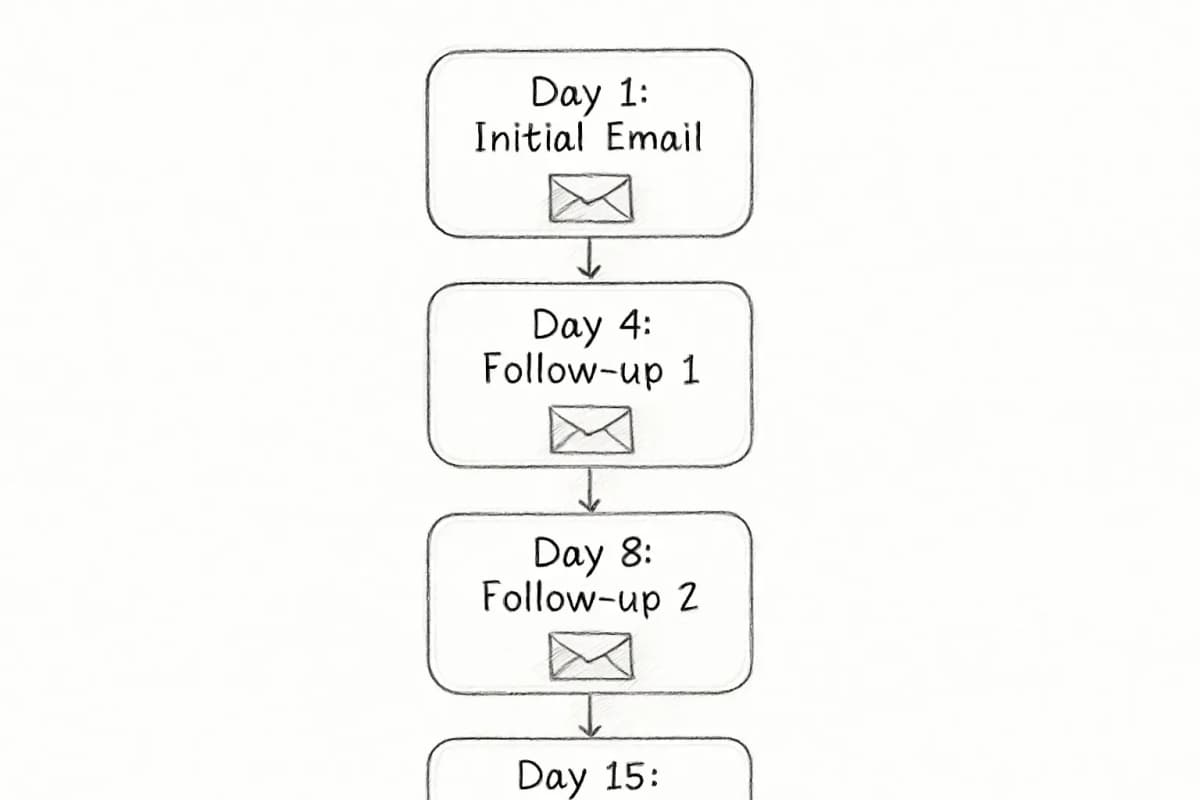
The cadence that consistently performs well in current benchmarks: Day 1 (initial), Day 4 (follow-up 1), Day 8 (follow-up 2), Day 15 (final break-up email). This cadence consistently outperforms compressed timelines, according to Lemlist data.
For send time, research shows that scheduling emails between 9:00 AM and 11:00 AM in the recipient's time zone consistently results in higher response rates. Saturday and Sunday show dramatically lower response rates of under 1%, making weekday sending essential.
The 3-7-7 cadence is worth testing for cold sequences. Sending messages on Day 0, Day 3, Day 10, and Day 17 captures 93% of total replies by Day 10. Sending follow-ups beyond this point typically yields marginal or negative returns.
Practical checklist for cadence:
Wait 2 to 4 days before the first follow-up
Space subsequent emails progressively further apart
Send Tuesday through Thursday during mid-morning local time
Stop at 3 total emails unless engagement signals suggest otherwise
Strategy 2: Add Fresh Value in Every Follow-Up
Each follow-up must earn its place in the inbox. Each follow-up should offer something new, such as a case study, a fresh angle, or a piece of social proof. Poor follow-ups repeat the same message or sound desperate.
Concrete ways to add value across a sequence:
Share a relevant case study or data point
Reference a recent development at their company
Offer a short insight connected to a problem they're likely facing
Present a different value angle from your first email
Each follow-up should reinforce value from a new angle. If you can't answer the question "Why should they open this one?", rewrite it before you send it.
This connects directly to improving your overall email marketing strategy. Follow-ups are not a workaround for a weak initial email; they are a series of distinct touchpoints, each with its own purpose.
Strategy 3: Personalize Beyond the First Name
Generic personalization no longer moves the needle. Generic cold emails might see around 9% response rates, whereas those with advanced personalization, tailored to the recipient's specific context, see about 18% response rates.
Timing is not a secondary consideration. It directly determines whether your message surfaces at a moment when the recipient can act.
One study found that following up the very next day can lead to 11% fewer responses, whereas giving prospects 2 to 3 days before the next touch yields better reply rates. A short wait gives the recipient space without letting them forget you.
The cadence that consistently performs well in current benchmarks: Day 1 (initial), Day 4 (follow-up 1), Day 8 (follow-up 2), Day 15 (final break-up email). This cadence consistently outperforms compressed timelines, according to Lemlist data.
For send time, research shows that scheduling emails between 9:00 AM and 11:00 AM in the recipient's time zone consistently results in higher response rates. Saturday and Sunday show dramatically lower response rates of under 1%, making weekday sending essential.
The 3-7-7 cadence is worth testing for cold sequences. Sending messages on Day 0, Day 3, Day 10, and Day 17 captures 93% of total replies by Day 10. Sending follow-ups beyond this point typically yields marginal or negative returns.
Practical checklist for cadence:
Wait 2 to 4 days before the first follow-up
Space subsequent emails progressively further apart
Send Tuesday through Thursday during mid-morning local time
Stop at 3 total emails unless engagement signals suggest otherwise
Strategy 2: Add Fresh Value in Every Follow-Up
Each follow-up must earn its place in the inbox. Each follow-up should offer something new, such as a case study, a fresh angle, or a piece of social proof. Poor follow-ups repeat the same message or sound desperate.
Concrete ways to add value across a sequence:
Share a relevant case study or data point
Reference a recent development at their company
Offer a short insight connected to a problem they're likely facing
Present a different value angle from your first email
Each follow-up should reinforce value from a new angle. If you can't answer the question "Why should they open this one?", rewrite it before you send it.
This connects directly to improving your overall email marketing strategy. Follow-ups are not a workaround for a weak initial email; they are a series of distinct touchpoints, each with its own purpose.
Strategy 3: Personalize Beyond the First Name
Generic personalization no longer moves the needle. Generic cold emails might see around 9% response rates, whereas those with advanced personalization, tailored to the recipient's specific context, see about 18% response rates.
Personalized emails increase response rates by approximately 32%, while subject lines tailored to the recipient can boost open rates by 50% and replies by up to 140%.
The personalization that works in 2025 goes well beyond inserting a first name. Advanced personalization beyond first name, referencing specific company signals like recent funding, job postings, or product launches, can double cold email response rates. Your follow-ups should continue this level of specificity, not abandon it after the first touch.
Research shows that 78% of decision-makers are more likely to respond to emails that showcase a deep understanding of the recipient's business.
For a deeper look at applying personalization techniques across your full email program, see 7 Email Personalization Techniques That Boost Conversions 47%.
Strategy 4: Write Shorter Follow-Up Emails
The longer the follow-up, the lower the response rate. This is one of the more consistent findings across recent data.
By 2025 and 2026, the optimal email length has compressed to 50 to 125 words, achieving reply rates roughly 50% higher than longer formats.
Follow-ups should be even shorter than your initial email. The 50 to 100 word range is the sweet spot. One point per email. One call to action. One reason to reply.
The structure that works:
Brief reference to context (the previous email or a specific trigger)
One new piece of value or insight
A single, low-friction ask
Each follow-up needs a single, clear, low-friction CTA. "Would you be open to a 15-minute call on Thursday?" dramatically outperforms "Let me know if you'd like to connect."
Strategy 5: Use a "Break-Up" Email to Close the Sequence
The final email in a sequence often performs better than the emails before it. "Break-up" emails, a final message acknowledging that you will not follow up again, generate a 33% response rate due to FOMO, according to HubSpot data.
This email does two things: it gives the prospect a clear off-ramp, and it signals that you respect their time. Both actions tend to prompt replies, even from people who ignored everything before it.
A break-up email should be short, direct, and free of guilt. Avoid phrases like "I never heard back from you." Saying "I never heard back" can have a negative impact on meeting booking rates, reducing them by 14%, according to data from Gong.
Instead, acknowledge the lack of response without judgment, state you're closing the loop, and leave the door open for the future.
Strategy 6: Protect Deliverability Throughout Your Sequence
A follow-up that lands in spam is worthless. Email deliverability remains a major factor for campaign success. Excessive follow-ups increase the likelihood of spam complaints, which can tank your sender reputation. Once that happens, your future emails risk landing in spam folders, no matter how strong the message.
SPF, DKIM, and DMARC authentication must be in place. Spam complaint rates must stay below 0.1%, and one-click unsubscribe must be supported.
Key deliverability habits for follow-up sequences:
Personalized emails increase response rates by approximately 32%, while subject lines tailored to the recipient can boost open rates by 50% and replies by up to 140%.
The personalization that works in 2025 goes well beyond inserting a first name. Advanced personalization beyond first name, referencing specific company signals like recent funding, job postings, or product launches, can double cold email response rates. Your follow-ups should continue this level of specificity, not abandon it after the first touch.
Research shows that 78% of decision-makers are more likely to respond to emails that showcase a deep understanding of the recipient's business.
For a deeper look at applying personalization techniques across your full email program, see 7 Email Personalization Techniques That Boost Conversions 47%.
Strategy 4: Write Shorter Follow-Up Emails
The longer the follow-up, the lower the response rate. This is one of the more consistent findings across recent data.
By 2025 and 2026, the optimal email length has compressed to 50 to 125 words, achieving reply rates roughly 50% higher than longer formats.
Follow-ups should be even shorter than your initial email. The 50 to 100 word range is the sweet spot. One point per email. One call to action. One reason to reply.
The structure that works:
Brief reference to context (the previous email or a specific trigger)
One new piece of value or insight
A single, low-friction ask
Each follow-up needs a single, clear, low-friction CTA. "Would you be open to a 15-minute call on Thursday?" dramatically outperforms "Let me know if you'd like to connect."
Strategy 5: Use a "Break-Up" Email to Close the Sequence
The final email in a sequence often performs better than the emails before it. "Break-up" emails, a final message acknowledging that you will not follow up again, generate a 33% response rate due to FOMO, according to HubSpot data.
This email does two things: it gives the prospect a clear off-ramp, and it signals that you respect their time. Both actions tend to prompt replies, even from people who ignored everything before it.
A break-up email should be short, direct, and free of guilt. Avoid phrases like "I never heard back from you." Saying "I never heard back" can have a negative impact on meeting booking rates, reducing them by 14%, according to data from Gong.
Instead, acknowledge the lack of response without judgment, state you're closing the loop, and leave the door open for the future.
Strategy 6: Protect Deliverability Throughout Your Sequence
A follow-up that lands in spam is worthless. Email deliverability remains a major factor for campaign success. Excessive follow-ups increase the likelihood of spam complaints, which can tank your sender reputation. Once that happens, your future emails risk landing in spam folders, no matter how strong the message.
SPF, DKIM, and DMARC authentication must be in place. Spam complaint rates must stay below 0.1%, and one-click unsubscribe must be supported.
Key deliverability habits for follow-up sequences:
Keep spam complaint rates below 0.1%
Remove bounced addresses immediately
Include a clear, one-click unsubscribe link
Avoid spam-trigger words like "free," "guaranteed," or excessive punctuation
Monitor sender reputation using tools like Google Postmaster Tools
Regularly remove inactive or invalid addresses to keep complaint and bounce rates low and your sender reputation intact.
Good deliverability is the foundation everything else is built on. For a broader look at how analytics connects to deliverability health, see Email Marketing Analytics Best Practices.
Strategy 7: Segment Your Follow-Up Sequences by Audience
Not every contact deserves the same follow-up sequence. Sending the same cadence to a cold prospect and a warm lead who clicked your last three emails is a missed opportunity at best and a reputation risk at worst.
Small and mid-size businesses tolerate more follow-ups, while enterprise prospects ghost quickly and punish persistence. Industry also makes a difference: manufacturing, solar, and logistics respond well to follow-ups, while crypto, cloud, and healthcare respond poorly.
Segment your sequences by:
Engagement level: Did they open? Did they click? Adjust frequency accordingly.
Lead source: Cold outreach versus warm inbound warrants different tone and cadence.
Company size: Enterprise contacts require more patience and less volume.
Industry: Match follow-up frequency to what benchmarks suggest for each vertical.
Set up signal-based triggers. If someone opens multiple times or clicks, accelerate. If they ghost you entirely, pause or wait longer.
Avoid spam-trigger words like "free," "guaranteed," or excessive punctuation
Monitor sender reputation using tools like Google Postmaster Tools
Regularly remove inactive or invalid addresses to keep complaint and bounce rates low and your sender reputation intact.
Good deliverability is the foundation everything else is built on. For a broader look at how analytics connects to deliverability health, see Email Marketing Analytics Best Practices.
Strategy 7: Segment Your Follow-Up Sequences by Audience
Not every contact deserves the same follow-up sequence. Sending the same cadence to a cold prospect and a warm lead who clicked your last three emails is a missed opportunity at best and a reputation risk at worst.
Small and mid-size businesses tolerate more follow-ups, while enterprise prospects ghost quickly and punish persistence. Industry also makes a difference: manufacturing, solar, and logistics respond well to follow-ups, while crypto, cloud, and healthcare respond poorly.
Segment your sequences by:
Engagement level: Did they open? Did they click? Adjust frequency accordingly.
Lead source: Cold outreach versus warm inbound warrants different tone and cadence.
Company size: Enterprise contacts require more patience and less volume.
Industry: Match follow-up frequency to what benchmarks suggest for each vertical.
Set up signal-based triggers. If someone opens multiple times or clicks, accelerate. If they ghost you entirely, pause or wait longer.
How to Measure Whether Your Follow-Ups Are Working
Tracking the right metrics separates guessing from improving. Reply rate is the primary signal for follow-up performance. Open rate matters less, especially with Apple Mail Privacy Protection inflating open tracking data.
Metrics to track per sequence step:
Reply rate per email: Is the second follow-up outperforming or underperforming the first?
Positive reply rate: Of all replies, how many are genuine interest versus unsubscribes or rejections?
Spam complaint rate: If this rises above 0.1%, pause and audit your sequence.
Unsubscribe rate: A spike after a specific follow-up often signals that email crossed a line.
A high open rate combined with a low response rate suggests that while your subject lines are engaging, the content may be lacking. Low open rates coupled with high response rates indicate that content is strong but reaching a limited audience.
Run A/B tests on each step of your sequence, not just the first email. A/B testing subject lines increases open rates by up to 20% over time, according to SalesHandy data. Test one variable at a time: subject line, opening line, CTA, or send day.
Frequently Asked Questions
How many follow-up emails should I send?
The ideal limit is 3 total emails (1 initial and 2 follow-ups). Beyond that, you risk annoying prospects, increasing spam complaints, and hurting deliverability. For warm leads or leads who have engaged (opened or clicked), you can extend the sequence with relevant content. The first follow-up alone accounts for 38% of responses, so do not skip it.
How long should I wait before sending a follow-up email?
Waiting three days before sending a follow-up email can increase the reply rate by a substantial 31%. Delaying your follow-up for more than five days leads to a significant decline in the likelihood of receiving a reply, with a drop of 24% in response rates. The sweet spot for most campaigns is 3 to 5 days between touches.
What is the best day and time to send a follow-up email?
Multiple sources confirm Wednesday as the peak engagement day, while Monday remains the best day to launch new sequences. For send time, mid-morning windows of 9:30 to 11:30 AM in the recipient's local timezone consistently outperform other slots.
What should a follow-up email include to get a response?
Every follow-up should include a brief context hook, a single new piece of value (a case study, insight, or relevant data point), and one clear call to action. The era of "I'm just touching base" emails is over. The effective approach is "I'm reaching out with something that might help you." Keep the email under 125 words and avoid repeating the ask from your previous message.
How to Measure Whether Your Follow-Ups Are Working
Tracking the right metrics separates guessing from improving. Reply rate is the primary signal for follow-up performance. Open rate matters less, especially with Apple Mail Privacy Protection inflating open tracking data.
Metrics to track per sequence step:
Reply rate per email: Is the second follow-up outperforming or underperforming the first?
Positive reply rate: Of all replies, how many are genuine interest versus unsubscribes or rejections?
Spam complaint rate: If this rises above 0.1%, pause and audit your sequence.
Unsubscribe rate: A spike after a specific follow-up often signals that email crossed a line.
A high open rate combined with a low response rate suggests that while your subject lines are engaging, the content may be lacking. Low open rates coupled with high response rates indicate that content is strong but reaching a limited audience.
Run A/B tests on each step of your sequence, not just the first email. A/B testing subject lines increases open rates by up to 20% over time, according to SalesHandy data. Test one variable at a time: subject line, opening line, CTA, or send day.
Frequently Asked Questions
How many follow-up emails should I send?
The ideal limit is 3 total emails (1 initial and 2 follow-ups). Beyond that, you risk annoying prospects, increasing spam complaints, and hurting deliverability. For warm leads or leads who have engaged (opened or clicked), you can extend the sequence with relevant content. The first follow-up alone accounts for 38% of responses, so do not skip it.
How long should I wait before sending a follow-up email?
Waiting three days before sending a follow-up email can increase the reply rate by a substantial 31%. Delaying your follow-up for more than five days leads to a significant decline in the likelihood of receiving a reply, with a drop of 24% in response rates. The sweet spot for most campaigns is 3 to 5 days between touches.
What is the best day and time to send a follow-up email?
Multiple sources confirm Wednesday as the peak engagement day, while Monday remains the best day to launch new sequences. For send time, mid-morning windows of 9:30 to 11:30 AM in the recipient's local timezone consistently outperform other slots.
What should a follow-up email include to get a response?
Every follow-up should include a brief context hook, a single new piece of value (a case study, insight, or relevant data point), and one clear call to action. The era of "I'm just touching base" emails is over. The effective approach is "I'm reaching out with something that might help you." Keep the email under 125 words and avoid repeating the ask from your previous message.