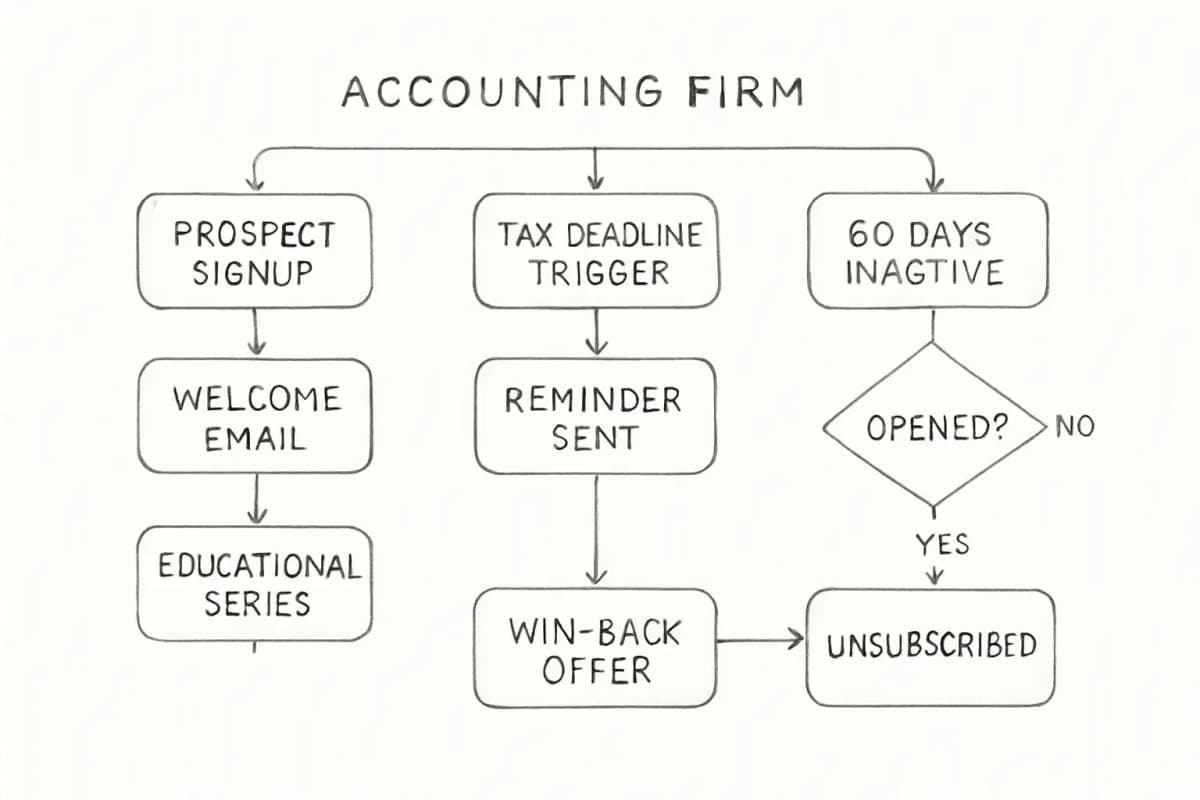
Accounting firms rely heavily on referrals, but referrals alone rarely fill a pipeline. Accounting services are not bought on impulse. Whether you're offering tax planning, bookkeeping, audit prep, or CFO services, the sales cycle often spans several touchpoints, and your prospects are evaluating options while waiting for the right time to engage. Email helps you stay top-of-mind throughout that journey.
The good news: email marketing remains one of the most powerful tools for accountants to nurture client relationships and attract potential clients. When done right, it delivers an impressive ROI of 4,400%, making it a financial no-brainer for accounting firms looking to grow their practice.
This guide covers the most effective email marketing examples for accounting firms, the campaign types that build trust and generate leads, and the tactics that separate firms that grow from firms that simply stay busy.
Key Takeaways
On average, businesses make about $36 for every $1 they spend on email marketing.
According to DMA, marketers have found a 760% increase in email revenue from segmented campaigns.
Email personalization goes far beyond using someone's name. For accounting firms, the more context you include in your messaging, the more trust you build. Personalized emails have 29% higher open rates and 41% higher click-through rates on average.
Automated workflows generate 320% more revenue than standard promotional campaigns.
Email marketing builds trust, provides value, and fosters client loyalty. Unlike other marketing channels, email lets firms deliver personalized, actionable content directly to their audience.
Why Email Marketing Works for Accounting Firms
Most accounting firm owners underestimate what consistent email communication can do for client retention and lead generation. Email newsletters are one of the most effective email marketing tools for CPAs and accountants. Many accounting firms fail to recognize the advantages of sending regular email newsletters, but they're missing out. This powerful business-to-business marketing strategy is a great way to maintain client relationships, establish trust with potential clients, and grow your practice.
The trust factor matters. Accounting is an information-heavy business. You want to educate clients without overwhelming them. With email marketing, you can provide information about critical financial deadlines, changes in tax laws, and relevant services your firm provides. For example, a small accounting firm could message local businesses about recent legal changes impacting deductions, helping them prepare for filing season. These timely updates also position your firm as a reliable source of expertise and show your commitment to clients' success.
Accounting firms rely heavily on referrals, but referrals alone rarely fill a pipeline. Accounting services are not bought on impulse. Whether you're offering tax planning, bookkeeping, audit prep, or CFO services, the sales cycle often spans several touchpoints, and your prospects are evaluating options while waiting for the right time to engage. Email helps you stay top-of-mind throughout that journey.
The good news: email marketing remains one of the most powerful tools for accountants to nurture client relationships and attract potential clients. When done right, it delivers an impressive ROI of 4,400%, making it a financial no-brainer for accounting firms looking to grow their practice.
This guide covers the most effective email marketing examples for accounting firms, the campaign types that build trust and generate leads, and the tactics that separate firms that grow from firms that simply stay busy.
Key Takeaways
On average, businesses make about $36 for every $1 they spend on email marketing.
According to DMA, marketers have found a 760% increase in email revenue from segmented campaigns.
Email personalization goes far beyond using someone's name. For accounting firms, the more context you include in your messaging, the more trust you build. Personalized emails have 29% higher open rates and 41% higher click-through rates on average.
Automated workflows generate 320% more revenue than standard promotional campaigns.
Email marketing builds trust, provides value, and fosters client loyalty. Unlike other marketing channels, email lets firms deliver personalized, actionable content directly to their audience.
Why Email Marketing Works for Accounting Firms
Most accounting firm owners underestimate what consistent email communication can do for client retention and lead generation. Email newsletters are one of the most effective email marketing tools for CPAs and accountants. Many accounting firms fail to recognize the advantages of sending regular email newsletters, but they're missing out. This powerful business-to-business marketing strategy is a great way to maintain client relationships, establish trust with potential clients, and grow your practice.
The trust factor matters. Accounting is an information-heavy business. You want to educate clients without overwhelming them. With email marketing, you can provide information about critical financial deadlines, changes in tax laws, and relevant services your firm provides. For example, a small accounting firm could message local businesses about recent legal changes impacting deductions, helping them prepare for filing season. These timely updates also position your firm as a reliable source of expertise and show your commitment to clients' success.
B2B services see 18 to 22% average open rates. Professional audiences check email regularly and expect relevant, targeted content. This focus on value drives higher engagement than consumer campaigns.
6 Email Marketing Examples for Accounting Firms That Actually Work
These are proven campaign types, each with a clear purpose and a real-world framing you can adapt.
1. The Tax Season Deadline Reminder
This is the single most obvious campaign for any accounting firm, and one of the most consistently high-performing.
During tax season, share IRS updates, tax tips, or links to tools like tax deduction checklists. In January, focus on topics like year-end bookkeeping and organizing financial records.
A well-timed reminder email sent two to three weeks before a major deadline (April 15, Q4 estimated payments, W-2 distribution) gives clients time to act and reinforces your firm's role as a proactive partner. The subject line should be specific: "Your Q2 Estimated Tax Payment Is Due June 15" performs far better than a generic "Tax Update" heading.
Keep these emails short. State the deadline, state the action required, and include one clear call to action such as a link to schedule a call or a secure document upload portal.
2. The Educational Newsletter
Share relevant content like tax saving strategies, new tax legislation updates, or financial planning tips. Educational email campaigns build trust and keep your firm top of mind when clients need accounting services.
The format works because it delivers real value without an overt sales pitch. People read newsletters to learn something that will help them, not to hear a sales pitch. If your newsletters are too salesy, people will quickly unsubscribe.
A good accounting newsletter follows this structure:
One main topic (a tax law change, a planning opportunity, a common compliance mistake)
Two to three paragraphs maximum per section
A single CTA at the end, usually a consultation booking link or a resource download
You don't have to send an email every week, but aim for at least one email per month. This keeps you top-of-mind with your audience and shows that you're reliable. When clients and leads notice you're consistent, it reinforces trust, which can improve retention for existing clients and make it easier to turn leads into new clients.
3. The Lead Magnet Welcome Sequence
New subscribers need a reason to stay engaged from the moment they join your list. A welcome sequence sets expectations, introduces your firm's expertise, and moves prospects toward a consultation.
Lead magnets are free resources or offers that you give clients and prospects in exchange for their email addresses. For accounting firms, this could include downloadable tools like tax planning worksheets or financial budgeting templates. Or you could limit a discount or special package only available to new sign-ups.
A strong welcome sequence for an accounting firm typically looks like this:
B2B services see 18 to 22% average open rates. Professional audiences check email regularly and expect relevant, targeted content. This focus on value drives higher engagement than consumer campaigns.
6 Email Marketing Examples for Accounting Firms That Actually Work
These are proven campaign types, each with a clear purpose and a real-world framing you can adapt.
1. The Tax Season Deadline Reminder
This is the single most obvious campaign for any accounting firm, and one of the most consistently high-performing.
During tax season, share IRS updates, tax tips, or links to tools like tax deduction checklists. In January, focus on topics like year-end bookkeeping and organizing financial records.
A well-timed reminder email sent two to three weeks before a major deadline (April 15, Q4 estimated payments, W-2 distribution) gives clients time to act and reinforces your firm's role as a proactive partner. The subject line should be specific: "Your Q2 Estimated Tax Payment Is Due June 15" performs far better than a generic "Tax Update" heading.
Keep these emails short. State the deadline, state the action required, and include one clear call to action such as a link to schedule a call or a secure document upload portal.
2. The Educational Newsletter
Share relevant content like tax saving strategies, new tax legislation updates, or financial planning tips. Educational email campaigns build trust and keep your firm top of mind when clients need accounting services.
The format works because it delivers real value without an overt sales pitch. People read newsletters to learn something that will help them, not to hear a sales pitch. If your newsletters are too salesy, people will quickly unsubscribe.
A good accounting newsletter follows this structure:
One main topic (a tax law change, a planning opportunity, a common compliance mistake)
Two to three paragraphs maximum per section
A single CTA at the end, usually a consultation booking link or a resource download
You don't have to send an email every week, but aim for at least one email per month. This keeps you top-of-mind with your audience and shows that you're reliable. When clients and leads notice you're consistent, it reinforces trust, which can improve retention for existing clients and make it easier to turn leads into new clients.
3. The Lead Magnet Welcome Sequence
New subscribers need a reason to stay engaged from the moment they join your list. A welcome sequence sets expectations, introduces your firm's expertise, and moves prospects toward a consultation.
Lead magnets are free resources or offers that you give clients and prospects in exchange for their email addresses. For accounting firms, this could include downloadable tools like tax planning worksheets or financial budgeting templates. Or you could limit a discount or special package only available to new sign-ups.
A strong welcome sequence for an accounting firm typically looks like this:
Email 1 (Day 0): Deliver the lead magnet. Introduce the firm and set expectations.
Email 2 (Day 2): Share a valuable piece of content tied to the subscriber's likely pain point.
Email 3 (Day 5): Highlight one specific service with a brief client outcome story.
Email 4 (Day 8): Soft CTA: invite them to book a free 15-minute consultation.
For more on structuring this kind of sequence effectively, see Welcome Email Sequence Best Practices: 7 Proven Strategies.
4. The Seasonal Service Promotion
Studies show that email marketing can generate $36 for every $1 spent. For accounting firms, that return can be even higher when campaigns are aligned with seasonal services like tax prep or year-end reporting.
This campaign type works best when it combines urgency with a specific offer. For example:
Year-end bookkeeping cleanup package (October through November)
Tax preparation onboarding offer for new small business clients (January)
Mid-year financial review consultation (June)
For example, you could offer a limited-time package for year-end financial planning. Be clear about the value (e.g., "Schedule a call before [date] to receive a complimentary tax strategy session valued at $300"). Create urgency with deadlines or limited spots. Use a strong call to action (e.g., "Book your complimentary tax strategy session now").
5. The Client Retention Check-In
Most email marketing for accounting firms focuses on acquisition. Retention emails are often overlooked, yet they protect your most valuable revenue. A simple, personalized check-in sent at a natural touchpoint (after tax season, at the start of a new fiscal year, or 90 days after onboarding) signals that you see each client as a long-term relationship rather than a transaction.
These emails do not need to be elaborate. A short, personal note from the assigned account manager asking how things are going and whether the client has questions about recent regulatory changes performs well. According to HubSpot, 80% of surveyed businesses feel email marketing helps keep customers coming back.
6. The Referral Request Email
Word-of-mouth drives most accounting firm growth, but most firms never formally ask satisfied clients to refer others. A short, direct email sent after a successful tax season or project completion is one of the highest-conversion campaigns you can run.
Keep it simple: thank the client, mention something specific about the work you did together, and ask if they know any business owners facing similar challenges who might benefit from an introduction. Include a one-click link to forward your contact details or a referral landing page.
Segmentation: The Strategy Behind Higher ROI
Generic emails sent to your entire list rarely produce the results a well-segmented campaign delivers. Segmentation is where accounting firms can truly shine with their email marketing efforts. By dividing your list strategically, you can deliver hyper-relevant content that speaks directly to each client's needs. Effective segmentation strategies for accountants include: by client type (individual taxpayers vs. small businesses vs. corporations), by service needs (tax preparation, audit, advisory, bookkeeping), and by industry (construction, healthcare, retail, etc.).
Email 1 (Day 0): Deliver the lead magnet. Introduce the firm and set expectations.
Email 2 (Day 2): Share a valuable piece of content tied to the subscriber's likely pain point.
Email 3 (Day 5): Highlight one specific service with a brief client outcome story.
Email 4 (Day 8): Soft CTA: invite them to book a free 15-minute consultation.
For more on structuring this kind of sequence effectively, see Welcome Email Sequence Best Practices: 7 Proven Strategies.
4. The Seasonal Service Promotion
Studies show that email marketing can generate $36 for every $1 spent. For accounting firms, that return can be even higher when campaigns are aligned with seasonal services like tax prep or year-end reporting.
This campaign type works best when it combines urgency with a specific offer. For example:
Year-end bookkeeping cleanup package (October through November)
Tax preparation onboarding offer for new small business clients (January)
Mid-year financial review consultation (June)
For example, you could offer a limited-time package for year-end financial planning. Be clear about the value (e.g., "Schedule a call before [date] to receive a complimentary tax strategy session valued at $300"). Create urgency with deadlines or limited spots. Use a strong call to action (e.g., "Book your complimentary tax strategy session now").
5. The Client Retention Check-In
Most email marketing for accounting firms focuses on acquisition. Retention emails are often overlooked, yet they protect your most valuable revenue. A simple, personalized check-in sent at a natural touchpoint (after tax season, at the start of a new fiscal year, or 90 days after onboarding) signals that you see each client as a long-term relationship rather than a transaction.
These emails do not need to be elaborate. A short, personal note from the assigned account manager asking how things are going and whether the client has questions about recent regulatory changes performs well. According to HubSpot, 80% of surveyed businesses feel email marketing helps keep customers coming back.
6. The Referral Request Email
Word-of-mouth drives most accounting firm growth, but most firms never formally ask satisfied clients to refer others. A short, direct email sent after a successful tax season or project completion is one of the highest-conversion campaigns you can run.
Keep it simple: thank the client, mention something specific about the work you did together, and ask if they know any business owners facing similar challenges who might benefit from an introduction. Include a one-click link to forward your contact details or a referral landing page.
Segmentation: The Strategy Behind Higher ROI
Generic emails sent to your entire list rarely produce the results a well-segmented campaign delivers. Segmentation is where accounting firms can truly shine with their email marketing efforts. By dividing your list strategically, you can deliver hyper-relevant content that speaks directly to each client's needs. Effective segmentation strategies for accountants include: by client type (individual taxpayers vs. small businesses vs. corporations), by service needs (tax preparation, audit, advisory, bookkeeping), and by industry (construction, healthcare, retail, etc.).
Segmented campaigns achieve 14% higher open rates and 28% better click rates compared to generic sends. Advanced segmentation and personalization can boost revenue by up to 760%.
If your firm is new to segmentation, start with three basic groups: existing clients, warm leads (people who have inquired but not signed), and cold contacts. Build a different 90-day email cadence for each group and measure the difference in engagement. For a deeper framework, see our guide to Email List Segmentation Strategies That Boost ROI by 760%.
Automation: Running Campaigns While Serving Clients
One of the biggest advantages of email marketing is automation. You can build sequences that run in the background, engaging your leads while you focus on client work.
For accounting firms, automation covers four high-value use cases:
Onboarding sequences for new clients, walking them through what to expect from your firm
Deadline reminders triggered by calendar dates or specific service milestones
Re-engagement campaigns for dormant contacts who have not opened an email in 90 days
Post-consultation follow-ups that arrive automatically after a prospect meeting
Marketing automation tools allow accounting firms to schedule regular newsletters, updates, and personalized messages based on predefined triggers. Tools like Mailchimp, ActiveCampaign, and HubSpot all support this level of automation without requiring technical expertise.
Subject Lines and Personalization That Drive Opens
Your subject line determines whether the email gets read or ignored. Your subject line is the first impression for your email, so make it count. Keep subject lines short, descriptive, and enticing so readers will open the email.
For accounting firms, high-performing subject line patterns include:
Segmented campaigns achieve 14% higher open rates and 28% better click rates compared to generic sends. Advanced segmentation and personalization can boost revenue by up to 760%.
If your firm is new to segmentation, start with three basic groups: existing clients, warm leads (people who have inquired but not signed), and cold contacts. Build a different 90-day email cadence for each group and measure the difference in engagement. For a deeper framework, see our guide to Email List Segmentation Strategies That Boost ROI by 760%.
Automation: Running Campaigns While Serving Clients
One of the biggest advantages of email marketing is automation. You can build sequences that run in the background, engaging your leads while you focus on client work.
For accounting firms, automation covers four high-value use cases:
Onboarding sequences for new clients, walking them through what to expect from your firm
Deadline reminders triggered by calendar dates or specific service milestones
Re-engagement campaigns for dormant contacts who have not opened an email in 90 days
Post-consultation follow-ups that arrive automatically after a prospect meeting
Marketing automation tools allow accounting firms to schedule regular newsletters, updates, and personalized messages based on predefined triggers. Tools like Mailchimp, ActiveCampaign, and HubSpot all support this level of automation without requiring technical expertise.
Subject Lines and Personalization That Drive Opens
Your subject line determines whether the email gets read or ignored. Your subject line is the first impression for your email, so make it count. Keep subject lines short, descriptive, and enticing so readers will open the email.
For accounting firms, high-performing subject line patterns include:
Deadline-specific: "Your S-Corp Election Deadline Is March 15"
Benefit-first: "3 Deductions Most Small Businesses Miss"
Client-type targeting: "If You're a Freelancer, Read This Before April"
Question format: "Did Your Payroll Setup Change This Year?"
For a full breakdown of what makes subject lines work, see Email Subject Line Best Practices That Boost Open Rates by 27%.
On personalization: email personalization goes far beyond using someone's name. For accounting firms, the more context you include in your messaging, the more trust you build. Reference the client's business type, the services they use, or a recent interaction. This specificity signals that the email was written for them, not a mass broadcast.
Tracking Performance: Metrics That Matter for Accounting Firms
Sending emails is only half the job. To run a successful email marketing campaign, you need to track key metrics and optimize your email marketing efforts over time. This is what separates accounting firms that just send emails from those that actually win new clients and strengthen client relationships.
The metrics worth tracking closely:
Open rates: Show if your subject line is strong enough to grab attention.
Click-through rates (CTR): Tell you if clients found your content valuable enough to click through to your landing pages.
Conversions: Track how many prospective clients booked a free consultation, downloaded a tax planning guide, or signed up for additional services.
Note on open rates: since Apple Mail accounts for 46% of email clients, Mail Privacy Protection has significantly skewed open rate data upward. Email marketers now prioritize click-through rates, click-to-open rates, and conversion metrics over open rates when evaluating campaign performance.
How often should an accounting firm send marketing emails?
Aim for at least one email per month. This keeps you top-of-mind with your audience and shows that you're reliable. For most firms, one to two emails per month is a sustainable and effective cadence. During peak periods like tax season, you can increase frequency to weekly deadline reminders without damaging unsubscribe rates, provided the content remains relevant and useful.
What types of emails work best for accounting firm lead generation?
Deadline-specific: "Your S-Corp Election Deadline Is March 15"
Benefit-first: "3 Deductions Most Small Businesses Miss"
Client-type targeting: "If You're a Freelancer, Read This Before April"
Question format: "Did Your Payroll Setup Change This Year?"
For a full breakdown of what makes subject lines work, see Email Subject Line Best Practices That Boost Open Rates by 27%.
On personalization: email personalization goes far beyond using someone's name. For accounting firms, the more context you include in your messaging, the more trust you build. Reference the client's business type, the services they use, or a recent interaction. This specificity signals that the email was written for them, not a mass broadcast.
Tracking Performance: Metrics That Matter for Accounting Firms
Sending emails is only half the job. To run a successful email marketing campaign, you need to track key metrics and optimize your email marketing efforts over time. This is what separates accounting firms that just send emails from those that actually win new clients and strengthen client relationships.
The metrics worth tracking closely:
Open rates: Show if your subject line is strong enough to grab attention.
Click-through rates (CTR): Tell you if clients found your content valuable enough to click through to your landing pages.
Conversions: Track how many prospective clients booked a free consultation, downloaded a tax planning guide, or signed up for additional services.
Note on open rates: since Apple Mail accounts for 46% of email clients, Mail Privacy Protection has significantly skewed open rate data upward. Email marketers now prioritize click-through rates, click-to-open rates, and conversion metrics over open rates when evaluating campaign performance.
How often should an accounting firm send marketing emails?
Aim for at least one email per month. This keeps you top-of-mind with your audience and shows that you're reliable. For most firms, one to two emails per month is a sustainable and effective cadence. During peak periods like tax season, you can increase frequency to weekly deadline reminders without damaging unsubscribe rates, provided the content remains relevant and useful.
What types of emails work best for accounting firm lead generation?
The most successful firms use a combination of campaign types to reach different segments of their audience. Cold emails are used to introduce your firm to new prospects who haven't interacted with you before. These contacts are typically sourced through outbound list building or LinkedIn research. Warm lead nurture sequences, lead magnet delivery emails, and consultation invitation campaigns also perform consistently well for accounting practices.
Should accounting firms build their email list organically or purchase lists?
Growing your accounting practice starts with a quality email list. Instead of purchasing lists, which violates regulations and yields poor results, create valuable lead magnets that attract your ideal clients. A purchased list bypasses consent, triggers spam complaints, and can damage your sending domain's reputation. Building organically through your website, social profiles, and client referrals takes longer but produces a far more engaged audience.
How do you personalize emails for different types of accounting clients?
You don't need to go to extremes when segmenting and personalizing your emails, but they should at least feel relevant to your recipients. You can use your CRM to incorporate personal information like your contact's name or business name. You can also segment your list based on relationship type, demographics (industry, service line, business type), interests, past email engagement, and customer lifecycle stage. Starting with two or three segments based on client type (individual vs. small business vs. corporate) gives you meaningful personalization without requiring a complex tech stack.
No comments yet. Be the first!
The most successful firms use a combination of campaign types to reach different segments of their audience. Cold emails are used to introduce your firm to new prospects who haven't interacted with you before. These contacts are typically sourced through outbound list building or LinkedIn research. Warm lead nurture sequences, lead magnet delivery emails, and consultation invitation campaigns also perform consistently well for accounting practices.
Should accounting firms build their email list organically or purchase lists?
Growing your accounting practice starts with a quality email list. Instead of purchasing lists, which violates regulations and yields poor results, create valuable lead magnets that attract your ideal clients. A purchased list bypasses consent, triggers spam complaints, and can damage your sending domain's reputation. Building organically through your website, social profiles, and client referrals takes longer but produces a far more engaged audience.
How do you personalize emails for different types of accounting clients?
You don't need to go to extremes when segmenting and personalizing your emails, but they should at least feel relevant to your recipients. You can use your CRM to incorporate personal information like your contact's name or business name. You can also segment your list based on relationship type, demographics (industry, service line, business type), interests, past email engagement, and customer lifecycle stage. Starting with two or three segments based on client type (individual vs. small business vs. corporate) gives you meaningful personalization without requiring a complex tech stack.