Learn how credit unions use email marketing to boost member engagement, increase loan applications, and improve retention. Data-driven strategies inside.
Learn how credit unions use email marketing to boost member engagement, increase loan applications, and improve retention. Data-driven strategies inside.
Credit union email marketing returns an average of $36 for every dollar spent, making it one of the highest-ROI channels available to financial institutions. Despite the rise of mobile apps, email remains the primary channel for official communication, alerts, and newsletters at credit unions. Yet most credit unions still treat email as a broadcast tool rather than a member engagement engine. This guide breaks down how to build a credit union email marketing strategy that deepens member relationships, drives product adoption, and produces measurable revenue growth.
Key Takeaways
Email marketing averages $36 for every dollar spent, making it one of the most cost-effective channels for member engagement and acquisition.
According to Mailchimp benchmarks, credit unions achieve a 38.5% email open rate, which significantly exceeds most industries, meaning more than one-third of recipients actually read each email sent.
Segmented campaigns can drive a 760% increase in email revenue, according to DMA research.
A 2024 NCUA report found that credit unions saw a 25% decrease in member engagement when relying on generic communications, underscoring how much personalization matters.
Most credit unions treat onboarding as a simple welcome email sequence. Growth performers treat it as a strategic campaign with the same intensity as member acquisition.
Why Email Outperforms Other Channels for Credit Unions
Credit unions operate in a trust-based relationship model. Unlike banks, which compete primarily on rate and reach, credit unions compete on member experience and community connection. Email is uniquely suited to that model.
Email marketing's direct communication approach ensures that messages reach members directly in their inbox without relying on social media algorithms. That matters for a financial institution where relevance and timing are critical to member action.
Recent Gallup research shows that the engagement advantage credit unions once held over banks is shrinking. In 2014, credit unions enjoyed a +21% engagement premium and a +29% higher Net Promoter Score. By 2021, those numbers had dropped to +11% and +17%, respectively. Email marketing, executed well, is one of the most direct levers credit unions can pull to close that gap.
Credit union email marketing returns an average of $36 for every dollar spent, making it one of the highest-ROI channels available to financial institutions. Despite the rise of mobile apps, email remains the primary channel for official communication, alerts, and newsletters at credit unions. Yet most credit unions still treat email as a broadcast tool rather than a member engagement engine. This guide breaks down how to build a credit union email marketing strategy that deepens member relationships, drives product adoption, and produces measurable revenue growth.
Key Takeaways
Email marketing averages $36 for every dollar spent, making it one of the most cost-effective channels for member engagement and acquisition.
According to Mailchimp benchmarks, credit unions achieve a 38.5% email open rate, which significantly exceeds most industries, meaning more than one-third of recipients actually read each email sent.
Segmented campaigns can drive a 760% increase in email revenue, according to DMA research.
A 2024 NCUA report found that credit unions saw a 25% decrease in member engagement when relying on generic communications, underscoring how much personalization matters.
Most credit unions treat onboarding as a simple welcome email sequence. Growth performers treat it as a strategic campaign with the same intensity as member acquisition.
Why Email Outperforms Other Channels for Credit Unions
Credit unions operate in a trust-based relationship model. Unlike banks, which compete primarily on rate and reach, credit unions compete on member experience and community connection. Email is uniquely suited to that model.
Email marketing's direct communication approach ensures that messages reach members directly in their inbox without relying on social media algorithms. That matters for a financial institution where relevance and timing are critical to member action.
Recent Gallup research shows that the engagement advantage credit unions once held over banks is shrinking. In 2014, credit unions enjoyed a +21% engagement premium and a +29% higher Net Promoter Score. By 2021, those numbers had dropped to +11% and +17%, respectively. Email marketing, executed well, is one of the most direct levers credit unions can pull to close that gap.
Michigan State University FCU generated 63% more clicks and 80% more certificate openings using needs-based segmentation over traditional demographic targeting, proving that how you target matters more than how much you spend.
Understanding the Two Types of Credit Union Emails
Before building campaigns, credit union marketers need to understand a foundational distinction.
All emails a bank or credit union sends break down into two fundamental categories: transactional and marketing emails. Transactional emails are messages triggered by a member's interaction with the institution, including confirmation emails for transactions, account statements, password resets, and account alerts.
Transactional emails are exempt from most provisions of the CAN-SPAM Act, provided they contain only information necessary for the transaction. Credit unions should carefully segment their transactional and marketing email plans to ensure CAN-SPAM conformance.
Marketing emails promote products or services and require opt-in consent, while transactional emails share essential account or service information and are typically sent automatically after a member action.
Keeping these two streams separate protects your sender reputation, keeps you compliant, and ensures members receive appropriate content in the right context.
Compliance and Data Privacy: The Non-Negotiable Layer
Credit union email marketing carries regulatory requirements that go beyond standard commercial email rules.
Enacted in 1999, the GLBA (Gramm-Leach-Bliley Act) requires credit unions and other financial institutions to safeguard sensitive customer information. Compliance involves providing notice of privacy policies, allowing customers to opt out of having their information shared with non-affiliated third parties, and implementing security measures to protect against unauthorized access to customer data.
Regulation P requires a credit union to create and disclose its privacy policy with their members, provide a notice describing the information it gathers and shares with third parties, and give members the opportunity to opt out of having their information shared.
Beyond GLBA, credit unions must also follow CAN-SPAM Act requirements for all commercial emails: clear sender identification, a physical address, an honest subject line, and a functioning unsubscribe mechanism. The GLBA Safeguards Rule instructs organizations to implement policies to encrypt or block email traffic based on the message sender, recipient, or content.
Practical compliance checklist for every marketing campaign:
Obtain explicit opt-in consent before adding members to marketing lists
Include a clear, working unsubscribe option in every send
Never purchase external email lists
Separate marketing and transactional email streams
Encrypt any email that contains member financial data
Michigan State University FCU generated 63% more clicks and 80% more certificate openings using needs-based segmentation over traditional demographic targeting, proving that how you target matters more than how much you spend.
Understanding the Two Types of Credit Union Emails
Before building campaigns, credit union marketers need to understand a foundational distinction.
All emails a bank or credit union sends break down into two fundamental categories: transactional and marketing emails. Transactional emails are messages triggered by a member's interaction with the institution, including confirmation emails for transactions, account statements, password resets, and account alerts.
Transactional emails are exempt from most provisions of the CAN-SPAM Act, provided they contain only information necessary for the transaction. Credit unions should carefully segment their transactional and marketing email plans to ensure CAN-SPAM conformance.
Marketing emails promote products or services and require opt-in consent, while transactional emails share essential account or service information and are typically sent automatically after a member action.
Keeping these two streams separate protects your sender reputation, keeps you compliant, and ensures members receive appropriate content in the right context.
Compliance and Data Privacy: The Non-Negotiable Layer
Credit union email marketing carries regulatory requirements that go beyond standard commercial email rules.
Enacted in 1999, the GLBA (Gramm-Leach-Bliley Act) requires credit unions and other financial institutions to safeguard sensitive customer information. Compliance involves providing notice of privacy policies, allowing customers to opt out of having their information shared with non-affiliated third parties, and implementing security measures to protect against unauthorized access to customer data.
Regulation P requires a credit union to create and disclose its privacy policy with their members, provide a notice describing the information it gathers and shares with third parties, and give members the opportunity to opt out of having their information shared.
Beyond GLBA, credit unions must also follow CAN-SPAM Act requirements for all commercial emails: clear sender identification, a physical address, an honest subject line, and a functioning unsubscribe mechanism. The GLBA Safeguards Rule instructs organizations to implement policies to encrypt or block email traffic based on the message sender, recipient, or content.
Practical compliance checklist for every marketing campaign:
Obtain explicit opt-in consent before adding members to marketing lists
Include a clear, working unsubscribe option in every send
Never purchase external email lists
Separate marketing and transactional email streams
Encrypt any email that contains member financial data
In the financial sector, compliance with legal and regulatory standards is critical. Credit unions must ensure their email marketing practices adhere to privacy laws and data protection regulations, including obtaining consent and providing clear unsubscribe options. Maintaining the security of member data is paramount to preventing breaches and maintaining trust.
Segmentation: The Strategy That Multiplies Revenue
Generic emails are not just inefficient in credit union email marketing. They actively damage member relationships.
Imagine a member who rents their home receiving a credit union email about refinancing programs. They are not likely to be excited, and more importantly, they are probably less likely to open future emails.
Segmented email marketing campaigns drive 760% more revenue than one-size-fits-all blasts. For credit unions, effective segmentation uses the rich data already available in member records. Check out our guide to email list segmentation strategies that boost ROI by 760% for a deeper breakdown of segmentation frameworks you can apply directly.
Key segmentation dimensions for credit unions:
Life stage: First-time homebuyers, new parents, retirees, and young professionals all have distinct financial needs
Product holdings: Members with a checking account only versus those with auto loans, mortgages, or investment accounts
Behavioral data: Website pages visited, loan applications started but not completed, and past email engagement
Geographic location: Branch proximity, local rate promotions, and community events
Engagement level: Active members versus dormant members who need re-engagement
An important rule is to divide your email list based on demographics, current products, behavior, and preferences. Segmenting allows for targeted messaging, which improves relevance and increases the likelihood of conversions.
Georgia United Credit Union used member profiles and data including current products and credit scores to trigger personalized email offers. The emails produced a 96% spike in application volume and thousands of new products sold. Beyond the success metrics, members felt more known and understood by their credit union, leading to deeper and more meaningful relationships.
The Member Onboarding Sequence: Your Most Important Automation
The first 90 days of membership determine whether a member becomes a multi-product, long-term advocate or a low-engagement account that eventually churns.
The 62% welcome email open rate demonstrates the engagement window when new members join. Use this opportunity to establish communication expectations, introduce key services, and build the relationship foundation.
In the financial sector, compliance with legal and regulatory standards is critical. Credit unions must ensure their email marketing practices adhere to privacy laws and data protection regulations, including obtaining consent and providing clear unsubscribe options. Maintaining the security of member data is paramount to preventing breaches and maintaining trust.
Segmentation: The Strategy That Multiplies Revenue
Generic emails are not just inefficient in credit union email marketing. They actively damage member relationships.
Imagine a member who rents their home receiving a credit union email about refinancing programs. They are not likely to be excited, and more importantly, they are probably less likely to open future emails.
Segmented email marketing campaigns drive 760% more revenue than one-size-fits-all blasts. For credit unions, effective segmentation uses the rich data already available in member records. Check out our guide to email list segmentation strategies that boost ROI by 760% for a deeper breakdown of segmentation frameworks you can apply directly.
Key segmentation dimensions for credit unions:
Life stage: First-time homebuyers, new parents, retirees, and young professionals all have distinct financial needs
Product holdings: Members with a checking account only versus those with auto loans, mortgages, or investment accounts
Behavioral data: Website pages visited, loan applications started but not completed, and past email engagement
Geographic location: Branch proximity, local rate promotions, and community events
Engagement level: Active members versus dormant members who need re-engagement
An important rule is to divide your email list based on demographics, current products, behavior, and preferences. Segmenting allows for targeted messaging, which improves relevance and increases the likelihood of conversions.
Georgia United Credit Union used member profiles and data including current products and credit scores to trigger personalized email offers. The emails produced a 96% spike in application volume and thousands of new products sold. Beyond the success metrics, members felt more known and understood by their credit union, leading to deeper and more meaningful relationships.
The Member Onboarding Sequence: Your Most Important Automation
The first 90 days of membership determine whether a member becomes a multi-product, long-term advocate or a low-engagement account that eventually churns.
The 62% welcome email open rate demonstrates the engagement window when new members join. Use this opportunity to establish communication expectations, introduce key services, and build the relationship foundation.
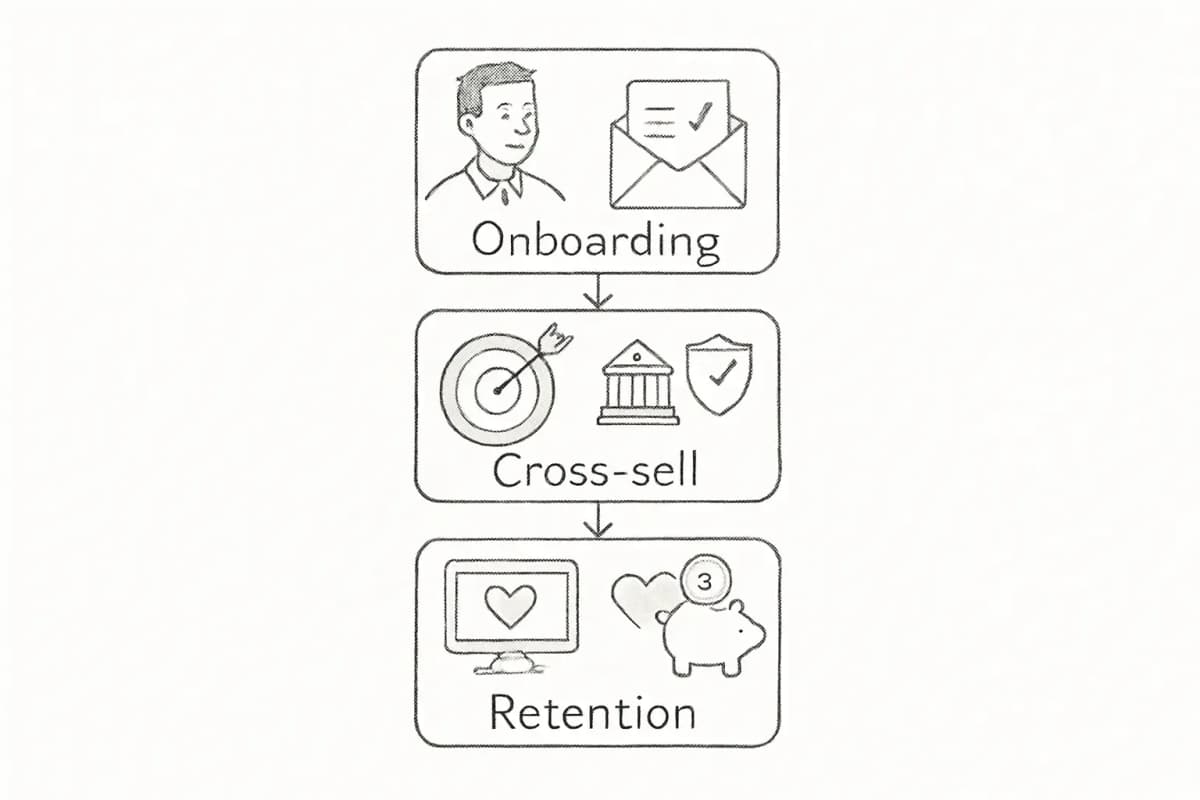
A well-structured onboarding sequence covers: Days 1 to 7 (welcome communication, account activation confirmation, mobile app download prompt), Days 8 to 30 (financial health assessment, product recommendations based on stated needs, direct deposit setup), Days 31 to 60 (cross-sell relevant products, introduce credit card or auto loan opportunities, financial education content), and Days 61 to 90 (relationship deepening, community connection, satisfaction check-in).
The results of a disciplined onboarding sequence are significant. Georgia United Credit Union automated a new-member onboarding sequence that shared educational content and resources new members were most likely to need. The team partnered with its member experience team to identify pain points, learn what members were calling about, and address those topics in their onboarding emails. The series earned a 77% open rate on welcome emails.
For best practices on structuring that first sequence, see our post on welcome email sequence best practices, which covers proven timing, structure, and messaging strategies.
One case study showed how expanding a new-member onboarding program from 3 emails to 16 highly targeted emails, with automated workflows created to segment members and personalize outreach, delivered measurable results. The key is not volume but relevance: each email should answer a question the member has at that specific stage of their journey.
Personalization Beyond the First Name
Most credit unions practice "personalization theater." Using someone's first name in an email does not count. Meaningful personalization predicts financial needs based on life events, not age brackets or income levels.
According to McKinsey, 71% of consumers expect personalized interactions, and 76% report frustration when those expectations are not met. Over 53% of consumers explicitly expect their financial provider to use their personal data to create relevant experiences.
Effective personalization in credit union email marketing uses behavioral signals to anticipate needs. With marketing automation, a credit union can target the customer journey through email sequences that send automatically depending on where the member is in the application process. For example, a prospective member who visited specific pages related to auto loans can receive an email with low rates or current specials to help further their interests or start an application.
Emails are 50% more likely to be opened if the subject line includes the recipient's name, job title, recent purchase, or any other kind of relevant personalization. But personalization that maps to the member's actual financial situation, such as a loan offer sent to a member who just started researching auto loans, outperforms name-based personalization significantly.
Learn more about high-impact approaches in our guide to 7 email personalization techniques that boost conversions.
A well-structured onboarding sequence covers: Days 1 to 7 (welcome communication, account activation confirmation, mobile app download prompt), Days 8 to 30 (financial health assessment, product recommendations based on stated needs, direct deposit setup), Days 31 to 60 (cross-sell relevant products, introduce credit card or auto loan opportunities, financial education content), and Days 61 to 90 (relationship deepening, community connection, satisfaction check-in).
The results of a disciplined onboarding sequence are significant. Georgia United Credit Union automated a new-member onboarding sequence that shared educational content and resources new members were most likely to need. The team partnered with its member experience team to identify pain points, learn what members were calling about, and address those topics in their onboarding emails. The series earned a 77% open rate on welcome emails.
For best practices on structuring that first sequence, see our post on welcome email sequence best practices, which covers proven timing, structure, and messaging strategies.
One case study showed how expanding a new-member onboarding program from 3 emails to 16 highly targeted emails, with automated workflows created to segment members and personalize outreach, delivered measurable results. The key is not volume but relevance: each email should answer a question the member has at that specific stage of their journey.
Personalization Beyond the First Name
Most credit unions practice "personalization theater." Using someone's first name in an email does not count. Meaningful personalization predicts financial needs based on life events, not age brackets or income levels.
According to McKinsey, 71% of consumers expect personalized interactions, and 76% report frustration when those expectations are not met. Over 53% of consumers explicitly expect their financial provider to use their personal data to create relevant experiences.
Effective personalization in credit union email marketing uses behavioral signals to anticipate needs. With marketing automation, a credit union can target the customer journey through email sequences that send automatically depending on where the member is in the application process. For example, a prospective member who visited specific pages related to auto loans can receive an email with low rates or current specials to help further their interests or start an application.
Emails are 50% more likely to be opened if the subject line includes the recipient's name, job title, recent purchase, or any other kind of relevant personalization. But personalization that maps to the member's actual financial situation, such as a loan offer sent to a member who just started researching auto loans, outperforms name-based personalization significantly.
Learn more about high-impact approaches in our guide to 7 email personalization techniques that boost conversions.
Email Content That Builds Trust and Drives Action
Credit unions have an asset that banks and fintechs cannot replicate: genuine community authority. Email content should reflect that.
Educational content transforms credit union email marketing into more than a promotion tool. It becomes a platform for empowerment. Credit unions become trusted advisors by sharing financial literacy tips and tailored advice, building loyalty far deeper than dollars and cents.
High-performing credit union email content types:
Rate announcements: Time-sensitive, directly valuable, and consistently high-click
Product awareness: Relevant product introductions tied to member life stage or behavior
Community updates: Local events, member stories, and charitable initiatives
Re-engagement campaigns: Win-back emails for dormant members with tailored incentives
To improve click-through rate, emails should contain clear calls to action and genuinely valuable content. Rate announcements, financial education resources, and personalized product recommendations consistently drive clicks.
Subject lines also carry significant weight. Personalized email subject lines can increase open rates by 26%. Review our email subject line best practices that boost open rates for a tested framework you can apply to every send.
Key Metrics for Credit Union Email Marketing
By tracking the right benchmarks and understanding the drivers behind them, banks and credit unions can continuously improve their marketing performance.
Credit union email benchmarks to target:
Metric
Credit Union Benchmark
Open rate (general)
38.5%
Welcome email open rate
62%
Click-through rate
3.2%
Bounce rate
Below 2%
Unsubscribe rate
Below 0.5%
Delivery rate
95%+
For onboarding and important account updates, aim for 30%+ open rates; for promotional emails, target 25%+.
Beyond open rates, the metrics that drive board-level decisions are different. Board members want outcome metrics: cost per new member, deposit growth attributed to marketing, and lifetime value projections. BAI's 2025 guidance emphasizes that winning over your CFO requires data-driven budget justification.
Email Content That Builds Trust and Drives Action
Credit unions have an asset that banks and fintechs cannot replicate: genuine community authority. Email content should reflect that.
Educational content transforms credit union email marketing into more than a promotion tool. It becomes a platform for empowerment. Credit unions become trusted advisors by sharing financial literacy tips and tailored advice, building loyalty far deeper than dollars and cents.
High-performing credit union email content types:
Rate announcements: Time-sensitive, directly valuable, and consistently high-click
Product awareness: Relevant product introductions tied to member life stage or behavior
Community updates: Local events, member stories, and charitable initiatives
Re-engagement campaigns: Win-back emails for dormant members with tailored incentives
To improve click-through rate, emails should contain clear calls to action and genuinely valuable content. Rate announcements, financial education resources, and personalized product recommendations consistently drive clicks.
Subject lines also carry significant weight. Personalized email subject lines can increase open rates by 26%. Review our email subject line best practices that boost open rates for a tested framework you can apply to every send.
Key Metrics for Credit Union Email Marketing
By tracking the right benchmarks and understanding the drivers behind them, banks and credit unions can continuously improve their marketing performance.
Credit union email benchmarks to target:
Metric
Credit Union Benchmark
Open rate (general)
38.5%
Welcome email open rate
62%
Click-through rate
3.2%
Bounce rate
Below 2%
Unsubscribe rate
Below 0.5%
Delivery rate
95%+
For onboarding and important account updates, aim for 30%+ open rates; for promotional emails, target 25%+.
Beyond open rates, the metrics that drive board-level decisions are different. Board members want outcome metrics: cost per new member, deposit growth attributed to marketing, and lifetime value projections. BAI's 2025 guidance emphasizes that winning over your CFO requires data-driven budget justification.
Tie campaign metrics to downstream outcomes: loan applications generated, products opened per member, and deposit growth attributed to specific email flows. This is the reporting that justifies budget and expands your program.
Frequently Asked Questions
What is a good email open rate for credit unions?
According to Mailchimp benchmarks, credit unions achieve a 38.5% open rate, which significantly exceeds most industries. When a credit union sends an email, more than one-third of recipients actually read it. Welcome emails perform even higher. The 62% welcome email open rate demonstrates the engagement window that opens when new members join.
How often should a credit union send marketing emails?
Sending 5 to 8 emails per month shows the highest ROI, around $48 per dollar spent. Most brands send emails 2 to 4 times per month, which is the most common cadence. For credit unions, the right frequency depends on the content's relevance. Behavioral and lifecycle-triggered emails (like onboarding sequences or product follow-ups) can exceed that frequency without hurting engagement because they respond to member actions rather than arbitrary schedules.
How is credit union email marketing different from bank email marketing?
Credit union marketing differs from bank email marketing in three key ways: member-not-customer positioning that emphasizes ownership and community, compliance requirements that affect messaging and targeting options, and smaller marketing budgets that demand higher efficiency. Credit unions also have a trust advantage, since members are owners rather than customers, which makes educational and value-driven content perform better than it would in traditional bank email marketing.
What regulations apply to credit union email marketing?
Credit union email marketing must comply with the CAN-SPAM Act, which governs all commercial emails, and the Gramm-Leach-Bliley Act (GLBA), which governs financial data privacy. Financial institutions covered by the Gramm-Leach-Bliley Act must tell their customers about their information-sharing practices and explain to customers their right to opt out if they do not want their information shared with certain third parties. Credit unions regulated by the NCUA must also meet Regulation P requirements, which govern member privacy notices and data sharing disclosures.
What types of emails work best for member retention at credit unions?
Successful credit unions use automated email marketing strategies including personalized onboarding, targeted product recommendations, and data segmentation to boost engagement and revenue. With thoughtful planning, behavior-based triggers, and clear consent practices, credit unions can deliver timely, relevant content that meets members where they are and turns everyday communications into lasting loyalty. Re-engagement campaigns, financial education series, and lifecycle-triggered cross-sell emails consistently show the strongest retention outcomes.
No comments yet. Be the first!
Tie campaign metrics to downstream outcomes: loan applications generated, products opened per member, and deposit growth attributed to specific email flows. This is the reporting that justifies budget and expands your program.
Frequently Asked Questions
What is a good email open rate for credit unions?
According to Mailchimp benchmarks, credit unions achieve a 38.5% open rate, which significantly exceeds most industries. When a credit union sends an email, more than one-third of recipients actually read it. Welcome emails perform even higher. The 62% welcome email open rate demonstrates the engagement window that opens when new members join.
How often should a credit union send marketing emails?
Sending 5 to 8 emails per month shows the highest ROI, around $48 per dollar spent. Most brands send emails 2 to 4 times per month, which is the most common cadence. For credit unions, the right frequency depends on the content's relevance. Behavioral and lifecycle-triggered emails (like onboarding sequences or product follow-ups) can exceed that frequency without hurting engagement because they respond to member actions rather than arbitrary schedules.
How is credit union email marketing different from bank email marketing?
Credit union marketing differs from bank email marketing in three key ways: member-not-customer positioning that emphasizes ownership and community, compliance requirements that affect messaging and targeting options, and smaller marketing budgets that demand higher efficiency. Credit unions also have a trust advantage, since members are owners rather than customers, which makes educational and value-driven content perform better than it would in traditional bank email marketing.
What regulations apply to credit union email marketing?
Credit union email marketing must comply with the CAN-SPAM Act, which governs all commercial emails, and the Gramm-Leach-Bliley Act (GLBA), which governs financial data privacy. Financial institutions covered by the Gramm-Leach-Bliley Act must tell their customers about their information-sharing practices and explain to customers their right to opt out if they do not want their information shared with certain third parties. Credit unions regulated by the NCUA must also meet Regulation P requirements, which govern member privacy notices and data sharing disclosures.
What types of emails work best for member retention at credit unions?
Successful credit unions use automated email marketing strategies including personalized onboarding, targeted product recommendations, and data segmentation to boost engagement and revenue. With thoughtful planning, behavior-based triggers, and clear consent practices, credit unions can deliver timely, relevant content that meets members where they are and turns everyday communications into lasting loyalty. Re-engagement campaigns, financial education series, and lifecycle-triggered cross-sell emails consistently show the strongest retention outcomes.