Manufacturing companies sell into long, complex buying cycles where a single deal can take months or years to close. In that environment, staying relevant across every stage of the sales process is what separates manufacturers who grow from those who stagnate. Email marketing for manufacturers solves that problem directly: it is a low-cost, high-return channel that keeps your brand in front of engineers, procurement managers, and executives throughout a procurement process that no other channel can sustain as efficiently.
The industrial and manufacturing sectors demonstrate that targeted, steady communication works, with 61% of respondents in these industries rating their email ROI as excellent or very good. That number is not an accident. This high ROI reflects consistency and focus in long-cycle B2B sales, where email remains an essential tool for maintaining visibility across extended procurement processes.
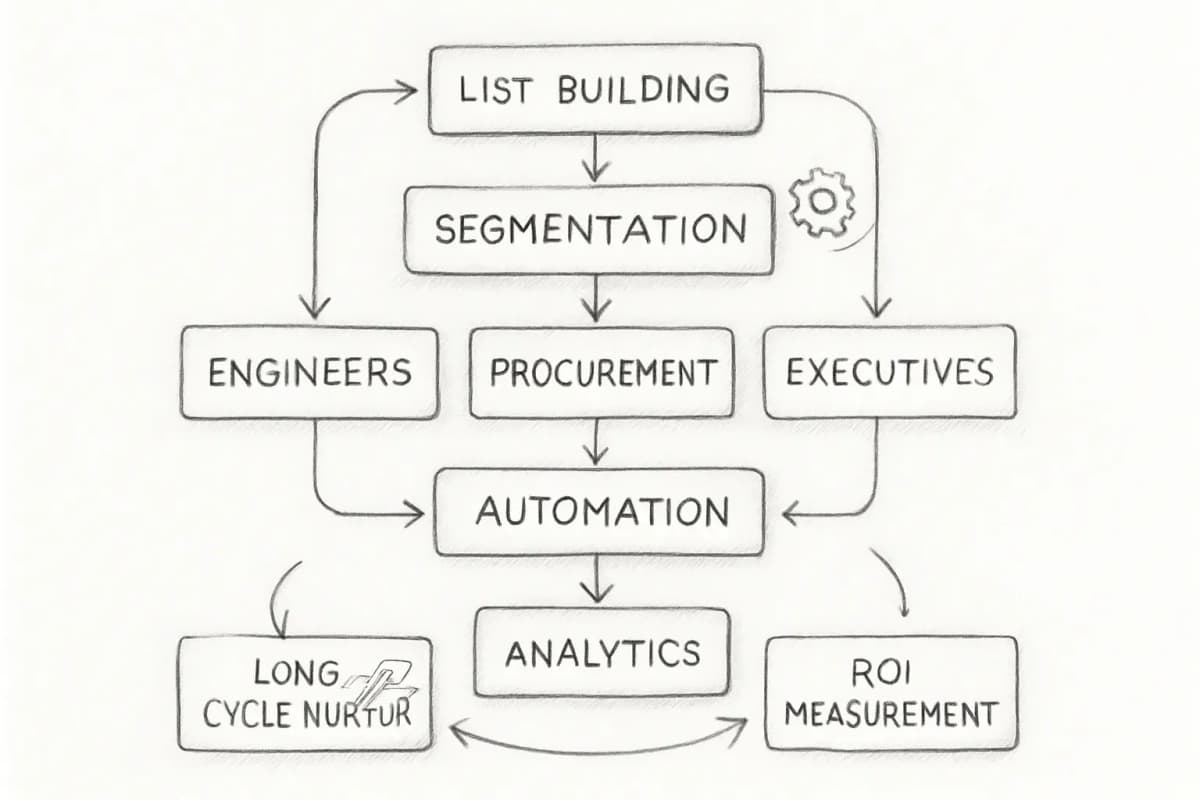
This guide breaks down how manufacturers should build, segment, automate, and measure an email program that converts contacts into customers.
Key Takeaways
For every $1 spent on email marketing, $36 is made in return, according to Litmus data.
74% of manufacturing marketers use email newsletters to distribute content, and 63% use other marketing and sales emails to nurture leads and win new business.
Companies using automation for lead nurturing generate 50% more sales-ready leads.
89% of engineers subscribe to at least one newsletter, and 54% subscribe to at least three, according to a 2023 TrewMarketing study.
Segmenting by buyer role (engineer, procurement, executive) and funnel stage is the single most impactful lever manufacturers can pull to improve email performance.
Why Email Works Differently for Manufacturers
Most marketing advice assumes a short sales cycle. Manufacturing is the opposite. For prospects working in commercial applications, the lead-to-sale timeline can stretch well over a year before an order is placed. That reality makes email indispensable, because it is the only channel that can maintain consistent, personalized contact over that timeline without requiring a human touchpoint at every stage.
73% of B2B buyers prefer that sellers contact them via email, which makes the inbox the natural home for manufacturer outreach. And the audience in manufacturing is already conditioned to receive and act on email: 89% of engineers subscribe to at least one newsletter, and 34% go to vendor emails and publication emails when researching a product or service for work.
Manufacturing companies sell into long, complex buying cycles where a single deal can take months or years to close. In that environment, staying relevant across every stage of the sales process is what separates manufacturers who grow from those who stagnate. Email marketing for manufacturers solves that problem directly: it is a low-cost, high-return channel that keeps your brand in front of engineers, procurement managers, and executives throughout a procurement process that no other channel can sustain as efficiently.
The industrial and manufacturing sectors demonstrate that targeted, steady communication works, with 61% of respondents in these industries rating their email ROI as excellent or very good. That number is not an accident. This high ROI reflects consistency and focus in long-cycle B2B sales, where email remains an essential tool for maintaining visibility across extended procurement processes.
This guide breaks down how manufacturers should build, segment, automate, and measure an email program that converts contacts into customers.
Key Takeaways
For every $1 spent on email marketing, $36 is made in return, according to Litmus data.
74% of manufacturing marketers use email newsletters to distribute content, and 63% use other marketing and sales emails to nurture leads and win new business.
Companies using automation for lead nurturing generate 50% more sales-ready leads.
89% of engineers subscribe to at least one newsletter, and 54% subscribe to at least three, according to a 2023 TrewMarketing study.
Segmenting by buyer role (engineer, procurement, executive) and funnel stage is the single most impactful lever manufacturers can pull to improve email performance.
Why Email Works Differently for Manufacturers
Most marketing advice assumes a short sales cycle. Manufacturing is the opposite. For prospects working in commercial applications, the lead-to-sale timeline can stretch well over a year before an order is placed. That reality makes email indispensable, because it is the only channel that can maintain consistent, personalized contact over that timeline without requiring a human touchpoint at every stage.
73% of B2B buyers prefer that sellers contact them via email, which makes the inbox the natural home for manufacturer outreach. And the audience in manufacturing is already conditioned to receive and act on email: 89% of engineers subscribe to at least one newsletter, and 34% go to vendor emails and publication emails when researching a product or service for work.
The challenge is not convincing manufacturing buyers to use email. It is sending them the right content, at the right stage, to the right person in the buying committee.
Build Your List the Right Way
Bought lists do not work for manufacturers. While you may want to purchase an email list, it is never a good idea, especially for B2B manufacturing contacts. The main benefit of email marketing is communicating with contacts who are already interested in your company, so quality outweighs quantity.
Instead, build a permission-based list through channels your buyers already use:
Include website pop-ups or footer CTAs for newsletter subscriptions, collect contact information from trade show or event attendees, and create gated content such as eBooks or whitepapers that users can download after providing their email.
Add email capture to product specification pages and CAD file download flows, where engineers are already in active research mode.
Promote your newsletter in trade publications and industry directories your buyers read.
The goal is a smaller, higher-quality list of contacts who have indicated interest in what you make. A list of 2,000 engaged procurement managers at relevant companies is worth far more than 20,000 unqualified contacts who will never open a single email.
Segment by Buyer Role and Funnel Stage
Manufacturing purchases rarely involve one decision-maker. An average of 6 to 10 people are involved in the decision process in B2B buying committees. Each of those people needs different information from you.
The three core personas in most industrial buying situations are:
The Engineer: Focused on specifications, technical compatibility, and performance data. Send them CAD files, data sheets, application notes, and technical case studies.
The Procurement Manager: Focused on price, lead times, supplier reliability, and approved vendor status. Procurement managers will frequently request samples for testing or additional information before negotiating contract terms and pricing. Give them proof of supply chain stability and comparison data.
The Executive (CEO/CFO): Focused on ROI, strategic risk, and total cost of ownership. Send them business case summaries and outcome-focused case studies.
Manufacturing buyers expect specificity, not general marketing language. Sending the same email to an engineer and a CFO wastes both their time and yours. Segment your list by role from the start, and use CRM tagging or form fields to capture job title data at the point of subscription.
The challenge is not convincing manufacturing buyers to use email. It is sending them the right content, at the right stage, to the right person in the buying committee.
Build Your List the Right Way
Bought lists do not work for manufacturers. While you may want to purchase an email list, it is never a good idea, especially for B2B manufacturing contacts. The main benefit of email marketing is communicating with contacts who are already interested in your company, so quality outweighs quantity.
Instead, build a permission-based list through channels your buyers already use:
Include website pop-ups or footer CTAs for newsletter subscriptions, collect contact information from trade show or event attendees, and create gated content such as eBooks or whitepapers that users can download after providing their email.
Add email capture to product specification pages and CAD file download flows, where engineers are already in active research mode.
Promote your newsletter in trade publications and industry directories your buyers read.
The goal is a smaller, higher-quality list of contacts who have indicated interest in what you make. A list of 2,000 engaged procurement managers at relevant companies is worth far more than 20,000 unqualified contacts who will never open a single email.
Segment by Buyer Role and Funnel Stage
Manufacturing purchases rarely involve one decision-maker. An average of 6 to 10 people are involved in the decision process in B2B buying committees. Each of those people needs different information from you.
The three core personas in most industrial buying situations are:
The Engineer: Focused on specifications, technical compatibility, and performance data. Send them CAD files, data sheets, application notes, and technical case studies.
The Procurement Manager: Focused on price, lead times, supplier reliability, and approved vendor status. Procurement managers will frequently request samples for testing or additional information before negotiating contract terms and pricing. Give them proof of supply chain stability and comparison data.
The Executive (CEO/CFO): Focused on ROI, strategic risk, and total cost of ownership. Send them business case summaries and outcome-focused case studies.
Manufacturing buyers expect specificity, not general marketing language. Sending the same email to an engineer and a CFO wastes both their time and yours. Segment your list by role from the start, and use CRM tagging or form fields to capture job title data at the point of subscription.
Beyond role, segment by funnel stage: awareness (educational content), consideration (product comparisons, case studies, demos), and decision (quotes, implementation guides, references). For a deeper look at how segmentation drives measurable results, see our guide on email list segmentation strategies that boost ROI.
What to Send: Content That Serves the Sales Cycle
Your email needs to include valuable B2B content to improve engagement. In manufacturing, your audience expects authority and educational content to help them use your products or do their jobs better. Your emails should focus more on education and less on making a sale, to build credibility.
Effective content types for manufacturers include:
Technical newsletters: Industry updates, regulatory changes, material or process innovations relevant to your customers' operations.
Product application emails: Show how your products solve specific problems in real industrial settings. Use images and short videos of products in action.
Case studies: Quantified results from real customers in similar industries or applications. Engineers and procurement managers both respond to documented proof.
Trade show follow-up sequences: Use email to turn trade show handshakes into active sales conversations, and re-engage prospects who received a quote months ago with a timely case study or update on new technical capabilities.
Win-back campaigns: For dormant contacts in your CRM, a structured re-engagement sequence can determine whether the prospect is still viable before your sales team spends time on outreach.
Campaigns that educate, inform, and reassure are more effective than an aggressive sales approach in industrial markets. Every email should give the recipient something useful regardless of whether they are ready to buy.
Strong subject lines are the gateway to all of this. A subject line that speaks directly to a reader's role and current problem will always outperform a generic product announcement. Our email subject line best practices guide covers the specific tactics that lift open rates by a measurable margin.
Automate the Long Sales Cycle
Manual email follow-up cannot sustain a 12-month nurture sequence. Automation is what makes email marketing scalable for manufacturers with small marketing teams and long buying cycles.
Automated emails generate 320% more revenue than non-automated emails, a gap that reflects the power of behavioral triggers, personalization at scale, and precision timing. For manufacturers, the most valuable automation flows are:
Beyond role, segment by funnel stage: awareness (educational content), consideration (product comparisons, case studies, demos), and decision (quotes, implementation guides, references). For a deeper look at how segmentation drives measurable results, see our guide on email list segmentation strategies that boost ROI.
What to Send: Content That Serves the Sales Cycle
Your email needs to include valuable B2B content to improve engagement. In manufacturing, your audience expects authority and educational content to help them use your products or do their jobs better. Your emails should focus more on education and less on making a sale, to build credibility.
Effective content types for manufacturers include:
Technical newsletters: Industry updates, regulatory changes, material or process innovations relevant to your customers' operations.
Product application emails: Show how your products solve specific problems in real industrial settings. Use images and short videos of products in action.
Case studies: Quantified results from real customers in similar industries or applications. Engineers and procurement managers both respond to documented proof.
Trade show follow-up sequences: Use email to turn trade show handshakes into active sales conversations, and re-engage prospects who received a quote months ago with a timely case study or update on new technical capabilities.
Win-back campaigns: For dormant contacts in your CRM, a structured re-engagement sequence can determine whether the prospect is still viable before your sales team spends time on outreach.
Campaigns that educate, inform, and reassure are more effective than an aggressive sales approach in industrial markets. Every email should give the recipient something useful regardless of whether they are ready to buy.
Strong subject lines are the gateway to all of this. A subject line that speaks directly to a reader's role and current problem will always outperform a generic product announcement. Our email subject line best practices guide covers the specific tactics that lift open rates by a measurable margin.
Automate the Long Sales Cycle
Manual email follow-up cannot sustain a 12-month nurture sequence. Automation is what makes email marketing scalable for manufacturers with small marketing teams and long buying cycles.
Automated emails generate 320% more revenue than non-automated emails, a gap that reflects the power of behavioral triggers, personalization at scale, and precision timing. For manufacturers, the most valuable automation flows are:
Welcome sequences: A triggered welcome email after a content download or subscription can deliver 4x the open rate and 5x the click rate of a standard campaign. Use a 3- to 5-email sequence to introduce your capabilities and direct new contacts toward relevant resources.
Lead nurture drips: Time-released sequences that move contacts from awareness through consideration over weeks or months. Tie content to funnel stage and persona role.
Behavior-triggered emails: Send a technical data sheet when someone downloads a product spec. Follow up a pricing page visit with a procurement-focused case study.
Re-engagement sequences: Set a trigger for contacts who have not opened or clicked in six months. Companies using automation for lead nurturing generate 50% more sales-ready leads, and re-engagement flows help recover contacts who would otherwise go cold.
A manufacturer that has various audiences with varying timelines needs to account for this when building automated email workflows. An architect specifying products for a commercial project operates on a completely different timeline than an MRO buyer with an urgent parts need. Your automation logic should reflect that.
For a structured approach to setting up these sequences, see our welcome email sequence best practices guide.
Measure What Matters
Roughly 50% of brands do not measure email interactions down to the conversion level, and fewer than 20% measure email marketing ROI, according to HubSpot research. That is a significant blind spot, particularly for manufacturers where a single converted lead can represent six or seven figures in revenue.
The metrics worth tracking for manufacturers:
Click-through rate (CTR): Measures whether your content is relevant enough to prompt action. B2B emails have a 3.18% click rate on average, so segment-level CTR benchmarked against that baseline tells you whether your content is hitting or missing.
Conversion rate: The percentage of recipients who take a meaningful next step, such as requesting a quote, downloading a spec sheet, or booking a demo. This is the metric most directly tied to pipeline.
Lead-to-opportunity rate: Track how many email-sourced leads become active sales opportunities. This connects your email program to revenue rather than just engagement.
Unsubscribe rate: A rising unsubscribe rate signals that frequency, relevance, or both are off. Segment-level unsubscribes tell you which audience is disengaging so you can fix the content before you lose more contacts.
A/B testing is a straightforward way to improve performance continuously. In A/B testing, you compare the results of two variations of the same element such as subject lines, sender names, or CTA buttons, then tailor your content and messaging based on what your audience responds to best.
None of the strategy above matters if your emails land in spam. Inbox placement is harder than it used to be. Roughly 7% of emails now land in spam, directly reducing ROI.
Welcome sequences: A triggered welcome email after a content download or subscription can deliver 4x the open rate and 5x the click rate of a standard campaign. Use a 3- to 5-email sequence to introduce your capabilities and direct new contacts toward relevant resources.
Lead nurture drips: Time-released sequences that move contacts from awareness through consideration over weeks or months. Tie content to funnel stage and persona role.
Behavior-triggered emails: Send a technical data sheet when someone downloads a product spec. Follow up a pricing page visit with a procurement-focused case study.
Re-engagement sequences: Set a trigger for contacts who have not opened or clicked in six months. Companies using automation for lead nurturing generate 50% more sales-ready leads, and re-engagement flows help recover contacts who would otherwise go cold.
A manufacturer that has various audiences with varying timelines needs to account for this when building automated email workflows. An architect specifying products for a commercial project operates on a completely different timeline than an MRO buyer with an urgent parts need. Your automation logic should reflect that.
For a structured approach to setting up these sequences, see our welcome email sequence best practices guide.
Measure What Matters
Roughly 50% of brands do not measure email interactions down to the conversion level, and fewer than 20% measure email marketing ROI, according to HubSpot research. That is a significant blind spot, particularly for manufacturers where a single converted lead can represent six or seven figures in revenue.
The metrics worth tracking for manufacturers:
Click-through rate (CTR): Measures whether your content is relevant enough to prompt action. B2B emails have a 3.18% click rate on average, so segment-level CTR benchmarked against that baseline tells you whether your content is hitting or missing.
Conversion rate: The percentage of recipients who take a meaningful next step, such as requesting a quote, downloading a spec sheet, or booking a demo. This is the metric most directly tied to pipeline.
Lead-to-opportunity rate: Track how many email-sourced leads become active sales opportunities. This connects your email program to revenue rather than just engagement.
Unsubscribe rate: A rising unsubscribe rate signals that frequency, relevance, or both are off. Segment-level unsubscribes tell you which audience is disengaging so you can fix the content before you lose more contacts.
A/B testing is a straightforward way to improve performance continuously. In A/B testing, you compare the results of two variations of the same element such as subject lines, sender names, or CTA buttons, then tailor your content and messaging based on what your audience responds to best.
None of the strategy above matters if your emails land in spam. Inbox placement is harder than it used to be. Roughly 7% of emails now land in spam, directly reducing ROI.
Manufacturers often have older contact databases assembled over years of trade shows, referrals, and legacy CRM imports. These lists accumulate invalid and inactive addresses that damage sender reputation over time. Address this with:
Regular list hygiene: Remove hard bounces immediately. Suppress contacts who have not engaged in 12 or more months, or run a re-engagement campaign before suppressing them.
Authenticated sending: Set up SPF, DKIM, and DMARC records for your sending domain. This is a technical baseline, not optional.
Consistent sending volume: Sudden spikes in volume trigger spam filters. Build cadence gradually, especially when using a new sending domain or IP.
Preference centers: Let subscribers choose their content type and frequency. Contacts who self-select their preferences are more engaged and less likely to mark you as spam.
The biggest gains in email ROI come from automation, personalization, deliverability discipline, and realistic attribution. When email is treated as a system rather than a tactic, the numbers consistently outperform nearly every alternative.
Frequently Asked Questions
What types of emails work best for manufacturers?
Educational content performs best across the manufacturing sales cycle. You can educate and inform your audience through email by offering practical tips, advice, and best practices related to manufacturing processes, equipment maintenance, safety protocols, or efficiency improvements. Case studies, technical application emails, and product update newsletters consistently outperform promotional emails in industrial markets because they deliver value regardless of where the buyer is in the procurement process.
How often should manufacturers send marketing emails?
The majority of industrial audiences prefer newsletters delivered either weekly or monthly, according to TrewMarketing research. For most manufacturers, a monthly or bi-weekly cadence works well for newsletters, with behavior-triggered emails sent as needed based on contact activity. Frequency should match the complexity of your sales cycle: high-consideration, long-cycle products warrant a slower, more deliberate cadence than consumables or maintenance supplies.
How do manufacturers build an email list without buying one?
Manufacturers often have older contact databases assembled over years of trade shows, referrals, and legacy CRM imports. These lists accumulate invalid and inactive addresses that damage sender reputation over time. Address this with:
Regular list hygiene: Remove hard bounces immediately. Suppress contacts who have not engaged in 12 or more months, or run a re-engagement campaign before suppressing them.
Authenticated sending: Set up SPF, DKIM, and DMARC records for your sending domain. This is a technical baseline, not optional.
Consistent sending volume: Sudden spikes in volume trigger spam filters. Build cadence gradually, especially when using a new sending domain or IP.
Preference centers: Let subscribers choose their content type and frequency. Contacts who self-select their preferences are more engaged and less likely to mark you as spam.
The biggest gains in email ROI come from automation, personalization, deliverability discipline, and realistic attribution. When email is treated as a system rather than a tactic, the numbers consistently outperform nearly every alternative.
Frequently Asked Questions
What types of emails work best for manufacturers?
Educational content performs best across the manufacturing sales cycle. You can educate and inform your audience through email by offering practical tips, advice, and best practices related to manufacturing processes, equipment maintenance, safety protocols, or efficiency improvements. Case studies, technical application emails, and product update newsletters consistently outperform promotional emails in industrial markets because they deliver value regardless of where the buyer is in the procurement process.
How often should manufacturers send marketing emails?
The majority of industrial audiences prefer newsletters delivered either weekly or monthly, according to TrewMarketing research. For most manufacturers, a monthly or bi-weekly cadence works well for newsletters, with behavior-triggered emails sent as needed based on contact activity. Frequency should match the complexity of your sales cycle: high-consideration, long-cycle products warrant a slower, more deliberate cadence than consumables or maintenance supplies.
How do manufacturers build an email list without buying one?
Effective list-building strategies for manufacturers include adding website subscription CTAs, collecting contact information from trade show attendees, creating gated content such as eBooks or whitepapers, and promoting the email newsletter across other content channels such as social media and blogs. Product specification pages and CAD file download flows are particularly high-intent touchpoints where engineers are already researching and are receptive to subscribing for relevant updates.
What ROI can manufacturers expect from email marketing?
61% of respondents in the industrial and manufacturing sectors rate their email ROI as excellent or very good. The broad industry benchmark is a return of $36 for every $1 spent, but manufacturers with strong segmentation and automation in place consistently outperform that average. Automated workflows generate 30x higher returns compared to one-off email campaigns, which means the gap between manufacturers with a system and those without one is substantial.
No comments yet. Be the first!
Effective list-building strategies for manufacturers include adding website subscription CTAs, collecting contact information from trade show attendees, creating gated content such as eBooks or whitepapers, and promoting the email newsletter across other content channels such as social media and blogs. Product specification pages and CAD file download flows are particularly high-intent touchpoints where engineers are already researching and are receptive to subscribing for relevant updates.
What ROI can manufacturers expect from email marketing?
61% of respondents in the industrial and manufacturing sectors rate their email ROI as excellent or very good. The broad industry benchmark is a return of $36 for every $1 spent, but manufacturers with strong segmentation and automation in place consistently outperform that average. Automated workflows generate 30x higher returns compared to one-off email campaigns, which means the gap between manufacturers with a system and those without one is substantial.