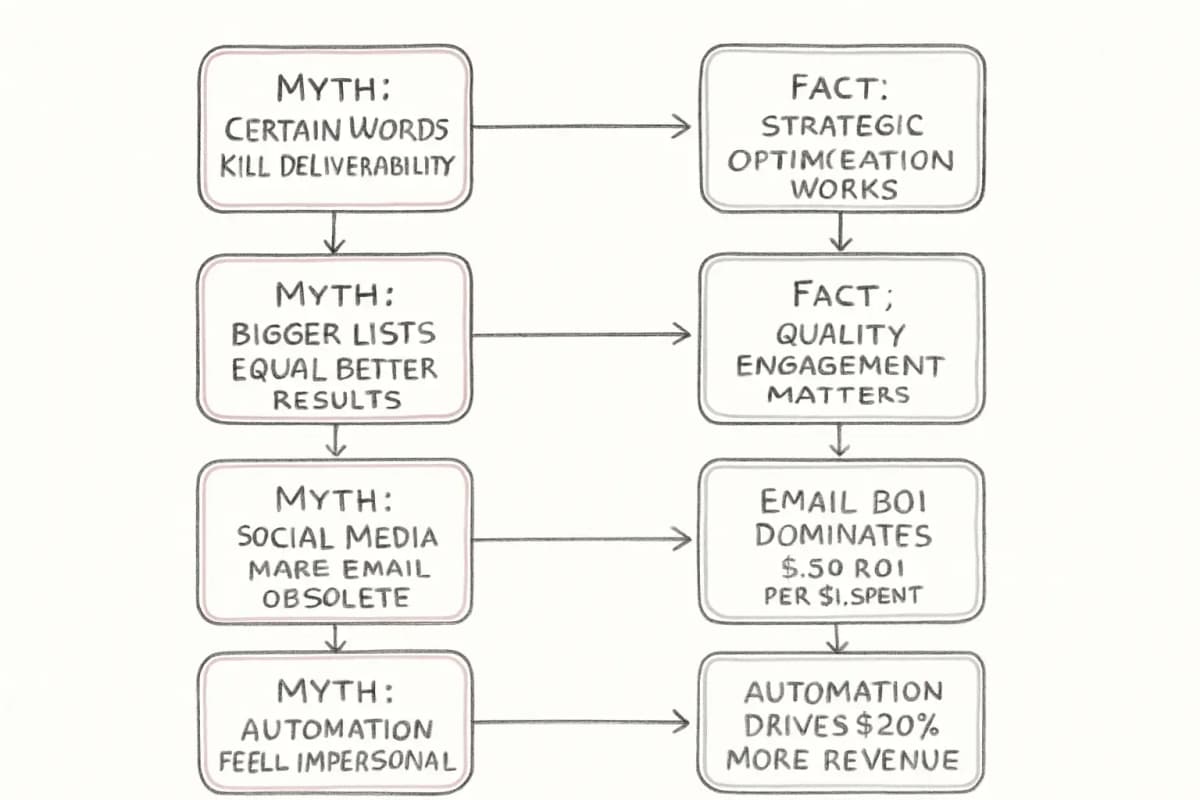
Most email marketers are working from a rulebook full of outdated assumptions. They believe certain words kill deliverability, that bigger lists mean better results, and that social media has made email obsolete. These email marketing myths do real damage, because they lead to decisions that leave money on the table and tank performance metrics. This post goes through the most persistent myths in the industry and replaces them with what the data actually shows.
Key Takeaways
Email marketing generates an average ROI of $36 for every $1 spent, according to a 2024 report by Litmus, making the "email is dead" narrative factually wrong.
Segmented campaigns deliver a 760% revenue increase compared to broadcast campaigns.
Emails with personalized content have a 29% higher open rate and a 41% higher click-through rate.
Unsubscribes via the direct unsubscribe link in your email have no known effect on your email sender reputation or deliverability, according to Litmus.
An estimated 50 to 60% of email opens come from mobile devices in 2024, making mobile optimization non-negotiable.
Myth 1: Email Marketing Is Dead
This myth resurfaces every few years, usually from people selling the next hot platform. The numbers do not support it.
Email marketing continues to thrive, with over 4 billion people worldwide checking their inboxes daily. 42% of marketers say email is their most effective channel, far ahead of social media and paid search, which both sit at just 16%. In 2024, 50% of consumers said they purchased directly from an email, more than from social media posts or ads.
89% of marketers use email as their primary lead generation channel, while 81% of SMEs rely on it to reach customers.
The "email is dead" narrative often comes from those pushing newer tools. The data consistently says otherwise.
Myth 2: A Bigger List Always Means Better Results
List size is a vanity metric. What matters is list quality.
A common belief is that a larger email list equates to greater success and revenue. While having a substantial list can be beneficial, the focus on quantity over quality can be misguided. A large list filled with unengaged or irrelevant contacts can hurt your deliverability. ISPs monitor engagement metrics, and low engagement from a big list can lead to emails being marked as spam.
Most email marketers are working from a rulebook full of outdated assumptions. They believe certain words kill deliverability, that bigger lists mean better results, and that social media has made email obsolete. These email marketing myths do real damage, because they lead to decisions that leave money on the table and tank performance metrics. This post goes through the most persistent myths in the industry and replaces them with what the data actually shows.
Key Takeaways
Email marketing generates an average ROI of $36 for every $1 spent, according to a 2024 report by Litmus, making the "email is dead" narrative factually wrong.
Segmented campaigns deliver a 760% revenue increase compared to broadcast campaigns.
Emails with personalized content have a 29% higher open rate and a 41% higher click-through rate.
Unsubscribes via the direct unsubscribe link in your email have no known effect on your email sender reputation or deliverability, according to Litmus.
An estimated 50 to 60% of email opens come from mobile devices in 2024, making mobile optimization non-negotiable.
Myth 1: Email Marketing Is Dead
This myth resurfaces every few years, usually from people selling the next hot platform. The numbers do not support it.
Email marketing continues to thrive, with over 4 billion people worldwide checking their inboxes daily. 42% of marketers say email is their most effective channel, far ahead of social media and paid search, which both sit at just 16%. In 2024, 50% of consumers said they purchased directly from an email, more than from social media posts or ads.
89% of marketers use email as their primary lead generation channel, while 81% of SMEs rely on it to reach customers.
The "email is dead" narrative often comes from those pushing newer tools. The data consistently says otherwise.
Myth 2: A Bigger List Always Means Better Results
List size is a vanity metric. What matters is list quality.
A common belief is that a larger email list equates to greater success and revenue. While having a substantial list can be beneficial, the focus on quantity over quality can be misguided. A large list filled with unengaged or irrelevant contacts can hurt your deliverability. ISPs monitor engagement metrics, and low engagement from a big list can lead to emails being marked as spam.
The fix is list segmentation. According to DMA, marketers have found a 760% increase in email revenue from segmented campaigns. Segmented email campaigns achieve a 14.31% higher open rate and a 100.95% higher click-through rate than non-segmented campaigns.
If you are sending the same email to everyone on a bloated list, you are not doing email marketing, you are doing email broadcasting, and there is a meaningful difference in results.
Myth 3: Personalization Just Means Using Someone's First Name
Using [First Name] in a subject line is a starting point, not a strategy. Real personalization is behavioral and contextual.
71% of consumers expect personalized interactions from brands, and 76% get frustrated when their brand interactions aren't personalized to their interests.
Adding attribute, behavior, and journey-based personalization to emails can improve the open rate by 20 to 40%. In fact, personalization can help email open rates reach as high as 37.04%.
Personalized emails generate 6x higher transaction rates. That is not a marginal gain from swapping in a first name. It comes from tailoring content to where a subscriber is in their customer journey, what they have browsed, what they have bought, and what problems they are trying to solve.
For practical techniques, see 7 email personalization techniques that boost conversions.
Myth 4: Certain Words Like "Free" Will Trigger Spam Filters
This myth has been circulating for years and causes marketers to write weaker subject lines than they need to.
According to HubSpot's Amanda MacDonald, Email Enablement Project Manager, "My least favorite email marketing myth is that using certain words like 'Free,' or exclamation points in your email will cause it to go to the spam folder."
The wording you use in the body of emails keeps subscribers engaged as they read the message, so it's unlikely that certain words will cause the email to be regarded as spam by the email browser's filtering system. As MacDonald states, "Email engagement is what determines if your email goes to the spam folder, so focusing on what drives engagement is key."
Modern spam filters evaluate sender reputation, authentication (SPF, DKIM, DMARC), and engagement signals. A word like "free" in a subject line from a trusted sender with strong authentication is not going to kill deliverability. Sending irrelevant emails to disengaged subscribers will.
Companies properly implementing DMARC see a 10 to 20% improvement in inbox placement rates, directly impacting campaign performance. With Gmail and Yahoo requiring DMARC for senders of 5,000 or more daily emails, authentication has become a deliverability prerequisite.
The fix is list segmentation. According to DMA, marketers have found a 760% increase in email revenue from segmented campaigns. Segmented email campaigns achieve a 14.31% higher open rate and a 100.95% higher click-through rate than non-segmented campaigns.
If you are sending the same email to everyone on a bloated list, you are not doing email marketing, you are doing email broadcasting, and there is a meaningful difference in results.
Myth 3: Personalization Just Means Using Someone's First Name
Using [First Name] in a subject line is a starting point, not a strategy. Real personalization is behavioral and contextual.
71% of consumers expect personalized interactions from brands, and 76% get frustrated when their brand interactions aren't personalized to their interests.
Adding attribute, behavior, and journey-based personalization to emails can improve the open rate by 20 to 40%. In fact, personalization can help email open rates reach as high as 37.04%.
Personalized emails generate 6x higher transaction rates. That is not a marginal gain from swapping in a first name. It comes from tailoring content to where a subscriber is in their customer journey, what they have browsed, what they have bought, and what problems they are trying to solve.
For practical techniques, see 7 email personalization techniques that boost conversions.
Myth 4: Certain Words Like "Free" Will Trigger Spam Filters
This myth has been circulating for years and causes marketers to write weaker subject lines than they need to.
According to HubSpot's Amanda MacDonald, Email Enablement Project Manager, "My least favorite email marketing myth is that using certain words like 'Free,' or exclamation points in your email will cause it to go to the spam folder."
The wording you use in the body of emails keeps subscribers engaged as they read the message, so it's unlikely that certain words will cause the email to be regarded as spam by the email browser's filtering system. As MacDonald states, "Email engagement is what determines if your email goes to the spam folder, so focusing on what drives engagement is key."
Modern spam filters evaluate sender reputation, authentication (SPF, DKIM, DMARC), and engagement signals. A word like "free" in a subject line from a trusted sender with strong authentication is not going to kill deliverability. Sending irrelevant emails to disengaged subscribers will.
Companies properly implementing DMARC see a 10 to 20% improvement in inbox placement rates, directly impacting campaign performance. With Gmail and Yahoo requiring DMARC for senders of 5,000 or more daily emails, authentication has become a deliverability prerequisite.
Focus your deliverability effort where it actually counts: authentication, list hygiene, and engagement rates.
Myth 5: Unsubscribes Are Terrible for Your Email Program
Seeing unsubscribes tick up feels discouraging. But treating them as a catastrophe leads to worse decisions than the unsubscribes themselves.
Unsubscribes via the direct unsubscribe link in your email have no known effect on your email sender reputation or deliverability. It can actually be a good thing because your list is now cleaner and more targeted toward the people that do want to receive your emails.
The real threat to your sender reputation is not someone clicking unsubscribe. It is someone clicking "Report Spam" instead, because you made it too hard to leave. Not providing a clear and easy way for recipients to opt out of your communications can severely harm your sender reputation, leading to lower inbox placement rates and a higher likelihood of your emails being flagged as spam.
Gmail and Yahoo have a 0.3% spam complaint threshold before you will start getting filtered into junk.
An unsubscribe is a clean, honest signal that someone no longer wants your emails. A spam complaint is a reputation hit that follows you. Make unsubscribing easy and welcome the people who leave.
Myth 6: There Is One Universal "Best Time" to Send Emails
Countless articles will tell you to send on Tuesday at 10am. This advice sounds authoritative and is nearly meaningless without context.
The "best time" to send your newsletter isn't universal. It depends on your audience. Your subscribers are diverse. Some may skim their inboxes mid-morning, while others catch up after dinner. While general statistics can offer a starting point, the real magic lies in testing and learning what works for your unique list.
According to HubSpot, Tuesdays are generally the most effective day, while Sundays are the least. However, after reviewing data from over 10,000 Canadian businesses and marketers, Cyberimpact found that Thursdays are the most popular day for email sends.
Different audiences behave differently. B2B readers behave differently than B2C. A SaaS audience behaves differently than an ecommerce customer. The only send time worth trusting is the one your own data supports. A/B test send times over several weeks before drawing any conclusions.
For subject line timing and performance insights based on real benchmarks, see email subject line best practices that boost open rates.
Myth 7: Mobile Optimization Is Optional
If you are still designing emails primarily for desktop and treating mobile as a secondary consideration, you are designing for a minority of your audience.
Mobile devices account for 55% of all email opens globally, with some sources reporting over 80% for specific audiences.
With over 55% of emails opened on mobile, and 75% of users deleting non-optimized messages, mobile-first email design is now a non-negotiable driver of engagement, clicks, and ROI.
Brands have observed a 15% rise in mobile clicks when they optimize email designs for mobile viewing.
Focus your deliverability effort where it actually counts: authentication, list hygiene, and engagement rates.
Myth 5: Unsubscribes Are Terrible for Your Email Program
Seeing unsubscribes tick up feels discouraging. But treating them as a catastrophe leads to worse decisions than the unsubscribes themselves.
Unsubscribes via the direct unsubscribe link in your email have no known effect on your email sender reputation or deliverability. It can actually be a good thing because your list is now cleaner and more targeted toward the people that do want to receive your emails.
The real threat to your sender reputation is not someone clicking unsubscribe. It is someone clicking "Report Spam" instead, because you made it too hard to leave. Not providing a clear and easy way for recipients to opt out of your communications can severely harm your sender reputation, leading to lower inbox placement rates and a higher likelihood of your emails being flagged as spam.
Gmail and Yahoo have a 0.3% spam complaint threshold before you will start getting filtered into junk.
An unsubscribe is a clean, honest signal that someone no longer wants your emails. A spam complaint is a reputation hit that follows you. Make unsubscribing easy and welcome the people who leave.
Myth 6: There Is One Universal "Best Time" to Send Emails
Countless articles will tell you to send on Tuesday at 10am. This advice sounds authoritative and is nearly meaningless without context.
The "best time" to send your newsletter isn't universal. It depends on your audience. Your subscribers are diverse. Some may skim their inboxes mid-morning, while others catch up after dinner. While general statistics can offer a starting point, the real magic lies in testing and learning what works for your unique list.
According to HubSpot, Tuesdays are generally the most effective day, while Sundays are the least. However, after reviewing data from over 10,000 Canadian businesses and marketers, Cyberimpact found that Thursdays are the most popular day for email sends.
Different audiences behave differently. B2B readers behave differently than B2C. A SaaS audience behaves differently than an ecommerce customer. The only send time worth trusting is the one your own data supports. A/B test send times over several weeks before drawing any conclusions.
For subject line timing and performance insights based on real benchmarks, see email subject line best practices that boost open rates.
Myth 7: Mobile Optimization Is Optional
If you are still designing emails primarily for desktop and treating mobile as a secondary consideration, you are designing for a minority of your audience.
Mobile devices account for 55% of all email opens globally, with some sources reporting over 80% for specific audiences.
With over 55% of emails opened on mobile, and 75% of users deleting non-optimized messages, mobile-first email design is now a non-negotiable driver of engagement, clicks, and ROI.
Brands have observed a 15% rise in mobile clicks when they optimize email designs for mobile viewing.
Mobile optimization is not just about making text bigger. It means single-column layouts, tap-friendly CTA buttons, concise preheader text, fast-loading images, and subject lines that work within the 25 to 30 characters a smartphone displays.
Myth 8: Automated Emails Feel Impersonal and Hurt Engagement
Many marketers resist automation because they worry it produces robotic, generic messages. The data shows the opposite.
Automated emails generate 320% more revenue than non-automated emails.
Welcome emails, a common automated trigger, achieve an impressive average open rate of 83.63% and a click-through rate of 16.60%, with a click-to-open rate of 19.85%.
Automation does not mean impersonal. It means timely. A cart abandonment email triggered 30 minutes after someone leaves your site feels relevant, not robotic. A re-engagement email sent to subscribers who have gone quiet for 90 days is useful, not generic. Leads nurtured through email automation tend to make purchases that are 47% larger than non-nurtured leads.
The key is building automation around behavior signals, not just time-based batch sends. See welcome email sequence best practices for a practical example of how to build automated sequences that earn engagement.
What Actually Works in Email Marketing
After clearing away the myths, the pattern in high-performing email programs is consistent:
Segmented lists with relevant, behavior-driven content
Genuine personalization that goes beyond a first name
Mobile-first design tested across devices
Clean authentication (SPF, DKIM, DMARC) as a baseline for deliverability
Ongoing A/B testing of subject lines, send times, and content formats
Automation built on triggers, not just calendar schedules
List hygiene maintained on a regular cycle
The most effective strategies for email marketing campaigns are subscriber segmentation (78%), message personalization (72%), and email automation campaigns (71%).
None of those are new ideas. They are just consistently overlooked in favor of chasing myths that feel like shortcuts.
Frequently Asked Questions
Does email marketing still have a strong ROI in 2025?
Mobile optimization is not just about making text bigger. It means single-column layouts, tap-friendly CTA buttons, concise preheader text, fast-loading images, and subject lines that work within the 25 to 30 characters a smartphone displays.
Myth 8: Automated Emails Feel Impersonal and Hurt Engagement
Many marketers resist automation because they worry it produces robotic, generic messages. The data shows the opposite.
Automated emails generate 320% more revenue than non-automated emails.
Welcome emails, a common automated trigger, achieve an impressive average open rate of 83.63% and a click-through rate of 16.60%, with a click-to-open rate of 19.85%.
Automation does not mean impersonal. It means timely. A cart abandonment email triggered 30 minutes after someone leaves your site feels relevant, not robotic. A re-engagement email sent to subscribers who have gone quiet for 90 days is useful, not generic. Leads nurtured through email automation tend to make purchases that are 47% larger than non-nurtured leads.
The key is building automation around behavior signals, not just time-based batch sends. See welcome email sequence best practices for a practical example of how to build automated sequences that earn engagement.
What Actually Works in Email Marketing
After clearing away the myths, the pattern in high-performing email programs is consistent:
Segmented lists with relevant, behavior-driven content
Genuine personalization that goes beyond a first name
Mobile-first design tested across devices
Clean authentication (SPF, DKIM, DMARC) as a baseline for deliverability
Ongoing A/B testing of subject lines, send times, and content formats
Automation built on triggers, not just calendar schedules
List hygiene maintained on a regular cycle
The most effective strategies for email marketing campaigns are subscriber segmentation (78%), message personalization (72%), and email automation campaigns (71%).
None of those are new ideas. They are just consistently overlooked in favor of chasing myths that feel like shortcuts.
Frequently Asked Questions
Does email marketing still have a strong ROI in 2025?
On average, businesses make about $36 for every $1 they spend on email marketing. 18% of companies achieve email marketing ROI greater than $70 per $1 invested. Email remains one of the highest-ROI channels available to marketers of any budget size.
Will using words like "free" or "discount" send my email to spam?
No. The wording you use in the body of emails keeps subscribers engaged, and it's unlikely that certain words will cause the email to be regarded as spam by the email browser's filtering system. Deliverability is driven by sender reputation, authentication infrastructure, and engagement rates, not keyword lists.
Is it bad if people unsubscribe from my email list?
Unsubscribes via the direct unsubscribe link have no known effect on your sender reputation or deliverability. It can actually be a good thing because your list becomes cleaner and more targeted toward people who do want your emails. What is genuinely harmful is spam complaints, which you reduce by making it easy to unsubscribe in the first place.
Does email list segmentation really make that much of a difference?
Yes. The DMA found that segmented email campaigns generate 58% of all email marketing revenue. Using segmented email campaigns can lead to a 760% increase in revenue. Segmentation is not a nice-to-have feature; it is the primary driver of email marketing profitability.
No comments yet. Be the first!
On average, businesses make about $36 for every $1 they spend on email marketing. 18% of companies achieve email marketing ROI greater than $70 per $1 invested. Email remains one of the highest-ROI channels available to marketers of any budget size.
Will using words like "free" or "discount" send my email to spam?
No. The wording you use in the body of emails keeps subscribers engaged, and it's unlikely that certain words will cause the email to be regarded as spam by the email browser's filtering system. Deliverability is driven by sender reputation, authentication infrastructure, and engagement rates, not keyword lists.
Is it bad if people unsubscribe from my email list?
Unsubscribes via the direct unsubscribe link have no known effect on your sender reputation or deliverability. It can actually be a good thing because your list becomes cleaner and more targeted toward people who do want your emails. What is genuinely harmful is spam complaints, which you reduce by making it easy to unsubscribe in the first place.
Does email list segmentation really make that much of a difference?
Yes. The DMA found that segmented email campaigns generate 58% of all email marketing revenue. Using segmented email campaigns can lead to a 760% increase in revenue. Segmentation is not a nice-to-have feature; it is the primary driver of email marketing profitability.