San Antonio businesses compete in one of the fastest-growing metro economies in the United States, yet many still treat email marketing as an afterthought. That is a costly mistake. Email marketing generates between $36 and $40 for every dollar spent, outperforming most other marketing channels by a significant margin. For San Antonio business owners, marketers, and growth teams, that return represents real opportunity in a market that is actively expanding.
In the past decade, the San Antonio region's economic output has grown by 40 percent, well above the national average of 28 percent. San Antonio's industry profile includes a concentration in health care, retail, education, insurance, financial services, food services, and hospitality and tourism, and each of those sectors has distinct email marketing needs, seasonal patterns, and audience expectations.
This guide covers what actually works for san antonio email marketing: from building a local list and segmenting it properly, to nailing deliverability and measuring what matters.
Key Takeaways
Email marketing generates $36 to $40 per dollar spent, a 3,600% to 4,000% return on investment that outperforms most other marketing channels.
Marketers have witnessed a 760% increase in revenue from segmented email campaigns, making audience segmentation one of the highest-leverage tactics available.
Automated emails account for just 2% of email sends but drive 30% of revenue, earning 16 times more per send than scheduled campaigns.
Fully authenticated B2B senders using SPF, DKIM, and DMARC are 2.7 times more likely to reach the inbox than unauthenticated senders.
San Antonio's diverse economy, spanning tourism, healthcare, military, and a growing tech sector, means local businesses need industry-specific email strategies, not generic templates.
Why San Antonio Is a Strong Email Marketing Market
San Antonio's demographics favor email as a primary channel. Doing business in San Antonio costs about 10 percent less than in peer cities, and San Antonio residents are relatively young on average, which is significant because younger audiences engage heavily with email. 79% of millennials and 57% of Gen Z members like being contacted by brands via email, according to Statista.
San Antonio businesses compete in one of the fastest-growing metro economies in the United States, yet many still treat email marketing as an afterthought. That is a costly mistake. Email marketing generates between $36 and $40 for every dollar spent, outperforming most other marketing channels by a significant margin. For San Antonio business owners, marketers, and growth teams, that return represents real opportunity in a market that is actively expanding.
In the past decade, the San Antonio region's economic output has grown by 40 percent, well above the national average of 28 percent. San Antonio's industry profile includes a concentration in health care, retail, education, insurance, financial services, food services, and hospitality and tourism, and each of those sectors has distinct email marketing needs, seasonal patterns, and audience expectations.
This guide covers what actually works for san antonio email marketing: from building a local list and segmenting it properly, to nailing deliverability and measuring what matters.
Key Takeaways
Email marketing generates $36 to $40 per dollar spent, a 3,600% to 4,000% return on investment that outperforms most other marketing channels.
Marketers have witnessed a 760% increase in revenue from segmented email campaigns, making audience segmentation one of the highest-leverage tactics available.
Automated emails account for just 2% of email sends but drive 30% of revenue, earning 16 times more per send than scheduled campaigns.
Fully authenticated B2B senders using SPF, DKIM, and DMARC are 2.7 times more likely to reach the inbox than unauthenticated senders.
San Antonio's diverse economy, spanning tourism, healthcare, military, and a growing tech sector, means local businesses need industry-specific email strategies, not generic templates.
Why San Antonio Is a Strong Email Marketing Market
San Antonio's demographics favor email as a primary channel. Doing business in San Antonio costs about 10 percent less than in peer cities, and San Antonio residents are relatively young on average, which is significant because younger audiences engage heavily with email. 79% of millennials and 57% of Gen Z members like being contacted by brands via email, according to Statista.
Growth is likely to continue in San Antonio's three leading industries: finance and professional services, hospitality and tourism, and construction. The region can also capitalize on four emerging focus industries: advanced manufacturing and logistics, cybersecurity and IT, life sciences and health, and aerospace and defense.
This industrial mix creates a rich environment for targeted san antonio email marketing. A cybersecurity firm targeting defense contractors needs a completely different approach than a River Walk restaurant targeting tourists or a healthcare provider communicating with patients. The common thread is that email reaches all of them effectively.
60% of consumers prefer to be contacted by brands through email, and 59% of consumers say marketing emails influence their purchase decisions, with over 50% saying they purchase from an email at least once a month.
Build a High-Quality Local Email List
The foundation of any effective san antonio email marketing program is a clean, permission-based list. Buying lists is not a strategy; it is a reputation risk. One documented case involved a client who purchased a 200,000-contact list, sent a launch email, saw their complaint rate hit 0.8% within 48 hours, spent four months rehabilitating their sender reputation, and lost tens of thousands in pipeline despite paying only $800 for the list.
Instead, grow your list through channels that signal genuine interest:
In-store or event sign-ups: San Antonio's tourism-heavy economy means events, festivals, and in-person touchpoints are prime list-building opportunities.
Lead magnets: Local guides, discount codes, and relevant resources tied to your specific industry.
Website opt-in forms: Positioned based on behavior, not just embedded in a footer.
Social media lead ads: Effective for reaching San Antonio's younger resident base.
Statista found that 48% of consumers surveyed happily gave their email address to receive a discount, which means a well-placed offer converts browsers into subscribers reliably.
For more on building and nurturing your list from the first contact, review these welcome email sequence best practices to turn new subscribers into engaged customers from day one.
Segment Your List for the San Antonio Audience
Sending the same email to everyone on your list is one of the most common email marketing mistakes. Marketers have witnessed a 760% increase in revenue from segmented email campaigns. For San Antonio businesses, this is especially relevant because the city's audience is layered: military families, university students, healthcare workers, tourists, and long-term residents all have different needs and behaviors.
Practical segmentation approaches for local businesses:
Growth is likely to continue in San Antonio's three leading industries: finance and professional services, hospitality and tourism, and construction. The region can also capitalize on four emerging focus industries: advanced manufacturing and logistics, cybersecurity and IT, life sciences and health, and aerospace and defense.
This industrial mix creates a rich environment for targeted san antonio email marketing. A cybersecurity firm targeting defense contractors needs a completely different approach than a River Walk restaurant targeting tourists or a healthcare provider communicating with patients. The common thread is that email reaches all of them effectively.
60% of consumers prefer to be contacted by brands through email, and 59% of consumers say marketing emails influence their purchase decisions, with over 50% saying they purchase from an email at least once a month.
Build a High-Quality Local Email List
The foundation of any effective san antonio email marketing program is a clean, permission-based list. Buying lists is not a strategy; it is a reputation risk. One documented case involved a client who purchased a 200,000-contact list, sent a launch email, saw their complaint rate hit 0.8% within 48 hours, spent four months rehabilitating their sender reputation, and lost tens of thousands in pipeline despite paying only $800 for the list.
Instead, grow your list through channels that signal genuine interest:
In-store or event sign-ups: San Antonio's tourism-heavy economy means events, festivals, and in-person touchpoints are prime list-building opportunities.
Lead magnets: Local guides, discount codes, and relevant resources tied to your specific industry.
Website opt-in forms: Positioned based on behavior, not just embedded in a footer.
Social media lead ads: Effective for reaching San Antonio's younger resident base.
Statista found that 48% of consumers surveyed happily gave their email address to receive a discount, which means a well-placed offer converts browsers into subscribers reliably.
For more on building and nurturing your list from the first contact, review these welcome email sequence best practices to turn new subscribers into engaged customers from day one.
Segment Your List for the San Antonio Audience
Sending the same email to everyone on your list is one of the most common email marketing mistakes. Marketers have witnessed a 760% increase in revenue from segmented email campaigns. For San Antonio businesses, this is especially relevant because the city's audience is layered: military families, university students, healthcare workers, tourists, and long-term residents all have different needs and behaviors.
Practical segmentation approaches for local businesses:
Geographic sub-segmentation: Subscribers in the Medical Center area versus the Pearl district versus suburbanizing New Braunfels have different contexts.
Industry or buyer type: A B2B company serving government contractors should not send the same emails as one serving restaurants.
Purchase history and engagement level: Separate active buyers from inactive subscribers and treat them differently.
Lifecycle stage: New subscribers, repeat customers, and lapsed contacts each need tailored messaging.
According to a HubSpot email marketing survey, 65% of marketers say their segmented emails have better open rates. Segmented email campaigns can drive 30% more opens and 50% more click-throughs than non-segmented ones.
Personalization in San Antonio email marketing goes well beyond inserting {FirstName} into a subject line. True personalization means connecting content to context: what the subscriber bought, when they visited, which location they went to, or which service they expressed interest in.
Brands that personalize promotional marketing emails experience 27% higher unique click rates and 11% higher open rates. Personalized emails deliver six times higher transactional rates.
For San Antonio's restaurant, retail, and hospitality sectors specifically, behavioral personalization is particularly powerful. Marketing emails sent in response to behavioral triggers generate 10 times greater revenue than other marketing email types, making them one of the most effective strategies for driving sales.
Practical personalization tactics:
Use dynamic content blocks to show different offers by neighborhood, purchase category, or visit frequency.
Reference local context where relevant: a local sports event, a Fiesta promotion, or a seasonal tourism pattern.
Trigger emails based on actions, not just time: a post-visit follow-up, a product view, or a cart abandonment.
Personalized subject lines increase email open rates by 26%, and that alone can move the needle on campaign performance meaningfully.
Automate the High-Value Touchpoints
Automation is where san antonio email marketing programs consistently leave revenue on the table. Most businesses set up one or two automations and stop there. The data suggests that is a significant oversight.
Automated emails account for just 2% of email sends, but drive 30% of revenue, earning 16 times more per send than scheduled campaigns. Automated emails generate 320% more revenue than non-automated emails.
The highest-priority automations for San Antonio businesses to build first:
Geographic sub-segmentation: Subscribers in the Medical Center area versus the Pearl district versus suburbanizing New Braunfels have different contexts.
Industry or buyer type: A B2B company serving government contractors should not send the same emails as one serving restaurants.
Purchase history and engagement level: Separate active buyers from inactive subscribers and treat them differently.
Lifecycle stage: New subscribers, repeat customers, and lapsed contacts each need tailored messaging.
According to a HubSpot email marketing survey, 65% of marketers say their segmented emails have better open rates. Segmented email campaigns can drive 30% more opens and 50% more click-throughs than non-segmented ones.
Personalization in San Antonio email marketing goes well beyond inserting {FirstName} into a subject line. True personalization means connecting content to context: what the subscriber bought, when they visited, which location they went to, or which service they expressed interest in.
Brands that personalize promotional marketing emails experience 27% higher unique click rates and 11% higher open rates. Personalized emails deliver six times higher transactional rates.
For San Antonio's restaurant, retail, and hospitality sectors specifically, behavioral personalization is particularly powerful. Marketing emails sent in response to behavioral triggers generate 10 times greater revenue than other marketing email types, making them one of the most effective strategies for driving sales.
Practical personalization tactics:
Use dynamic content blocks to show different offers by neighborhood, purchase category, or visit frequency.
Reference local context where relevant: a local sports event, a Fiesta promotion, or a seasonal tourism pattern.
Trigger emails based on actions, not just time: a post-visit follow-up, a product view, or a cart abandonment.
Personalized subject lines increase email open rates by 26%, and that alone can move the needle on campaign performance meaningfully.
Automate the High-Value Touchpoints
Automation is where san antonio email marketing programs consistently leave revenue on the table. Most businesses set up one or two automations and stop there. The data suggests that is a significant oversight.
Automated emails account for just 2% of email sends, but drive 30% of revenue, earning 16 times more per send than scheduled campaigns. Automated emails generate 320% more revenue than non-automated emails.
The highest-priority automations for San Antonio businesses to build first:
Welcome series: Welcome email workflows have the highest click-to-conversion rate at 58.26%. This is your best window to set expectations and drive a first purchase or booking.
Post-visit or post-purchase follow-up: Particularly relevant for San Antonio's service-heavy economy, covering restaurants, healthcare, hospitality, and retail.
Re-engagement sequence: If a subscriber has not engaged in 90 to 180 days depending on your sending frequency, run a re-engagement campaign. If they still do not respond, remove them.
Abandoned cart recovery: Abandoned cart email campaigns have an open rate of 50.50%, and businesses earn an average of $3.45 in revenue per abandoned cart email recipient.
58% of businesses have included automation as part of their email marketing strategy in 2024. 47% of companies use automation for sending welcome emails, meaning there is still significant competitive advantage available for businesses that go deeper into their automation stack.
Nail Deliverability: Getting Into the Inbox
None of your San Antonio email marketing strategy matters if your emails land in spam. Deliverability has become more demanding since 2024, when Google and Yahoo introduced mandatory authentication rules for bulk senders.
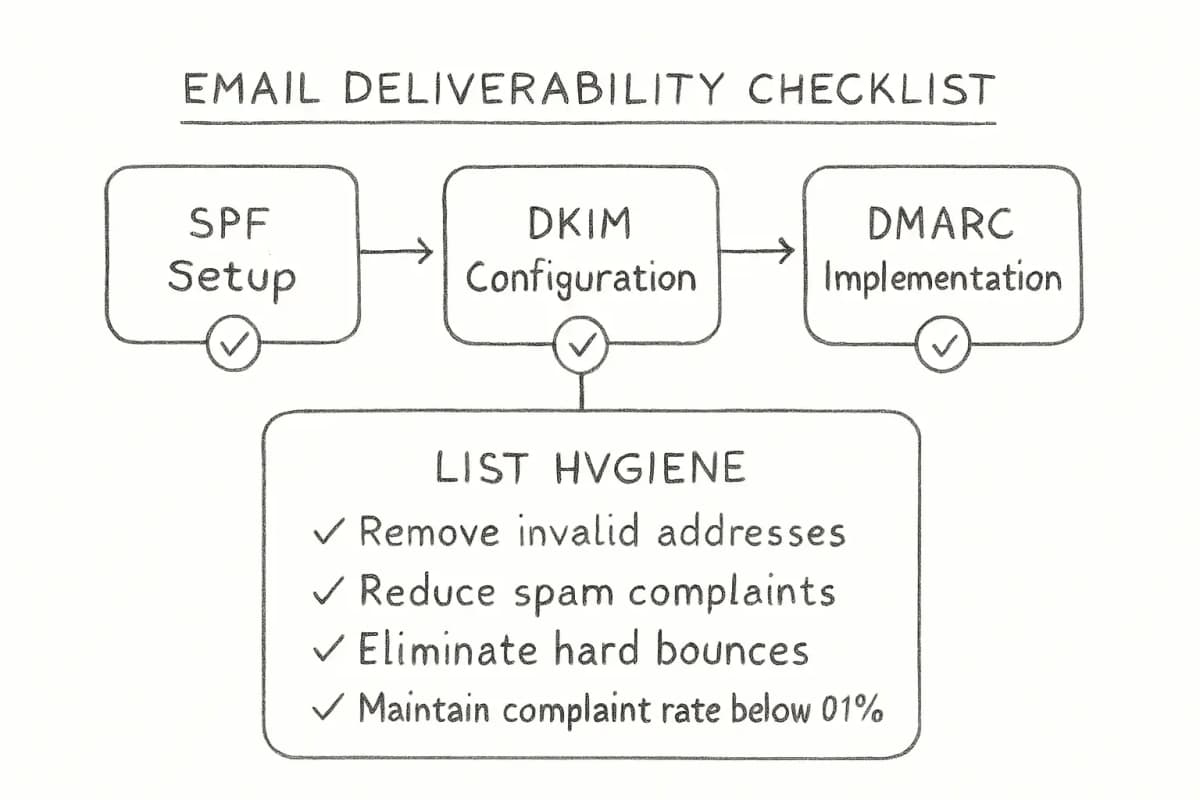
Fully authenticated B2B senders using SPF, DKIM, and DMARC are 2.7 times more likely to reach the inbox than unauthenticated senders, directly affecting open rates, revenue, and campaign ROI.
The core technical requirements every San Antonio business sender must have in place:
SPF: SPF is a DNS text record that lists all the mail servers authorized to send email on behalf of your domain, functioning like an approved sender list.
DKIM: DKIM adds a tamper-proof digital signature to your emails, and the receiving server uses a public key in your DNS to verify that the message has not been altered in transit.
DMARC: DMARC builds on SPF and DKIM, telling receiving servers what to do if an email fails authentication checks and providing reports on your email activity.
Google and Yahoo require DMARC for bulk senders sending 5,000 or more messages per day since February 2024, and Microsoft began rejecting non-compliant email in May 2025.
Beyond authentication, list hygiene is the other major deliverability lever. Removing invalid addresses regularly reduces spam complaints, bounces, and wasted messages. Keep your complaint rate below 0.1% and remove hard bounces immediately after every send.
Welcome series: Welcome email workflows have the highest click-to-conversion rate at 58.26%. This is your best window to set expectations and drive a first purchase or booking.
Post-visit or post-purchase follow-up: Particularly relevant for San Antonio's service-heavy economy, covering restaurants, healthcare, hospitality, and retail.
Re-engagement sequence: If a subscriber has not engaged in 90 to 180 days depending on your sending frequency, run a re-engagement campaign. If they still do not respond, remove them.
Abandoned cart recovery: Abandoned cart email campaigns have an open rate of 50.50%, and businesses earn an average of $3.45 in revenue per abandoned cart email recipient.
58% of businesses have included automation as part of their email marketing strategy in 2024. 47% of companies use automation for sending welcome emails, meaning there is still significant competitive advantage available for businesses that go deeper into their automation stack.
Nail Deliverability: Getting Into the Inbox
None of your San Antonio email marketing strategy matters if your emails land in spam. Deliverability has become more demanding since 2024, when Google and Yahoo introduced mandatory authentication rules for bulk senders.
Fully authenticated B2B senders using SPF, DKIM, and DMARC are 2.7 times more likely to reach the inbox than unauthenticated senders, directly affecting open rates, revenue, and campaign ROI.
The core technical requirements every San Antonio business sender must have in place:
SPF: SPF is a DNS text record that lists all the mail servers authorized to send email on behalf of your domain, functioning like an approved sender list.
DKIM: DKIM adds a tamper-proof digital signature to your emails, and the receiving server uses a public key in your DNS to verify that the message has not been altered in transit.
DMARC: DMARC builds on SPF and DKIM, telling receiving servers what to do if an email fails authentication checks and providing reports on your email activity.
Google and Yahoo require DMARC for bulk senders sending 5,000 or more messages per day since February 2024, and Microsoft began rejecting non-compliant email in May 2025.
Beyond authentication, list hygiene is the other major deliverability lever. Removing invalid addresses regularly reduces spam complaints, bounces, and wasted messages. Keep your complaint rate below 0.1% and remove hard bounces immediately after every send.
Write Subject Lines and Content That Work Locally
The inbox is competitive in any market. In San Antonio, where consumers are price-conscious but community-oriented, your subject lines and content need to connect on both levels.
Subject lines with 6 to 10 words achieve the highest open rates, and keeping them between 30 and 35 characters produces strong results for mobile users, where a significant share of San Antonio's younger demographic reads email.
Tips for writing effective subject lines for the San Antonio market:
Reference local events, seasons, or cultural moments when they are genuinely relevant (Fiesta, Spurs season, holiday shopping at North Star Mall, etc.).
Be specific about the value: "10% off at our Alamo Heights location this weekend" outperforms "Check out our latest offers."
Test urgency versus curiosity across segments, since behavior varies by audience type.
For subject line fundamentals backed by data, the guide on email subject line best practices that boost open rates by 27% covers specific tactics with benchmarks.
On content: 71% of consumers expect personalized interactions from brands, and 76% get frustrated when their brand interactions are not personalized to their interests. San Antonio's audience is no different. Generic promotional emails underperform. Local relevance, specific offers, and content that acknowledges context consistently produce better results.
Measure What Actually Matters
Too many San Antonio businesses track open rates and call it a day. Open rates are useful but incomplete. The metrics that predict revenue more reliably are click-to-conversion rate, revenue per email, list growth rate, and unsubscribe rate.
Open rates rose for the fifth consecutive year, increasing from 26.6% in 2024 to 30.7% in 2025, even as click rates declined. That divergence is a signal: people are opening more emails but clicking fewer. It means your subject line strategy may be working while your content or offers need adjustment.
Key benchmarks to track for san antonio email marketing programs:
Open rate: Industry average is 32.55% across industries according to Constant Contact's 2024 data.
Click-through rate: Average is approximately 2% to 3% across most industries.
Revenue per email: Automated emails generate $2.87 per email compared to $0.18 for campaigns, so segment your tracking by email type.
Spam complaint rate: Keep this below 0.1% to protect sender reputation.
List churn: Monitor unsubscribes and re-engagement rates to assess audience health.
The inbox is competitive in any market. In San Antonio, where consumers are price-conscious but community-oriented, your subject lines and content need to connect on both levels.
Subject lines with 6 to 10 words achieve the highest open rates, and keeping them between 30 and 35 characters produces strong results for mobile users, where a significant share of San Antonio's younger demographic reads email.
Tips for writing effective subject lines for the San Antonio market:
Reference local events, seasons, or cultural moments when they are genuinely relevant (Fiesta, Spurs season, holiday shopping at North Star Mall, etc.).
Be specific about the value: "10% off at our Alamo Heights location this weekend" outperforms "Check out our latest offers."
Test urgency versus curiosity across segments, since behavior varies by audience type.
For subject line fundamentals backed by data, the guide on email subject line best practices that boost open rates by 27% covers specific tactics with benchmarks.
On content: 71% of consumers expect personalized interactions from brands, and 76% get frustrated when their brand interactions are not personalized to their interests. San Antonio's audience is no different. Generic promotional emails underperform. Local relevance, specific offers, and content that acknowledges context consistently produce better results.
Measure What Actually Matters
Too many San Antonio businesses track open rates and call it a day. Open rates are useful but incomplete. The metrics that predict revenue more reliably are click-to-conversion rate, revenue per email, list growth rate, and unsubscribe rate.
Open rates rose for the fifth consecutive year, increasing from 26.6% in 2024 to 30.7% in 2025, even as click rates declined. That divergence is a signal: people are opening more emails but clicking fewer. It means your subject line strategy may be working while your content or offers need adjustment.
Key benchmarks to track for san antonio email marketing programs:
Open rate: Industry average is 32.55% across industries according to Constant Contact's 2024 data.
Click-through rate: Average is approximately 2% to 3% across most industries.
Revenue per email: Automated emails generate $2.87 per email compared to $0.18 for campaigns, so segment your tracking by email type.
Spam complaint rate: Keep this below 0.1% to protect sender reputation.
List churn: Monitor unsubscribes and re-engagement rates to assess audience health.
What makes san antonio email marketing different from general email marketing?
San Antonio has a distinctive economic profile centered on healthcare, tourism, military, education, and a growing tech sector. Each industry has different audience behaviors, seasonal patterns, and competitive dynamics. Effective san antonio email marketing accounts for these local factors: referencing community events, understanding that military and government audiences have specific communication preferences, and recognizing that the city's bilingual population may benefit from Spanish-language or culturally adapted content in certain sectors.
How often should San Antonio businesses send marketing emails?
Sending 5 to 8 emails per month shows the highest ROI at about $48 per dollar spent. For B2B communications, most companies find emailing twice a month optimal, as increasing the frequency to more than once a week significantly boosts the unsubscribe rate. The right frequency depends on your industry, audience expectations, and the quality of content you can consistently produce.
Do small San Antonio businesses need email authentication (SPF, DKIM, DMARC)?
Yes. Even if you are not a bulk sender, implementing SPF, DKIM, and DMARC is a smart move, as mailbox providers are getting serious about stopping spoofing and reducing spam. Authentication also protects your brand from being impersonated and directly improves inbox placement rates, which affects every metric downstream.
What is a realistic email marketing ROI for a San Antonio business?
For every $1 spent on email marketing, $36 is made in return, equaling a 3600% ROI, according to data from Litmus. Statista reports the same average, with some industries performing better, including retail, ecommerce, and consumer goods businesses, which see a $45 ROI for every dollar spent. Results vary based on list quality, segmentation, send frequency, and offer relevance, but email consistently outperforms paid social and display advertising on a cost-per-revenue basis.
No comments yet. Be the first!
Frequently Asked Questions
What makes san antonio email marketing different from general email marketing?
San Antonio has a distinctive economic profile centered on healthcare, tourism, military, education, and a growing tech sector. Each industry has different audience behaviors, seasonal patterns, and competitive dynamics. Effective san antonio email marketing accounts for these local factors: referencing community events, understanding that military and government audiences have specific communication preferences, and recognizing that the city's bilingual population may benefit from Spanish-language or culturally adapted content in certain sectors.
How often should San Antonio businesses send marketing emails?
Sending 5 to 8 emails per month shows the highest ROI at about $48 per dollar spent. For B2B communications, most companies find emailing twice a month optimal, as increasing the frequency to more than once a week significantly boosts the unsubscribe rate. The right frequency depends on your industry, audience expectations, and the quality of content you can consistently produce.
Do small San Antonio businesses need email authentication (SPF, DKIM, DMARC)?
Yes. Even if you are not a bulk sender, implementing SPF, DKIM, and DMARC is a smart move, as mailbox providers are getting serious about stopping spoofing and reducing spam. Authentication also protects your brand from being impersonated and directly improves inbox placement rates, which affects every metric downstream.
What is a realistic email marketing ROI for a San Antonio business?
For every $1 spent on email marketing, $36 is made in return, equaling a 3600% ROI, according to data from Litmus. Statista reports the same average, with some industries performing better, including retail, ecommerce, and consumer goods businesses, which see a $45 ROI for every dollar spent. Results vary based on list quality, segmentation, send frequency, and offer relevance, but email consistently outperforms paid social and display advertising on a cost-per-revenue basis.