Most email marketers know they should be doing "more with email." What that actually means in practice, backed by numbers, is what separates campaigns that drive revenue from ones that fill inboxes and accomplish nothing. For every $1 spent on email marketing, $36 is made in return, according to data from Litmus, which equals a 3,600% ROI. No other owned channel comes close. But that average is pulled up by teams who apply the right email marketing tips consistently. If you are leaving results on the table, the gaps are usually in segmentation, personalization, automation, deliverability, or testing. This guide covers each one with specific tactics and real data.
Key Takeaways
Email segmentation delivers a 760% higher revenue lift compared to broadcast campaigns, with segmented campaigns achieving 14.31% higher open rates and 100.95% higher click rates.
Automated emails generate 320% more revenue than non-automated emails.
Personalized emails increase open rates by 26%, with 80% of consumers more likely to convert and purchase.
Poor mobile rendering has severe consequences: 70% of users immediately delete emails that fail to display properly on their devices.
IP and domain reputation management is critical to email deliverability. A positive sender reputation signals to mailbox providers that the sender is legitimate, resulting in higher chances of inbox delivery.
1. Start with List Segmentation, Not List Size
Growing your list matters less than what you do with it. Sending the same message to everyone wastes budget and burns subscriber trust.
Segmentation plays a crucial role in deciding the success of email marketing campaigns. Segmented email campaigns drive 30% more opens and 50% more click-throughs than unsegmented ones, and 78% of marketers state that subscriber segmentation is the most effective strategy for email marketing campaigns.
According to Klaviyo data from over 2.5 billion emails, highly segmented email sends had nearly double the open and click-through rates of unsegmented lists. Even more striking, highly segmented lists return more than 3x the revenue per recipient of unsegmented lists.
Most email marketers know they should be doing "more with email." What that actually means in practice, backed by numbers, is what separates campaigns that drive revenue from ones that fill inboxes and accomplish nothing. For every $1 spent on email marketing, $36 is made in return, according to data from Litmus, which equals a 3,600% ROI. No other owned channel comes close. But that average is pulled up by teams who apply the right email marketing tips consistently. If you are leaving results on the table, the gaps are usually in segmentation, personalization, automation, deliverability, or testing. This guide covers each one with specific tactics and real data.
Key Takeaways
Email segmentation delivers a 760% higher revenue lift compared to broadcast campaigns, with segmented campaigns achieving 14.31% higher open rates and 100.95% higher click rates.
Automated emails generate 320% more revenue than non-automated emails.
Personalized emails increase open rates by 26%, with 80% of consumers more likely to convert and purchase.
Poor mobile rendering has severe consequences: 70% of users immediately delete emails that fail to display properly on their devices.
IP and domain reputation management is critical to email deliverability. A positive sender reputation signals to mailbox providers that the sender is legitimate, resulting in higher chances of inbox delivery.
1. Start with List Segmentation, Not List Size
Growing your list matters less than what you do with it. Sending the same message to everyone wastes budget and burns subscriber trust.
Segmentation plays a crucial role in deciding the success of email marketing campaigns. Segmented email campaigns drive 30% more opens and 50% more click-throughs than unsegmented ones, and 78% of marketers state that subscriber segmentation is the most effective strategy for email marketing campaigns.
According to Klaviyo data from over 2.5 billion emails, highly segmented email sends had nearly double the open and click-through rates of unsegmented lists. Even more striking, highly segmented lists return more than 3x the revenue per recipient of unsegmented lists.
Practical ways to segment your list:
Purchase history: Send relevant product recommendations or replenishment reminders.
Engagement level: Separate active subscribers from those who have not opened in 90 days and treat them differently.
Lifecycle stage: New subscribers, repeat buyers, and at-risk customers each need a different message.
Browse behavior: Trigger emails based on pages or product categories a subscriber visited.
Dropping a subscriber's name into a subject line is the floor, not the ceiling, of personalization.
Segmented and personalized emails generate 58% of all revenue, and personalized emails deliver six times higher transaction rates than non-personalized ones. That is not a marginal lift. It is a structural advantage.
Adding attribute, behavior, and journey-based personalization to emails can improve open rates by 20 to 40%, with behavior-based personalization helping email open rates reach as high as 37.04%.
Tactics that go beyond surface-level personalization:
Behavioral triggers: Send emails in response to specific actions, like viewing a product page, abandoning a cart, or completing a purchase. Marketing emails sent in response to behavioral triggers generate 10 times greater revenue than other marketing email types, making them one of the most effective strategies for driving sales.
Dynamic content blocks: Show different content sections to different segments within the same email send.
Purchase-based recommendations: Reference what a subscriber already bought and suggest relevant complements or upgrades.
Studies show that 63% of consumers will stop buying from brands that do not use effective personalization strategies. That is a retention risk, not just a conversion problem.
Practical ways to segment your list:
Purchase history: Send relevant product recommendations or replenishment reminders.
Engagement level: Separate active subscribers from those who have not opened in 90 days and treat them differently.
Lifecycle stage: New subscribers, repeat buyers, and at-risk customers each need a different message.
Browse behavior: Trigger emails based on pages or product categories a subscriber visited.
Dropping a subscriber's name into a subject line is the floor, not the ceiling, of personalization.
Segmented and personalized emails generate 58% of all revenue, and personalized emails deliver six times higher transaction rates than non-personalized ones. That is not a marginal lift. It is a structural advantage.
Adding attribute, behavior, and journey-based personalization to emails can improve open rates by 20 to 40%, with behavior-based personalization helping email open rates reach as high as 37.04%.
Tactics that go beyond surface-level personalization:
Behavioral triggers: Send emails in response to specific actions, like viewing a product page, abandoning a cart, or completing a purchase. Marketing emails sent in response to behavioral triggers generate 10 times greater revenue than other marketing email types, making them one of the most effective strategies for driving sales.
Dynamic content blocks: Show different content sections to different segments within the same email send.
Purchase-based recommendations: Reference what a subscriber already bought and suggest relevant complements or upgrades.
Studies show that 63% of consumers will stop buying from brands that do not use effective personalization strategies. That is a retention risk, not just a conversion problem.
3. Build Automation Workflows That Work While You Sleep
Automation is the single highest-leverage email marketing tip for teams that want to scale results without scaling headcount.
According to Litmus, automated emails drive 37% of all email-generated sales, despite making up only 2% of email volume. That ratio tells you exactly where to focus your effort.
The highest-performing automated workflows to prioritize:
3. Build Automation Workflows That Work While You Sleep
Automation is the single highest-leverage email marketing tip for teams that want to scale results without scaling headcount.
According to Litmus, automated emails drive 37% of all email-generated sales, despite making up only 2% of email volume. That ratio tells you exactly where to focus your effort.
The highest-performing automated workflows to prioritize:
Welcome series: Welcome emails achieve an average open rate of 83.6%, making them one of the highest-performing automated email types. Use this attention to set expectations, share your brand story, and guide new subscribers toward their first purchase or conversion. See our Welcome Email Sequence Best Practices: 7 Proven Strategies for how to structure this properly.
Abandoned cart recovery: Abandoned cart emails achieve an average open rate of 50.5%, a click rate of 6.25%, and a conversion rate of 3.33%, with top-performing brands reaching conversion rates of 7.69%.
Post-purchase flows: These build loyalty, reduce buyer's remorse, and create upsell opportunities through a moment of high trust.
Re-engagement campaigns: Automated winback email campaigns can achieve impressive click-through rates of 18.27%.
Welcome series: Welcome emails achieve an average open rate of 83.6%, making them one of the highest-performing automated email types. Use this attention to set expectations, share your brand story, and guide new subscribers toward their first purchase or conversion. See our Welcome Email Sequence Best Practices: 7 Proven Strategies for how to structure this properly.
Abandoned cart recovery: Abandoned cart emails achieve an average open rate of 50.5%, a click rate of 6.25%, and a conversion rate of 3.33%, with top-performing brands reaching conversion rates of 7.69%.
Post-purchase flows: These build loyalty, reduce buyer's remorse, and create upsell opportunities through a moment of high trust.
Re-engagement campaigns: Automated winback email campaigns can achieve impressive click-through rates of 18.27%.
E-commerce brands sending automated campaigns (welcome, cart recovery, post-purchase) see up to 30% more revenue per email compared to one-off promotional newsletters.
4. Write Subject Lines That Earn the Open
Your subject line is not a headline. It is a gate. If subscribers do not open, nothing else in your campaign matters.
More than 80% of marketers reported seeing at least some performance improvement when using subject line personalization.
A MailerLite study identified that the most opened campaigns are 45% more likely to use a subject line between 20 and 40 characters. Shorter is not always better, but discipline helps.
Additional subject line tips backed by data:
Use preheader text (the preview text visible in inboxes) to complement your subject line. This additional 40 to 130 characters can reinforce your message and boost open rates by 7 to 10%.
69% of recipients will report an email as spam based solely on the subject line if it looks suspicious or irrelevant. Avoid clickbait that does not match the email content.
Test one variable at a time. A/B testing increases email ROI by 37% compared to brands that never test.
50% of people will delete an email if it is not optimized for mobile. That is half your potential audience gone before they read a single word.
Mobile-responsive design increases unique mobile clicks from 2.7% to 3.3%, a 15% improvement. For high-volume senders, that seemingly modest percentage translates to thousands of additional conversions.
What mobile optimization actually requires:
Single-column layouts that do not break on small screens.
Tap targets (buttons and links) at least 44x44 pixels so they are easy to tap with a thumb.
Minimum 14-point font size for body text.
Compressed images that load quickly on cellular connections.
Subject lines and preheader text that do not get cut off on the lock screen.
When sending mobile-friendly emails, companies see a 15% increase in clicks. This is a low-effort change with a measurable, repeatable payoff.
6. Protect Your Deliverability Like a Business Asset
You can write a perfect email, but if it lands in spam, the campaign does not exist. Deliverability is the foundation every other email marketing tip depends on.
E-commerce brands sending automated campaigns (welcome, cart recovery, post-purchase) see up to 30% more revenue per email compared to one-off promotional newsletters.
4. Write Subject Lines That Earn the Open
Your subject line is not a headline. It is a gate. If subscribers do not open, nothing else in your campaign matters.
More than 80% of marketers reported seeing at least some performance improvement when using subject line personalization.
A MailerLite study identified that the most opened campaigns are 45% more likely to use a subject line between 20 and 40 characters. Shorter is not always better, but discipline helps.
Additional subject line tips backed by data:
Use preheader text (the preview text visible in inboxes) to complement your subject line. This additional 40 to 130 characters can reinforce your message and boost open rates by 7 to 10%.
69% of recipients will report an email as spam based solely on the subject line if it looks suspicious or irrelevant. Avoid clickbait that does not match the email content.
Test one variable at a time. A/B testing increases email ROI by 37% compared to brands that never test.
50% of people will delete an email if it is not optimized for mobile. That is half your potential audience gone before they read a single word.
Mobile-responsive design increases unique mobile clicks from 2.7% to 3.3%, a 15% improvement. For high-volume senders, that seemingly modest percentage translates to thousands of additional conversions.
What mobile optimization actually requires:
Single-column layouts that do not break on small screens.
Tap targets (buttons and links) at least 44x44 pixels so they are easy to tap with a thumb.
Minimum 14-point font size for body text.
Compressed images that load quickly on cellular connections.
Subject lines and preheader text that do not get cut off on the lock screen.
When sending mobile-friendly emails, companies see a 15% increase in clicks. This is a low-effort change with a measurable, repeatable payoff.
6. Protect Your Deliverability Like a Business Asset
You can write a perfect email, but if it lands in spam, the campaign does not exist. Deliverability is the foundation every other email marketing tip depends on.
DMARC is an email authentication and reporting protocol that builds on SPF and DKIM. It allows domain owners to set policies specifying what action receivers should take if an email fails authentication, and provides reporting mechanisms to send feedback about authentication results.
Improving email deliverability is no longer just about crafting great messages. With cyber threats like phishing and spoofing on the rise, businesses must rely on authentication protocols such as DMARC, SPF, and DKIM to protect their domains and maintain sender reputation. A properly configured DMARC setup, supported by robust SPF and DKIM alignment, helps authenticate legitimate emails so they pass through ISP filters and land directly in recipients' inboxes.
Core deliverability actions to take now:
Confirm SPF, DKIM, and DMARC records are correctly configured for your sending domain.
Keep your spam complaint rate well below 0.1%.
Keep your bounce rate under 2% to maintain sender reputation.
Remove hard bounces immediately and audit inactive subscribers every three to six months.
Never send to purchased lists. Purchased lists are full of unengaged profiles that are more likely to mark your emails as spam.
You can write the perfect email, but it will not matter if it lands in spam. Deliverability problems, poor sender reputation, and overly aggressive sending schedules can prevent even well-crafted campaigns from reaching subscribers.
7. Measure What Moves Revenue, Not Just Opens
Apple's Mail Privacy Protection has made open rates less reliable. MPP automatically preloads email content and images for Apple Mail users, even if they never actually open the email. Teams that still use open rate as their primary success metric are measuring noise.
Shift your measurement focus to metrics that connect to revenue:
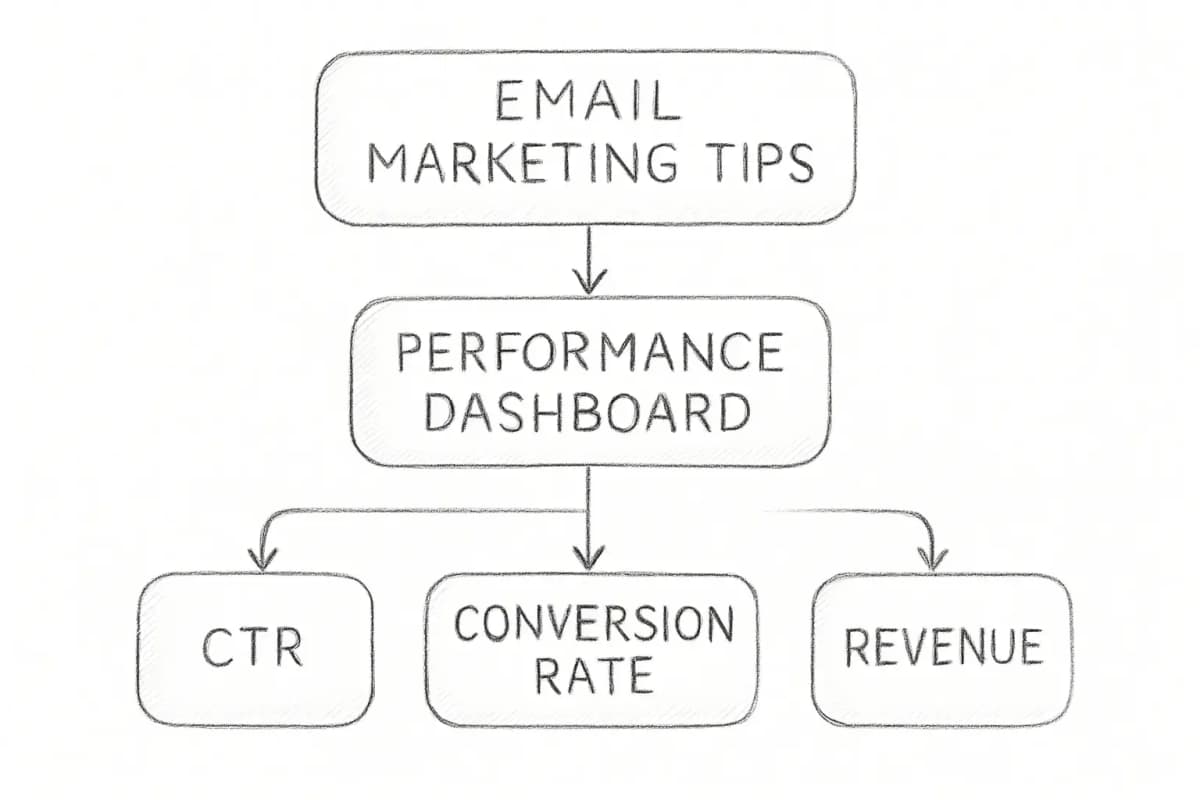
Click-through rate (CTR): The global average CTR is roughly 2.03% to 2.62%. Know your baseline and test toward it.
Revenue per email (RPE): How much revenue does each email you send generate?
Conversion rate: The percentage of recipients who complete the desired action, such as a purchase, sign-up, or download.
Unsubscribe rate: Under 0.5% is healthy. Higher than that suggests a content-audience mismatch.
List growth rate: A healthy list grows net of unsubscribes and bounces.
Email campaign click-to-conversion rates grew by 27.6% in 2024, suggesting that subscribers who engage are increasingly likely to act. That trend rewards teams who prioritize relevance over volume.
Frequently Asked Questions
What are the most effective email marketing tips for small businesses?
DMARC is an email authentication and reporting protocol that builds on SPF and DKIM. It allows domain owners to set policies specifying what action receivers should take if an email fails authentication, and provides reporting mechanisms to send feedback about authentication results.
Improving email deliverability is no longer just about crafting great messages. With cyber threats like phishing and spoofing on the rise, businesses must rely on authentication protocols such as DMARC, SPF, and DKIM to protect their domains and maintain sender reputation. A properly configured DMARC setup, supported by robust SPF and DKIM alignment, helps authenticate legitimate emails so they pass through ISP filters and land directly in recipients' inboxes.
Core deliverability actions to take now:
Confirm SPF, DKIM, and DMARC records are correctly configured for your sending domain.
Keep your spam complaint rate well below 0.1%.
Keep your bounce rate under 2% to maintain sender reputation.
Remove hard bounces immediately and audit inactive subscribers every three to six months.
Never send to purchased lists. Purchased lists are full of unengaged profiles that are more likely to mark your emails as spam.
You can write the perfect email, but it will not matter if it lands in spam. Deliverability problems, poor sender reputation, and overly aggressive sending schedules can prevent even well-crafted campaigns from reaching subscribers.
7. Measure What Moves Revenue, Not Just Opens
Apple's Mail Privacy Protection has made open rates less reliable. MPP automatically preloads email content and images for Apple Mail users, even if they never actually open the email. Teams that still use open rate as their primary success metric are measuring noise.
Shift your measurement focus to metrics that connect to revenue:
Click-through rate (CTR): The global average CTR is roughly 2.03% to 2.62%. Know your baseline and test toward it.
Revenue per email (RPE): How much revenue does each email you send generate?
Conversion rate: The percentage of recipients who complete the desired action, such as a purchase, sign-up, or download.
Unsubscribe rate: Under 0.5% is healthy. Higher than that suggests a content-audience mismatch.
List growth rate: A healthy list grows net of unsubscribes and bounces.
Email campaign click-to-conversion rates grew by 27.6% in 2024, suggesting that subscribers who engage are increasingly likely to act. That trend rewards teams who prioritize relevance over volume.
Frequently Asked Questions
What are the most effective email marketing tips for small businesses?
For small businesses, the highest-impact starting points are segmentation, automation, and a strong welcome series. 81% of SMBs rely on email as their primary customer acquisition channel. You do not need a large list to see strong results. Focus on relevance and timing over volume, set up a three-email welcome sequence, and automate your highest-intent touchpoints like cart abandonment.
How often should I send marketing emails?
There is no universal answer, but the data offers guardrails. Frequency matters: too many or irrelevant emails drive unsubscribes. In the B2C sector, some studies suggest trying frequencies as high as 10 to 19 times a month for potentially higher sales, though this may not suit every audience. For B2B communications, most companies find emailing twice a month optimal, as increasing the frequency to more than once a week significantly boosts the unsubscribe rate. Test your specific audience and let engagement data guide the decision.
What is a good email open rate?
The median email open rate across all industries is 42.35%, though this figure is inflated by Apple's Mail Privacy Protection. A more reliable benchmark: above 30% is a solid open rate when measured in environments where MPP inflation is accounted for. More importantly, track click-through rate and conversions alongside open rate to get a complete picture of campaign health.
How does email segmentation improve ROI?
Segmentation improves ROI by sending more relevant content to smaller, better-targeted groups, which reduces unsubscribes, increases engagement, and drives more conversions per send. Highly segmented lists return more than 3x the revenue per recipient of unsegmented lists. The unsubscribe rate for unsegmented campaigns is 2x that of highly segmented campaigns, demonstrating why a batch-and-blast strategy is detrimental. The investment in segmentation pays back through better deliverability, lower churn, and compounding improvements to sender reputation over time.
No comments yet. Be the first!
For small businesses, the highest-impact starting points are segmentation, automation, and a strong welcome series. 81% of SMBs rely on email as their primary customer acquisition channel. You do not need a large list to see strong results. Focus on relevance and timing over volume, set up a three-email welcome sequence, and automate your highest-intent touchpoints like cart abandonment.
How often should I send marketing emails?
There is no universal answer, but the data offers guardrails. Frequency matters: too many or irrelevant emails drive unsubscribes. In the B2C sector, some studies suggest trying frequencies as high as 10 to 19 times a month for potentially higher sales, though this may not suit every audience. For B2B communications, most companies find emailing twice a month optimal, as increasing the frequency to more than once a week significantly boosts the unsubscribe rate. Test your specific audience and let engagement data guide the decision.
What is a good email open rate?
The median email open rate across all industries is 42.35%, though this figure is inflated by Apple's Mail Privacy Protection. A more reliable benchmark: above 30% is a solid open rate when measured in environments where MPP inflation is accounted for. More importantly, track click-through rate and conversions alongside open rate to get a complete picture of campaign health.
How does email segmentation improve ROI?
Segmentation improves ROI by sending more relevant content to smaller, better-targeted groups, which reduces unsubscribes, increases engagement, and drives more conversions per send. Highly segmented lists return more than 3x the revenue per recipient of unsegmented lists. The unsubscribe rate for unsegmented campaigns is 2x that of highly segmented campaigns, demonstrating why a batch-and-blast strategy is detrimental. The investment in segmentation pays back through better deliverability, lower churn, and compounding improvements to sender reputation over time.