Email marketing is the highest-ROI channel available to ecommerce brands, and the data proves it. While the average email marketing ROI sits at $36 for every dollar spent, retail, ecommerce, and consumer goods businesses consistently reach $45 for every dollar invested. Yet most ecommerce stores leave that return on the table because they rely on one-size-fits-all broadcasts instead of the targeted, automated tactics that actually move the needle.
If you want to capture more of that revenue, these seven email marketing tips for ecommerce give you a clear, evidence-backed starting point.
Key Takeaways
Segmented campaigns generate 760% more revenue than non-segmented sends, making list segmentation the single highest-leverage tactic available.
Abandoned cart emails convert at 10.7% on average, with a three-email sequence producing roughly 6.5x more revenue than a single-email approach.
Welcome emails achieve an average open rate of 83.63% and generate 320% more revenue per email than standard promotional campaigns.
Automated emails drive 320% more revenue than non-automated sends, from just 2% of total email volume.
Post-purchase sequences that include personalized recommendations boost repeat purchase rates by 10 to 15%, directly improving customer lifetime value.
1. Segment Your List Before You Send Anything
Batch-and-blast email is the fastest way to train your subscribers to ignore you. Segmentation fixes that at the source.
Segmented campaigns generate 760% more revenue than non-segmented sends. That number comes up consistently across sources because the mechanism is simple: relevant emails get opened, clicked, and acted on.
According to a HubSpot survey, 65% of marketers say their segmented emails achieve better open rates. And it is not just opens. Email segmentation and personalization generate 58% of total revenue, and segmented email campaigns have 100.95% higher click-through rates compared to non-segmented campaigns.
For ecommerce, the most useful segments are:
Purchase history (first-time buyers vs. repeat customers vs. VIPs)
Email marketing is the highest-ROI channel available to ecommerce brands, and the data proves it. While the average email marketing ROI sits at $36 for every dollar spent, retail, ecommerce, and consumer goods businesses consistently reach $45 for every dollar invested. Yet most ecommerce stores leave that return on the table because they rely on one-size-fits-all broadcasts instead of the targeted, automated tactics that actually move the needle.
If you want to capture more of that revenue, these seven email marketing tips for ecommerce give you a clear, evidence-backed starting point.
Key Takeaways
Segmented campaigns generate 760% more revenue than non-segmented sends, making list segmentation the single highest-leverage tactic available.
Abandoned cart emails convert at 10.7% on average, with a three-email sequence producing roughly 6.5x more revenue than a single-email approach.
Welcome emails achieve an average open rate of 83.63% and generate 320% more revenue per email than standard promotional campaigns.
Automated emails drive 320% more revenue than non-automated sends, from just 2% of total email volume.
Post-purchase sequences that include personalized recommendations boost repeat purchase rates by 10 to 15%, directly improving customer lifetime value.
1. Segment Your List Before You Send Anything
Batch-and-blast email is the fastest way to train your subscribers to ignore you. Segmentation fixes that at the source.
Segmented campaigns generate 760% more revenue than non-segmented sends. That number comes up consistently across sources because the mechanism is simple: relevant emails get opened, clicked, and acted on.
According to a HubSpot survey, 65% of marketers say their segmented emails achieve better open rates. And it is not just opens. Email segmentation and personalization generate 58% of total revenue, and segmented email campaigns have 100.95% higher click-through rates compared to non-segmented campaigns.
For ecommerce, the most useful segments are:
Purchase history (first-time buyers vs. repeat customers vs. VIPs)
The moment someone subscribes is your best chance to make a sale. Most brands waste it with a single generic email.
Welcome emails achieve an average open rate of 83.63% and a click-through rate of 16.60%, with a click-to-open rate of 19.85%. No other email type comes close to those numbers. Welcome emails generate up to 320% more revenue per email than other promotional emails, and subscribers who receive a welcome email show 33% more engagement with the brand.
Despite this, 74% of subscribers expect to receive an immediate welcome email, but only 57.7% of brands deliver one. That gap is a direct revenue leak.
A strong welcome sequence for ecommerce typically runs three to five emails:
Immediate send: confirm the subscription and deliver any promised incentive
Day two or three: brand story, bestsellers, and social proof
Day five to seven: a time-sensitive offer to convert subscribers into buyers
Sending multiple welcome messages rather than a single email can increase revenue by up to 51%. This revenue lift comes from multiple conversion opportunities and reinforced brand messaging.
For the full framework, see our post on welcome email sequence best practices.
3. Automate Your Abandoned Cart Recovery
Cart abandonment is not a problem to solve. It is a revenue stream to build. The global average cart abandonment rate is 70.22%, meaning roughly seven out of every ten shoppers who add items to their cart leave without purchasing.
Abandoned cart emails exist specifically to recover that revenue. Cart abandonment email open rates are incredibly high. In 2024, open rates stood at around 39.07%, while the average click-through rate was 23.33%, with an average conversion rate of 10.7%.
Timing is critical. Emails sent within 30 to 60 minutes of cart abandonment are the most effective at recovering lost revenue, and 40% of retailers send their first email within one hour.
Sequence length also matters. Email campaigns with three cart abandonment emails generated $24.9 million compared to $3.8 million for those who only sent one email. A typical three-email sequence covers:
The moment someone subscribes is your best chance to make a sale. Most brands waste it with a single generic email.
Welcome emails achieve an average open rate of 83.63% and a click-through rate of 16.60%, with a click-to-open rate of 19.85%. No other email type comes close to those numbers. Welcome emails generate up to 320% more revenue per email than other promotional emails, and subscribers who receive a welcome email show 33% more engagement with the brand.
Despite this, 74% of subscribers expect to receive an immediate welcome email, but only 57.7% of brands deliver one. That gap is a direct revenue leak.
A strong welcome sequence for ecommerce typically runs three to five emails:
Immediate send: confirm the subscription and deliver any promised incentive
Day two or three: brand story, bestsellers, and social proof
Day five to seven: a time-sensitive offer to convert subscribers into buyers
Sending multiple welcome messages rather than a single email can increase revenue by up to 51%. This revenue lift comes from multiple conversion opportunities and reinforced brand messaging.
For the full framework, see our post on welcome email sequence best practices.
3. Automate Your Abandoned Cart Recovery
Cart abandonment is not a problem to solve. It is a revenue stream to build. The global average cart abandonment rate is 70.22%, meaning roughly seven out of every ten shoppers who add items to their cart leave without purchasing.
Abandoned cart emails exist specifically to recover that revenue. Cart abandonment email open rates are incredibly high. In 2024, open rates stood at around 39.07%, while the average click-through rate was 23.33%, with an average conversion rate of 10.7%.
Timing is critical. Emails sent within 30 to 60 minutes of cart abandonment are the most effective at recovering lost revenue, and 40% of retailers send their first email within one hour.
Sequence length also matters. Email campaigns with three cart abandonment emails generated $24.9 million compared to $3.8 million for those who only sent one email. A typical three-email sequence covers:
Email 1 (within 1 hour): a simple reminder, product image, and a clear "Complete your purchase" button
Email 2 (24 hours later): social proof, reviews, or an FAQ about the product
Email 3 (48 to 72 hours later): a time-limited incentive if your margins allow it
Sending an email within one hour after cart abandonment boosts conversions by 20%.
4. Personalize Beyond First Name
Personalization in ecommerce email means more than inserting {{first_name}} in the subject line. It means using purchase history, browse behavior, and lifecycle stage to send emails that feel individually written.
Powering your email campaigns with customer data increases your open rate by 29% and your click-through rate by 41%. The revenue impact is just as clear. Personalization typically increases revenue by 10 to 15%, but some ecommerce businesses manage to enhance their results by almost 40%.
Consumer expectations back this up. 71% of consumers now expect personalized brand interactions, with 76% getting frustrated when communications are not personalized.
Practical personalization tactics for ecommerce include:
Product recommendations based on previous purchases or browsed categories
Dynamic email content that changes by location, purchase tier, or lifecycle stage
Replenishment reminders timed to your product's average consumption cycle
Birthday or anniversary emails with a relevant offer
49% of consumers say they will likely become repeat buyers after a personalized online shopping experience, and 80% of business leaders say consumers spend 34% more on average when their experience is personalized.
For specific techniques and real examples, see our article on email personalization techniques that boost conversions 47%.
5. Build Your Email List with Intentional Lead Capture
Your email list decays whether you are paying attention or not. The average email list decays by 20 to 30% annually through unsubscribes, address abandonment, and natural churn, meaning a brand that stops actively building its list loses a quarter of its audience every year.
Active list building requires a systematic approach to capturing subscriber emails from your site traffic.
The average email popup conversion rate in 2025 is 2.1%, with rates below 1.5% considered underperforming and 5% and above considered excellent. The format and offer drive most of that variation.
Offering a discount code in an email capture popup raises conversion rates to between 7.5% and 7.65%, compared to 5.10% for popups without any incentive. Going a step further, gamified popups lead to huge engagement numbers, with a 13.23% average conversion rate.
Key list-building tactics:
Email 1 (within 1 hour): a simple reminder, product image, and a clear "Complete your purchase" button
Email 2 (24 hours later): social proof, reviews, or an FAQ about the product
Email 3 (48 to 72 hours later): a time-limited incentive if your margins allow it
Sending an email within one hour after cart abandonment boosts conversions by 20%.
4. Personalize Beyond First Name
Personalization in ecommerce email means more than inserting {{first_name}} in the subject line. It means using purchase history, browse behavior, and lifecycle stage to send emails that feel individually written.
Powering your email campaigns with customer data increases your open rate by 29% and your click-through rate by 41%. The revenue impact is just as clear. Personalization typically increases revenue by 10 to 15%, but some ecommerce businesses manage to enhance their results by almost 40%.
Consumer expectations back this up. 71% of consumers now expect personalized brand interactions, with 76% getting frustrated when communications are not personalized.
Practical personalization tactics for ecommerce include:
Product recommendations based on previous purchases or browsed categories
Dynamic email content that changes by location, purchase tier, or lifecycle stage
Replenishment reminders timed to your product's average consumption cycle
Birthday or anniversary emails with a relevant offer
49% of consumers say they will likely become repeat buyers after a personalized online shopping experience, and 80% of business leaders say consumers spend 34% more on average when their experience is personalized.
For specific techniques and real examples, see our article on email personalization techniques that boost conversions 47%.
5. Build Your Email List with Intentional Lead Capture
Your email list decays whether you are paying attention or not. The average email list decays by 20 to 30% annually through unsubscribes, address abandonment, and natural churn, meaning a brand that stops actively building its list loses a quarter of its audience every year.
Active list building requires a systematic approach to capturing subscriber emails from your site traffic.
The average email popup conversion rate in 2025 is 2.1%, with rates below 1.5% considered underperforming and 5% and above considered excellent. The format and offer drive most of that variation.
Offering a discount code in an email capture popup raises conversion rates to between 7.5% and 7.65%, compared to 5.10% for popups without any incentive. Going a step further, gamified popups lead to huge engagement numbers, with a 13.23% average conversion rate.
Key list-building tactics:
Exit-intent popups with a specific, relevant offer (first-order discount, free shipping)
Category-specific popups that tailor the incentive to the product a visitor is browsing
Post-checkout opt-ins for customers who did not subscribe before buying
Quiz-based lead capture for brands in competitive categories like beauty or wellness
Statista found that 48% of consumers happily gave their email address to receive a discount. Give people a clear reason to subscribe and most will.
6. Set Up a Post-Purchase Email Sequence
Most ecommerce stores treat the order confirmation as the end of the email conversation. It is actually the beginning.
A returning customer spends 67% more than a new one, and the probability of selling to an existing customer is 60 to 70%, compared to just 5 to 20% for a new prospect.
Automated post-purchase sequences show 40 to 45% open rates with 10 to 15% repeat purchase rates, far exceeding industry averages.
A well-structured post-purchase sequence looks like this:
Order confirmation (immediate): order details, expected delivery date, support contact
Shipping confirmation (when label prints): tracking link and honest delivery estimate
Product education (3 to 5 days after delivery): usage tips, care instructions, or how-to content
Review request (7 to 14 days after delivery): ask for feedback while the experience is fresh
Cross-sell or replenishment email (14 to 30 days later): personalized recommendations based on what they bought
Post-purchase email sequences featuring personalized product recommendations based on previous buying behavior typically boost repeat rates by 10 to 15%.
Customers who make a second purchase are 45% more likely to make a third, and customers who make a third are 54% more likely to make a fourth. The probability of every subsequent purchase climbs with each transaction. That is why the first-to-second conversion is the highest-impact retention move you can make.
7. Optimize Your Subject Lines to Drive Opens
Every other tactic in this list depends on people opening your emails. Subject lines determine whether that happens.
Personalized subject lines increase open rates by 26%. That is one of the most consistent findings across email marketing research, and it requires minimal effort to implement at scale with most modern email service providers.
Beyond personalization, a few structural principles drive open rates consistently:
Specificity beats vague cleverness. "Your cart has 2 items" outperforms "Don't miss out."
Numbers and specifics work. "3 products matching your recent purchase" feels different from "Products you'll love."
Length matters. Subject lines in the 20 to 60 character range tend to see the best open and click-through rates across platforms.
A/B test every campaign. Subject line testing is the fastest way to compound improvements over time.
Exit-intent popups with a specific, relevant offer (first-order discount, free shipping)
Category-specific popups that tailor the incentive to the product a visitor is browsing
Post-checkout opt-ins for customers who did not subscribe before buying
Quiz-based lead capture for brands in competitive categories like beauty or wellness
Statista found that 48% of consumers happily gave their email address to receive a discount. Give people a clear reason to subscribe and most will.
6. Set Up a Post-Purchase Email Sequence
Most ecommerce stores treat the order confirmation as the end of the email conversation. It is actually the beginning.
A returning customer spends 67% more than a new one, and the probability of selling to an existing customer is 60 to 70%, compared to just 5 to 20% for a new prospect.
Automated post-purchase sequences show 40 to 45% open rates with 10 to 15% repeat purchase rates, far exceeding industry averages.
A well-structured post-purchase sequence looks like this:
Order confirmation (immediate): order details, expected delivery date, support contact
Shipping confirmation (when label prints): tracking link and honest delivery estimate
Product education (3 to 5 days after delivery): usage tips, care instructions, or how-to content
Review request (7 to 14 days after delivery): ask for feedback while the experience is fresh
Cross-sell or replenishment email (14 to 30 days later): personalized recommendations based on what they bought
Post-purchase email sequences featuring personalized product recommendations based on previous buying behavior typically boost repeat rates by 10 to 15%.
Customers who make a second purchase are 45% more likely to make a third, and customers who make a third are 54% more likely to make a fourth. The probability of every subsequent purchase climbs with each transaction. That is why the first-to-second conversion is the highest-impact retention move you can make.
7. Optimize Your Subject Lines to Drive Opens
Every other tactic in this list depends on people opening your emails. Subject lines determine whether that happens.
Personalized subject lines increase open rates by 26%. That is one of the most consistent findings across email marketing research, and it requires minimal effort to implement at scale with most modern email service providers.
Beyond personalization, a few structural principles drive open rates consistently:
Specificity beats vague cleverness. "Your cart has 2 items" outperforms "Don't miss out."
Numbers and specifics work. "3 products matching your recent purchase" feels different from "Products you'll love."
Length matters. Subject lines in the 20 to 60 character range tend to see the best open and click-through rates across platforms.
A/B test every campaign. Subject line testing is the fastest way to compound improvements over time.
Email campaigns see the highest open rates shortly after marketers send them, with 21.2% of all email opens happening within the first hour. That means your subject line and preview text have to earn attention immediately, in a crowded inbox.
For a complete breakdown of what works across industries and send times, read our post on email subject line best practices that boost open rates by 27%.
Putting It Together
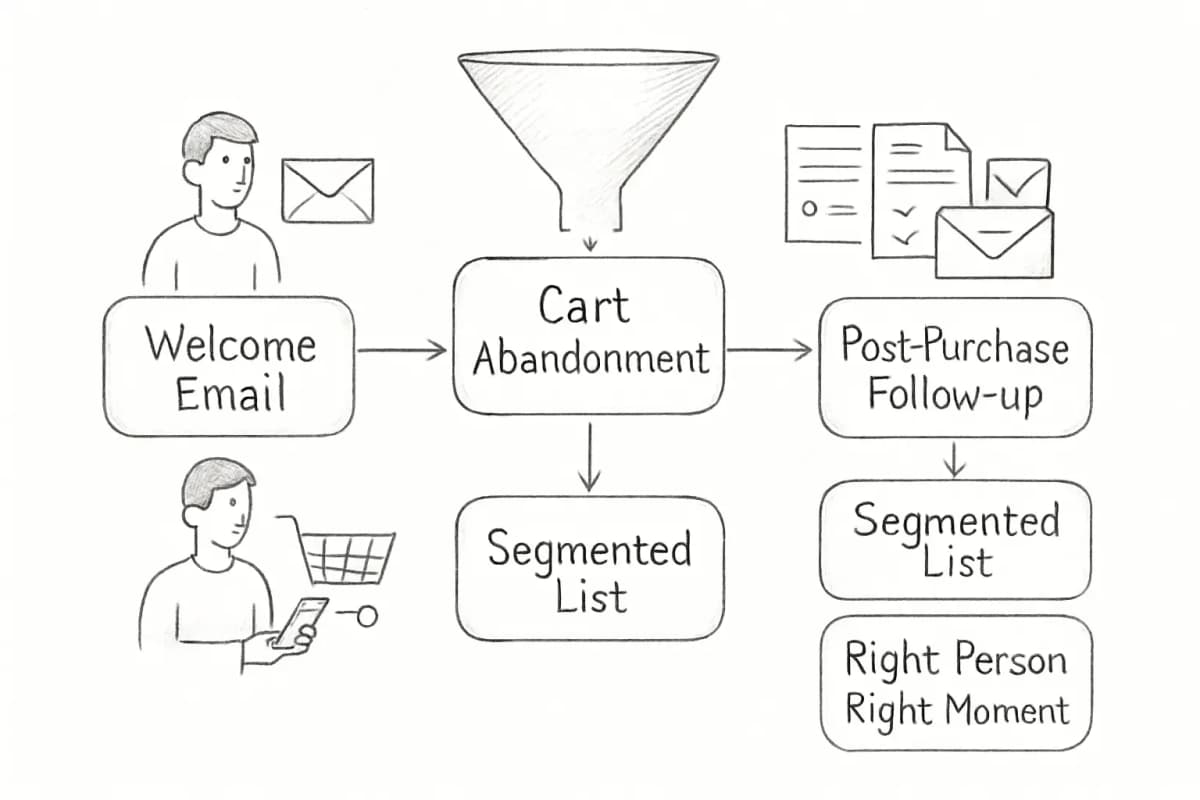
The email marketing tips for ecommerce that consistently compound into meaningful revenue are not complicated. They share one principle: send the right email to the right person at the right moment in their journey.
Start with segmentation so your list is ready to receive targeted messages. Build a welcome sequence to convert new subscribers quickly. Set up cart abandonment automation to recover revenue that would otherwise disappear. Add personalization to every send you can. Grow your list deliberately so natural decay does not quietly erase your progress. Follow up after purchase to turn one-time buyers into repeat customers. And write subject lines that earn the open before anything else matters.
Email marketing remains the most reliable high-ROI digital channel, but the biggest gains come from automation, personalization, deliverability discipline, and realistic attribution, not from sending more emails. Execute the fundamentals with consistency and the numbers will reflect it.
Frequently Asked Questions
What is the most important email marketing tip for ecommerce stores just starting out?
Set up an abandoned cart automation first. It directly targets shoppers who have shown purchase intent and recovers revenue that would otherwise be lost with no additional ad spend required. Automated abandoned cart email sequences remain one of the highest-ROI activities in ecommerce, with up to 20% of all abandonments recoverable and converted to sales. Once that is running, layer in a welcome sequence.
How many emails should an ecommerce abandoned cart sequence have?
Three emails is the proven standard for most stores. Sending three abandoned cart emails results in 69% more orders than just one email. Send the first within an hour, the second within 24 hours, and the third within 48 to 72 hours. Monitor your unsubscribe rate after each send; if it spikes after a specific email, shorten the sequence.
How often should ecommerce stores send marketing emails?
Email campaigns see the highest open rates shortly after marketers send them, with 21.2% of all email opens happening within the first hour. That means your subject line and preview text have to earn attention immediately, in a crowded inbox.
For a complete breakdown of what works across industries and send times, read our post on email subject line best practices that boost open rates by 27%.
Putting It Together
The email marketing tips for ecommerce that consistently compound into meaningful revenue are not complicated. They share one principle: send the right email to the right person at the right moment in their journey.
Start with segmentation so your list is ready to receive targeted messages. Build a welcome sequence to convert new subscribers quickly. Set up cart abandonment automation to recover revenue that would otherwise disappear. Add personalization to every send you can. Grow your list deliberately so natural decay does not quietly erase your progress. Follow up after purchase to turn one-time buyers into repeat customers. And write subject lines that earn the open before anything else matters.
Email marketing remains the most reliable high-ROI digital channel, but the biggest gains come from automation, personalization, deliverability discipline, and realistic attribution, not from sending more emails. Execute the fundamentals with consistency and the numbers will reflect it.
Frequently Asked Questions
What is the most important email marketing tip for ecommerce stores just starting out?
Set up an abandoned cart automation first. It directly targets shoppers who have shown purchase intent and recovers revenue that would otherwise be lost with no additional ad spend required. Automated abandoned cart email sequences remain one of the highest-ROI activities in ecommerce, with up to 20% of all abandonments recoverable and converted to sales. Once that is running, layer in a welcome sequence.
How many emails should an ecommerce abandoned cart sequence have?
Three emails is the proven standard for most stores. Sending three abandoned cart emails results in 69% more orders than just one email. Send the first within an hour, the second within 24 hours, and the third within 48 to 72 hours. Monitor your unsubscribe rate after each send; if it spikes after a specific email, shorten the sequence.
How often should ecommerce stores send marketing emails?
Frequency depends on your list size, content quality, and product category, but engagement data provides the clearest signal. The top three reasons people unsubscribe are too many emails (59%), information no longer relevant (43%), and not remembering signing up (43%). Start with one to two emails per week and adjust based on open rates, click rates, and unsubscribes rather than a fixed schedule.
What metrics should ecommerce stores track for email marketing performance?
Focus on revenue per recipient alongside the standard engagement metrics. Open rate and click-through rate tell you about engagement, but revenue per recipient tells you whether that engagement is translating to sales. Also track unsubscribe rate, list growth rate, and conversion rate by email type (welcome vs. cart abandonment vs. promotional). For a detailed breakdown of what to track and how to act on it, see our guide on email marketing analytics best practices.
No comments yet. Be the first!
Frequency depends on your list size, content quality, and product category, but engagement data provides the clearest signal. The top three reasons people unsubscribe are too many emails (59%), information no longer relevant (43%), and not remembering signing up (43%). Start with one to two emails per week and adjust based on open rates, click rates, and unsubscribes rather than a fixed schedule.
What metrics should ecommerce stores track for email marketing performance?
Focus on revenue per recipient alongside the standard engagement metrics. Open rate and click-through rate tell you about engagement, but revenue per recipient tells you whether that engagement is translating to sales. Also track unsubscribe rate, list growth rate, and conversion rate by email type (welcome vs. cart abandonment vs. promotional). For a detailed breakdown of what to track and how to act on it, see our guide on email marketing analytics best practices.