See real-world email marketing examples that boost opens, clicks, and conversions. Learn proven strategies from top brands and apply them to your campaigns.
See real-world email marketing examples that boost opens, clicks, and conversions. Learn proven strategies from top brands and apply them to your campaigns.
Email is one of the few marketing channels where effort maps directly to measurable revenue. Email marketing ROI averages about $36 to $42 for every $1 spent, making it consistently the highest-returning digital channel available to businesses of any size. But raw ROI averages don't tell you much about why some campaigns work and others don't. The difference is almost always in execution: the type of campaign, how well it's timed, how precisely the audience is segmented, and whether automation is doing the heavy lifting.
This guide walks through the most effective examples of email marketing, what makes each one work, and what you can take directly into your own strategy.
Key Takeaways
Welcome emails are the single highest-performing email type, with open rates averaging above 80% across most benchmarks.
Abandoned cart emails generate the highest revenue per recipient of any automated flow, at $3.65 on average.
Automated emails account for just 2% of email volume but drive 30% of total email revenue.
Segmented campaigns can generate up to 760% more revenue than unsegmented blasts.
Every example of email marketing that consistently performs well shares three traits: behavioral triggers, personalization, and a clear single call to action.
1. Welcome Email Series
The welcome email is the most reliable performer in examples of email marketing. Welcome emails continue to prove their worth as the most effective email marketing campaign type, achieving an impressive average open rate of 83.63% and a click-through rate of 16.60%.
That level of engagement happens because the subscriber just opted in. Their interest is at its peak. Sending a single welcome email is a missed opportunity. According to Omnisend, a series of three welcome emails can generate 90% more orders than a single welcome email.
What makes a welcome series work:
Send the first email within minutes of signup, not hours
Set clear expectations: what content they'll receive and how often
Introduce your brand's value proposition without pitching hard in email one
Email is one of the few marketing channels where effort maps directly to measurable revenue. Email marketing ROI averages about $36 to $42 for every $1 spent, making it consistently the highest-returning digital channel available to businesses of any size. But raw ROI averages don't tell you much about why some campaigns work and others don't. The difference is almost always in execution: the type of campaign, how well it's timed, how precisely the audience is segmented, and whether automation is doing the heavy lifting.
This guide walks through the most effective examples of email marketing, what makes each one work, and what you can take directly into your own strategy.
Key Takeaways
Welcome emails are the single highest-performing email type, with open rates averaging above 80% across most benchmarks.
Abandoned cart emails generate the highest revenue per recipient of any automated flow, at $3.65 on average.
Automated emails account for just 2% of email volume but drive 30% of total email revenue.
Segmented campaigns can generate up to 760% more revenue than unsegmented blasts.
Every example of email marketing that consistently performs well shares three traits: behavioral triggers, personalization, and a clear single call to action.
1. Welcome Email Series
The welcome email is the most reliable performer in examples of email marketing. Welcome emails continue to prove their worth as the most effective email marketing campaign type, achieving an impressive average open rate of 83.63% and a click-through rate of 16.60%.
That level of engagement happens because the subscriber just opted in. Their interest is at its peak. Sending a single welcome email is a missed opportunity. According to Omnisend, a series of three welcome emails can generate 90% more orders than a single welcome email.
What makes a welcome series work:
Send the first email within minutes of signup, not hours
Set clear expectations: what content they'll receive and how often
Introduce your brand's value proposition without pitching hard in email one
Include a low-friction offer (a discount, a free resource, a guide) in email two
Use email three to direct subscribers toward their first conversion action
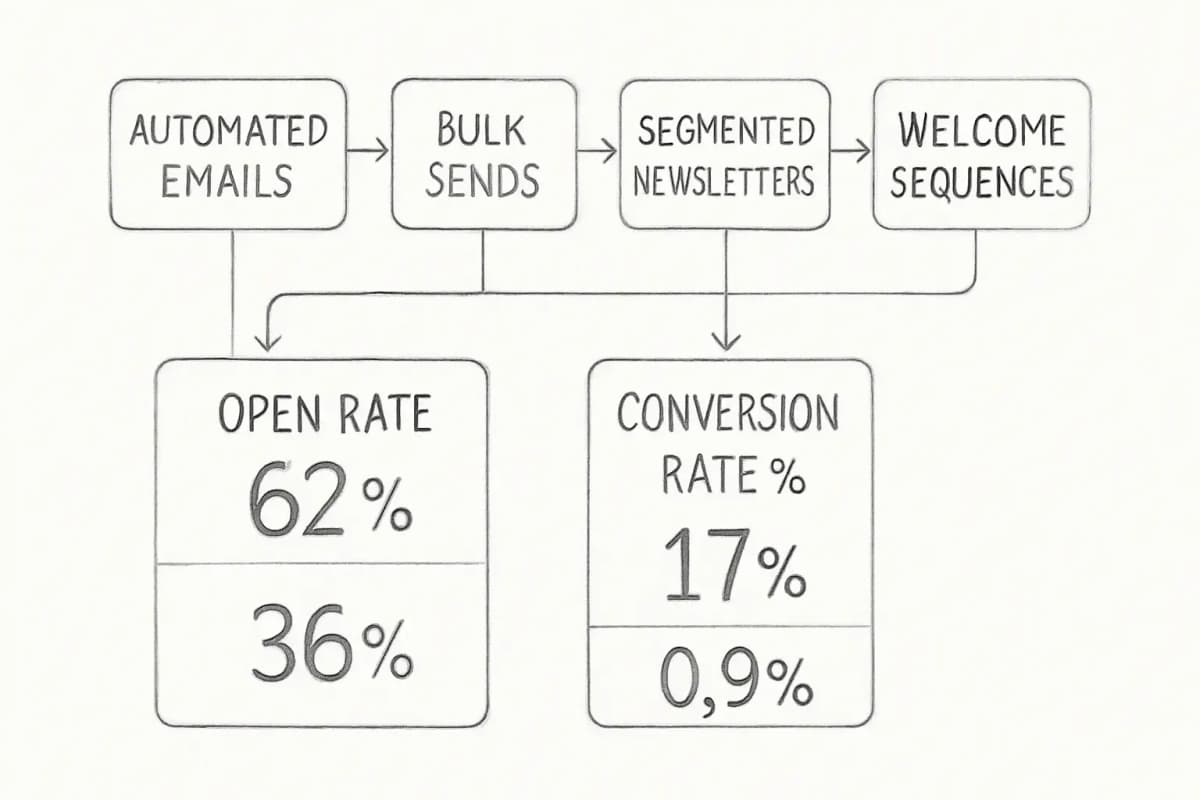
In B2B, the performance gap is even more striking. The average open rate for regular emails runs around 18%, while the welcome email series delivers an open rate of 63%.
For a deeper look at building these sequences, see our guide on welcome email sequence best practices.
2. Abandoned Cart Emails
Cart abandonment is a structural ecommerce problem. The average shopping cart abandonment rate across industries sits at just over 70%. That represents a large, recoverable pool of revenue for any business that acts on it.
Abandoned cart flows drive the highest average revenue per recipient ($3.65) and the highest average conversion rate (3.33%) of all automated email flows. No other automated sequence outperforms it on revenue generation.
Timing matters significantly here. Sending an abandoned cart email within one hour of the customer's abandonment action boosts conversions by 20%.
Key elements of a high-converting cart abandonment email:
Subject line that references the specific item left behind
A product image and clear CTA back to the cart
Social proof near the product (reviews, ratings)
An urgency or scarcity signal if inventory is limited
Optional: a time-limited discount in a follow-up email if the first one goes unopened
Campaigns using three cart abandonment emails generate significantly higher revenue ($24.9 million) compared to campaigns with only one email ($3.8 million).
3. Post-Purchase and Re-Engagement Campaigns
The sale is not the end of the email relationship. Post-purchase emails serve two purposes: they reduce buyer's remorse and they open the door to repeat purchases.
Order confirmation and shipping confirmation emails are among the most-opened emails a business sends. Order and shipping confirmation emails convert 22 times better than campaign emails.
Re-engagement campaigns target subscribers who have gone quiet, typically after 60 to 90 days of inactivity. A well-structured re-engagement sequence does two things: it recovers a portion of lapsed subscribers and it helps you clean contacts who will never convert, which protects your deliverability.
A simple re-engagement sequence that works:
Email 1: A "we miss you" message with a relevant offer or piece of content
Email 2 (3-5 days later): A last-chance message with a stronger incentive
Email 3 (5-7 days later): A final opt-out or stay-on-list prompt
Removing subscribers who don't re-engage improves your sender reputation, open rates, and long-term deliverability. A smaller, engaged list consistently outperforms a bloated, unresponsive one.
Include a low-friction offer (a discount, a free resource, a guide) in email two
Use email three to direct subscribers toward their first conversion action
In B2B, the performance gap is even more striking. The average open rate for regular emails runs around 18%, while the welcome email series delivers an open rate of 63%.
For a deeper look at building these sequences, see our guide on welcome email sequence best practices.
2. Abandoned Cart Emails
Cart abandonment is a structural ecommerce problem. The average shopping cart abandonment rate across industries sits at just over 70%. That represents a large, recoverable pool of revenue for any business that acts on it.
Abandoned cart flows drive the highest average revenue per recipient ($3.65) and the highest average conversion rate (3.33%) of all automated email flows. No other automated sequence outperforms it on revenue generation.
Timing matters significantly here. Sending an abandoned cart email within one hour of the customer's abandonment action boosts conversions by 20%.
Key elements of a high-converting cart abandonment email:
Subject line that references the specific item left behind
A product image and clear CTA back to the cart
Social proof near the product (reviews, ratings)
An urgency or scarcity signal if inventory is limited
Optional: a time-limited discount in a follow-up email if the first one goes unopened
Campaigns using three cart abandonment emails generate significantly higher revenue ($24.9 million) compared to campaigns with only one email ($3.8 million).
3. Post-Purchase and Re-Engagement Campaigns
The sale is not the end of the email relationship. Post-purchase emails serve two purposes: they reduce buyer's remorse and they open the door to repeat purchases.
Order confirmation and shipping confirmation emails are among the most-opened emails a business sends. Order and shipping confirmation emails convert 22 times better than campaign emails.
Re-engagement campaigns target subscribers who have gone quiet, typically after 60 to 90 days of inactivity. A well-structured re-engagement sequence does two things: it recovers a portion of lapsed subscribers and it helps you clean contacts who will never convert, which protects your deliverability.
A simple re-engagement sequence that works:
Email 1: A "we miss you" message with a relevant offer or piece of content
Email 2 (3-5 days later): A last-chance message with a stronger incentive
Email 3 (5-7 days later): A final opt-out or stay-on-list prompt
Removing subscribers who don't re-engage improves your sender reputation, open rates, and long-term deliverability. A smaller, engaged list consistently outperforms a bloated, unresponsive one.
4. Segmented Promotional Campaigns
Generic promotional blasts are among the weakest examples of email marketing in terms of ROI. Segmentation changes that equation dramatically.
Segmenting email lists can lead to up to a 760% increase in email revenue in documented cases. Marketers report that segmented emails result in 50% more clickthroughs and 30% more opens, with segmented campaigns achieving 50% higher CTRs than unsegmented ones.
Promotional emails work best when the offer is matched to subscriber behavior or purchase history. A few practical segmentation criteria that drive results:
Purchase history: Recommend products adjacent to what they've already bought
Browse behavior: Trigger emails based on product pages visited but not purchased
Lifecycle stage: New subscribers, active buyers, and lapsed customers all need different offers
Geographic location: Useful for local promotions, store events, or region-specific offers
According to HubSpot, 65% of marketers say their segmented emails have better open rates.
The email newsletter is one of the oldest and most consistent examples of email marketing. Its job is not direct conversion; it's building the relationship that makes future conversions easier.
Newsletters rank as the second most-used email type, with 58% of marketers including them as part of their strategy, up from 46% in 2024.
About 71% of B2B marketers used email newsletters to nurture leads in 2024, making it one of the most-used channels within any 12-month period.
A newsletter that drives real results shares a few common characteristics:
It delivers genuine value: industry insight, practical tips, curated resources
It has a consistent format so subscribers know what to expect
It keeps a single focused CTA rather than competing for clicks across five different topics
It sounds like a real person wrote it, not a template
The moment a newsletter starts feeling like an ad, unsubscribes follow. 69% of consumers say they unsubscribed from a brand because they received too many emails from them. Frequency discipline is as important as content quality.
6. Behavioral Trigger Emails
Trigger emails are sent in response to a specific action a subscriber takes: viewing a product, completing an onboarding step, reaching a milestone, or failing to complete a signup flow. They're the backbone of any mature examples of email marketing program.
4. Segmented Promotional Campaigns
Generic promotional blasts are among the weakest examples of email marketing in terms of ROI. Segmentation changes that equation dramatically.
Segmenting email lists can lead to up to a 760% increase in email revenue in documented cases. Marketers report that segmented emails result in 50% more clickthroughs and 30% more opens, with segmented campaigns achieving 50% higher CTRs than unsegmented ones.
Promotional emails work best when the offer is matched to subscriber behavior or purchase history. A few practical segmentation criteria that drive results:
Purchase history: Recommend products adjacent to what they've already bought
Browse behavior: Trigger emails based on product pages visited but not purchased
Lifecycle stage: New subscribers, active buyers, and lapsed customers all need different offers
Geographic location: Useful for local promotions, store events, or region-specific offers
According to HubSpot, 65% of marketers say their segmented emails have better open rates.
The email newsletter is one of the oldest and most consistent examples of email marketing. Its job is not direct conversion; it's building the relationship that makes future conversions easier.
Newsletters rank as the second most-used email type, with 58% of marketers including them as part of their strategy, up from 46% in 2024.
About 71% of B2B marketers used email newsletters to nurture leads in 2024, making it one of the most-used channels within any 12-month period.
A newsletter that drives real results shares a few common characteristics:
It delivers genuine value: industry insight, practical tips, curated resources
It has a consistent format so subscribers know what to expect
It keeps a single focused CTA rather than competing for clicks across five different topics
It sounds like a real person wrote it, not a template
The moment a newsletter starts feeling like an ad, unsubscribes follow. 69% of consumers say they unsubscribed from a brand because they received too many emails from them. Frequency discipline is as important as content quality.
6. Behavioral Trigger Emails
Trigger emails are sent in response to a specific action a subscriber takes: viewing a product, completing an onboarding step, reaching a milestone, or failing to complete a signup flow. They're the backbone of any mature examples of email marketing program.
Automated emails accounted for just 2% of email sends but drove 30% of revenue, earning 16 times more per send than scheduled campaigns.
Automated emails showed 52% higher open rates, 332% higher click rates, and 2,361% better conversion rates compared to regular campaigns.
Common trigger email types that consistently perform:
Onboarding sequences: Guide new users or customers through product adoption milestones
Milestone emails: Celebrate a customer's first purchase, first anniversary, or loyalty status
Browse abandonment: Reach contacts who viewed products but didn't add to cart
Replenishment reminders: For consumable products, prompt reorders before a subscriber runs out
Win-back after churn signals: For SaaS or subscription products, catch declining usage before cancellation
Personalization goes well beyond using a first name in a subject line. The most effective examples of email marketing use behavioral and purchase data to tailor the actual content of each email.
Emails with personalization achieve 29% higher open rates and 41% higher click-through rates compared to generic messages, with personalized emails generating 6 times higher transaction rates.
71% of consumers expect personalized interactions from brands, and 76% get frustrated when their brand interactions aren't personalized to their interests.
Real examples of personalization that move revenue:
Product recommendations based on purchase or browse history (used by retailers like Amazon and Netflix with documented success)
Dynamic content blocks that change based on subscriber segment or location
Birthday or anniversary emails with a time-limited offer
Behavior-based subject lines referencing the specific action taken
Back-in-stock emails deliver the highest conversion rate at 6.46%, while birthday messages produce an average order value more than 4 times higher than average ($744.37).
For more on applying this at scale, see our guide on email personalization techniques.
8. Real Campaign Results Worth Studying
Data from real campaigns reinforces what strategy frameworks suggest.
Automated emails accounted for just 2% of email sends but drove 30% of revenue, earning 16 times more per send than scheduled campaigns.
Automated emails showed 52% higher open rates, 332% higher click rates, and 2,361% better conversion rates compared to regular campaigns.
Common trigger email types that consistently perform:
Onboarding sequences: Guide new users or customers through product adoption milestones
Milestone emails: Celebrate a customer's first purchase, first anniversary, or loyalty status
Browse abandonment: Reach contacts who viewed products but didn't add to cart
Replenishment reminders: For consumable products, prompt reorders before a subscriber runs out
Win-back after churn signals: For SaaS or subscription products, catch declining usage before cancellation
Personalization goes well beyond using a first name in a subject line. The most effective examples of email marketing use behavioral and purchase data to tailor the actual content of each email.
Emails with personalization achieve 29% higher open rates and 41% higher click-through rates compared to generic messages, with personalized emails generating 6 times higher transaction rates.
71% of consumers expect personalized interactions from brands, and 76% get frustrated when their brand interactions aren't personalized to their interests.
Real examples of personalization that move revenue:
Product recommendations based on purchase or browse history (used by retailers like Amazon and Netflix with documented success)
Dynamic content blocks that change based on subscriber segment or location
Birthday or anniversary emails with a time-limited offer
Behavior-based subject lines referencing the specific action taken
Back-in-stock emails deliver the highest conversion rate at 6.46%, while birthday messages produce an average order value more than 4 times higher than average ($744.37).
For more on applying this at scale, see our guide on email personalization techniques.
8. Real Campaign Results Worth Studying
Data from real campaigns reinforces what strategy frameworks suggest.
One brand built automated welcome flows and abandoned cart reminders with separate B2B and B2C campaigns targeting customers by occupation and purchasing behavior. Within less than a year, the welcome series achieved a 58.7% open rate and a click-through rate of 5.4%, a 315% improvement above the ecommerce industry benchmark, while the overall program generated a 30x revenue ROI.
In another case, automated campaigns accounted for 40% of all email-driven revenue, with open rates for automated emails 1.7 times higher than bulk sends and a conversion rate 18 times that of mass communications.
These outcomes aren't exceptional outliers. They follow directly from the same principles: segmentation, behavioral triggers, automation, and relevant content.
Frequently Asked Questions
What are the most effective types of email marketing examples for small businesses?
Welcome sequences, abandoned cart emails (for ecommerce), and segmented newsletters consistently deliver the strongest results for smaller operations. In 2024, 53% of small business owners in the US, UK, Canada, and Australia used email marketing to acquire and retain customers. These campaign types require minimal budget but generate disproportionate return relative to setup effort.
How often should I send marketing emails to avoid unsubscribes?
There is no universal frequency. The right cadence depends on your audience, content quality, and the type of emails you send. 96% of recipients have unsubscribed because emails were sent too frequently. As a starting point, one to two emails per week is a reasonable ceiling for most businesses. Monitor unsubscribe rates and reduce frequency if they rise above 0.5% per send.
What makes an email marketing campaign example "high-performing"?
Three things: the right audience, a relevant message, and a single clear action. The most effective email marketing campaigns deliver the right message to the right person at the right time, meaning understanding your audience's needs, personalizing content based on behavior, and timing emails when they're most likely to engage.
How does email marketing ROI compare to other digital channels?
42% of marketers say email is their most effective channel, far ahead of social media and paid search, which both sit at just 16%. In 2024, 50% of consumers said they purchased directly from an email, more than from social media posts or ads. No other owned channel matches email for direct purchase attribution.
One brand built automated welcome flows and abandoned cart reminders with separate B2B and B2C campaigns targeting customers by occupation and purchasing behavior. Within less than a year, the welcome series achieved a 58.7% open rate and a click-through rate of 5.4%, a 315% improvement above the ecommerce industry benchmark, while the overall program generated a 30x revenue ROI.
In another case, automated campaigns accounted for 40% of all email-driven revenue, with open rates for automated emails 1.7 times higher than bulk sends and a conversion rate 18 times that of mass communications.
These outcomes aren't exceptional outliers. They follow directly from the same principles: segmentation, behavioral triggers, automation, and relevant content.
Frequently Asked Questions
What are the most effective types of email marketing examples for small businesses?
Welcome sequences, abandoned cart emails (for ecommerce), and segmented newsletters consistently deliver the strongest results for smaller operations. In 2024, 53% of small business owners in the US, UK, Canada, and Australia used email marketing to acquire and retain customers. These campaign types require minimal budget but generate disproportionate return relative to setup effort.
How often should I send marketing emails to avoid unsubscribes?
There is no universal frequency. The right cadence depends on your audience, content quality, and the type of emails you send. 96% of recipients have unsubscribed because emails were sent too frequently. As a starting point, one to two emails per week is a reasonable ceiling for most businesses. Monitor unsubscribe rates and reduce frequency if they rise above 0.5% per send.
What makes an email marketing campaign example "high-performing"?
Three things: the right audience, a relevant message, and a single clear action. The most effective email marketing campaigns deliver the right message to the right person at the right time, meaning understanding your audience's needs, personalizing content based on behavior, and timing emails when they're most likely to engage.
How does email marketing ROI compare to other digital channels?
42% of marketers say email is their most effective channel, far ahead of social media and paid search, which both sit at just 16%. In 2024, 50% of consumers said they purchased directly from an email, more than from social media posts or ads. No other owned channel matches email for direct purchase attribution.