Franchise Email Marketing: Strategy for Multi-Location Success
Build a unified email strategy across franchise locations. Learn templates, segmentation, and compliance tactics to boost revenue and brand consistency.
Franchise Email Marketing: Strategy for Multi-Location Success
Build a unified email strategy across franchise locations. Learn templates, segmentation, and compliance tactics to boost revenue and brand consistency.
Franchise businesses operate under a structural tension that single-location brands never face: how do you send emails that feel locally relevant across dozens or hundreds of locations without letting your brand drift into chaos? Franchise brands face a unique marketing challenge: maintaining brand consistency across every location while enabling franchisees to market locally. When dozens or even hundreds of locations run their own campaigns, messaging can quickly become inconsistent.
Franchise email marketing solves this problem. A strategic approach to managing email campaigns across multi-location brands, franchise email marketing ensures brand consistency while addressing local market needs. It helps businesses connect with local audiences through tailored campaigns, and bridges the gap between corporate messaging and franchise-level dynamics. As a result, email marketing for franchises is effective at increasing engagement and boosting foot traffic to different locations, while strengthening brand loyalty and driving revenue and business growth.
The stakes are high. Email marketing generates between $36 and $40 for every dollar spent, translating to a 3,600% to 4,000% return on investment, outperforming most other marketing channels by a significant margin. For franchises with dozens of locations, that multiplier is a serious opportunity, but only if the strategy is built correctly from the start.
Key Takeaways
Franchise email marketing requires a two-layer structure: corporate controls brand standards, franchisees control local execution.
47% of franchisors cite managing brand reputation across multiple markets as their biggest hurdle, and 59% emphasize brand consistency as the primary reason for setting marketing control levels.
Segmenting email campaigns can achieve 50% more click-through rate and a 760% increase in revenue compared to sending the same email to all subscribers.
Automations account for just 2% of email sends but drive 30% of revenue, earning 16x more per send than scheduled campaigns.
Compliance with CAN-SPAM, GDPR, and CASL must be standardized across every franchise location, not left to individual operators.
What Makes Franchise Email Marketing Different
Standard email marketing assumes one sender, one audience, one message. Franchise email marketing operates across a distributed network where each location has its own customer base, local context, and competitive environment.
Franchise businesses operate under a structural tension that single-location brands never face: how do you send emails that feel locally relevant across dozens or hundreds of locations without letting your brand drift into chaos? Franchise brands face a unique marketing challenge: maintaining brand consistency across every location while enabling franchisees to market locally. When dozens or even hundreds of locations run their own campaigns, messaging can quickly become inconsistent.
Franchise email marketing solves this problem. A strategic approach to managing email campaigns across multi-location brands, franchise email marketing ensures brand consistency while addressing local market needs. It helps businesses connect with local audiences through tailored campaigns, and bridges the gap between corporate messaging and franchise-level dynamics. As a result, email marketing for franchises is effective at increasing engagement and boosting foot traffic to different locations, while strengthening brand loyalty and driving revenue and business growth.
The stakes are high. Email marketing generates between $36 and $40 for every dollar spent, translating to a 3,600% to 4,000% return on investment, outperforming most other marketing channels by a significant margin. For franchises with dozens of locations, that multiplier is a serious opportunity, but only if the strategy is built correctly from the start.
Key Takeaways
Franchise email marketing requires a two-layer structure: corporate controls brand standards, franchisees control local execution.
47% of franchisors cite managing brand reputation across multiple markets as their biggest hurdle, and 59% emphasize brand consistency as the primary reason for setting marketing control levels.
Segmenting email campaigns can achieve 50% more click-through rate and a 760% increase in revenue compared to sending the same email to all subscribers.
Automations account for just 2% of email sends but drive 30% of revenue, earning 16x more per send than scheduled campaigns.
Compliance with CAN-SPAM, GDPR, and CASL must be standardized across every franchise location, not left to individual operators.
What Makes Franchise Email Marketing Different
Standard email marketing assumes one sender, one audience, one message. Franchise email marketing operates across a distributed network where each location has its own customer base, local context, and competitive environment.
Franchise email marketing is a specialized approach designed to address the unique needs of multi-location businesses. Unlike standard email marketing campaigns, which typically focus on a single brand or entity, franchise email marketing balances corporate management with local franchise autonomy. The corporate office maintains brand consistency while franchisees customize messages to ensure they resonate with local audiences, resulting in a blend of uniformity and personalization.
This dual-layer model creates three operational challenges that every franchise marketing team must solve:
Managing subscriber lists across multiple locations, coordinating promotional calendars, and ensuring compliance with varying regional regulations.
Maintaining brand trust when franchisees have different levels of marketing skill and resources.
Measuring performance network-wide while still giving each location the local data it needs to improve.
The Corporate vs. Local Control Framework
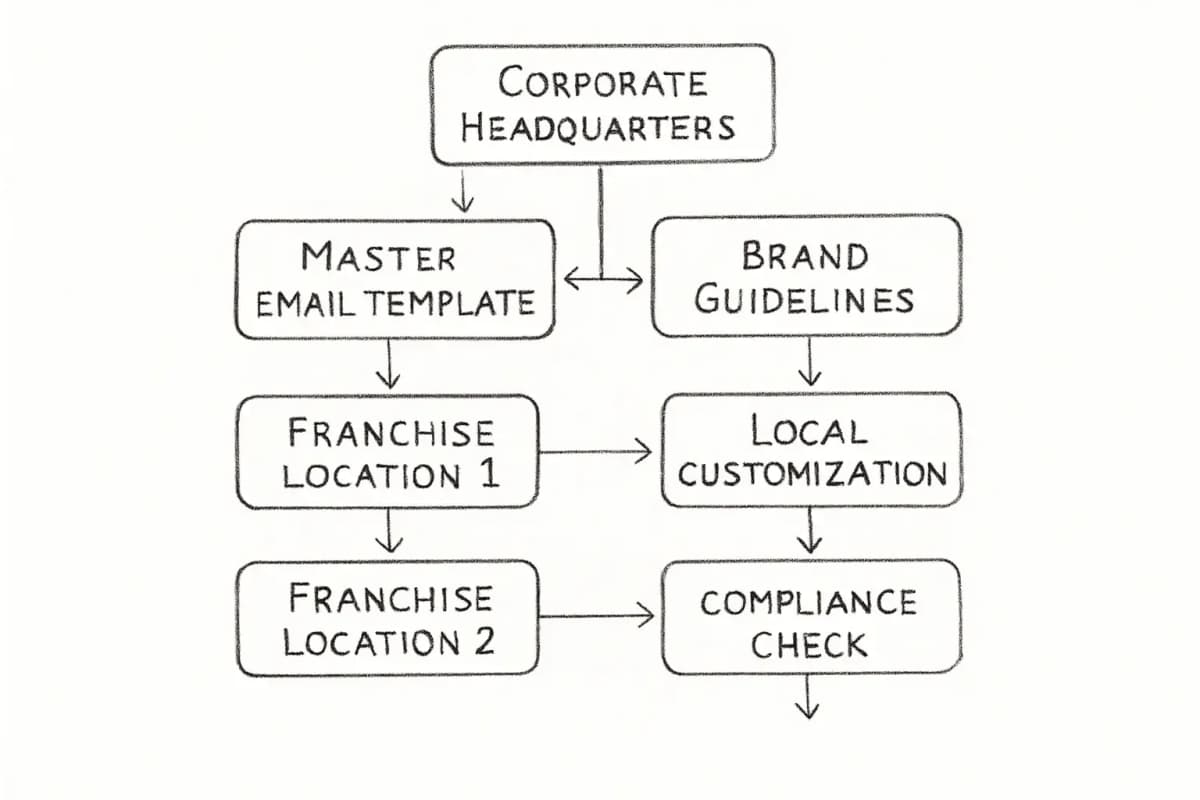
The most critical strategic decision in franchise email marketing is deciding what corporate owns and what franchisees control. Get this wrong and you either strangle local operators with bureaucracy or let brand drift erode customer trust.
Purpose, promise, and tone should never vary. How those show up can and should adapt. Successful multi-unit brands strike this balance deliberately, protecting core elements whilst giving locations freedom to connect with their markets.
A practical governance model looks like this:
Corporate owns:
Brand voice, tone, and visual identity
Email templates with locked design sections
Network-wide promotional calendars
Global unsubscribe and compliance infrastructure
Franchisees control:
Local offer customization within approved templates
Location-specific event promotion
Subscriber list management for their territory
Send timing based on local audience behavior
A centralized email marketing tool that has control at the HQ level, but with individual accounts, campaigns, and email lists at the local level allows franchisors to exercise control, while each franchisee has their own sub-account, contacts, and campaigns. This helps franchisees control their own marketing while benefiting from the expertise and organization of the corporate franchise.
Franchisors recognize that control must be balanced with the need for local customization, with 50% of franchisors also prioritizing local responsiveness. By utilizing a tool like Constant Contact, franchisors can deploy email templates with "locked" branding and even content and imagery sections, while leaving some parts open for franchisees to customize with their own messaging.
Segmentation: The Engine of Local Relevance
Franchise email marketing is a specialized approach designed to address the unique needs of multi-location businesses. Unlike standard email marketing campaigns, which typically focus on a single brand or entity, franchise email marketing balances corporate management with local franchise autonomy. The corporate office maintains brand consistency while franchisees customize messages to ensure they resonate with local audiences, resulting in a blend of uniformity and personalization.
This dual-layer model creates three operational challenges that every franchise marketing team must solve:
Managing subscriber lists across multiple locations, coordinating promotional calendars, and ensuring compliance with varying regional regulations.
Maintaining brand trust when franchisees have different levels of marketing skill and resources.
Measuring performance network-wide while still giving each location the local data it needs to improve.
The Corporate vs. Local Control Framework
The most critical strategic decision in franchise email marketing is deciding what corporate owns and what franchisees control. Get this wrong and you either strangle local operators with bureaucracy or let brand drift erode customer trust.
Purpose, promise, and tone should never vary. How those show up can and should adapt. Successful multi-unit brands strike this balance deliberately, protecting core elements whilst giving locations freedom to connect with their markets.
A practical governance model looks like this:
Corporate owns:
Brand voice, tone, and visual identity
Email templates with locked design sections
Network-wide promotional calendars
Global unsubscribe and compliance infrastructure
Franchisees control:
Local offer customization within approved templates
Location-specific event promotion
Subscriber list management for their territory
Send timing based on local audience behavior
A centralized email marketing tool that has control at the HQ level, but with individual accounts, campaigns, and email lists at the local level allows franchisors to exercise control, while each franchisee has their own sub-account, contacts, and campaigns. This helps franchisees control their own marketing while benefiting from the expertise and organization of the corporate franchise.
Franchisors recognize that control must be balanced with the need for local customization, with 50% of franchisors also prioritizing local responsiveness. By utilizing a tool like Constant Contact, franchisors can deploy email templates with "locked" branding and even content and imagery sections, while leaving some parts open for franchisees to customize with their own messaging.
Segmentation: The Engine of Local Relevance
Sending the same email to every subscriber in your network regardless of location or behavior is one of the fastest ways to damage your deliverability and your brand. 74% of customers ignore email content that isn't relevant to them.
For franchise systems, geographic segmentation is the foundation. To ensure effective communication and targeted marketing, it's crucial to segment subscriber lists. While maintaining a unified subscriber list across the entire franchise system is beneficial for overall brand communication, it's best to segment that list by location, among other relevant qualifiers like demographics or purchase history.
Beyond location, franchises can layer in:
Behavioral segments: Customers who visited a location recently versus those who haven't engaged in 90 days.
Purchase history: Loyalty customers vs. first-time visitors.
Local event triggers: Subscribers near a specific location who are relevant to an in-store promotion.
Customer lifecycle stage: New subscribers get a welcome sequence. Active regulars get VIP offers.
Personalization is key to engaging local audiences. Businesses can use dynamic content blocks to automatically display location-specific promotions or store details based on a recipient's geographic data, showcase hours, in-store events, or regionally popular products within each email, and direct customers to their nearest franchise location. Incorporating regional details improves engagement and fosters a stronger local connection.
Franchisees are operators first and marketers second. Marketing tools must be easy to use so locations can launch campaigns without needing advanced marketing expertise.
Automation solves this. Corporate builds the workflows once. Every location benefits automatically.
The core automation sequences every franchise email program needs:
Sending the same email to every subscriber in your network regardless of location or behavior is one of the fastest ways to damage your deliverability and your brand. 74% of customers ignore email content that isn't relevant to them.
For franchise systems, geographic segmentation is the foundation. To ensure effective communication and targeted marketing, it's crucial to segment subscriber lists. While maintaining a unified subscriber list across the entire franchise system is beneficial for overall brand communication, it's best to segment that list by location, among other relevant qualifiers like demographics or purchase history.
Beyond location, franchises can layer in:
Behavioral segments: Customers who visited a location recently versus those who haven't engaged in 90 days.
Purchase history: Loyalty customers vs. first-time visitors.
Local event triggers: Subscribers near a specific location who are relevant to an in-store promotion.
Customer lifecycle stage: New subscribers get a welcome sequence. Active regulars get VIP offers.
Personalization is key to engaging local audiences. Businesses can use dynamic content blocks to automatically display location-specific promotions or store details based on a recipient's geographic data, showcase hours, in-store events, or regionally popular products within each email, and direct customers to their nearest franchise location. Incorporating regional details improves engagement and fosters a stronger local connection.
Franchisees are operators first and marketers second. Marketing tools must be easy to use so locations can launch campaigns without needing advanced marketing expertise.
Automation solves this. Corporate builds the workflows once. Every location benefits automatically.
The core automation sequences every franchise email program needs:
Welcome series: Triggered when a new subscriber joins a location's list. Welcome emails have an average open rate of 69%, reaching up to 80%. This is your highest-engagement moment, use it to introduce the local team and the brand.
Post-visit follow-up: Sent after a confirmed in-store interaction, triggered by POS or loyalty data.
Win-back sequence: For subscribers who haven't engaged in 60 to 90 days, offer a local incentive to re-engage.
Promotional calendar syncs: Corporate pushes network-wide promotions automatically, with franchisees able to add local context.
Automated emails account for just 2% of email sends but drive 30% of revenue, earning 16x more per send than scheduled campaigns. For franchise systems where franchisees have limited time for manual marketing, automation is not optional. It is the strategy.
Building a strong welcome experience is particularly important. Our welcome email sequence best practices guide covers exactly how to structure those first few touchpoints to maximize long-term subscriber value.
Personalization at Scale
Personalization in franchise email marketing means more than using a subscriber's first name. It means showing content that reflects the specific location, local inventory, regional promotions, and community context the subscriber actually cares about.
Personalized campaigns achieve 29% open rates and 41% click-through rates.
Dynamic content blocks make this possible at scale. A single email template can pull different content depending on the subscriber's location, so a customer near a franchise in Chicago sees a different promotion than a customer near a location in Dallas, even though corporate sent one campaign.
Personalizing email subject lines or headers with local landmarks, city names, or cultural references, featuring sales or exclusive offers tied to seasonal festivals, sports events, or community celebrations, and using regional phrasing that resonates with the target market all contribute to higher local engagement.
AI tools like HubSpot or Klaviyo analyze customer behavior to send personalized offers. For instance, a fast-food franchise can send a discount code for a customer's favorite burger based on past orders.
For a detailed breakdown of personalization mechanics, see our article on email personalization techniques that boost conversions 47%.
Compliance Across Multiple Locations
Compliance is where franchise email marketing gets genuinely complicated. When multiple franchisees are sending email across different states or countries, a single misstep can expose the entire network to legal risk.
The four major frameworks franchise brands encounter are CAN-SPAM (US), GDPR (EU), CASL (Canada), and CCPA/CPRA (California), each with real financial penalties for violations.
Welcome series: Triggered when a new subscriber joins a location's list. Welcome emails have an average open rate of 69%, reaching up to 80%. This is your highest-engagement moment, use it to introduce the local team and the brand.
Post-visit follow-up: Sent after a confirmed in-store interaction, triggered by POS or loyalty data.
Win-back sequence: For subscribers who haven't engaged in 60 to 90 days, offer a local incentive to re-engage.
Promotional calendar syncs: Corporate pushes network-wide promotions automatically, with franchisees able to add local context.
Automated emails account for just 2% of email sends but drive 30% of revenue, earning 16x more per send than scheduled campaigns. For franchise systems where franchisees have limited time for manual marketing, automation is not optional. It is the strategy.
Building a strong welcome experience is particularly important. Our welcome email sequence best practices guide covers exactly how to structure those first few touchpoints to maximize long-term subscriber value.
Personalization at Scale
Personalization in franchise email marketing means more than using a subscriber's first name. It means showing content that reflects the specific location, local inventory, regional promotions, and community context the subscriber actually cares about.
Personalized campaigns achieve 29% open rates and 41% click-through rates.
Dynamic content blocks make this possible at scale. A single email template can pull different content depending on the subscriber's location, so a customer near a franchise in Chicago sees a different promotion than a customer near a location in Dallas, even though corporate sent one campaign.
Personalizing email subject lines or headers with local landmarks, city names, or cultural references, featuring sales or exclusive offers tied to seasonal festivals, sports events, or community celebrations, and using regional phrasing that resonates with the target market all contribute to higher local engagement.
AI tools like HubSpot or Klaviyo analyze customer behavior to send personalized offers. For instance, a fast-food franchise can send a discount code for a customer's favorite burger based on past orders.
For a detailed breakdown of personalization mechanics, see our article on email personalization techniques that boost conversions 47%.
Compliance Across Multiple Locations
Compliance is where franchise email marketing gets genuinely complicated. When multiple franchisees are sending email across different states or countries, a single misstep can expose the entire network to legal risk.
The four major frameworks franchise brands encounter are CAN-SPAM (US), GDPR (EU), CASL (Canada), and CCPA/CPRA (California), each with real financial penalties for violations.
Adhering to compliance regulations such as GDPR and CAN-SPAM is essential to avoid legal issues and protect customer data. By working with all franchisees, you can ensure they follow standardized data collection and storage practices. Being transparent about your data security builds trust with customers and safeguards your franchise's reputation.
Compliance must be corporate-owned, not franchisee-dependent. Specific areas to lock down at the system level:
Global unsubscribe management: Managing subscriber lists across multiple locations can create compliance challenges. Features like global unsubscribe ensure customer preferences are respected across the entire franchise system.
Consent records: Every subscriber's opt-in must be logged, including the date, method, and location.
Standardized opt-out processing: Honor unsubscribe requests quickly. GDPR gives you 72 hours while CAN-SPAM gives you ten business days. Make the unsubscribe process simple, quick, and free.
Authentication protocols: SPF, DKIM, and DMARC records must be configured for every sending domain used across the network.
Compliant lists are also higher-quality lists, which means better deliverability and more revenue per subscriber. Compliance and performance are not in conflict. A well-governed list earns better inbox placement and better results.
Measuring Performance Network-Wide
Utilizing tools for better reporting helps franchises monitor email campaign success, identify areas for improvement, and optimize future strategies. Franchisees should have access to location-specific data while maintaining corporate guidance for network-wide performance. Metrics like open rates, click-through rates, and ROI are necessary for continued improvement.
At the corporate level, look at:
Network-wide open rate and click rate trends to identify whether brand-level messaging is resonating.
Revenue per email by location to identify which operators are driving the most return.
Deliverability health: Bounce rates and spam complaint rates across all sending domains.
List growth rate per location to flag underperforming territories.
At the franchisee level, performance reporting should focus on metrics the operator can actually act on: local open rates, foot traffic attributable to campaigns, and promotion redemption rates.
Use dashboards to monitor each location's marketing performance. Identify top performers and share their strategies with the network. This creates a feedback loop that raises the floor across all locations over time.
Choosing the Right Platform for Franchise Email Marketing
Adhering to compliance regulations such as GDPR and CAN-SPAM is essential to avoid legal issues and protect customer data. By working with all franchisees, you can ensure they follow standardized data collection and storage practices. Being transparent about your data security builds trust with customers and safeguards your franchise's reputation.
Compliance must be corporate-owned, not franchisee-dependent. Specific areas to lock down at the system level:
Global unsubscribe management: Managing subscriber lists across multiple locations can create compliance challenges. Features like global unsubscribe ensure customer preferences are respected across the entire franchise system.
Consent records: Every subscriber's opt-in must be logged, including the date, method, and location.
Standardized opt-out processing: Honor unsubscribe requests quickly. GDPR gives you 72 hours while CAN-SPAM gives you ten business days. Make the unsubscribe process simple, quick, and free.
Authentication protocols: SPF, DKIM, and DMARC records must be configured for every sending domain used across the network.
Compliant lists are also higher-quality lists, which means better deliverability and more revenue per subscriber. Compliance and performance are not in conflict. A well-governed list earns better inbox placement and better results.
Measuring Performance Network-Wide
Utilizing tools for better reporting helps franchises monitor email campaign success, identify areas for improvement, and optimize future strategies. Franchisees should have access to location-specific data while maintaining corporate guidance for network-wide performance. Metrics like open rates, click-through rates, and ROI are necessary for continued improvement.
At the corporate level, look at:
Network-wide open rate and click rate trends to identify whether brand-level messaging is resonating.
Revenue per email by location to identify which operators are driving the most return.
Deliverability health: Bounce rates and spam complaint rates across all sending domains.
List growth rate per location to flag underperforming territories.
At the franchisee level, performance reporting should focus on metrics the operator can actually act on: local open rates, foot traffic attributable to campaigns, and promotion redemption rates.
Use dashboards to monitor each location's marketing performance. Identify top performers and share their strategies with the network. This creates a feedback loop that raises the floor across all locations over time.
Choosing the Right Platform for Franchise Email Marketing
Not every email platform is built for multi-location management. The right platform for franchise email marketing needs:
Sub-account architecture: Each location gets its own account, list, and reporting, but corporate retains visibility and control.
Locked template functionality: Brand sections are protected while local sections are editable.
Multi-user permissions: Corporate administrators, regional managers, and individual franchisees each have appropriate access levels.
Integration with CRM and POS systems: Connect your email marketing platform for franchises with CRM systems, POS tools, and customer service solutions to trigger behavioral campaigns from real purchase data.
Centralized compliance tools: Global unsubscribes, consent logging, and suppression list management built in.
BigMailer's built-in brand and user-access management allows you to easily manage multiple brands (sub-accounts) and team members from a single account. Mailjet is designed for collaboration features for franchises and lets you work on emails together as a team, just like you would in a Google Doc, with the ability to lock specific parts of email templates so they cannot be edited by certain users.
Whatever platform you choose, evaluate it against the question: can corporate lock what matters and empower what doesn't?
Frequently Asked Questions
What is franchise email marketing?
Franchise email marketing is a specialized email marketing approach designed to address the unique needs of multi-location businesses. Unlike standard email marketing campaigns, which typically focus on a single brand or entity, franchise email marketing balances corporate management with local franchise autonomy. Corporate maintains brand standards while franchisees customize content for their local market.
How do franchisors maintain brand consistency in email campaigns?
A centralized email marketing tool that has control at the HQ level, but with individual accounts, campaigns, and email lists at the local level allows franchisors to exercise control while each franchisee has their own sub-account, contacts, and campaigns. Locked template sections protect brand assets while leaving designated areas open for local customization.
How should franchise email lists be segmented?
Start with geographic segmentation to separate subscribers by location, then layer in behavioral and demographic data. Segmenting email campaigns can achieve 50% more click-through rate and a 760% increase in revenue compared to sending the same email to all subscribers. For franchise systems, segmenting by location is the minimum. Adding purchase history, visit recency, and lifecycle stage produces significantly better results.
What compliance rules apply to franchise email marketing?
The universal best practices that keep you safe across all regions are: clear opt-in language, logged consent records, a visible one-click unsubscribe in every email, a physical address in your footer, and a clean process for data deletion requests. Corporate should own and enforce these standards across the entire franchise network to avoid regulatory exposure from individual location errors.
Not every email platform is built for multi-location management. The right platform for franchise email marketing needs:
Sub-account architecture: Each location gets its own account, list, and reporting, but corporate retains visibility and control.
Locked template functionality: Brand sections are protected while local sections are editable.
Multi-user permissions: Corporate administrators, regional managers, and individual franchisees each have appropriate access levels.
Integration with CRM and POS systems: Connect your email marketing platform for franchises with CRM systems, POS tools, and customer service solutions to trigger behavioral campaigns from real purchase data.
Centralized compliance tools: Global unsubscribes, consent logging, and suppression list management built in.
BigMailer's built-in brand and user-access management allows you to easily manage multiple brands (sub-accounts) and team members from a single account. Mailjet is designed for collaboration features for franchises and lets you work on emails together as a team, just like you would in a Google Doc, with the ability to lock specific parts of email templates so they cannot be edited by certain users.
Whatever platform you choose, evaluate it against the question: can corporate lock what matters and empower what doesn't?
Frequently Asked Questions
What is franchise email marketing?
Franchise email marketing is a specialized email marketing approach designed to address the unique needs of multi-location businesses. Unlike standard email marketing campaigns, which typically focus on a single brand or entity, franchise email marketing balances corporate management with local franchise autonomy. Corporate maintains brand standards while franchisees customize content for their local market.
How do franchisors maintain brand consistency in email campaigns?
A centralized email marketing tool that has control at the HQ level, but with individual accounts, campaigns, and email lists at the local level allows franchisors to exercise control while each franchisee has their own sub-account, contacts, and campaigns. Locked template sections protect brand assets while leaving designated areas open for local customization.
How should franchise email lists be segmented?
Start with geographic segmentation to separate subscribers by location, then layer in behavioral and demographic data. Segmenting email campaigns can achieve 50% more click-through rate and a 760% increase in revenue compared to sending the same email to all subscribers. For franchise systems, segmenting by location is the minimum. Adding purchase history, visit recency, and lifecycle stage produces significantly better results.
What compliance rules apply to franchise email marketing?
The universal best practices that keep you safe across all regions are: clear opt-in language, logged consent records, a visible one-click unsubscribe in every email, a physical address in your footer, and a clean process for data deletion requests. Corporate should own and enforce these standards across the entire franchise network to avoid regulatory exposure from individual location errors.