Healthcare email marketing is one of the highest-ROI channels available to practices and health organizations, yet most providers underuse it or execute it poorly. Email marketing drives the strongest ROI of any marketing channel, returning $42 on average for every $1 spent, and the healthcare sector consistently outperforms industry averages. Email open rates for healthcare campaigns average 22.6%, above the cross-industry average of roughly 21.3%. The challenge is not whether email works in healthcare; it is knowing which campaign types to run, how to personalize them, and how to stay fully HIPAA-compliant while doing it.
This guide breaks down the most effective healthcare email marketing examples, the data behind each type, and how to build campaigns that bring patients back through the door.
Key Takeaways
Drip campaigns outperform standard marketing emails in healthcare, with an average view rate of 56.36%, likely because of higher patient relevance and better timing.
Patient reminder emails reduce no-show rates by 28 to 54%.
Emails with personalized content see transaction rates six times higher than generic messages.
CTR for segmented healthcare email campaigns is 100.95% higher than non-segmented sends.
The average unsubscribe rate in healthcare email is just 0.07%, lower than most industries, suggesting patients genuinely value this communication.
Why Email Still Wins in Healthcare
Every other channel in healthcare marketing competes with shrinking organic reach, rising ad costs, and fragmented attention. Email does not have those problems.
Well-written emails are likely to have a 50 to 100 times higher click-through rate than social media platforms like Facebook and Twitter. Patients who have already chosen your practice want to hear from you. They have opted in. The channel is direct, personal, and measurable.
Email is the best digital marketing channel for healthcare providers to build long-lasting relationships with patients. After the initial visit, email lets you stay in touch until they need you again.
Saturdays have the highest view rate (49%) and CTR (5%) for healthcare email campaigns, which suggests patients are most receptive to health communications when they are not in work mode. Send timing matters.
Healthcare email marketing is one of the highest-ROI channels available to practices and health organizations, yet most providers underuse it or execute it poorly. Email marketing drives the strongest ROI of any marketing channel, returning $42 on average for every $1 spent, and the healthcare sector consistently outperforms industry averages. Email open rates for healthcare campaigns average 22.6%, above the cross-industry average of roughly 21.3%. The challenge is not whether email works in healthcare; it is knowing which campaign types to run, how to personalize them, and how to stay fully HIPAA-compliant while doing it.
This guide breaks down the most effective healthcare email marketing examples, the data behind each type, and how to build campaigns that bring patients back through the door.
Key Takeaways
Drip campaigns outperform standard marketing emails in healthcare, with an average view rate of 56.36%, likely because of higher patient relevance and better timing.
Patient reminder emails reduce no-show rates by 28 to 54%.
Emails with personalized content see transaction rates six times higher than generic messages.
CTR for segmented healthcare email campaigns is 100.95% higher than non-segmented sends.
The average unsubscribe rate in healthcare email is just 0.07%, lower than most industries, suggesting patients genuinely value this communication.
Why Email Still Wins in Healthcare
Every other channel in healthcare marketing competes with shrinking organic reach, rising ad costs, and fragmented attention. Email does not have those problems.
Well-written emails are likely to have a 50 to 100 times higher click-through rate than social media platforms like Facebook and Twitter. Patients who have already chosen your practice want to hear from you. They have opted in. The channel is direct, personal, and measurable.
Email is the best digital marketing channel for healthcare providers to build long-lasting relationships with patients. After the initial visit, email lets you stay in touch until they need you again.
Saturdays have the highest view rate (49%) and CTR (5%) for healthcare email campaigns, which suggests patients are most receptive to health communications when they are not in work mode. Send timing matters.
The combination of a trusted relationship, a willing audience, and strong measurability makes email the most reliable patient engagement tool available to healthcare marketers.
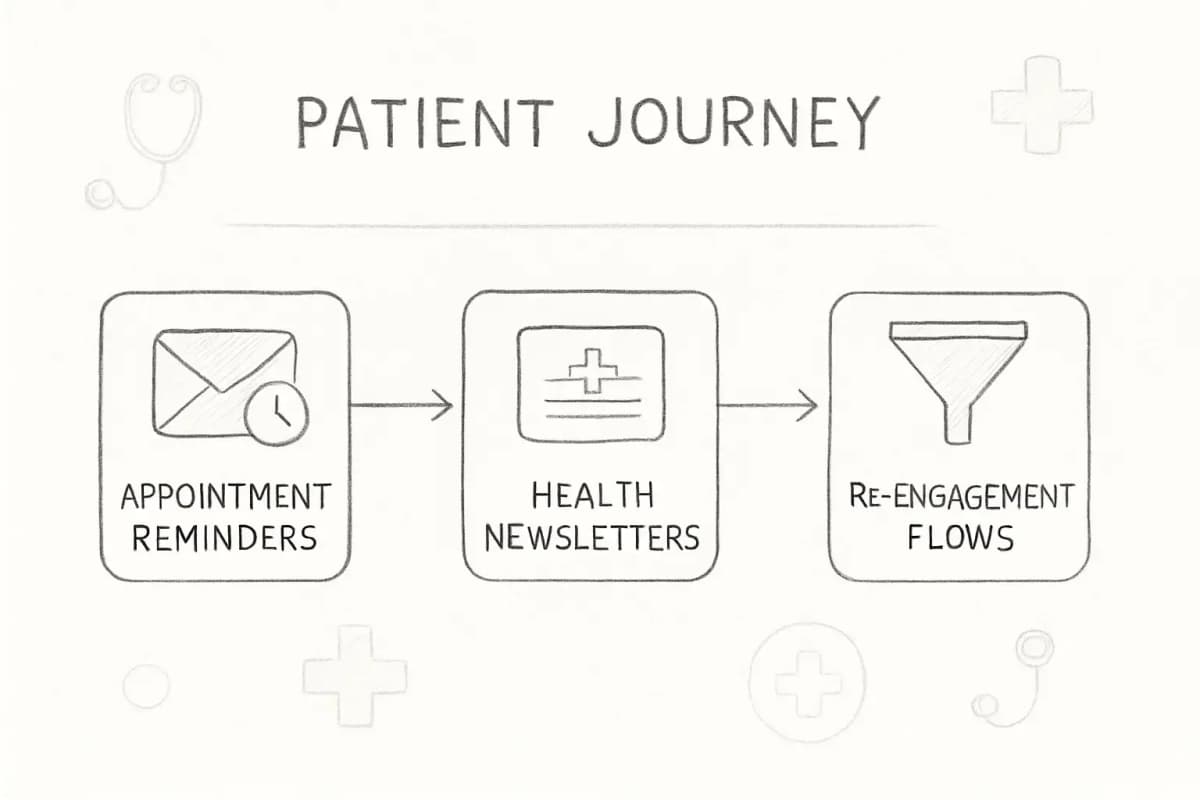
1. Appointment Reminder Emails
Appointment reminder emails are the single most operationally impactful campaign type in healthcare. Missed healthcare appointments rack up an estimated $150 billion in losses annually in the United States.
Patients receiving appointment reminders showed a weighted mean relative reduction in non-attendance of 34% from baseline rates, according to a systematic review. That is a meaningful number for any practice managing a full schedule.
What works in a reminder email:
Send 48 to 72 hours before the appointment, with a follow-up the morning of
Include the appointment date, time, provider name, and location
Add a single, clear CTA: confirm, reschedule, or cancel
Keep the design mobile-first; most patients check on their phones
A layered approach works well: send an email reminder five days prior, a phone call three days in advance, and a text message a day before or the morning of the appointment.
Reminder emails also protect revenue. A study analyzing over 1.6 million appointments found that reducing no-shows by roughly 23% boosted practice production by $31,456. For practices with a 10-provider team, reducing no-show rates from 23% to just 5% can recover up to $51,769 in revenue.
2. Welcome Email Sequences for New Patients
A new patient's first email interaction with your practice sets the tone for the entire relationship. Done well, it builds trust immediately. Done poorly, it creates the impression of a disorganized practice.
Use a welcome email series to establish communication with new patients, but avoid promoting anything the first time you contact them. The first email should be a warm welcome that introduces you and your practice.
A three-part welcome sequence works well in healthcare:
Email 1: A warm introduction from the provider or practice, what patients can expect, and how to reach you
Email 2: Helpful resources, FAQs, and a patient guide they can download
Email 3: An overview of additional services and a soft invitation to book their next visit
Welcome sequences should send the first email immediately post-signup with a practice introduction and appointment booking CTA.
For a deeper look at structuring automated multi-step flows like these, see Welcome Email Sequence Best Practices: 7 Proven Strategies.
3. Educational Newsletters and Health Content
Patients value emails that provide health tips, wellness advice, or updates on new services. This establishes trust and positions your practice as a thought leader.
The combination of a trusted relationship, a willing audience, and strong measurability makes email the most reliable patient engagement tool available to healthcare marketers.
1. Appointment Reminder Emails
Appointment reminder emails are the single most operationally impactful campaign type in healthcare. Missed healthcare appointments rack up an estimated $150 billion in losses annually in the United States.
Patients receiving appointment reminders showed a weighted mean relative reduction in non-attendance of 34% from baseline rates, according to a systematic review. That is a meaningful number for any practice managing a full schedule.
What works in a reminder email:
Send 48 to 72 hours before the appointment, with a follow-up the morning of
Include the appointment date, time, provider name, and location
Add a single, clear CTA: confirm, reschedule, or cancel
Keep the design mobile-first; most patients check on their phones
A layered approach works well: send an email reminder five days prior, a phone call three days in advance, and a text message a day before or the morning of the appointment.
Reminder emails also protect revenue. A study analyzing over 1.6 million appointments found that reducing no-shows by roughly 23% boosted practice production by $31,456. For practices with a 10-provider team, reducing no-show rates from 23% to just 5% can recover up to $51,769 in revenue.
2. Welcome Email Sequences for New Patients
A new patient's first email interaction with your practice sets the tone for the entire relationship. Done well, it builds trust immediately. Done poorly, it creates the impression of a disorganized practice.
Use a welcome email series to establish communication with new patients, but avoid promoting anything the first time you contact them. The first email should be a warm welcome that introduces you and your practice.
A three-part welcome sequence works well in healthcare:
Email 1: A warm introduction from the provider or practice, what patients can expect, and how to reach you
Email 2: Helpful resources, FAQs, and a patient guide they can download
Email 3: An overview of additional services and a soft invitation to book their next visit
Welcome sequences should send the first email immediately post-signup with a practice introduction and appointment booking CTA.
For a deeper look at structuring automated multi-step flows like these, see Welcome Email Sequence Best Practices: 7 Proven Strategies.
3. Educational Newsletters and Health Content
Patients value emails that provide health tips, wellness advice, or updates on new services. This establishes trust and positions your practice as a thought leader.
Educational newsletters are a long-game strategy. They keep your practice visible between appointments and build the kind of credibility that converts uncertain patients into loyal ones.
Patient education content such as wellness tips and preventive care guides sees the highest engagement of any healthcare email content type.
Effective newsletter content in healthcare includes:
Seasonal health tips (flu season prep, summer sun safety, cold and allergy guidance)
Explainers on common conditions or procedures your practice handles
Updates on new services, technology, or providers
Links to trusted external resources or your own blog content
Providers with patient education content see 34% higher retention. That number alone justifies the time invested in a monthly newsletter.
Keep newsletters scannable. Use short paragraphs, a single main topic per email, and one primary CTA. Patients are not reading long emails; they are skimming for relevance.
4. Post-Visit Follow-Up Emails
The period immediately after an appointment is a high-value window for patient engagement. Patients are still thinking about their health, their provider, and any next steps they were given.
Post-treatment check-in messages improve patient loyalty by 30%. A simple follow-up does not have to be complex. It just needs to arrive quickly and feel personal.
Effective post-visit follow-up content:
A thank-you message acknowledging the visit
A summary of key takeaways or next steps (without including PHI in unsecured emails)
Links to post-procedure care guides or educational resources
A request for a review or feedback survey
A prompt to book the next appointment
Automated follow-ups increase repeat appointments by roughly 32%.
Email-based review requests increase Google reviews by 3 to 6 times, making post-visit emails an effective patient reputation tool as well.
5. Re-engagement Campaigns for Lapsed Patients
Every practice has a segment of patients who visited once, twice, or regularly, then went quiet. A well-timed re-engagement campaign can recover a meaningful percentage of them without any additional ad spend.
Re-engagement campaigns recover 8 to 15% of inactive patients. That is low-cost, high-return growth from a list you already own.
A typical healthcare re-engagement sequence includes:
Email 1: A simple "We miss you" message with a reminder of your services and a booking link
Email 2: A value-driven send highlighting something new (a new provider, service, or seasonal offer)
Email 3: A final "last chance" message with a clear opt-out option for those who genuinely do not want to hear from you
Re-engagement series help reconnect with patients who haven't visited in a while by reminding them of the importance of regular care. These nurturing emails help recover potentially lapsed patients while reinforcing the value your practice provides.
Educational newsletters are a long-game strategy. They keep your practice visible between appointments and build the kind of credibility that converts uncertain patients into loyal ones.
Patient education content such as wellness tips and preventive care guides sees the highest engagement of any healthcare email content type.
Effective newsletter content in healthcare includes:
Seasonal health tips (flu season prep, summer sun safety, cold and allergy guidance)
Explainers on common conditions or procedures your practice handles
Updates on new services, technology, or providers
Links to trusted external resources or your own blog content
Providers with patient education content see 34% higher retention. That number alone justifies the time invested in a monthly newsletter.
Keep newsletters scannable. Use short paragraphs, a single main topic per email, and one primary CTA. Patients are not reading long emails; they are skimming for relevance.
4. Post-Visit Follow-Up Emails
The period immediately after an appointment is a high-value window for patient engagement. Patients are still thinking about their health, their provider, and any next steps they were given.
Post-treatment check-in messages improve patient loyalty by 30%. A simple follow-up does not have to be complex. It just needs to arrive quickly and feel personal.
Effective post-visit follow-up content:
A thank-you message acknowledging the visit
A summary of key takeaways or next steps (without including PHI in unsecured emails)
Links to post-procedure care guides or educational resources
A request for a review or feedback survey
A prompt to book the next appointment
Automated follow-ups increase repeat appointments by roughly 32%.
Email-based review requests increase Google reviews by 3 to 6 times, making post-visit emails an effective patient reputation tool as well.
5. Re-engagement Campaigns for Lapsed Patients
Every practice has a segment of patients who visited once, twice, or regularly, then went quiet. A well-timed re-engagement campaign can recover a meaningful percentage of them without any additional ad spend.
Re-engagement campaigns recover 8 to 15% of inactive patients. That is low-cost, high-return growth from a list you already own.
A typical healthcare re-engagement sequence includes:
Email 1: A simple "We miss you" message with a reminder of your services and a booking link
Email 2: A value-driven send highlighting something new (a new provider, service, or seasonal offer)
Email 3: A final "last chance" message with a clear opt-out option for those who genuinely do not want to hear from you
Re-engagement series help reconnect with patients who haven't visited in a while by reminding them of the importance of regular care. These nurturing emails help recover potentially lapsed patients while reinforcing the value your practice provides.
Keep the tone warm and non-pressuring. Healthcare re-engagement is about care, not sales.
6. Personalization and Segmentation in Healthcare Emails
Generic healthcare emails underperform. The data on this is not subtle.
Personalized emails improve engagement by roughly 140%. Birthday and anniversary emails have an average open rate of 56%, three times higher than other email types sent to the same individuals.
Not every patient should receive the same email. Segmenting your audience by age, condition, treatment history, or appointment type ensures your messages are relevant.
Practical segmentation examples for healthcare:
By age group: Pediatric content to parents of minors, senior care information to patients over 65
By condition or service: Diabetes management tips to diabetic patients, dental hygiene reminders to dental patients
By appointment history: Re-engagement series to patients who have not visited in 12 months
By location: If you have multiple offices, route patients to the right facility
CTR for segmented healthcare email campaigns is 100.95% higher than unsegmented sends. That difference compounds over time.
Keep the tone warm and non-pressuring. Healthcare re-engagement is about care, not sales.
6. Personalization and Segmentation in Healthcare Emails
Generic healthcare emails underperform. The data on this is not subtle.
Personalized emails improve engagement by roughly 140%. Birthday and anniversary emails have an average open rate of 56%, three times higher than other email types sent to the same individuals.
Not every patient should receive the same email. Segmenting your audience by age, condition, treatment history, or appointment type ensures your messages are relevant.
Practical segmentation examples for healthcare:
By age group: Pediatric content to parents of minors, senior care information to patients over 65
By condition or service: Diabetes management tips to diabetic patients, dental hygiene reminders to dental patients
By appointment history: Re-engagement series to patients who have not visited in 12 months
By location: If you have multiple offices, route patients to the right facility
CTR for segmented healthcare email campaigns is 100.95% higher than unsegmented sends. That difference compounds over time.
Personalization and engagement mean nothing if your campaigns violate HIPAA. This is not a footnote; it is a prerequisite.
The HIPAA Privacy Rule gives individuals important controls over whether and how their protected health information is used and disclosed for marketing purposes. With limited exceptions, it requires individual written authorization before protected health information can be used for marketing.
The core compliance requirements for healthcare email marketing are: get written permission from patients before sending emails that include their health information; do not include PHI unless necessary; use encryption to protect emails both during sending and storage; work with HIPAA-compliant email providers who sign a Business Associate Agreement (BAA); and only share the minimum necessary information in each email.
No matter how secure an email vendor is, if they are unwilling or unable to sign a BAA, they are not HIPAA-compliant. An email provider is considered a business associate under HIPAA because they receive, transmit, and store data on behalf of their healthcare clients.
Email subject lines cannot be encrypted, so PHI should never appear in the subject line of an email.
Key HIPAA checklist for healthcare email marketing:
Obtain explicit written patient consent before adding them to marketing lists
Use only HIPAA-compliant platforms with signed BAAs
Encrypt emails containing any ePHI
Never include condition-specific or identifying information in subject lines
Keep unsubscribe mechanisms clearly visible in every email
Conduct annual HIPAA training for all staff involved in marketing
8. Metrics That Tell You What Is Actually Working
You cannot improve what you do not measure. Healthcare email campaigns have distinct benchmarks that differ from general email marketing.
The average open rate for healthcare-related email campaigns is 41%. Click-through rates average 2.8% in healthcare emails, versus 2.3% across all industries. The average conversion rate for email in the healthcare industry is 2.6%.
Core metrics to track for every campaign:
Open rate: Measures subject line and sender reputation effectiveness
Click-through rate (CTR): Shows whether your content and CTA are relevant
Conversion rate: Tracks appointment bookings, downloads, or form completions
Unsubscribe rate: A rising rate signals content mismatch or over-sending
Bounce rate: Indicates list health and deliverability issues
In healthcare, drip campaigns achieve an average CTR of 5.36%, compared to 1.98% for standard marketing emails. If your CTR is well below these benchmarks, the issue is usually poor segmentation or weak subject lines.
7. HIPAA Compliance in Healthcare Email Marketing
Personalization and engagement mean nothing if your campaigns violate HIPAA. This is not a footnote; it is a prerequisite.
The HIPAA Privacy Rule gives individuals important controls over whether and how their protected health information is used and disclosed for marketing purposes. With limited exceptions, it requires individual written authorization before protected health information can be used for marketing.
The core compliance requirements for healthcare email marketing are: get written permission from patients before sending emails that include their health information; do not include PHI unless necessary; use encryption to protect emails both during sending and storage; work with HIPAA-compliant email providers who sign a Business Associate Agreement (BAA); and only share the minimum necessary information in each email.
No matter how secure an email vendor is, if they are unwilling or unable to sign a BAA, they are not HIPAA-compliant. An email provider is considered a business associate under HIPAA because they receive, transmit, and store data on behalf of their healthcare clients.
Email subject lines cannot be encrypted, so PHI should never appear in the subject line of an email.
Key HIPAA checklist for healthcare email marketing:
Obtain explicit written patient consent before adding them to marketing lists
Use only HIPAA-compliant platforms with signed BAAs
Encrypt emails containing any ePHI
Never include condition-specific or identifying information in subject lines
Keep unsubscribe mechanisms clearly visible in every email
Conduct annual HIPAA training for all staff involved in marketing
8. Metrics That Tell You What Is Actually Working
You cannot improve what you do not measure. Healthcare email campaigns have distinct benchmarks that differ from general email marketing.
The average open rate for healthcare-related email campaigns is 41%. Click-through rates average 2.8% in healthcare emails, versus 2.3% across all industries. The average conversion rate for email in the healthcare industry is 2.6%.
Core metrics to track for every campaign:
Open rate: Measures subject line and sender reputation effectiveness
Click-through rate (CTR): Shows whether your content and CTA are relevant
Conversion rate: Tracks appointment bookings, downloads, or form completions
Unsubscribe rate: A rising rate signals content mismatch or over-sending
Bounce rate: Indicates list health and deliverability issues
In healthcare, drip campaigns achieve an average CTR of 5.36%, compared to 1.98% for standard marketing emails. If your CTR is well below these benchmarks, the issue is usually poor segmentation or weak subject lines.
How often should a healthcare practice send marketing emails?
Healthcare organizations should send marketing emails at a frequency that keeps patients informed without overwhelming them, typically once a month or bi-monthly, depending on the relevance and urgency of the information. Transactional emails such as appointment reminders and post-visit follow-ups should be sent as triggered events, not on a fixed schedule.
What types of healthcare emails get the highest engagement?
Drip campaigns significantly outperform standard marketing emails in healthcare, with an average view rate of 56.36% versus 36.23% for regular sends. Personalized birthday and milestone emails also perform well, with open rates up to three times the average. Content that directly addresses the patient's health stage or recent appointment generates the most engagement.
Do healthcare email campaigns need to be HIPAA-compliant even if they don't contain medical details?
Yes. The HIPAA Privacy Rule requires written authorization for any use of PHI in marketing, and typical marketing emails sent to patient lists often contain PHI by implication, making them subject to HIPAA safeguards even when they appear generic. Work with a HIPAA-compliant platform and obtain explicit consent before any marketing sends.
How does email segmentation improve healthcare campaign results?
Not every patient should receive the same email. Segmenting by age, condition, treatment history, or appointment type ensures messages are relevant. Beyond relevance, CTR for segmented healthcare email campaigns is 100.95% higher than non-segmented campaigns, which has a direct impact on appointment bookings, patient retention, and revenue. For practical personalization tactics that go beyond basic segmentation, see 7 Email Personalization Techniques That Boost Conversions 47%.
How often should a healthcare practice send marketing emails?
Healthcare organizations should send marketing emails at a frequency that keeps patients informed without overwhelming them, typically once a month or bi-monthly, depending on the relevance and urgency of the information. Transactional emails such as appointment reminders and post-visit follow-ups should be sent as triggered events, not on a fixed schedule.
What types of healthcare emails get the highest engagement?
Drip campaigns significantly outperform standard marketing emails in healthcare, with an average view rate of 56.36% versus 36.23% for regular sends. Personalized birthday and milestone emails also perform well, with open rates up to three times the average. Content that directly addresses the patient's health stage or recent appointment generates the most engagement.
Do healthcare email campaigns need to be HIPAA-compliant even if they don't contain medical details?
Yes. The HIPAA Privacy Rule requires written authorization for any use of PHI in marketing, and typical marketing emails sent to patient lists often contain PHI by implication, making them subject to HIPAA safeguards even when they appear generic. Work with a HIPAA-compliant platform and obtain explicit consent before any marketing sends.
How does email segmentation improve healthcare campaign results?
Not every patient should receive the same email. Segmenting by age, condition, treatment history, or appointment type ensures messages are relevant. Beyond relevance, CTR for segmented healthcare email campaigns is 100.95% higher than non-segmented campaigns, which has a direct impact on appointment bookings, patient retention, and revenue. For practical personalization tactics that go beyond basic segmentation, see 7 Email Personalization Techniques That Boost Conversions 47%.