Hotel email marketing is one of the highest-ROI channels available to hospitality businesses, and the numbers back that up clearly. Hotel email marketing generates $36 in ROI for every $1 spent when executed well, delivering the highest marketing ROI of any channel. Yet most hotels still send the same generic promotions to every guest on their list and wonder why bookings stay flat. The difference between a campaign that converts and one that gets deleted comes down to how well you apply a handful of proven practices: clean data, smart segmentation, timed automation, and genuinely personal content.
This guide covers the hotel email marketing best practices that drive real booking revenue, whether you manage a boutique property or a multi-site portfolio.
Key Takeaways
Hotel email marketing delivers $36 ROI per $1 spent, making it the most cost-efficient channel in hospitality marketing.
Segmented email marketing drives a 760% increase in earnings compared to generic, unsegmented campaigns.
Automated or triggered emails produce a 624% higher conversion rate than standard batch-and-blast emails, according to a Blueshift study of 2 billion emails.
Over 70% of emails are opened on mobile devices, making mobile-first design non-negotiable.
Recurring automated hotel campaigns average a 56.6% open rate and 15.17% click-through rate, far outperforming one-time sends.
1. Build a High-Quality Guest Email List
Every email strategy is only as strong as the list behind it. Your hospitality email marketing efforts are only as strong as the list you build. Quality trumps quantity, and the best email lists come from ethical, guest-first practices.
To realize the best ROI, focus on the quality of your email subscribers rather than the quantity. Use "clean" data collected directly from guests or guest activity, rather than outdated information or data from purchased lists.
The most effective collection touchpoints for hotels:
Website opt-in forms with a clear value offer (early access to deals, a local travel guide)
Wi-Fi login capture at the property
Booking confirmation flows
Front desk prompts at check-in and check-out
Hotel email marketing is one of the highest-ROI channels available to hospitality businesses, and the numbers back that up clearly. Hotel email marketing generates $36 in ROI for every $1 spent when executed well, delivering the highest marketing ROI of any channel. Yet most hotels still send the same generic promotions to every guest on their list and wonder why bookings stay flat. The difference between a campaign that converts and one that gets deleted comes down to how well you apply a handful of proven practices: clean data, smart segmentation, timed automation, and genuinely personal content.
This guide covers the hotel email marketing best practices that drive real booking revenue, whether you manage a boutique property or a multi-site portfolio.
Key Takeaways
Hotel email marketing delivers $36 ROI per $1 spent, making it the most cost-efficient channel in hospitality marketing.
Segmented email marketing drives a 760% increase in earnings compared to generic, unsegmented campaigns.
Automated or triggered emails produce a 624% higher conversion rate than standard batch-and-blast emails, according to a Blueshift study of 2 billion emails.
Over 70% of emails are opened on mobile devices, making mobile-first design non-negotiable.
Recurring automated hotel campaigns average a 56.6% open rate and 15.17% click-through rate, far outperforming one-time sends.
1. Build a High-Quality Guest Email List
Every email strategy is only as strong as the list behind it. Your hospitality email marketing efforts are only as strong as the list you build. Quality trumps quantity, and the best email lists come from ethical, guest-first practices.
To realize the best ROI, focus on the quality of your email subscribers rather than the quantity. Use "clean" data collected directly from guests or guest activity, rather than outdated information or data from purchased lists.
The most effective collection touchpoints for hotels:
Website opt-in forms with a clear value offer (early access to deals, a local travel guide)
Wi-Fi login capture at the property
Booking confirmation flows
Front desk prompts at check-in and check-out
Post-stay survey links
Best practices for list building include creating a secure opt-in form prominently on your website, using inviting language on your opt-in button rather than simply "subscribe," keeping the form short with only two to four fields, and including a privacy statement with an easy-to-spot unsubscribe link.
Compliance is not optional. GDPR and CAN-SPAM regulations require clear opt-in processes, transparent data handling practices, and easy unsubscribe options. Double opt-in protects your sender reputation and keeps your list genuinely engaged.
2. Segment Your Audience Before You Send Anything
Segmentation is where most hotels leave money on the table. Hotels too often fall into the trap of panic marketing when they see a dip in bookings, bulk-emailing every customer who ever stayed, disregarding whether those customers had previously stayed in the low season, whether they are leisure or business travelers, or what language they speak.
Segmentation involves dividing email subscribers into groups based on specific criteria. For hotels, this might include age, location, purpose of travel (business or leisure), and preferences such as rooms, activities, and dining.
A practical segmentation framework for hotels:
Guest type: Business vs. leisure, couples vs. families, groups vs. solo
Booking history: First-time guests vs. repeat guests, booking frequency, average spend
Geography: Local drive market vs. international travelers
Engagement level: Active vs. lapsed subscribers
Data from Revinate shows that simply applying enough segment filters to reduce your segments to 5,000 recipients or fewer can increase email open rates by about 15%.
The most important segmentation for hotels is separating business from leisure guests. You can then send business guests focused offers to use the business lounge instead of the spa, and send leisure guests destination content instead of meeting room rates.
Personalized emails generate six times higher transaction rates than non-personalized emails, which means personalization is a revenue lever, not just a nice touch.
Post-stay survey links
Best practices for list building include creating a secure opt-in form prominently on your website, using inviting language on your opt-in button rather than simply "subscribe," keeping the form short with only two to four fields, and including a privacy statement with an easy-to-spot unsubscribe link.
Compliance is not optional. GDPR and CAN-SPAM regulations require clear opt-in processes, transparent data handling practices, and easy unsubscribe options. Double opt-in protects your sender reputation and keeps your list genuinely engaged.
2. Segment Your Audience Before You Send Anything
Segmentation is where most hotels leave money on the table. Hotels too often fall into the trap of panic marketing when they see a dip in bookings, bulk-emailing every customer who ever stayed, disregarding whether those customers had previously stayed in the low season, whether they are leisure or business travelers, or what language they speak.
Segmentation involves dividing email subscribers into groups based on specific criteria. For hotels, this might include age, location, purpose of travel (business or leisure), and preferences such as rooms, activities, and dining.
A practical segmentation framework for hotels:
Guest type: Business vs. leisure, couples vs. families, groups vs. solo
Booking history: First-time guests vs. repeat guests, booking frequency, average spend
Geography: Local drive market vs. international travelers
Engagement level: Active vs. lapsed subscribers
Data from Revinate shows that simply applying enough segment filters to reduce your segments to 5,000 recipients or fewer can increase email open rates by about 15%.
The most important segmentation for hotels is separating business from leisure guests. You can then send business guests focused offers to use the business lounge instead of the spa, and send leisure guests destination content instead of meeting room rates.
Personalized emails generate six times higher transaction rates than non-personalized emails, which means personalization is a revenue lever, not just a nice touch.
Modern email marketing technology allows you to create deeply personalized messages, such as pre-arrival emails that recommend activities based on past stays, suggest restaurants aligned with dining preferences, or offer upgrades based on previous room choices, making every guest feel genuinely seen.
Personalization should go beyond just adding a guest's name. You can reference their last stay, suggest upgrades based on their preferences, or even share local events happening during their upcoming visit.
Specific personalization tactics that convert:
Use stay history to reference the room type or property features a guest enjoyed
Recommend amenities based on what a guest has used before (spa bookings, restaurant reservations)
Tailor destination content based on a guest's home city or language
Four Seasons excels in personalized email marketing. Their campaigns often feature tailored recommendations based on guests' previous stays, preferences, and upcoming travel plans.
Automated or triggered emails have a 624% higher conversion rate than standard batch-and-blast emails, according to a Blueshift study that analyzed 2 billion emails and push notifications. For hotels, this means setting up lifecycle automation tied to real guest behavior, not just calendar dates.
A critical aspect of successful email marketing is meeting guests where they are in their travel journey, from the inspiration and research stages to the booking, pre-arrival, on-property, and post-stay stages. Each stage presents unique opportunities to boost engagement and drive upsells.
Core automated sequences for hotels:
Modern email marketing technology allows you to create deeply personalized messages, such as pre-arrival emails that recommend activities based on past stays, suggest restaurants aligned with dining preferences, or offer upgrades based on previous room choices, making every guest feel genuinely seen.
Personalization should go beyond just adding a guest's name. You can reference their last stay, suggest upgrades based on their preferences, or even share local events happening during their upcoming visit.
Specific personalization tactics that convert:
Use stay history to reference the room type or property features a guest enjoyed
Recommend amenities based on what a guest has used before (spa bookings, restaurant reservations)
Tailor destination content based on a guest's home city or language
Four Seasons excels in personalized email marketing. Their campaigns often feature tailored recommendations based on guests' previous stays, preferences, and upcoming travel plans.
Automated or triggered emails have a 624% higher conversion rate than standard batch-and-blast emails, according to a Blueshift study that analyzed 2 billion emails and push notifications. For hotels, this means setting up lifecycle automation tied to real guest behavior, not just calendar dates.
A critical aspect of successful email marketing is meeting guests where they are in their travel journey, from the inspiration and research stages to the booking, pre-arrival, on-property, and post-stay stages. Each stage presents unique opportunities to boost engagement and drive upsells.
Core automated sequences for hotels:
Welcome series: Introduce new subscribers to the property, highlight unique offerings, include a first-booking incentive. See our guide on welcome email sequence best practices for a proven framework.
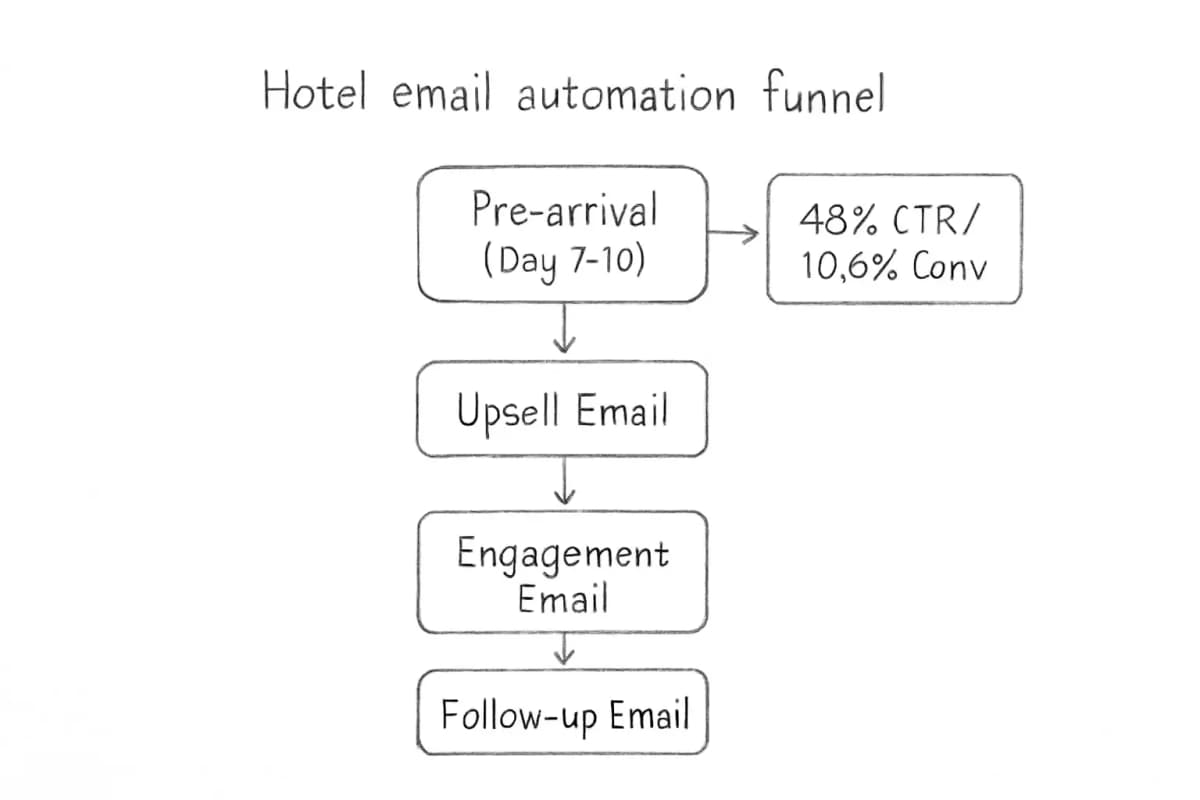
Pre-arrival emails: Build excitement, share property details, and present upgrade offers. The pre-arrival upsell email is one of the best-performing automated emails. Revinate customers see an average 58% open rate, 21% click-through rate, and 7% upsell conversion rate on these emails.
During-stay communication: Promote on-site amenities and real-time offers while the guest is on property.
Post-stay follow-up: Request feedback, offer a return discount, and encourage a direct rebook. Staying in touch with guests after checkout increases retention by fostering the relationship and keeping your property at the forefront of their travel thoughts. Sending a follow-up survey, highlighting upcoming promotions, or sharing hotel updates keeps guests engaged and promotes loyalty.
Re-engagement campaign: Win back guests who have not opened an email in 90 or more days with an exclusive offer.
Welcome series: Introduce new subscribers to the property, highlight unique offerings, include a first-booking incentive. See our guide on welcome email sequence best practices for a proven framework.
Pre-arrival emails: Build excitement, share property details, and present upgrade offers. The pre-arrival upsell email is one of the best-performing automated emails. Revinate customers see an average 58% open rate, 21% click-through rate, and 7% upsell conversion rate on these emails.
During-stay communication: Promote on-site amenities and real-time offers while the guest is on property.
Post-stay follow-up: Request feedback, offer a return discount, and encourage a direct rebook. Staying in touch with guests after checkout increases retention by fostering the relationship and keeping your property at the forefront of their travel thoughts. Sending a follow-up survey, highlighting upcoming promotions, or sharing hotel updates keeps guests engaged and promotes loyalty.
Re-engagement campaign: Win back guests who have not opened an email in 90 or more days with an exclusive offer.
Timing matters for upsells specifically. Research from Oaky suggests that the first upsell email sent 7 to 10 days before the stay results in the highest click-through rate of 48% and a conversion rate of 10.6%. This is nearly double the click-through rate observed on other days.
5. Write Subject Lines That Earn the Open
No subject line, no open. No open, no booking. The email open rate measures the percentage of recipients who open a campaign and provides a window into the effectiveness of your subject lines and overall content, revealing whether your message resonates with your audience.
The global average email open rate for hoteliers, according to Revinate data, is 42.7%. Automated, segmented campaigns consistently beat that benchmark. To stay competitive, your subject lines need to do real work.
Principles that apply directly to hotel email marketing:
Keep subject lines under 40 characters to avoid truncation on mobile screens
Use specificity over vague promises ("Your upgrade awaits, [First Name]" beats "Special Offer Inside")
Reference the destination, not just the hotel ("5 things to do in [City] this weekend")
Test urgency carefully: deadline-based lines work, but overuse trains guests to ignore them
Personalize with the guest's name, stay date, or home city where the data exists
By running consistent A/B tests and tracking open rates, click-through rates, and conversions, hotels can significantly increase bookings with email. The key is to test one element at a time and let the data guide your next campaign.
Timing matters for upsells specifically. Research from Oaky suggests that the first upsell email sent 7 to 10 days before the stay results in the highest click-through rate of 48% and a conversion rate of 10.6%. This is nearly double the click-through rate observed on other days.
5. Write Subject Lines That Earn the Open
No subject line, no open. No open, no booking. The email open rate measures the percentage of recipients who open a campaign and provides a window into the effectiveness of your subject lines and overall content, revealing whether your message resonates with your audience.
The global average email open rate for hoteliers, according to Revinate data, is 42.7%. Automated, segmented campaigns consistently beat that benchmark. To stay competitive, your subject lines need to do real work.
Principles that apply directly to hotel email marketing:
Keep subject lines under 40 characters to avoid truncation on mobile screens
Use specificity over vague promises ("Your upgrade awaits, [First Name]" beats "Special Offer Inside")
Reference the destination, not just the hotel ("5 things to do in [City] this weekend")
Test urgency carefully: deadline-based lines work, but overuse trains guests to ignore them
Personalize with the guest's name, stay date, or home city where the data exists
By running consistent A/B tests and tracking open rates, click-through rates, and conversions, hotels can significantly increase bookings with email. The key is to test one element at a time and let the data guide your next campaign.
In 2025, mobile-first email marketing continues to dominate. Over 70% of emails are opened on mobile devices, which means your email campaigns need to be designed with mobile responsiveness in mind. For hotel guests who are often researching and booking while traveling, that number may be even higher.
Over half of travel emails are opened on a phone. A desktop-first design that looks good in an email client but breaks on a 6-inch screen will cost you bookings.
Mobile design requirements for hotel emails:
Single-column layout for easy vertical scrolling
Tap-friendly CTA buttons (minimum 44x44 pixels)
Large, legible fonts (minimum 16px for body text)
Fast-loading images that are optimized for mobile bandwidth
A single, clear call to action per email, not three competing links
Preview text that extends the subject line's message
If your emails are not mobile-friendly, you risk losing potential bookings as guests may abandon them if they are difficult to navigate on smaller screens.
7. Track the Metrics That Connect to Revenue
Open rates and click-through rates tell you what is working in the inbox. Revenue metrics tell you what is working in the business. Both matter, but most hotel marketers only track the former.
While open rates and click-through rates are important metrics for optimization, you need to translate these into metrics that directly impact your property's ROI and Net Operating Income.
Metrics every hotel email program should track:
Open rate: Benchmark against the 42.7% hospitality average from Revinate's 2025 data
Click-through rate (CTR): Measures CTA effectiveness and content relevance
Conversion rate: Percentage of recipients who completed a booking after clicking
Revenue per email sent: Ties campaign performance directly to room revenue
Unsubscribe rate: A rising unsubscribe rate signals content-audience mismatch
Deliverability rate: The travel and hospitality sector boasts a remarkable 98.6% email delivery rate, a clear sign that marketers are maintaining clean data, using reliable platforms, and optimizing their tech stacks.
Tracking the performance of your email campaigns is essential. Most email marketing platforms offer reporting tools to monitor key performance metrics such as click-through rates, conversion rates, and open rates. Regularly reviewing these metrics helps you identify what works and what does not, allowing you to continually refine your strategy.
For a structured approach to measuring what matters, our email marketing analytics best practices guide covers attribution models and the metrics that connect campaigns to revenue.
8. Protect Deliverability and Sender Reputation
In 2025, mobile-first email marketing continues to dominate. Over 70% of emails are opened on mobile devices, which means your email campaigns need to be designed with mobile responsiveness in mind. For hotel guests who are often researching and booking while traveling, that number may be even higher.
Over half of travel emails are opened on a phone. A desktop-first design that looks good in an email client but breaks on a 6-inch screen will cost you bookings.
Mobile design requirements for hotel emails:
Single-column layout for easy vertical scrolling
Tap-friendly CTA buttons (minimum 44x44 pixels)
Large, legible fonts (minimum 16px for body text)
Fast-loading images that are optimized for mobile bandwidth
A single, clear call to action per email, not three competing links
Preview text that extends the subject line's message
If your emails are not mobile-friendly, you risk losing potential bookings as guests may abandon them if they are difficult to navigate on smaller screens.
7. Track the Metrics That Connect to Revenue
Open rates and click-through rates tell you what is working in the inbox. Revenue metrics tell you what is working in the business. Both matter, but most hotel marketers only track the former.
While open rates and click-through rates are important metrics for optimization, you need to translate these into metrics that directly impact your property's ROI and Net Operating Income.
Metrics every hotel email program should track:
Open rate: Benchmark against the 42.7% hospitality average from Revinate's 2025 data
Click-through rate (CTR): Measures CTA effectiveness and content relevance
Conversion rate: Percentage of recipients who completed a booking after clicking
Revenue per email sent: Ties campaign performance directly to room revenue
Unsubscribe rate: A rising unsubscribe rate signals content-audience mismatch
Deliverability rate: The travel and hospitality sector boasts a remarkable 98.6% email delivery rate, a clear sign that marketers are maintaining clean data, using reliable platforms, and optimizing their tech stacks.
Tracking the performance of your email campaigns is essential. Most email marketing platforms offer reporting tools to monitor key performance metrics such as click-through rates, conversion rates, and open rates. Regularly reviewing these metrics helps you identify what works and what does not, allowing you to continually refine your strategy.
For a structured approach to measuring what matters, our email marketing analytics best practices guide covers attribution models and the metrics that connect campaigns to revenue.
8. Protect Deliverability and Sender Reputation
The most persuasive email in the world does nothing if it lands in the spam folder. Hotel email marketing fails without clean data. Duplicate profiles, missing emails, and unlinked booking records break campaigns before they send. Email deliverability, personalization, and measurement all depend on data quality.
Key deliverability practices for hotel marketers:
Authenticate your sending domain with SPF, DKIM, and DMARC records
Use a reputable email service provider with a proven deliverability track record
Remove hard bounces immediately and suppress long-term inactive contacts
Keep your bounce rate below 1%
Never purchase email lists
Monitor spam complaint rates and investigate any spike above 0.1%
Your sender reputation takes time to build but can be damaged quickly. When customers consistently open your emails and click through your content, your reputation strengthens. But if your emails frequently bounce or recipients mark them as spam, your reputation suffers, and future emails may not even reach the inbox.
Frequently Asked Questions
How often should hotels send marketing emails?
The right cadence depends on your audience and segmentation, but most hotels perform well with a mix of always-on lifecycle campaigns plus one to four promotional campaigns per month, adjusted by season and demand. Over-sending is a fast path to unsubscribes. Under-sending means guests forget you exist before they next plan a trip.
What types of hotel emails generate the most direct bookings?
Booking recovery, pre-arrival, seasonal promotions, and post-stay reactivation campaigns typically have the strongest impact on direct bookings because they target guests at high-intent points in the funnel. Automated recurring campaigns like these also outperform one-time promotional blasts significantly.
Do hotel email campaigns need to offer discounts to drive bookings?
Many successful hotel email campaigns focus on reassurance, clarity, exclusive access, or added value rather than discounts, which helps protect rate integrity while still driving direct bookings. Discounts can erode perceived value. Exclusivity, personalization, and well-timed relevant offers often convert just as well without cutting into margin.
What is a good open rate for hotel email marketing?
Recurring automated hotel campaigns average a 56.6% open rate and 15.17% CTR, while one-time campaigns average an open rate of 32.2% and a CTR of 2.37%. If your one-time campaigns are consistently below 20%, the first areas to examine are subject lines, list hygiene, and audience segmentation.
No comments yet. Be the first!
The most persuasive email in the world does nothing if it lands in the spam folder. Hotel email marketing fails without clean data. Duplicate profiles, missing emails, and unlinked booking records break campaigns before they send. Email deliverability, personalization, and measurement all depend on data quality.
Key deliverability practices for hotel marketers:
Authenticate your sending domain with SPF, DKIM, and DMARC records
Use a reputable email service provider with a proven deliverability track record
Remove hard bounces immediately and suppress long-term inactive contacts
Keep your bounce rate below 1%
Never purchase email lists
Monitor spam complaint rates and investigate any spike above 0.1%
Your sender reputation takes time to build but can be damaged quickly. When customers consistently open your emails and click through your content, your reputation strengthens. But if your emails frequently bounce or recipients mark them as spam, your reputation suffers, and future emails may not even reach the inbox.
Frequently Asked Questions
How often should hotels send marketing emails?
The right cadence depends on your audience and segmentation, but most hotels perform well with a mix of always-on lifecycle campaigns plus one to four promotional campaigns per month, adjusted by season and demand. Over-sending is a fast path to unsubscribes. Under-sending means guests forget you exist before they next plan a trip.
What types of hotel emails generate the most direct bookings?
Booking recovery, pre-arrival, seasonal promotions, and post-stay reactivation campaigns typically have the strongest impact on direct bookings because they target guests at high-intent points in the funnel. Automated recurring campaigns like these also outperform one-time promotional blasts significantly.
Do hotel email campaigns need to offer discounts to drive bookings?
Many successful hotel email campaigns focus on reassurance, clarity, exclusive access, or added value rather than discounts, which helps protect rate integrity while still driving direct bookings. Discounts can erode perceived value. Exclusivity, personalization, and well-timed relevant offers often convert just as well without cutting into margin.
What is a good open rate for hotel email marketing?
Recurring automated hotel campaigns average a 56.6% open rate and 15.17% CTR, while one-time campaigns average an open rate of 32.2% and a CTR of 2.37%. If your one-time campaigns are consistently below 20%, the first areas to examine are subject lines, list hygiene, and audience segmentation.