Email marketing returns $36 for every $1 spent, on average. No other marketing channel consistently matches that figure. If you want to know how to do email marketing correctly, the short answer is: build a clean, permission-based list, send relevant content to the right segments, automate the high-value workflows, protect your deliverability, and measure what actually drives revenue.
This guide walks through each of those steps with the data to back them up.
Key Takeaways
For every $1 spent on email marketing, businesses see an average return of $36, a 3,600% ROI.
Automated emails represent just 2% of send volume but generated 37% of all email-attributed sales in 2024.
Marketers report a 760% increase in email revenue from segmented campaigns compared to non-segmented sends.
As of February 2024, Google and Yahoo require bulk senders to authenticate with SPF and DKIM, publish a DMARC record, and maintain low spam complaint rates.
Open rates are no longer a reliable success metric. Clicks, conversions, replies, and revenue are better measures of performance.
Why Email Marketing Still Outperforms Every Other Channel
Before getting into how to do email marketing, it is worth establishing why it deserves priority attention.
Global email users are forecast to grow from 4.48 billion in 2024 to 4.97 billion by 2028, reaching over 60% of the global population. That reach is unmatched by any social platform, and unlike social media, you own the relationship. No algorithm controls whether your message reaches your audience.
41% of marketers say email is their most effective channel, more than double the share who say the same about social media and paid search (16% each). The data on purchasing behavior reinforces this. 52% of consumers made a purchase directly from an email they received, making email the most effective channel for driving sales. It beats social media posts by 13% and social media ads by 11%.
The top 8% of email programs, those hitting a 45:1 or better ROI, most commonly send newsletters and onboarding emails, not promotions. That is a useful frame: strong email marketing is built on relationships, not broadcasts.
Step 1: Build a Permission-Based Email List
Email marketing returns $36 for every $1 spent, on average. No other marketing channel consistently matches that figure. If you want to know how to do email marketing correctly, the short answer is: build a clean, permission-based list, send relevant content to the right segments, automate the high-value workflows, protect your deliverability, and measure what actually drives revenue.
This guide walks through each of those steps with the data to back them up.
Key Takeaways
For every $1 spent on email marketing, businesses see an average return of $36, a 3,600% ROI.
Automated emails represent just 2% of send volume but generated 37% of all email-attributed sales in 2024.
Marketers report a 760% increase in email revenue from segmented campaigns compared to non-segmented sends.
As of February 2024, Google and Yahoo require bulk senders to authenticate with SPF and DKIM, publish a DMARC record, and maintain low spam complaint rates.
Open rates are no longer a reliable success metric. Clicks, conversions, replies, and revenue are better measures of performance.
Why Email Marketing Still Outperforms Every Other Channel
Before getting into how to do email marketing, it is worth establishing why it deserves priority attention.
Global email users are forecast to grow from 4.48 billion in 2024 to 4.97 billion by 2028, reaching over 60% of the global population. That reach is unmatched by any social platform, and unlike social media, you own the relationship. No algorithm controls whether your message reaches your audience.
41% of marketers say email is their most effective channel, more than double the share who say the same about social media and paid search (16% each). The data on purchasing behavior reinforces this. 52% of consumers made a purchase directly from an email they received, making email the most effective channel for driving sales. It beats social media posts by 13% and social media ads by 11%.
The top 8% of email programs, those hitting a 45:1 or better ROI, most commonly send newsletters and onboarding emails, not promotions. That is a useful frame: strong email marketing is built on relationships, not broadcasts.
Step 1: Build a Permission-Based Email List
Everything downstream depends on list quality. A small, engaged list consistently outperforms a large, cold one.
What is a lead magnet and why does it matter?
A lead magnet is a free resource you offer in exchange for a visitor's contact information, usually an email address. The concept is simple: give something valuable, get permission to follow up.
Effective lead magnets solve a specific, immediate problem for your target audience. They deliver a quick win, something the reader can apply right away to see a tangible result. Checklists, templates, short guides, and quizzes all work well because they are easy to consume.
The most common mistake is creating a lead magnet that appeals to everyone and resonates with no one. A "Complete Guide to Marketing" attracts tire-kickers instead of qualified prospects. Specificity converts better: "Facebook Ad Templates for Real Estate Agents" speaks directly to one audience.
Where to place opt-in forms:
Homepage, above the fold
Blog post footer and mid-content upgrades
Exit-intent popups
Dedicated landing pages linked from social and paid ads
When users subscribe to your mailing list, send them an email asking them to confirm their opt-in. Sending email to users who are not reading them, or who report them as spam, will harm your delivery metrics and reputation. Monitor hard and soft bounces as well as inactive recipients. Reduce the number of invalid recipients by using a confirm opt-in process. Remove invalid recipients from your list promptly.
Double opt-in adds one step but gives you a cleaner list with higher engagement rates from the start.
Step 2: Choose the Right Email Service Provider
Your email service provider (ESP) is the infrastructure that powers everything: sending, automation, segmentation, and reporting. The right choice depends on your list size, technical needs, and budget.
Key capabilities to evaluate:
Everything downstream depends on list quality. A small, engaged list consistently outperforms a large, cold one.
What is a lead magnet and why does it matter?
A lead magnet is a free resource you offer in exchange for a visitor's contact information, usually an email address. The concept is simple: give something valuable, get permission to follow up.
Effective lead magnets solve a specific, immediate problem for your target audience. They deliver a quick win, something the reader can apply right away to see a tangible result. Checklists, templates, short guides, and quizzes all work well because they are easy to consume.
The most common mistake is creating a lead magnet that appeals to everyone and resonates with no one. A "Complete Guide to Marketing" attracts tire-kickers instead of qualified prospects. Specificity converts better: "Facebook Ad Templates for Real Estate Agents" speaks directly to one audience.
Where to place opt-in forms:
Homepage, above the fold
Blog post footer and mid-content upgrades
Exit-intent popups
Dedicated landing pages linked from social and paid ads
When users subscribe to your mailing list, send them an email asking them to confirm their opt-in. Sending email to users who are not reading them, or who report them as spam, will harm your delivery metrics and reputation. Monitor hard and soft bounces as well as inactive recipients. Reduce the number of invalid recipients by using a confirm opt-in process. Remove invalid recipients from your list promptly.
Double opt-in adds one step but gives you a cleaner list with higher engagement rates from the start.
Step 2: Choose the Right Email Service Provider
Your email service provider (ESP) is the infrastructure that powers everything: sending, automation, segmentation, and reporting. The right choice depends on your list size, technical needs, and budget.
Key capabilities to evaluate:
Automation builder: Can you create multi-step behavior-triggered workflows without coding?
Segmentation: Does it support tagging, custom fields, and behavioral segments?
Deliverability: Does the platform maintain strong sender reputation and provide dedicated IP options?
Integrations: Does it connect to your CRM, ecommerce platform, and analytics stack?
Analytics: Can you track revenue per email, not just opens and clicks?
Popular platforms include Klaviyo (strong for ecommerce), ActiveCampaign (advanced B2B automation), Mailchimp (accessible for beginners), HubSpot (CRM-integrated), and Brevo (cost-effective for high-volume senders). Each has different pricing models, some charge by subscriber count, others by send volume.
Step 3: Segment Your List Before You Send Anything
Segmentation is one of the most impactful levers in email marketing. Marketers have found a 760% increase in email revenue from segmented campaigns.
Segmented email campaigns achieve a 14.31% higher open rate and a 100.95% higher click-through rate than non-segmented campaigns. That gap is not marginal. It is the difference between a program that breaks even and one that compounds revenue.
Common segmentation criteria:
Purchase history and order frequency
Acquisition source (which lead magnet, page, or campaign they came from)
Engagement level (active, at-risk, lapsed)
Industry or job role (for B2B lists)
Geographic location
Stage in the customer lifecycle
Personalized emails deliver six times more transactions than generic, non-personalized ones. Companies that invest in personalizing email outreach earn 40% more than their competitors.
Automation is where email marketing scales without proportional effort. Email automations deliver 30 times more revenue per recipient than one-off promotional campaigns. The average return per recipient for campaigns sits at $0.11, while automated flows earn $1.94 per recipient.
Start with three: a welcome series triggered the moment someone subscribes, an abandoned cart sequence if you sell products, and a re-engagement campaign for subscribers who have not opened in 90 days.
Welcome Series
The welcome sequence consistently performs as the highest-performing automation for a simple reason: it reaches subscribers at their moment of maximum interest. Someone who just signed up is more likely to open, click, and engage than they will be in a month.
A strong 3 to 5 email welcome series should:
Automation builder: Can you create multi-step behavior-triggered workflows without coding?
Segmentation: Does it support tagging, custom fields, and behavioral segments?
Deliverability: Does the platform maintain strong sender reputation and provide dedicated IP options?
Integrations: Does it connect to your CRM, ecommerce platform, and analytics stack?
Analytics: Can you track revenue per email, not just opens and clicks?
Popular platforms include Klaviyo (strong for ecommerce), ActiveCampaign (advanced B2B automation), Mailchimp (accessible for beginners), HubSpot (CRM-integrated), and Brevo (cost-effective for high-volume senders). Each has different pricing models, some charge by subscriber count, others by send volume.
Step 3: Segment Your List Before You Send Anything
Segmentation is one of the most impactful levers in email marketing. Marketers have found a 760% increase in email revenue from segmented campaigns.
Segmented email campaigns achieve a 14.31% higher open rate and a 100.95% higher click-through rate than non-segmented campaigns. That gap is not marginal. It is the difference between a program that breaks even and one that compounds revenue.
Common segmentation criteria:
Purchase history and order frequency
Acquisition source (which lead magnet, page, or campaign they came from)
Engagement level (active, at-risk, lapsed)
Industry or job role (for B2B lists)
Geographic location
Stage in the customer lifecycle
Personalized emails deliver six times more transactions than generic, non-personalized ones. Companies that invest in personalizing email outreach earn 40% more than their competitors.
Automation is where email marketing scales without proportional effort. Email automations deliver 30 times more revenue per recipient than one-off promotional campaigns. The average return per recipient for campaigns sits at $0.11, while automated flows earn $1.94 per recipient.
Start with three: a welcome series triggered the moment someone subscribes, an abandoned cart sequence if you sell products, and a re-engagement campaign for subscribers who have not opened in 90 days.
Welcome Series
The welcome sequence consistently performs as the highest-performing automation for a simple reason: it reaches subscribers at their moment of maximum interest. Someone who just signed up is more likely to open, click, and engage than they will be in a month.
A strong 3 to 5 email welcome series should:
Deliver what you promised immediately (lead magnet, discount, confirmation)
Introduce your brand and set expectations for what subscribers will receive
Share your most useful content or best-performing resource
Make a soft offer or direct them toward a purchase decision
For detailed welcome sequence guidance, see welcome email sequence best practices: 7 proven strategies.
Abandoned Cart Sequence
The abandoned cart sequence is the single highest-ROI automation for most ecommerce businesses. When a customer adds items to their cart but does not complete checkout, an automated sequence retrieves them.
Time abandoned cart reminders at 1 hour, 24 hours, and 3 days after abandonment. The first email (no discount) is a simple reminder. The second addresses objections. The third can introduce an incentive if the economics support it.
Lead Nurture Sequences
Nurtured leads make 47% larger purchases than non-nurtured leads, making automation a critical component of effective marketing.
For B2B especially, nurture sequences move prospects through awareness to consideration to decision stages. For B2B nurture sequences, sending too fast is the common mistake. One email per day for cold or warm leads usually produces disengagement and spam reports. One email every 2 to 3 days is more sustainable for a 7 to 14 email sequence.
Step 5: Write Subject Lines and Email Copy That Drive Clicks
A great subject line is the single most controllable factor in whether your email gets opened. 43% of people open emails based on the subject line.
Email subject lines with the recipient's first name have a 26% higher open rate. But personalization goes beyond first names. Reference the action that triggered the email, their industry, or their recent behavior.
Key subject line principles:
Keep them specific. Vague curiosity bait gets lower click-through rates even when it lifts opens.
Use numbers where relevant ("5 ways to..." outperforms most generic alternatives).
Test length. Subject lines of 61 to 70 characters generate the highest open rates at 43.38%.
A/B test every campaign. Brands that regularly A/B test their emails achieve 83% higher ROI than those that never test.
For proven subject line formulas with data behind them, read email subject line best practices that boost open rates by 27%.
Body copy principles:
Lead with what matters to the reader, not what matters to you
One email, one goal. Multiple competing CTAs reduce conversions
The ideal email body is between 50 and 125 words for most campaign types, though content newsletters can be longer if every paragraph earns its place
50% of people will delete an email if it is not optimized for mobile, so single-column layouts and large tap targets are not optional
Step 6: Protect Your Deliverability
You can write excellent emails that never reach the inbox. Deliverability is not a one-time setup task. It requires ongoing maintenance.
Authentication Is Now Mandatory
Deliver what you promised immediately (lead magnet, discount, confirmation)
Introduce your brand and set expectations for what subscribers will receive
Share your most useful content or best-performing resource
Make a soft offer or direct them toward a purchase decision
For detailed welcome sequence guidance, see welcome email sequence best practices: 7 proven strategies.
Abandoned Cart Sequence
The abandoned cart sequence is the single highest-ROI automation for most ecommerce businesses. When a customer adds items to their cart but does not complete checkout, an automated sequence retrieves them.
Time abandoned cart reminders at 1 hour, 24 hours, and 3 days after abandonment. The first email (no discount) is a simple reminder. The second addresses objections. The third can introduce an incentive if the economics support it.
Lead Nurture Sequences
Nurtured leads make 47% larger purchases than non-nurtured leads, making automation a critical component of effective marketing.
For B2B especially, nurture sequences move prospects through awareness to consideration to decision stages. For B2B nurture sequences, sending too fast is the common mistake. One email per day for cold or warm leads usually produces disengagement and spam reports. One email every 2 to 3 days is more sustainable for a 7 to 14 email sequence.
Step 5: Write Subject Lines and Email Copy That Drive Clicks
A great subject line is the single most controllable factor in whether your email gets opened. 43% of people open emails based on the subject line.
Email subject lines with the recipient's first name have a 26% higher open rate. But personalization goes beyond first names. Reference the action that triggered the email, their industry, or their recent behavior.
Key subject line principles:
Keep them specific. Vague curiosity bait gets lower click-through rates even when it lifts opens.
Use numbers where relevant ("5 ways to..." outperforms most generic alternatives).
Test length. Subject lines of 61 to 70 characters generate the highest open rates at 43.38%.
A/B test every campaign. Brands that regularly A/B test their emails achieve 83% higher ROI than those that never test.
For proven subject line formulas with data behind them, read email subject line best practices that boost open rates by 27%.
Body copy principles:
Lead with what matters to the reader, not what matters to you
One email, one goal. Multiple competing CTAs reduce conversions
The ideal email body is between 50 and 125 words for most campaign types, though content newsletters can be longer if every paragraph earns its place
50% of people will delete an email if it is not optimized for mobile, so single-column layouts and large tap targets are not optional
Step 6: Protect Your Deliverability
You can write excellent emails that never reach the inbox. Deliverability is not a one-time setup task. It requires ongoing maintenance.
Authentication Is Now Mandatory
As of February 2024, Google and Yahoo require bulk senders to authenticate with SPF and DKIM, publish a DMARC record (at least p=none), and maintain low spam complaint rates, with Gmail recommending complaints stay below 0.1%.
Here is what each protocol does:
SPF (Sender Policy Framework): SPF is an email validation system designed to prevent email spam and authenticate senders. It looks at the sender IP address and checks to ensure that the mail is coming from an authenticated and verified sender.
DKIM (DomainKeys Identified Mail): DKIM is an authentication protocol used by email receivers to determine if the sender is really who they say they are. The domain key is a specialized key that can be used only by one particular sender, reassuring the mailbox that a message is legitimate.
DMARC: DMARC is an email authentication and reporting protocol that builds on SPF and DKIM. It allows domain owners to set policies specifying what action receivers should take if an email fails authentication, and provides reporting mechanisms to give domain owners feedback.
List Hygiene
Remove hard bounces immediately after every send. Implement a sunset policy: if someone has not engaged in 90 to 180 days (depending on your sending frequency), run a re-engagement campaign.
Keep spam rates reported in Postmaster Tools below 0.3%. In practice, aim to stay well below 0.1%. Three complaints out of 1,000 emails sent puts you at the warning threshold.
Global inbox placement in 2024 sat at approximately 83.5%, which means about one in six legitimate marketing emails never reached the inbox. Technical setup is the most controllable lever for improving that number.
Step 7: Measure What Actually Drives Revenue
Bot-driven phantom engagement has made open rates unreliable, pushing high-performing teams toward revenue per email, list churn, and lifetime value as the metrics that matter.
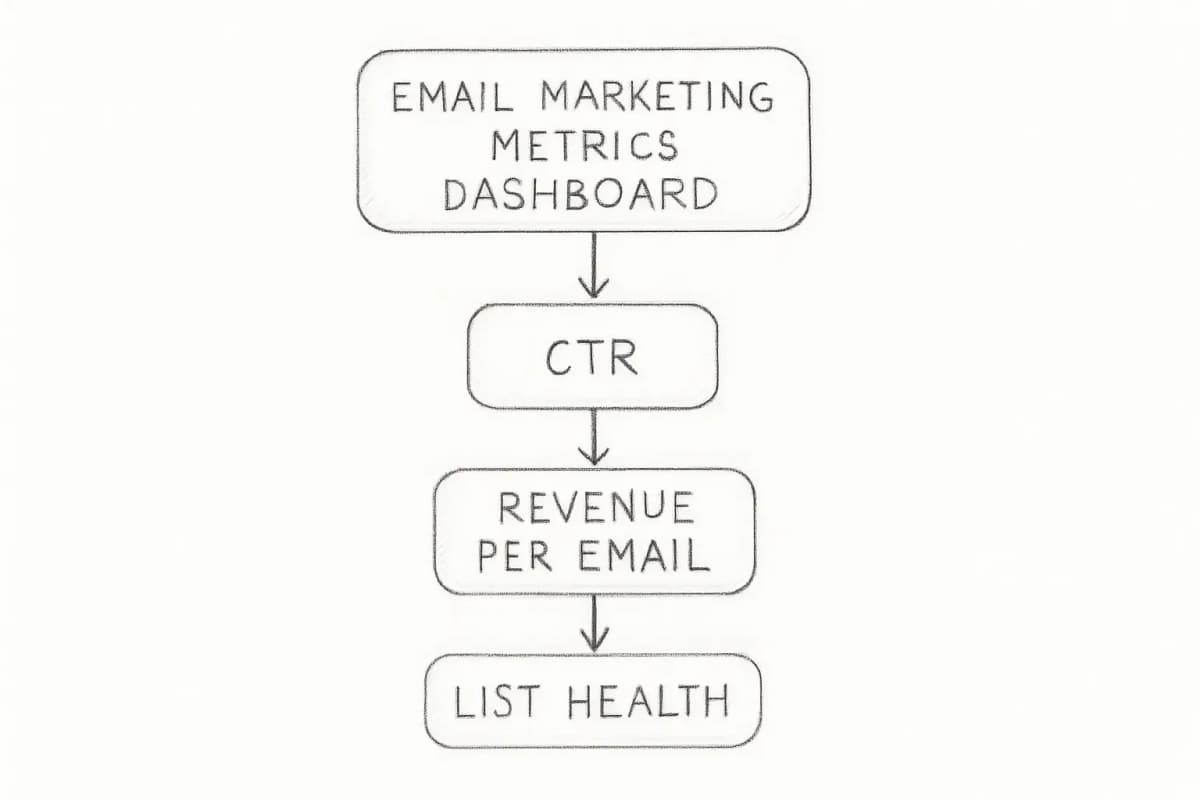
The metrics worth tracking:
Click-through rate (CTR): Click rate is currently the most accurate indicator of email newsletter engagement since it is not reliant on tracking opens. Benchmark: 2% to 3% for campaigns.
Click-to-open rate (CTOR): CTOR tells you what percentage of people who opened an email actually clicked something. It is the truest measure of content quality.
Revenue per email (RPE): Total revenue attributed divided by emails sent. Breaks down by campaign vs. automation to show where the real returns come from.
Unsubscribe and complaint rates: Leading indicators of list health and content relevance.
List growth rate: Net new subscribers minus churn, measured monthly.
Multi-channel attribution and marketing-qualified leads (MQLs) jumped 22% year-over-year as email campaign reporting moves away from engagement proxies toward revenue accountability.
As of February 2024, Google and Yahoo require bulk senders to authenticate with SPF and DKIM, publish a DMARC record (at least p=none), and maintain low spam complaint rates, with Gmail recommending complaints stay below 0.1%.
Here is what each protocol does:
SPF (Sender Policy Framework): SPF is an email validation system designed to prevent email spam and authenticate senders. It looks at the sender IP address and checks to ensure that the mail is coming from an authenticated and verified sender.
DKIM (DomainKeys Identified Mail): DKIM is an authentication protocol used by email receivers to determine if the sender is really who they say they are. The domain key is a specialized key that can be used only by one particular sender, reassuring the mailbox that a message is legitimate.
DMARC: DMARC is an email authentication and reporting protocol that builds on SPF and DKIM. It allows domain owners to set policies specifying what action receivers should take if an email fails authentication, and provides reporting mechanisms to give domain owners feedback.
List Hygiene
Remove hard bounces immediately after every send. Implement a sunset policy: if someone has not engaged in 90 to 180 days (depending on your sending frequency), run a re-engagement campaign.
Keep spam rates reported in Postmaster Tools below 0.3%. In practice, aim to stay well below 0.1%. Three complaints out of 1,000 emails sent puts you at the warning threshold.
Global inbox placement in 2024 sat at approximately 83.5%, which means about one in six legitimate marketing emails never reached the inbox. Technical setup is the most controllable lever for improving that number.
Step 7: Measure What Actually Drives Revenue
Bot-driven phantom engagement has made open rates unreliable, pushing high-performing teams toward revenue per email, list churn, and lifetime value as the metrics that matter.
The metrics worth tracking:
Click-through rate (CTR): Click rate is currently the most accurate indicator of email newsletter engagement since it is not reliant on tracking opens. Benchmark: 2% to 3% for campaigns.
Click-to-open rate (CTOR): CTOR tells you what percentage of people who opened an email actually clicked something. It is the truest measure of content quality.
Revenue per email (RPE): Total revenue attributed divided by emails sent. Breaks down by campaign vs. automation to show where the real returns come from.
Unsubscribe and complaint rates: Leading indicators of list health and content relevance.
List growth rate: Net new subscribers minus churn, measured monthly.
Multi-channel attribution and marketing-qualified leads (MQLs) jumped 22% year-over-year as email campaign reporting moves away from engagement proxies toward revenue accountability.
Brands sending 9 to 16 emails monthly achieve average ROI of 4,600%, the highest of any frequency bracket. That works out to roughly 2 to 4 emails per week. However, frequency should match your content quality and audience expectations. Watch unsubscribe rates. If they rise after an increase in send frequency, pull back. The right cadence is the one your list tolerates without churning.
What is a good email open rate?
Email open rates rose from 18.7% in 2016 to 35.9% in 2024, which on paper appears to be a huge success. In practice, it is largely the result of Apple's Mail Privacy Protection (MPP), which began registering automatic opens regardless of whether a person viewed the message. That means open rates now show inbox delivery and technical detection more than true engagement. Use click-through rate and revenue per email as your primary performance indicators.
How do I improve email deliverability?
Start with authentication: Google recommends that you always set up SPF, DKIM, and DMARC for your sending domains. Then focus on list hygiene (removing bounces and inactive contacts), sending consistent volume rather than erratic spikes, and producing content that earns clicks. A smaller, engaged list consistently outperforms a large cold one. Deliverability is about relevance, not volume.
Do I need email marketing automation as a small business?
Yes, and it does not require a complex setup to start. Automated emails generate 320% more revenue than non-automated emails. A welcome series, an abandoned cart sequence (if you sell products), and a re-engagement flow are the three automations that deliver the most return with the least ongoing effort. Most modern ESPs make these straightforward to configure, even without technical experience.
What email types should I send regularly?
The most popular objectives for email marketing strategies are product awareness and product promotions, with 14.6% of email marketers prioritizing customer retention and newsletters as the second most common campaign type. A sustainable program typically combines weekly or biweekly newsletters (relationship-building), product or promotional emails (conversion-focused), and behavioral automations (triggered by subscriber actions). The top-performing programs prioritize newsletters and onboarding emails over pure promotional sends.
Brands sending 9 to 16 emails monthly achieve average ROI of 4,600%, the highest of any frequency bracket. That works out to roughly 2 to 4 emails per week. However, frequency should match your content quality and audience expectations. Watch unsubscribe rates. If they rise after an increase in send frequency, pull back. The right cadence is the one your list tolerates without churning.
What is a good email open rate?
Email open rates rose from 18.7% in 2016 to 35.9% in 2024, which on paper appears to be a huge success. In practice, it is largely the result of Apple's Mail Privacy Protection (MPP), which began registering automatic opens regardless of whether a person viewed the message. That means open rates now show inbox delivery and technical detection more than true engagement. Use click-through rate and revenue per email as your primary performance indicators.
How do I improve email deliverability?
Start with authentication: Google recommends that you always set up SPF, DKIM, and DMARC for your sending domains. Then focus on list hygiene (removing bounces and inactive contacts), sending consistent volume rather than erratic spikes, and producing content that earns clicks. A smaller, engaged list consistently outperforms a large cold one. Deliverability is about relevance, not volume.
Do I need email marketing automation as a small business?
Yes, and it does not require a complex setup to start. Automated emails generate 320% more revenue than non-automated emails. A welcome series, an abandoned cart sequence (if you sell products), and a re-engagement flow are the three automations that deliver the most return with the least ongoing effort. Most modern ESPs make these straightforward to configure, even without technical experience.
What email types should I send regularly?
The most popular objectives for email marketing strategies are product awareness and product promotions, with 14.6% of email marketers prioritizing customer retention and newsletters as the second most common campaign type. A sustainable program typically combines weekly or biweekly newsletters (relationship-building), product or promotional emails (conversion-focused), and behavioral automations (triggered by subscriber actions). The top-performing programs prioritize newsletters and onboarding emails over pure promotional sends.