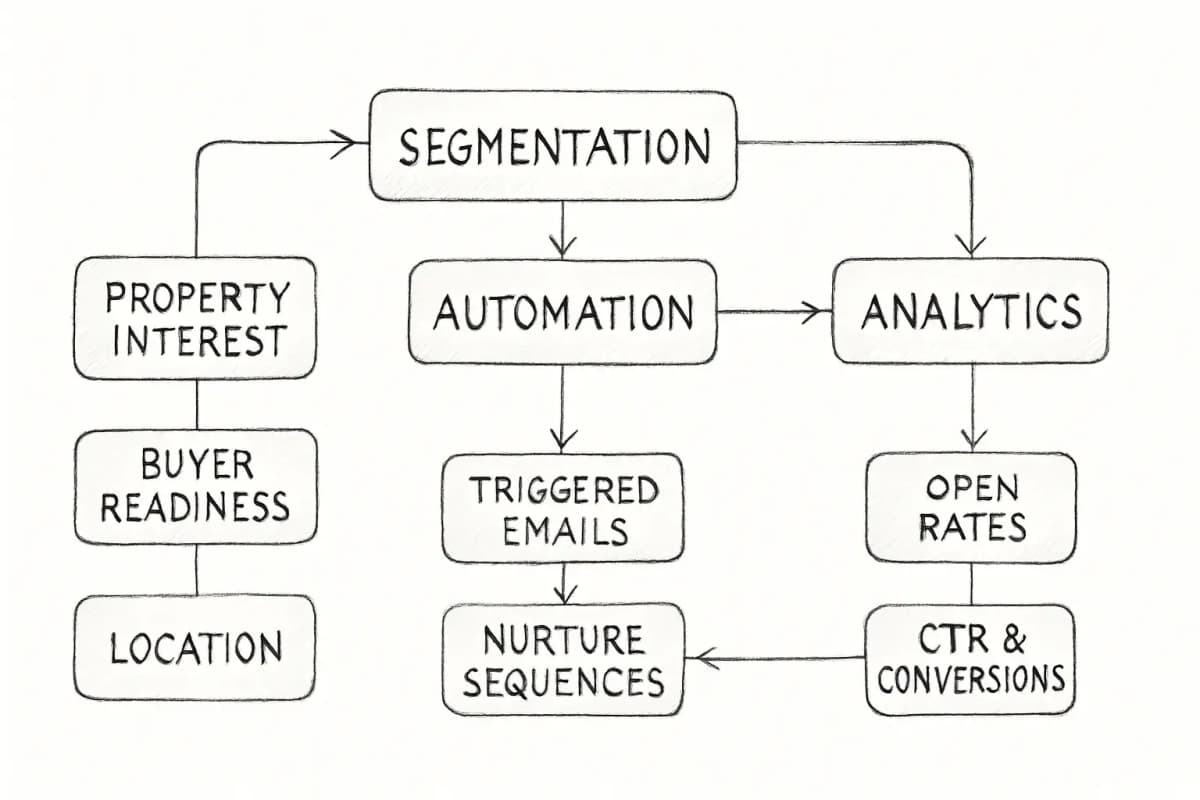
Real estate is one of the highest-stakes purchase decisions a person makes, and email is still the channel most likely to influence that decision. Email marketing converts 40% better than social media for real estate professionals, yet most agents and brokerages leave that advantage on the table by sending generic, untargeted messages that never get opened. If you want to know how to improve your real estate email marketing, the answer sits at the intersection of better segmentation, sharper subject lines, smarter automation, and consistent measurement.
This guide covers exactly that, with specific tactics and benchmarks you can apply today.
Key Takeaways
Real estate businesses have a 37.18% average email open rate, and email marketing returns an average of $40 for every $1 spent.
Email drip campaigns improve conversion rates by 25%.
Segmented email campaigns can boost revenue by up to 760%, according to the Data and Marketing Association.
Automated emails generate 320% more revenue than non-automated ones because they deliver highly personalized, timely messages.
Gmail and Yahoo enforce stricter sender authentication requirements, including SPF, DKIM, and DMARC records. If your sending domain is not properly authenticated, your emails may land in spam or be rejected entirely.
Why Real Estate Email Marketing Still Outperforms Other Channels
Before diving into tactics, it helps to understand why email warrants your attention over social ads or direct mail.
Real estate email marketing is the single most controllable, highest-ROI channel you have as an agent or brokerage. While social platforms shift algorithms and ad costs climb, email gives you direct, ungated access to the people most likely to buy, sell, or refer.
The numbers back this up. According to Litmus, email marketing returns an average of $36 for every $1 spent. And unlike paid social, your list is an asset you own outright. Your email list is your marketing land. Social media platforms can throttle your reach or change their rules overnight. Your email list cannot be taken away, and your contacts receive your message directly in their inbox with no gatekeeper in between.
The highest click-through rates across all email industries are observed in Real Estate, Design and Construction (3.6%), putting the sector well ahead of most consumer categories.
Real estate is one of the highest-stakes purchase decisions a person makes, and email is still the channel most likely to influence that decision. Email marketing converts 40% better than social media for real estate professionals, yet most agents and brokerages leave that advantage on the table by sending generic, untargeted messages that never get opened. If you want to know how to improve your real estate email marketing, the answer sits at the intersection of better segmentation, sharper subject lines, smarter automation, and consistent measurement.
This guide covers exactly that, with specific tactics and benchmarks you can apply today.
Key Takeaways
Real estate businesses have a 37.18% average email open rate, and email marketing returns an average of $40 for every $1 spent.
Email drip campaigns improve conversion rates by 25%.
Segmented email campaigns can boost revenue by up to 760%, according to the Data and Marketing Association.
Automated emails generate 320% more revenue than non-automated ones because they deliver highly personalized, timely messages.
Gmail and Yahoo enforce stricter sender authentication requirements, including SPF, DKIM, and DMARC records. If your sending domain is not properly authenticated, your emails may land in spam or be rejected entirely.
Why Real Estate Email Marketing Still Outperforms Other Channels
Before diving into tactics, it helps to understand why email warrants your attention over social ads or direct mail.
Real estate email marketing is the single most controllable, highest-ROI channel you have as an agent or brokerage. While social platforms shift algorithms and ad costs climb, email gives you direct, ungated access to the people most likely to buy, sell, or refer.
The numbers back this up. According to Litmus, email marketing returns an average of $36 for every $1 spent. And unlike paid social, your list is an asset you own outright. Your email list is your marketing land. Social media platforms can throttle your reach or change their rules overnight. Your email list cannot be taken away, and your contacts receive your message directly in their inbox with no gatekeeper in between.
The highest click-through rates across all email industries are observed in Real Estate, Design and Construction (3.6%), putting the sector well ahead of most consumer categories.
1. Segment Your List Before You Send Anything
The single most impactful change you can make to improve real estate email marketing is segmentation. Sending the same email to buyers, sellers, investors, and past clients guarantees low engagement from all of them.
Segmentation means grouping contacts into categories like buyers, sellers, investors, downsizers, or open-house visitors. This helps agents tailor content to where someone is in their real estate journey, making each message more relevant and effective.
Segment by lifecycle (new leads, active buyers, active sellers, past clients), preferences (price, neighborhood, property type), and timeline. Segmented campaigns see 14% higher opens and 100% more clicks.
A practical starting framework for your segments:
New leads (form fills, open house sign-ins, lead magnet downloads)
Active buyers (currently searching, price range and area known)
Active sellers (home valuation requests, listing inquiries)
Investors (multi-family, ROI-focused content)
Past clients (post-close relationship and referral nurture)
Segmenting your email list by geography, buyer persona, and funnel stage can increase click-through rates by double digits compared to unsegmented sends.
No subject line, no open. No open, no conversion. This is the most visible part of your email and the easiest to test.
The best subject lines are short (under 50 characters), specific, and include either the recipient's name or a property detail.
Personalized subject lines can lift opens by 26%. That alone makes first-name personalization worth doing in every campaign.
A few specific tactics:
New listing emails consistently generate high open rates. New listing emails almost always have sky-high open rates. To paraphrase ad legend David Ogilvy, the most powerful word in marketing is "new."
Emojis can help. Studies show that adding an emoji to your subject line can increase open rate by 5-15%.
Avoid spam triggers. Avoid spam triggers such as excessive punctuation or all caps in subject lines.
1. Segment Your List Before You Send Anything
The single most impactful change you can make to improve real estate email marketing is segmentation. Sending the same email to buyers, sellers, investors, and past clients guarantees low engagement from all of them.
Segmentation means grouping contacts into categories like buyers, sellers, investors, downsizers, or open-house visitors. This helps agents tailor content to where someone is in their real estate journey, making each message more relevant and effective.
Segment by lifecycle (new leads, active buyers, active sellers, past clients), preferences (price, neighborhood, property type), and timeline. Segmented campaigns see 14% higher opens and 100% more clicks.
A practical starting framework for your segments:
New leads (form fills, open house sign-ins, lead magnet downloads)
Active buyers (currently searching, price range and area known)
Active sellers (home valuation requests, listing inquiries)
Investors (multi-family, ROI-focused content)
Past clients (post-close relationship and referral nurture)
Segmenting your email list by geography, buyer persona, and funnel stage can increase click-through rates by double digits compared to unsegmented sends.
No subject line, no open. No open, no conversion. This is the most visible part of your email and the easiest to test.
The best subject lines are short (under 50 characters), specific, and include either the recipient's name or a property detail.
Personalized subject lines can lift opens by 26%. That alone makes first-name personalization worth doing in every campaign.
A few specific tactics:
New listing emails consistently generate high open rates. New listing emails almost always have sky-high open rates. To paraphrase ad legend David Ogilvy, the most powerful word in marketing is "new."
Emojis can help. Studies show that adding an emoji to your subject line can increase open rate by 5-15%.
Avoid spam triggers. Avoid spam triggers such as excessive punctuation or all caps in subject lines.
A/B test subject line variations consistently. Send one version to 20% of a segment, the second to another 20%, and send the winner to the remaining 60%. Even small subject line improvements compound over time.
For a comprehensive breakdown of what drives opens, read our post on email subject line best practices that boost open rates by 27%.
3. Build Automated Drip Campaigns for Every Lead Type
Manual follow-up at scale is not realistic. Automation is how you maintain consistent, timely outreach without burning out.
Automated email campaigns increase lead conversion by 30%. The key is building sequences that match the recipient's context rather than blasting everyone with the same nurture flow.
Here is how to build a real estate drip campaign in five steps: Identify the trigger action, defining the behavior that starts the sequence. Common triggers include completing a home valuation tool, signing up for listing alerts, or attending an open house. Write a three-to-five email sequence with a distinct goal for each message: Email 1 introduces you and delivers immediate value. Email 2 provides a deeper resource or market insight. Email 3 creates urgency and includes a clear call to action. Set timing delays between each send: a common cadence is Email 1 immediately after the trigger, Email 2 three days later if no reply, and Email 3 three days after that.
The results of well-structured sequences are measurable. In one documented case, a Chicago-based real estate professional built a three-email automated sequence targeting buyer leads. Email 1 achieved a 31% open rate. Email 2 generated a 43% click-through rate. The campaign produced a 43% boost in buyer engagement with zero unsubscribes across the entire sequence.
Beyond lead nurture, build automation for:
Welcome sequences for new subscribers
Post-open-house follow-ups
Property alert emails triggered by IDX behavior
Home anniversary check-ins for past clients
Re-engagement campaigns for cold leads
Companies that use lead nurturing generate 50% more sales-ready leads at a 33% lower cost.
For ideas on structuring your first sequence, see our article on welcome email sequence best practices.
4. Personalize Beyond the First Name
Personalization in real estate email marketing goes well beyond inserting {first_name} into a greeting. True personalization matches content to what a contact has actually done, searched, or expressed interest in.
AI can segment contacts based on browsing history, past interactions, and intent signals. Buyers might receive neighborhood guides and mortgage tips, while sellers get market reports and staging advice.
Practical personalization tactics for real estate:
Dynamic content blocks that swap in the neighborhood, price range, or property type relevant to each recipient
Behavior-triggered sends based on which listings a contact viewed or clicked
Lifecycle-stage content (pre-approval education for early buyers, staging tips for sellers preparing to list)
A/B test subject line variations consistently. Send one version to 20% of a segment, the second to another 20%, and send the winner to the remaining 60%. Even small subject line improvements compound over time.
For a comprehensive breakdown of what drives opens, read our post on email subject line best practices that boost open rates by 27%.
3. Build Automated Drip Campaigns for Every Lead Type
Manual follow-up at scale is not realistic. Automation is how you maintain consistent, timely outreach without burning out.
Automated email campaigns increase lead conversion by 30%. The key is building sequences that match the recipient's context rather than blasting everyone with the same nurture flow.
Here is how to build a real estate drip campaign in five steps: Identify the trigger action, defining the behavior that starts the sequence. Common triggers include completing a home valuation tool, signing up for listing alerts, or attending an open house. Write a three-to-five email sequence with a distinct goal for each message: Email 1 introduces you and delivers immediate value. Email 2 provides a deeper resource or market insight. Email 3 creates urgency and includes a clear call to action. Set timing delays between each send: a common cadence is Email 1 immediately after the trigger, Email 2 three days later if no reply, and Email 3 three days after that.
The results of well-structured sequences are measurable. In one documented case, a Chicago-based real estate professional built a three-email automated sequence targeting buyer leads. Email 1 achieved a 31% open rate. Email 2 generated a 43% click-through rate. The campaign produced a 43% boost in buyer engagement with zero unsubscribes across the entire sequence.
Beyond lead nurture, build automation for:
Welcome sequences for new subscribers
Post-open-house follow-ups
Property alert emails triggered by IDX behavior
Home anniversary check-ins for past clients
Re-engagement campaigns for cold leads
Companies that use lead nurturing generate 50% more sales-ready leads at a 33% lower cost.
For ideas on structuring your first sequence, see our article on welcome email sequence best practices.
4. Personalize Beyond the First Name
Personalization in real estate email marketing goes well beyond inserting {first_name} into a greeting. True personalization matches content to what a contact has actually done, searched, or expressed interest in.
AI can segment contacts based on browsing history, past interactions, and intent signals. Buyers might receive neighborhood guides and mortgage tips, while sellers get market reports and staging advice.
Practical personalization tactics for real estate:
Dynamic content blocks that swap in the neighborhood, price range, or property type relevant to each recipient
Behavior-triggered sends based on which listings a contact viewed or clicked
Lifecycle-stage content (pre-approval education for early buyers, staging tips for sellers preparing to list)
Personalization in your lead management system can improve sales by up to 20%, making it a necessary part of your marketing campaign.
Personalize beyond names: use dynamic neighborhoods, saved searches, and listing recommendations based on behavior.
5. Nail Your Send Timing and Frequency
Getting your email in front of someone when they are actively checking their inbox matters. Sending at the wrong time compresses your results regardless of content quality.
Research shows midweek days outperform others for real estate professionals. Emails sent on Tuesday, Wednesday, or Thursday achieve open rates of 20-30% in the real estate industry, compared to 10-15% on Mondays or Fridays.
Different audiences have different habits. Buyers, such as first-time homebuyers or families, often check emails during downtime, like evenings or weekends. Sellers, including those planning to list properties, may engage during work hours while researching market trends. Investors often review emails early in the morning for market updates.
On frequency: research shows that marketers who send out one campaign per week get the highest average open and click-through rate. More is not better. Sending too frequently erodes trust and spikes unsubscribe rates. Start with biweekly sends and adjust based on engagement data, not assumptions.
6. Protect Your Deliverability
You can have great content, strong segmentation, and optimized subject lines, and still fail if your emails land in spam. Deliverability is the foundation everything else rests on.
Authenticate (SPF/DKIM/DMARC), warm domains, maintain cadence, clean inactives, verify imports, keep complaints near zero, and use a separate subdomain for cold outreach.
Key deliverability rules to follow:
Authenticate your domain. Gmail and Yahoo both enforce stricter sender authentication requirements, including SPF, DKIM, and DMARC records. If your sending domain is not properly authenticated, your emails may land in spam or be rejected entirely.
Clean your list regularly. Keep your bounce rate under 2% to protect your sender reputation and maintain deliverability. Clean your list quarterly to remove invalid addresses.
Monitor spam complaints. Keep complaints near 0%. Anything approaching 0.1% can damage inbox placement across your list. Set expectations at opt-in and make "unsubscribe" easy to find.
Grow your list organically. Growing your list with lead magnets, landing pages, and social proof is more effective than buying contacts, and it keeps you compliant with the CAN-SPAM Act.
7. Measure What Actually Moves the Needle
Most agents over-rely on open rate as a proxy for success. That metric is no longer reliable on its own.
Open rates alone are no longer a reliable metric due to Apple Mail Privacy Protection. Prioritize click-through rate and conversion tracking instead.
The metrics that actually tell you whether your real estate email marketing is working:
Personalization in your lead management system can improve sales by up to 20%, making it a necessary part of your marketing campaign.
Personalize beyond names: use dynamic neighborhoods, saved searches, and listing recommendations based on behavior.
5. Nail Your Send Timing and Frequency
Getting your email in front of someone when they are actively checking their inbox matters. Sending at the wrong time compresses your results regardless of content quality.
Research shows midweek days outperform others for real estate professionals. Emails sent on Tuesday, Wednesday, or Thursday achieve open rates of 20-30% in the real estate industry, compared to 10-15% on Mondays or Fridays.
Different audiences have different habits. Buyers, such as first-time homebuyers or families, often check emails during downtime, like evenings or weekends. Sellers, including those planning to list properties, may engage during work hours while researching market trends. Investors often review emails early in the morning for market updates.
On frequency: research shows that marketers who send out one campaign per week get the highest average open and click-through rate. More is not better. Sending too frequently erodes trust and spikes unsubscribe rates. Start with biweekly sends and adjust based on engagement data, not assumptions.
6. Protect Your Deliverability
You can have great content, strong segmentation, and optimized subject lines, and still fail if your emails land in spam. Deliverability is the foundation everything else rests on.
Authenticate (SPF/DKIM/DMARC), warm domains, maintain cadence, clean inactives, verify imports, keep complaints near zero, and use a separate subdomain for cold outreach.
Key deliverability rules to follow:
Authenticate your domain. Gmail and Yahoo both enforce stricter sender authentication requirements, including SPF, DKIM, and DMARC records. If your sending domain is not properly authenticated, your emails may land in spam or be rejected entirely.
Clean your list regularly. Keep your bounce rate under 2% to protect your sender reputation and maintain deliverability. Clean your list quarterly to remove invalid addresses.
Monitor spam complaints. Keep complaints near 0%. Anything approaching 0.1% can damage inbox placement across your list. Set expectations at opt-in and make "unsubscribe" easy to find.
Grow your list organically. Growing your list with lead magnets, landing pages, and social proof is more effective than buying contacts, and it keeps you compliant with the CAN-SPAM Act.
7. Measure What Actually Moves the Needle
Most agents over-rely on open rate as a proxy for success. That metric is no longer reliable on its own.
Open rates alone are no longer a reliable metric due to Apple Mail Privacy Protection. Prioritize click-through rate and conversion tracking instead.
The metrics that actually tell you whether your real estate email marketing is working:
Click-through rate (CTR): A CTR between 2% and 5% is a strong target for real estate campaigns. This is your most reliable engagement metric.
Conversion rate: For real estate, conversions mean "Request a home valuation," "Book a seller consult," "RSVP to an open house," or "Create a saved search."
Unsubscribe rate: If more than 0.5% of recipients unsubscribe from a single send, your content may be irrelevant or your send frequency may be too high. Investigate and adjust.
List health: Delivery rate, bounce rate, and spam complaint rate all signal whether your list and infrastructure are healthy.
Take campaign assessment further with A/B split testing. Send one variation to part of your list and another version to the remaining contacts. See which version drives higher open rates, CTRs, and conversions.
Your email platform determines what automation, segmentation, and personalization you can actually execute. A basic tool limits your ability to act on the tactics above.
Key user needs include easy-to-use interfaces with drag-and-drop editors, integration with CRM and listing databases, strong email deliverability, and compliance with privacy regulations.
Features driving adoption include automated drip campaigns, property alerts, powerful analytics dashboards, customizable templates, and list segmentation.
Popular options used by real estate teams include Mailchimp, ActiveCampaign, Follow Up Boss, and kvCORE, each with varying strengths in automation depth and CRM integration. Platforms such as HubSpot and Salesforce Einstein use AI to analyze email performance, recommend content personalization, and optimize sending schedules.
When evaluating a platform, prioritize:
Click-through rate (CTR): A CTR between 2% and 5% is a strong target for real estate campaigns. This is your most reliable engagement metric.
Conversion rate: For real estate, conversions mean "Request a home valuation," "Book a seller consult," "RSVP to an open house," or "Create a saved search."
Unsubscribe rate: If more than 0.5% of recipients unsubscribe from a single send, your content may be irrelevant or your send frequency may be too high. Investigate and adjust.
List health: Delivery rate, bounce rate, and spam complaint rate all signal whether your list and infrastructure are healthy.
Take campaign assessment further with A/B split testing. Send one variation to part of your list and another version to the remaining contacts. See which version drives higher open rates, CTRs, and conversions.
Your email platform determines what automation, segmentation, and personalization you can actually execute. A basic tool limits your ability to act on the tactics above.
Key user needs include easy-to-use interfaces with drag-and-drop editors, integration with CRM and listing databases, strong email deliverability, and compliance with privacy regulations.
Features driving adoption include automated drip campaigns, property alerts, powerful analytics dashboards, customizable templates, and list segmentation.
Popular options used by real estate teams include Mailchimp, ActiveCampaign, Follow Up Boss, and kvCORE, each with varying strengths in automation depth and CRM integration. Platforms such as HubSpot and Salesforce Einstein use AI to analyze email performance, recommend content personalization, and optimize sending schedules.
When evaluating a platform, prioritize:
Native CRM integration or clean API connections to your existing stack
Behavior-based triggers (property views, listing clicks, form fills)
Domain authentication setup support
List hygiene and bounce management tools
A/B testing at the subject line and content level
Frequently Asked Questions
How often should real estate agents send marketing emails?
Research shows that marketers who send out one campaign per week get the highest average open and click-through rate. For most agents, weekly sends to your most engaged segments and biweekly to broader lists is a solid starting cadence. Adjust based on unsubscribe rates and engagement trends, not guesswork.
What types of emails work best for real estate lead nurture?
The most effective real estate email types include new listing announcements, market update newsletters, drip campaign sequences for buyer and seller leads, open house invitations, past-client check-ins, home anniversary emails, and referral requests. Match the email type to the recipient's segment and stage in the buying or selling process for best results.
What is a good click-through rate for real estate emails?
The average CTR for email marketing in the real estate industry hovers around 2.5%. Aim for 2-5%. A ~2.5% baseline is expected, with 3-4% achievable by focusing each email on one primary CTA.
How do I improve email deliverability for my real estate campaigns?
Start with domain authentication. Authenticate with SPF, DKIM, and DMARC, warm your domain, maintain send cadence, clean inactive contacts, verify new imports, keep spam complaints near zero, and use a separate subdomain for cold outreach. List hygiene is equally important: remove hard bounces immediately and suppress contacts who have not engaged in 90 or more days.
No comments yet. Be the first!
Native CRM integration or clean API connections to your existing stack
Behavior-based triggers (property views, listing clicks, form fills)
Domain authentication setup support
List hygiene and bounce management tools
A/B testing at the subject line and content level
Frequently Asked Questions
How often should real estate agents send marketing emails?
Research shows that marketers who send out one campaign per week get the highest average open and click-through rate. For most agents, weekly sends to your most engaged segments and biweekly to broader lists is a solid starting cadence. Adjust based on unsubscribe rates and engagement trends, not guesswork.
What types of emails work best for real estate lead nurture?
The most effective real estate email types include new listing announcements, market update newsletters, drip campaign sequences for buyer and seller leads, open house invitations, past-client check-ins, home anniversary emails, and referral requests. Match the email type to the recipient's segment and stage in the buying or selling process for best results.
What is a good click-through rate for real estate emails?
The average CTR for email marketing in the real estate industry hovers around 2.5%. Aim for 2-5%. A ~2.5% baseline is expected, with 3-4% achievable by focusing each email on one primary CTA.
How do I improve email deliverability for my real estate campaigns?
Start with domain authentication. Authenticate with SPF, DKIM, and DMARC, warm your domain, maintain send cadence, clean inactive contacts, verify new imports, keep spam complaints near zero, and use a separate subdomain for cold outreach. List hygiene is equally important: remove hard bounces immediately and suppress contacts who have not engaged in 90 or more days.