Email marketing consistently delivers more measurable return than almost any other digital channel. Businesses earn an average of $36 for every dollar spent on email marketing, and 87% of marketing leaders say email marketing is critical to their company's success. But those results don't come from sending emails at random. They come from understanding how to create email marketing campaigns that are built on strategy, not guesswork.
This guide covers each step of the process in practical detail, from setting goals and building a clean list to writing subject lines that get opened, configuring authentication, and measuring what actually matters.
Key Takeaways
The average ROI for email marketing is $38 for every $1 spent, but performance varies significantly based on how well campaigns are planned and executed.
Marketers have witnessed a 760% increase in revenue from segmented email campaigns, making list segmentation one of the highest-leverage actions you can take.
A/B testing can increase email marketing ROI by 83%: businesses that never A/B test report an average ROI of 2300%, versus 4200% for those that test frequently.
According to Validity's 2025 Email Deliverability Benchmark Report, one in six legitimate marketing emails now fails to reach the inbox, and global inbox placement declined to 83.5% in 2024. Authentication is no longer optional.
Automated email campaigns generate 320% higher ROI compared to manually executed campaigns.
1. Set a Clear Goal Before You Write Anything
Every effective email campaign starts with a single, specific objective. Without one, your copy, design, and call-to-action pull in different directions.
Common email campaign goals include:
Driving purchases or sign-ups
Nurturing leads through a buying journey
Re-engaging inactive subscribers
Announcing a product or feature launch
Retaining existing customers and reducing churn
An email marketing strategy is the overarching plan for your campaign. It should include not only your methods, objectives, and analysis, but also what you're aiming for, why you're aiming for it, and how you will measure success.
Email marketing consistently delivers more measurable return than almost any other digital channel. Businesses earn an average of $36 for every dollar spent on email marketing, and 87% of marketing leaders say email marketing is critical to their company's success. But those results don't come from sending emails at random. They come from understanding how to create email marketing campaigns that are built on strategy, not guesswork.
This guide covers each step of the process in practical detail, from setting goals and building a clean list to writing subject lines that get opened, configuring authentication, and measuring what actually matters.
Key Takeaways
The average ROI for email marketing is $38 for every $1 spent, but performance varies significantly based on how well campaigns are planned and executed.
Marketers have witnessed a 760% increase in revenue from segmented email campaigns, making list segmentation one of the highest-leverage actions you can take.
A/B testing can increase email marketing ROI by 83%: businesses that never A/B test report an average ROI of 2300%, versus 4200% for those that test frequently.
According to Validity's 2025 Email Deliverability Benchmark Report, one in six legitimate marketing emails now fails to reach the inbox, and global inbox placement declined to 83.5% in 2024. Authentication is no longer optional.
Automated email campaigns generate 320% higher ROI compared to manually executed campaigns.
1. Set a Clear Goal Before You Write Anything
Every effective email campaign starts with a single, specific objective. Without one, your copy, design, and call-to-action pull in different directions.
Common email campaign goals include:
Driving purchases or sign-ups
Nurturing leads through a buying journey
Re-engaging inactive subscribers
Announcing a product or feature launch
Retaining existing customers and reducing churn
An email marketing strategy is the overarching plan for your campaign. It should include not only your methods, objectives, and analysis, but also what you're aiming for, why you're aiming for it, and how you will measure success.
Make each goal measurable and time-bound. "Increase trial sign-ups by 15% over the next 30 days" is a usable goal. "Get more leads" is not.
2. Know Your Audience and Build a Quality List
The right message to the wrong audience generates nothing. 43% of consumers will unsubscribe from email marketing if the messages are not relevant. Knowing exactly who you're talking to is a prerequisite for every other decision you make.
Define your audience using:
Demographics: age, location, industry, job role
Behavior: past purchases, pages visited, emails opened
Lifecycle stage: new subscriber, active customer, lapsed buyer
For building your list, add clear, simple sign-up forms to your website and promote them on social channels. Keep forms short and easy to fill out, and offer something of value in return for subscribing, such as an exclusive guide, discount, or early access.
Never purchase email lists. Prioritize growth through opt-ins and avoid purchasing email lists. Keeping your list clean matters too: regularly removing inactive subscribers improves quality in the long run.
Sending the same email to your entire list is one of the most common reasons campaigns underperform. Using segmented email campaigns can lead to a 760% increase in revenue, as segmented campaigns significantly boost engagement, conversions, and overall revenue by addressing specific audience needs and preferences.
Segmentation enables you to deliver relevant messages to the right audiences. You can segment your subscriber list based on demographics, engagement levels, past purchases, preferences, and more. A more tailored message resonates more deeply, and increases opens, clicks, and conversions.
Common segmentation criteria:
Purchase history: what they bought, how recently, how often
Engagement level: active openers vs. subscribers who haven't clicked in 90 days
Geographic location: for region-specific offers or timing
Lifecycle stage: new subscriber, loyal customer, or at-risk of churning
Lead source: how they joined your list
Make each goal measurable and time-bound. "Increase trial sign-ups by 15% over the next 30 days" is a usable goal. "Get more leads" is not.
2. Know Your Audience and Build a Quality List
The right message to the wrong audience generates nothing. 43% of consumers will unsubscribe from email marketing if the messages are not relevant. Knowing exactly who you're talking to is a prerequisite for every other decision you make.
Define your audience using:
Demographics: age, location, industry, job role
Behavior: past purchases, pages visited, emails opened
Lifecycle stage: new subscriber, active customer, lapsed buyer
For building your list, add clear, simple sign-up forms to your website and promote them on social channels. Keep forms short and easy to fill out, and offer something of value in return for subscribing, such as an exclusive guide, discount, or early access.
Never purchase email lists. Prioritize growth through opt-ins and avoid purchasing email lists. Keeping your list clean matters too: regularly removing inactive subscribers improves quality in the long run.
Sending the same email to your entire list is one of the most common reasons campaigns underperform. Using segmented email campaigns can lead to a 760% increase in revenue, as segmented campaigns significantly boost engagement, conversions, and overall revenue by addressing specific audience needs and preferences.
Segmentation enables you to deliver relevant messages to the right audiences. You can segment your subscriber list based on demographics, engagement levels, past purchases, preferences, and more. A more tailored message resonates more deeply, and increases opens, clicks, and conversions.
Common segmentation criteria:
Purchase history: what they bought, how recently, how often
Engagement level: active openers vs. subscribers who haven't clicked in 90 days
Geographic location: for region-specific offers or timing
Lifecycle stage: new subscriber, loyal customer, or at-risk of churning
Lead source: how they joined your list
According to a HubSpot survey, 65% of marketers say their segmented emails have better open rates. For a deeper look at how to structure this, see our guide on email list segmentation strategies that boost ROI.
4. Choose the Right Campaign Type
The type of email you send should match your goal and where subscribers are in their journey. Sending a promotional campaign to a brand-new subscriber who hasn't engaged yet will likely push them to unsubscribe.
The most common types of email marketing campaigns worldwide are newsletters (16.8%), followed by promotional offers (15.3%).
Here are the main campaign types and when to use each:
Welcome sequences: sent immediately after sign-up to introduce your brand and set expectations. Welcome flows offer strong returns, with an average revenue per recipient of $2.65 and top 10% returns of $21.18 per recipient.
Promotional campaigns: time-sensitive offers, product launches, and seasonal sales
Newsletters: regular value-driven content that builds trust and keeps your brand top of mind
Abandoned cart emails: abandoned cart campaigns have an open rate of 50.50%, and businesses earn an average of $3.45 in revenue per abandoned cart email recipient.
Re-engagement campaigns: targeted at subscribers who have gone quiet
Transactional emails: order confirmations, receipts, and shipping notifications, often with high open rates
For welcome sequence best practices, see our welcome email sequence guide.
5. Write Email Copy That Earns the Click
Subject Lines
47% of recipients open emails based solely on the subject line, while 69% report emails as spam for the same reason. Your subject line does more work than any other element in the email.
Key subject line principles:
Most subject lines range from 41 to 50 characters. Even less of your subject line shows on mobile screens, so putting the most important parts at the start is wise.
Be specific about what's inside. Vague lines like "We have something for you" lose to lines that name the benefit or the offer.
Simply personalizing subject lines can drive an impressive 50% increase in open rates.
For a detailed breakdown, our email subject line best practices post covers the formats and techniques that consistently lift open rates.
Email Body Copy
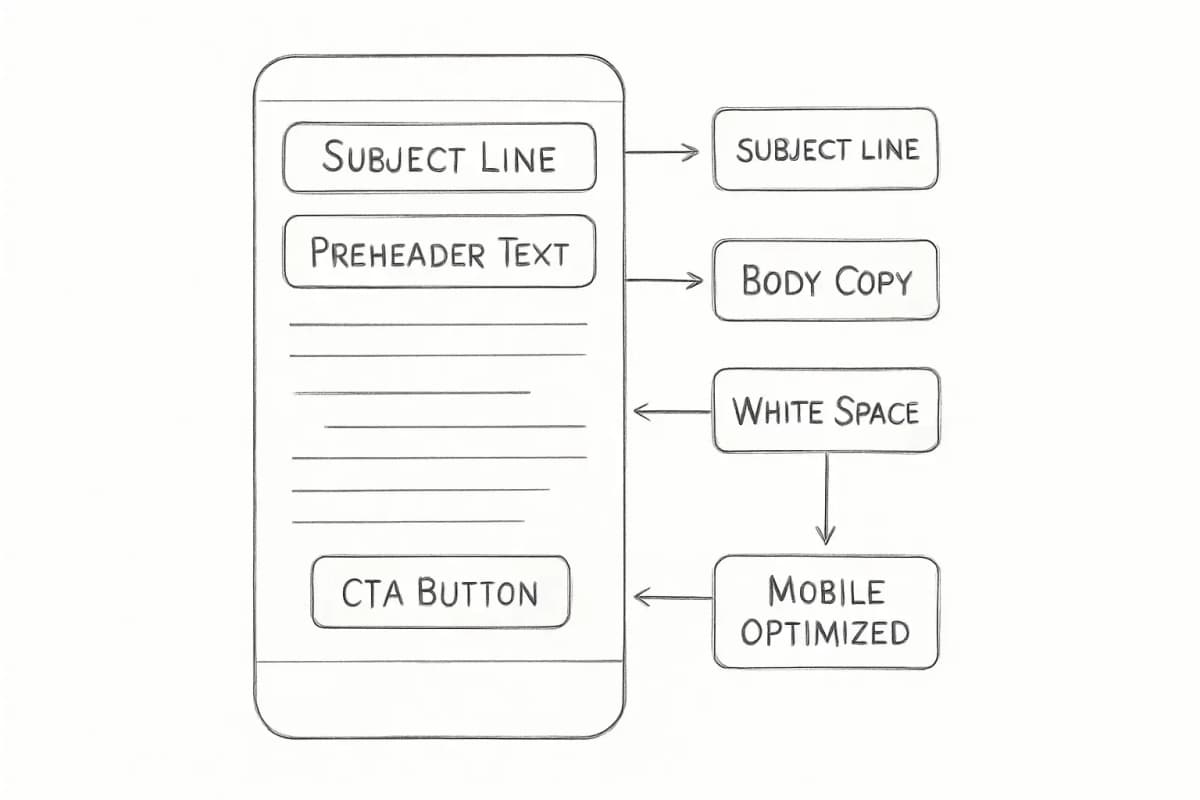
Keep the body copy focused on a single idea. Each email should have one primary message, one primary call-to-action. Multiple CTAs dilute attention.
According to a HubSpot survey, 65% of marketers say their segmented emails have better open rates. For a deeper look at how to structure this, see our guide on email list segmentation strategies that boost ROI.
4. Choose the Right Campaign Type
The type of email you send should match your goal and where subscribers are in their journey. Sending a promotional campaign to a brand-new subscriber who hasn't engaged yet will likely push them to unsubscribe.
The most common types of email marketing campaigns worldwide are newsletters (16.8%), followed by promotional offers (15.3%).
Here are the main campaign types and when to use each:
Welcome sequences: sent immediately after sign-up to introduce your brand and set expectations. Welcome flows offer strong returns, with an average revenue per recipient of $2.65 and top 10% returns of $21.18 per recipient.
Promotional campaigns: time-sensitive offers, product launches, and seasonal sales
Newsletters: regular value-driven content that builds trust and keeps your brand top of mind
Abandoned cart emails: abandoned cart campaigns have an open rate of 50.50%, and businesses earn an average of $3.45 in revenue per abandoned cart email recipient.
Re-engagement campaigns: targeted at subscribers who have gone quiet
Transactional emails: order confirmations, receipts, and shipping notifications, often with high open rates
For welcome sequence best practices, see our welcome email sequence guide.
5. Write Email Copy That Earns the Click
Subject Lines
47% of recipients open emails based solely on the subject line, while 69% report emails as spam for the same reason. Your subject line does more work than any other element in the email.
Key subject line principles:
Most subject lines range from 41 to 50 characters. Even less of your subject line shows on mobile screens, so putting the most important parts at the start is wise.
Be specific about what's inside. Vague lines like "We have something for you" lose to lines that name the benefit or the offer.
Simply personalizing subject lines can drive an impressive 50% increase in open rates.
For a detailed breakdown, our email subject line best practices post covers the formats and techniques that consistently lift open rates.
Email Body Copy
Keep the body copy focused on a single idea. Each email should have one primary message, one primary call-to-action. Multiple CTAs dilute attention.
Every email should include a clear, actionable, and visually appealing call-to-action. Use concise language that clearly conveys the next step. Position your CTA prominently, making it easy for subscribers to engage.
For design, you don't need a complex design to create effective emails. Clear structure and a focused message usually perform better than overly busy layouts. Keep paragraphs short, use white space generously, and make sure the email reads well on mobile.
6. Configure Email Authentication Before You Send
This is the step most small business owners skip, and it's the one that quietly destroys deliverability. Before February 2024, email authentication was a best practice. After it, authentication became a prerequisite for delivery to the world's largest mailbox providers, including Gmail with 2.5 billion users, where bulk senders must implement SPF, DKIM, and DMARC.
As of 2024, all senders need to have email authentication protocols in place to reach people using major services like Gmail, Yahoo Mail, and Outlook.
The three core protocols to configure:
SPF (Sender Policy Framework): SPF is an email validation protocol that enables domain owners to define a list of authorized email servers allowed to send emails on behalf of their domain. Domain owners publish SPF records in their DNS to specify which servers are legitimate senders.
DKIM (DomainKeys Identified Mail): DKIM enables domain owners to automatically "sign" emails from their domain. The DKIM signature is a digital signature that uses cryptography to mathematically verify that the email came from the domain.
DMARC (Domain-based Message Authentication, Reporting and Conformance): DMARC tells a receiving email server what to do given the results after checking SPF and DKIM.
Global inbox placement rates declined to 83.5% in 2024, and spam placement nearly doubled over the course of the year, rising from 4.5% in Q1 to 8.6% in Q4. Proper authentication is one of the most direct ways to protect inbox placement.
7. Test, Send, and Optimize
A/B Testing
Never send a campaign without testing at least one variable. A/B testing can increase email marketing ROI by 83%. Businesses that often A/B test report an average ROI of 4200%, compared to 2300% for those that never do.
Test one element at a time so you know what caused any change in performance:
Every email should include a clear, actionable, and visually appealing call-to-action. Use concise language that clearly conveys the next step. Position your CTA prominently, making it easy for subscribers to engage.
For design, you don't need a complex design to create effective emails. Clear structure and a focused message usually perform better than overly busy layouts. Keep paragraphs short, use white space generously, and make sure the email reads well on mobile.
6. Configure Email Authentication Before You Send
This is the step most small business owners skip, and it's the one that quietly destroys deliverability. Before February 2024, email authentication was a best practice. After it, authentication became a prerequisite for delivery to the world's largest mailbox providers, including Gmail with 2.5 billion users, where bulk senders must implement SPF, DKIM, and DMARC.
As of 2024, all senders need to have email authentication protocols in place to reach people using major services like Gmail, Yahoo Mail, and Outlook.
The three core protocols to configure:
SPF (Sender Policy Framework): SPF is an email validation protocol that enables domain owners to define a list of authorized email servers allowed to send emails on behalf of their domain. Domain owners publish SPF records in their DNS to specify which servers are legitimate senders.
DKIM (DomainKeys Identified Mail): DKIM enables domain owners to automatically "sign" emails from their domain. The DKIM signature is a digital signature that uses cryptography to mathematically verify that the email came from the domain.
DMARC (Domain-based Message Authentication, Reporting and Conformance): DMARC tells a receiving email server what to do given the results after checking SPF and DKIM.
Global inbox placement rates declined to 83.5% in 2024, and spam placement nearly doubled over the course of the year, rising from 4.5% in Q1 to 8.6% in Q4. Proper authentication is one of the most direct ways to protect inbox placement.
7. Test, Send, and Optimize
A/B Testing
Never send a campaign without testing at least one variable. A/B testing can increase email marketing ROI by 83%. Businesses that often A/B test report an average ROI of 4200%, compared to 2300% for those that never do.
Test one element at a time so you know what caused any change in performance:
Subject line wording or length
Send time (day and hour)
CTA button copy or placement
Preview text
Email length or layout
Timing and Frequency
The "sweet spot" for sending frequency is 9 to 16 emails a month, which gives an average ROI of 4600%. That said, the right frequency depends heavily on your audience and the nature of your content. B2B audiences typically tolerate less frequent contact than B2C.
Email campaigns see the highest open rates shortly after sending, with 21.2% of all email opens happening within the first hour. Monitor your send-time data within your email platform to identify when your specific list is most active.
Automation
In 2023, automated emails accounted for 41% of all email orders from only 2% of email sends. Setting up automated workflows for welcome sequences, abandoned carts, and post-purchase follow-ups means your best-performing messages keep running without manual effort.
8. Measure Performance and Improve Continuously
Bot-driven phantom engagement has made open rates unreliable, pushing high-performing teams toward revenue per email, list churn, and lifetime value as the metrics that matter.
Track these metrics after every campaign:
Click-through rate (CTR): in 2024, the average marketing email click-through rate was 2.62%. Use this as a baseline.
Conversion rate: the percentage of recipients who completed the desired action
Revenue per email: total revenue divided by emails delivered
Unsubscribe rate: a spike here often signals relevance or frequency problems
Bounce rate: in 2024, 9% of subscribers unsubscribed and 7% became non-deliverable due to bouncing, representing roughly 16% annual list loss before any growth effort. Regularly remove unengaged contacts.
The top 8% of email programs, those hitting 45:1 or higher ROI, most commonly send newsletters and onboarding emails rather than promotions. The pattern is consistent: relationship-focused programs built on clean lists, strong segmentation, and consistent testing outperform one-off broadcast campaigns every time.
Frequently Asked Questions
How long does it take to create an email marketing campaign?
Subject line wording or length
Send time (day and hour)
CTA button copy or placement
Preview text
Email length or layout
Timing and Frequency
The "sweet spot" for sending frequency is 9 to 16 emails a month, which gives an average ROI of 4600%. That said, the right frequency depends heavily on your audience and the nature of your content. B2B audiences typically tolerate less frequent contact than B2C.
Email campaigns see the highest open rates shortly after sending, with 21.2% of all email opens happening within the first hour. Monitor your send-time data within your email platform to identify when your specific list is most active.
Automation
In 2023, automated emails accounted for 41% of all email orders from only 2% of email sends. Setting up automated workflows for welcome sequences, abandoned carts, and post-purchase follow-ups means your best-performing messages keep running without manual effort.
8. Measure Performance and Improve Continuously
Bot-driven phantom engagement has made open rates unreliable, pushing high-performing teams toward revenue per email, list churn, and lifetime value as the metrics that matter.
Track these metrics after every campaign:
Click-through rate (CTR): in 2024, the average marketing email click-through rate was 2.62%. Use this as a baseline.
Conversion rate: the percentage of recipients who completed the desired action
Revenue per email: total revenue divided by emails delivered
Unsubscribe rate: a spike here often signals relevance or frequency problems
Bounce rate: in 2024, 9% of subscribers unsubscribed and 7% became non-deliverable due to bouncing, representing roughly 16% annual list loss before any growth effort. Regularly remove unengaged contacts.
The top 8% of email programs, those hitting 45:1 or higher ROI, most commonly send newsletters and onboarding emails rather than promotions. The pattern is consistent: relationship-focused programs built on clean lists, strong segmentation, and consistent testing outperform one-off broadcast campaigns every time.
Frequently Asked Questions
How long does it take to create an email marketing campaign?
In 2024, 62% of teams took two weeks or more to send a single email. By 2026, 76% of teams deploy within three days, largely due to AI-assisted content creation, better templates, and streamlined approval workflows. The timeline depends on campaign complexity, team size, and how much original copy and design is required.
What is a good open rate for an email marketing campaign?
A good email open rate in 2025 is above 30%, with 45 to 50% being strong, and over 50% being exceptional. Keep in mind that open rates have become less reliable as a standalone metric due to Apple's Mail Privacy Protection, which pre-loads tracking pixels. Pair open rates with click-through and conversion data for a more accurate picture of engagement.
Do I need to segment my email list to see results?
Not necessarily from day one, but segmentation becomes critical as your list grows. Segmented email campaigns can drive 30% more opens and 50% more click-throughs than non-segmented campaigns. Even basic segmentation, such as separating new subscribers from active buyers, will improve relevance and reduce unsubscribes.
What email authentication records do I need to set up?
At minimum, you need SPF, DKIM, and DMARC configured in your domain's DNS settings. Google recommends always setting up SPF, DKIM, and DMARC for your domains to improve email delivery. Messages that aren't authenticated with these methods might be marked as spam or rejected with a 5.7.26 error. Contact your email service provider to confirm which records they configure on your behalf and which ones you need to set up manually through your domain registrar.
No comments yet. Be the first!
In 2024, 62% of teams took two weeks or more to send a single email. By 2026, 76% of teams deploy within three days, largely due to AI-assisted content creation, better templates, and streamlined approval workflows. The timeline depends on campaign complexity, team size, and how much original copy and design is required.
What is a good open rate for an email marketing campaign?
A good email open rate in 2025 is above 30%, with 45 to 50% being strong, and over 50% being exceptional. Keep in mind that open rates have become less reliable as a standalone metric due to Apple's Mail Privacy Protection, which pre-loads tracking pixels. Pair open rates with click-through and conversion data for a more accurate picture of engagement.
Do I need to segment my email list to see results?
Not necessarily from day one, but segmentation becomes critical as your list grows. Segmented email campaigns can drive 30% more opens and 50% more click-throughs than non-segmented campaigns. Even basic segmentation, such as separating new subscribers from active buyers, will improve relevance and reduce unsubscribes.
What email authentication records do I need to set up?
At minimum, you need SPF, DKIM, and DMARC configured in your domain's DNS settings. Google recommends always setting up SPF, DKIM, and DMARC for your domains to improve email delivery. Messages that aren't authenticated with these methods might be marked as spam or rejected with a 5.7.26 error. Contact your email service provider to confirm which records they configure on your behalf and which ones you need to set up manually through your domain registrar.