How to Do Email Affiliate Marketing: Step-by-Step Guide
Learn how to build an email affiliate marketing strategy that drives revenue. Discover list-building tactics, partner selection, and proven promotion methods.
How to Do Email Affiliate Marketing: Step-by-Step Guide
Learn how to build an email affiliate marketing strategy that drives revenue. Discover list-building tactics, partner selection, and proven promotion methods.
Email affiliate marketing sits at the intersection of two of the highest-ROI channels in digital marketing. Done correctly, it lets you generate consistent, trackable revenue from an audience you already own. Done poorly, it destroys your sender reputation and burns subscriber trust. This guide covers exactly how to do email affiliate marketing, from picking the right program to protecting deliverability and scaling what works.
Key Takeaways
Email affiliate marketing is a method of earning commissions by promoting products or services through email campaigns. Affiliates who use email marketing earn 66.4% more than those who don't, according to a survey by AuthorityHacker.
Email marketing generates between $36 and $40 for every dollar spent, making it one of the most cost-effective channels for affiliate promotion.
Email and newsletters are used by 50% of affiliates as their top promotion channel.
Proper consent is the bedrock of good email deliverability. Without it, your emails are unsolicited and prone to being marked as spam. For affiliates, ensuring every recipient has explicitly opted in is not just a best practice, but a legal requirement under CAN-SPAM and GDPR.
The FTC requires affiliate disclosures to help protect consumers from deceptive marketing practices, and they apply to anyone promoting products or brands.
What Email Affiliate Marketing Actually Is
In affiliate marketing, companies offer their partners the opportunity to promote their products or services and receive a commission on sales as a reward. To track sales made by partners, a unique affiliate link is used.
When that promotion happens through email, you control the channel entirely. Unlike social media or paid ads, your list is an owned asset. No algorithm change can cut off your reach overnight.
Affiliate marketing is a monetization strategy that doesn't require you to create products, manage inventory, or handle customer service. You just need an engaged email list and the willingness to recommend products you genuinely believe will help your audience.
The mechanics are straightforward: you embed a unique tracking link in your email. When a subscriber clicks it and completes a qualifying action (usually a purchase), you earn a commission. Most affiliate programs offer recurring commissions ranging from 20% to 40% per referral.
Email affiliate marketing sits at the intersection of two of the highest-ROI channels in digital marketing. Done correctly, it lets you generate consistent, trackable revenue from an audience you already own. Done poorly, it destroys your sender reputation and burns subscriber trust. This guide covers exactly how to do email affiliate marketing, from picking the right program to protecting deliverability and scaling what works.
Key Takeaways
Email affiliate marketing is a method of earning commissions by promoting products or services through email campaigns. Affiliates who use email marketing earn 66.4% more than those who don't, according to a survey by AuthorityHacker.
Email marketing generates between $36 and $40 for every dollar spent, making it one of the most cost-effective channels for affiliate promotion.
Email and newsletters are used by 50% of affiliates as their top promotion channel.
Proper consent is the bedrock of good email deliverability. Without it, your emails are unsolicited and prone to being marked as spam. For affiliates, ensuring every recipient has explicitly opted in is not just a best practice, but a legal requirement under CAN-SPAM and GDPR.
The FTC requires affiliate disclosures to help protect consumers from deceptive marketing practices, and they apply to anyone promoting products or brands.
What Email Affiliate Marketing Actually Is
In affiliate marketing, companies offer their partners the opportunity to promote their products or services and receive a commission on sales as a reward. To track sales made by partners, a unique affiliate link is used.
When that promotion happens through email, you control the channel entirely. Unlike social media or paid ads, your list is an owned asset. No algorithm change can cut off your reach overnight.
Affiliate marketing is a monetization strategy that doesn't require you to create products, manage inventory, or handle customer service. You just need an engaged email list and the willingness to recommend products you genuinely believe will help your audience.
The mechanics are straightforward: you embed a unique tracking link in your email. When a subscriber clicks it and completes a qualifying action (usually a purchase), you earn a commission. Most affiliate programs offer recurring commissions ranging from 20% to 40% per referral.
Step 1: Choose the Right Affiliate Program
Not every affiliate program belongs in your emails. Picking the wrong one wastes your subscribers' attention and your credibility.
Evaluate programs on these criteria:
Relevance. The product must match your audience's actual needs. Only pick affiliate products that resonate with subscribers' interests, like recommending quality kitchen knives on a cooking blog rather than random running shoes.
Commission structure. SaaS-based products offer a commission of 20% to 70%, according to Influencer Marketing Hub. Physical products typically pay far less.
Cookie duration. Longer attribution windows give you more time to earn credit for delayed conversions.
Program reputation. Partner with brands that have solid customer support, because a bad post-purchase experience reflects on you.
Affiliate marketing networks like Skimlinks or Sovrn give you instant access to affiliate programs at many retailers, so you can promote a variety of products without having to join each program independently. Alternatively, search directly for "[your niche] affiliate programs" or check the tools you already use and recommend to your audience.
Step 2: Pick an Email Platform That Allows Affiliate Links
This step trips up more marketers than any other. The first step is to ensure that your preferred email provider permits the use of affiliate links in your email campaigns. Due to deliverability issues, many providers prevent or ban the use of affiliate links, which can be frustrating to marketers. Failing to check this can make you lose your account or, even worse, lose access to your precious mailing lists.
There are many popular email service providers, but the main criterion for affiliate marketing is an ESP that allows affiliate links. For example, Constant Contact does not allow affiliate links. MailChimp allows affiliate links but not affiliate marketing. ConvertKit, AWeber, GetResponse, Brevo, and Drip also do not allow affiliate links.
Research each platform's terms of service carefully before committing. Platforms built for performance marketers, such as ActiveCampaign, Klaviyo, or MailerLite, tend to be more permissive. Always confirm with support before sending.
Beyond policy, look for platforms with strong segmentation, automation, and A/B testing features. These are non-negotiable for scaling affiliate campaigns effectively.
Step 3: Build and Segment Your Email List
To make affiliate marketing viable, you need large email lists. But size alone doesn't drive conversions. A smaller, well-segmented list consistently outperforms a large, undifferentiated one.
How to grow your list:
Step 1: Choose the Right Affiliate Program
Not every affiliate program belongs in your emails. Picking the wrong one wastes your subscribers' attention and your credibility.
Evaluate programs on these criteria:
Relevance. The product must match your audience's actual needs. Only pick affiliate products that resonate with subscribers' interests, like recommending quality kitchen knives on a cooking blog rather than random running shoes.
Commission structure. SaaS-based products offer a commission of 20% to 70%, according to Influencer Marketing Hub. Physical products typically pay far less.
Cookie duration. Longer attribution windows give you more time to earn credit for delayed conversions.
Program reputation. Partner with brands that have solid customer support, because a bad post-purchase experience reflects on you.
Affiliate marketing networks like Skimlinks or Sovrn give you instant access to affiliate programs at many retailers, so you can promote a variety of products without having to join each program independently. Alternatively, search directly for "[your niche] affiliate programs" or check the tools you already use and recommend to your audience.
Step 2: Pick an Email Platform That Allows Affiliate Links
This step trips up more marketers than any other. The first step is to ensure that your preferred email provider permits the use of affiliate links in your email campaigns. Due to deliverability issues, many providers prevent or ban the use of affiliate links, which can be frustrating to marketers. Failing to check this can make you lose your account or, even worse, lose access to your precious mailing lists.
There are many popular email service providers, but the main criterion for affiliate marketing is an ESP that allows affiliate links. For example, Constant Contact does not allow affiliate links. MailChimp allows affiliate links but not affiliate marketing. ConvertKit, AWeber, GetResponse, Brevo, and Drip also do not allow affiliate links.
Research each platform's terms of service carefully before committing. Platforms built for performance marketers, such as ActiveCampaign, Klaviyo, or MailerLite, tend to be more permissive. Always confirm with support before sending.
Beyond policy, look for platforms with strong segmentation, automation, and A/B testing features. These are non-negotiable for scaling affiliate campaigns effectively.
Step 3: Build and Segment Your Email List
To make affiliate marketing viable, you need large email lists. But size alone doesn't drive conversions. A smaller, well-segmented list consistently outperforms a large, undifferentiated one.
How to grow your list:
Creating a compelling landing page is one of the most effective ways to attract subscribers. Short landing pages with clear calls to action perform 13.5% better than longer ones.
When readers find your advice helpful, they're often willing to sign up for more, especially if you offer lead magnets like free workout plans, exclusive product discounts, or in-depth guides related to the article topic.
Use double opt-in to maintain list quality. Double opt-in means that after someone subscribes, you send them a follow-up email with a confirmation link. When you use double opt-in, your email lists will be much more qualified, and your subscribers will be much more engaged.
Segmenting your list will not only increase your opt-ins, open rates, and conversion rates, but it will also help you focus on each audience and enable you to send the right content to the right buyer at the right time.
Step 4: Structure Your Affiliate Email Sequences
One-off promotional emails underperform. A well-structured sequence builds trust before it pitches.
Create a new affiliate marketing email sequence and affiliate email marketing campaign for each new affiliate product to attract new audiences and not overload your successful emails with affiliate links.
Core sequences every affiliate email marketer needs:
Welcome sequence. Your welcome series is make-or-break time. These emails hit when subscribers are most excited about hearing from you, right after they sign up. That's why 75% of marketers send welcome emails immediately. See our welcome email sequence best practices for a proven framework.
Nurture sequence. Deliver value before you promote. Educate subscribers on the problem your affiliate product solves. Warm trust first.
Promotional sequence. Introduce the product in email one, address objections in email two, and use social proof or urgency in email three.
Re-engagement sequence. Use trigger emails to send affiliate emails to your subscribers based on their responses to your content. Start with emails to welcome your subscribers and continue supporting them to help them get all the benefits of your affiliate products. Email triggers also help motivate positive behavior or send essential updates.
The primary goal in every affiliate email is not to close the sale. The primary goal of affiliate emails is to get the reader interested in the sales page or webinar. This means selling a click. The affiliate's landing page handles the sale.
Step 5: Write Emails That Convert Without Sounding Like Ads
Subject lines, body copy, and calls to action all shape whether a subscriber clicks or ignores you.
Creating a compelling landing page is one of the most effective ways to attract subscribers. Short landing pages with clear calls to action perform 13.5% better than longer ones.
When readers find your advice helpful, they're often willing to sign up for more, especially if you offer lead magnets like free workout plans, exclusive product discounts, or in-depth guides related to the article topic.
Use double opt-in to maintain list quality. Double opt-in means that after someone subscribes, you send them a follow-up email with a confirmation link. When you use double opt-in, your email lists will be much more qualified, and your subscribers will be much more engaged.
Segmenting your list will not only increase your opt-ins, open rates, and conversion rates, but it will also help you focus on each audience and enable you to send the right content to the right buyer at the right time.
Step 4: Structure Your Affiliate Email Sequences
One-off promotional emails underperform. A well-structured sequence builds trust before it pitches.
Create a new affiliate marketing email sequence and affiliate email marketing campaign for each new affiliate product to attract new audiences and not overload your successful emails with affiliate links.
Core sequences every affiliate email marketer needs:
Welcome sequence. Your welcome series is make-or-break time. These emails hit when subscribers are most excited about hearing from you, right after they sign up. That's why 75% of marketers send welcome emails immediately. See our welcome email sequence best practices for a proven framework.
Nurture sequence. Deliver value before you promote. Educate subscribers on the problem your affiliate product solves. Warm trust first.
Promotional sequence. Introduce the product in email one, address objections in email two, and use social proof or urgency in email three.
Re-engagement sequence. Use trigger emails to send affiliate emails to your subscribers based on their responses to your content. Start with emails to welcome your subscribers and continue supporting them to help them get all the benefits of your affiliate products. Email triggers also help motivate positive behavior or send essential updates.
The primary goal in every affiliate email is not to close the sale. The primary goal of affiliate emails is to get the reader interested in the sales page or webinar. This means selling a click. The affiliate's landing page handles the sale.
Step 5: Write Emails That Convert Without Sounding Like Ads
Subject lines, body copy, and calls to action all shape whether a subscriber clicks or ignores you.
Subject lines: Your subject line determines whether the email gets opened at all. Our breakdown of email subject line best practices that boost open rates by 27% gives you specific formulas that work across industries.
Body copy principles:
Lead with the subscriber's problem, not the product's features.
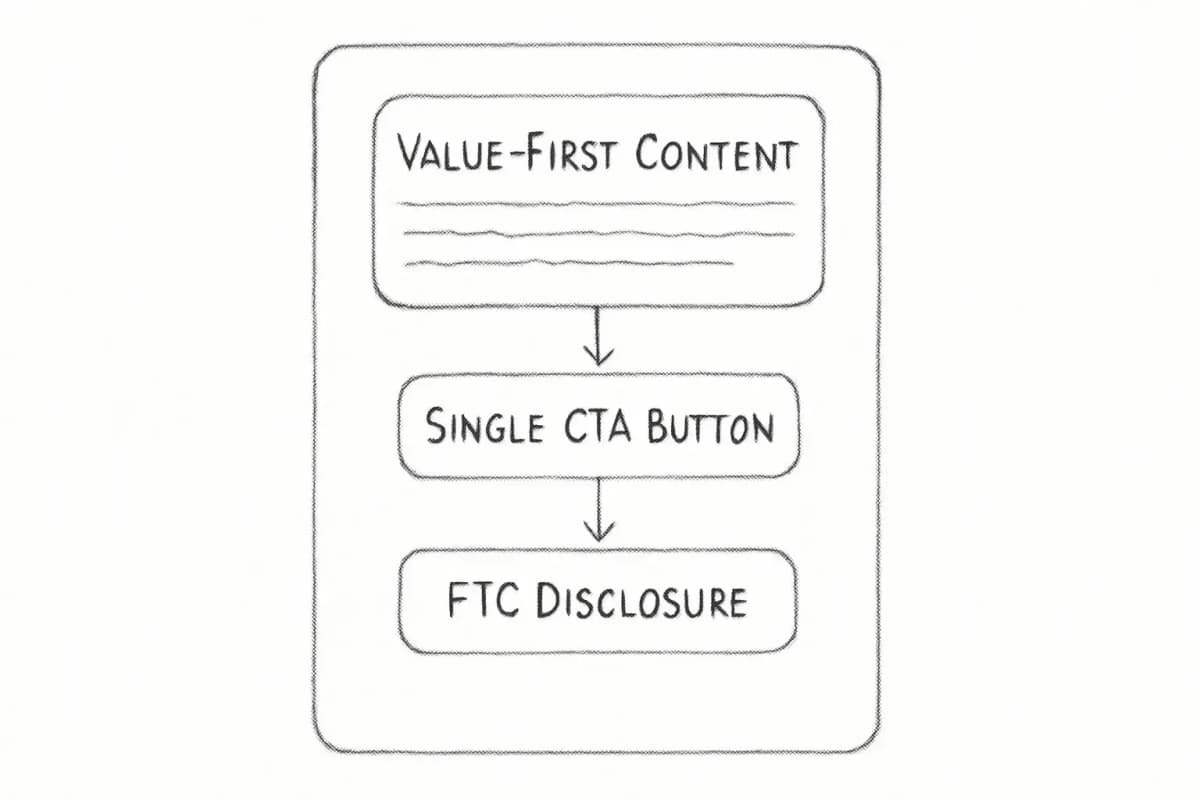
Strategically place your affiliate links within valuable content that naturally ties into the products you're promoting. Provide context and explain how the product benefits them so the link feels like a helpful resource rather than a sales pitch.
Keep paragraphs short. Most email readers scan before they read.
Use a single, clear CTA. Multiple links create decision paralysis.
Personalization: More than half (54%) of marketers personalize email content, which helps boost the effectiveness of promotions. Reference the subscriber's segment, past behavior, or stated preferences to make the recommendation feel relevant rather than generic.
Step 6: Protect Your Deliverability
Affiliate links are a known spam signal. If you're not careful, your campaigns will land in junk folders instead of inboxes, killing your revenue before it starts.
A 2024 study across 15 leading email service providers measured an average deliverability rate of just 83.1%, meaning roughly one in five emails never hits the inbox.
Aggressive, hard-selling copy, excessive use of capitalized words, exclamation points, and a high density of links, especially to unfamiliar domains, can trigger spam filters.
Deliverability checklist for affiliate senders:
Subject lines: Your subject line determines whether the email gets opened at all. Our breakdown of email subject line best practices that boost open rates by 27% gives you specific formulas that work across industries.
Body copy principles:
Lead with the subscriber's problem, not the product's features.
Strategically place your affiliate links within valuable content that naturally ties into the products you're promoting. Provide context and explain how the product benefits them so the link feels like a helpful resource rather than a sales pitch.
Keep paragraphs short. Most email readers scan before they read.
Use a single, clear CTA. Multiple links create decision paralysis.
Personalization: More than half (54%) of marketers personalize email content, which helps boost the effectiveness of promotions. Reference the subscriber's segment, past behavior, or stated preferences to make the recommendation feel relevant rather than generic.
Step 6: Protect Your Deliverability
Affiliate links are a known spam signal. If you're not careful, your campaigns will land in junk folders instead of inboxes, killing your revenue before it starts.
A 2024 study across 15 leading email service providers measured an average deliverability rate of just 83.1%, meaning roughly one in five emails never hits the inbox.
Aggressive, hard-selling copy, excessive use of capitalized words, exclamation points, and a high density of links, especially to unfamiliar domains, can trigger spam filters.
Deliverability checklist for affiliate senders:
Authentication. As of 2024, DMARC is mandatory for bulk senders targeting Gmail or Yahoo. Without it, you risk filtered or rejected emails, even if SPF and DKIM are in place.
Spam rate. Gmail, Outlook, and iOS Mail now use machine learning to score sender reputation. If your complaint rate exceeds 0.1% or bounce rate rises above 2%, future campaigns will be throttled or rejected.
Link placement. Limit affiliate links to two or three per email. Route them through a redirect on your own domain rather than using raw third-party URLs, which are more likely to be flagged.
List hygiene. Email lists decay by over 30% annually, and every outdated or unchecked contact increases your exposure to bounces and spam traps. Clean your list quarterly.
Sending cadence. Send at regular intervals such as weekly or bi-weekly. Inconsistency confuses filters and can harm reputation.
Step 7: Stay Compliant with FTC and CAN-SPAM Rules
Compliance is not optional. The FTC requires affiliate disclosures to help protect consumers from deceptive marketing practices, and they apply to anyone promoting products or brands.
For emails, integrate the disclosure clearly within the body of the email, close to the relevant recommendation or affiliate link. A short line like "This email contains affiliate links. If you purchase through them, I earn a small commission at no extra cost to you" satisfies the requirement.
The "clear and conspicuous" requirement is at the heart of FTC compliance for affiliate marketing. There is nothing inherently misleading or deceptive about affiliate marketing, and this is expressly recognized by the FTC. However, affiliate marketers and companies can run into trouble when they attempt to hide the nature of their relationship. If it is not clear that an affiliate is being compensated for generating sales, this can lead to FTC enforcement action.
Beyond disclosure, follow these CAN-SPAM requirements in every send:
Include your physical mailing address.
Make the "from" name and address accurate and consistent.
Include a working unsubscribe link and honor requests promptly.
Never use deceptive subject lines.
Note the FTC's 2024 Consumer Reviews and Testimonials Rule, which bans fake or manipulated reviews, with civil penalties for violations.
Step 8: Track, Test, and Improve
In A/B testing, you can create two different emails and discover the one that gets a better response from your target audience. Affiliate email marketing is much more effective when campaigns are monitored and adjusted according to the email with the best results.
Key metrics to track:
Open rate. Measures subject line and sender name performance.
Click-through rate (CTR). Measures how compelling your copy and CTA are.
Click-to-conversion rate. Click-to-conversion jumped 53% year-over-year in 2025, rising from 5.9% to 9%, meaning fewer people clicked but those who did were far more likely to buy.
Revenue per email (RPE). The clearest indicator of affiliate campaign profitability.
Unsubscribe rate. A rising rate signals that your content or frequency is off.
Test one variable at a time: subject line, CTA copy, offer framing, or send time. Run tests for a statistically significant sample before drawing conclusions.
Authentication. As of 2024, DMARC is mandatory for bulk senders targeting Gmail or Yahoo. Without it, you risk filtered or rejected emails, even if SPF and DKIM are in place.
Spam rate. Gmail, Outlook, and iOS Mail now use machine learning to score sender reputation. If your complaint rate exceeds 0.1% or bounce rate rises above 2%, future campaigns will be throttled or rejected.
Link placement. Limit affiliate links to two or three per email. Route them through a redirect on your own domain rather than using raw third-party URLs, which are more likely to be flagged.
List hygiene. Email lists decay by over 30% annually, and every outdated or unchecked contact increases your exposure to bounces and spam traps. Clean your list quarterly.
Sending cadence. Send at regular intervals such as weekly or bi-weekly. Inconsistency confuses filters and can harm reputation.
Step 7: Stay Compliant with FTC and CAN-SPAM Rules
Compliance is not optional. The FTC requires affiliate disclosures to help protect consumers from deceptive marketing practices, and they apply to anyone promoting products or brands.
For emails, integrate the disclosure clearly within the body of the email, close to the relevant recommendation or affiliate link. A short line like "This email contains affiliate links. If you purchase through them, I earn a small commission at no extra cost to you" satisfies the requirement.
The "clear and conspicuous" requirement is at the heart of FTC compliance for affiliate marketing. There is nothing inherently misleading or deceptive about affiliate marketing, and this is expressly recognized by the FTC. However, affiliate marketers and companies can run into trouble when they attempt to hide the nature of their relationship. If it is not clear that an affiliate is being compensated for generating sales, this can lead to FTC enforcement action.
Beyond disclosure, follow these CAN-SPAM requirements in every send:
Include your physical mailing address.
Make the "from" name and address accurate and consistent.
Include a working unsubscribe link and honor requests promptly.
Never use deceptive subject lines.
Note the FTC's 2024 Consumer Reviews and Testimonials Rule, which bans fake or manipulated reviews, with civil penalties for violations.
Step 8: Track, Test, and Improve
In A/B testing, you can create two different emails and discover the one that gets a better response from your target audience. Affiliate email marketing is much more effective when campaigns are monitored and adjusted according to the email with the best results.
Key metrics to track:
Open rate. Measures subject line and sender name performance.
Click-through rate (CTR). Measures how compelling your copy and CTA are.
Click-to-conversion rate. Click-to-conversion jumped 53% year-over-year in 2025, rising from 5.9% to 9%, meaning fewer people clicked but those who did were far more likely to buy.
Revenue per email (RPE). The clearest indicator of affiliate campaign profitability.
Unsubscribe rate. A rising rate signals that your content or frequency is off.
Test one variable at a time: subject line, CTA copy, offer framing, or send time. Run tests for a statistically significant sample before drawing conclusions.
Is email affiliate marketing allowed by all email service providers?
No. There are many popular email service providers, but the main criterion for affiliate marketing is choosing an ESP that allows affiliate links. For example, Constant Contact does not allow affiliate links. Always verify your platform's terms of service before sending affiliate content. Some providers permit affiliate links but prohibit using the account solely as an affiliate broadcast tool. When in doubt, contact support directly.
Do I need to disclose affiliate links in emails?
Yes, always. The Federal Trade Commission requires by law that you disclose relationships that could influence the endorsement or promotion of products. No matter how big or small the promotion, all affiliate marketers are required to do this. The disclosure must appear clearly in the email body, near the relevant link, not buried in a footer or hidden in small print.
How many affiliate links should I include per email?
Generally, it's best to maintain a balance that keeps subscribers engaged without overwhelming them and hitting spam folders. Test frequencies with A/B testing to determine what works best for your list. As a practical starting point, limit emails to one primary affiliate offer with one or two supporting links. More than three affiliate links per email increases both spam filter risk and reader distraction.
How do I grow an email list for affiliate marketing if I'm starting from scratch?
Start with a lead magnet that solves a specific problem your target audience faces. Effective lead magnets for affiliate marketers include educational content like free ebooks, guides, and email courses; practical tools like checklists and templates; and exclusive offers like discount codes or early access related to your promoted affiliate products. Pair this with a simple opt-in page and consistent content publishing to drive organic traffic and subscriber growth over time.
Is email affiliate marketing allowed by all email service providers?
No. There are many popular email service providers, but the main criterion for affiliate marketing is choosing an ESP that allows affiliate links. For example, Constant Contact does not allow affiliate links. Always verify your platform's terms of service before sending affiliate content. Some providers permit affiliate links but prohibit using the account solely as an affiliate broadcast tool. When in doubt, contact support directly.
Do I need to disclose affiliate links in emails?
Yes, always. The Federal Trade Commission requires by law that you disclose relationships that could influence the endorsement or promotion of products. No matter how big or small the promotion, all affiliate marketers are required to do this. The disclosure must appear clearly in the email body, near the relevant link, not buried in a footer or hidden in small print.
How many affiliate links should I include per email?
Generally, it's best to maintain a balance that keeps subscribers engaged without overwhelming them and hitting spam folders. Test frequencies with A/B testing to determine what works best for your list. As a practical starting point, limit emails to one primary affiliate offer with one or two supporting links. More than three affiliate links per email increases both spam filter risk and reader distraction.
How do I grow an email list for affiliate marketing if I'm starting from scratch?
Start with a lead magnet that solves a specific problem your target audience faces. Effective lead magnets for affiliate marketers include educational content like free ebooks, guides, and email courses; practical tools like checklists and templates; and exclusive offers like discount codes or early access related to your promoted affiliate products. Pair this with a simple opt-in page and consistent content publishing to drive organic traffic and subscriber growth over time.