Mass email marketing delivers one of the highest returns in digital marketing, and the numbers back it up: for every $1 spent on email marketing, businesses make $36 in return, according to data from Litmus, equaling a 3,600% ROI. But raw scale alone does not produce those results. Sending millions of emails to an unvetted list is a fast path to spam folders, blacklists, and wasted budget.
This guide covers exactly how to do mass email marketing in a way that protects your sender reputation, reaches the inbox, and converts subscribers into buyers.
Key Takeaways
The average ROI for marketing emails in the US and UK is between 3,600% and 3,800%.
Nearly 20% of marketing emails never make it to the inbox due to poor deliverability. Technical setup matters as much as content.
Segmented campaigns drive up to a 760% increase in email revenue, according to DMA data.
As of February 2024, Gmail and Yahoo implemented stricter regulations for bulk email senders. Senders who send more than 5,000 emails daily to Gmail or Yahoo addresses are now required to comply with a newly established set of guidelines.
Automated emails generate 320% more revenue than non-automated emails.
What Mass Email Marketing Actually Means
Mass email marketing is the practice of sending a single email campaign to a large number of recipients at once. It works differently from other email types: transactional emails go out automatically when someone makes a purchase or resets their password, while mass emails broadcast the same message to many people at once.
The distinction matters because mailbox providers treat bulk sends with more scrutiny than transactional sends. Promotional campaigns face stricter filtering because recipients often do not interact with these emails. Sending relevant content to well-segmented audiences is the best way to protect your campaign's deliverability rate.
Done well, mass email is one of the most cost-efficient channels available. 41% of marketers say email is their most effective channel, far ahead of social media and paid search at 16%.
Step 1: Build a Clean, Permission-Based List
The quality of your email list determines everything downstream: deliverability, engagement, and revenue. A large list built on bad data is worse than a small list built on genuine opt-ins.
Mass email marketing delivers one of the highest returns in digital marketing, and the numbers back it up: for every $1 spent on email marketing, businesses make $36 in return, according to data from Litmus, equaling a 3,600% ROI. But raw scale alone does not produce those results. Sending millions of emails to an unvetted list is a fast path to spam folders, blacklists, and wasted budget.
This guide covers exactly how to do mass email marketing in a way that protects your sender reputation, reaches the inbox, and converts subscribers into buyers.
Key Takeaways
The average ROI for marketing emails in the US and UK is between 3,600% and 3,800%.
Nearly 20% of marketing emails never make it to the inbox due to poor deliverability. Technical setup matters as much as content.
Segmented campaigns drive up to a 760% increase in email revenue, according to DMA data.
As of February 2024, Gmail and Yahoo implemented stricter regulations for bulk email senders. Senders who send more than 5,000 emails daily to Gmail or Yahoo addresses are now required to comply with a newly established set of guidelines.
Automated emails generate 320% more revenue than non-automated emails.
What Mass Email Marketing Actually Means
Mass email marketing is the practice of sending a single email campaign to a large number of recipients at once. It works differently from other email types: transactional emails go out automatically when someone makes a purchase or resets their password, while mass emails broadcast the same message to many people at once.
The distinction matters because mailbox providers treat bulk sends with more scrutiny than transactional sends. Promotional campaigns face stricter filtering because recipients often do not interact with these emails. Sending relevant content to well-segmented audiences is the best way to protect your campaign's deliverability rate.
Done well, mass email is one of the most cost-efficient channels available. 41% of marketers say email is their most effective channel, far ahead of social media and paid search at 16%.
Step 1: Build a Clean, Permission-Based List
The quality of your email list determines everything downstream: deliverability, engagement, and revenue. A large list built on bad data is worse than a small list built on genuine opt-ins.
How to grow your list properly:
Use opt-in forms with clear consent language on your website, landing pages, and checkout flows
Offer an incentive. Statista found that 48% of consumers happily gave their email address to receive a discount.
Use double opt-in to confirm subscriber intent. Double opt-in confirms subscribers genuinely want your emails, leading to higher engagement and fewer complaints. Confirmed subscribers engage more consistently.
Never buy email lists. Purchased lists are riddled with invalid addresses, spam traps, and contacts who never consented to hear from you.
Skipping technical configuration is the single most common reason mass email campaigns land in spam. Authentication protocols (SPF, DKIM, and DMARC) add layers of security and contribute to a positive sender reputation.
Required authentication records:
SPF (Sender Policy Framework): authorizes which servers can send on your domain's behalf
DKIM (DomainKeys Identified Mail): adds a cryptographic signature to each email
DMARC: tells mailbox providers what to do when SPF or DKIM fails
Authentication proves you are who you claim to be. Major providers now require proper authentication for bulk senders. It is mandatory, not optional, especially for mass email campaigns.
IP warm-up: If you are sending from a new IP address or domain, do not blast your full list on day one. You should send a low number of emails at first, then gradually increase your email volume over the next 30 to 60 days. This establishes your sender reputation before volume ramps up.
Step 3: Segment Your List for Better Results
Sending the same message to everyone on your list feels like mass email marketing, but it rarely performs like it. The average office worker receives 121 emails per day. With so much competition for attention in the inbox, generic email blasts just do not cut it anymore. To stand out, engage readers, and drive action, you need to send targeted, personalized content.
Segmentation is the bridge between mass reach and relevant messaging.
High-impact segmentation approaches:
How to grow your list properly:
Use opt-in forms with clear consent language on your website, landing pages, and checkout flows
Offer an incentive. Statista found that 48% of consumers happily gave their email address to receive a discount.
Use double opt-in to confirm subscriber intent. Double opt-in confirms subscribers genuinely want your emails, leading to higher engagement and fewer complaints. Confirmed subscribers engage more consistently.
Never buy email lists. Purchased lists are riddled with invalid addresses, spam traps, and contacts who never consented to hear from you.
Skipping technical configuration is the single most common reason mass email campaigns land in spam. Authentication protocols (SPF, DKIM, and DMARC) add layers of security and contribute to a positive sender reputation.
Required authentication records:
SPF (Sender Policy Framework): authorizes which servers can send on your domain's behalf
DKIM (DomainKeys Identified Mail): adds a cryptographic signature to each email
DMARC: tells mailbox providers what to do when SPF or DKIM fails
Authentication proves you are who you claim to be. Major providers now require proper authentication for bulk senders. It is mandatory, not optional, especially for mass email campaigns.
IP warm-up: If you are sending from a new IP address or domain, do not blast your full list on day one. You should send a low number of emails at first, then gradually increase your email volume over the next 30 to 60 days. This establishes your sender reputation before volume ramps up.
Step 3: Segment Your List for Better Results
Sending the same message to everyone on your list feels like mass email marketing, but it rarely performs like it. The average office worker receives 121 emails per day. With so much competition for attention in the inbox, generic email blasts just do not cut it anymore. To stand out, engage readers, and drive action, you need to send targeted, personalized content.
Segmentation is the bridge between mass reach and relevant messaging.
High-impact segmentation approaches:
Behavioral: based on links clicked, pages visited, or products viewed
Purchase history: cross-sell related items, target lapsed buyers, reward VIP customers
Lifecycle stage: new subscribers need different messaging than long-term customers
Engagement level: separate active openers from dormant contacts
The DMA reports that segmented emails generate 64% fewer spam complaints than non-segmented campaigns on average. Fewer complaints means better inbox placement and a stronger sender reputation over time.
According to Litmus research, segmentation is perceived to be the most effective email personalization strategy by marketers, ahead of dynamic content and personalized subject lines.
Your subject line is doing the most important job in mass email: convincing someone to open before they delete. As of 2025, the average email open rate across industries is 42.35%, but much of that is inflated by Apple Mail Privacy Protection automatically preloading content. Clicks and conversions are the metrics that actually tell you what is working.
Subject line rules for mass email:
Keep lines specific and direct. Vague subject lines lose to specific ones every time.
Words like "Free!!" or "Urgent" can send emails straight to promotions or junk folders. Spam filters have become increasingly sophisticated at detecting promotional language and pressure tactics. Even ALL CAPS subject lines or multiple exclamation marks can lower sender reputation over time.
Test one variable at a time. A/B tests run by MailerLite showed that personal sender names resulted in 3.81% more opens.
Email body best practices:
One email, one purpose. Focus on one main action per email to avoid confusing readers.
Text-forward or lightly designed emails are on the rise in 2025. Today's audiences are more wary of emails that feel overly produced. Simpler designs feel more human, more trustworthy, and more like a direct message from a real person.
50% of people will delete an email if it is not optimized for mobile. Always design and test for mobile first.
Behavioral: based on links clicked, pages visited, or products viewed
Purchase history: cross-sell related items, target lapsed buyers, reward VIP customers
Lifecycle stage: new subscribers need different messaging than long-term customers
Engagement level: separate active openers from dormant contacts
The DMA reports that segmented emails generate 64% fewer spam complaints than non-segmented campaigns on average. Fewer complaints means better inbox placement and a stronger sender reputation over time.
According to Litmus research, segmentation is perceived to be the most effective email personalization strategy by marketers, ahead of dynamic content and personalized subject lines.
Your subject line is doing the most important job in mass email: convincing someone to open before they delete. As of 2025, the average email open rate across industries is 42.35%, but much of that is inflated by Apple Mail Privacy Protection automatically preloading content. Clicks and conversions are the metrics that actually tell you what is working.
Subject line rules for mass email:
Keep lines specific and direct. Vague subject lines lose to specific ones every time.
Words like "Free!!" or "Urgent" can send emails straight to promotions or junk folders. Spam filters have become increasingly sophisticated at detecting promotional language and pressure tactics. Even ALL CAPS subject lines or multiple exclamation marks can lower sender reputation over time.
Test one variable at a time. A/B tests run by MailerLite showed that personal sender names resulted in 3.81% more opens.
Email body best practices:
One email, one purpose. Focus on one main action per email to avoid confusing readers.
Text-forward or lightly designed emails are on the rise in 2025. Today's audiences are more wary of emails that feel overly produced. Simpler designs feel more human, more trustworthy, and more like a direct message from a real person.
50% of people will delete an email if it is not optimized for mobile. Always design and test for mobile first.
For proven subject line strategies, see our guide to email subject line best practices.
Step 5: Protect Deliverability at Scale
Only 83.5% of emails globally reach inboxes, meaning one in six emails sent may never be seen. For a list of 100,000 subscribers, that is 16,500 people who never had a chance to engage.
The key deliverability levers for mass email:
List hygiene: List hygiene ensures you only email engaged, valid subscribers. Clean lists reduce bounces, minimize complaints, and improve engagement signals. Remove hard bounces immediately. Monitor soft bounces and remove persistent failures indicating inactive accounts.
Suppress inactive contacts: Suppress unengaged contacts using a 60 to 90 day no-click window. As engagement decays, inbox placement suffers. Proactively removing inactive contacts helps you stay ahead of deliverability issues.
Keep spam complaints below threshold: Google implemented stricter complaint thresholds in Q4 2024, explicitly flagging senders exceeding 0.3%, and Microsoft followed suit in May 2025. Your target should be well below 0.1%.
Content signals: Mailbox providers do not just analyze your domain. They scan every part of your email content. If your copy, formatting, or structure looks like spam, it will be treated like spam regardless of your email infrastructure.
Step 6: Stay Compliant with Email Marketing Law
Mass email marketing carries legal obligations that vary by country. Getting this wrong exposes your business to significant penalties, not just spam folder placement.
Key laws to understand:
CAN-SPAM (United States): The CAN-SPAM Act does not apply just to bulk email. It covers all commercial messages, defined as any electronic mail message whose primary purpose is the commercial advertisement or promotion of a commercial product or service. Each separate email in violation of the CAN-SPAM Act is subject to penalties of up to $53,088.
GDPR (European Union): GDPR operates on opt-in consent. Organizations cannot send marketing emails without prior consent. The burden falls on organizations to obtain and document valid consent before initiating marketing communications. Under GDPR, organizations face penalties determined by individual EU country regulators, which can go up to €20 million or 4% of the organization's global annual turnover.
Gmail and Yahoo (2024 bulk sender requirements): Email authentication is now mandatory. Specifically, bulk senders must use security protocols like DKIM, SPF, and DMARC to authenticate their emails.
The practical takeaway: build your list through explicit consent, include a clear unsubscribe mechanism in every email, honor opt-out requests immediately, and keep your physical address in the footer.
Step 7: Automate, Test, and Improve
For proven subject line strategies, see our guide to email subject line best practices.
Step 5: Protect Deliverability at Scale
Only 83.5% of emails globally reach inboxes, meaning one in six emails sent may never be seen. For a list of 100,000 subscribers, that is 16,500 people who never had a chance to engage.
The key deliverability levers for mass email:
List hygiene: List hygiene ensures you only email engaged, valid subscribers. Clean lists reduce bounces, minimize complaints, and improve engagement signals. Remove hard bounces immediately. Monitor soft bounces and remove persistent failures indicating inactive accounts.
Suppress inactive contacts: Suppress unengaged contacts using a 60 to 90 day no-click window. As engagement decays, inbox placement suffers. Proactively removing inactive contacts helps you stay ahead of deliverability issues.
Keep spam complaints below threshold: Google implemented stricter complaint thresholds in Q4 2024, explicitly flagging senders exceeding 0.3%, and Microsoft followed suit in May 2025. Your target should be well below 0.1%.
Content signals: Mailbox providers do not just analyze your domain. They scan every part of your email content. If your copy, formatting, or structure looks like spam, it will be treated like spam regardless of your email infrastructure.
Step 6: Stay Compliant with Email Marketing Law
Mass email marketing carries legal obligations that vary by country. Getting this wrong exposes your business to significant penalties, not just spam folder placement.
Key laws to understand:
CAN-SPAM (United States): The CAN-SPAM Act does not apply just to bulk email. It covers all commercial messages, defined as any electronic mail message whose primary purpose is the commercial advertisement or promotion of a commercial product or service. Each separate email in violation of the CAN-SPAM Act is subject to penalties of up to $53,088.
GDPR (European Union): GDPR operates on opt-in consent. Organizations cannot send marketing emails without prior consent. The burden falls on organizations to obtain and document valid consent before initiating marketing communications. Under GDPR, organizations face penalties determined by individual EU country regulators, which can go up to €20 million or 4% of the organization's global annual turnover.
Gmail and Yahoo (2024 bulk sender requirements): Email authentication is now mandatory. Specifically, bulk senders must use security protocols like DKIM, SPF, and DMARC to authenticate their emails.
The practical takeaway: build your list through explicit consent, include a clear unsubscribe mechanism in every email, honor opt-out requests immediately, and keep your physical address in the footer.
Step 7: Automate, Test, and Improve
Mass email is not a "set it and forget it" activity. The teams generating the best returns treat their programs as systems that improve over time.
Automation:
Setting up automated email sequences, such as a welcome series for new subscribers or follow-up emails after a purchase, can keep customers engaged and drive conversions. Automated workflows generate 30x higher returns compared to one-off email campaigns.
A/B testing:
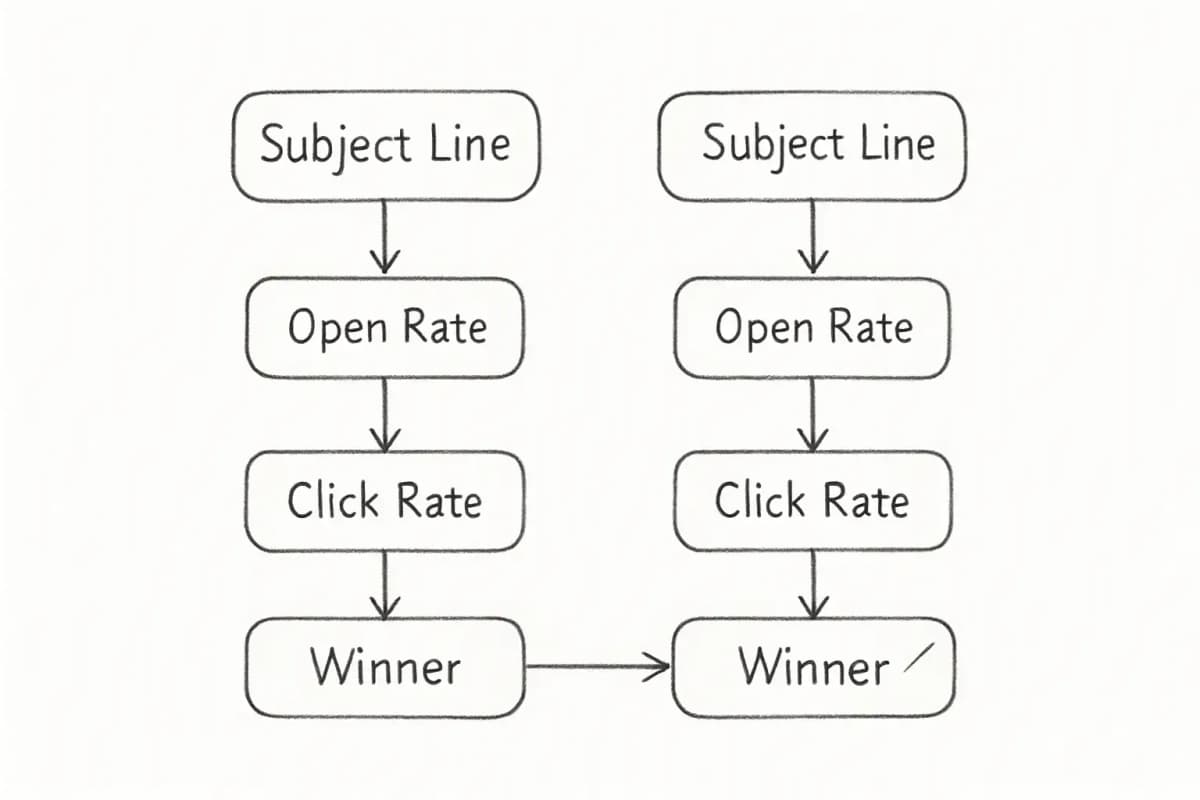
Email marketing A/B testing is the process of sending two versions of an email to a small segment of your audience to determine which performs better. By testing variables like subject lines, CTAs, and design elements, you can make data-driven decisions to optimize future campaigns.
Test one element at a time. Subject lines first, then send times, then body copy, then CTAs. A common challenge in A/B testing is testing too many things at once and not being able to isolate variables. It is tempting to test everything, but this strategy is not effective if you want to really answer the core question of how to improve your email marketing.
Metrics to track:
Clicks, conversions, replies, and revenue are better metrics of success than open rates. With Apple MPP inflating open rate data, shift your attention to click-through rate (CTR), conversion rate, revenue per email, and list churn.
How many emails can I send in a mass email campaign?
There is no universal cap, but your sending volume should match your sender reputation. To ensure consistent delivery and establish a positive reputation with email inbox providers, you should gradually ramp up the volume and frequency of the emails you send. If you have a large, well-maintained list with strong engagement history, you can send at high volume. If you are starting fresh or switching to a new domain or IP, start small and scale over 30 to 60 days.
What is the best time to send mass marketing emails?
Send time depends on your audience, but data offers a useful starting point. MailerLite's email send time study found that emails sent between 3 PM and 7 PM get the most opens. Email campaigns also see the highest open rates shortly after sending: 21.2% of all email opens happen within the first hour. Use send-time optimization tools to deliver at the right moment for each subscriber, and A/B test timing within your own list to find what works for your audience specifically.
How do I avoid my mass emails going to spam?
Mass email is not a "set it and forget it" activity. The teams generating the best returns treat their programs as systems that improve over time.
Automation:
Setting up automated email sequences, such as a welcome series for new subscribers or follow-up emails after a purchase, can keep customers engaged and drive conversions. Automated workflows generate 30x higher returns compared to one-off email campaigns.
A/B testing:
Email marketing A/B testing is the process of sending two versions of an email to a small segment of your audience to determine which performs better. By testing variables like subject lines, CTAs, and design elements, you can make data-driven decisions to optimize future campaigns.
Test one element at a time. Subject lines first, then send times, then body copy, then CTAs. A common challenge in A/B testing is testing too many things at once and not being able to isolate variables. It is tempting to test everything, but this strategy is not effective if you want to really answer the core question of how to improve your email marketing.
Metrics to track:
Clicks, conversions, replies, and revenue are better metrics of success than open rates. With Apple MPP inflating open rate data, shift your attention to click-through rate (CTR), conversion rate, revenue per email, and list churn.
How many emails can I send in a mass email campaign?
There is no universal cap, but your sending volume should match your sender reputation. To ensure consistent delivery and establish a positive reputation with email inbox providers, you should gradually ramp up the volume and frequency of the emails you send. If you have a large, well-maintained list with strong engagement history, you can send at high volume. If you are starting fresh or switching to a new domain or IP, start small and scale over 30 to 60 days.
What is the best time to send mass marketing emails?
Send time depends on your audience, but data offers a useful starting point. MailerLite's email send time study found that emails sent between 3 PM and 7 PM get the most opens. Email campaigns also see the highest open rates shortly after sending: 21.2% of all email opens happen within the first hour. Use send-time optimization tools to deliver at the right moment for each subscriber, and A/B test timing within your own list to find what works for your audience specifically.
How do I avoid my mass emails going to spam?
Focus on the fundamentals: set up SPF, DKIM, and DMARC authentication on your sending domain; build your list through genuine opt-in; maintain list hygiene by removing hard bounces and inactive subscribers; keep spam complaint rates below 0.1%; and send content that is relevant to each segment. A positive sender reputation signals to mailbox providers that the sender is legitimate and trustworthy, resulting in higher chances of successful email delivery. A poor reputation can lead to emails being filtered out, undelivered, or marked as spam.
Do I need different tools for mass email versus regular email?
Yes. A regular email client such as Gmail or Yahoo Mail is not enough for business communication because you do not get metrics such as opens, bounces, and click-through rate, and it does not scale to send tens of thousands or millions of messages at once. You need a dedicated email service provider (ESP) such as Mailchimp, Klaviyo, HubSpot, Brevo, or a similar platform built to handle bulk sending, deliverability monitoring, list management, and campaign analytics.
No comments yet. Be the first!
Focus on the fundamentals: set up SPF, DKIM, and DMARC authentication on your sending domain; build your list through genuine opt-in; maintain list hygiene by removing hard bounces and inactive subscribers; keep spam complaint rates below 0.1%; and send content that is relevant to each segment. A positive sender reputation signals to mailbox providers that the sender is legitimate and trustworthy, resulting in higher chances of successful email delivery. A poor reputation can lead to emails being filtered out, undelivered, or marked as spam.
Do I need different tools for mass email versus regular email?
Yes. A regular email client such as Gmail or Yahoo Mail is not enough for business communication because you do not get metrics such as opens, bounces, and click-through rate, and it does not scale to send tens of thousands or millions of messages at once. You need a dedicated email service provider (ESP) such as Mailchimp, Klaviyo, HubSpot, Brevo, or a similar platform built to handle bulk sending, deliverability monitoring, list management, and campaign analytics.