Most business teams track opens and clicks but rarely connect those numbers to revenue. That gap is where most email programs lose money. If you want to know how to improve email marketing metrics that actually matter, the answer is not one tactic but a combination of six areas: list quality, subject lines, segmentation, personalization, deliverability, and automation. Address all six, and your metrics will compound.
Key Takeaways
Email delivers an average ROI of $36 for every $1 spent. Improving your core metrics moves that number up, not sideways.
47% of people open emails based on the subject line alone. Your subject line is the single highest-leverage place to start.
Segmented email campaigns drive 30% more opens and 50% more click-throughs than non-segmented ones.
Automated emails generate 320% more revenue than non-automated emails. Behavioral triggers outperform batch sends by a wide margin.
According to Validity's 2025 Email Deliverability Benchmark Report, one in six legitimate marketing emails now fails to reach the inbox, with global inbox placement rates declining to 83.5% in 2024. Deliverability is not a technical side note; it is a revenue issue.
1. Understand Your Benchmarks Before You Optimize
You cannot improve what you do not measure in context. Email marketing benchmarks vary by industry, and a "good" open rate or click-through rate in one industry may be average or even weak in another.
Email marketing benchmarks are industry standards that help businesses measure the success of their campaigns by comparing key performance metrics to average engagement rates. Common benchmarks include open rates, click-through rates, bounce rates, unsubscribe rates, and conversion rates.
As a starting point: the average open rate across industries is 32.55% (Constant Contact, 2024), and the average click-through rate is 2.03% (Constant Contact, 2024). However, email marketing initiatives in 2025 often aim for a click-through rate of 2% to 5%, depending on business type and email type.
One important caveat on open rates: open rate is no longer a fully reliable engagement metric. Apple Mail Privacy Protection can register emails as opened even if the recipient never reads them, which can inflate open rates, especially for audiences using Apple Mail. Because of this, open rate works best as a directional metric. Use it to track trends over time, not to measure true interest or content performance.
Most business teams track opens and clicks but rarely connect those numbers to revenue. That gap is where most email programs lose money. If you want to know how to improve email marketing metrics that actually matter, the answer is not one tactic but a combination of six areas: list quality, subject lines, segmentation, personalization, deliverability, and automation. Address all six, and your metrics will compound.
Key Takeaways
Email delivers an average ROI of $36 for every $1 spent. Improving your core metrics moves that number up, not sideways.
47% of people open emails based on the subject line alone. Your subject line is the single highest-leverage place to start.
Segmented email campaigns drive 30% more opens and 50% more click-throughs than non-segmented ones.
Automated emails generate 320% more revenue than non-automated emails. Behavioral triggers outperform batch sends by a wide margin.
According to Validity's 2025 Email Deliverability Benchmark Report, one in six legitimate marketing emails now fails to reach the inbox, with global inbox placement rates declining to 83.5% in 2024. Deliverability is not a technical side note; it is a revenue issue.
1. Understand Your Benchmarks Before You Optimize
You cannot improve what you do not measure in context. Email marketing benchmarks vary by industry, and a "good" open rate or click-through rate in one industry may be average or even weak in another.
Email marketing benchmarks are industry standards that help businesses measure the success of their campaigns by comparing key performance metrics to average engagement rates. Common benchmarks include open rates, click-through rates, bounce rates, unsubscribe rates, and conversion rates.
As a starting point: the average open rate across industries is 32.55% (Constant Contact, 2024), and the average click-through rate is 2.03% (Constant Contact, 2024). However, email marketing initiatives in 2025 often aim for a click-through rate of 2% to 5%, depending on business type and email type.
One important caveat on open rates: open rate is no longer a fully reliable engagement metric. Apple Mail Privacy Protection can register emails as opened even if the recipient never reads them, which can inflate open rates, especially for audiences using Apple Mail. Because of this, open rate works best as a directional metric. Use it to track trends over time, not to measure true interest or content performance.
For a sharper view of performance, prioritize click-to-open rate (CTOR) alongside CTR. Click-through rate (CTR) measures how many recipients click a link out of all deliveries, while click-to-open rate (CTOR) focuses on how many click after opening. Together, they give a more complete picture of engagement: open rate shows attention, CTR measures reach, and CTOR reflects how effectively the content drives action once opened.
Poor list hygiene silently kills every other metric. In 2024, 9% of subscribers unsubscribed and 7% became non-deliverable due to bouncing. That's roughly 16% annual list loss before any growth effort. Only 35% of marketers regularly delete unengaged subscribers, and retaining inactive contacts inflates list size numbers while quietly dragging down open rates and deliverability scores.
People change jobs, unsubscribe, and stop checking old email addresses. Scrubbing your email list helps you focus your marketing efforts on the people who can actually turn into customers. It improves your open and click-through rates.
On the technical side, email authentication is now a requirement, not a recommendation. Before February 2024, email authentication was a best practice. After it, authentication became a prerequisite for delivery to the world's largest mailbox providers: Gmail (2.5 billion users) requires bulk senders to implement SPF, DKIM, and DMARC. Following Google and Yahoo's 2024 rollout of bulk sender requirements, Microsoft introduced its own email authentication rules for high-volume senders targeting Outlook.com domains, with businesses sending more than 5,000 emails a day required to comply or risk having messages throttled, sent to spam, or blocked entirely.
Fully authenticated domains (SPF, DKIM, and DMARC) achieve a 2.7x higher likelihood of inbox placement compared to unauthenticated emails.
Beyond authentication, keep your spam complaint rate in check. Yahoo and Google sender requirements stipulate a 0.3% threshold for spam complaint rate. However, it is strongly suggested that bulk senders keep their spam complaint rate below 0.1%.
Steps to protect deliverability:
Set up SPF, DKIM, and DMARC on your sending domain.
Remove hard bounces after every send.
Run re-engagement campaigns before deleting inactive subscribers.
Keep your spam complaint rate below 0.1%.
Use double opt-in for new subscribers where possible.
3. Write Subject Lines That Earn the Open
Your subject line is the single most important factor in determining whether your email gets opened or ignored. This is where most teams can see a fast, measurable improvement.
For a sharper view of performance, prioritize click-to-open rate (CTOR) alongside CTR. Click-through rate (CTR) measures how many recipients click a link out of all deliveries, while click-to-open rate (CTOR) focuses on how many click after opening. Together, they give a more complete picture of engagement: open rate shows attention, CTR measures reach, and CTOR reflects how effectively the content drives action once opened.
Poor list hygiene silently kills every other metric. In 2024, 9% of subscribers unsubscribed and 7% became non-deliverable due to bouncing. That's roughly 16% annual list loss before any growth effort. Only 35% of marketers regularly delete unengaged subscribers, and retaining inactive contacts inflates list size numbers while quietly dragging down open rates and deliverability scores.
People change jobs, unsubscribe, and stop checking old email addresses. Scrubbing your email list helps you focus your marketing efforts on the people who can actually turn into customers. It improves your open and click-through rates.
On the technical side, email authentication is now a requirement, not a recommendation. Before February 2024, email authentication was a best practice. After it, authentication became a prerequisite for delivery to the world's largest mailbox providers: Gmail (2.5 billion users) requires bulk senders to implement SPF, DKIM, and DMARC. Following Google and Yahoo's 2024 rollout of bulk sender requirements, Microsoft introduced its own email authentication rules for high-volume senders targeting Outlook.com domains, with businesses sending more than 5,000 emails a day required to comply or risk having messages throttled, sent to spam, or blocked entirely.
Fully authenticated domains (SPF, DKIM, and DMARC) achieve a 2.7x higher likelihood of inbox placement compared to unauthenticated emails.
Beyond authentication, keep your spam complaint rate in check. Yahoo and Google sender requirements stipulate a 0.3% threshold for spam complaint rate. However, it is strongly suggested that bulk senders keep their spam complaint rate below 0.1%.
Steps to protect deliverability:
Set up SPF, DKIM, and DMARC on your sending domain.
Remove hard bounces after every send.
Run re-engagement campaigns before deleting inactive subscribers.
Keep your spam complaint rate below 0.1%.
Use double opt-in for new subscribers where possible.
3. Write Subject Lines That Earn the Open
Your subject line is the single most important factor in determining whether your email gets opened or ignored. This is where most teams can see a fast, measurable improvement.
Personalization in email messages improves open rates by 29% and click-through rates by 41%. Personalized subject lines increase email open rates by 26%.
The email subject line length that yields the highest open rates is between 30 to 35 characters, including spaces. Keeping subject lines short also protects visibility on mobile, where truncation is common.
What to test in your subject lines:
Personalization: Use the subscriber's first name, company, or a recent behavior.
Specificity: Numbers and clear outcomes outperform vague teasers.
Urgency: Time-limited offers drive faster opens but should not be overused.
A/B testing: Regularly A/B test different variations to see exactly what resonates with your audience and drives higher open rates.
For a structured framework covering subject line length, tone, and testing cadence, read our post on Email Subject Line Best Practices That Boost Open Rates by 27%.
4. Segment Your List to Lift Every Core Metric
Segmentation is consistently the highest-impact lever available to email marketers. Segmented and personalized emails generate 58% of all revenue. Segmented email lists are associated with a 760% increase in revenue, making it the single highest-impact tactical lever in email marketing.
The business case is straightforward. According to an email marketing survey from HubSpot, 65% of marketers say their segmented emails have better open rates. Segmenting your email list makes your messages more relevant to your audience and can significantly improve open rates, with segmented email campaigns driving 30% more opens and 50% more click-throughs than unsegmented ones.
Effective segmentation categories to start with:
Behavioral: Recent clicks, purchases, or page visits.
Engagement level: Active, inactive, or lapsed subscribers.
Lifecycle stage: New subscribers, loyal customers, or win-back candidates.
Demographics: Location, role, or age group where relevant to your offer.
According to Campaign Monitor, 74% of online consumers get frustrated when content like offers, ads, and promotions are not aligned with their interests. Segmentation directly solves that problem.
Personalization in email messages improves open rates by 29% and click-through rates by 41%. Personalized subject lines increase email open rates by 26%.
The email subject line length that yields the highest open rates is between 30 to 35 characters, including spaces. Keeping subject lines short also protects visibility on mobile, where truncation is common.
What to test in your subject lines:
Personalization: Use the subscriber's first name, company, or a recent behavior.
Specificity: Numbers and clear outcomes outperform vague teasers.
Urgency: Time-limited offers drive faster opens but should not be overused.
A/B testing: Regularly A/B test different variations to see exactly what resonates with your audience and drives higher open rates.
For a structured framework covering subject line length, tone, and testing cadence, read our post on Email Subject Line Best Practices That Boost Open Rates by 27%.
4. Segment Your List to Lift Every Core Metric
Segmentation is consistently the highest-impact lever available to email marketers. Segmented and personalized emails generate 58% of all revenue. Segmented email lists are associated with a 760% increase in revenue, making it the single highest-impact tactical lever in email marketing.
The business case is straightforward. According to an email marketing survey from HubSpot, 65% of marketers say their segmented emails have better open rates. Segmenting your email list makes your messages more relevant to your audience and can significantly improve open rates, with segmented email campaigns driving 30% more opens and 50% more click-throughs than unsegmented ones.
Effective segmentation categories to start with:
Behavioral: Recent clicks, purchases, or page visits.
Engagement level: Active, inactive, or lapsed subscribers.
Lifecycle stage: New subscribers, loyal customers, or win-back candidates.
Demographics: Location, role, or age group where relevant to your offer.
According to Campaign Monitor, 74% of online consumers get frustrated when content like offers, ads, and promotions are not aligned with their interests. Segmentation directly solves that problem.
Personalization works at a different layer than segmentation. Segmentation is one-to-many; personalization is one-to-one. Both improve email marketing metrics, and the best programs combine them.
Personalized emails have been shown to deliver six times more transactions than generic, non-personalized ones. Data shows that companies that invest in personalizing email outreach earn 40% more than their competitors.
71% of consumers expect personalized interactions from brands, and 76% get frustrated when their brand interactions aren't personalized to their interests.
Personalization tactics that move metrics:
Dynamic content blocks: Show different product recommendations or offers based on past behavior.
Behavioral triggers: Send emails based on what a subscriber just did, not on a fixed calendar.
Lifecycle-relevant messaging: New subscriber emails should look and read differently from re-engagement emails.
Purchase history targeting: When Virgin used subscriber data to personalize the images within their email, they increased their click-through rate by 29%.
Open rates often see 20 to 25% improvements with personalized subject lines, while click-through rates commonly increase by 10 to 15% when content is tailored to individual preferences. Conversion rates frequently show the most dramatic improvements, with personalized product recommendations and targeted offers driving 15 to 30% increases in purchases.
For real-world examples of how personalization techniques translate into measurable outcomes, see 7 Email Personalization Techniques That Boost Conversions 47%.
6. Build Automation Flows That Work While You Sleep
Automated flows like abandoned cart or post-purchase messages generate up to 30x more revenue per recipient than campaigns because they are so timely and targeted.
In 2024, automated emails drove 37% of all email-generated sales, despite accounting for just 2% of email volume. That is a remarkable efficiency gap that most teams leave on the table.
Welcome email workflows have the highest click-to-conversion rate (58.26%). Abandoned cart (42.02%) and back-in-stock (27.45%) automations round out the top three.
Core automated flows to build first:
Welcome sequence: A welcome email sent to new subscribers upon joining a mailing list achieves an impressive average open rate of 82%. This is your highest-engagement window.
Abandoned cart: Abandoned cart email campaigns have an open rate of 50.50%. Businesses also earn an average of $3.45 in revenue per abandoned cart email recipient.
Post-purchase: Drives repeat purchases and reduces churn.
Re-engagement: Identifies and either reactivates or removes inactive subscribers.
Companies with email automation see 80% higher engagement rates. Automation is not a shortcut; it is the baseline for a competitive email program in 2025.
7. Optimize Send Timing and Frequency
Personalization works at a different layer than segmentation. Segmentation is one-to-many; personalization is one-to-one. Both improve email marketing metrics, and the best programs combine them.
Personalized emails have been shown to deliver six times more transactions than generic, non-personalized ones. Data shows that companies that invest in personalizing email outreach earn 40% more than their competitors.
71% of consumers expect personalized interactions from brands, and 76% get frustrated when their brand interactions aren't personalized to their interests.
Personalization tactics that move metrics:
Dynamic content blocks: Show different product recommendations or offers based on past behavior.
Behavioral triggers: Send emails based on what a subscriber just did, not on a fixed calendar.
Lifecycle-relevant messaging: New subscriber emails should look and read differently from re-engagement emails.
Purchase history targeting: When Virgin used subscriber data to personalize the images within their email, they increased their click-through rate by 29%.
Open rates often see 20 to 25% improvements with personalized subject lines, while click-through rates commonly increase by 10 to 15% when content is tailored to individual preferences. Conversion rates frequently show the most dramatic improvements, with personalized product recommendations and targeted offers driving 15 to 30% increases in purchases.
For real-world examples of how personalization techniques translate into measurable outcomes, see 7 Email Personalization Techniques That Boost Conversions 47%.
6. Build Automation Flows That Work While You Sleep
Automated flows like abandoned cart or post-purchase messages generate up to 30x more revenue per recipient than campaigns because they are so timely and targeted.
In 2024, automated emails drove 37% of all email-generated sales, despite accounting for just 2% of email volume. That is a remarkable efficiency gap that most teams leave on the table.
Welcome email workflows have the highest click-to-conversion rate (58.26%). Abandoned cart (42.02%) and back-in-stock (27.45%) automations round out the top three.
Core automated flows to build first:
Welcome sequence: A welcome email sent to new subscribers upon joining a mailing list achieves an impressive average open rate of 82%. This is your highest-engagement window.
Abandoned cart: Abandoned cart email campaigns have an open rate of 50.50%. Businesses also earn an average of $3.45 in revenue per abandoned cart email recipient.
Post-purchase: Drives repeat purchases and reduces churn.
Re-engagement: Identifies and either reactivates or removes inactive subscribers.
Companies with email automation see 80% higher engagement rates. Automation is not a shortcut; it is the baseline for a competitive email program in 2025.
7. Optimize Send Timing and Frequency
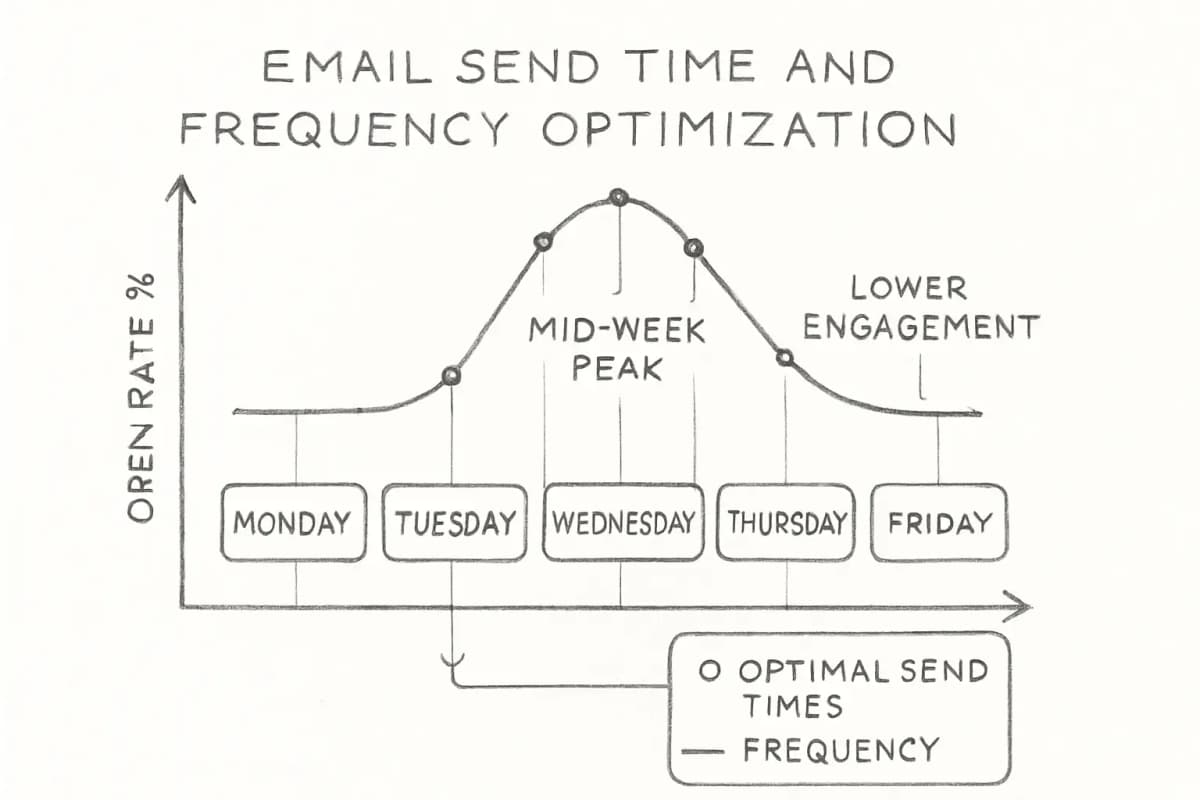
Timing affects deliverability signals, not just opens. Target mid-week sends: aim to send your most important emails Tuesday through Thursday for maximum engagement, with Tuesday having the slight advantage. Schedule emails to land in inboxes early morning, around 9 to 10 AM, to catch the first engagement wave of the day.
On frequency: sending 5 to 8 emails per month shows the highest ROI, at about $48 per $1 spent. However, frequency should match audience expectations set at sign-up. Sudden spikes in volume damage sender reputation, while consistent sending builds it.
A good unsubscribe rate for email marketing is below 0.5%. Anything under 0.2% is considered excellent. If your unsubscribe rate climbs above 0.5%, your frequency or content relevance needs attention, not just your subject lines.
8. Test Continuously and Track the Right Numbers
Metrics only improve through iteration. A/B testing consistently improves conversion outcomes, with documented ROI improvements of up to 37%.
Test CTR improvements continuously through A/B testing, but allow enough time for statistical significance. For email campaigns, test one element per campaign and run tests for at least a week or 1,000 opens.
Elements worth testing in order of impact:
Subject line (personalization, length, tone, specificity)
Send time and day
Call-to-action copy and placement
Email length and content format
Sender name and preheader text
Instead of relying solely on open rates, evaluate other indicators such as click-through rates, conversion rates, and ROI. These metrics offer a more comprehensive view of your email marketing performance.
Frequently Asked Questions
What is a good open rate for email marketing?
The average open rate across industries is 32.55% (Constant Contact, 2024). However, benchmarks vary significantly by industry. A 30% open rate is generally considered solid performance across most industries and suggests healthy engagement with your audience. Note that Apple Mail Privacy Protection inflates open rate data for some audiences, so track directional trends over time rather than treating open rate as an absolute measure.
How do I improve my email click-through rate?
Timing affects deliverability signals, not just opens. Target mid-week sends: aim to send your most important emails Tuesday through Thursday for maximum engagement, with Tuesday having the slight advantage. Schedule emails to land in inboxes early morning, around 9 to 10 AM, to catch the first engagement wave of the day.
On frequency: sending 5 to 8 emails per month shows the highest ROI, at about $48 per $1 spent. However, frequency should match audience expectations set at sign-up. Sudden spikes in volume damage sender reputation, while consistent sending builds it.
A good unsubscribe rate for email marketing is below 0.5%. Anything under 0.2% is considered excellent. If your unsubscribe rate climbs above 0.5%, your frequency or content relevance needs attention, not just your subject lines.
8. Test Continuously and Track the Right Numbers
Metrics only improve through iteration. A/B testing consistently improves conversion outcomes, with documented ROI improvements of up to 37%.
Test CTR improvements continuously through A/B testing, but allow enough time for statistical significance. For email campaigns, test one element per campaign and run tests for at least a week or 1,000 opens.
Elements worth testing in order of impact:
Subject line (personalization, length, tone, specificity)
Send time and day
Call-to-action copy and placement
Email length and content format
Sender name and preheader text
Instead of relying solely on open rates, evaluate other indicators such as click-through rates, conversion rates, and ROI. These metrics offer a more comprehensive view of your email marketing performance.
Frequently Asked Questions
What is a good open rate for email marketing?
The average open rate across industries is 32.55% (Constant Contact, 2024). However, benchmarks vary significantly by industry. A 30% open rate is generally considered solid performance across most industries and suggests healthy engagement with your audience. Note that Apple Mail Privacy Protection inflates open rate data for some audiences, so track directional trends over time rather than treating open rate as an absolute measure.
How do I improve my email click-through rate?
Email personalization is the best way to improve your CTR, because it allows you to offer your audience a curated experience with your brand that caters to them on an individual level. Beyond that, use a single, clear call-to-action per email, keep design clean and mobile-friendly, and test your copy. When text in a call-to-action button is changed from second-person to first-person viewpoint, clicks improve by 90%. Including a call-to-action button instead of a text link can increase conversion rates by up to 28%.
Why is my email deliverability dropping?
The most common causes are missing authentication (SPF, DKIM, DMARC not configured), high bounce rates from unclean lists, and spam complaint rates above 0.1%. Factors affecting deliverability include sender reputation, email content quality, recipient engagement, list hygiene, authentication protocols, and bounce rates. Check Google Postmaster Tools and Microsoft SNDS first to identify which factor is affecting your inbox placement.
How often should I send marketing emails?
The majority of marketers send 1 to 2 newsletters per week, and this approach produces good results overall, with open rates reaching 4.3% and click-through rates reaching 5.7%. Sending 2 newsletters per week is considered optimal if you want to maintain high open and click-through rates. However, the right frequency depends on your audience, your content value, and the expectations you set when subscribers signed up. Test frequency changes carefully and monitor unsubscribe rates closely.
No comments yet. Be the first!
Email personalization is the best way to improve your CTR, because it allows you to offer your audience a curated experience with your brand that caters to them on an individual level. Beyond that, use a single, clear call-to-action per email, keep design clean and mobile-friendly, and test your copy. When text in a call-to-action button is changed from second-person to first-person viewpoint, clicks improve by 90%. Including a call-to-action button instead of a text link can increase conversion rates by up to 28%.
Why is my email deliverability dropping?
The most common causes are missing authentication (SPF, DKIM, DMARC not configured), high bounce rates from unclean lists, and spam complaint rates above 0.1%. Factors affecting deliverability include sender reputation, email content quality, recipient engagement, list hygiene, authentication protocols, and bounce rates. Check Google Postmaster Tools and Microsoft SNDS first to identify which factor is affecting your inbox placement.
How often should I send marketing emails?
The majority of marketers send 1 to 2 newsletters per week, and this approach produces good results overall, with open rates reaching 4.3% and click-through rates reaching 5.7%. Sending 2 newsletters per week is considered optimal if you want to maintain high open and click-through rates. However, the right frequency depends on your audience, your content value, and the expectations you set when subscribers signed up. Test frequency changes carefully and monitor unsubscribe rates closely.