Keep customers coming back with proven email strategies. Learn segmentation, automation, and messaging tactics that reduce churn and boost lifetime value.
Keep customers coming back with proven email strategies. Learn segmentation, automation, and messaging tactics that reduce churn and boost lifetime value.
Retaining a customer costs far less than acquiring a new one. According to Bain & Company, increasing customer retention by just 5% can increase profits by 25 to 95%, and it costs 5 to 7 times more to acquire a new customer than to keep an existing one. So if your marketing budget is heavy on acquisition and light on retention, you are leaving significant revenue on the table.
Email is the most cost-effective tool you have to close that gap. 80% of small and midsized businesses say that email marketing is their most important online tool for customer retention. The channel gives you direct, owned access to your customers, no algorithm standing between your message and their inbox.
This guide shows you exactly how to use email marketing for customer retention, from the post-purchase sequence that starts the relationship on solid footing, to the segmented win-back campaigns that pull back lapsed customers before you lose them for good.
Key Takeaways
A 5% increase in retention can grow profits by 25 to 95%, and retaining customers costs 5 to 7 times less than acquiring new ones.
80% of marketers say email is more important than social media for customer retention.
60% of shoppers returned to complete their purchase after receiving a personalized abandoned cart email, and 80% of business professionals believe email marketing increases customer retention.
Lifecycle automation improves open rates by 83.4%, click rates by 341.1%, and conversion rates by 2,270% compared to broadcast campaigns.
Companies using RFM analysis for email personalization achieve 10 to 30% increases in customer retention rates.
Why Email Outperforms Other Channels for Retention
Paid social, retargeting ads, and SMS all have a role to play, but none of them match email when it comes to long-term customer retention. The core reason is ownership: your email list is a first-party asset. Unlike social media reach, it does not depend on platform algorithms or ad spend.
Retaining a customer costs far less than acquiring a new one. According to Bain & Company, increasing customer retention by just 5% can increase profits by 25 to 95%, and it costs 5 to 7 times more to acquire a new customer than to keep an existing one. So if your marketing budget is heavy on acquisition and light on retention, you are leaving significant revenue on the table.
Email is the most cost-effective tool you have to close that gap. 80% of small and midsized businesses say that email marketing is their most important online tool for customer retention. The channel gives you direct, owned access to your customers, no algorithm standing between your message and their inbox.
This guide shows you exactly how to use email marketing for customer retention, from the post-purchase sequence that starts the relationship on solid footing, to the segmented win-back campaigns that pull back lapsed customers before you lose them for good.
Key Takeaways
A 5% increase in retention can grow profits by 25 to 95%, and retaining customers costs 5 to 7 times less than acquiring new ones.
80% of marketers say email is more important than social media for customer retention.
60% of shoppers returned to complete their purchase after receiving a personalized abandoned cart email, and 80% of business professionals believe email marketing increases customer retention.
Lifecycle automation improves open rates by 83.4%, click rates by 341.1%, and conversion rates by 2,270% compared to broadcast campaigns.
Companies using RFM analysis for email personalization achieve 10 to 30% increases in customer retention rates.
Why Email Outperforms Other Channels for Retention
Paid social, retargeting ads, and SMS all have a role to play, but none of them match email when it comes to long-term customer retention. The core reason is ownership: your email list is a first-party asset. Unlike social media reach, it does not depend on platform algorithms or ad spend.
Consumers also prefer email for brand interactions. A June 2024 survey reveals 69% of consumers worldwide want brands to contact them through email. Consumers spend 32% more and are 40% more likely to make repeat purchases from brands that use their preferred communication channels.
Email is one of the most efficient channels for gaining and keeping customers. Email marketing delivers strong ROI because it combines direct audience access, low distribution costs, and the ability to personalize at scale. Retention and lifecycle campaigns produce stronger long-term returns than acquisition campaigns.
The numbers reflect this consistently. Email marketing is used most for lead generation (85%), sales (84%), lead nurturing (78%), and customer retention (74%). Retention is where the long-term revenue lives.
Build a Post-Purchase Email Sequence That Retains From Day One
The period immediately after a purchase is your highest-leverage window for retention. The customer is engaged, their purchase is fresh, and they are open to further communication. Most businesses waste this moment with a generic order confirmation and nothing else.
According to research by Klaviyo, post-purchase email automation can yield up to 30 times more income per recipient than campaigns due to their timely and tailored nature, generating open rates 17% higher than the average email automation.
A well-structured post-purchase sequence does more than confirm the order. The eight most effective post-purchase email types are order confirmations, shipping notifications, delivery confirmations, thank-you messages, educational how-to emails, loyalty program invitations, referral requests, and cross-sell or upsell recommendations.
Here is how to sequence them effectively:
Order confirmation (immediately): Confirm the purchase, reassure the customer, and set clear expectations.
Shipping update (when dispatched): Reduce anxiety and keep the customer informed.
Educational email (days 3 to 7 post-delivery): Show them how to get maximum value from what they bought.
Loyalty program invite (day 10 to 14): The period following a purchase is the perfect time to promote your brand loyalty or rewards program. Demonstrating to customers that they can earn rewards the more they shop incentivizes them to return.
Review request (day 14 to 21): Follow up for reviews 1 to 2 weeks post-delivery, and offer product suggestions after customers have used their purchase.
Cross-sell or replenishment email (30 to 45 days): Recommend complementary products based on what they bought.
Automated post-purchase emails covering order confirmations, tips, and support reduce 90-day churn by 14%. That single automation can meaningfully shift your retention numbers.
Consumers also prefer email for brand interactions. A June 2024 survey reveals 69% of consumers worldwide want brands to contact them through email. Consumers spend 32% more and are 40% more likely to make repeat purchases from brands that use their preferred communication channels.
Email is one of the most efficient channels for gaining and keeping customers. Email marketing delivers strong ROI because it combines direct audience access, low distribution costs, and the ability to personalize at scale. Retention and lifecycle campaigns produce stronger long-term returns than acquisition campaigns.
The numbers reflect this consistently. Email marketing is used most for lead generation (85%), sales (84%), lead nurturing (78%), and customer retention (74%). Retention is where the long-term revenue lives.
Build a Post-Purchase Email Sequence That Retains From Day One
The period immediately after a purchase is your highest-leverage window for retention. The customer is engaged, their purchase is fresh, and they are open to further communication. Most businesses waste this moment with a generic order confirmation and nothing else.
According to research by Klaviyo, post-purchase email automation can yield up to 30 times more income per recipient than campaigns due to their timely and tailored nature, generating open rates 17% higher than the average email automation.
A well-structured post-purchase sequence does more than confirm the order. The eight most effective post-purchase email types are order confirmations, shipping notifications, delivery confirmations, thank-you messages, educational how-to emails, loyalty program invitations, referral requests, and cross-sell or upsell recommendations.
Here is how to sequence them effectively:
Order confirmation (immediately): Confirm the purchase, reassure the customer, and set clear expectations.
Shipping update (when dispatched): Reduce anxiety and keep the customer informed.
Educational email (days 3 to 7 post-delivery): Show them how to get maximum value from what they bought.
Loyalty program invite (day 10 to 14): The period following a purchase is the perfect time to promote your brand loyalty or rewards program. Demonstrating to customers that they can earn rewards the more they shop incentivizes them to return.
Review request (day 14 to 21): Follow up for reviews 1 to 2 weeks post-delivery, and offer product suggestions after customers have used their purchase.
Cross-sell or replenishment email (30 to 45 days): Recommend complementary products based on what they bought.
Automated post-purchase emails covering order confirmations, tips, and support reduce 90-day churn by 14%. That single automation can meaningfully shift your retention numbers.
Segment Your List to Send Emails Customers Actually Want
Sending the same email to your entire list is one of the fastest ways to drive unsubscribes. Retention depends on relevance, and relevance depends on segmentation.
Segmentation in retention emails enables customers to succeed with a product or service by tailoring messaging to their specific needs and preferences. By dividing the customer base into distinct segments based on demographics, behavior, and interests, a business can create more personalized and relevant retention campaigns.
The most reliable segmentation framework for retention is RFM analysis, which evaluates customers across three dimensions:
Recency: How recently they made a purchase
Frequency: How often they buy
Monetary: How much they spend
Companies using RFM analysis for email personalization achieve 10 to 30% increases in customer retention rates, directly impacting long-term revenue per customer.
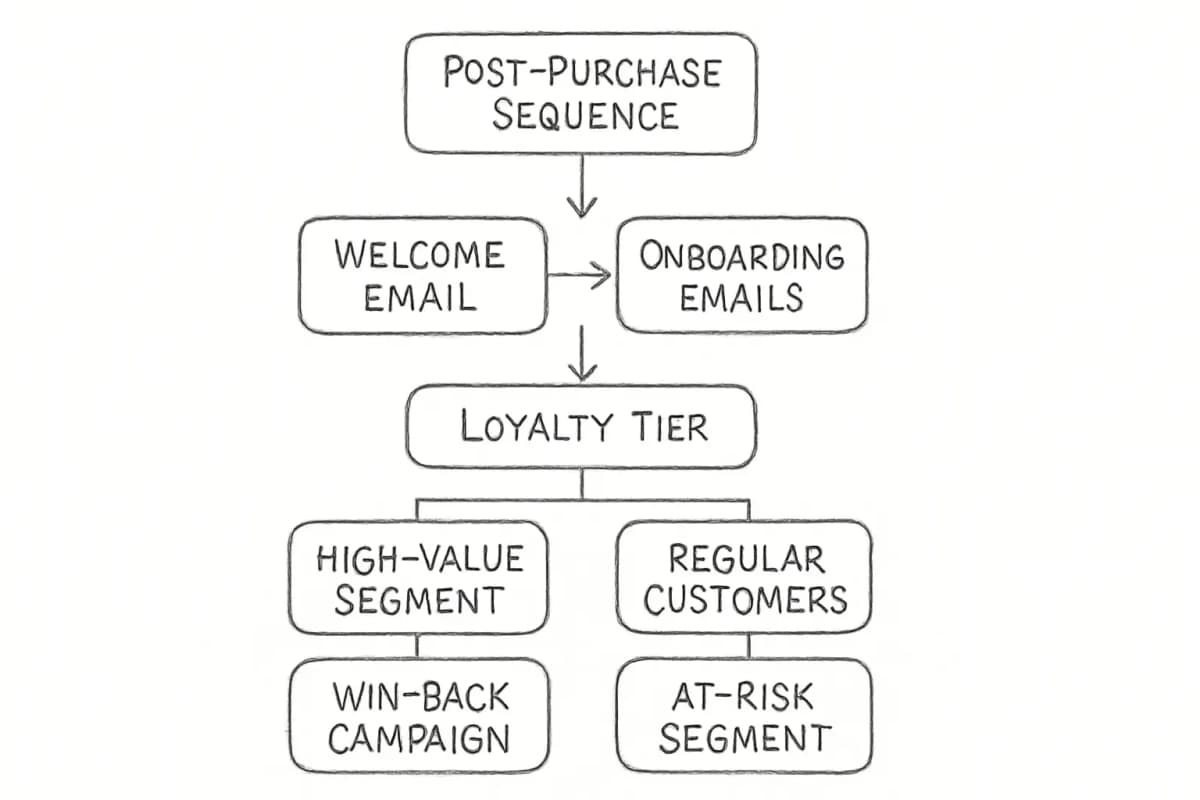
In practice, RFM segmentation lets you send targeted loyalty rewards to your highest-value customers, re-engagement sequences to those who have gone quiet, and win-back campaigns to those who are close to churning. The deeper power of RFM analysis is that it lets you stay ahead of churn. With an "at risk" segment, you can send multi-step messaging when a customer is close to churning but has not yet, ultimately reducing the need for reactive win-back campaigns.
Personalize at Every Stage of the Customer Lifecycle
Segmentation tells you who to email. Personalization determines what to say. These two work together, and combining them produces measurable retention gains.
Personalized campaigns achieve 29% open rates and 41% click-through rates, and 60% of shoppers returned to complete their purchase after receiving a personalized abandoned cart email.
Personalized email increases repeat purchases by 29%. This goes well beyond inserting a first name in the subject line. Effective personalization includes:
Segment Your List to Send Emails Customers Actually Want
Sending the same email to your entire list is one of the fastest ways to drive unsubscribes. Retention depends on relevance, and relevance depends on segmentation.
Segmentation in retention emails enables customers to succeed with a product or service by tailoring messaging to their specific needs and preferences. By dividing the customer base into distinct segments based on demographics, behavior, and interests, a business can create more personalized and relevant retention campaigns.
The most reliable segmentation framework for retention is RFM analysis, which evaluates customers across three dimensions:
Recency: How recently they made a purchase
Frequency: How often they buy
Monetary: How much they spend
Companies using RFM analysis for email personalization achieve 10 to 30% increases in customer retention rates, directly impacting long-term revenue per customer.
In practice, RFM segmentation lets you send targeted loyalty rewards to your highest-value customers, re-engagement sequences to those who have gone quiet, and win-back campaigns to those who are close to churning. The deeper power of RFM analysis is that it lets you stay ahead of churn. With an "at risk" segment, you can send multi-step messaging when a customer is close to churning but has not yet, ultimately reducing the need for reactive win-back campaigns.
Personalize at Every Stage of the Customer Lifecycle
Segmentation tells you who to email. Personalization determines what to say. These two work together, and combining them produces measurable retention gains.
Personalized campaigns achieve 29% open rates and 41% click-through rates, and 60% of shoppers returned to complete their purchase after receiving a personalized abandoned cart email.
Personalized email increases repeat purchases by 29%. This goes well beyond inserting a first name in the subject line. Effective personalization includes:
Product recommendations based on purchase history
Replenishment reminders timed to when a consumable product runs out
Anniversary or milestone emails tied to the customer's purchase date
Behavior-triggered sequences based on what a subscriber clicked or browsed
The best retention email marketing strategy is to send personalized post-purchase follow-ups that set the stage for the next purchase. You can do this by segmenting customers based on RFM to create a highly personalized and targeted strategy that caters to their unique purchase behaviors.
Customers who receive personalized product recommendations after their first purchase have 26% higher 12-month retention. That single tactic, applied consistently across your post-purchase flow, compounds significantly over time.
For tactical implementation, 7 Email Personalization Techniques That Boost Conversions 47% covers the specific mechanics of personalization at scale.
Run Win-Back Campaigns Before Customers Drift Away
Even well-engaged customers go quiet. The mistake most teams make is waiting too long to act, or not acting at all. A structured win-back campaign addresses this systematically.
According to WinBack Labs, the probability of winning back a previous customer is between 20% and 40%. Once a customer is won back, their lifetime value can double or even triple. In fact, 47% of returning customers generated more revenue after coming back.
Re-engagement email sequences sent at 30, 60, and 90 days recover 6 to 22% of inactive customers, depending on the vertical.
The key to an effective win-back sequence is segmentation. Not every lapsed customer left for the same reason. Not all customers are the same, and they did not all stop shopping for the exact same reasons. Many fall into similar categories that share broad characteristics you can address in your messaging. Common segments include:
Price-sensitive customers who respond to a targeted discount
Customers who had a poor experience and need to hear what has changed
Customers who simply got busy and need a timely, relevant nudge
Loyalty and marketing experts suggest sending 3 to 5 emails in a win-back sequence, with one email sent every 3 to 5 days. If a customer does not re-engage after the full sequence, remove them from active sends to protect deliverability.
Successful win-back campaigns should achieve 20 to 40% reactivation rates. If you are not hitting that range, test your subject lines, offer type, and timing before widening your list.
Use Lifecycle Automation to Keep Retention Running Without Manual Work
Manual campaigns cannot scale. Retention at volume requires automation, specifically behavioral triggers that send the right email when a customer takes a defined action or crosses a defined threshold.
Lifecycle automation improves open rates by 83.4%, click rates by 341.1%, and conversion rates by 2,270%. Companies using advanced lifecycle segmentation show higher customer lifetime value and 20 to 30% lower churn compared to broadcast-only marketers.
Modern email marketing success relies heavily on automation workflows that trigger based on customer behavior and lifecycle stages. Approximately 44% of marketers use lifecycle emails for customer activation, engagement, and retention.
The most impactful automated retention flows to build:
Product recommendations based on purchase history
Replenishment reminders timed to when a consumable product runs out
Anniversary or milestone emails tied to the customer's purchase date
Behavior-triggered sequences based on what a subscriber clicked or browsed
The best retention email marketing strategy is to send personalized post-purchase follow-ups that set the stage for the next purchase. You can do this by segmenting customers based on RFM to create a highly personalized and targeted strategy that caters to their unique purchase behaviors.
Customers who receive personalized product recommendations after their first purchase have 26% higher 12-month retention. That single tactic, applied consistently across your post-purchase flow, compounds significantly over time.
For tactical implementation, 7 Email Personalization Techniques That Boost Conversions 47% covers the specific mechanics of personalization at scale.
Run Win-Back Campaigns Before Customers Drift Away
Even well-engaged customers go quiet. The mistake most teams make is waiting too long to act, or not acting at all. A structured win-back campaign addresses this systematically.
According to WinBack Labs, the probability of winning back a previous customer is between 20% and 40%. Once a customer is won back, their lifetime value can double or even triple. In fact, 47% of returning customers generated more revenue after coming back.
Re-engagement email sequences sent at 30, 60, and 90 days recover 6 to 22% of inactive customers, depending on the vertical.
The key to an effective win-back sequence is segmentation. Not every lapsed customer left for the same reason. Not all customers are the same, and they did not all stop shopping for the exact same reasons. Many fall into similar categories that share broad characteristics you can address in your messaging. Common segments include:
Price-sensitive customers who respond to a targeted discount
Customers who had a poor experience and need to hear what has changed
Customers who simply got busy and need a timely, relevant nudge
Loyalty and marketing experts suggest sending 3 to 5 emails in a win-back sequence, with one email sent every 3 to 5 days. If a customer does not re-engage after the full sequence, remove them from active sends to protect deliverability.
Successful win-back campaigns should achieve 20 to 40% reactivation rates. If you are not hitting that range, test your subject lines, offer type, and timing before widening your list.
Use Lifecycle Automation to Keep Retention Running Without Manual Work
Manual campaigns cannot scale. Retention at volume requires automation, specifically behavioral triggers that send the right email when a customer takes a defined action or crosses a defined threshold.
Lifecycle automation improves open rates by 83.4%, click rates by 341.1%, and conversion rates by 2,270%. Companies using advanced lifecycle segmentation show higher customer lifetime value and 20 to 30% lower churn compared to broadcast-only marketers.
Modern email marketing success relies heavily on automation workflows that trigger based on customer behavior and lifecycle stages. Approximately 44% of marketers use lifecycle emails for customer activation, engagement, and retention.
The most impactful automated retention flows to build:
Welcome series: Sets the tone and reduces early churn. Welcome emails generate 320% more revenue per email than promotional ones.
Post-purchase sequence: Covered above. Runs for 30 to 60 days after each purchase.
Loyalty milestone emails: Trigger when a customer hits a spending tier or anniversary.
Win-back sequence: Triggers after 30, 60, or 90 days of inactivity, depending on your average purchase cycle.
Replenishment reminders: Timed to the likely depletion date of consumable products.
Automated email sequences improve customer retention rates by 10%, drip campaigns see 80% higher open rates than single sends, and triggered emails have a 70.5% higher open rate than regular newsletters.
The goal is to build a system that maintains consistent, relevant communication throughout the customer lifecycle without requiring manual input for every send.
Measure Retention-Specific Email Metrics
Most teams default to open rates and click rates. These metrics are useful for optimizing individual sends, but they do not tell you whether your emails are actually retaining customers. You need a different metric layer for retention.
The metrics that matter most for email-driven retention:
Repeat purchase rate: The share of customers who make a second purchase within a defined window. This is the clearest signal your post-purchase emails are working.
Customer lifetime value (CLV) by email segment: Compare CLV across segments to see whether your personalization and segmentation are driving meaningful differences.
Churn rate by cohort: Track whether customers who receive certain email sequences churn at lower rates than those who do not.
Win-back conversion rate: The percentage of lapsed customers who make a purchase after a re-engagement sequence.
Revenue per recipient (RPR): Total email-attributed revenue divided by the number of recipients. Email helps nurture relationships and increase CLV. Metrics like revenue per contact and revenue per email address are emerging to reflect that contribution across the customer lifecycle.
39% of marketers assess email's impact on customer retention or loyalty as a core performance indicator. If you are not in that group, start tying your email performance data to purchase behavior in your CRM.
Welcome series: Sets the tone and reduces early churn. Welcome emails generate 320% more revenue per email than promotional ones.
Post-purchase sequence: Covered above. Runs for 30 to 60 days after each purchase.
Loyalty milestone emails: Trigger when a customer hits a spending tier or anniversary.
Win-back sequence: Triggers after 30, 60, or 90 days of inactivity, depending on your average purchase cycle.
Replenishment reminders: Timed to the likely depletion date of consumable products.
Automated email sequences improve customer retention rates by 10%, drip campaigns see 80% higher open rates than single sends, and triggered emails have a 70.5% higher open rate than regular newsletters.
The goal is to build a system that maintains consistent, relevant communication throughout the customer lifecycle without requiring manual input for every send.
Measure Retention-Specific Email Metrics
Most teams default to open rates and click rates. These metrics are useful for optimizing individual sends, but they do not tell you whether your emails are actually retaining customers. You need a different metric layer for retention.
The metrics that matter most for email-driven retention:
Repeat purchase rate: The share of customers who make a second purchase within a defined window. This is the clearest signal your post-purchase emails are working.
Customer lifetime value (CLV) by email segment: Compare CLV across segments to see whether your personalization and segmentation are driving meaningful differences.
Churn rate by cohort: Track whether customers who receive certain email sequences churn at lower rates than those who do not.
Win-back conversion rate: The percentage of lapsed customers who make a purchase after a re-engagement sequence.
Revenue per recipient (RPR): Total email-attributed revenue divided by the number of recipients. Email helps nurture relationships and increase CLV. Metrics like revenue per contact and revenue per email address are emerging to reflect that contribution across the customer lifecycle.
39% of marketers assess email's impact on customer retention or loyalty as a core performance indicator. If you are not in that group, start tying your email performance data to purchase behavior in your CRM.
Protect Deliverability to Keep Retention Emails Landing
None of the tactics above work if your emails land in spam. Deliverability is the infrastructure layer that holds your retention strategy together.
76% of unsubscribers say the frequency of emails was the reason they left. Sending too much, or sending irrelevant content to unengaged segments, damages your sender reputation and reduces inbox placement rates for your entire list.
Practical steps to protect deliverability in a retention program:
Suppress disengaged subscribers from active sends after a defined period of inactivity
Use double opt-in for new subscribers to build a cleaner list from the start
Maintain a suppression list and honor unsubscribe requests immediately
Monitor your spam complaint rate and keep it below 0.08%
Avoid sudden large volume spikes; warm up new sending domains gradually
Sending reactivation messages reduces churn by 8 to 14%, but only if they reach the inbox. A degraded sender reputation undermines every win-back and lifecycle campaign you run.
Frequently Asked Questions
What types of emails are most effective for customer retention?
The most effective retention email types are order confirmations, shipping notifications, delivery confirmations, thank-you messages, educational how-to emails, loyalty program invitations, referral requests, and cross-sell or upsell recommendations. Win-back sequences and milestone emails also perform strongly for re-engaging lapsed customers and rewarding loyal ones.
How often should I email existing customers for retention?
There is no universal answer, but 76% of unsubscribers cite email frequency as the reason they opted out, so erring toward relevance over volume is the safer approach. Use behavioral triggers to send emails when customers take actions, rather than on a fixed calendar schedule. Let preference centers give subscribers control over frequency.
How do I measure whether my emails are improving customer retention?
Track repeat purchase rate, customer lifetime value by email segment, cohort-level churn rates, and revenue per recipient. The trend in retention marketing is to link email value to the wider customer lifecycle. Many marketers now think of email ROI in similar terms to customer lifetime value, looking beyond individual campaign returns. Connecting your email platform data to your CRM or e-commerce analytics is essential for this level of measurement.
What is RFM analysis and why does it matter for email retention?
Protect Deliverability to Keep Retention Emails Landing
None of the tactics above work if your emails land in spam. Deliverability is the infrastructure layer that holds your retention strategy together.
76% of unsubscribers say the frequency of emails was the reason they left. Sending too much, or sending irrelevant content to unengaged segments, damages your sender reputation and reduces inbox placement rates for your entire list.
Practical steps to protect deliverability in a retention program:
Suppress disengaged subscribers from active sends after a defined period of inactivity
Use double opt-in for new subscribers to build a cleaner list from the start
Maintain a suppression list and honor unsubscribe requests immediately
Monitor your spam complaint rate and keep it below 0.08%
Avoid sudden large volume spikes; warm up new sending domains gradually
Sending reactivation messages reduces churn by 8 to 14%, but only if they reach the inbox. A degraded sender reputation undermines every win-back and lifecycle campaign you run.
Frequently Asked Questions
What types of emails are most effective for customer retention?
The most effective retention email types are order confirmations, shipping notifications, delivery confirmations, thank-you messages, educational how-to emails, loyalty program invitations, referral requests, and cross-sell or upsell recommendations. Win-back sequences and milestone emails also perform strongly for re-engaging lapsed customers and rewarding loyal ones.
How often should I email existing customers for retention?
There is no universal answer, but 76% of unsubscribers cite email frequency as the reason they opted out, so erring toward relevance over volume is the safer approach. Use behavioral triggers to send emails when customers take actions, rather than on a fixed calendar schedule. Let preference centers give subscribers control over frequency.
How do I measure whether my emails are improving customer retention?
Track repeat purchase rate, customer lifetime value by email segment, cohort-level churn rates, and revenue per recipient. The trend in retention marketing is to link email value to the wider customer lifecycle. Many marketers now think of email ROI in similar terms to customer lifetime value, looking beyond individual campaign returns. Connecting your email platform data to your CRM or e-commerce analytics is essential for this level of measurement.
What is RFM analysis and why does it matter for email retention?
RFM (Recency, Frequency, Monetary) analysis is one of the most powerful segmentation strategies for email marketing. It segments customers based on how recently they made a purchase, how often they purchase, and how much they spend. This framework allows you to send highly targeted retention emails, rewarding your best customers differently than those who are at risk of churning, which produces measurably better outcomes than sending a single message to your whole list.
When should I start a win-back campaign?
Re-engagement email sequences sent at 30, 60, and 90 days recover 6 to 22% of inactive customers, depending on the vertical. The right trigger point depends on your average purchase cycle. A consumable brand might define inactivity at 45 days; a furniture retailer might not consider a customer lapsed until 12 months. Set your threshold based on what a normal repurchase window looks like in your category.
No comments yet. Be the first!
RFM (Recency, Frequency, Monetary) analysis is one of the most powerful segmentation strategies for email marketing. It segments customers based on how recently they made a purchase, how often they purchase, and how much they spend. This framework allows you to send highly targeted retention emails, rewarding your best customers differently than those who are at risk of churning, which produces measurably better outcomes than sending a single message to your whole list.
When should I start a win-back campaign?
Re-engagement email sequences sent at 30, 60, and 90 days recover 6 to 22% of inactive customers, depending on the vertical. The right trigger point depends on your average purchase cycle. A consumable brand might define inactivity at 45 days; a furniture retailer might not consider a customer lapsed until 12 months. Set your threshold based on what a normal repurchase window looks like in your category.