Compare ZoomInfo, Apollo.io, Hunter.io, and 5 other top lead gathering tools. Build verified B2B email lists with contact data and enrichment features.
Compare ZoomInfo, Apollo.io, Hunter.io, and 5 other top lead gathering tools. Build verified B2B email lists with contact data and enrichment features.
Before you can nurture a lead, warm up a prospect, or run a single email sequence, you need a list of people worth talking to. For B2B startups in particular, manually piecing together contact data is a costly distraction from actual selling. The right lead gathering tools for your email list compress that process from days to minutes, and they give you something far more valuable than raw addresses: verified, targeted contacts that match your ideal customer profile.
This review covers 8 tools worth knowing in 2025, from enterprise-grade databases to lightweight email finders. Each one earns a place on this list for a specific reason. None of them replace the hard work of building a message people actually want to receive, but paired with a strong email marketing strategy and solid outreach sequencing, they give you a complete top-of-funnel engine.
Key Takeaways
Match the tool to your market. Global tools like ZoomInfo and Cognism dominate North America and Europe respectively. For ANZ teams, Firmable is the clear choice.
Free tiers exist but have real limits. Apollo.io and Hunter.io both offer free plans, but serious outbound work requires a paid tier.
Enrichment tools (Clay, Clearbit) layer on top of lists. They are not standalone list builders.
Verified contacts protect deliverability. High bounce rates damage your sender reputation. Choose tools that verify email addresses before export.
Stack wisely. Many growth teams combine Apollo or Lusha for contact discovery with Clay for enrichment and personalization.
1. ZoomInfo
ZoomInfo is the market leader in B2B contact intelligence, and it earns that position through sheer scale and depth.
Before you can nurture a lead, warm up a prospect, or run a single email sequence, you need a list of people worth talking to. For B2B startups in particular, manually piecing together contact data is a costly distraction from actual selling. The right lead gathering tools for your email list compress that process from days to minutes, and they give you something far more valuable than raw addresses: verified, targeted contacts that match your ideal customer profile.
This review covers 8 tools worth knowing in 2025, from enterprise-grade databases to lightweight email finders. Each one earns a place on this list for a specific reason. None of them replace the hard work of building a message people actually want to receive, but paired with a strong email marketing strategy and solid outreach sequencing, they give you a complete top-of-funnel engine.
Key Takeaways
Match the tool to your market. Global tools like ZoomInfo and Cognism dominate North America and Europe respectively. For ANZ teams, Firmable is the clear choice.
Free tiers exist but have real limits. Apollo.io and Hunter.io both offer free plans, but serious outbound work requires a paid tier.
Enrichment tools (Clay, Clearbit) layer on top of lists. They are not standalone list builders.
Verified contacts protect deliverability. High bounce rates damage your sender reputation. Choose tools that verify email addresses before export.
Stack wisely. Many growth teams combine Apollo or Lusha for contact discovery with Clay for enrichment and personalization.
1. ZoomInfo
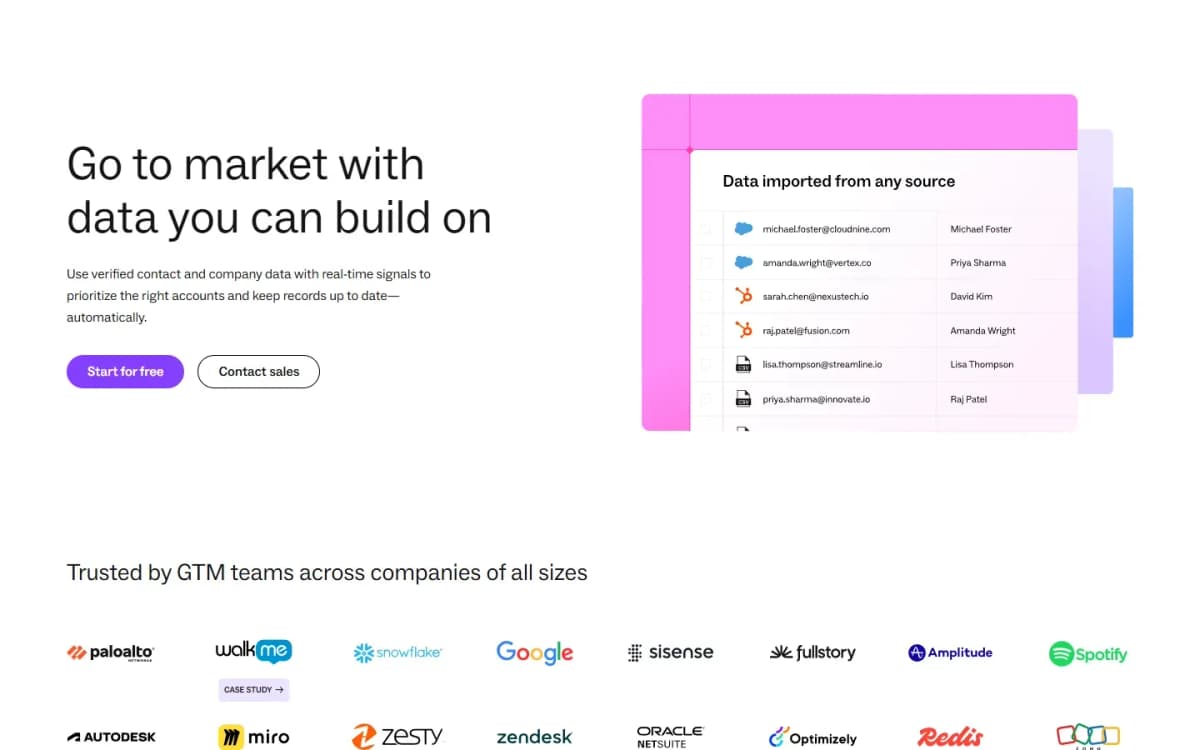
ZoomInfo is the market leader in B2B contact intelligence, and it earns that position through sheer scale and depth.
What it does best: With over 320 million business contacts and 100 million companies in its database, ZoomInfo provides one of the most comprehensive sales intelligence platforms available today. Beyond raw contacts, it is an AI-powered GTM intelligence platform that brings together company and contact data, buying intent signals, and workflow automation.
Who it's ideal for: Well-funded sales teams at Series A and beyond, particularly those targeting North American markets. ZoomInfo's data is especially strong for companies and professionals in North American geographies, making it a key plus point for GTM teams with primary audiences in the US and Canada.
Standout feature: Paid plans unlock intent signals that show which companies are actively researching solutions like yours, sourced from a large network of websites and behavioral signals that indicate when a company is likely entering a buying cycle.
Honest take on limitations: Pricing is the main barrier. ZoomInfo does not offer fixed pricing. Instead, it builds custom quotes based on team size, feature requirements, and usage patterns. For a small to mid-sized B2B team, a realistic ZoomInfo budget sits somewhere between $15,000 and $35,000 per year. Beyond the base cost, the pricing is deliberately opaque, the data requires more validation than the marketing suggests, and the credit system creates ongoing costs that are easy to underestimate. For early-stage startups, the investment is hard to justify before you've validated your ICP.
2. Firmable (Best for ANZ Markets)
Firmable is not just a regional alternative; for Australian and New Zealand businesses, it is the better choice. Global platforms simply do not have the local depth that Firmable has built specifically for this market.
What it does best: With Australia and New Zealand's largest B2B database, rich buying signals, and an AI sales engine built for local markets, Firmable helps teams connect with the right buyers at the right time.
Who it's ideal for: Any B2B startup or growth team operating in Australia or New Zealand. Global data tools consistently underperform on local accuracy, ABN data, and mobile numbers for this region.
What it does best: With over 320 million business contacts and 100 million companies in its database, ZoomInfo provides one of the most comprehensive sales intelligence platforms available today. Beyond raw contacts, it is an AI-powered GTM intelligence platform that brings together company and contact data, buying intent signals, and workflow automation.
Who it's ideal for: Well-funded sales teams at Series A and beyond, particularly those targeting North American markets. ZoomInfo's data is especially strong for companies and professionals in North American geographies, making it a key plus point for GTM teams with primary audiences in the US and Canada.
Standout feature: Paid plans unlock intent signals that show which companies are actively researching solutions like yours, sourced from a large network of websites and behavioral signals that indicate when a company is likely entering a buying cycle.
Honest take on limitations: Pricing is the main barrier. ZoomInfo does not offer fixed pricing. Instead, it builds custom quotes based on team size, feature requirements, and usage patterns. For a small to mid-sized B2B team, a realistic ZoomInfo budget sits somewhere between $15,000 and $35,000 per year. Beyond the base cost, the pricing is deliberately opaque, the data requires more validation than the marketing suggests, and the credit system creates ongoing costs that are easy to underestimate. For early-stage startups, the investment is hard to justify before you've validated your ICP.
2. Firmable (Best for ANZ Markets)
Firmable is not just a regional alternative; for Australian and New Zealand businesses, it is the better choice. Global platforms simply do not have the local depth that Firmable has built specifically for this market.
What it does best: With Australia and New Zealand's largest B2B database, rich buying signals, and an AI sales engine built for local markets, Firmable helps teams connect with the right buyers at the right time.
Who it's ideal for: Any B2B startup or growth team operating in Australia or New Zealand. Global data tools consistently underperform on local accuracy, ABN data, and mobile numbers for this region.
Standout feature: The database depth is the real differentiator. The Firmable platform covers over 1 million Australian B2B companies and 10 million people, with accurate and detailed profiles including localised information such as ABN, industry segments, and tech stacks. On top of that, you can filter by industry, location, tech stack, hiring activity, and more, and AI agents continuously track role changes, funding events, company growth, and technology adoption across target accounts.
Honest take on limitations: As Firmable focuses on the Australian market, businesses seeking global data will need to supplement with additional resources. If your ICP spans beyond ANZ, you will need a second tool for international coverage. Pricing is custom and quote-based, so contact their team directly.
3. Lusha
Lusha sits between Hunter.io's simplicity and ZoomInfo's complexity. It is a strong option for SDR teams and solo founders who need clean contact data fast, without an enterprise contract.
What it does best: Lusha provides access to a database of over 300 million business profiles, including direct phone numbers, email addresses, and company information. Its Chrome extension is the heart of its user experience, letting you reveal contact information directly on LinkedIn profiles, company websites, and within your CRM, with verified phone numbers and email addresses in a single click.
Who it's ideal for: Small to mid-sized sales teams doing outbound prospecting, particularly those with a phone-first motion. With Lusha, SDRs reportedly spend 87 additional hours prospecting each month, and teams have tripled the number of outbound meetings generated.
Standout feature: Data accuracy for direct dials. Lusha's contact database reports an 81% data accuracy rate, which is above the industry standard that hovers between 60 to 70%.
Honest take on limitations: Lusha pricing is based on per-user tiers plus a credit model that determines how many contacts you can reveal or enrich each month. Core CRM integrations like Salesforce are only available on the top-tier Scale plan, which is a real friction point for teams that need Salesforce sync on a tighter budget. Data accuracy is strong for North American contacts, but lower quality for European markets, so European teams should evaluate carefully. Paid plans start at approximately $22 to $29 per user per month, billed annually.
4. Apollo.io
Standout feature: The database depth is the real differentiator. The Firmable platform covers over 1 million Australian B2B companies and 10 million people, with accurate and detailed profiles including localised information such as ABN, industry segments, and tech stacks. On top of that, you can filter by industry, location, tech stack, hiring activity, and more, and AI agents continuously track role changes, funding events, company growth, and technology adoption across target accounts.
Honest take on limitations: As Firmable focuses on the Australian market, businesses seeking global data will need to supplement with additional resources. If your ICP spans beyond ANZ, you will need a second tool for international coverage. Pricing is custom and quote-based, so contact their team directly.
3. Lusha
Lusha sits between Hunter.io's simplicity and ZoomInfo's complexity. It is a strong option for SDR teams and solo founders who need clean contact data fast, without an enterprise contract.
What it does best: Lusha provides access to a database of over 300 million business profiles, including direct phone numbers, email addresses, and company information. Its Chrome extension is the heart of its user experience, letting you reveal contact information directly on LinkedIn profiles, company websites, and within your CRM, with verified phone numbers and email addresses in a single click.
Who it's ideal for: Small to mid-sized sales teams doing outbound prospecting, particularly those with a phone-first motion. With Lusha, SDRs reportedly spend 87 additional hours prospecting each month, and teams have tripled the number of outbound meetings generated.
Standout feature: Data accuracy for direct dials. Lusha's contact database reports an 81% data accuracy rate, which is above the industry standard that hovers between 60 to 70%.
Honest take on limitations: Lusha pricing is based on per-user tiers plus a credit model that determines how many contacts you can reveal or enrich each month. Core CRM integrations like Salesforce are only available on the top-tier Scale plan, which is a real friction point for teams that need Salesforce sync on a tighter budget. Data accuracy is strong for North American contacts, but lower quality for European markets, so European teams should evaluate carefully. Paid plans start at approximately $22 to $29 per user per month, billed annually.
4. Apollo.io
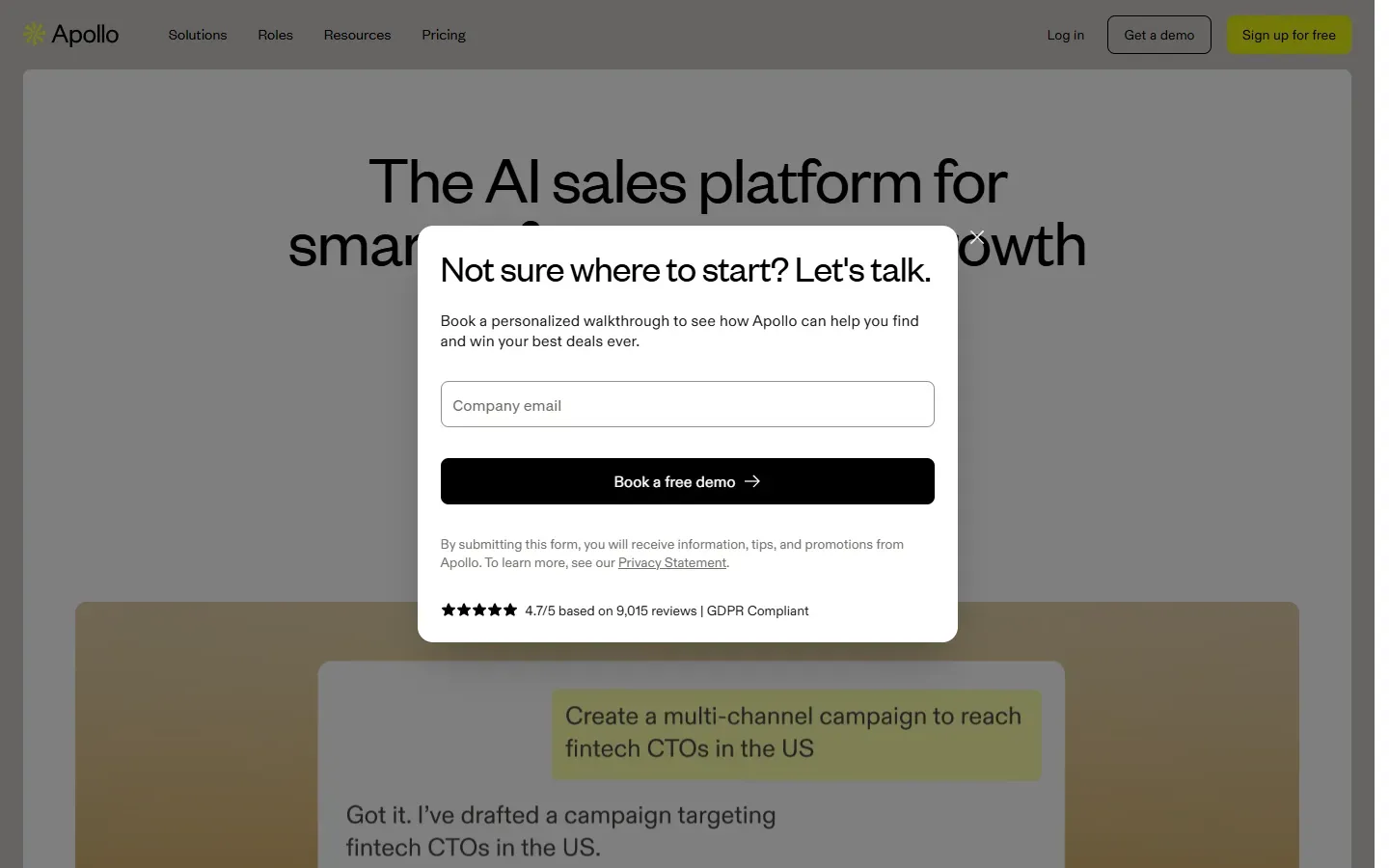
Apollo.io is the most popular lead gathering tool among early-stage startups, and for good reason. It combines a massive B2B contact database with outreach sequencing in a single platform, removing the need to stitch together separate tools at the beginning.
What it does best: Apollo.io has become one of the most popular sales intelligence platforms on the market, with over 210 million contacts in its database and pricing that starts at free. Crucially, the contact data and the email sequencing live in the same platform, which matters when you are moving fast.
Who it's ideal for: Pre-seed to Series A teams that want to find contacts and start outreach without a complex tech stack. The free tier is genuinely useful for testing.
Standout feature: The free tier is one of the more generous in this space. Apollo's free tier gives you access to the full contact database, basic search filters, and unlimited email credits (subject to fair use limits of approximately 250 emails per day). The catch is you are limited to 5 mobile credits and 10 export credits per month. Paid plans start at $49 per user per month billed annually, rising to $119 per user per month for the Organization tier.
Honest take on limitations: Real-world data accuracy hovers around 65 to 70% according to user reviews, with email bounce rates of 15 to 25% reported across G2 and Trustpilot. That is worth noting for deliverability, so supplement with an email verifier if you are running large campaigns. The credit system can also catch teams off guard: credits are strictly tied to the billing cycle and do not roll over, and any unused credits disappear at the end of the month, while excess usage triggers automatic overages. Before you send your first campaign, make sure your email list segmentation is tight enough to get maximum value from every export.
5. Clay
Apollo.io is the most popular lead gathering tool among early-stage startups, and for good reason. It combines a massive B2B contact database with outreach sequencing in a single platform, removing the need to stitch together separate tools at the beginning.
What it does best: Apollo.io has become one of the most popular sales intelligence platforms on the market, with over 210 million contacts in its database and pricing that starts at free. Crucially, the contact data and the email sequencing live in the same platform, which matters when you are moving fast.
Who it's ideal for: Pre-seed to Series A teams that want to find contacts and start outreach without a complex tech stack. The free tier is genuinely useful for testing.
Standout feature: The free tier is one of the more generous in this space. Apollo's free tier gives you access to the full contact database, basic search filters, and unlimited email credits (subject to fair use limits of approximately 250 emails per day). The catch is you are limited to 5 mobile credits and 10 export credits per month. Paid plans start at $49 per user per month billed annually, rising to $119 per user per month for the Organization tier.
Honest take on limitations: Real-world data accuracy hovers around 65 to 70% according to user reviews, with email bounce rates of 15 to 25% reported across G2 and Trustpilot. That is worth noting for deliverability, so supplement with an email verifier if you are running large campaigns. The credit system can also catch teams off guard: credits are strictly tied to the billing cycle and do not roll over, and any unused credits disappear at the end of the month, while excess usage triggers automatic overages. Before you send your first campaign, make sure your email list segmentation is tight enough to get maximum value from every export.
5. Clay
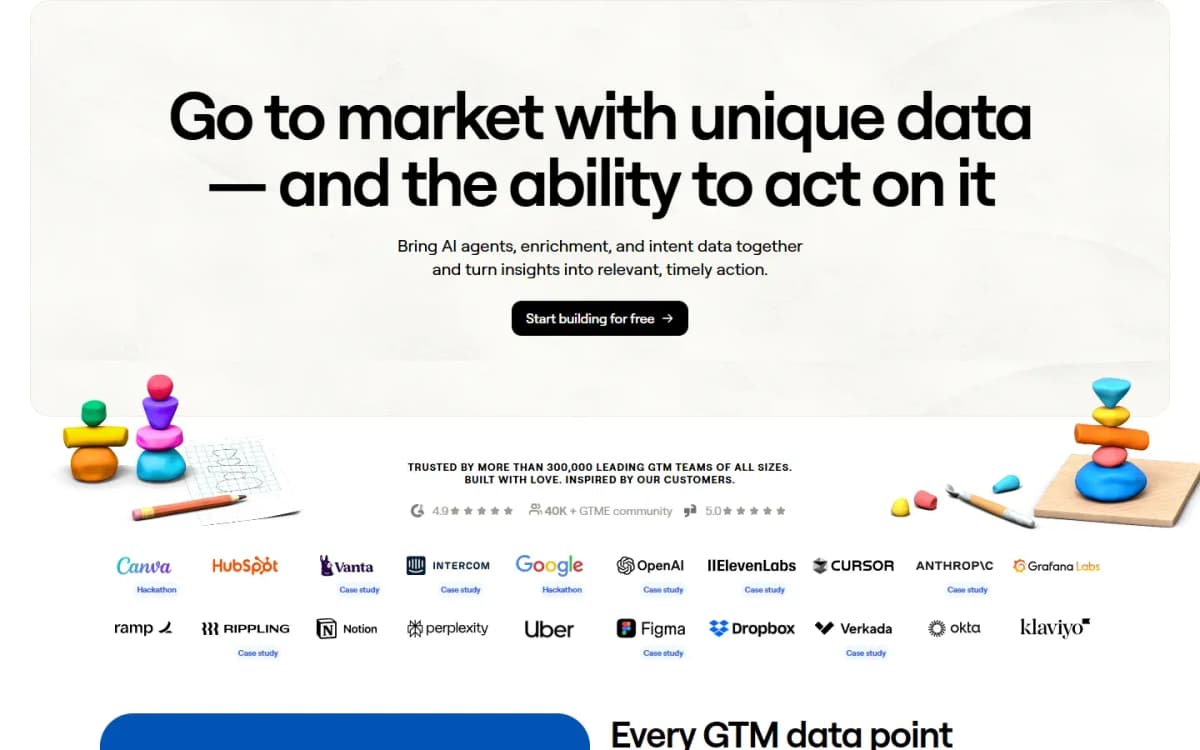
Clay is not a contact database. It is an enrichment and automation layer that sits on top of multiple data sources, and it is what growth teams use when they want to build highly customised lead lists that no single vendor can produce.
What it does best: Clay gives you access to premium data from 150+ providers, letting you identify new leads, score accounts and contacts, and personalise outreach. The waterfall enrichment logic is the core value proposition: Clay's waterfall approach typically discovers emails for 80% or more of B2B prospects when properly configured, compared to roughly 40 to 50% from a single-source tool.
Who it's ideal for: Clay is recommended for growth, sales, and RevOps teams who want to automate lead enrichment, build targeted lists, and improve outbound campaigns with unique data and AI, trusted by companies like OpenAI and Rippling. It rewards technical users and those comfortable with spreadsheet-style logic.
Standout feature: Conditional logic and multi-provider waterfall enrichment in one place. Clay is a modern, spreadsheet-like platform for outbound prospecting, lead enrichment, and personalisation at scale. It sits between a data provider, a flexible automation tool, and a lightweight CRM, giving startups a powerful way to find, qualify, and reach out to B2B prospects.
Honest take on limitations: There is a learning curve. New users who attempt advanced workflows before mastering the basics tend to waste credits quickly. Pricing starts free, with the Launch plan starting at $185 per month and the Growth plan at $495 per month. Costs can climb with heavy usage, and high-volume enrichment and AI personalisation can get expensive if not monitored. Clay is a power tool, not a quick start option.
6. Hunter.io
Hunter.io is the simplest, most focused tool on this list. It does one thing well: finds and verifies professional email addresses associated with a domain.
What it does best: The Domain Search feature allows users to discover email addresses associated with a specific company domain, which is invaluable for B2B marketers and sales professionals looking to connect with decision-makers at target organisations. By entering a company's domain, you can access a list of email addresses complete with verification status and confidence scores.
Who it's ideal for: Founders and solo operators doing targeted, account-specific outreach. If you know the five companies you want to reach this week, Hunter.io gets you to the right contacts in minutes without a database subscription.
Clay is not a contact database. It is an enrichment and automation layer that sits on top of multiple data sources, and it is what growth teams use when they want to build highly customised lead lists that no single vendor can produce.
What it does best: Clay gives you access to premium data from 150+ providers, letting you identify new leads, score accounts and contacts, and personalise outreach. The waterfall enrichment logic is the core value proposition: Clay's waterfall approach typically discovers emails for 80% or more of B2B prospects when properly configured, compared to roughly 40 to 50% from a single-source tool.
Who it's ideal for: Clay is recommended for growth, sales, and RevOps teams who want to automate lead enrichment, build targeted lists, and improve outbound campaigns with unique data and AI, trusted by companies like OpenAI and Rippling. It rewards technical users and those comfortable with spreadsheet-style logic.
Standout feature: Conditional logic and multi-provider waterfall enrichment in one place. Clay is a modern, spreadsheet-like platform for outbound prospecting, lead enrichment, and personalisation at scale. It sits between a data provider, a flexible automation tool, and a lightweight CRM, giving startups a powerful way to find, qualify, and reach out to B2B prospects.
Honest take on limitations: There is a learning curve. New users who attempt advanced workflows before mastering the basics tend to waste credits quickly. Pricing starts free, with the Launch plan starting at $185 per month and the Growth plan at $495 per month. Costs can climb with heavy usage, and high-volume enrichment and AI personalisation can get expensive if not monitored. Clay is a power tool, not a quick start option.
6. Hunter.io
Hunter.io is the simplest, most focused tool on this list. It does one thing well: finds and verifies professional email addresses associated with a domain.
What it does best: The Domain Search feature allows users to discover email addresses associated with a specific company domain, which is invaluable for B2B marketers and sales professionals looking to connect with decision-makers at target organisations. By entering a company's domain, you can access a list of email addresses complete with verification status and confidence scores.
Who it's ideal for: Founders and solo operators doing targeted, account-specific outreach. If you know the five companies you want to reach this week, Hunter.io gets you to the right contacts in minutes without a database subscription.
Standout feature: Verification is built in. Hunter.io is highly accurate, with bounce rates under 1% for emails marked as Valid. That matters more than most teams realise: high bounce rates are one of the fastest ways to damage your sender reputation and kill deliverability. More than 6 million professionals use Hunter, which reflects a level of adoption that only comes with a tool that genuinely works.
Honest take on limitations: Hunter.io is strictly for email addresses. It does not provide mobile numbers or direct dials. It also removed its LinkedIn integration years ago, meaning you cannot find emails directly on LinkedIn profiles. The free plan offers 25 searches per month, which is enough to test but not enough to run outbound at any scale. Paid plans start at $49 per month for 500 searches. For volume prospecting across a large ICP, you will need Apollo or a more complete database tool.
7. Clearbit (Now Breeze Intelligence by HubSpot)
Clearbit has undergone a significant transformation. In December 2023, Clearbit was acquired by HubSpot, and the Clearbit team has since fully integrated into HubSpot, combining their expertise with HubSpot's talent and resources. The product now lives inside HubSpot as Breeze Intelligence.
What it does best: Enrichment of existing records. It enriches contact and company records with precise, standardised data, providing real-time context on existing records to convert your best opportunities. You can add 100+ B2B data points on every contact or company in your target market, including technologies installed, employee count, revenue, location, and much more.
Who it's ideal for: Existing HubSpot customers who want enrichment layered directly into their CRM workflow. Clearbit, now Breeze Intelligence, is not ideal for individual prospecting. It is integrated within HubSpot and designed primarily to enrich inbound CRM records, not build outbound lead lists.
Standout feature: Form shortening. Clearbit's ability to pre-fill form fields using enrichment data reduces friction for high-intent visitors, meaning fewer fields and more completions on your lead capture forms.
Honest take on limitations: The acquisition has changed the economics significantly. On top of your HubSpot subscription, Breeze Intelligence runs on HubSpot Credits. Since June 2025, 1 enrichment costs 10 HubSpot Credits, and HubSpot sells credits at $10 per 1,000. Credits reset every month with no rollover. There is no standalone product anymore. If you are not a HubSpot customer, you cannot access it. For non-HubSpot teams, look elsewhere.
8. Cognism
Standout feature: Verification is built in. Hunter.io is highly accurate, with bounce rates under 1% for emails marked as Valid. That matters more than most teams realise: high bounce rates are one of the fastest ways to damage your sender reputation and kill deliverability. More than 6 million professionals use Hunter, which reflects a level of adoption that only comes with a tool that genuinely works.
Honest take on limitations: Hunter.io is strictly for email addresses. It does not provide mobile numbers or direct dials. It also removed its LinkedIn integration years ago, meaning you cannot find emails directly on LinkedIn profiles. The free plan offers 25 searches per month, which is enough to test but not enough to run outbound at any scale. Paid plans start at $49 per month for 500 searches. For volume prospecting across a large ICP, you will need Apollo or a more complete database tool.
7. Clearbit (Now Breeze Intelligence by HubSpot)
Clearbit has undergone a significant transformation. In December 2023, Clearbit was acquired by HubSpot, and the Clearbit team has since fully integrated into HubSpot, combining their expertise with HubSpot's talent and resources. The product now lives inside HubSpot as Breeze Intelligence.
What it does best: Enrichment of existing records. It enriches contact and company records with precise, standardised data, providing real-time context on existing records to convert your best opportunities. You can add 100+ B2B data points on every contact or company in your target market, including technologies installed, employee count, revenue, location, and much more.
Who it's ideal for: Existing HubSpot customers who want enrichment layered directly into their CRM workflow. Clearbit, now Breeze Intelligence, is not ideal for individual prospecting. It is integrated within HubSpot and designed primarily to enrich inbound CRM records, not build outbound lead lists.
Standout feature: Form shortening. Clearbit's ability to pre-fill form fields using enrichment data reduces friction for high-intent visitors, meaning fewer fields and more completions on your lead capture forms.
Honest take on limitations: The acquisition has changed the economics significantly. On top of your HubSpot subscription, Breeze Intelligence runs on HubSpot Credits. Since June 2025, 1 enrichment costs 10 HubSpot Credits, and HubSpot sells credits at $10 per 1,000. Credits reset every month with no rollover. There is no standalone product anymore. If you are not a HubSpot customer, you cannot access it. For non-HubSpot teams, look elsewhere.
8. Cognism
Cognism is the strongest ZoomInfo competitor for teams operating in Europe and, increasingly, the ANZ region. Its differentiator is not database size but data accuracy and compliance, particularly around phone-verified mobile numbers.
What it does best: Cognism offers access to over 400 million business profiles and 200 million verified business emails, with a focus on phone-verified mobile numbers and European market coverage. Its Diamond Data offering is where it pulls ahead of competitors: with over 10 million phone-verified contacts globally, teams can expect to connect with their ideal contact every 8 dials, and the database contains more than 2x the volume of mobile numbers than other providers.
Who it's ideal for: Mid-sized to enterprise B2B teams doing cold calling alongside email, particularly those selling into the UK, EMEA, or ANZ. Compliance is built in, with the platform holding ISO 27001, ISO 27701, and SOC 2 Type II certifications, and the database is scrubbed against 13 major Do Not Call lists.
Standout feature: GDPR-compliant data by design. For teams selling into Europe, this is not optional. Data is Cognism's biggest strength. When stacked against tools like Apollo, Lusha, and Seamless.ai, it stands out for its GDPR compliance and accuracy.
Honest take on limitations: Cognism does not publish public pricing, but reports suggest plans start around $15,000 per year, with added costs for features like export credits. Many users point out that while the data quality is strong, the pricing and contracts make it more suitable for mid to large enterprises than for lean startups. There is no free trial; you book a demo and negotiate pricing directly. Pairing Cognism's verified contacts with a well-crafted welcome email sequence gives you a clean entry point into any new list segment you build.
How to Choose the Right Tool
The honest answer is that most startups end up using more than one tool. Here is a simple decision framework:
Budget under $100/month: Start with Apollo.io (free tier or Basic plan) for contacts and sequencing, and layer Hunter.io on top for specific domain-based lookups. Both have free or low-cost entry points.
Cognism is the strongest ZoomInfo competitor for teams operating in Europe and, increasingly, the ANZ region. Its differentiator is not database size but data accuracy and compliance, particularly around phone-verified mobile numbers.
What it does best: Cognism offers access to over 400 million business profiles and 200 million verified business emails, with a focus on phone-verified mobile numbers and European market coverage. Its Diamond Data offering is where it pulls ahead of competitors: with over 10 million phone-verified contacts globally, teams can expect to connect with their ideal contact every 8 dials, and the database contains more than 2x the volume of mobile numbers than other providers.
Who it's ideal for: Mid-sized to enterprise B2B teams doing cold calling alongside email, particularly those selling into the UK, EMEA, or ANZ. Compliance is built in, with the platform holding ISO 27001, ISO 27701, and SOC 2 Type II certifications, and the database is scrubbed against 13 major Do Not Call lists.
Standout feature: GDPR-compliant data by design. For teams selling into Europe, this is not optional. Data is Cognism's biggest strength. When stacked against tools like Apollo, Lusha, and Seamless.ai, it stands out for its GDPR compliance and accuracy.
Honest take on limitations: Cognism does not publish public pricing, but reports suggest plans start around $15,000 per year, with added costs for features like export credits. Many users point out that while the data quality is strong, the pricing and contracts make it more suitable for mid to large enterprises than for lean startups. There is no free trial; you book a demo and negotiate pricing directly. Pairing Cognism's verified contacts with a well-crafted welcome email sequence gives you a clean entry point into any new list segment you build.
How to Choose the Right Tool
The honest answer is that most startups end up using more than one tool. Here is a simple decision framework:
Budget under $100/month: Start with Apollo.io (free tier or Basic plan) for contacts and sequencing, and layer Hunter.io on top for specific domain-based lookups. Both have free or low-cost entry points.
Scaling outbound in North America: Apollo or ZoomInfo, depending on budget. Apollo gives you speed and an all-in-one workflow. ZoomInfo gives you intent data and firmographic depth at a cost that only makes sense once you have a dedicated sales team.
Operating in Australia or New Zealand: Firmable, without question. No global platform matches its local data depth for ABN-validated contacts, local mobile numbers, and ANZ firmographics.
Selling into Europe or EMEA: Cognism is the first call. Its GDPR compliance infrastructure and verified mobile coverage in EMEA are hard to match. Lusha is a more affordable fallback if budget is the constraint.
Building highly customised lists with conditional enrichment logic: Clay, once you have validated your ICP and have someone on the team comfortable building workflows. Not recommended as a first tool.
Already on HubSpot and want enrichment in-CRM: Breeze Intelligence (formerly Clearbit) is the path of least resistance. Just budget carefully for credits.
No tool replaces a reason for someone to want to hear from you. But the right tool dramatically shortens the time between "who should I be talking to?" and "they are in my list." The best B2B email marketing for startups starts with knowing exactly who you are reaching, and these tools give you that foundation faster than any manual process.
Frequently Asked Questions
What is the best lead gathering tool for building a B2B email list?
There is no single best tool because the answer depends on your target market, budget, and use case. Apollo.io is the most popular choice for early-stage B2B startups because it combines a large contact database with outreach sequencing and offers a generous free tier. ZoomInfo is the most powerful but costs significantly more. For ANZ markets, Firmable is the standout option.
How do lead enrichment tools differ from contact database tools?
Contact database tools (like ZoomInfo, Apollo, or Lusha) let you search and export contact records by ICP criteria. Lead enrichment tools (like Clay or Breeze Intelligence by HubSpot) take existing records and fill in missing data points such as company size, tech stack, or firmographic attributes. The two types are often used together.
Will using these tools hurt my email deliverability?
Scaling outbound in North America: Apollo or ZoomInfo, depending on budget. Apollo gives you speed and an all-in-one workflow. ZoomInfo gives you intent data and firmographic depth at a cost that only makes sense once you have a dedicated sales team.
Operating in Australia or New Zealand: Firmable, without question. No global platform matches its local data depth for ABN-validated contacts, local mobile numbers, and ANZ firmographics.
Selling into Europe or EMEA: Cognism is the first call. Its GDPR compliance infrastructure and verified mobile coverage in EMEA are hard to match. Lusha is a more affordable fallback if budget is the constraint.
Building highly customised lists with conditional enrichment logic: Clay, once you have validated your ICP and have someone on the team comfortable building workflows. Not recommended as a first tool.
Already on HubSpot and want enrichment in-CRM: Breeze Intelligence (formerly Clearbit) is the path of least resistance. Just budget carefully for credits.
No tool replaces a reason for someone to want to hear from you. But the right tool dramatically shortens the time between "who should I be talking to?" and "they are in my list." The best B2B email marketing for startups starts with knowing exactly who you are reaching, and these tools give you that foundation faster than any manual process.
Frequently Asked Questions
What is the best lead gathering tool for building a B2B email list?
There is no single best tool because the answer depends on your target market, budget, and use case. Apollo.io is the most popular choice for early-stage B2B startups because it combines a large contact database with outreach sequencing and offers a generous free tier. ZoomInfo is the most powerful but costs significantly more. For ANZ markets, Firmable is the standout option.
How do lead enrichment tools differ from contact database tools?
Contact database tools (like ZoomInfo, Apollo, or Lusha) let you search and export contact records by ICP criteria. Lead enrichment tools (like Clay or Breeze Intelligence by HubSpot) take existing records and fill in missing data points such as company size, tech stack, or firmographic attributes. The two types are often used together.
Will using these tools hurt my email deliverability?
It depends on the data quality. Tools that verify email addresses before export (Hunter.io, Cognism, Lusha) reduce the risk of high bounce rates that can damage your sender reputation. Real-world data accuracy on some platforms hovers around 65 to 70%, with email bounce rates of 15 to 25% reported. Teams may need supplementary verification tools. Always verify a list before your first send, and keep a close eye on your email marketing analytics to catch deliverability issues early.
Are there free lead gathering tools that actually work?
Yes, with caveats. Apollo.io's free plan gives you access to its full contact database with limited monthly export credits. Hunter.io's free plan offers 25 domain searches per month. Both are useful for testing your ICP before committing to a paid plan, but neither is sufficient for running real outbound campaigns at any meaningful volume.
No comments yet. Be the first!
It depends on the data quality. Tools that verify email addresses before export (Hunter.io, Cognism, Lusha) reduce the risk of high bounce rates that can damage your sender reputation. Real-world data accuracy on some platforms hovers around 65 to 70%, with email bounce rates of 15 to 25% reported. Teams may need supplementary verification tools. Always verify a list before your first send, and keep a close eye on your email marketing analytics to catch deliverability issues early.
Are there free lead gathering tools that actually work?
Yes, with caveats. Apollo.io's free plan gives you access to its full contact database with limited monthly export credits. Hunter.io's free plan offers 25 domain searches per month. Both are useful for testing your ICP before committing to a paid plan, but neither is sufficient for running real outbound campaigns at any meaningful volume.