Persuasive Email Marketing Techniques That Drive Results
Learn 8 persuasive email marketing techniques backed by data. Increase open rates, clicks, and conversions with proven psychology and copywriting strategies.
Persuasive Email Marketing Techniques That Drive Results
Learn 8 persuasive email marketing techniques backed by data. Increase open rates, clicks, and conversions with proven psychology and copywriting strategies.
Most persuasive email marketing techniques do not rely on clever copywriting alone. They combine psychology, data, and structure to move subscribers from passive reading to active buying. Email marketing generates between $36 and $40 for every dollar spent, translating to a 3,600% to 4,000% return on investment, outperforming most other marketing channels by a significant margin. But averages mean nothing without the right techniques behind them. This guide covers the persuasive email marketing techniques that consistently produce measurable results, with data to back each one.
Key Takeaways
Personalized subject lines increase email open rates by 26%.
Emails with a single CTA receive 371% more clicks compared to those with multiple calls to action.
Automated emails drive 320% more revenue than non-automated emails.
Marketers who segment email lists increase email marketing revenue by 760%.
59% of consumers say marketing emails influence their purchase decisions, with over 50% saying they purchase from an email at least once a month.
1. Write Subject Lines That Earn the Open
Your subject line is the first and most important persuasive lever in any email. 43% of people open an email based on the subject line alone. Get it wrong and the rest of your work never gets seen.
Personalization is the most reliable driver. Emails with personalized subject lines boast a 46% open rate, compared to a mere 35% without. That is not just a first-name token. Personalized subject lines that include a relevant event, the recipient's company, or their location significantly boost both open and reply rates.
Numbers and urgency also work. Adding numbers to subject lines boosts open rates by 57%. Urgent subject lines increase open rates by 22% on average. But urgency that feels manufactured backfires. Terms steeped in marketing hype, urgency phrases like "ASAP," and generic greetings drag open rates below 36%, signaling a clear shift toward authenticity and clarity.
Length matters too. Subject lines with 2 to 4 words yield the highest open rates at 46%. Extremely short one-word or long lines with 9 to 10 words underperform due to a lack of clarity or visual clutter.
Most persuasive email marketing techniques do not rely on clever copywriting alone. They combine psychology, data, and structure to move subscribers from passive reading to active buying. Email marketing generates between $36 and $40 for every dollar spent, translating to a 3,600% to 4,000% return on investment, outperforming most other marketing channels by a significant margin. But averages mean nothing without the right techniques behind them. This guide covers the persuasive email marketing techniques that consistently produce measurable results, with data to back each one.
Key Takeaways
Personalized subject lines increase email open rates by 26%.
Emails with a single CTA receive 371% more clicks compared to those with multiple calls to action.
Automated emails drive 320% more revenue than non-automated emails.
Marketers who segment email lists increase email marketing revenue by 760%.
59% of consumers say marketing emails influence their purchase decisions, with over 50% saying they purchase from an email at least once a month.
1. Write Subject Lines That Earn the Open
Your subject line is the first and most important persuasive lever in any email. 43% of people open an email based on the subject line alone. Get it wrong and the rest of your work never gets seen.
Personalization is the most reliable driver. Emails with personalized subject lines boast a 46% open rate, compared to a mere 35% without. That is not just a first-name token. Personalized subject lines that include a relevant event, the recipient's company, or their location significantly boost both open and reply rates.
Numbers and urgency also work. Adding numbers to subject lines boosts open rates by 57%. Urgent subject lines increase open rates by 22% on average. But urgency that feels manufactured backfires. Terms steeped in marketing hype, urgency phrases like "ASAP," and generic greetings drag open rates below 36%, signaling a clear shift toward authenticity and clarity.
Length matters too. Subject lines with 2 to 4 words yield the highest open rates at 46%. Extremely short one-word or long lines with 9 to 10 words underperform due to a lack of clarity or visual clutter.
For a deeper dive into crafting high-performing subject lines, see our guide on email subject line best practices that boost open rates by 27%.
2. Use Personalization Beyond the First Name
Surface-level personalization ("Hi [First Name]") no longer moves the needle on its own. 71% of consumers expect personalized interactions from brands, and 76% get frustrated when their brand interactions are not personalized to their interests.
The more useful approach is behavioral and contextual personalization. Behavior-based emails generate roughly 3 times higher engagement than scheduled campaigns, as they are triggered by specific user actions. Emails with personalized content generate up to 6 times higher transaction rates compared to non-personalized campaigns.
65% of email marketers identify dynamic content as their most effective personalization tactic. Emails with personalization reach 29% open rates compared to the industry average. Click-through rates hit 41% for personalized messages.
Despite these results, only about 13% of teams use advanced personalization techniques. This gap highlights a major opportunity. Most teams benefit from personalization, but few fully leverage behavioral or real-time data.
Practical personalization techniques include:
Product recommendations based on past purchases
Re-engagement emails triggered by browsing behavior
Content blocks that change based on subscriber segment
Send-time personalization based on individual open history
For practical examples of this in action, see 7 email personalization techniques that boost conversions 47%.
3. Apply Scarcity and Urgency Honestly
Scarcity marketing leverages a fundamental psychological trigger: when consumers perceive a product or offer as rare or available only for a limited time, their motivation to act intensifies. In email marketing, scarcity tactics such as limited-time offers and exclusive access create urgency that compels subscribers to move quickly from consideration to purchase. This sense of urgency can significantly increase conversion rates by transforming passive recipients into engaged buyers.
When implemented ethically and strategically, scarcity marketing delivers tangible benefits including conversion rate increases of 10 to 30% depending on product fit and execution.
The key word is honestly. A genuine deadline such as "offer ends Sunday" or limited availability such as "12 left in stock" creates real urgency. Fake countdown timers and artificial scarcity destroy trust when customers notice them, and they do.
Effective scarcity techniques for email include:
Countdown timers tied to actual expiry dates
Low-stock alerts pulled from real inventory data
Early-access windows for subscribers only
Flash sales with clearly stated end times
For a deeper dive into crafting high-performing subject lines, see our guide on email subject line best practices that boost open rates by 27%.
2. Use Personalization Beyond the First Name
Surface-level personalization ("Hi [First Name]") no longer moves the needle on its own. 71% of consumers expect personalized interactions from brands, and 76% get frustrated when their brand interactions are not personalized to their interests.
The more useful approach is behavioral and contextual personalization. Behavior-based emails generate roughly 3 times higher engagement than scheduled campaigns, as they are triggered by specific user actions. Emails with personalized content generate up to 6 times higher transaction rates compared to non-personalized campaigns.
65% of email marketers identify dynamic content as their most effective personalization tactic. Emails with personalization reach 29% open rates compared to the industry average. Click-through rates hit 41% for personalized messages.
Despite these results, only about 13% of teams use advanced personalization techniques. This gap highlights a major opportunity. Most teams benefit from personalization, but few fully leverage behavioral or real-time data.
Practical personalization techniques include:
Product recommendations based on past purchases
Re-engagement emails triggered by browsing behavior
Content blocks that change based on subscriber segment
Send-time personalization based on individual open history
For practical examples of this in action, see 7 email personalization techniques that boost conversions 47%.
3. Apply Scarcity and Urgency Honestly
Scarcity marketing leverages a fundamental psychological trigger: when consumers perceive a product or offer as rare or available only for a limited time, their motivation to act intensifies. In email marketing, scarcity tactics such as limited-time offers and exclusive access create urgency that compels subscribers to move quickly from consideration to purchase. This sense of urgency can significantly increase conversion rates by transforming passive recipients into engaged buyers.
When implemented ethically and strategically, scarcity marketing delivers tangible benefits including conversion rate increases of 10 to 30% depending on product fit and execution.
The key word is honestly. A genuine deadline such as "offer ends Sunday" or limited availability such as "12 left in stock" creates real urgency. Fake countdown timers and artificial scarcity destroy trust when customers notice them, and they do.
Effective scarcity techniques for email include:
Countdown timers tied to actual expiry dates
Low-stock alerts pulled from real inventory data
Early-access windows for subscribers only
Flash sales with clearly stated end times
Research shows 69% of millennials experience FOMO (fear of missing out), and 60% make impulsive purchases because of it. That behavioral reality makes honest scarcity one of the most powerful persuasive email marketing techniques available.
4. Build Trust With Social Proof
Social proof is the idea that people are more likely to take action when they see that others have already taken that action. In email, this means bringing evidence of trust directly into the message rather than leaving it on a landing page.
Reviews, ratings, and customer photos near the add-to-cart button consistently lift conversions. People are more likely to buy when they can see others already have.
Social proof formats that work in email:
Verified customer reviews with star ratings
User-generated photos of products in use
Testimonials tied to a specific outcome ("I got 40% more leads in 30 days")
Subscriber counts or community size ("Join 85,000 marketers")
Trust badges from recognized third-party platforms
Using scarcity, urgency, and social proof in isolation works, but the real power lies in combining them strategically. An email that shows a limited-time offer alongside a review from someone who benefited from the same offer works harder than either element alone.
5. Segment Your List Before You Send
Sending one email to your entire list is the fastest way to underperform. Segmented email campaigns generate 30% more opens and 50% more click-throughs than non-segmented campaigns.
Only 1 in 5 ecommerce merchants were actually using segments, meaning that ecommerce merchants were sending the same emails to their entire list without any kind of targeting in place. The financial gap between those who segment and those who do not is significant. Merchants using segments were earning five times more revenue than merchants who were not.
Segmentation turns generic persuasion into relevant persuasion. The most effective segmentation criteria include:
Purchase history and product category interest
Engagement level (active, lapsed, dormant)
Geographic location and time zone
Stage in the customer lifecycle (new subscriber, first buyer, repeat customer)
Behavioral data (pages visited, links clicked in previous emails)
The most effective strategies for email marketing campaigns are subscriber segmentation (78%), message personalization (72%), and email automation campaigns (71%).
Emails with a single CTA receive 371% more clicks compared to those with multiple calls to action. More options create analysis paralysis. When a reader has to choose between "Buy Now," "Learn More," "Follow Us," and "See Plans," they often choose nothing.
Research shows 69% of millennials experience FOMO (fear of missing out), and 60% make impulsive purchases because of it. That behavioral reality makes honest scarcity one of the most powerful persuasive email marketing techniques available.
4. Build Trust With Social Proof
Social proof is the idea that people are more likely to take action when they see that others have already taken that action. In email, this means bringing evidence of trust directly into the message rather than leaving it on a landing page.
Reviews, ratings, and customer photos near the add-to-cart button consistently lift conversions. People are more likely to buy when they can see others already have.
Social proof formats that work in email:
Verified customer reviews with star ratings
User-generated photos of products in use
Testimonials tied to a specific outcome ("I got 40% more leads in 30 days")
Subscriber counts or community size ("Join 85,000 marketers")
Trust badges from recognized third-party platforms
Using scarcity, urgency, and social proof in isolation works, but the real power lies in combining them strategically. An email that shows a limited-time offer alongside a review from someone who benefited from the same offer works harder than either element alone.
5. Segment Your List Before You Send
Sending one email to your entire list is the fastest way to underperform. Segmented email campaigns generate 30% more opens and 50% more click-throughs than non-segmented campaigns.
Only 1 in 5 ecommerce merchants were actually using segments, meaning that ecommerce merchants were sending the same emails to their entire list without any kind of targeting in place. The financial gap between those who segment and those who do not is significant. Merchants using segments were earning five times more revenue than merchants who were not.
Segmentation turns generic persuasion into relevant persuasion. The most effective segmentation criteria include:
Purchase history and product category interest
Engagement level (active, lapsed, dormant)
Geographic location and time zone
Stage in the customer lifecycle (new subscriber, first buyer, repeat customer)
Behavioral data (pages visited, links clicked in previous emails)
The most effective strategies for email marketing campaigns are subscriber segmentation (78%), message personalization (72%), and email automation campaigns (71%).
Emails with a single CTA receive 371% more clicks compared to those with multiple calls to action. More options create analysis paralysis. When a reader has to choose between "Buy Now," "Learn More," "Follow Us," and "See Plans," they often choose nothing.
The principle is one email, one goal, one CTA. A good CTA does not just stand out; it highlights the value of what happens beyond the click.
What makes a CTA persuasive in practice:
Action-oriented language: Verbs like "Get," "Claim," "Start," and "Download" perform better than passive phrases like "Click here."
Specificity: "Get My Free 14-Day Trial" outperforms "Sign Up."
Visual contrast: The button color should contrast with the email background so it is impossible to miss.
Mobile size: Mobile is the top way to read email, with 44.7% of opens taking place on a mobile device or client. As mobile continues to gain popularity, the physical size of CTAs is more important than ever.
Placement: Put the primary CTA above the fold so it is visible without scrolling.
A/B testing CTA wording, placement, and design yields 28% higher conversion rates on average.
7. Use Automation to Deliver the Right Message at the Right Moment
Batch-and-blast campaigns have a ceiling. Automated, behavior-triggered emails do not. Automated emails drive 320% more revenue than non-automated emails. Automations accounted for just 2% of email sends but drove 30% of revenue, earning 16 times more per send than scheduled campaigns.
The highest-performing automation sequences to build first:
Welcome series: Welcome email workflows have the highest click-to-conversion rate at 58.26%.
Abandoned cart: Abandoned cart email campaigns have an open rate of 50.50%, and businesses earn an average of $3.45 in revenue per abandoned cart email recipient.
Post-purchase sequence: One company's order confirmation email accounts for just 2.4% of their email send but generates 16.7% of its yearly email revenue. Nearly one in three customers who click on the order confirmation email make another purchase, resulting in a 32% conversion rate.
Re-engagement series: Target subscribers who have not opened or clicked in 60 to 90 days before removing them from your active list.
The top 10% of email workflows generate $16.96 in revenue per recipient, while average email flows generate $1.94. The gap between average and top-performing automation is almost entirely explained by better personalization, segmentation, and trigger logic.
8. Test, Measure, and Iterate
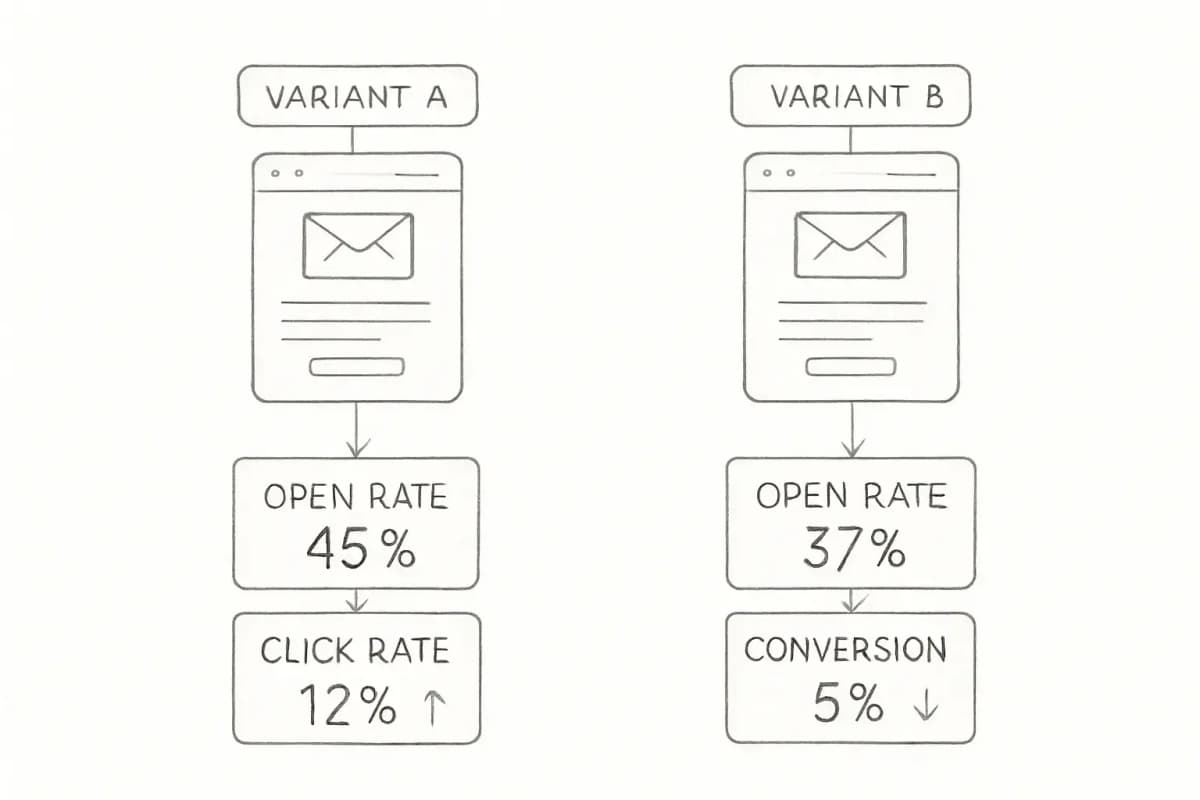
No persuasive email marketing technique works without consistent testing. Brands that regularly A/B test their emails achieve 83% higher ROI than those that never test. Companies that never test report average ROI of 2,300%, while those that often test achieve 4,200%.
The metrics that tell the full story are not just open rates. Bot-driven phantom engagement has made open rates unreliable, pushing high-performing teams toward revenue per email, list churn, and lifetime value as the metrics that matter.
Prioritize testing in this order:
The principle is one email, one goal, one CTA. A good CTA does not just stand out; it highlights the value of what happens beyond the click.
What makes a CTA persuasive in practice:
Action-oriented language: Verbs like "Get," "Claim," "Start," and "Download" perform better than passive phrases like "Click here."
Specificity: "Get My Free 14-Day Trial" outperforms "Sign Up."
Visual contrast: The button color should contrast with the email background so it is impossible to miss.
Mobile size: Mobile is the top way to read email, with 44.7% of opens taking place on a mobile device or client. As mobile continues to gain popularity, the physical size of CTAs is more important than ever.
Placement: Put the primary CTA above the fold so it is visible without scrolling.
A/B testing CTA wording, placement, and design yields 28% higher conversion rates on average.
7. Use Automation to Deliver the Right Message at the Right Moment
Batch-and-blast campaigns have a ceiling. Automated, behavior-triggered emails do not. Automated emails drive 320% more revenue than non-automated emails. Automations accounted for just 2% of email sends but drove 30% of revenue, earning 16 times more per send than scheduled campaigns.
The highest-performing automation sequences to build first:
Welcome series: Welcome email workflows have the highest click-to-conversion rate at 58.26%.
Abandoned cart: Abandoned cart email campaigns have an open rate of 50.50%, and businesses earn an average of $3.45 in revenue per abandoned cart email recipient.
Post-purchase sequence: One company's order confirmation email accounts for just 2.4% of their email send but generates 16.7% of its yearly email revenue. Nearly one in three customers who click on the order confirmation email make another purchase, resulting in a 32% conversion rate.
Re-engagement series: Target subscribers who have not opened or clicked in 60 to 90 days before removing them from your active list.
The top 10% of email workflows generate $16.96 in revenue per recipient, while average email flows generate $1.94. The gap between average and top-performing automation is almost entirely explained by better personalization, segmentation, and trigger logic.
8. Test, Measure, and Iterate
No persuasive email marketing technique works without consistent testing. Brands that regularly A/B test their emails achieve 83% higher ROI than those that never test. Companies that never test report average ROI of 2,300%, while those that often test achieve 4,200%.
The metrics that tell the full story are not just open rates. Bot-driven phantom engagement has made open rates unreliable, pushing high-performing teams toward revenue per email, list churn, and lifetime value as the metrics that matter.
Prioritize testing in this order:
Subject line (highest impact on whether an email gets opened)
From name (personal names often outperform brand names)
CTA text, color, and placement
Email length and content structure
Send time and day of week
Offer type (discount vs. free trial vs. content)
Track results at the revenue level, not just the engagement level. Clicks and opens that do not convert to sales are metrics without meaning.
Frequently Asked Questions
What are the most effective persuasive email marketing techniques?
The most consistently effective persuasive email marketing techniques are behavioral personalization, list segmentation, single-focused CTAs, and triggered automation sequences. The biggest gains come from automation, personalization, deliverability discipline, and realistic attribution, not from sending more emails. Combining these techniques produces compounding results because each layer reinforces the others.
How does personalization improve email persuasion?
Personalized emails are 6 times more likely to drive conversions. Personalization works because it makes the email feel relevant to the individual rather than generic. 52% of consumers say they will go elsewhere to find what they want if an email is not personalized. The more the content matches the subscriber's actual behavior, interests, or purchase history, the stronger the persuasive pull.
Is scarcity in email marketing ethical?
Scarcity is ethical when it reflects reality. This is not about being deceptive; it is about framing real limitations transparently. A genuine "sale ends midnight Sunday" or "only 8 seats left" is legitimate and persuasive. Manufactured countdown timers that reset on every visit, or fake "low stock" alerts, damage trust over time and reduce the long-term value of your list. Use scarcity to communicate real constraints, not to manufacture artificial pressure.
How many emails should an automated sequence contain?
The right length depends on the goal. Welcome sequences typically perform well with 3 to 5 emails. Email sequences with 3 or more messages generate 527% more revenue than single emails. Abandoned cart sequences work well as a 3-email flow: a reminder at one hour, social proof at 24 hours, and a discount offer at 48 hours. The guiding principle is that each email in a sequence should add distinct value, not repeat the same ask in slightly different words.
What is the best way to measure email persuasion performance?
Subject line (highest impact on whether an email gets opened)
From name (personal names often outperform brand names)
CTA text, color, and placement
Email length and content structure
Send time and day of week
Offer type (discount vs. free trial vs. content)
Track results at the revenue level, not just the engagement level. Clicks and opens that do not convert to sales are metrics without meaning.
Frequently Asked Questions
What are the most effective persuasive email marketing techniques?
The most consistently effective persuasive email marketing techniques are behavioral personalization, list segmentation, single-focused CTAs, and triggered automation sequences. The biggest gains come from automation, personalization, deliverability discipline, and realistic attribution, not from sending more emails. Combining these techniques produces compounding results because each layer reinforces the others.
How does personalization improve email persuasion?
Personalized emails are 6 times more likely to drive conversions. Personalization works because it makes the email feel relevant to the individual rather than generic. 52% of consumers say they will go elsewhere to find what they want if an email is not personalized. The more the content matches the subscriber's actual behavior, interests, or purchase history, the stronger the persuasive pull.
Is scarcity in email marketing ethical?
Scarcity is ethical when it reflects reality. This is not about being deceptive; it is about framing real limitations transparently. A genuine "sale ends midnight Sunday" or "only 8 seats left" is legitimate and persuasive. Manufactured countdown timers that reset on every visit, or fake "low stock" alerts, damage trust over time and reduce the long-term value of your list. Use scarcity to communicate real constraints, not to manufacture artificial pressure.
How many emails should an automated sequence contain?
The right length depends on the goal. Welcome sequences typically perform well with 3 to 5 emails. Email sequences with 3 or more messages generate 527% more revenue than single emails. Abandoned cart sequences work well as a 3-email flow: a reminder at one hour, social proof at 24 hours, and a discount offer at 48 hours. The guiding principle is that each email in a sequence should add distinct value, not repeat the same ask in slightly different words.
What is the best way to measure email persuasion performance?
Move beyond open rates. The most meaningful metrics are click-to-conversion rate, revenue per email sent, and list engagement health (unsubscribe and complaint rates). Click rates may have declined, but click-to-conversion rates grew to 5.88%, meaning that prospects who do click are increasingly likely to make a purchase. Align your measurement framework with revenue outcomes, not just inbox behavior, for a clear picture of what your persuasive email marketing techniques are actually producing.
No comments yet. Be the first!
Move beyond open rates. The most meaningful metrics are click-to-conversion rate, revenue per email sent, and list engagement health (unsubscribe and complaint rates). Click rates may have declined, but click-to-conversion rates grew to 5.88%, meaning that prospects who do click are increasingly likely to make a purchase. Align your measurement framework with revenue outcomes, not just inbox behavior, for a clear picture of what your persuasive email marketing techniques are actually producing.