Restaurant email marketing delivers some of the most measurable returns in digital marketing, yet most restaurants collect fewer than 15% of guest emails and send generic blasts that barely move the needle. Restaurant email marketing generates $36 for every $1 spent, but most chains capture fewer than 15% of guest emails and send undifferentiated blasts to stale lists. The gap between average and exceptional results is not about templates. It is about understanding which campaign types actually drive visits, orders, and repeat business, then executing them with precision.
This guide breaks down the most effective restaurant email marketing examples, backed by data, so you can build campaigns that fill tables and grow revenue consistently.
Key Takeaways
Email marketing generates an average return of $36 for every $1 spent across all industries, according to the 2024 Litmus State of Email report. For restaurants, the return can be even higher due to lower repeat-visit acquisition costs.
More than 53% of diners have attended a new restaurant because of a marketing email, based on a 6-month study by Mspark.
60% of a restaurant's revenue comes from repeat customers, who also spend 67% more than new customers. Email is the most cost-effective channel to keep them coming back.
Olo's data shows that personalized marketing can result in a 20% lift in spend by email recipients over 30 days, with a surge in sales the day after it's sent.
Automated emails outperform manual campaigns, achieving an average of 52% higher open rates and 2,361% higher conversion rates.
Why Email Outperforms Other Channels for Restaurants
Before diving into specific restaurant email marketing examples, it helps to understand why email consistently outperforms social and paid channels for this industry.
69% of guests worldwide chose email as their preferred communication method from consumer brands, and research shows that email is 40x more effective at bringing new guests back than Facebook or Twitter.
Email gives you a direct line to diners. On social media, constantly changing algorithms mean that even people who follow your account sometimes will not see your content because the platform decides not to serve it to them. Your email list, by contrast, is an owned asset.
Restaurant email marketing delivers some of the most measurable returns in digital marketing, yet most restaurants collect fewer than 15% of guest emails and send generic blasts that barely move the needle. Restaurant email marketing generates $36 for every $1 spent, but most chains capture fewer than 15% of guest emails and send undifferentiated blasts to stale lists. The gap between average and exceptional results is not about templates. It is about understanding which campaign types actually drive visits, orders, and repeat business, then executing them with precision.
This guide breaks down the most effective restaurant email marketing examples, backed by data, so you can build campaigns that fill tables and grow revenue consistently.
Key Takeaways
Email marketing generates an average return of $36 for every $1 spent across all industries, according to the 2024 Litmus State of Email report. For restaurants, the return can be even higher due to lower repeat-visit acquisition costs.
More than 53% of diners have attended a new restaurant because of a marketing email, based on a 6-month study by Mspark.
60% of a restaurant's revenue comes from repeat customers, who also spend 67% more than new customers. Email is the most cost-effective channel to keep them coming back.
Olo's data shows that personalized marketing can result in a 20% lift in spend by email recipients over 30 days, with a surge in sales the day after it's sent.
Automated emails outperform manual campaigns, achieving an average of 52% higher open rates and 2,361% higher conversion rates.
Why Email Outperforms Other Channels for Restaurants
Before diving into specific restaurant email marketing examples, it helps to understand why email consistently outperforms social and paid channels for this industry.
69% of guests worldwide chose email as their preferred communication method from consumer brands, and research shows that email is 40x more effective at bringing new guests back than Facebook or Twitter.
Email gives you a direct line to diners. On social media, constantly changing algorithms mean that even people who follow your account sometimes will not see your content because the platform decides not to serve it to them. Your email list, by contrast, is an owned asset.
Nearly 60% of customers claim to have registered for a restaurant's email list to receive exclusive discounts and deals. That intent signals something powerful: people who join your list are already primed to spend.
According to HubSpot's industry benchmarks, the average open rate for the food and beverage industry was 40.56%. That is well above the cross-industry average, meaning restaurant emails get read more often than most.
1. Welcome Email Sequences
The welcome email is the single highest-leverage touchpoint in your entire email program. Welcome emails boast an incredible 91.43% open rate, making them your most powerful opportunity to engage new subscribers.
Welcome emails have an open rate of 68.6% on average and achieve 4x higher open rates and 5x higher click-through rates than standard campaigns. That reach disappears fast if you waste it with a generic "Thanks for subscribing" message.
What a high-performing restaurant welcome email includes:
An immediate, tangible offer (free appetizer, 10% off first visit, or a complimentary drink)
A brief introduction to your brand story or chef
High-quality food photography that makes the reader hungry
A single clear CTA, such as "Reserve Your Table" or "Order Now"
Chipotle's welcome email is widely cited as one of the best examples of engaging new customers. It combines a friendly tone with clear information about rewards, making subscribers more likely to make their first purchase.
For a multi-email welcome sequence, a proven structure is to send an incentive immediately, menu highlights on day 3, and social proof or testimonials on day 7.
Birthday emails are among the most personal and highest-converting restaurant email marketing examples you can deploy. They work because the intent is already there: guests want to celebrate somewhere special.
While the average email open rate for restaurants hovers around 40%, birthday emails draw greater attention. On average, birthday email open rates rise to and often exceed 45%.
According to the TouchBistro 2024 Restaurant Industry Trends report, 64% of restaurateurs are sending personalized offers to customers, up from 55% in 2023. Birthday and anniversary campaigns are the most common form these personalized offers take.
Timing matters. Schedule birthday offers 7 to 10 days before the birthday, not on the day itself, for better conversion. This gives guests time to make a reservation.
Nearly 60% of customers claim to have registered for a restaurant's email list to receive exclusive discounts and deals. That intent signals something powerful: people who join your list are already primed to spend.
According to HubSpot's industry benchmarks, the average open rate for the food and beverage industry was 40.56%. That is well above the cross-industry average, meaning restaurant emails get read more often than most.
1. Welcome Email Sequences
The welcome email is the single highest-leverage touchpoint in your entire email program. Welcome emails boast an incredible 91.43% open rate, making them your most powerful opportunity to engage new subscribers.
Welcome emails have an open rate of 68.6% on average and achieve 4x higher open rates and 5x higher click-through rates than standard campaigns. That reach disappears fast if you waste it with a generic "Thanks for subscribing" message.
What a high-performing restaurant welcome email includes:
An immediate, tangible offer (free appetizer, 10% off first visit, or a complimentary drink)
A brief introduction to your brand story or chef
High-quality food photography that makes the reader hungry
A single clear CTA, such as "Reserve Your Table" or "Order Now"
Chipotle's welcome email is widely cited as one of the best examples of engaging new customers. It combines a friendly tone with clear information about rewards, making subscribers more likely to make their first purchase.
For a multi-email welcome sequence, a proven structure is to send an incentive immediately, menu highlights on day 3, and social proof or testimonials on day 7.
Birthday emails are among the most personal and highest-converting restaurant email marketing examples you can deploy. They work because the intent is already there: guests want to celebrate somewhere special.
While the average email open rate for restaurants hovers around 40%, birthday emails draw greater attention. On average, birthday email open rates rise to and often exceed 45%.
According to the TouchBistro 2024 Restaurant Industry Trends report, 64% of restaurateurs are sending personalized offers to customers, up from 55% in 2023. Birthday and anniversary campaigns are the most common form these personalized offers take.
Timing matters. Schedule birthday offers 7 to 10 days before the birthday, not on the day itself, for better conversion. This gives guests time to make a reservation.
A 2024 report from Mailjet found that 61% of recipients opened emails with their names in the subject line, so always personalize the subject with the guest's first name in birthday campaigns.
What to include:
A time-limited reward (free dessert, complimentary starter, or a dollar discount)
A "bring your friends" angle to increase party size and average check
A clear, single CTA tied to reservation or online ordering
3. Promotional and Flash Sale Emails
Promotional emails drive immediate revenue. They work best when they create genuine scarcity around a specific time window, not a vague ongoing discount.
According to research from Gourmet Marketing, 70% of customers want restaurants to send them coupons and are prepared to use them.
Promotional emails are your revenue drivers because they create urgency and prompt immediate action. Examples that generate strong responses include time-limited flash sales: "Tonight only: half-price appetizers from 5 to 7 PM."
The best days to send restaurant emails are Monday (51.90% open rate), Tuesday (51%), and Sunday (51.28%). The optimal send window is 3 PM to 7 PM, according to MailerLite data.
A strong promotional email for restaurants:
Opens with the offer in the subject line, no mystery
Uses a single food image that makes the dish look irresistible
States the exact expiry date and any redemption conditions
Includes one CTA button ("Claim This Offer" or "Book Now")
One example from a restaurant using the Owner platform lists all eligible dishes and reminds guests they must order through the website or app to get the discount. This simple, recurring strategy brings in $500 or more every week while driving direct orders.
4. Loyalty Program Emails
Loyalty emails convert occasional diners into regulars. The data makes a clear case for investing in this campaign type.
Data from the National Restaurant Association indicates that 77% of loyalty program members are more likely to return to a restaurant.
Regulars who join a rewards program order 17% more often on average. That compounding effect on visit frequency is where the real revenue lives.
Effective loyalty email examples include:
Points balance updates with a progress bar showing how close the guest is to a reward
Milestone notifications: "You're 50 points away from a free entrée"
Double-points weekend promotions to drive traffic on slow days
Tier upgrade announcements that make guests feel recognized
Tailored emails can increase customer lifetime value by up to 15%. Pair loyalty emails with behavioral segmentation, grouping guests by visit frequency, average spend, and preferred items, to make every message land more precisely.
A 2024 report from Mailjet found that 61% of recipients opened emails with their names in the subject line, so always personalize the subject with the guest's first name in birthday campaigns.
What to include:
A time-limited reward (free dessert, complimentary starter, or a dollar discount)
A "bring your friends" angle to increase party size and average check
A clear, single CTA tied to reservation or online ordering
3. Promotional and Flash Sale Emails
Promotional emails drive immediate revenue. They work best when they create genuine scarcity around a specific time window, not a vague ongoing discount.
According to research from Gourmet Marketing, 70% of customers want restaurants to send them coupons and are prepared to use them.
Promotional emails are your revenue drivers because they create urgency and prompt immediate action. Examples that generate strong responses include time-limited flash sales: "Tonight only: half-price appetizers from 5 to 7 PM."
The best days to send restaurant emails are Monday (51.90% open rate), Tuesday (51%), and Sunday (51.28%). The optimal send window is 3 PM to 7 PM, according to MailerLite data.
A strong promotional email for restaurants:
Opens with the offer in the subject line, no mystery
Uses a single food image that makes the dish look irresistible
States the exact expiry date and any redemption conditions
Includes one CTA button ("Claim This Offer" or "Book Now")
One example from a restaurant using the Owner platform lists all eligible dishes and reminds guests they must order through the website or app to get the discount. This simple, recurring strategy brings in $500 or more every week while driving direct orders.
4. Loyalty Program Emails
Loyalty emails convert occasional diners into regulars. The data makes a clear case for investing in this campaign type.
Data from the National Restaurant Association indicates that 77% of loyalty program members are more likely to return to a restaurant.
Regulars who join a rewards program order 17% more often on average. That compounding effect on visit frequency is where the real revenue lives.
Effective loyalty email examples include:
Points balance updates with a progress bar showing how close the guest is to a reward
Milestone notifications: "You're 50 points away from a free entrée"
Double-points weekend promotions to drive traffic on slow days
Tier upgrade announcements that make guests feel recognized
Tailored emails can increase customer lifetime value by up to 15%. Pair loyalty emails with behavioral segmentation, grouping guests by visit frequency, average spend, and preferred items, to make every message land more precisely.
Every restaurant has a segment of lapsed guests who simply drifted away. A well-structured win-back campaign brings a meaningful portion back without paid acquisition costs.
The conversion rate for well-executed automated win-back sequences reaches 10.34%, demonstrating the revenue potential of re-engaging dormant customers.
Patina Restaurant Group's "We miss you" email is a frequently cited example. The message is simple and polite, reminding guests of what they have been missing without pushing too hard, while offering an incentive to bring them back.
Research shows that win-back emails with the phrases "miss you" or "come back" in the subject line achieve a 13% read rate, compared to just 1.8% for generic re-opt-in emails.
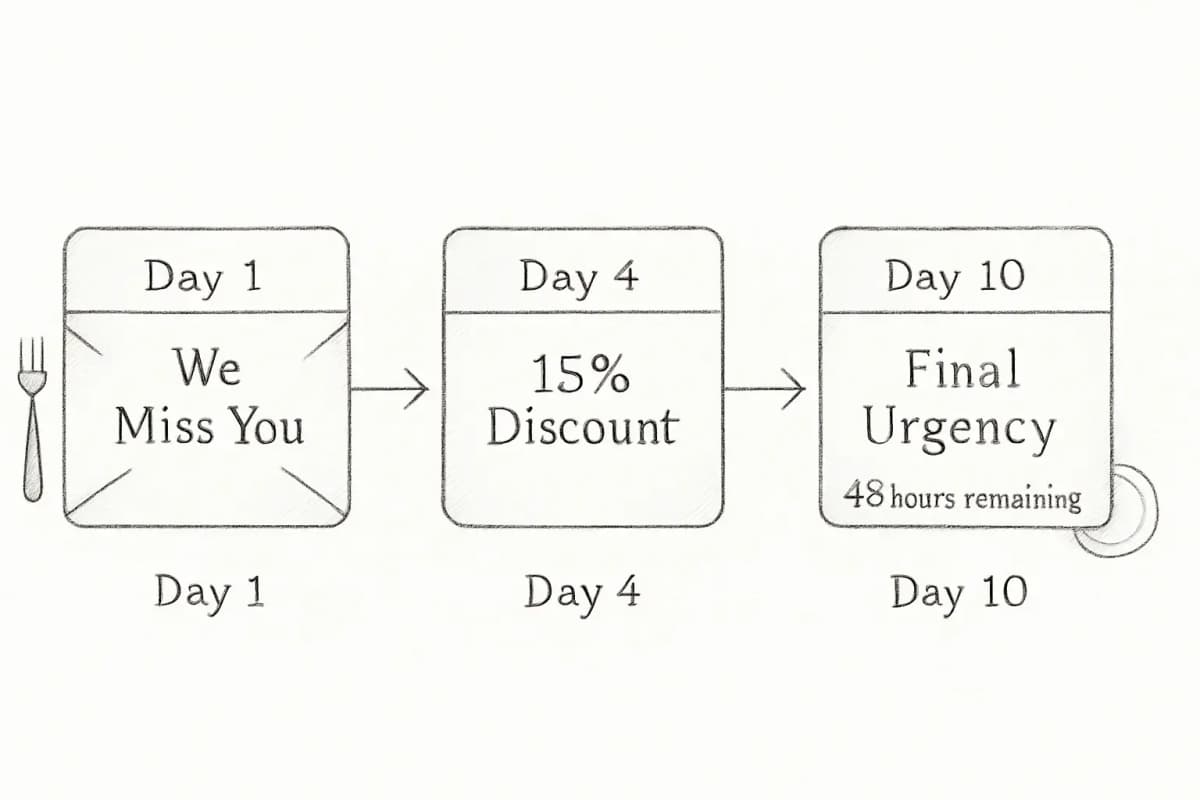
Structure a win-back sequence in three steps:
Email 1 (day 1): Emotional reconnection. "We miss you, [First Name]." No hard sell.
Email 2 (day 4): A modest incentive. "Here's 15% off your next visit, just for coming back."
Adding urgency elements to win-back campaigns drives 14% higher click-through rates than standard re-engagement emails.
6. New Menu Item and Seasonal Announcements
New menu launches and seasonal updates give you a natural reason to email. These campaigns perform well because they offer genuinely new information, not recycled promotions.
Restaurants are increasingly using email to highlight sustainability initiatives, local sourcing, and community events alongside new menu items. This authentic storytelling resonates with modern diners who value transparency, turning ordinary updates into meaningful engagement.
Every restaurant has a segment of lapsed guests who simply drifted away. A well-structured win-back campaign brings a meaningful portion back without paid acquisition costs.
The conversion rate for well-executed automated win-back sequences reaches 10.34%, demonstrating the revenue potential of re-engaging dormant customers.
Patina Restaurant Group's "We miss you" email is a frequently cited example. The message is simple and polite, reminding guests of what they have been missing without pushing too hard, while offering an incentive to bring them back.
Research shows that win-back emails with the phrases "miss you" or "come back" in the subject line achieve a 13% read rate, compared to just 1.8% for generic re-opt-in emails.
Structure a win-back sequence in three steps:
Email 1 (day 1): Emotional reconnection. "We miss you, [First Name]." No hard sell.
Email 2 (day 4): A modest incentive. "Here's 15% off your next visit, just for coming back."
Adding urgency elements to win-back campaigns drives 14% higher click-through rates than standard re-engagement emails.
6. New Menu Item and Seasonal Announcements
New menu launches and seasonal updates give you a natural reason to email. These campaigns perform well because they offer genuinely new information, not recycled promotions.
Restaurants are increasingly using email to highlight sustainability initiatives, local sourcing, and community events alongside new menu items. This authentic storytelling resonates with modern diners who value transparency, turning ordinary updates into meaningful engagement.
What makes a new menu announcement email work:
A bold hero image of the new dish, shot to make it look compelling
A brief, specific description of what makes it different or seasonal
An early-access framing for subscribers: "You're seeing this before anyone else"
A direct reservation or order CTA
Exclusivity changes the way subscribers interact with your brand. When you give them access before the general public, you create a VIP mindset. These guests are more likely to book and engage more with future campaigns.
Segment by order preference: adjust promotions based on past order history. Pizza lovers get pizza-related offers; guests with a sweet tooth get dessert promotions. Apply this same logic to menu launches by routing the announcement to guests most likely to order that category.
7. Post-Dining Follow-Up Emails
A post-visit email sent within 24 to 48 hours does two things: it requests a review while the experience is still fresh, and it plants the seed for the next visit.
Post-dining follow-up emails work best when sent at 48 hours and paired with a "10% off your next meal" incentive.
Send an automated welcome or thank-you email within 24 hours of an online order being placed, featuring an incentive for a return visit. Opted-in guests trust brands with their data, and 57% of consumers say trust in a brand drives their purchase decisions.
What to include:
A genuine thank-you with the guest's name
A one-question feedback prompt or link to your review platform
A soft incentive for the next visit, not a hard sell
A link to your loyalty program if they are not yet enrolled
Personalized emails deliver six times higher transaction rates than non-personalized ones. Using the guest's name and referencing their recent visit, rather than sending a generic follow-up, is the difference between a message that feels like care and one that feels like spam.
Holidays and events create natural urgency that makes promotional emails easier to write and easier to convert.
Seasonal events bring people out, and well-timed emails drive them to your restaurant. Instead of a one-off promo, a three-part campaign (before, day-of, and follow-up) consistently outperforms a single send.
A three-email holiday campaign structure:
A bold hero image of the new dish, shot to make it look compelling
A brief, specific description of what makes it different or seasonal
An early-access framing for subscribers: "You're seeing this before anyone else"
A direct reservation or order CTA
Exclusivity changes the way subscribers interact with your brand. When you give them access before the general public, you create a VIP mindset. These guests are more likely to book and engage more with future campaigns.
Segment by order preference: adjust promotions based on past order history. Pizza lovers get pizza-related offers; guests with a sweet tooth get dessert promotions. Apply this same logic to menu launches by routing the announcement to guests most likely to order that category.
7. Post-Dining Follow-Up Emails
A post-visit email sent within 24 to 48 hours does two things: it requests a review while the experience is still fresh, and it plants the seed for the next visit.
Post-dining follow-up emails work best when sent at 48 hours and paired with a "10% off your next meal" incentive.
Send an automated welcome or thank-you email within 24 hours of an online order being placed, featuring an incentive for a return visit. Opted-in guests trust brands with their data, and 57% of consumers say trust in a brand drives their purchase decisions.
What to include:
A genuine thank-you with the guest's name
A one-question feedback prompt or link to your review platform
A soft incentive for the next visit, not a hard sell
A link to your loyalty program if they are not yet enrolled
Personalized emails deliver six times higher transaction rates than non-personalized ones. Using the guest's name and referencing their recent visit, rather than sending a generic follow-up, is the difference between a message that feels like care and one that feels like spam.
Holidays and events create natural urgency that makes promotional emails easier to write and easier to convert.
Seasonal events bring people out, and well-timed emails drive them to your restaurant. Instead of a one-off promo, a three-part campaign (before, day-of, and follow-up) consistently outperforms a single send.
A three-email holiday campaign structure:
7 to 10 days out: Announce the event or special menu. Build anticipation.
Day before or morning of: Last chance reminder with a reservation link.
Two days after: Follow-up with a recap, thank-you, or next event teaser.
Event emails promoting holidays like Mother's Day work best with a clean, scannable layout that makes the offer and booking details immediately visible.
How to Measure Whether Your Restaurant Email Campaigns Are Working
Sending campaigns is only half the job. Knowing which metrics to watch tells you whether they are actually driving revenue.
The metrics that matter most:
Open rate: According to GetResponse's 2023 Email Marketing Benchmarks, the restaurant industry benchmark open rate is around 35%. Anything above that is a strong signal your subject lines are working.
Click-through rate (CTR): This measures whether your content and CTA are compelling enough to drive action after the open.
Conversion rate: Track reservations, online orders, or loyalty sign-ups directly tied to a specific campaign.
Revenue per email sent: The most direct measure of campaign ROI.
A/B testing CTAs and subject lines is the most reliable way to find what resonates. Try variations like "Order Now" versus "Claim My Reward" to identify what drives the most engagement and sales.
Frequently Asked Questions
What types of emails work best for restaurant marketing?
The most profitable email campaigns for restaurants include cart abandonment emails, welcome emails, first-time customer campaigns, repeat order emails, and win-back emails, all designed to drive sales and customer retention. Automated, behavior-triggered campaigns consistently outperform one-off broadcast emails.
How often should restaurants send marketing emails?
The ideal email frequency depends heavily on the subscriber segment. New email subscribers can receive a welcome series up to three times a week, while loyal visitors respond well to one to two emails per week with targeted promotions or event invites.
What is a good open rate for restaurant email campaigns?
According to HubSpot's industry benchmarks, the average open rate for the food and beverage industry is 40.56%. Birthday and welcome emails consistently exceed this benchmark, while promotional emails tend to land closer to the average. Use your own historical data as the primary benchmark over time.
How do restaurants build an email list?
The most effective way for restaurants to build an email list is through automated data capture across multiple guest touchpoints, including guest WiFi logins, POS transaction data, online ordering systems, reservation platforms, and website interaction widgets. Pairing each touchpoint with a clear incentive (a free item, loyalty points, or exclusive access) significantly increases sign-up rates.
7 to 10 days out: Announce the event or special menu. Build anticipation.
Day before or morning of: Last chance reminder with a reservation link.
Two days after: Follow-up with a recap, thank-you, or next event teaser.
Event emails promoting holidays like Mother's Day work best with a clean, scannable layout that makes the offer and booking details immediately visible.
How to Measure Whether Your Restaurant Email Campaigns Are Working
Sending campaigns is only half the job. Knowing which metrics to watch tells you whether they are actually driving revenue.
The metrics that matter most:
Open rate: According to GetResponse's 2023 Email Marketing Benchmarks, the restaurant industry benchmark open rate is around 35%. Anything above that is a strong signal your subject lines are working.
Click-through rate (CTR): This measures whether your content and CTA are compelling enough to drive action after the open.
Conversion rate: Track reservations, online orders, or loyalty sign-ups directly tied to a specific campaign.
Revenue per email sent: The most direct measure of campaign ROI.
A/B testing CTAs and subject lines is the most reliable way to find what resonates. Try variations like "Order Now" versus "Claim My Reward" to identify what drives the most engagement and sales.
Frequently Asked Questions
What types of emails work best for restaurant marketing?
The most profitable email campaigns for restaurants include cart abandonment emails, welcome emails, first-time customer campaigns, repeat order emails, and win-back emails, all designed to drive sales and customer retention. Automated, behavior-triggered campaigns consistently outperform one-off broadcast emails.
How often should restaurants send marketing emails?
The ideal email frequency depends heavily on the subscriber segment. New email subscribers can receive a welcome series up to three times a week, while loyal visitors respond well to one to two emails per week with targeted promotions or event invites.
What is a good open rate for restaurant email campaigns?
According to HubSpot's industry benchmarks, the average open rate for the food and beverage industry is 40.56%. Birthday and welcome emails consistently exceed this benchmark, while promotional emails tend to land closer to the average. Use your own historical data as the primary benchmark over time.
How do restaurants build an email list?
The most effective way for restaurants to build an email list is through automated data capture across multiple guest touchpoints, including guest WiFi logins, POS transaction data, online ordering systems, reservation platforms, and website interaction widgets. Pairing each touchpoint with a clear incentive (a free item, loyalty points, or exclusive access) significantly increases sign-up rates.