Email marketing delivers an average return of $36 to $42 for every $1 spent, yet most SaaS companies still treat it as an afterthought. They send a welcome email on day one, a newsletter when they remember, and a discount when numbers look bad. That approach leaves serious money on the table. A well-structured SaaS email marketing strategy moves users from free trial to paid plan, keeps them engaged through onboarding, and reduces churn before it shows up in your MRR. This guide breaks down exactly how to build one.
Key Takeaways
Segmented campaigns can drive up to 760% more email revenue, and heavily personalized emails can 2 to 3x reply rates.
Automated emails generate roughly 320% more revenue than non-automated ones.
In 2025, SaaS and tech marketing emails typically see 23 to 30% open rates and 3 to 4% click-through rates.
Reducing churn by just 5% can boost profits by an impressive 25% to 95%.
Across B2B, reported email marketing ROI remains roughly $36 to $42 returned per $1 spent, and 59% of B2B marketers still call email their most effective revenue channel.
Why SaaS Email Marketing Is Different
Email marketing for SaaS is not the same as retail or media email. The goals are fundamentally different: email campaigns for software companies need a unique approach. In this industry, the focus is on user onboarding and retention, subscription renewal and upselling, product announcements, and educational content.
The SaaS subscription model means every email either supports or threatens recurring revenue. A bad onboarding sequence drives trial abandonment. An irrelevant upsell email at the wrong lifecycle stage damages trust. At the same time, about 71% of B2B marketers used email newsletters to nurture leads in 2024, and 73% of B2B buyers prefer that sellers contact them via email.
Your audience is also more technically literate than average. You are reaching out to people who already have some technical knowledge in your niche. You need to be accurate and engaging at the same time. Vague benefit claims and generic copy get ignored or unsubscribed.
The benchmark data reflects this: the technology and SaaS industry sees an open rate of roughly 38.1%. That is significantly above many other sectors, which means a good SaaS email list is engaged and expectant. The risk is squandering that attention with poor targeting and weak sequencing.
Email marketing delivers an average return of $36 to $42 for every $1 spent, yet most SaaS companies still treat it as an afterthought. They send a welcome email on day one, a newsletter when they remember, and a discount when numbers look bad. That approach leaves serious money on the table. A well-structured SaaS email marketing strategy moves users from free trial to paid plan, keeps them engaged through onboarding, and reduces churn before it shows up in your MRR. This guide breaks down exactly how to build one.
Key Takeaways
Segmented campaigns can drive up to 760% more email revenue, and heavily personalized emails can 2 to 3x reply rates.
Automated emails generate roughly 320% more revenue than non-automated ones.
In 2025, SaaS and tech marketing emails typically see 23 to 30% open rates and 3 to 4% click-through rates.
Reducing churn by just 5% can boost profits by an impressive 25% to 95%.
Across B2B, reported email marketing ROI remains roughly $36 to $42 returned per $1 spent, and 59% of B2B marketers still call email their most effective revenue channel.
Why SaaS Email Marketing Is Different
Email marketing for SaaS is not the same as retail or media email. The goals are fundamentally different: email campaigns for software companies need a unique approach. In this industry, the focus is on user onboarding and retention, subscription renewal and upselling, product announcements, and educational content.
The SaaS subscription model means every email either supports or threatens recurring revenue. A bad onboarding sequence drives trial abandonment. An irrelevant upsell email at the wrong lifecycle stage damages trust. At the same time, about 71% of B2B marketers used email newsletters to nurture leads in 2024, and 73% of B2B buyers prefer that sellers contact them via email.
Your audience is also more technically literate than average. You are reaching out to people who already have some technical knowledge in your niche. You need to be accurate and engaging at the same time. Vague benefit claims and generic copy get ignored or unsubscribed.
The benchmark data reflects this: the technology and SaaS industry sees an open rate of roughly 38.1%. That is significantly above many other sectors, which means a good SaaS email list is engaged and expectant. The risk is squandering that attention with poor targeting and weak sequencing.
Build Your Lifecycle Email Framework First
Before writing a single subject line, map your customer lifecycle. Every SaaS email program needs to cover these core stages:
Lead nurture: Convert trial signups and content subscribers into product-qualified leads.
Onboarding: Guide new users to their first meaningful outcome inside the product.
Activation: Encourage adoption of the features that correlate with long-term retention.
Retention and expansion: Reinforce value and surface upsell opportunities at the right moment.
Win-back: Re-engage churned or at-risk users with targeted sequences.
Research shows that most email marketing efforts are focused on the top of the funnel with minimal follow-up or nurturing through the lifecycle stages. This highlights a potential area for improvement, as implementing a more robust lifecycle email marketing strategy could enhance engagement and conversions throughout the buyer journey.
Most SaaS teams focus on the first one or two stages and then go quiet. That silence is where churn starts.
Onboarding Emails: The Highest-Leverage Sequence You Have
Your onboarding sequence has one job: get users to value, fast. Between 40 and 60% of users who sign up for a free trial of your software will use it once and never come back. Email is the primary tool for recovering those users and guiding them toward an "aha moment."
A proven onboarding framework for SaaS works in three tracks:
Quick Win track: Get users to their first success inside the product.
Hook track: Use habit-forming principles (trigger, action, reward, investment) to build repeat usage.
Conversion track: Move product-qualified leads from free to paid with specific, outcome-focused copy.
Anchor your onboarding emails around five core types: welcome emails, usage tips, sales touches, usage reviews, and expiry warnings. Write emails that address objections, teach outcomes, emphasize benefits over features, and include one clear CTA.
Most effective onboarding sequences run 5 to 7 emails over 14 days, with the first email confirming signup, setting expectations, and giving users ONE action to take.
Build Your Lifecycle Email Framework First
Before writing a single subject line, map your customer lifecycle. Every SaaS email program needs to cover these core stages:
Lead nurture: Convert trial signups and content subscribers into product-qualified leads.
Onboarding: Guide new users to their first meaningful outcome inside the product.
Activation: Encourage adoption of the features that correlate with long-term retention.
Retention and expansion: Reinforce value and surface upsell opportunities at the right moment.
Win-back: Re-engage churned or at-risk users with targeted sequences.
Research shows that most email marketing efforts are focused on the top of the funnel with minimal follow-up or nurturing through the lifecycle stages. This highlights a potential area for improvement, as implementing a more robust lifecycle email marketing strategy could enhance engagement and conversions throughout the buyer journey.
Most SaaS teams focus on the first one or two stages and then go quiet. That silence is where churn starts.
Onboarding Emails: The Highest-Leverage Sequence You Have
Your onboarding sequence has one job: get users to value, fast. Between 40 and 60% of users who sign up for a free trial of your software will use it once and never come back. Email is the primary tool for recovering those users and guiding them toward an "aha moment."
A proven onboarding framework for SaaS works in three tracks:
Quick Win track: Get users to their first success inside the product.
Hook track: Use habit-forming principles (trigger, action, reward, investment) to build repeat usage.
Conversion track: Move product-qualified leads from free to paid with specific, outcome-focused copy.
Anchor your onboarding emails around five core types: welcome emails, usage tips, sales touches, usage reviews, and expiry warnings. Write emails that address objections, teach outcomes, emphasize benefits over features, and include one clear CTA.
Most effective onboarding sequences run 5 to 7 emails over 14 days, with the first email confirming signup, setting expectations, and giving users ONE action to take.
The first email from your welcome flow is typically your most opened: expect 40 to 60% open rates. Use that first email to confirm the signup, establish the next step clearly, and set a warm tone from a real person, not a no-reply address. Our welcome email sequence best practices guide covers the structure in detail.
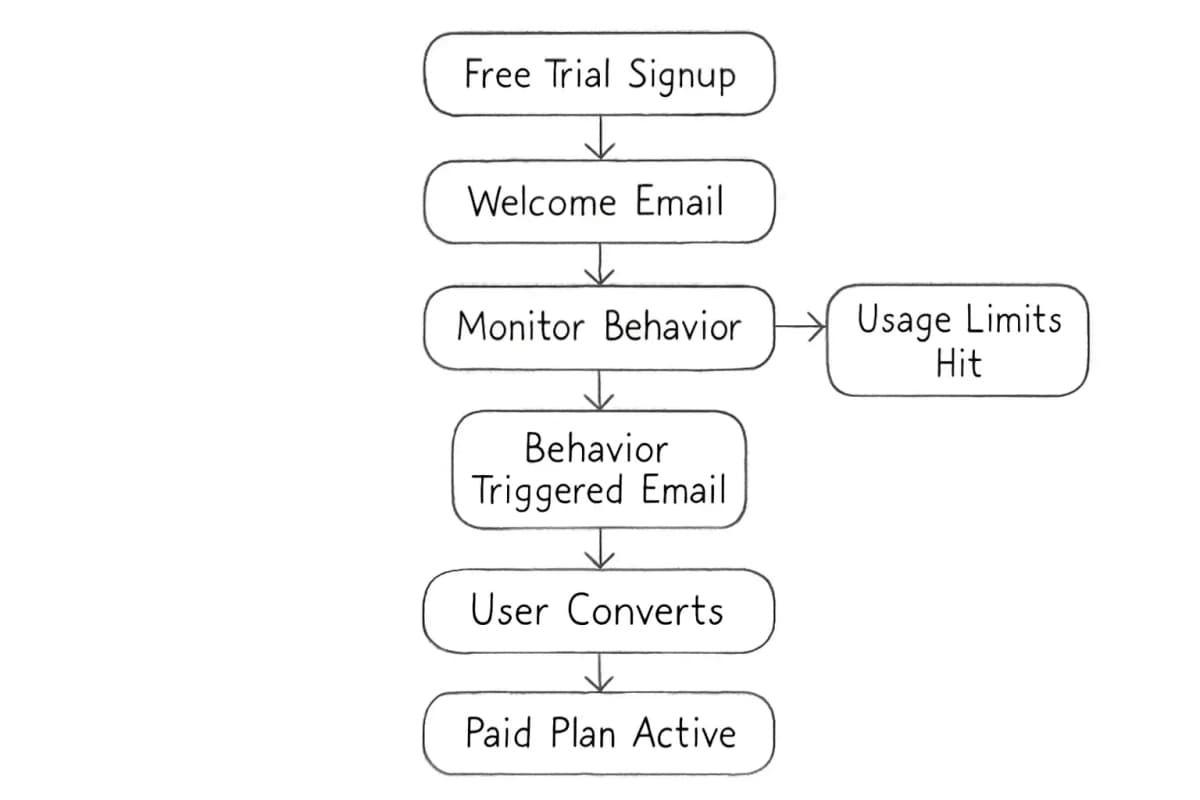
Avoid "nagging" messages that are purely time-based; combine timing with behavior signals to send just-in-time guidance. The simplest version of this: if a user completes setup, stop sending setup tips. Trigger the next relevant email based on what they did, or did not do, inside the product.
Segmentation: Send the Right Message, Not the Same Message
Sending the same email to every user on your list is one of the fastest ways to degrade your sender reputation and subscriber trust. Segmenting your SaaS email list helps you deliver the right message to the right audience based on different customer profiles and personas. It is a simple yet effective strategy for enhanced personalization.
For SaaS, the most useful segmentation dimensions are:
Plan type: Free, trial, paying, churned
Role or job title: Developer, marketer, founder, enterprise buyer
Feature adoption: Which features they have or have not used
Lifecycle stage: Days since signup, last login date, engagement score
Company size or industry: SMB versus mid-market versus enterprise
For example, the messaging for a startup founder should focus on growth and scalability, while the pitch to an enterprise CIO should emphasize security and integration.
Behavioral segmentation is the most powerful layer. Analyze how email subscribers and current users interact with your emails and SaaS platform. Use data such as previous purchases, frequency of usage, feature adoption, level of engagement with your emails or website, or stage in the customer lifecycle.
Automation: Scale What Works Without Scaling the Work
Automations account for just 2% of email sends but drive 30% of revenue, earning 16 times more per send than scheduled campaigns. For SaaS teams with limited resources, that ratio matters enormously.
The highest-impact automations to build first:
The first email from your welcome flow is typically your most opened: expect 40 to 60% open rates. Use that first email to confirm the signup, establish the next step clearly, and set a warm tone from a real person, not a no-reply address. Our welcome email sequence best practices guide covers the structure in detail.
Avoid "nagging" messages that are purely time-based; combine timing with behavior signals to send just-in-time guidance. The simplest version of this: if a user completes setup, stop sending setup tips. Trigger the next relevant email based on what they did, or did not do, inside the product.
Segmentation: Send the Right Message, Not the Same Message
Sending the same email to every user on your list is one of the fastest ways to degrade your sender reputation and subscriber trust. Segmenting your SaaS email list helps you deliver the right message to the right audience based on different customer profiles and personas. It is a simple yet effective strategy for enhanced personalization.
For SaaS, the most useful segmentation dimensions are:
Plan type: Free, trial, paying, churned
Role or job title: Developer, marketer, founder, enterprise buyer
Feature adoption: Which features they have or have not used
Lifecycle stage: Days since signup, last login date, engagement score
Company size or industry: SMB versus mid-market versus enterprise
For example, the messaging for a startup founder should focus on growth and scalability, while the pitch to an enterprise CIO should emphasize security and integration.
Behavioral segmentation is the most powerful layer. Analyze how email subscribers and current users interact with your emails and SaaS platform. Use data such as previous purchases, frequency of usage, feature adoption, level of engagement with your emails or website, or stage in the customer lifecycle.
Automation: Scale What Works Without Scaling the Work
Automations account for just 2% of email sends but drive 30% of revenue, earning 16 times more per send than scheduled campaigns. For SaaS teams with limited resources, that ratio matters enormously.
The highest-impact automations to build first:
Trial expiry warnings: Send the expiry warning email when there is one week left in the trial to remind users to buy your product. Be helpful and confident, not pushy and salesy.
Behavior-triggered tips: Fire when a user does, or fails to do, a key action in your product.
Re-engagement sequences: A churn prevention email sequence is a series of automated emails sent to users who show signs of disengagement or inactivity, with the goal of re-engaging them before they cancel.
Dunning emails: A significant portion of SaaS churn, between 20 and 40%, comes from involuntary churn when subscriptions are canceled because of failed payments, often caused by expired cards or insufficient funds. Automated dunning sequences catch these before they become permanent losses.
Upsell triggers: Fire when users hit usage limits or adopt features associated with higher-tier plans.
Real-world results back this up: BugHerd increased trial activations by 35% with automated email workflows, while Monarch Money cut trial cancellations by 3.36% and tripled referrals with behavior-triggered messaging.
Personalization: Go Beyond First Name
Basic personalization is table stakes. What moves the needle for email marketing in SaaS is behavioral personalization: showing users data about their own activity, surfacing features relevant to their specific use case, and writing copy that reflects where they actually are in their journey.
Users are always trying to find ways to get the most out of the software they have purchased. Sending SaaS emails that feature personalized insights can help them do just that.
Practical personalization tactics for SaaS:
Show users their own product metrics (reports sent, tasks completed, time saved)
Reference the specific feature they used last or a feature they have not tried yet
Adjust copy based on plan type: trial users need activation guidance, paying users need expansion ideas
Use the product data in your CRM or CDP to trigger emails when meaningful thresholds are reached
Proactive email marketing campaigns keep clients engaged. Educational content, product updates, bug-fix notifications, and progress reports help maintain customers' interest and reinforce the value of your SaaS.
Trial expiry warnings: Send the expiry warning email when there is one week left in the trial to remind users to buy your product. Be helpful and confident, not pushy and salesy.
Behavior-triggered tips: Fire when a user does, or fails to do, a key action in your product.
Re-engagement sequences: A churn prevention email sequence is a series of automated emails sent to users who show signs of disengagement or inactivity, with the goal of re-engaging them before they cancel.
Dunning emails: A significant portion of SaaS churn, between 20 and 40%, comes from involuntary churn when subscriptions are canceled because of failed payments, often caused by expired cards or insufficient funds. Automated dunning sequences catch these before they become permanent losses.
Upsell triggers: Fire when users hit usage limits or adopt features associated with higher-tier plans.
Real-world results back this up: BugHerd increased trial activations by 35% with automated email workflows, while Monarch Money cut trial cancellations by 3.36% and tripled referrals with behavior-triggered messaging.
Personalization: Go Beyond First Name
Basic personalization is table stakes. What moves the needle for email marketing in SaaS is behavioral personalization: showing users data about their own activity, surfacing features relevant to their specific use case, and writing copy that reflects where they actually are in their journey.
Users are always trying to find ways to get the most out of the software they have purchased. Sending SaaS emails that feature personalized insights can help them do just that.
Practical personalization tactics for SaaS:
Show users their own product metrics (reports sent, tasks completed, time saved)
Reference the specific feature they used last or a feature they have not tried yet
Adjust copy based on plan type: trial users need activation guidance, paying users need expansion ideas
Use the product data in your CRM or CDP to trigger emails when meaningful thresholds are reached
Proactive email marketing campaigns keep clients engaged. Educational content, product updates, bug-fix notifications, and progress reports help maintain customers' interest and reinforce the value of your SaaS.
Reducing Churn With Email: A Retention-First Mindset
SaaS services spend six times more on acquiring new clients than on retaining existing ones, yet reducing churn rate should be among the top priorities of all businesses. Email is your most scalable retention tool.
Churn rarely happens overnight. It is usually the result of multiple missed moments: confusion, lack of progress, or declining motivation. A single email is rarely enough to reverse that trend. A well-timed sequence of emails gives you multiple touchpoints to remind users of value, remove friction, and guide them back toward successful product usage.
Effective churn-prevention signals to monitor and act on:
Login drop-off: No login in 7 to 14 days triggers a re-engagement flow
Feature abandonment: Started setup but did not complete it
Declining usage: Month-over-month drop in activity
Support friction: Unresolved tickets or repeated help-doc visits on the same topic
Mention, the media monitoring SaaS, was able to lower churn by 22% in a single month by combining automated emails that encouraged feature activation with a webinar that demonstrated product value. The key was acting on behavioral data, not just calendar-based sends.
HubSpot uses automated email campaigns, in-app messaging, and personalized outreach to address customer concerns, gather feedback, and offer assistance, reducing churn by addressing issues before they escalate.
Measuring What Actually Matters
Most SaaS email programs track open rates and click-through rates and stop there. Those metrics describe engagement. They do not describe business impact.
For SaaS executives, understanding email marketing metrics is not just about tracking opens and clicks. It is about connecting these metrics to revenue growth, customer retention, and product adoption.
The metrics that matter for a SaaS email marketing strategy:
Trial-to-paid conversion rate: According to Acoustic's benchmark data, the average conversion rate from email campaigns ranges from 1 to 3% for SaaS companies.
Feature adoption rate per email: Which sequences actually drive product usage
Churn rate by cohort: Compare churn for users who received onboarding emails versus those who did not
Revenue per email (RPE): Globally, automated emails generate $2.87 per email compared to $0.18 for scheduled campaigns.
MQL-to-SQL conversion from email: Email marketing MQLs have an 11.3% better conversion rate compared to the blended average across channels.
Treat opens as a directional metric only. For sales development, benchmark success on replies, meetings booked, and pipeline created, not vanity open rates.
Reducing Churn With Email: A Retention-First Mindset
SaaS services spend six times more on acquiring new clients than on retaining existing ones, yet reducing churn rate should be among the top priorities of all businesses. Email is your most scalable retention tool.
Churn rarely happens overnight. It is usually the result of multiple missed moments: confusion, lack of progress, or declining motivation. A single email is rarely enough to reverse that trend. A well-timed sequence of emails gives you multiple touchpoints to remind users of value, remove friction, and guide them back toward successful product usage.
Effective churn-prevention signals to monitor and act on:
Login drop-off: No login in 7 to 14 days triggers a re-engagement flow
Feature abandonment: Started setup but did not complete it
Declining usage: Month-over-month drop in activity
Support friction: Unresolved tickets or repeated help-doc visits on the same topic
Mention, the media monitoring SaaS, was able to lower churn by 22% in a single month by combining automated emails that encouraged feature activation with a webinar that demonstrated product value. The key was acting on behavioral data, not just calendar-based sends.
HubSpot uses automated email campaigns, in-app messaging, and personalized outreach to address customer concerns, gather feedback, and offer assistance, reducing churn by addressing issues before they escalate.
Measuring What Actually Matters
Most SaaS email programs track open rates and click-through rates and stop there. Those metrics describe engagement. They do not describe business impact.
For SaaS executives, understanding email marketing metrics is not just about tracking opens and clicks. It is about connecting these metrics to revenue growth, customer retention, and product adoption.
The metrics that matter for a SaaS email marketing strategy:
Trial-to-paid conversion rate: According to Acoustic's benchmark data, the average conversion rate from email campaigns ranges from 1 to 3% for SaaS companies.
Feature adoption rate per email: Which sequences actually drive product usage
Churn rate by cohort: Compare churn for users who received onboarding emails versus those who did not
Revenue per email (RPE): Globally, automated emails generate $2.87 per email compared to $0.18 for scheduled campaigns.
MQL-to-SQL conversion from email: Email marketing MQLs have an 11.3% better conversion rate compared to the blended average across channels.
Treat opens as a directional metric only. For sales development, benchmark success on replies, meetings booked, and pipeline created, not vanity open rates.
Deliverability: The Foundation Everything Else Depends On
A great email campaign that lands in spam generates zero revenue. Keep spam complaints under 0.1% and hard bounces under 0.5%. Authenticate every domain with SPF, DKIM, and DMARC to stay compliant with Gmail and Yahoo's 2024 and later rules.
In 2025, Gmail and Yahoo enforce strict authentication and spam thresholds for bulk senders. Treat SPF, DKIM, DMARC, domain warm-up, and complaint rates as board-level issues, not IT chores.
Additional deliverability practices for SaaS teams:
Run list hygiene at least quarterly. Remove hard bounces immediately, suppress contacts who repeatedly soft bounce, and quarantine any segments driving elevated complaint rates.
Never send from a no-reply address. Make sure you are using real reply-to emails and checking your inbox regularly. Do not send onboarding emails from a no-reply email.
Warm up new sending domains gradually before ramping volume.
Your subject lines also affect deliverability indirectly. Clickbait subject lines can spike opens while depressing replies and damaging trust, which means less revenue even if the dashboard looks good. Instead, benchmark subject lines on downstream metrics: positive replies, meetings booked, and opportunities created. See email subject line best practices that boost open rates by 27% for a tested framework.
Frequently Asked Questions
What types of emails should a SaaS company send?
The core email types for a SaaS company are welcome and onboarding sequences, behavior-triggered usage tips, trial expiry warnings, feature adoption nudges, upsell and expansion offers, renewal reminders, re-engagement sequences for inactive users, and dunning emails for failed payments. Each serves a specific stage in the customer lifecycle and should be triggered by user behavior, not just calendar timing.
What is a good open rate for SaaS emails?
One 2025 benchmark reports about 29.2% average opens and 4.1% CTR, while another SaaS-focused dataset reports 23.4% opens and 3.2% CTR. Onboarding and lifecycle emails tend to outperform newsletter benchmarks because the audience has higher intent and more context. The first welcome email from an onboarding flow typically sees 40 to 60% open rates.
How often should SaaS companies email their users?
Deliverability: The Foundation Everything Else Depends On
A great email campaign that lands in spam generates zero revenue. Keep spam complaints under 0.1% and hard bounces under 0.5%. Authenticate every domain with SPF, DKIM, and DMARC to stay compliant with Gmail and Yahoo's 2024 and later rules.
In 2025, Gmail and Yahoo enforce strict authentication and spam thresholds for bulk senders. Treat SPF, DKIM, DMARC, domain warm-up, and complaint rates as board-level issues, not IT chores.
Additional deliverability practices for SaaS teams:
Run list hygiene at least quarterly. Remove hard bounces immediately, suppress contacts who repeatedly soft bounce, and quarantine any segments driving elevated complaint rates.
Never send from a no-reply address. Make sure you are using real reply-to emails and checking your inbox regularly. Do not send onboarding emails from a no-reply email.
Warm up new sending domains gradually before ramping volume.
Your subject lines also affect deliverability indirectly. Clickbait subject lines can spike opens while depressing replies and damaging trust, which means less revenue even if the dashboard looks good. Instead, benchmark subject lines on downstream metrics: positive replies, meetings booked, and opportunities created. See email subject line best practices that boost open rates by 27% for a tested framework.
Frequently Asked Questions
What types of emails should a SaaS company send?
The core email types for a SaaS company are welcome and onboarding sequences, behavior-triggered usage tips, trial expiry warnings, feature adoption nudges, upsell and expansion offers, renewal reminders, re-engagement sequences for inactive users, and dunning emails for failed payments. Each serves a specific stage in the customer lifecycle and should be triggered by user behavior, not just calendar timing.
What is a good open rate for SaaS emails?
One 2025 benchmark reports about 29.2% average opens and 4.1% CTR, while another SaaS-focused dataset reports 23.4% opens and 3.2% CTR. Onboarding and lifecycle emails tend to outperform newsletter benchmarks because the audience has higher intent and more context. The first welcome email from an onboarding flow typically sees 40 to 60% open rates.
How often should SaaS companies email their users?
Frequency depends on lifecycle stage. During a 14-day trial, 5 to 7 emails spread across the trial period is normal and expected. Avoid daily emails. More than one per day during a trial is too much. For paying customers, a cadence of 2 to 4 emails per month, with additional behavior-triggered emails as needed, tends to keep engagement high without driving unsubscribes. Always let user behavior, not arbitrary schedules, dictate timing.
How does email marketing reduce SaaS churn?
An onboarding email series reduces early churn by guiding subscribers through your product's core features step by step, which builds confidence, drives engagement, and fosters long-term loyalty. Beyond onboarding, churn-prevention sequences detect disengagement signals (login drop-off, feature abandonment, declining usage) and intervene before users decide to cancel. Reducing churn by just 5% can boost profits by 25% to 95%, which makes a systematic email retention program one of the highest-ROI investments a SaaS company can make.
No comments yet. Be the first!
Frequency depends on lifecycle stage. During a 14-day trial, 5 to 7 emails spread across the trial period is normal and expected. Avoid daily emails. More than one per day during a trial is too much. For paying customers, a cadence of 2 to 4 emails per month, with additional behavior-triggered emails as needed, tends to keep engagement high without driving unsubscribes. Always let user behavior, not arbitrary schedules, dictate timing.
How does email marketing reduce SaaS churn?
An onboarding email series reduces early churn by guiding subscribers through your product's core features step by step, which builds confidence, drives engagement, and fosters long-term loyalty. Beyond onboarding, churn-prevention sequences detect disengagement signals (login drop-off, feature abandonment, declining usage) and intervene before users decide to cancel. Reducing churn by just 5% can boost profits by 25% to 95%, which makes a systematic email retention program one of the highest-ROI investments a SaaS company can make.