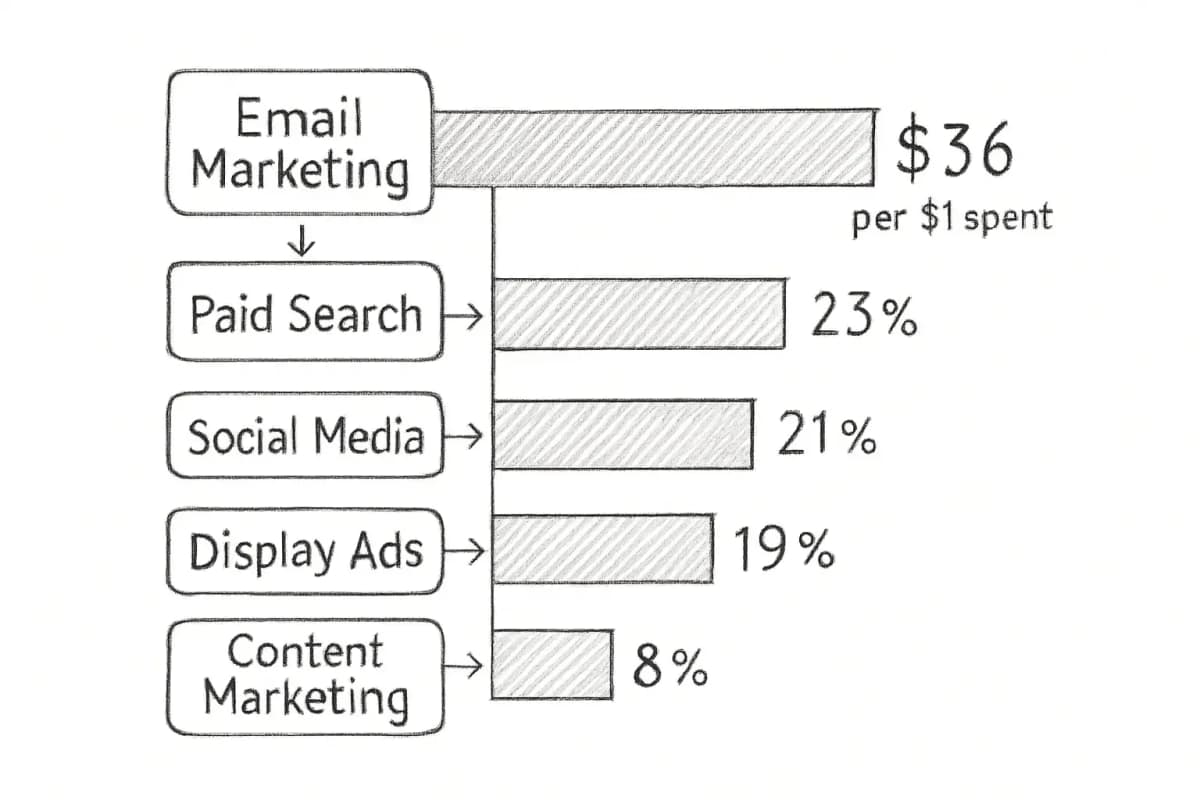
Email marketing still delivers better ROI than almost any other digital channel. Businesses earn an average of $36 for every dollar spent on email marketing, and that figure climbs higher for brands that treat their programs with discipline. The problem is that most teams know email works in theory but struggle to put the right practices together consistently. This guide covers seven tips for successful email marketing that directly affect deliverability, engagement, and revenue, whether you run a small business or a growth team at a scaling company.
Key Takeaways
For every $1 spent on email marketing, businesses see a return of $36, a 3,600% ROI.
Automated messages account for just 2% of email volume but generated 37% of all email-attributed sales in 2024.
Segmented email campaigns generate 30% more opens and 50% more click-throughs than non-segmented campaigns.
Personalized emails see a 29% higher open rate, and personalized calls to action result in 42% higher conversion rates than standard CTAs.
Brands that regularly A/B test their emails achieve 83% higher ROI than those that never test.
1. Build and Maintain a Clean, Permission-Based List
Your list is the foundation of everything. A large list with poor quality will cost you more in platform fees, hurt your sender reputation, and suppress your results across every other tactic you apply.
Nearly 4.5 billion people use email worldwide in 2025, and 88% of users check their email multiple times a day. The opportunity is enormous, but only if you are reaching the right people.
What to do:
Use confirmed opt-in (double opt-in) to verify addresses before they enter your main list.
Remove hard bounces immediately and suppress unengaged contacts every 90 days.
Never purchase lists. Staying off spam lists requires working with a reputable email platform and ensuring every person on your list has signed up and wants to receive your messages.
Audit your list hygiene quarterly. A smaller, engaged list consistently outperforms a bloated, disengaged one.
For practical tools to grow your list the right way, see our guide on .
Email marketing still delivers better ROI than almost any other digital channel. Businesses earn an average of $36 for every dollar spent on email marketing, and that figure climbs higher for brands that treat their programs with discipline. The problem is that most teams know email works in theory but struggle to put the right practices together consistently. This guide covers seven tips for successful email marketing that directly affect deliverability, engagement, and revenue, whether you run a small business or a growth team at a scaling company.
Key Takeaways
For every $1 spent on email marketing, businesses see a return of $36, a 3,600% ROI.
Automated messages account for just 2% of email volume but generated 37% of all email-attributed sales in 2024.
Segmented email campaigns generate 30% more opens and 50% more click-throughs than non-segmented campaigns.
Personalized emails see a 29% higher open rate, and personalized calls to action result in 42% higher conversion rates than standard CTAs.
Brands that regularly A/B test their emails achieve 83% higher ROI than those that never test.
1. Build and Maintain a Clean, Permission-Based List
Your list is the foundation of everything. A large list with poor quality will cost you more in platform fees, hurt your sender reputation, and suppress your results across every other tactic you apply.
Nearly 4.5 billion people use email worldwide in 2025, and 88% of users check their email multiple times a day. The opportunity is enormous, but only if you are reaching the right people.
What to do:
Use confirmed opt-in (double opt-in) to verify addresses before they enter your main list.
Remove hard bounces immediately and suppress unengaged contacts every 90 days.
Never purchase lists. Staying off spam lists requires working with a reputable email platform and ensuring every person on your list has signed up and wants to receive your messages.
Audit your list hygiene quarterly. A smaller, engaged list consistently outperforms a bloated, disengaged one.
For practical tools to grow your list the right way, see our guide on .
Sending the same message to your entire list is one of the most reliable ways to depress results. Segmentation fixes this by matching the message to the audience.
An impressive 77% of ROI in email content marketing comes from segmented, targeted, and triggered campaigns. That number alone should change how you think about your send strategy.
Segmented campaigns can drive 30% more opens and 50% more click-throughs than non-segmented ones, and 78% of marketers say segmenting their email lists is the best way to make their campaigns work.
Common segmentation criteria to start with:
Purchase history (first-time buyers vs. repeat customers)
Geographic location
Lead source (how they joined your list)
Engagement level (active openers vs. lapsed subscribers)
Funnel stage (awareness, consideration, decision)
According to Campaign Monitor, 74% of online consumers get frustrated when content like offers, ads, and promotions are not aligned with their interests. Segmentation is how you prevent that frustration.
If your subject line fails, nothing else matters. The rest of your email never gets seen.
47% of recipients open emails based solely on the subject line, while 69% report emails as spam for the same reason. That single variable carries enormous weight in both directions.
Sending the same message to your entire list is one of the most reliable ways to depress results. Segmentation fixes this by matching the message to the audience.
An impressive 77% of ROI in email content marketing comes from segmented, targeted, and triggered campaigns. That number alone should change how you think about your send strategy.
Segmented campaigns can drive 30% more opens and 50% more click-throughs than non-segmented ones, and 78% of marketers say segmenting their email lists is the best way to make their campaigns work.
Common segmentation criteria to start with:
Purchase history (first-time buyers vs. repeat customers)
Geographic location
Lead source (how they joined your list)
Engagement level (active openers vs. lapsed subscribers)
Funnel stage (awareness, consideration, decision)
According to Campaign Monitor, 74% of online consumers get frustrated when content like offers, ads, and promotions are not aligned with their interests. Segmentation is how you prevent that frustration.
If your subject line fails, nothing else matters. The rest of your email never gets seen.
47% of recipients open emails based solely on the subject line, while 69% report emails as spam for the same reason. That single variable carries enormous weight in both directions.
Key subject line principles backed by data:
Use personalization. Personalized subject lines are 26% more likely to be opened.
Keep it focused. Emails with subject lines between 61 and 70 characters get the highest open rates, averaging 43.38%.
Ask questions. Questions in subject lines can increase opens by up to 50%, and numbers can boost them by 17%.
Test continuously. The best-performing subject line for your audience is specific to them, not a general best practice.
Avoid clickbait. It may inflate opens short-term, but it trains subscribers to expect misleading content and accelerates unsubscribes. For a data-driven deep dive, read our article on email subject line best practices.
4. Personalize Beyond the First Name
Personalization has moved well past inserting {{first_name}} into a greeting. That is now the baseline, not the differentiator.
Personalized emails have been shown to deliver six times more transactions than generic, non-personalized ones. The mechanism is relevance. When content matches what a subscriber actually cares about, they engage and buy.
71% of consumers expect personalized interactions from brands, and 76% get frustrated when their brand interactions are not personalized to their interests.
Effective personalization tactics include:
Dynamic content blocks that change based on subscriber behavior or preferences
Product recommendations based on purchase or browsing history
Triggered emails sent in response to specific actions (cart abandonment, page views, form completions)
Send-time optimization per individual subscriber rather than one fixed time for the whole list
Data shows that companies that invest in personalizing email outreach earn 40% more than their competitors.
Explore specific techniques in our guide on email personalization techniques that boost conversions.
5. Use Automation to Send the Right Message at the Right Time
Manual campaigns have their place, but automated workflows do the heavy lifting for consistent, scalable revenue.
Automations accounted for just 2% of email sends but drove 30% of revenue, earning 16 times more per send than scheduled campaigns.
Email automations deliver 30 times more revenue per recipient than one-off promotional campaigns. The average return per recipient for campaigns sits at $0.11, while automated flows earn $1.94 per recipient.
The most impactful automated sequences to build first:
Welcome series. Welcome emails achieve an impressive average open rate of 83.63% and a click-through rate of 16.60%. This is your highest-engagement window.
Abandoned cart recovery. Abandoned cart emails have an open rate of 50.50%, and businesses earn an average of $3.45 in revenue per abandoned cart email recipient.
Post-purchase nurture. Drives repeat purchases and increases lifetime value.
Re-engagement sequence. Targets lapsed subscribers before you suppress them.
For best practices on setting up your welcome sequence, see our article on welcome email sequence best practices.
6. Prioritize Deliverability and Sender Reputation
Use personalization. Personalized subject lines are 26% more likely to be opened.
Keep it focused. Emails with subject lines between 61 and 70 characters get the highest open rates, averaging 43.38%.
Ask questions. Questions in subject lines can increase opens by up to 50%, and numbers can boost them by 17%.
Test continuously. The best-performing subject line for your audience is specific to them, not a general best practice.
Avoid clickbait. It may inflate opens short-term, but it trains subscribers to expect misleading content and accelerates unsubscribes. For a data-driven deep dive, read our article on email subject line best practices.
4. Personalize Beyond the First Name
Personalization has moved well past inserting {{first_name}} into a greeting. That is now the baseline, not the differentiator.
Personalized emails have been shown to deliver six times more transactions than generic, non-personalized ones. The mechanism is relevance. When content matches what a subscriber actually cares about, they engage and buy.
71% of consumers expect personalized interactions from brands, and 76% get frustrated when their brand interactions are not personalized to their interests.
Effective personalization tactics include:
Dynamic content blocks that change based on subscriber behavior or preferences
Product recommendations based on purchase or browsing history
Triggered emails sent in response to specific actions (cart abandonment, page views, form completions)
Send-time optimization per individual subscriber rather than one fixed time for the whole list
Data shows that companies that invest in personalizing email outreach earn 40% more than their competitors.
Explore specific techniques in our guide on email personalization techniques that boost conversions.
5. Use Automation to Send the Right Message at the Right Time
Manual campaigns have their place, but automated workflows do the heavy lifting for consistent, scalable revenue.
Automations accounted for just 2% of email sends but drove 30% of revenue, earning 16 times more per send than scheduled campaigns.
Email automations deliver 30 times more revenue per recipient than one-off promotional campaigns. The average return per recipient for campaigns sits at $0.11, while automated flows earn $1.94 per recipient.
The most impactful automated sequences to build first:
Welcome series. Welcome emails achieve an impressive average open rate of 83.63% and a click-through rate of 16.60%. This is your highest-engagement window.
Abandoned cart recovery. Abandoned cart emails have an open rate of 50.50%, and businesses earn an average of $3.45 in revenue per abandoned cart email recipient.
Post-purchase nurture. Drives repeat purchases and increases lifetime value.
Re-engagement sequence. Targets lapsed subscribers before you suppress them.
For best practices on setting up your welcome sequence, see our article on welcome email sequence best practices.
6. Prioritize Deliverability and Sender Reputation
Getting to the inbox is not automatic. In 2024, only 86% of marketing emails successfully reached recipients' inboxes, while 7% were classified as spam and another 7% went missing. If you are landing in the spam folder, your engagement metrics, revenue attribution, and sender reputation all suffer, regardless of how good your content is.
The average deliverability rate sits at 85% in 2024, heavily influenced by authentication protocols like DMARC, SPF, and DKIM. Brands that implement proper authentication see deliverability rates above 90%, while those without proper setup struggle with inbox placement.
Core deliverability actions:
Set up SPF, DKIM, and DMARC records for your sending domain.
Keep your spam complaint rate below 0.08%. Bot-driven phantom engagement has made open rates unreliable, pushing high-performing teams toward revenue per email, list churn, and lifetime value as the metrics that matter.
Warm up new sending domains gradually before scaling volume.
Include a one-click unsubscribe link and honor removals within 10 business days (required by Gmail and Yahoo sender guidelines as of 2024).
Deliverability testing increases returns by 39% by ensuring emails avoid spam folders and reach intended destinations.
7. Test, Measure, and Iterate Based on Real Data
The teams seeing the best returns are not guessing. The top 8% of email programs, those hitting 45:1 or better ROI, most commonly send newsletters and onboarding emails, not promotions. They also track the metrics that actually connect to revenue.
Brands that regularly A/B test their emails achieve 83% higher ROI than those that never test. Companies that never test report average ROI of 2,300%, while those that often test achieve 4,200%.
What to test:
Subject lines and preview text
Send day and time
CTA copy, color, and placement
Email length and structure
Personalization elements
What to measure:
Move beyond open rates as your primary signal. Email marketers now prioritize click-through rates, click-to-open rates, and conversion metrics over open rates when evaluating campaign performance.
Multi-channel attribution and marketing-qualified leads jumped 22% year-over-year as email campaign reporting moves away from engagement proxies toward revenue accountability.
Track revenue per email sent, conversion rate by segment, unsubscribe rate trends, and list growth rate. These numbers tell you whether your program is actually growing the business.
Getting to the inbox is not automatic. In 2024, only 86% of marketing emails successfully reached recipients' inboxes, while 7% were classified as spam and another 7% went missing. If you are landing in the spam folder, your engagement metrics, revenue attribution, and sender reputation all suffer, regardless of how good your content is.
The average deliverability rate sits at 85% in 2024, heavily influenced by authentication protocols like DMARC, SPF, and DKIM. Brands that implement proper authentication see deliverability rates above 90%, while those without proper setup struggle with inbox placement.
Core deliverability actions:
Set up SPF, DKIM, and DMARC records for your sending domain.
Keep your spam complaint rate below 0.08%. Bot-driven phantom engagement has made open rates unreliable, pushing high-performing teams toward revenue per email, list churn, and lifetime value as the metrics that matter.
Warm up new sending domains gradually before scaling volume.
Include a one-click unsubscribe link and honor removals within 10 business days (required by Gmail and Yahoo sender guidelines as of 2024).
Deliverability testing increases returns by 39% by ensuring emails avoid spam folders and reach intended destinations.
7. Test, Measure, and Iterate Based on Real Data
The teams seeing the best returns are not guessing. The top 8% of email programs, those hitting 45:1 or better ROI, most commonly send newsletters and onboarding emails, not promotions. They also track the metrics that actually connect to revenue.
Brands that regularly A/B test their emails achieve 83% higher ROI than those that never test. Companies that never test report average ROI of 2,300%, while those that often test achieve 4,200%.
What to test:
Subject lines and preview text
Send day and time
CTA copy, color, and placement
Email length and structure
Personalization elements
What to measure:
Move beyond open rates as your primary signal. Email marketers now prioritize click-through rates, click-to-open rates, and conversion metrics over open rates when evaluating campaign performance.
Multi-channel attribution and marketing-qualified leads jumped 22% year-over-year as email campaign reporting moves away from engagement proxies toward revenue accountability.
Track revenue per email sent, conversion rate by segment, unsubscribe rate trends, and list growth rate. These numbers tell you whether your program is actually growing the business.
What are the most important tips for successful email marketing?
The most impactful practices are building a clean, permission-based list, segmenting your audience, writing strong subject lines, personalizing content beyond surface-level fields, using automation for triggered sequences, protecting deliverability through technical authentication, and testing consistently. Each of these areas has measurable impact on open rates, click rates, and revenue.
How often should I send marketing emails?
Brands sending 9 to 16 emails monthly achieve an average ROI of 4,600%. That said, the right frequency depends on your audience, content quality, and industry. For B2B, most companies find emailing twice a month optimal, as increasing frequency beyond once a week significantly boosts the unsubscribe rate. Test cadence with a small segment before rolling it out to your full list.
How do I improve email deliverability?
Start with technical setup. Authenticate your sending domain with SPF, DKIM, and DMARC. Keep your list clean by removing hard bounces and unengaged contacts. Maintain a spam complaint rate below 0.08%. Use a reputable email service provider, warm up new domains gradually, and include a clear, functional unsubscribe option in every email.
What metrics should I track in email marketing?
Click-through rate, the percentage of total recipients who clicked any link, is the engagement north star. Beyond that, track click-to-open rate (content quality signal), conversion rate (revenue impact), unsubscribe rate (content-audience fit), and revenue per email sent (overall program health). Open rates are still useful for spotting anomalies but should not be your primary performance measure given the distortion from Apple Mail Privacy Protection.
What are the most important tips for successful email marketing?
The most impactful practices are building a clean, permission-based list, segmenting your audience, writing strong subject lines, personalizing content beyond surface-level fields, using automation for triggered sequences, protecting deliverability through technical authentication, and testing consistently. Each of these areas has measurable impact on open rates, click rates, and revenue.
How often should I send marketing emails?
Brands sending 9 to 16 emails monthly achieve an average ROI of 4,600%. That said, the right frequency depends on your audience, content quality, and industry. For B2B, most companies find emailing twice a month optimal, as increasing frequency beyond once a week significantly boosts the unsubscribe rate. Test cadence with a small segment before rolling it out to your full list.
How do I improve email deliverability?
Start with technical setup. Authenticate your sending domain with SPF, DKIM, and DMARC. Keep your list clean by removing hard bounces and unengaged contacts. Maintain a spam complaint rate below 0.08%. Use a reputable email service provider, warm up new domains gradually, and include a clear, functional unsubscribe option in every email.
What metrics should I track in email marketing?
Click-through rate, the percentage of total recipients who clicked any link, is the engagement north star. Beyond that, track click-to-open rate (content quality signal), conversion rate (revenue impact), unsubscribe rate (content-audience fit), and revenue per email sent (overall program health). Open rates are still useful for spotting anomalies but should not be your primary performance measure given the distortion from Apple Mail Privacy Protection.