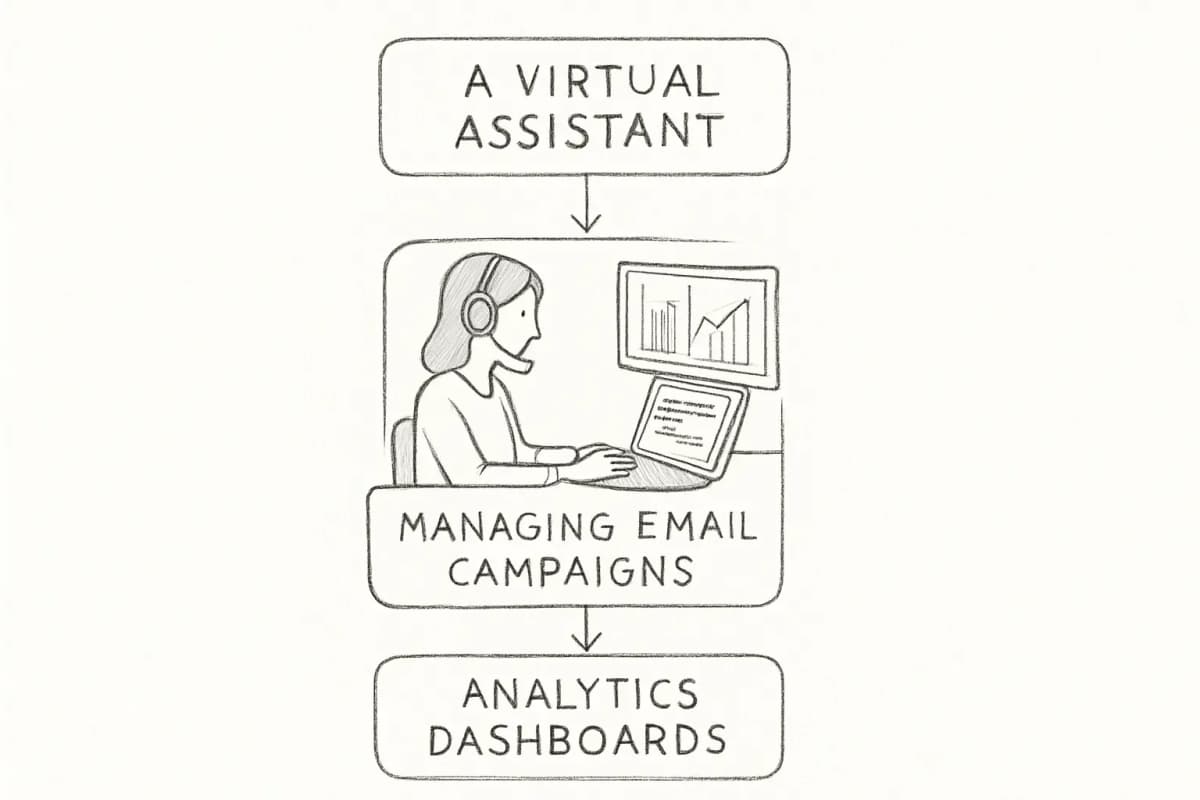
Learn how to hire, train, and manage virtual assistants for email marketing. Cut costs, scale campaigns, and improve ROI without building an in-house team.
Learn how to hire, train, and manage virtual assistants for email marketing. Cut costs, scale campaigns, and improve ROI without building an in-house team.
Email marketing generates between $36 and $40 for every dollar spent, according to multiple industry sources, yet most business owners never extract that return because execution is the bottleneck. Writing copy, segmenting lists, scheduling sends, monitoring deliverability, and running A/B tests are all tasks that demand consistent time and skill. That is where virtual assistant email marketing comes in. A well-hired, well-trained VA removes the execution drag so your strategy can actually run.
This guide covers everything you need: what a virtual assistant email marketing setup looks like, what tasks to delegate, where to find qualified VAs, how to onboard them with systems that work, and how to scale output without losing quality.
Key Takeaways
Automated emails account for just 2% of email sends, but drive 30% of revenue, earning 16 times more per send than scheduled campaigns. A VA can own that automation layer.
The average cost to hire a virtual assistant in a marketing role ranges from $20 to $50 per hour, depending on expertise, location, and the scope of responsibilities.
Email marketing requires a significant time investment, and outsourcing this function gives you back hours in your work week.
Companies with documented SOPs report up to 30% improvement in operational efficiency and reduce onboarding time by 19%.
When processes are documented in SOPs, new hires onboard faster, errors drop, and output stays consistent.
What Is a Virtual Assistant Email Marketing Role?
An email marketing virtual assistant is someone you hire remotely to manage your email campaigns and newsletters. They are typically self-employed professionals who offer administrative and technical support to businesses on a contract basis. Email marketing VAs possess experience in building, sending, and optimizing email newsletters using ESPs like Mailchimp, Constant Contact, and AWeber.
You may also hear virtual assistants referred to as fractional service providers, which means they offer their services as needed to multiple clients. Unlike employees who are committed to one organization, you can access their skill set and experience without the full-time employee price tag.
The scope of the role can range from execution-only (send the emails, manage the list) to strategic support (write copy, set up automations, interpret analytics). The right scope depends on your team's existing skills and where your biggest gaps are.
Email marketing generates between $36 and $40 for every dollar spent, according to multiple industry sources, yet most business owners never extract that return because execution is the bottleneck. Writing copy, segmenting lists, scheduling sends, monitoring deliverability, and running A/B tests are all tasks that demand consistent time and skill. That is where virtual assistant email marketing comes in. A well-hired, well-trained VA removes the execution drag so your strategy can actually run.
This guide covers everything you need: what a virtual assistant email marketing setup looks like, what tasks to delegate, where to find qualified VAs, how to onboard them with systems that work, and how to scale output without losing quality.
Key Takeaways
Automated emails account for just 2% of email sends, but drive 30% of revenue, earning 16 times more per send than scheduled campaigns. A VA can own that automation layer.
The average cost to hire a virtual assistant in a marketing role ranges from $20 to $50 per hour, depending on expertise, location, and the scope of responsibilities.
Email marketing requires a significant time investment, and outsourcing this function gives you back hours in your work week.
Companies with documented SOPs report up to 30% improvement in operational efficiency and reduce onboarding time by 19%.
When processes are documented in SOPs, new hires onboard faster, errors drop, and output stays consistent.
What Is a Virtual Assistant Email Marketing Role?
An email marketing virtual assistant is someone you hire remotely to manage your email campaigns and newsletters. They are typically self-employed professionals who offer administrative and technical support to businesses on a contract basis. Email marketing VAs possess experience in building, sending, and optimizing email newsletters using ESPs like Mailchimp, Constant Contact, and AWeber.
You may also hear virtual assistants referred to as fractional service providers, which means they offer their services as needed to multiple clients. Unlike employees who are committed to one organization, you can access their skill set and experience without the full-time employee price tag.
The scope of the role can range from execution-only (send the emails, manage the list) to strategic support (write copy, set up automations, interpret analytics). The right scope depends on your team's existing skills and where your biggest gaps are.
What Tasks Should You Delegate?
An email marketing virtual assistant is a remote worker skilled at creating marketing campaigns that boost sales and conversions. They are experienced in setting up email marketing campaigns, writing email copy, designing the emails, segmenting your email lists, and monitoring the performance of your email marketing initiatives.
More specifically, here is what a capable VA can own:
What Tasks Should You Delegate?
An email marketing virtual assistant is a remote worker skilled at creating marketing campaigns that boost sales and conversions. They are experienced in setting up email marketing campaigns, writing email copy, designing the emails, segmenting your email lists, and monitoring the performance of your email marketing initiatives.
More specifically, here is what a capable VA can own:
List management: Managing subscriber lists, keeping them organized and segmented, and maintaining hygiene by removing inactive subscribers.
Campaign creation: Creating promotional emails on platforms such as Mailchimp or Brevo. Whether launching a new product, announcing a limited-time offer, or sharing important news, a skilled VA can make sure emails are professional and engaging.
Automation setup: Managing drip campaigns and automations in platforms like Marketo, Mailchimp, and HubSpot.
A/B testing: Running A/B tests on subject lines, content, and send times, and reporting on open rates, response rates, and conversions.
Analytics reporting: Reviewing analytics such as campaign open rates and clickthrough rates to make adjustments as needed.
Compliance and deliverability maintenance: Monitoring bounce rates, spam complaints, and unsubscribe rates to protect sender reputation.
List management: Managing subscriber lists, keeping them organized and segmented, and maintaining hygiene by removing inactive subscribers.
Campaign creation: Creating promotional emails on platforms such as Mailchimp or Brevo. Whether launching a new product, announcing a limited-time offer, or sharing important news, a skilled VA can make sure emails are professional and engaging.
Automation setup: Managing drip campaigns and automations in platforms like Marketo, Mailchimp, and HubSpot.
A/B testing: Running A/B tests on subject lines, content, and send times, and reporting on open rates, response rates, and conversions.
Analytics reporting: Reviewing analytics such as campaign open rates and clickthrough rates to make adjustments as needed.
Compliance and deliverability maintenance: Monitoring bounce rates, spam complaints, and unsubscribe rates to protect sender reputation.
Tasks related to email are not one-offs; they must be completed on a daily or weekly basis. The recurring nature of these tasks makes them ideal candidates for delegation because, in business terms, they are appreciating assets. Offloading recurring tasks allows you to take advantage of reclaimed time and increased productivity every day or week on a continual basis.
Rates vary significantly based on location, experience level, and the complexity of tasks.
Geographic location creates the most dramatic pricing variance. Philippine-based VAs typically charge $3 to $7 per hour for general work and $15 to $20 per hour for specialized services.
The average cost to hire a virtual assistant in a marketing role ranges from $20 to $50 per hour, depending on expertise, location, and the scope of responsibilities.
For US-based specialists, once a marketing assistant has proven their skills and can work independently on complex projects, their rates jump to $35 to $45 per hour. These specialists understand marketing strategy, can manage multi-step campaigns, and deliver results without extensive hand-holding.
Hiring a virtual assistant is a budget-friendly alternative to hiring a full-time employee. You get access to specialized skills without overhead. Virtual assistants typically work flexibly, so you only pay for what you need. Many are already familiar with popular email marketing platforms, which saves time and money on training.
Hiring models to consider:
Hourly via freelance platforms: Lower upfront cost, but requires more management effort from you.
Monthly retainer: Predictable output and cost, better suited to ongoing campaign work.
Agency-managed VA: Agencies provide pre-vetted talent and backup support, leading to 40% faster onboarding than hiring independent freelancers.
Where to Find a Qualified Email Marketing VA
You have two primary hiring paths: open marketplaces and managed agencies.
Open marketplaces:
Upwork remains the largest freelancer marketplace. You can post jobs or invite talent with built-in time tracking and contracts, making it great for testing VA support before committing full-time.
Fiverr is ideal for one-off admin, design, or social tasks. Buyers browse listings and hire with no back-and-forth, though quality varies and it is best for microtasks rather than ongoing roles.
What to look for when vetting candidates:
Tasks related to email are not one-offs; they must be completed on a daily or weekly basis. The recurring nature of these tasks makes them ideal candidates for delegation because, in business terms, they are appreciating assets. Offloading recurring tasks allows you to take advantage of reclaimed time and increased productivity every day or week on a continual basis.
Rates vary significantly based on location, experience level, and the complexity of tasks.
Geographic location creates the most dramatic pricing variance. Philippine-based VAs typically charge $3 to $7 per hour for general work and $15 to $20 per hour for specialized services.
The average cost to hire a virtual assistant in a marketing role ranges from $20 to $50 per hour, depending on expertise, location, and the scope of responsibilities.
For US-based specialists, once a marketing assistant has proven their skills and can work independently on complex projects, their rates jump to $35 to $45 per hour. These specialists understand marketing strategy, can manage multi-step campaigns, and deliver results without extensive hand-holding.
Hiring a virtual assistant is a budget-friendly alternative to hiring a full-time employee. You get access to specialized skills without overhead. Virtual assistants typically work flexibly, so you only pay for what you need. Many are already familiar with popular email marketing platforms, which saves time and money on training.
Hiring models to consider:
Hourly via freelance platforms: Lower upfront cost, but requires more management effort from you.
Monthly retainer: Predictable output and cost, better suited to ongoing campaign work.
Agency-managed VA: Agencies provide pre-vetted talent and backup support, leading to 40% faster onboarding than hiring independent freelancers.
Where to Find a Qualified Email Marketing VA
You have two primary hiring paths: open marketplaces and managed agencies.
Open marketplaces:
Upwork remains the largest freelancer marketplace. You can post jobs or invite talent with built-in time tracking and contracts, making it great for testing VA support before committing full-time.
Fiverr is ideal for one-off admin, design, or social tasks. Buyers browse listings and hire with no back-and-forth, though quality varies and it is best for microtasks rather than ongoing roles.
What to look for when vetting candidates:
Platform-specific experience with your ESP (Mailchimp, Klaviyo, ActiveCampaign, etc.)
Portfolio or samples of past campaign work
Demonstrated understanding of deliverability and list hygiene
Strong time management skills, adherence to campaign calendars, and the ability to meet deadlines without prompting. Asking for references or trial periods can help verify reliability before making a long-term commitment.
Conducting a paid test project is a practical way to assess a VA's responsiveness, attention to detail, and ability to meet deadlines before committing to a long-term engagement.
One non-negotiable: a great virtual email marketing assistant should be able to write persuasively and convey your brand message in a way that resonates with your target audience.
How to Train Your Email Marketing VA with SOPs
Hiring is only half the equation. The reason most VA relationships underperform is weak onboarding, not weak talent.
Hiring a virtual assistant is only half the job; training them well is what makes the partnership succeed. Many businesses skip this step, assuming VAs will "figure it out." But without guidance, productivity drops and mistakes multiply. A smart training plan turns a new VA into a reliable team member within days instead of weeks.
Standard Operating Procedures (SOPs) are the foundation.
An SOP is a written guide that explains how to do a task. For virtual assistants, SOPs act as a map. They explain your business processes, your team's tools, and the steps for each job. Clear SOPs lead to efficiency because your assistant always knows what to do.
SOPs reduce onboarding time for new VAs by 40 to 60%. Instead of re-training from scratch, the new VA reads your SOP library, follows the documented processes, and can start producing quality work within days.
Your email marketing SOP library should cover at minimum:
How to build and schedule a campaign in your ESP
List cleaning and segmentation procedures
Subject line and copy approval process
A/B test setup and reporting format
Weekly analytics reporting template
Deliverability monitoring checklist
Record two to three short screen-share videos demonstrating how to perform each major task. Visual learning drastically improves retention for remote onboarding.
Offer feedback quickly within 24 hours to reinforce good habits or correct misunderstandings early.
Once your SOP system is built, the same documentation scales to every new hire. Once you create a solid SOP, you can use it to train new team members without starting from scratch every time you make a hire.
What KPIs Should Your VA Track and Report?
Knowing what works and what does not is crucial for refining your strategy. A virtual assistant can monitor and report key email marketing metrics. These insights allow you to adjust campaigns for better performance over time. Consistent reporting also helps you gain a clearer picture of what content resonates with your audience and make better-informed decisions moving forward.
Platform-specific experience with your ESP (Mailchimp, Klaviyo, ActiveCampaign, etc.)
Portfolio or samples of past campaign work
Demonstrated understanding of deliverability and list hygiene
Strong time management skills, adherence to campaign calendars, and the ability to meet deadlines without prompting. Asking for references or trial periods can help verify reliability before making a long-term commitment.
Conducting a paid test project is a practical way to assess a VA's responsiveness, attention to detail, and ability to meet deadlines before committing to a long-term engagement.
One non-negotiable: a great virtual email marketing assistant should be able to write persuasively and convey your brand message in a way that resonates with your target audience.
How to Train Your Email Marketing VA with SOPs
Hiring is only half the equation. The reason most VA relationships underperform is weak onboarding, not weak talent.
Hiring a virtual assistant is only half the job; training them well is what makes the partnership succeed. Many businesses skip this step, assuming VAs will "figure it out." But without guidance, productivity drops and mistakes multiply. A smart training plan turns a new VA into a reliable team member within days instead of weeks.
Standard Operating Procedures (SOPs) are the foundation.
An SOP is a written guide that explains how to do a task. For virtual assistants, SOPs act as a map. They explain your business processes, your team's tools, and the steps for each job. Clear SOPs lead to efficiency because your assistant always knows what to do.
SOPs reduce onboarding time for new VAs by 40 to 60%. Instead of re-training from scratch, the new VA reads your SOP library, follows the documented processes, and can start producing quality work within days.
Your email marketing SOP library should cover at minimum:
How to build and schedule a campaign in your ESP
List cleaning and segmentation procedures
Subject line and copy approval process
A/B test setup and reporting format
Weekly analytics reporting template
Deliverability monitoring checklist
Record two to three short screen-share videos demonstrating how to perform each major task. Visual learning drastically improves retention for remote onboarding.
Offer feedback quickly within 24 hours to reinforce good habits or correct misunderstandings early.
Once your SOP system is built, the same documentation scales to every new hire. Once you create a solid SOP, you can use it to train new team members without starting from scratch every time you make a hire.
What KPIs Should Your VA Track and Report?
Knowing what works and what does not is crucial for refining your strategy. A virtual assistant can monitor and report key email marketing metrics. These insights allow you to adjust campaigns for better performance over time. Consistent reporting also helps you gain a clearer picture of what content resonates with your audience and make better-informed decisions moving forward.
Assign your VA a weekly reporting cadence. Check daily metrics including open rate, open-rate variation, bounce rate, and soft-bounce rate, as these might help you spot incoming problems. Weekly metrics include overall email campaign performance, email campaign conversion and revenue reporting, click-through rates, spam-complaint rates, unsubscribes, and active audience trend.
Core KPIs your VA should own:
Open rate: Indicates subject line and send-time performance. Open rates rose to 30.7% in 2025, the fifth consecutive year of growth.
Click-through rate (CTR): Measures content and CTA effectiveness.
Conversion rate: The bottom-line measure of whether emails drive action.
Bounce rate: In 2024, the average bounce rate across all industries was 2.33%. A bounce rate below 2% is generally considered acceptable, and under 1% is ideal.
Unsubscribe rate: A signal of list health and content relevance.
Revenue per email: Especially important for e-commerce and sales-driven teams.
How to Scale from One VA to a Full Email Marketing Team
Once your VA is running independently and your SOP system is proven, scaling is a matter of replication rather than reinvention.
With SOPs, your VA handles 80% of work autonomously, and you focus on the 20% that actually needs your brain.
Here is a practical scaling model:
Stage 1 (1 VA, part-time): One generalist VA handles campaign execution, list management, and basic reporting.
Stage 2 (1-2 VAs, full-time): Split responsibilities. One VA owns copy and design. One owns list segmentation, automations, and analytics.
Stage 3 (VA team): Add a specialist for deliverability monitoring, a second for paid and organic list growth, and a coordinator to manage the team's output calendar.
As your business and email list grow, your VA can seamlessly take on more work and responsibility.
SOPs also protect your business. If a VA leaves, the knowledge does not leave with them. If you hire a second VA, they can self-train.
Assign your VA a weekly reporting cadence. Check daily metrics including open rate, open-rate variation, bounce rate, and soft-bounce rate, as these might help you spot incoming problems. Weekly metrics include overall email campaign performance, email campaign conversion and revenue reporting, click-through rates, spam-complaint rates, unsubscribes, and active audience trend.
Core KPIs your VA should own:
Open rate: Indicates subject line and send-time performance. Open rates rose to 30.7% in 2025, the fifth consecutive year of growth.
Click-through rate (CTR): Measures content and CTA effectiveness.
Conversion rate: The bottom-line measure of whether emails drive action.
Bounce rate: In 2024, the average bounce rate across all industries was 2.33%. A bounce rate below 2% is generally considered acceptable, and under 1% is ideal.
Unsubscribe rate: A signal of list health and content relevance.
Revenue per email: Especially important for e-commerce and sales-driven teams.
How to Scale from One VA to a Full Email Marketing Team
Once your VA is running independently and your SOP system is proven, scaling is a matter of replication rather than reinvention.
With SOPs, your VA handles 80% of work autonomously, and you focus on the 20% that actually needs your brain.
Here is a practical scaling model:
Stage 1 (1 VA, part-time): One generalist VA handles campaign execution, list management, and basic reporting.
Stage 2 (1-2 VAs, full-time): Split responsibilities. One VA owns copy and design. One owns list segmentation, automations, and analytics.
Stage 3 (VA team): Add a specialist for deliverability monitoring, a second for paid and organic list growth, and a coordinator to manage the team's output calendar.
As your business and email list grow, your VA can seamlessly take on more work and responsibility.
SOPs also protect your business. If a VA leaves, the knowledge does not leave with them. If you hire a second VA, they can self-train.
For teams running more complex, personalization-driven campaigns, the techniques in our email personalization guide are worth building into your VA's standard workflow.
Signs You Are Ready to Hire an Email Marketing VA
You do not need a large list or big budget to benefit from virtual assistant email marketing support. Signs that you should bring a VA on board include: having never created an email marketing campaign before and having no idea what to do, having developed a couple of email marketing campaigns but achieving low open rates, having emails going to subscribers' spam folders, having emails that are opened by subscribers but not converting, being unable to determine if your analytics indicate good or bad performance, or having campaigns that performed well but having exhausted your own capabilities.
If more than two of those descriptions apply, the cost of inaction almost certainly exceeds the cost of hiring.
Frequently Asked Questions
What tasks can a virtual assistant handle for email marketing?
An email marketing VA can handle a variety of tasks including writing emails, designing templates, managing lists, setting up automation, tracking analytics, and optimizing campaigns. The exact scope depends on their experience level and the platforms you use.
How much does an email marketing virtual assistant cost?
The average cost to hire a virtual assistant in a marketing role ranges from $20 to $50 per hour, depending on expertise, location, and the scope of responsibilities. Offshore VAs from the Philippines or Latin America typically cost less, while US-based specialists command higher rates for more strategic work.
How long does it take to train a virtual assistant for email marketing?
Clients who invest two to three days creating SOPs before their VA starts see their VA operating independently within the first week, compared to three to four weeks for clients who skip this step. The more thoroughly you document your processes upfront, the faster your VA reaches full productivity.
Should I hire a VA directly or through an agency?
Both paths work. Open marketplaces are best for one-off tasks, trial projects, or when you have well-documented SOPs. Agencies cost more per hour but include vetting, backup coverage, and faster placement. If you are hiring a VA for the first time and lack strong internal management processes, an agency often delivers faster results.
How do I know if my email marketing VA is performing well?
For teams running more complex, personalization-driven campaigns, the techniques in our email personalization guide are worth building into your VA's standard workflow.
Signs You Are Ready to Hire an Email Marketing VA
You do not need a large list or big budget to benefit from virtual assistant email marketing support. Signs that you should bring a VA on board include: having never created an email marketing campaign before and having no idea what to do, having developed a couple of email marketing campaigns but achieving low open rates, having emails going to subscribers' spam folders, having emails that are opened by subscribers but not converting, being unable to determine if your analytics indicate good or bad performance, or having campaigns that performed well but having exhausted your own capabilities.
If more than two of those descriptions apply, the cost of inaction almost certainly exceeds the cost of hiring.
Frequently Asked Questions
What tasks can a virtual assistant handle for email marketing?
An email marketing VA can handle a variety of tasks including writing emails, designing templates, managing lists, setting up automation, tracking analytics, and optimizing campaigns. The exact scope depends on their experience level and the platforms you use.
How much does an email marketing virtual assistant cost?
The average cost to hire a virtual assistant in a marketing role ranges from $20 to $50 per hour, depending on expertise, location, and the scope of responsibilities. Offshore VAs from the Philippines or Latin America typically cost less, while US-based specialists command higher rates for more strategic work.
How long does it take to train a virtual assistant for email marketing?
Clients who invest two to three days creating SOPs before their VA starts see their VA operating independently within the first week, compared to three to four weeks for clients who skip this step. The more thoroughly you document your processes upfront, the faster your VA reaches full productivity.
Should I hire a VA directly or through an agency?
Both paths work. Open marketplaces are best for one-off tasks, trial projects, or when you have well-documented SOPs. Agencies cost more per hour but include vetting, backup coverage, and faster placement. If you are hiring a VA for the first time and lack strong internal management processes, an agency often delivers faster results.
How do I know if my email marketing VA is performing well?
Set clear KPIs from day one. Track open rates, click-through rates, conversion rates, bounce rates, and unsubscribe rates on a weekly basis. Compare results to industry benchmarks and use a consistent reporting template your VA completes every week. While it is important to trust your VA's abilities, it is also important to keep track of their progress on the tasks assigned.
No comments yet. Be the first!
Set clear KPIs from day one. Track open rates, click-through rates, conversion rates, bounce rates, and unsubscribe rates on a weekly basis. Compare results to industry benchmarks and use a consistent reporting template your VA completes every week. While it is important to trust your VA's abilities, it is also important to keep track of their progress on the tasks assigned.