Every email list shrinks over time, whether you notice it or not. Subscribers go quiet, stop opening, stop clicking, and eventually forget you exist. We miss you email marketing is the deliberate strategy of reaching back out to those lapsed contacts before they are gone for good, and the data shows it works far better than most marketers expect.
Re-engagement emails have the potential to win back up to 45% of inactive subscribers, according to a study by Validity's Return Path. That is nearly half your dormant list, waiting to be reactivated, often with nothing more than a well-timed, well-crafted message.
This guide covers what a "we miss you" email actually is, why you need one, how to build a sequence that converts, and what to do with subscribers who never come back.
Key Takeaways
Win-back emails can recover up to 45% of inactive subscribers, making re-engagement one of the highest-ROI activities in email marketing.
A win-back campaign is essential because it costs five times more to acquire a new customer than to keep one you already have.
The average email list loses between 22% and 30% of its subscribers to inactivity each year, which means your list is degrading even when your campaigns look healthy.
When a large portion of your list stops opening or clicking, inbox providers start filtering your sends more aggressively, and inactive subscribers quietly pull down your engagement metrics while increasing your complaint risk.
Timing, segmentation, and a clear incentive are the three variables that separate a successful win-back sequence from one that gets ignored.
What Is a "We Miss You" Email, and Why Does It Matter?
A win-back email is an email you send to existing but dormant subscribers: people on your email list who previously visited your website, clicked on an email, or made a purchase, but have not bought from your store or opened your emails in a long time.
A "we miss you" email is a targeted message sent to inactive customers. Its primary purpose is to rekindle interest, reignite engagement, and ultimately bring these customers back. A re-engagement email typically conveys sincerity and appreciation for the customer's past interactions.
Every email list shrinks over time, whether you notice it or not. Subscribers go quiet, stop opening, stop clicking, and eventually forget you exist. We miss you email marketing is the deliberate strategy of reaching back out to those lapsed contacts before they are gone for good, and the data shows it works far better than most marketers expect.
Re-engagement emails have the potential to win back up to 45% of inactive subscribers, according to a study by Validity's Return Path. That is nearly half your dormant list, waiting to be reactivated, often with nothing more than a well-timed, well-crafted message.
This guide covers what a "we miss you" email actually is, why you need one, how to build a sequence that converts, and what to do with subscribers who never come back.
Key Takeaways
Win-back emails can recover up to 45% of inactive subscribers, making re-engagement one of the highest-ROI activities in email marketing.
A win-back campaign is essential because it costs five times more to acquire a new customer than to keep one you already have.
The average email list loses between 22% and 30% of its subscribers to inactivity each year, which means your list is degrading even when your campaigns look healthy.
When a large portion of your list stops opening or clicking, inbox providers start filtering your sends more aggressively, and inactive subscribers quietly pull down your engagement metrics while increasing your complaint risk.
Timing, segmentation, and a clear incentive are the three variables that separate a successful win-back sequence from one that gets ignored.
What Is a "We Miss You" Email, and Why Does It Matter?
A win-back email is an email you send to existing but dormant subscribers: people on your email list who previously visited your website, clicked on an email, or made a purchase, but have not bought from your store or opened your emails in a long time.
A "we miss you" email is a targeted message sent to inactive customers. Its primary purpose is to rekindle interest, reignite engagement, and ultimately bring these customers back. A re-engagement email typically conveys sincerity and appreciation for the customer's past interactions.
The business case is straightforward. 80% of retail professionals indicate that email marketing is their greatest driver of customer retention, and for every $1 you spend on email marketing, you can expect an average return of $38. Letting lapsed subscribers sit on your list unaddressed means leaving a slice of that return on the table.
There is also a deliverability cost to ignoring your inactive subscribers. If subscribers keep receiving but not engaging with your emails, that is a bad signal to mailbox providers and can cause them to think your content is spammy or unwanted, leading to a lower sender reputation. Running a re-engagement campaign before you suppress or remove those contacts protects both your revenue and your domain health.
When Do Subscribers Become "Inactive"?
Defining inactivity is the first practical step. There is no universal threshold, but industry guidance points to clear markers.
Here is a basic sending time range to work from: 2 to 7 days after cart abandonment, a quick reminder; 30 to 60 days of inactivity, a light nudge; 90 or more days of inactivity, a stronger message with urgency or an offer; 120 or more days of inactivity, a last-chance email before removing them.
One month of inactivity may be a crucial point: after this point, only 11% of consumers will re-engage. That number underlines the importance of acting early. The longer you wait, the harder the recovery.
If you send a win-back email too early, you risk annoying customers. If you send one too late, your lost customers are gone for good. A rule of thumb is to wait a few months of inactivity before reaching out.
For most businesses, the practical window is 60 to 90 days of no engagement. SaaS companies may shorten that window. Ecommerce brands with seasonal purchase patterns may extend it. Check your own repurchase cycle first.
How to Segment Your Inactive List Before Sending
Not all inactive subscribers are the same. Treating them as a single audience leads to generic campaigns that underperform.
Define the criteria for customers who are likely to reactivate using the RFM matrix. Segment your existing customers based on recency (how recently they made their last purchase), frequency (how often they typically make repeat orders), and monetary value (the dollar value of their average purchase). Start your win-back campaign by prioritizing your highest-value customers first.
Once you have your RFM segments, you can tailor the offer and tone to match. A subscriber who purchased five times last year and went quiet three months ago deserves a different message than someone who bought once 14 months ago.
Good segmentation also protects deliverability. Low engagement over time trains spam filters to deprioritize your sends. Segmenting by engagement level and removing consistently inactive contacts keeps your engagement signals healthy.
The business case is straightforward. 80% of retail professionals indicate that email marketing is their greatest driver of customer retention, and for every $1 you spend on email marketing, you can expect an average return of $38. Letting lapsed subscribers sit on your list unaddressed means leaving a slice of that return on the table.
There is also a deliverability cost to ignoring your inactive subscribers. If subscribers keep receiving but not engaging with your emails, that is a bad signal to mailbox providers and can cause them to think your content is spammy or unwanted, leading to a lower sender reputation. Running a re-engagement campaign before you suppress or remove those contacts protects both your revenue and your domain health.
When Do Subscribers Become "Inactive"?
Defining inactivity is the first practical step. There is no universal threshold, but industry guidance points to clear markers.
Here is a basic sending time range to work from: 2 to 7 days after cart abandonment, a quick reminder; 30 to 60 days of inactivity, a light nudge; 90 or more days of inactivity, a stronger message with urgency or an offer; 120 or more days of inactivity, a last-chance email before removing them.
One month of inactivity may be a crucial point: after this point, only 11% of consumers will re-engage. That number underlines the importance of acting early. The longer you wait, the harder the recovery.
If you send a win-back email too early, you risk annoying customers. If you send one too late, your lost customers are gone for good. A rule of thumb is to wait a few months of inactivity before reaching out.
For most businesses, the practical window is 60 to 90 days of no engagement. SaaS companies may shorten that window. Ecommerce brands with seasonal purchase patterns may extend it. Check your own repurchase cycle first.
How to Segment Your Inactive List Before Sending
Not all inactive subscribers are the same. Treating them as a single audience leads to generic campaigns that underperform.
Define the criteria for customers who are likely to reactivate using the RFM matrix. Segment your existing customers based on recency (how recently they made their last purchase), frequency (how often they typically make repeat orders), and monetary value (the dollar value of their average purchase). Start your win-back campaign by prioritizing your highest-value customers first.
Once you have your RFM segments, you can tailor the offer and tone to match. A subscriber who purchased five times last year and went quiet three months ago deserves a different message than someone who bought once 14 months ago.
Good segmentation also protects deliverability. Low engagement over time trains spam filters to deprioritize your sends. Segmenting by engagement level and removing consistently inactive contacts keeps your engagement signals healthy.
The most effective re-engagement emails are personalized, value-packed, and action-driven. Here is what each element should accomplish.
Subject Line
The subject line is the only part of your email that competes for attention before a single word of the body is read. Studies find that 47% of subscribers open or skip an email based on the subject line alone.
The subject line of your win-back email offers a place to get creative, but simple emotional cues work well. The classic "we miss you" and "we miss you already" instantly make an emotional connection with the reader.
Beyond emotional appeal, leading with the incentive often lifts open rates. Subject lines like "We miss you. Here's $20." (used by Girlfriend Collective) or "We want you back. Here's 50% off." tell the reader exactly what is inside. Personalized subject lines produce a 26% boost in open rates.
For more guidance on crafting subject lines that perform, read our article on email subject line best practices that boost open rates by 27%.
Personalization
Start with the basics and use their first name in the subject line or greeting. Then take it further by mentioning what they bought before or what they showed interest in. Something like "Hey [name], we thought you'd love our new running shoes since you picked up those trail runners last spring" feels much more genuine than a blanket "Come back and shop with us."
Body Copy and Offer
Discounts and special offers are not necessary for every email campaign. But if a customer has not engaged with your brand in 3 to 6 months, it will likely take a discount to re-engage them.
Consider making this a dollar-off discount rather than a percentage discount. One study of win-back campaigns found that dollar-off discounts activated more subscribers.
If a discount does not fit your business model, alternatives include exclusive content, a free resource, a product update highlight, or simply asking for feedback. Feedback emails, which ask lapsed customers why they have moved on, may be enough incentive to re-engage them or at the very least provide valuable feedback on how to improve your brand.
Call to Action
Keep it singular and specific. Conversion rates can increase by up to 42% when emails contain a single, targeted call to action. Do not ask the reader to browse, review, share, and buy all in one email. Pick one action and make it frictionless.
Building a Win-Back Email Sequence
A single email is rarely enough. A great win-back email can work all on its own, but a win-back email series of strategically timed and targeted messages can be even more effective.
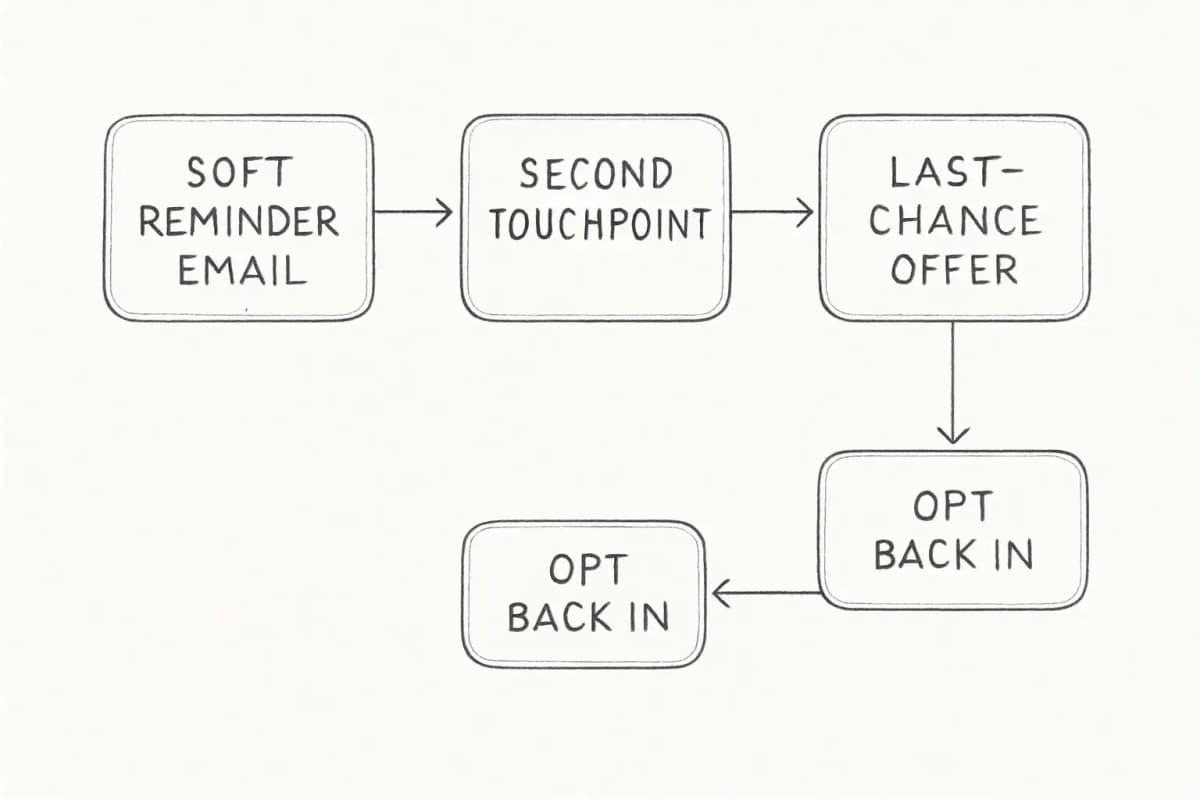
Here is a practical three-email sequence structure:
The most effective re-engagement emails are personalized, value-packed, and action-driven. Here is what each element should accomplish.
Subject Line
The subject line is the only part of your email that competes for attention before a single word of the body is read. Studies find that 47% of subscribers open or skip an email based on the subject line alone.
The subject line of your win-back email offers a place to get creative, but simple emotional cues work well. The classic "we miss you" and "we miss you already" instantly make an emotional connection with the reader.
Beyond emotional appeal, leading with the incentive often lifts open rates. Subject lines like "We miss you. Here's $20." (used by Girlfriend Collective) or "We want you back. Here's 50% off." tell the reader exactly what is inside. Personalized subject lines produce a 26% boost in open rates.
For more guidance on crafting subject lines that perform, read our article on email subject line best practices that boost open rates by 27%.
Personalization
Start with the basics and use their first name in the subject line or greeting. Then take it further by mentioning what they bought before or what they showed interest in. Something like "Hey [name], we thought you'd love our new running shoes since you picked up those trail runners last spring" feels much more genuine than a blanket "Come back and shop with us."
Body Copy and Offer
Discounts and special offers are not necessary for every email campaign. But if a customer has not engaged with your brand in 3 to 6 months, it will likely take a discount to re-engage them.
Consider making this a dollar-off discount rather than a percentage discount. One study of win-back campaigns found that dollar-off discounts activated more subscribers.
If a discount does not fit your business model, alternatives include exclusive content, a free resource, a product update highlight, or simply asking for feedback. Feedback emails, which ask lapsed customers why they have moved on, may be enough incentive to re-engage them or at the very least provide valuable feedback on how to improve your brand.
Call to Action
Keep it singular and specific. Conversion rates can increase by up to 42% when emails contain a single, targeted call to action. Do not ask the reader to browse, review, share, and buy all in one email. Pick one action and make it frictionless.
Building a Win-Back Email Sequence
A single email is rarely enough. A great win-back email can work all on its own, but a win-back email series of strategically timed and targeted messages can be even more effective.
Here is a practical three-email sequence structure:
Email 1 (Day 0): The soft reminder. Acknowledge the silence without pressure. Remind the subscriber of what they are missing. No heavy discount yet. Keep tone warm and conversational.
Email 2 (Day 7 to 10): The value email. Highlight new products, features, or improvements since they last engaged. Include a moderate incentive (10 to 15% off or a free resource).
Email 3 (Day 18 to 21): The last-chance message. Increase urgency. Offer your strongest incentive. Make clear this is the final outreach before removing them from your active list.
If a subscriber has not opened or clicked in 90 to 180 days, or after three to four win-back attempts, it is time to remove them from your marketing sends. Holding onto non-responders beyond this point costs you in deliverability and platform fees without any realistic recovery upside.
Subject Line and Copy Approaches That Work
The tone of a win-back email can vary significantly by brand voice. Here are the approaches with the strongest track records.
Emotional appeal: Using "we miss you" in the subject line and "has the spark really died?" in the heading pulls on emotion and makes the reader feel their presence is appreciated.
Humor and brand personality: Dollar Shave Club has used "Have you been seeing someone else?" as a curiosity-inducing subject line. The copy continues with a breakup theme, suggesting the inactive subscriber should get back together with the brand.
Urgency with a clear offer: Nothing spurs re-engagement like time-limited offers. They create a sense of urgency, and they also trigger a scarcity mindset. When people believe a discount is limited, it becomes more desirable.
Feedback-driven approach: Asking "can we ask you one question?" opens a low-friction conversation. A satisfaction survey that readers can complete within the email reduces friction and also helps the brand identify which customers are inactive because they are unsatisfied.
The goodbye email: Subject lines like "this is the last email you will see" flip the narrative so it feels like a farewell, while the email still includes an option to opt back in, often sweetened with a discount. This format creates urgency through loss aversion.
Measuring Win-Back Campaign Performance
Re-engagement emails achieve 12% average open rates and can recover 5 to 15% of inactive subscribers. Use these benchmarks to evaluate whether your campaign is working.
Key metrics to track:
Email 1 (Day 0): The soft reminder. Acknowledge the silence without pressure. Remind the subscriber of what they are missing. No heavy discount yet. Keep tone warm and conversational.
Email 2 (Day 7 to 10): The value email. Highlight new products, features, or improvements since they last engaged. Include a moderate incentive (10 to 15% off or a free resource).
Email 3 (Day 18 to 21): The last-chance message. Increase urgency. Offer your strongest incentive. Make clear this is the final outreach before removing them from your active list.
If a subscriber has not opened or clicked in 90 to 180 days, or after three to four win-back attempts, it is time to remove them from your marketing sends. Holding onto non-responders beyond this point costs you in deliverability and platform fees without any realistic recovery upside.
Subject Line and Copy Approaches That Work
The tone of a win-back email can vary significantly by brand voice. Here are the approaches with the strongest track records.
Emotional appeal: Using "we miss you" in the subject line and "has the spark really died?" in the heading pulls on emotion and makes the reader feel their presence is appreciated.
Humor and brand personality: Dollar Shave Club has used "Have you been seeing someone else?" as a curiosity-inducing subject line. The copy continues with a breakup theme, suggesting the inactive subscriber should get back together with the brand.
Urgency with a clear offer: Nothing spurs re-engagement like time-limited offers. They create a sense of urgency, and they also trigger a scarcity mindset. When people believe a discount is limited, it becomes more desirable.
Feedback-driven approach: Asking "can we ask you one question?" opens a low-friction conversation. A satisfaction survey that readers can complete within the email reduces friction and also helps the brand identify which customers are inactive because they are unsatisfied.
The goodbye email: Subject lines like "this is the last email you will see" flip the narrative so it feels like a farewell, while the email still includes an option to opt back in, often sweetened with a discount. This format creates urgency through loss aversion.
Measuring Win-Back Campaign Performance
Re-engagement emails achieve 12% average open rates and can recover 5 to 15% of inactive subscribers. Use these benchmarks to evaluate whether your campaign is working.
Key metrics to track:
Open rate: If open rates are low, your subject line probably is not grabbing attention. If people are opening but not clicking, your message or offer might not be compelling enough.
Click-through rate: This measures whether the offer is resonating once subscribers open.
Conversion rate: Automated win-back email campaigns demonstrate strong conversion rates of 10.34%, making them one of the most effective email marketing strategies available.
Reactivation rate: The percentage of inactive subscribers who take any desired action after the campaign.
List growth or churn rate: Track whether your overall engagement rate improves after the campaign and list cleaning.
Research shows that 45% of subscribers who receive a win-back email will open future emails from your brand, making the long-term impact on list engagement just as important as the immediate conversion rate.
Re-engagement has limits. Not everyone is worth pursuing, and keeping definitively disengaged contacts on your list creates real damage.
Continuing to send to profiles with zero engagement erodes your sending reputation. Mailbox providers use this information to determine where your emails are placed, whether in the inbox or the spam folder. Having a list that contains uninterested people or a high percentage of invalid emails will only hurt your efforts to reach those who actually want your emails.
For inactive subscribers, run a re-engagement campaign every 6 to 12 months, then remove anyone who does not respond. Regular list maintenance keeps your engagement metrics healthy and protects your sender reputation.
Before removing subscribers entirely, offer one final preference update. Let them choose email frequency or content type. Some people disengage not because they lost interest but because the volume or content stopped matching what they signed up for. Giving them control over their inbox experience recovers some of that group without requiring a purchase incentive.
How long should I wait before sending a "we miss you" email?
Open rate: If open rates are low, your subject line probably is not grabbing attention. If people are opening but not clicking, your message or offer might not be compelling enough.
Click-through rate: This measures whether the offer is resonating once subscribers open.
Conversion rate: Automated win-back email campaigns demonstrate strong conversion rates of 10.34%, making them one of the most effective email marketing strategies available.
Reactivation rate: The percentage of inactive subscribers who take any desired action after the campaign.
List growth or churn rate: Track whether your overall engagement rate improves after the campaign and list cleaning.
Research shows that 45% of subscribers who receive a win-back email will open future emails from your brand, making the long-term impact on list engagement just as important as the immediate conversion rate.
Re-engagement has limits. Not everyone is worth pursuing, and keeping definitively disengaged contacts on your list creates real damage.
Continuing to send to profiles with zero engagement erodes your sending reputation. Mailbox providers use this information to determine where your emails are placed, whether in the inbox or the spam folder. Having a list that contains uninterested people or a high percentage of invalid emails will only hurt your efforts to reach those who actually want your emails.
For inactive subscribers, run a re-engagement campaign every 6 to 12 months, then remove anyone who does not respond. Regular list maintenance keeps your engagement metrics healthy and protects your sender reputation.
Before removing subscribers entirely, offer one final preference update. Let them choose email frequency or content type. Some people disengage not because they lost interest but because the volume or content stopped matching what they signed up for. Giving them control over their inbox experience recovers some of that group without requiring a purchase incentive.
How long should I wait before sending a "we miss you" email?
A win-back campaign is a series of targeted messages aimed at regaining lost or disengaged customers. The best time to send a win-back email is typically a few months after a customer becomes inactive, as it allows time for any negative feelings to fade or for new experiences to potentially not meet expectations. For most businesses, 60 to 90 days of no engagement is the right trigger point.
How many emails should a win-back sequence include?
You might not be able to cover all the bases with just a single email. Setting up an entire re-engagement email series of 3 to 4 emails covering key elements works better, starting with an initial email that reminds them they have not engaged and that you have missed them. Three emails is a practical standard for most businesses.
Should I always offer a discount in a win-back email?
Not necessarily. Incentives do not have to be a discount. A product incentive is often a stronger draw than a blanket discount because it offers something tangible the customer can anticipate. Feedback requests, exclusive content, or simply sharing what has improved since their last visit can also work, especially for brand loyalty-driven businesses.
What happens to deliverability if I do not clean my inactive list?
Low engagement rates can cause mailbox providers to think your content is potentially spammy or unwanted, leading to a lower sender reputation. As you send fewer emails to inactive subscribers, you can focus more on those who do engage with your content and improve your overall email deliverability. Ignoring your inactive subscribers is not a neutral choice: it actively degrades your ability to reach engaged ones.
What is a realistic re-engagement rate to expect?
Re-engagement emails achieve 12% average open rates and can recover 5 to 15% of inactive subscribers. With a strong sequence, personalized subject lines, and a meaningful offer, recovery rates toward the top of that range are achievable. Any subscriber you do not win back through a re-engagement campaign can then be removed cleanly, knowing you gave them every reasonable opportunity.
No comments yet. Be the first!
A win-back campaign is a series of targeted messages aimed at regaining lost or disengaged customers. The best time to send a win-back email is typically a few months after a customer becomes inactive, as it allows time for any negative feelings to fade or for new experiences to potentially not meet expectations. For most businesses, 60 to 90 days of no engagement is the right trigger point.
How many emails should a win-back sequence include?
You might not be able to cover all the bases with just a single email. Setting up an entire re-engagement email series of 3 to 4 emails covering key elements works better, starting with an initial email that reminds them they have not engaged and that you have missed them. Three emails is a practical standard for most businesses.
Should I always offer a discount in a win-back email?
Not necessarily. Incentives do not have to be a discount. A product incentive is often a stronger draw than a blanket discount because it offers something tangible the customer can anticipate. Feedback requests, exclusive content, or simply sharing what has improved since their last visit can also work, especially for brand loyalty-driven businesses.
What happens to deliverability if I do not clean my inactive list?
Low engagement rates can cause mailbox providers to think your content is potentially spammy or unwanted, leading to a lower sender reputation. As you send fewer emails to inactive subscribers, you can focus more on those who do engage with your content and improve your overall email deliverability. Ignoring your inactive subscribers is not a neutral choice: it actively degrades your ability to reach engaged ones.
What is a realistic re-engagement rate to expect?
Re-engagement emails achieve 12% average open rates and can recover 5 to 15% of inactive subscribers. With a strong sequence, personalized subject lines, and a meaningful offer, recovery rates toward the top of that range are achievable. Any subscriber you do not win back through a re-engagement campaign can then be removed cleanly, knowing you gave them every reasonable opportunity.