Email Deliverability Blueprint for Scaling Startups
German startup guide tackles inbox placement crisis. Authentication, list hygiene, and platform choice determine whether scaling email succeeds or fails.
Email Deliverability Blueprint for Scaling Startups
German startup guide tackles inbox placement crisis. Authentication, list hygiene, and platform choice determine whether scaling email succeeds or fails.
Scaling a startup's email channel without destroying deliverability is one of the most underrated growth challenges in 2026, and a Deutsche Startups analysis published April 22 puts a clear framework around how fast-growing companies can do it right. The piece, aimed at the German startup ecosystem, covers the full stack: ROI fundamentals, list hygiene discipline, double opt-in compliance, and platform selection. The advice travels well beyond German borders.
Why Email Deliverability Is a Growth Problem, Not Just a Technical One
Email marketing delivers an average ROI of $36 for every dollar spent, which explains why startups lean on the channel hard during growth phases. But rapid scaling introduces a specific risk: the faster you grow your list, the more likely you are to collect low-quality addresses that damage your sender reputation.
Email remains the backbone of digital outreach for startups in 2026, but the rules have shifted again. Getting a message into the inbox is no longer as simple as hitting send, because new authentication protocols, AI-powered spam filters, and evolving sender reputation systems mean that what worked last year may not work today.
Sender reputation is the biggest influence on email deliverability. If your reputation drops too low, ISPs start to block or filter your emails. The biggest damage to sender reputation comes from spam complaints and high bounce rates.
For startups under pressure to hit growth metrics, this creates a genuine tension: speed versus list quality.
The Volume Trap That Kills Startup Deliverability
Most founders know email scales cheaply. What they underestimate is how quickly a dirty list can crater a sending domain.
The pressure to "grow at all costs" often leads founders into dangerous territory. Common mistakes include the volume trap: the belief that more volume equals more leads. Founders often scrape 10,000 emails and blast them all on day one. This is the fastest way to get flagged as spam.
Scaling a startup's email channel without destroying deliverability is one of the most underrated growth challenges in 2026, and a Deutsche Startups analysis published April 22 puts a clear framework around how fast-growing companies can do it right. The piece, aimed at the German startup ecosystem, covers the full stack: ROI fundamentals, list hygiene discipline, double opt-in compliance, and platform selection. The advice travels well beyond German borders.
Why Email Deliverability Is a Growth Problem, Not Just a Technical One
Email marketing delivers an average ROI of $36 for every dollar spent, which explains why startups lean on the channel hard during growth phases. But rapid scaling introduces a specific risk: the faster you grow your list, the more likely you are to collect low-quality addresses that damage your sender reputation.
Email remains the backbone of digital outreach for startups in 2026, but the rules have shifted again. Getting a message into the inbox is no longer as simple as hitting send, because new authentication protocols, AI-powered spam filters, and evolving sender reputation systems mean that what worked last year may not work today.
Sender reputation is the biggest influence on email deliverability. If your reputation drops too low, ISPs start to block or filter your emails. The biggest damage to sender reputation comes from spam complaints and high bounce rates.
For startups under pressure to hit growth metrics, this creates a genuine tension: speed versus list quality.
The Volume Trap That Kills Startup Deliverability
Most founders know email scales cheaply. What they underestimate is how quickly a dirty list can crater a sending domain.
The pressure to "grow at all costs" often leads founders into dangerous territory. Common mistakes include the volume trap: the belief that more volume equals more leads. Founders often scrape 10,000 emails and blast them all on day one. This is the fastest way to get flagged as spam.
Key metrics to track as you scale include hard bounce rate (keep it under 2%) and spam complaint rate. Startups should also monitor reply rate and deliverability metrics from the start.
Yahoo sets a spam complaint rate ceiling of 0.3%, meaning just 3 spam complaints for every 1,000 emails sent. Anything above that hurts deliverability. Gmail enforces similar thresholds. Crossing them during a growth push can sideline an entire sending domain at exactly the wrong moment.
Double Opt-In: The Infrastructure Decision That Protects ROI
The Deutsche Startups piece is specific about double opt-in as a foundational practice, not just a compliance checkbox. This matters especially for companies operating under GDPR, where Germany and Austria legally require confirmed opt-in.
Several countries, including Germany and Austria, legally require double opt-in for email marketing, making it essential for businesses targeting international audiences or European markets.
Beyond the legal requirement, the performance case is strong. Research shows that the conversion rate on opt-in lists runs roughly 1,359% higher than on non-opt-in lists. In other words, a permission-based list converts around 15 times better than a non-permission-based one.
People who take the extra step to confirm their subscription signal genuine interest. They open more emails, click more links, and convert at higher rates than single opt-in contacts. Double opt-in also minimizes accidental signups and mistyped addresses, reducing spam complaints and protecting domain reputation.
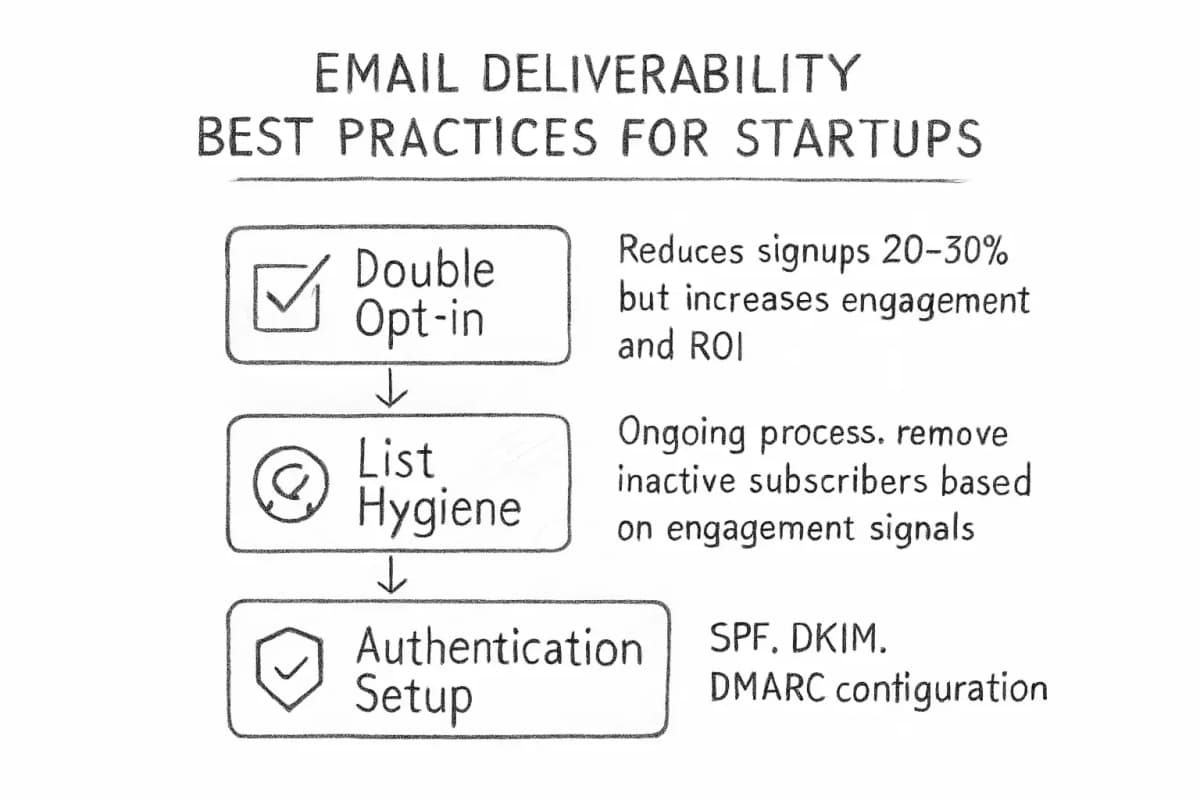
The trade-off is worth understanding. Double opt-in typically reduces initial signups by 20 to 30%, but confirmed subscribers engage at much higher rates, leading to improved ROI and deliverability. For a startup optimizing for long-term revenue rather than vanity list metrics, that trade-off is straightforward.
List Hygiene as an Ongoing Practice
List hygiene is not a one-time cleanup; it is a recurring process that sits at the center of any sustainable email strategy.
Cleaning lists and removing inactive recipients is as important as ever. Engagement signals, including opens, clicks, and replies, are the core metrics mailbox providers use to judge emails. Unengaged lists lead to spam folder placement, while engaged lists keep sender reputation strong.
Key metrics to track as you scale include hard bounce rate (keep it under 2%) and spam complaint rate. Startups should also monitor reply rate and deliverability metrics from the start.
Yahoo sets a spam complaint rate ceiling of 0.3%, meaning just 3 spam complaints for every 1,000 emails sent. Anything above that hurts deliverability. Gmail enforces similar thresholds. Crossing them during a growth push can sideline an entire sending domain at exactly the wrong moment.
Double Opt-In: The Infrastructure Decision That Protects ROI
The Deutsche Startups piece is specific about double opt-in as a foundational practice, not just a compliance checkbox. This matters especially for companies operating under GDPR, where Germany and Austria legally require confirmed opt-in.
Several countries, including Germany and Austria, legally require double opt-in for email marketing, making it essential for businesses targeting international audiences or European markets.
Beyond the legal requirement, the performance case is strong. Research shows that the conversion rate on opt-in lists runs roughly 1,359% higher than on non-opt-in lists. In other words, a permission-based list converts around 15 times better than a non-permission-based one.
People who take the extra step to confirm their subscription signal genuine interest. They open more emails, click more links, and convert at higher rates than single opt-in contacts. Double opt-in also minimizes accidental signups and mistyped addresses, reducing spam complaints and protecting domain reputation.
The trade-off is worth understanding. Double opt-in typically reduces initial signups by 20 to 30%, but confirmed subscribers engage at much higher rates, leading to improved ROI and deliverability. For a startup optimizing for long-term revenue rather than vanity list metrics, that trade-off is straightforward.
List Hygiene as an Ongoing Practice
List hygiene is not a one-time cleanup; it is a recurring process that sits at the center of any sustainable email strategy.
Cleaning lists and removing inactive recipients is as important as ever. Engagement signals, including opens, clicks, and replies, are the core metrics mailbox providers use to judge emails. Unengaged lists lead to spam folder placement, while engaged lists keep sender reputation strong.
If a user ignores a re-engagement sequence, automate their unsubscribe. Holding onto unresponsive contacts lowers overall engagement rates, which signals to ISPs that the content is irrelevant and hurts deliverability for the subscribers who actually want to hear from you.
Segmented email campaigns generate 30% more opens and 50% more click-throughs, and 78% of marketers say segmentation is their most effective tactic. Keeping lists segmented by engagement level and removing dead weight regularly compounds over time.
Platform Selection: Match the Tool to the Growth Stage
The Deutsche Startups piece addresses platform selection directly, recognizing that the right ESP at 500 subscribers is rarely the right choice at 50,000. The European startup market has its own pricing sensitivities, but the logic applies globally.
Startups just getting started and needing something straightforward can begin with MailerLite or Brevo's free plan. Both offer generous limits and room to grow without switching platforms early.
Between Brevo and Klaviyo, Brevo is easier to use and offers more value for money, making it a good choice for general small-to-medium businesses, especially those on a tight budget. Klaviyo stands out as a purpose-built solution for ecommerce businesses, with deep integrations with platforms like Shopify and WooCommerce. Its advanced segmentation and predictive analytics make it ideal for data-driven marketers focused on driving sales through personalized communication.
For ecommerce stores, it is worth investing in Klaviyo once monthly revenue exceeds $50,000 and email drives more than 15% of sales. Below that threshold, Omnisend or Drip deliver roughly 80% of Klaviyo's capability at 40 to 60% of the cost.
One platform consideration that often catches scaling startups: most small business email tools send from shared IP addresses. If another account on the same platform sends high spam volumes, your reputation suffers. Bigger senders should prefer a dedicated IP address to maintain control over their sender reputation.
The Technical Foundation No Startup Should Skip
Whatever platform a startup chooses, the authentication layer is non-negotiable. Setting up proper email authentication (SPF, DKIM, DMARC), warming up new domains gradually, and watching bounce rates are the baseline requirements that ensure emails even get a chance in the inbox.
Domain warming is critical for new sending infrastructure. A practical ramp for new domains runs from 5 to 10 emails per day in weeks one and two, scaling to 15 to 20 in weeks three and four, and reaching a maximum of 50 emails per day per inbox by week seven or beyond.
The payoff for getting these fundamentals right is real. Automated campaigns demonstrate 2,361% higher conversion rates than traditional batch campaigns, but automation built on a dirty list or an unauthenticated domain never reaches that potential. For startups, the sequence matters: infrastructure first, then volume.
No comments yet. Be the first!
If a user ignores a re-engagement sequence, automate their unsubscribe. Holding onto unresponsive contacts lowers overall engagement rates, which signals to ISPs that the content is irrelevant and hurts deliverability for the subscribers who actually want to hear from you.
Segmented email campaigns generate 30% more opens and 50% more click-throughs, and 78% of marketers say segmentation is their most effective tactic. Keeping lists segmented by engagement level and removing dead weight regularly compounds over time.
Platform Selection: Match the Tool to the Growth Stage
The Deutsche Startups piece addresses platform selection directly, recognizing that the right ESP at 500 subscribers is rarely the right choice at 50,000. The European startup market has its own pricing sensitivities, but the logic applies globally.
Startups just getting started and needing something straightforward can begin with MailerLite or Brevo's free plan. Both offer generous limits and room to grow without switching platforms early.
Between Brevo and Klaviyo, Brevo is easier to use and offers more value for money, making it a good choice for general small-to-medium businesses, especially those on a tight budget. Klaviyo stands out as a purpose-built solution for ecommerce businesses, with deep integrations with platforms like Shopify and WooCommerce. Its advanced segmentation and predictive analytics make it ideal for data-driven marketers focused on driving sales through personalized communication.
For ecommerce stores, it is worth investing in Klaviyo once monthly revenue exceeds $50,000 and email drives more than 15% of sales. Below that threshold, Omnisend or Drip deliver roughly 80% of Klaviyo's capability at 40 to 60% of the cost.
One platform consideration that often catches scaling startups: most small business email tools send from shared IP addresses. If another account on the same platform sends high spam volumes, your reputation suffers. Bigger senders should prefer a dedicated IP address to maintain control over their sender reputation.
The Technical Foundation No Startup Should Skip
Whatever platform a startup chooses, the authentication layer is non-negotiable. Setting up proper email authentication (SPF, DKIM, DMARC), warming up new domains gradually, and watching bounce rates are the baseline requirements that ensure emails even get a chance in the inbox.
Domain warming is critical for new sending infrastructure. A practical ramp for new domains runs from 5 to 10 emails per day in weeks one and two, scaling to 15 to 20 in weeks three and four, and reaching a maximum of 50 emails per day per inbox by week seven or beyond.
The payoff for getting these fundamentals right is real. Automated campaigns demonstrate 2,361% higher conversion rates than traditional batch campaigns, but automation built on a dirty list or an unauthenticated domain never reaches that potential. For startups, the sequence matters: infrastructure first, then volume.