New Study Shows 56% of Emails Blocked Before Inbox
New global research reveals 56% of emails blocked before inbox and only 13% handwritten. Discover why AI-only strategies fail and what successful senders do differently.
New Study Shows 56% of Emails Blocked Before Inbox
New global research reveals 56% of emails blocked before inbox and only 13% handwritten. Discover why AI-only strategies fail and what successful senders do differently.
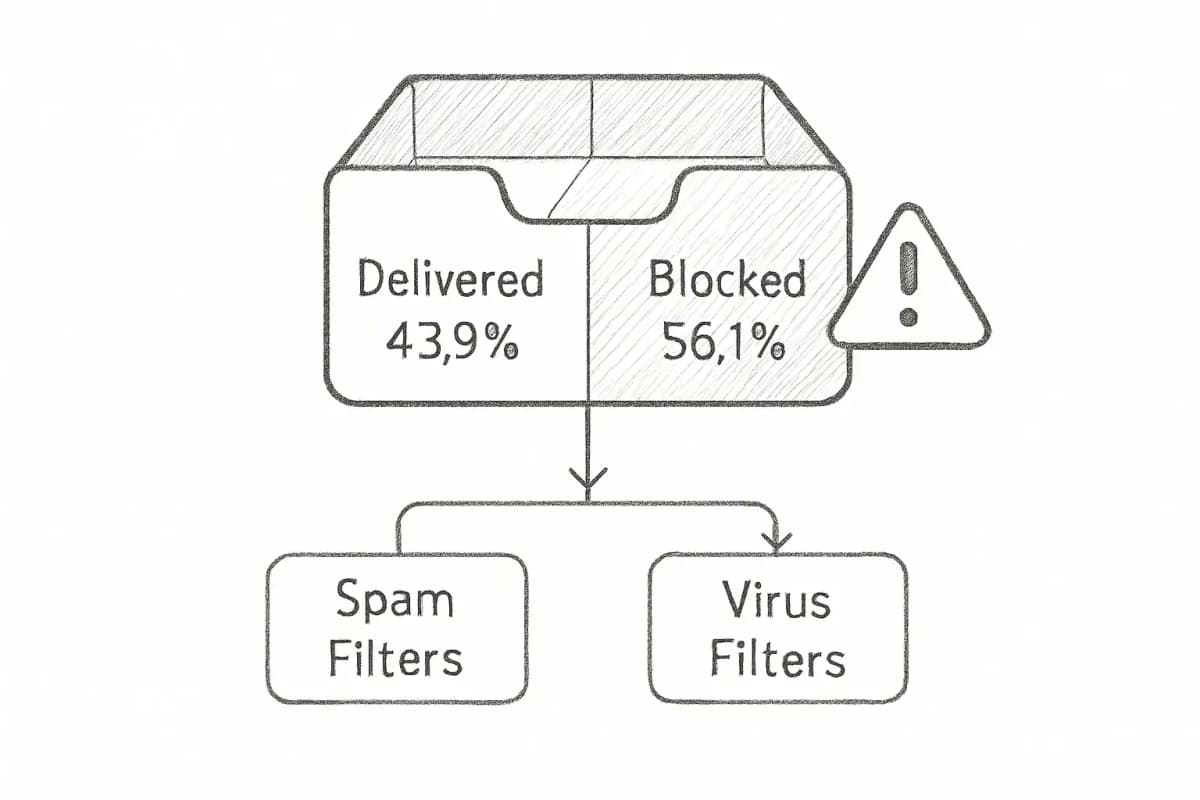
More than half of all emails sent today never reach a single inbox. That is the headline finding from a Hostinger analysis of one billion emails processed through its infrastructure in January 2026, reported by PuroMarketing. Only 43.9% of all processed emails were successfully delivered, while the remaining 56.1% were blocked by spam and virus filters before reaching any inbox. For marketers who treat email as their highest-ROI channel, that figure demands immediate attention.
The Automation Problem Behind the Blocking Rate
The deliverability crisis does not exist in isolation. It connects directly to a structural shift in who, or what, is writing emails in the first place. New Hostinger research has found that only 13% of global email traffic is actually human-written, with the remaining 87% generated by automated systems.
Of the different categories of emails received by Hostinger inboxes, only personal email providers and low-volume senders predominated as human-written. The rest, including business tools, SaaS platforms, marketing systems, and social networks, were mostly automated.
Of the emails that do get through, business tools and SaaS platforms make up the largest share at 21.62%, covering CRMs, project management tools, and workflow automation.
The volume signal alone explains why filters are tightening. Daily global email traffic is projected at 376.4 billion emails in 2025, with spam making up nearly 46.8% of all email traffic as of December 2024. Inbox providers are responding by applying increasingly aggressive filtering, and legitimate marketing emails are getting caught in the crossfire.
What Is Triggering the Blocks
Hostinger found the most common reason why emails were being blocked was because they were being marked as phishing, scam, malware, or botnets, accounting for 34% of all blocked messages.
More than half of all emails sent today never reach a single inbox. That is the headline finding from a Hostinger analysis of one billion emails processed through its infrastructure in January 2026, reported by PuroMarketing. Only 43.9% of all processed emails were successfully delivered, while the remaining 56.1% were blocked by spam and virus filters before reaching any inbox. For marketers who treat email as their highest-ROI channel, that figure demands immediate attention.
The Automation Problem Behind the Blocking Rate
The deliverability crisis does not exist in isolation. It connects directly to a structural shift in who, or what, is writing emails in the first place. New Hostinger research has found that only 13% of global email traffic is actually human-written, with the remaining 87% generated by automated systems.
Of the different categories of emails received by Hostinger inboxes, only personal email providers and low-volume senders predominated as human-written. The rest, including business tools, SaaS platforms, marketing systems, and social networks, were mostly automated.
Of the emails that do get through, business tools and SaaS platforms make up the largest share at 21.62%, covering CRMs, project management tools, and workflow automation.
The volume signal alone explains why filters are tightening. Daily global email traffic is projected at 376.4 billion emails in 2025, with spam making up nearly 46.8% of all email traffic as of December 2024. Inbox providers are responding by applying increasingly aggressive filtering, and legitimate marketing emails are getting caught in the crossfire.
What Is Triggering the Blocks
Hostinger found the most common reason why emails were being blocked was because they were being marked as phishing, scam, malware, or botnets, accounting for 34% of all blocked messages.
The authentication gap is making things worse. Deliverability conditions have deteriorated significantly, with Office365 placement rates declining 26.73%, Outlook falling 22.56%, and Google Workspace dropping 10.49% year-over-year. These steep drops reflect stricter filtering enforcement following Gmail and Yahoo's 2024 sender requirement updates mandating SPF, DKIM, and DMARC authentication plus one-click unsubscribe functionality.
Google and Yahoo implemented new deliverability requirements starting February 2024 for bulk email senders (anyone sending more than 5,000 emails per day), which became strictly enforced throughout 2025. Brands that did not adapt are now paying for it in blocked sends.
The AI Content Paradox
Nearly two-thirds of marketers now use AI tools for email campaigns, with 87% of AI adopters specifically applying it to email marketing. The productivity case is clear. But the data shows a growing gap between volume and quality.
The quality gap between AI-augmented emails (with human oversight, brand voice training, and strategic deployment) and AI-replaced emails (template-driven, generic content) is becoming obvious, and inbox algorithms may begin identifying and deprioritizing generic AI-generated content.
Consumer sentiment reinforces this. According to an Adobe Express survey of 1,007 US consumers conducted in December 2025, nearly one in five (18%) have already unsubscribed from a marketing email because they suspected it was written by AI, and 46% said they would be more likely to unsubscribe if they knew the email was clearly AI-written.
The conclusion Hostinger draws is direct. "The data suggests email is at an inflection point," Hostinger concludes, noting that companies need to totally reassess their email strategies to match the AI-driven, automated world of communications.
What Marketers Need to Do Now
The strategic response is not to abandon AI, it is to use it differently. Edgaras Lukoševičius, Engineering Manager at Hostinger, said senders need to be "far more intentional" about how they send messages to "stay relevant in crowded inboxes."
The authentication gap is making things worse. Deliverability conditions have deteriorated significantly, with Office365 placement rates declining 26.73%, Outlook falling 22.56%, and Google Workspace dropping 10.49% year-over-year. These steep drops reflect stricter filtering enforcement following Gmail and Yahoo's 2024 sender requirement updates mandating SPF, DKIM, and DMARC authentication plus one-click unsubscribe functionality.
Google and Yahoo implemented new deliverability requirements starting February 2024 for bulk email senders (anyone sending more than 5,000 emails per day), which became strictly enforced throughout 2025. Brands that did not adapt are now paying for it in blocked sends.
The AI Content Paradox
Nearly two-thirds of marketers now use AI tools for email campaigns, with 87% of AI adopters specifically applying it to email marketing. The productivity case is clear. But the data shows a growing gap between volume and quality.
The quality gap between AI-augmented emails (with human oversight, brand voice training, and strategic deployment) and AI-replaced emails (template-driven, generic content) is becoming obvious, and inbox algorithms may begin identifying and deprioritizing generic AI-generated content.
Consumer sentiment reinforces this. According to an Adobe Express survey of 1,007 US consumers conducted in December 2025, nearly one in five (18%) have already unsubscribed from a marketing email because they suspected it was written by AI, and 46% said they would be more likely to unsubscribe if they knew the email was clearly AI-written.
The conclusion Hostinger draws is direct. "The data suggests email is at an inflection point," Hostinger concludes, noting that companies need to totally reassess their email strategies to match the AI-driven, automated world of communications.
What Marketers Need to Do Now
The strategic response is not to abandon AI, it is to use it differently. Edgaras Lukoševičius, Engineering Manager at Hostinger, said senders need to be "far more intentional" about how they send messages to "stay relevant in crowded inboxes."
Personalization remains the clearest lever. Marketers implementing AI-powered personalization report revenue increasing by 41% and click-through rates rising 13.44% compared to non-personalized campaigns. The difference is using AI to tailor content rather than to mass-produce generic copy.
Shifting email content from volume to value is now a deliverability strategy in itself. With AI agents filtering inboxes and Gmail enabling batch unsubscribes, low-value messages face faster deletion. Replacing frequent promotional sends with high-value content: educational updates, loyalty messaging, and lifecycle guidance, gives both subscribers and filters a reason to let emails through.
On the technical side, authentication is non-negotiable. Low reply or open rates, missing SPF/DKIM/DMARC records, and spam complaint rates above 0.3% quickly reduce inbox placement. Both are within a sender's control.
The Business Case for Getting This Right
In February 2025, 26.9% of UK and US marketers said email delivered their best ROI, ahead of websites and blogs (22.7%), SEO (19.2%), paid search (16.1%), and social media advertising (11.4%). A channel that returns this much is worth protecting.
The Hostinger data makes the cost of inaction concrete: if 56.1% of your emails are blocked before delivery, you are effectively paying to send campaigns that more than half your audience will never see. Email is still one of the highest-ROI channels available, but the gap between senders who use it well and those who do not is widening. AI tools are making it easier to personalize at scale, time campaigns intelligently, and create professional-looking emails without a design team. The businesses that will get the most out of email in the next few years are the ones treating it as a strategic channel, not just a broadcast tool.
No comments yet. Be the first!
Personalization remains the clearest lever. Marketers implementing AI-powered personalization report revenue increasing by 41% and click-through rates rising 13.44% compared to non-personalized campaigns. The difference is using AI to tailor content rather than to mass-produce generic copy.
Shifting email content from volume to value is now a deliverability strategy in itself. With AI agents filtering inboxes and Gmail enabling batch unsubscribes, low-value messages face faster deletion. Replacing frequent promotional sends with high-value content: educational updates, loyalty messaging, and lifecycle guidance, gives both subscribers and filters a reason to let emails through.
On the technical side, authentication is non-negotiable. Low reply or open rates, missing SPF/DKIM/DMARC records, and spam complaint rates above 0.3% quickly reduce inbox placement. Both are within a sender's control.
The Business Case for Getting This Right
In February 2025, 26.9% of UK and US marketers said email delivered their best ROI, ahead of websites and blogs (22.7%), SEO (19.2%), paid search (16.1%), and social media advertising (11.4%). A channel that returns this much is worth protecting.
The Hostinger data makes the cost of inaction concrete: if 56.1% of your emails are blocked before delivery, you are effectively paying to send campaigns that more than half your audience will never see. Email is still one of the highest-ROI channels available, but the gap between senders who use it well and those who do not is widening. AI tools are making it easier to personalize at scale, time campaigns intelligently, and create professional-looking emails without a design team. The businesses that will get the most out of email in the next few years are the ones treating it as a strategic channel, not just a broadcast tool.