
HomeNewsEmberpoint Releases Email Authentication Checklist for 2026
Email Deliverability

Emberpoint Releases Email Authentication Checklist for 2026

Emberpoint publishes six-step whitepaper for Gmail compliance. New authentication requirements now enforced with rejections.

P

Priya Kapoor

April 26, 2026

4 min read
HomeNewsEmberpoint Releases Email Authentication Checklist for 2026
Email Deliverability

Emberpoint Releases Email Authentication Checklist for 2026

Emberpoint publishes six-step whitepaper for Gmail compliance. New authentication requirements now enforced with rejections.

P

Priya Kapoor

April 26, 2026

4 min read
Share:
Share:
#Compliance#SPF/DKIM/DMARC#Gmail & Yahoo
Illustration for report: Emberpoint Releases Email Authentication Checklist for 2026

Stay in the loop

Get the latest posts delivered straight to your inbox. No spam, unsubscribe anytime.

Tokyo-based EmberPoint's email marketing platform, Mail Publisher, holds the top position in Japan's email sending market. Now the company is turning that expertise outward, publishing a practical authentication guide for 2026. Founded in 1999 and headquartered in Tokyo, EmberPoint has released a whitepaper via PR Times outlining a six-step checklist to help email senders navigate Gmail's tightened authentication requirements. The guide targets marketers, IT teams, and business owners who send email at scale and need a structured path to compliance before deliverability problems force their hand.

The timing is deliberate. Starting November 2025, Gmail ramped up its enforcement on non-compliant traffic, meaning messages that fail to meet sender requirements now face disruptions including temporary and permanent rejections. For marketing teams that rely on Gmail inboxes to reach customers, that is a direct revenue risk.

What Gmail Now Requires from Bulk Senders

As of February 2024, any sender that sends 5,000 or more messages per day to Gmail addresses must publish a valid DMARC record for their domain. But a record alone is not enough. To ensure successful delivery, all outgoing emails must pass SPF validation, outbound messages must pass DKIM checks, domains must carry a DMARC record with a policy of at least p=none, the "From" header must align with authenticated domains, and all messages must be sent using a TLS connection.

Emails must also include a one-click unsubscribe option with requests processed within 48 hours, and senders must maintain a spam complaint rate below 0.3%.

EmberPoint's six-step whitepaper maps directly onto these requirements, walking teams through implementation and ongoing monitoring of each standard. The guide is written for Japanese enterprise senders, but the underlying standards are global, and the compliance gap is wide enough to matter everywhere.

Most Senders Are Still Behind

The compliance picture in 2026 remains patchy. DMARC adoption is stuck at 64%, meaning over a third of email-sending domains still have no DMARC policy in place. Google and Yahoo made DMARC a requirement for bulk senders in February 2024, and Gmail tightened enforcement further in November 2025.

Stay in the loop

Get the latest posts delivered straight to your inbox. No spam, unsubscribe anytime.

Tokyo-based EmberPoint's email marketing platform, Mail Publisher, holds the top position in Japan's email sending market. Now the company is turning that expertise outward, publishing a practical authentication guide for 2026. Founded in 1999 and headquartered in Tokyo, EmberPoint has released a whitepaper via PR Times outlining a six-step checklist to help email senders navigate Gmail's tightened authentication requirements. The guide targets marketers, IT teams, and business owners who send email at scale and need a structured path to compliance before deliverability problems force their hand.

The timing is deliberate. Starting November 2025, Gmail ramped up its enforcement on non-compliant traffic, meaning messages that fail to meet sender requirements now face disruptions including temporary and permanent rejections. For marketing teams that rely on Gmail inboxes to reach customers, that is a direct revenue risk.

What Gmail Now Requires from Bulk Senders

As of February 2024, any sender that sends 5,000 or more messages per day to Gmail addresses must publish a valid DMARC record for their domain. But a record alone is not enough. To ensure successful delivery, all outgoing emails must pass SPF validation, outbound messages must pass DKIM checks, domains must carry a DMARC record with a policy of at least p=none, the "From" header must align with authenticated domains, and all messages must be sent using a TLS connection.

Emails must also include a one-click unsubscribe option with requests processed within 48 hours, and senders must maintain a spam complaint rate below 0.3%.

EmberPoint's six-step whitepaper maps directly onto these requirements, walking teams through implementation and ongoing monitoring of each standard. The guide is written for Japanese enterprise senders, but the underlying standards are global, and the compliance gap is wide enough to matter everywhere.

Most Senders Are Still Behind

The compliance picture in 2026 remains patchy. DMARC adoption is stuck at 64%, meaning over a third of email-sending domains still have no DMARC policy in place. Google and Yahoo made DMARC a requirement for bulk senders in February 2024, and Gmail tightened enforcement further in November 2025.

Even among those who have published a DMARC record, enforcement is weak. Only 42% of DMARC-publishing domains actually enforce it. Millions of small and mid-sized companies published a DMARC record because Google or Yahoo told them to, but left it at p=none, which provides monitoring and zero actual blocking, leaving those domains wide open to spoofing.

Even among those who have published a DMARC record, enforcement is weak. Only 42% of DMARC-publishing domains actually enforce it. Millions of small and mid-sized companies published a DMARC record because Google or Yahoo told them to, but left it at p=none, which provides monitoring and zero actual blocking, leaving those domains wide open to spoofing.

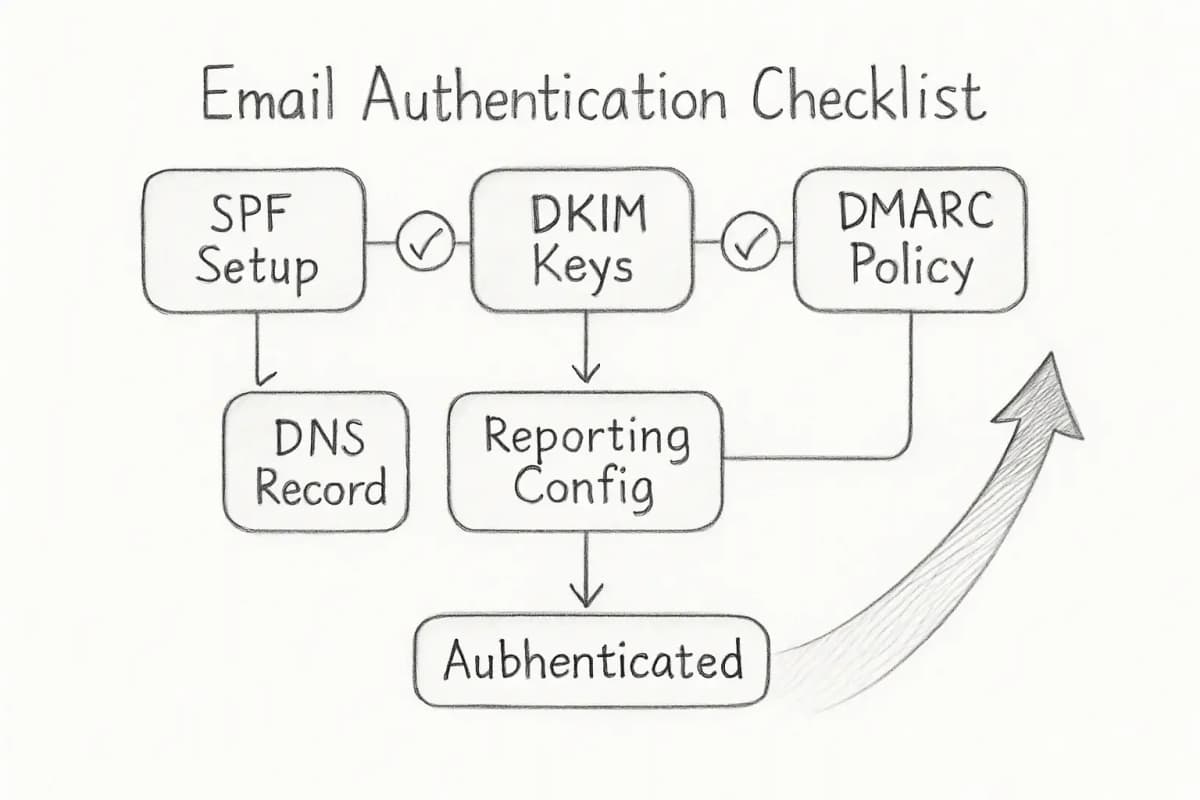
The deliverability cost of this gap is measurable. Despite mandatory authentication requirements from Google (February 2024), Yahoo (February 2024), and Microsoft (May 2025), fully authenticated senders are 2.7x more likely to reach inboxes than their unauthenticated counterparts. Average inbox deliverability sits at roughly 83.1%, meaning about 1 in 6 marketing emails never reach the inbox at all. Email authentication checklist diagram showing three sequential authentication protocols: SPF (Sender Policy Framework) with setup steps including DNS record configuration, DKIM (DomainKeys Identified Mail) with key generation and DNS publication steps, and DMARC (Domain-based Message Authentication, Reporting and Conformance) with policy settings and reporting configuration. Each protocol box should show 2-3 specific setup steps in a left-to-right flow. Include checkmark icons for completed items and highlight the connection between all three as an integrated authentication stack. Add visual indicators showing these work together to improve deliverability rates.

The deliverability cost of this gap is measurable. Despite mandatory authentication requirements from Google (February 2024), Yahoo (February 2024), and Microsoft (May 2025), fully authenticated senders are 2.7x more likely to reach inboxes than their unauthenticated counterparts. Average inbox deliverability sits at roughly 83.1%, meaning about 1 in 6 marketing emails never reach the inbox at all. Email authentication checklist diagram showing three sequential authentication protocols: SPF (Sender Policy Framework) with setup steps including DNS record configuration, DKIM (DomainKeys Identified Mail) with key generation and DNS publication steps, and DMARC (Domain-based Message Authentication, Reporting and Conformance) with policy settings and reporting configuration. Each protocol box should show 2-3 specific setup steps in a left-to-right flow. Include checkmark icons for completed items and highlight the connection between all three as an integrated authentication stack. Add visual indicators showing these work together to improve deliverability rates.

Why This Checklist Matters for Growth Teams

For marketers and growth teams, authentication is not a one-time technical task. It requires ongoing monitoring. Before doing anything, it makes sense to audit your current email sending setup using a mail checker tool combined with DMARC reporting, then work through sender requirements to verify that all sending sources are compliant, ensuring SPF, DKIM, and DMARC are configured in a way that guarantees DMARC alignment.

A full implementation typically takes six to eight weeks. Organizations that complete it gain better deliverability, stronger security, and the ability to display verified logos in inboxes through BIMI.

EmberPoint's checklist structure follows a logical phased approach that mirrors what security teams recommend: assess your current configuration, implement the missing protocols, move DMARC policy from p=none toward enforcement, and then monitor aggregate reports continuously. Monitoring DMARC aggregate reports weekly helps catch misconfigurations and unauthorized senders before they damage sender reputation.

EmberPoint's Mail Publisher platform is capable of delivering up to 41 million emails per hour, which means the company understands at a technical level what breaks at scale when authentication is misconfigured. The platform can detect and classify more than 500 distinct types of email delivery issues, allowing marketing and IT teams to quickly identify problems and improve deliverability.

The Practical Takeaway

Gmail's enforcement is no longer theoretical. The grace period is over. Senders who do not comply will experience disruptions. For any business sending marketing, transactional, or operational email to Gmail accounts at volume, the question is not whether to implement full authentication but how fast to do it.

Companies that delay implementing SPF, DKIM, and DMARC risk increasing delivery issues, higher phishing exposure, and reduced trust in their domains as authentication standards continue to mature.

EmberPoint's whitepaper offers a structured starting point, particularly for teams that have been treating authentication as a low-priority IT task. The full guide is available via PR Times in Japanese.

No comments yet. Be the first!

Leave a comment

Comments are reviewed before publishing.

Why This Checklist Matters for Growth Teams

For marketers and growth teams, authentication is not a one-time technical task. It requires ongoing monitoring. Before doing anything, it makes sense to audit your current email sending setup using a mail checker tool combined with DMARC reporting, then work through sender requirements to verify that all sending sources are compliant, ensuring SPF, DKIM, and DMARC are configured in a way that guarantees DMARC alignment.

A full implementation typically takes six to eight weeks. Organizations that complete it gain better deliverability, stronger security, and the ability to display verified logos in inboxes through BIMI.

EmberPoint's checklist structure follows a logical phased approach that mirrors what security teams recommend: assess your current configuration, implement the missing protocols, move DMARC policy from p=none toward enforcement, and then monitor aggregate reports continuously. Monitoring DMARC aggregate reports weekly helps catch misconfigurations and unauthorized senders before they damage sender reputation.

EmberPoint's Mail Publisher platform is capable of delivering up to 41 million emails per hour, which means the company understands at a technical level what breaks at scale when authentication is misconfigured. The platform can detect and classify more than 500 distinct types of email delivery issues, allowing marketing and IT teams to quickly identify problems and improve deliverability.

The Practical Takeaway

Gmail's enforcement is no longer theoretical. The grace period is over. Senders who do not comply will experience disruptions. For any business sending marketing, transactional, or operational email to Gmail accounts at volume, the question is not whether to implement full authentication but how fast to do it.

Companies that delay implementing SPF, DKIM, and DMARC risk increasing delivery issues, higher phishing exposure, and reduced trust in their domains as authentication standards continue to mature.

EmberPoint's whitepaper offers a structured starting point, particularly for teams that have been treating authentication as a low-priority IT task. The full guide is available via PR Times in Japanese.

No comments yet. Be the first!

Leave a comment

Comments are reviewed before publishing.

Breaking

Related news

Illustration for new_technology: Gmail's New RETVec AI Boosts Spam Detection by 38%
Email DeliverabilityMay 22, 2026 6 min

Gmail's New RETVec AI Boosts Spam Detection by 38%

Google deployed RETVec, an AI spam filter that detects obfuscated spam, improving detection 38% while reducing false positives 19.4%. Here's what email marketers need to know.

Breaking

Related news

Illustration for new_technology: Gmail's New RETVec AI Boosts Spam Detection by 38%
Email DeliverabilityMay 22, 2026 6 min

Gmail's New RETVec AI Boosts Spam Detection by 38%

Google deployed RETVec, an AI spam filter that detects obfuscated spam, improving detection 38% while reducing false positives 19.4%. Here's what email marketers need to know.

R
Rachel Torres
R
Rachel Torres
Illustration for new_technology: IETF Publishes RFC 9989 DMARC Standard in May 2026
Email DeliverabilityMay 22, 2026 6 min

IETF Publishes RFC 9989 DMARC Standard in May 2026

IETF officially published RFC 9989 in May 2026, upgrading DMARC to Proposed Standard status. The update improves spoofing prevention and email authentication with clarified terminology and stronger subdomain protection.

JJames Chen
Illustration for new_technology: IETF Publishes RFC 9989 DMARC Standard in May 2026
Email DeliverabilityMay 22, 2026 6 min

IETF Publishes RFC 9989 DMARC Standard in May 2026

IETF officially published RFC 9989 in May 2026, upgrading DMARC to Proposed Standard status. The update improves spoofing prevention and email authentication with clarified terminology and stronger subdomain protection.

JJames Chen
Illustration for industry_trend: Gmail Spam Filter Collapse Jams 1.8B Inboxes
Email DeliverabilityMay 22, 2026 6 min

Gmail Spam Filter Collapse Jams 1.8B Inboxes

Gmail's spam filters collapsed on Saturday, flooding 1.8 billion inboxes with promotions while blocking legitimate mail. Here's what happened.

RRachel Torres
Illustration for industry_trend: Gmail Spam Filter Collapse Jams 1.8B Inboxes
Email DeliverabilityMay 22, 2026 6 min

Gmail Spam Filter Collapse Jams 1.8B Inboxes

Gmail's spam filters collapsed on Saturday, flooding 1.8 billion inboxes with promotions while blocking legitimate mail. Here's what happened.

RRachel Torres