HomeBlogIndustry-Specific Email MarketingEmail Marketing Examples for Restaurants: 7 Proven Strategies
Industry-Specific Email Marketing

Email Marketing Examples for Restaurants: 7 Proven Strategies

See 7 real email marketing examples restaurants use to boost reservations and repeat orders. Learn what works and how to apply it to your restaurant.

S

Sarah Mitchell

July 11, 2026

HomeBlogIndustry-Specific Email MarketingEmail Marketing Examples for Restaurants: 7 Proven Strategies
Industry-Specific Email Marketing

Email Marketing Examples for Restaurants: 7 Proven Strategies

See 7 real email marketing examples restaurants use to boost reservations and repeat orders. Learn what works and how to apply it to your restaurant.

S

Sarah Mitchell

July 11, 2026

12 min read
12 min read
Share:
Share:
#Restaurant Marketing#Email Examples#Customer Retention#Hospitality
Illustration for examples of email marketing for restaurants

Stay in the loop

Get the latest posts delivered straight to your inbox. No spam, unsubscribe anytime.

Restaurant email marketing is one of the few owned channels that directly closes the gap between a diner's last visit and their next one. Email marketing ROI for restaurants sits at approximately $42 for every dollar spent, and more than 53% of diners have visited a new restaurant because of a marketing email, based on a six-month study. That combination of reach, cost efficiency, and proven conversion power makes email the most controllable growth lever a restaurant operator can use.

This post breaks down seven proven examples of email marketing for restaurants, with real strategies, campaign types, and the data behind each one.


Key Takeaways

  • The average restaurant email open rate is 43.69%, well above most other industries, which means diners are already primed to engage.
  • Targeted, segmented campaigns drive 77% of total email revenue for restaurants that use them, yet most still send generic blasts to everyone.
  • Personalized marketing can result in a 20% lift in spend by email recipients over 30 days, with a surge in sales the day after it's sent.
  • Birthday and anniversary emails achieve open rates three times higher than standard emails, making milestone triggers the highest-leverage automation to set up first.
  • Automated email campaigns generate 320% more revenue than non-automated email marketing campaigns.

Why Email Still Outperforms Social for Restaurants

Before getting into specific examples of email marketing for restaurants, it is worth understanding why email deserves dedicated budget and attention.

69% of guests worldwide chose email as their preferred communication method from consumer brands, and research shows that email is 40x more effective at bringing new guests back than Facebook or Twitter. Social media requires algorithm favor and ongoing paid spend to reach your own followers. Email does not.

If you have 2,000 email subscribers and 2,000 followers on Facebook, 435 people will open your email but only 120 Facebook fans will see your message. That reach gap alone justifies building a dedicated email program.

Restaurant margins average between 3% and 9% net profit, which means every marketing dollar has to work. Email delivers because it targets people who already know you.

Stay in the loop

Get the latest posts delivered straight to your inbox. No spam, unsubscribe anytime.

Restaurant email marketing is one of the few owned channels that directly closes the gap between a diner's last visit and their next one. Email marketing ROI for restaurants sits at approximately $42 for every dollar spent, and more than 53% of diners have visited a new restaurant because of a marketing email, based on a six-month study. That combination of reach, cost efficiency, and proven conversion power makes email the most controllable growth lever a restaurant operator can use.

This post breaks down seven proven examples of email marketing for restaurants, with real strategies, campaign types, and the data behind each one.


Key Takeaways

  • The average restaurant email open rate is 43.69%, well above most other industries, which means diners are already primed to engage.
  • Targeted, segmented campaigns drive 77% of total email revenue for restaurants that use them, yet most still send generic blasts to everyone.
  • Personalized marketing can result in a 20% lift in spend by email recipients over 30 days, with a surge in sales the day after it's sent.
  • Birthday and anniversary emails achieve open rates three times higher than standard emails, making milestone triggers the highest-leverage automation to set up first.
  • Automated email campaigns generate 320% more revenue than non-automated email marketing campaigns.

Why Email Still Outperforms Social for Restaurants

Before getting into specific examples of email marketing for restaurants, it is worth understanding why email deserves dedicated budget and attention.

69% of guests worldwide chose email as their preferred communication method from consumer brands, and research shows that email is 40x more effective at bringing new guests back than Facebook or Twitter. Social media requires algorithm favor and ongoing paid spend to reach your own followers. Email does not.

If you have 2,000 email subscribers and 2,000 followers on Facebook, 435 people will open your email but only 120 Facebook fans will see your message. That reach gap alone justifies building a dedicated email program.

Restaurant margins average between 3% and 9% net profit, which means every marketing dollar has to work. Email delivers because it targets people who already know you.


Strategy 1: The Welcome Email Series

The welcome email is your first impression in the inbox. Send it within minutes of sign-up, not days.

Welcome emails increase long-term engagement by 33%, and 74.4% of subscribers say they expect a welcome message as soon as they subscribe. Most restaurants set up a single welcome message. The stronger approach is a short sequence.

What a three-part welcome series looks like for restaurants:

  1. Day 0 (immediately): Confirm the sign-up, deliver the incentive (a free appetizer, a discount, or early access to the menu), and introduce the brand briefly.
  2. Day 3: Highlight two or three menu items with food photography, and include a link to reserve a table or place an order.
  3. Day 7: Share a customer testimonial or a behind-the-scenes story from the kitchen, and include a secondary CTA to follow on social or join the loyalty program.

Chipotle's welcome email is widely cited as a strong model: it combines a friendly tone with clear information about the rewards program, which makes subscribers more likely to make their first purchase.

For more on structuring this kind of sequence, see our guide to welcome email sequence best practices.


Strategy 2: List Segmentation by Guest Behavior

The most common reason restaurant email underperforms is not deliverability, design, or subject lines. It is that most restaurants send the same message to everyone at once, a practice known as batch-and-blast, and expect it to perform like a targeted campaign. A guest who ordered yesterday does not need a win-back message.

The four segments that drive the most email revenue for independent restaurants are: new guests (first order, goal: convert to a second visit), repeat guests (2-3 orders, goal: build the habit), VIP guests (4+ orders or above a spending threshold, goal: recognize and retain), and lapsed guests (those who have not ordered in 30, 60, or 90 days).

Each group needs a different message. A new guest gets a warm follow-up with a reason to return. A VIP gets early access to something exclusive. A lapsed guest gets a "we miss you" offer with a clear expiration to create urgency.

Segment by dining frequency, and also by menu preferences: identify customers' favorite dishes or cuisines and send targeted emails according to their preferences.

To go deeper on this, our email list segmentation strategies guide covers the mechanics of building behavior-based segments that consistently outperform static lists.


Strategy 3: Birthday and Anniversary Emails


Strategy 1: The Welcome Email Series

The welcome email is your first impression in the inbox. Send it within minutes of sign-up, not days.

Welcome emails increase long-term engagement by 33%, and 74.4% of subscribers say they expect a welcome message as soon as they subscribe. Most restaurants set up a single welcome message. The stronger approach is a short sequence.

What a three-part welcome series looks like for restaurants:

  1. Day 0 (immediately): Confirm the sign-up, deliver the incentive (a free appetizer, a discount, or early access to the menu), and introduce the brand briefly.
  2. Day 3: Highlight two or three menu items with food photography, and include a link to reserve a table or place an order.
  3. Day 7: Share a customer testimonial or a behind-the-scenes story from the kitchen, and include a secondary CTA to follow on social or join the loyalty program.

Chipotle's welcome email is widely cited as a strong model: it combines a friendly tone with clear information about the rewards program, which makes subscribers more likely to make their first purchase.

For more on structuring this kind of sequence, see our guide to welcome email sequence best practices.


Strategy 2: List Segmentation by Guest Behavior

The most common reason restaurant email underperforms is not deliverability, design, or subject lines. It is that most restaurants send the same message to everyone at once, a practice known as batch-and-blast, and expect it to perform like a targeted campaign. A guest who ordered yesterday does not need a win-back message.

The four segments that drive the most email revenue for independent restaurants are: new guests (first order, goal: convert to a second visit), repeat guests (2-3 orders, goal: build the habit), VIP guests (4+ orders or above a spending threshold, goal: recognize and retain), and lapsed guests (those who have not ordered in 30, 60, or 90 days).

Each group needs a different message. A new guest gets a warm follow-up with a reason to return. A VIP gets early access to something exclusive. A lapsed guest gets a "we miss you" offer with a clear expiration to create urgency.

Segment by dining frequency, and also by menu preferences: identify customers' favorite dishes or cuisines and send targeted emails according to their preferences.

To go deeper on this, our email list segmentation strategies guide covers the mechanics of building behavior-based segments that consistently outperform static lists.


Strategy 3: Birthday and Anniversary Emails

On average, birthday email open rates reach and often exceed 45%. Guests anticipate birthday rewards, which gives restaurants the opportunity to boost guest engagement and drive revenue.

Birthday emails work because personal milestones drive emotional loyalty. Guests appreciate acknowledgment on their special day. When they come in for the birthday offer, they often bring others, which increases table size and average order value.

What makes a birthday email convert:

  • Collect the birthday date at sign-up or through your loyalty program intake form.
  • Schedule the offer 7 to 10 days before the birthday, not on the day itself, for better conversion.
  • Include the customer's first name in the subject line. A 2024 report from Mailjet found that 61% of recipients opened emails with their names in the subject line.
  • Keep the offer simple: a free dessert, a free appetizer, or a fixed discount, with a clear redemption window.

The same logic applies to dining anniversaries. Personalized offers include special birthday discounts, recommendations based on past orders, or exclusive deals for frequent diners. Restaurateurs typically use dining history, favorite dishes, frequency of visits, and special dates like birthdays or anniversaries as data points.


Strategy 4: Promotional and Seasonal Campaigns

Promotions work best when they are tied to a real hook, not just a generic discount. A seasonal menu launch, a holiday, a local event, or a limited-time item all give the email a reason to exist beyond "here is a coupon."

Restaurant emails that include promotional campaigns with triggers show higher CTR of 21.32% and conversion rates.

Seasonal events bring people out, and well-timed emails can drive them to your restaurant. Instead of a one-off promo, a three-part campaign works better: before, day-of, and follow-up. Event-specific dishes, discounts, or contests help you stand out.

Seasonal emails have some of the highest open rates in restaurant marketing because they arrive when guests are already thinking about food and occasion. A well-timed message around Mother's Day, game day, or a local festival turns ambient demand into a direct order.

Format tips for promotional emails:

  • Lead with one clear offer. Multiple promotions dilute focus and lower CTR.
  • Use high-quality food photography. 69% of casual diners choose restaurants based on food photos, and food images increase CTR and conversions.
  • Use a single, prominent CTA that links directly to your reservation or online ordering page.
  • Build urgency with a specific expiration date, not vague language like "limited time."

Strategy 5: Loyalty Program Emails

Data from the National Restaurant Association indicates that 77% of loyalty program members are more likely to return to a restaurant. Email is the primary channel through which loyalty programs stay active in customers' minds between visits.

Loyalty program members spend 20% more than non-member customers. Nearly half (47%) use their memberships several times a month, while a third (32%) do so several times a week.

Loyalty emails fall into three categories:

On average, birthday email open rates reach and often exceed 45%. Guests anticipate birthday rewards, which gives restaurants the opportunity to boost guest engagement and drive revenue.

Birthday emails work because personal milestones drive emotional loyalty. Guests appreciate acknowledgment on their special day. When they come in for the birthday offer, they often bring others, which increases table size and average order value.

What makes a birthday email convert:

  • Collect the birthday date at sign-up or through your loyalty program intake form.
  • Schedule the offer 7 to 10 days before the birthday, not on the day itself, for better conversion.
  • Include the customer's first name in the subject line. A 2024 report from Mailjet found that 61% of recipients opened emails with their names in the subject line.
  • Keep the offer simple: a free dessert, a free appetizer, or a fixed discount, with a clear redemption window.

The same logic applies to dining anniversaries. Personalized offers include special birthday discounts, recommendations based on past orders, or exclusive deals for frequent diners. Restaurateurs typically use dining history, favorite dishes, frequency of visits, and special dates like birthdays or anniversaries as data points.


Strategy 4: Promotional and Seasonal Campaigns

Promotions work best when they are tied to a real hook, not just a generic discount. A seasonal menu launch, a holiday, a local event, or a limited-time item all give the email a reason to exist beyond "here is a coupon."

Restaurant emails that include promotional campaigns with triggers show higher CTR of 21.32% and conversion rates.

Seasonal events bring people out, and well-timed emails can drive them to your restaurant. Instead of a one-off promo, a three-part campaign works better: before, day-of, and follow-up. Event-specific dishes, discounts, or contests help you stand out.

Seasonal emails have some of the highest open rates in restaurant marketing because they arrive when guests are already thinking about food and occasion. A well-timed message around Mother's Day, game day, or a local festival turns ambient demand into a direct order.

Format tips for promotional emails:

  • Lead with one clear offer. Multiple promotions dilute focus and lower CTR.
  • Use high-quality food photography. 69% of casual diners choose restaurants based on food photos, and food images increase CTR and conversions.
  • Use a single, prominent CTA that links directly to your reservation or online ordering page.
  • Build urgency with a specific expiration date, not vague language like "limited time."

Strategy 5: Loyalty Program Emails

Data from the National Restaurant Association indicates that 77% of loyalty program members are more likely to return to a restaurant. Email is the primary channel through which loyalty programs stay active in customers' minds between visits.

Loyalty program members spend 20% more than non-member customers. Nearly half (47%) use their memberships several times a month, while a third (32%) do so several times a week.

Loyalty emails fall into three categories:

  1. Progress notifications: "You're 50 points away from a free entrée." These nudge guests toward the next visit.
  2. Reward redemption reminders: "Your birthday reward expires in 7 days." These recover potential lost redemptions.
  3. Tier upgrade announcements: "You've reached Gold status." These reinforce the emotional investment in the relationship.

According to the 2026 Restaurant Industry Trends Report, 66% of consumers order more often from restaurants where they actively use a loyalty program. The key word is "actively." A loyalty program that guests forget about generates nothing. Email keeps it front of mind.


Strategy 6: Win-Back Emails for Lapsed Guests

Approximately 70% of first-time restaurant diners never come back, which makes win-back campaigns one of the highest-value automations a restaurant can run.

A lapsed guest already knows your food. They do not need to be convinced. They just need a reason to come back now. A win-back email with a relevant offer is one of the highest-converting campaigns in restaurant marketing, and it costs nothing unless the guest redeems.

A simple win-back sequence structure:

  • Trigger: Guest has not visited or ordered in 30, 60, or 90 days (set the threshold based on your typical visit frequency).
  • Email 1 (30 days): Soft reminder with a "we miss you" tone and a menu highlight. No heavy discount yet.
  • Email 2 (45 days): Add a modest incentive, 10% off or a free side dish, with a 14-day expiration.
  • Email 3 (60 days): Final notice with a slightly stronger offer and clear urgency.

A study by Return Path found that 45% of recipients who received win-back emails read subsequent messages, meaning the sequence effect compounds even when the first email does not convert immediately.

Many inactive subscribers do not disengage intentionally. They drift. A light nudge brings a portion back. Win-back emails often generate high ROI because the audience already knows the brand.


Strategy 7: Post-Visit Follow-Up and Feedback Emails

Asking customers to share their dining experience after they visit works best as a triggered automation sent a few hours or a day after the visit.

This type of email serves two purposes at once: it gathers reviews that improve your public reputation, and it creates a personal touchpoint that increases the likelihood of a return visit. Guests who feel heard are more likely to become regulars.

What a high-performing post-visit email includes:

  • A brief, warm message from the chef, GM, or owner.
  • A single question or a link to a short survey (three questions or fewer).
  • An optional incentive for completing the feedback, such as $10 in credit for their next visit.
  • A reminder of your loyalty program if the guest is not yet enrolled.
  1. Progress notifications: "You're 50 points away from a free entrée." These nudge guests toward the next visit.
  2. Reward redemption reminders: "Your birthday reward expires in 7 days." These recover potential lost redemptions.
  3. Tier upgrade announcements: "You've reached Gold status." These reinforce the emotional investment in the relationship.

According to the 2026 Restaurant Industry Trends Report, 66% of consumers order more often from restaurants where they actively use a loyalty program. The key word is "actively." A loyalty program that guests forget about generates nothing. Email keeps it front of mind.


Strategy 6: Win-Back Emails for Lapsed Guests

Approximately 70% of first-time restaurant diners never come back, which makes win-back campaigns one of the highest-value automations a restaurant can run.

A lapsed guest already knows your food. They do not need to be convinced. They just need a reason to come back now. A win-back email with a relevant offer is one of the highest-converting campaigns in restaurant marketing, and it costs nothing unless the guest redeems.

A simple win-back sequence structure:

  • Trigger: Guest has not visited or ordered in 30, 60, or 90 days (set the threshold based on your typical visit frequency).
  • Email 1 (30 days): Soft reminder with a "we miss you" tone and a menu highlight. No heavy discount yet.
  • Email 2 (45 days): Add a modest incentive, 10% off or a free side dish, with a 14-day expiration.
  • Email 3 (60 days): Final notice with a slightly stronger offer and clear urgency.

A study by Return Path found that 45% of recipients who received win-back emails read subsequent messages, meaning the sequence effect compounds even when the first email does not convert immediately.

Many inactive subscribers do not disengage intentionally. They drift. A light nudge brings a portion back. Win-back emails often generate high ROI because the audience already knows the brand.


Strategy 7: Post-Visit Follow-Up and Feedback Emails

Asking customers to share their dining experience after they visit works best as a triggered automation sent a few hours or a day after the visit.

This type of email serves two purposes at once: it gathers reviews that improve your public reputation, and it creates a personal touchpoint that increases the likelihood of a return visit. Guests who feel heard are more likely to become regulars.

What a high-performing post-visit email includes:

  • A brief, warm message from the chef, GM, or owner.
  • A single question or a link to a short survey (three questions or fewer).
  • An optional incentive for completing the feedback, such as $10 in credit for their next visit.
  • A reminder of your loyalty program if the guest is not yet enrolled.

Because post-visit emails are sent to each individual rather than a large, depersonalized batch, they tend to have higher open rates and generate greater ROI. Automated emails can thank guests after their first visit, re-engage them when they have not visited in a while, and follow up on positive and negative feedback.

For more on measuring what each campaign type actually produces, see our post on email marketing analytics best practices.


How to Measure Restaurant Email Marketing Performance

Email metrics like open and click-through rates help you understand how well your emails are performing. But it is not open rates that matter to the bottom line: it is the dollars those opens generate. Email success is measured in both engagement and revenue, and you should track both for every email you send.

The metrics to track per campaign:

  • Open rate (benchmark: 43.69% average for restaurants)
  • Click-through rate (benchmark: 1.13% average for restaurants)
  • Redemption rate on any coupon or offer included
  • Revenue attributed to the campaign (use unique promo codes per send to connect email activity to in-store or online orders)
  • Unsubscribe rate (a rising unsubscribe rate after a specific campaign type usually signals a mismatch between the audience segment and the message)

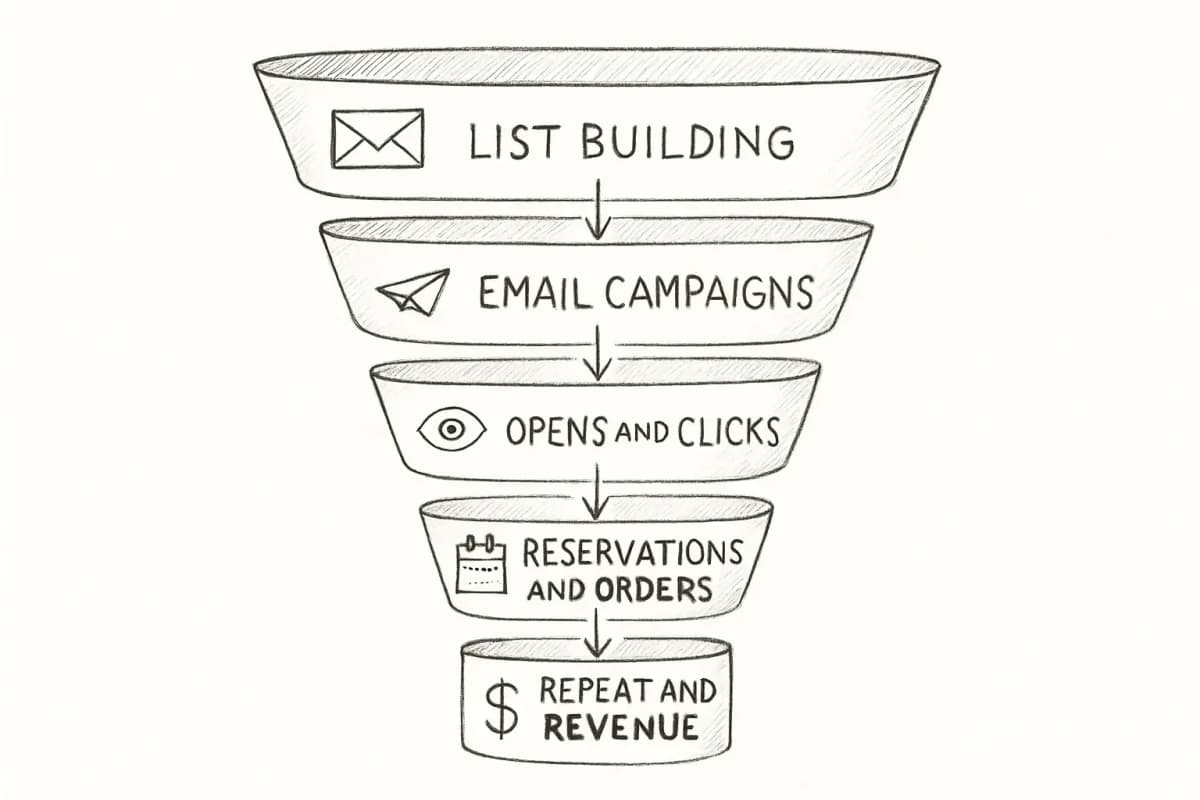
Opens and clicks tell part of the story. Revenue tells the rest. The most important metrics for restaurant email marketing tie directly to business outcomes: reservations made, orders placed, and guests who return. Restaurant email marketing funnel visualization showing the progression from initial list building through engagement metrics to final business outcomes. The funnel should display five sequential stages: (1) List Building at the top (widest section, showing email list growth from first-time diners), (2) Email Campaigns flowing downward (showing multiple campaign touchpoints), (3) Engagement Metrics in the middle (opens and clicks represented as narrowing funnel), (4) Action Metrics (reservations made, orders placed), and (5) Revenue and Loyalty at the bottom (narrowest section, showing repeat guests and attributed revenue). Use a restaurant-themed color palette with warm tones. Include subtle icons representing each stage: envelope for list building, paper plane for campaigns, eye for opens, cursor for clicks, calendar for reservations, shopping bag for orders, and dollar sign for revenue. The overall visual should communicate that restaurant email marketing is a progression from building audience trust to driving measurable business outcomes.

Building Your Restaurant Email List

Because post-visit emails are sent to each individual rather than a large, depersonalized batch, they tend to have higher open rates and generate greater ROI. Automated emails can thank guests after their first visit, re-engage them when they have not visited in a while, and follow up on positive and negative feedback.

For more on measuring what each campaign type actually produces, see our post on email marketing analytics best practices.


How to Measure Restaurant Email Marketing Performance

Email metrics like open and click-through rates help you understand how well your emails are performing. But it is not open rates that matter to the bottom line: it is the dollars those opens generate. Email success is measured in both engagement and revenue, and you should track both for every email you send.

The metrics to track per campaign:

  • Open rate (benchmark: 43.69% average for restaurants)
  • Click-through rate (benchmark: 1.13% average for restaurants)
  • Redemption rate on any coupon or offer included
  • Revenue attributed to the campaign (use unique promo codes per send to connect email activity to in-store or online orders)
  • Unsubscribe rate (a rising unsubscribe rate after a specific campaign type usually signals a mismatch between the audience segment and the message)

Opens and clicks tell part of the story. Revenue tells the rest. The most important metrics for restaurant email marketing tie directly to business outcomes: reservations made, orders placed, and guests who return. Restaurant email marketing funnel visualization showing the progression from initial list building through engagement metrics to final business outcomes. The funnel should display five sequential stages: (1) List Building at the top (widest section, showing email list growth from first-time diners), (2) Email Campaigns flowing downward (showing multiple campaign touchpoints), (3) Engagement Metrics in the middle (opens and clicks represented as narrowing funnel), (4) Action Metrics (reservations made, orders placed), and (5) Revenue and Loyalty at the bottom (narrowest section, showing repeat guests and attributed revenue). Use a restaurant-themed color palette with warm tones. Include subtle icons representing each stage: envelope for list building, paper plane for campaigns, eye for opens, cursor for clicks, calendar for reservations, shopping bag for orders, and dollar sign for revenue. The overall visual should communicate that restaurant email marketing is a progression from building audience trust to driving measurable business outcomes.


Building Your Restaurant Email List

Every strategy above depends on having a clean, permission-based list of real guests. A list of 500 actual guests who dined with you in the last 90 days will outperform a list of 5,000 cold contacts every time. Focus on collecting emails from people who have tasted your food. They already know they like you.

Practical collection points for restaurants:

  • Online ordering checkout: Every order captures an email. With proper opt-in language at checkout, you can legally add them to your marketing list. Make sure the permission language is explicit and visible, not buried in terms and conditions.
  • WiFi login: Guests who connect to in-venue WiFi can be prompted to register with their email.
  • Reservation systems: OpenTable, Resy, and similar platforms collect email addresses as part of the booking flow.
  • Loyalty sign-up: Nearly 60% of customers say they have registered for a restaurant's email list to receive exclusive discounts and deals. A loyalty program enrollment doubles as list growth.

Avoid buying lists. They hurt deliverability and do not align with solid email marketing practices. Always get permission before emailing.

For broader guidance on structuring your campaigns, our restaurant email marketing examples resource covers additional campaign formats with real-world templates.


Frequently Asked Questions

What types of emails work best for restaurants?

The most profitable email campaigns for restaurants include welcome emails, first-time customer campaigns, repeat order emails, and win-back emails, all designed to drive sales and customer retention. Behavior-triggered campaigns consistently outperform scheduled newsletters because they reach guests at a relevant moment in the customer lifecycle.

How often should a restaurant send marketing emails?

For one-time campaigns, most independent restaurants see strong engagement at 2 to 4 sends per month. Automated campaigns, like birthday emails or post-visit follow-ups, send on their own schedule based on each guest's behavior, so frequency varies by individual. The general principle: send when you have something relevant to say, not to fill a calendar.

How do I improve my restaurant email open rates?

Three factors have the most measurable impact on open rates: subject line quality, sender name recognition, and send timing. Including just a first name in the subject line can increase open rates by 14.68%. On timing, Monday shows the highest open rate at 51.90%, followed by Tuesday at 51%, and Sunday at 51.28%, with the best sending window between 3 PM and 7 PM. See our post on email subject line best practices for a full breakdown of what drives opens.

Do I need a large email list to see results from restaurant email marketing?

Every strategy above depends on having a clean, permission-based list of real guests. A list of 500 actual guests who dined with you in the last 90 days will outperform a list of 5,000 cold contacts every time. Focus on collecting emails from people who have tasted your food. They already know they like you.

Practical collection points for restaurants:

  • Online ordering checkout: Every order captures an email. With proper opt-in language at checkout, you can legally add them to your marketing list. Make sure the permission language is explicit and visible, not buried in terms and conditions.
  • WiFi login: Guests who connect to in-venue WiFi can be prompted to register with their email.
  • Reservation systems: OpenTable, Resy, and similar platforms collect email addresses as part of the booking flow.
  • Loyalty sign-up: Nearly 60% of customers say they have registered for a restaurant's email list to receive exclusive discounts and deals. A loyalty program enrollment doubles as list growth.

Avoid buying lists. They hurt deliverability and do not align with solid email marketing practices. Always get permission before emailing.

For broader guidance on structuring your campaigns, our restaurant email marketing examples resource covers additional campaign formats with real-world templates.


Frequently Asked Questions

What types of emails work best for restaurants?

The most profitable email campaigns for restaurants include welcome emails, first-time customer campaigns, repeat order emails, and win-back emails, all designed to drive sales and customer retention. Behavior-triggered campaigns consistently outperform scheduled newsletters because they reach guests at a relevant moment in the customer lifecycle.

How often should a restaurant send marketing emails?

For one-time campaigns, most independent restaurants see strong engagement at 2 to 4 sends per month. Automated campaigns, like birthday emails or post-visit follow-ups, send on their own schedule based on each guest's behavior, so frequency varies by individual. The general principle: send when you have something relevant to say, not to fill a calendar.

How do I improve my restaurant email open rates?

Three factors have the most measurable impact on open rates: subject line quality, sender name recognition, and send timing. Including just a first name in the subject line can increase open rates by 14.68%. On timing, Monday shows the highest open rate at 51.90%, followed by Tuesday at 51%, and Sunday at 51.28%, with the best sending window between 3 PM and 7 PM. See our post on email subject line best practices for a full breakdown of what drives opens.

Do I need a large email list to see results from restaurant email marketing?

No. A restaurant with a 1,000-diner email list can generate approximately $10,000 in annual attributed revenue from automated campaigns alone, before a single one-time promotion is ever sent. List quality matters far more than size. A small list of genuinely interested guests who have eaten your food will consistently outperform a large list of cold or purchased contacts.
No comments yet. Be the first!

Leave a comment

Comments are reviewed before publishing.

No. A restaurant with a 1,000-diner email list can generate approximately $10,000 in annual attributed revenue from automated campaigns alone, before a single one-time promotion is ever sent. List quality matters far more than size. A small list of genuinely interested guests who have eaten your food will consistently outperform a large list of cold or purchased contacts.

No comments yet. Be the first!

Leave a comment

Comments are reviewed before publishing.

More from

Related posts

Illustration for email marketing templates for plumbers
Industry-Specific Email MarketingMay 17, 2026 13 min

Email Marketing Templates for Plumbers

Ready-to-use email templates designed for plumbers. Increase bookings, reduce no-shows, and build customer loyalty with proven templates.

More from

Related posts

Illustration for email marketing templates for plumbers
Industry-Specific Email MarketingMay 17, 2026 13 min

Email Marketing Templates for Plumbers

Ready-to-use email templates designed for plumbers. Increase bookings, reduce no-shows, and build customer loyalty with proven templates.

S
Sarah Mitchell
S
Sarah Mitchell
Illustration for email marketing ideas for photographers
Industry-Specific Email MarketingMay 17, 2026 11 min

Email Marketing Ideas for Photographers

Grow your photography business with proven email strategies. Learn how to build client lists, showcase portfolios, and boost bookings through targeted campaigns.

JJames Chen
Illustration for email marketing ideas for photographers
Industry-Specific Email MarketingMay 17, 2026 11 min

Email Marketing Ideas for Photographers

Grow your photography business with proven email strategies. Learn how to build client lists, showcase portfolios, and boost bookings through targeted campaigns.

JJames Chen
Illustration for email marketing tips for asset management firms
Industry-Specific Email MarketingMay 17, 2026 12 min

Email Marketing Tips for Asset Management Firms

Boost client engagement and AUM with proven email strategies designed for asset managers. Learn compliance-safe tactics that drive conversions.

SSarah Mitchell
Illustration for email marketing tips for asset management firms
Industry-Specific Email MarketingMay 17, 2026 12 min

Email Marketing Tips for Asset Management Firms

Boost client engagement and AUM with proven email strategies designed for asset managers. Learn compliance-safe tactics that drive conversions.

SSarah Mitchell