
Financial services email marketing is one of the highest-performing channels in the industry, and the data makes a clear case for it. The average ROI for email marketing has climbed to $42 for every $1 spent in 2025. For banks, wealth managers, fintechs, and insurers, that number is backed by real campaign results, not projections. The challenge is not whether email works in this sector. It is knowing which types of financial services email marketing examples actually drive opens, engagement, and revenue.
This guide breaks down the most effective campaign types, real-world examples from established financial brands, and the practices that separate high-performing programs from the ones collecting spam complaints.
Key Takeaways
- Financial services email open rates average 21.2 to 24.8%, outperforming the cross-industry mean of 17.8%.
- Triggered emails, including welcome sequences and event follow-ups, generate 2 to 3 times the click-through rates of batch newsletter sends across financial services, according to HubSpot's 2025 benchmarks.
- Institutions implementing comprehensive email programs see 67% higher client growth.
- GDPR violations can result in fines up to €20 million or 4% of global turnover, and CAN-SPAM Act violations cost up to $43,280 per email, with multiple violations stacking per incident.
- Segmentation and personalization are the clearest drivers of performance. Proper segmentation enables institutions to send targeted messages that achieve 14% higher click-through rates.
Why Email Outperforms Other Channels in Financial Services
Financial services companies face a marketing environment that penalizes interruption. Paid search for finance keywords is expensive, social media reach is unreliable, and display advertising rarely earns trust in a sector where trust is the entire product.
Email sits in a different position. Financial services operate in a space where trust is essential. Customers expect sensitive information like account updates and investment advice to be delivered securely and reliably. Email provides a direct, private channel that aligns with these expectations, helping institutions maintain credibility and foster long-term relationships.
The engagement data supports this. Financial services see average click-through rates of 4.42%, well above the North American average of 2.96%. Financial services emails average a 26.84% open rate and a 4.88% click-through rate, according to Campaign Monitor.
The B2B sales cycle in finance runs 6 to 18 months per Salesforce's State of Sales report, so email's ability to maintain consistent touchpoints across that timeline is a structural advantage.
1. Welcome and Onboarding Email Sequences
The welcome sequence is the most important email series a financial services firm sends. It establishes expectations, builds early trust, and sets the tone for every subsequent communication.
Marketers typically see 3x higher engagement on welcome emails, and the emails with the highest open rates are welcome emails, with an average of 69% opens, reaching up to 80%.
PayPal is a well-cited example in this category. PayPal has refined the art of the gentle onboarding email. When someone signs up for its basic service, they receive a well-organized email detailing some of the other services PayPal offers. The approach introduces cross-sell opportunities without overwhelming a new user.
For financial advisors and wealth managers, onboarding new clients with a welcome sequence works well whether they signed up to get a free download or purchased a product. The first email should deliver whatever triggered the signup, then the series introduces the firm, identifies the prospect's problems, and offers resources on how to address them.
For more on structuring this type of campaign, see Welcome Email Sequence Best Practices: 7 Proven Strategies.
What to include in a financial welcome series
- A confirmation of what the subscriber signed up for
- An introduction to your firm's core value, not your product list
- A request for preferences to enable better segmentation later
- One clear next step, such as scheduling a consultation or completing a profile
2. Financial Education and Nurture Campaigns
Educational content is one of the most effective formats for financial services because it delivers value without asking for anything in return. It builds the kind of authority that converts readers into clients over longer sales cycles.
Product education emails deliver valuable content on financial literacy, product features, and best practices. They empower customers to make informed decisions and increase product adoption.
Educational campaigns work as content marketing, demonstrating expertise to the audience and building the brand. Keeping the content focus narrower also allows these emails to nurture leads and move them through the funnel. Drip campaigns like this help build credibility and trust with prospective customers by offering value first.
Examples of educational email topics by sub-sector:
- Financial advisors: retirement planning guides, market commentary, tax-season prep
- Mortgage lenders: home buying timelines, rate change explanations, refinancing decision frameworks
- Fintechs: feature walkthroughs, security updates, savings goal trackers
- Insurance providers: policy explainers, annual review reminders, claims process guides
Educational content that adds value to subscribers' lives should be a core pillar of the email strategy. Topics such as budgeting or investing tips work well, as does content tied to time-sensitive events like tax deadlines.
Acorns provides a useful example of tone in this category. Instead of boring its customers with nuanced investment details, Acorns meets its audience halfway. Benefits, not features, is the name of the Acorns game.
3. Transactional and Account Update Emails
Transactional emails are not purely operational. They are also marketing touchpoints that reinforce trust, introduce related services, and reduce support volume.
Customers need confirmation for every transaction or operation they carry out through a financial service. If all actions go through a website, most people prefer to get a message to confirm everything went smoothly. That is why transactional emails belong in a financial services email marketing strategy.
Coinbase uses transaction confirmation emails to acknowledge crypto purchases with clear, branded messaging. Intuit uses the action of filing taxes as a reason to add newsletter-style content alongside the confirmation, layering educational value onto a required communication.
PayPal sends transactional emails each time a user receives a payment. Effective financial transactional emails require integration with backend systems, action-based automation, recognizable branding, and separate subdomains to keep transactional sends separate from marketing emails.
The key rule: keep compliance language present but format it so it does not trigger spam filters. Compliance-heavy email content with multiple disclaimers can trigger spam filters if not formatted carefully.
4. Segmented Life-Stage and Life-Event Campaigns
People have different financial needs depending on their age and family situation: going to college, starting a business, buying a first home, having a baby, paying for a child's college, retiring, or downsizing. Generic newsletters cannot address these needs. Segmented life-stage campaigns can.
With 73% of millennials preferring email communications from businesses, and technological demands in banking accelerating rapidly, mastering segmented email marketing is no longer optional for financial services.
Life-stage segmentation allows a bank to send different content to a 28-year-old first-time homebuyer than to a 58-year-old planning retirement. The mechanism is the same, the message is completely different.
Janus Henderson Investors provides a clear example. Their retirement planning email links to new content on their website. The updates reflect the needs of the reader, with subscribers able to learn about the merits of investing, different pension types, and investment strategies.
For a systematic approach to building this kind of list architecture, see Email List Segmentation Strategies That Boost ROI by 760%.
5. Annual Review and Financial Check-Up Emails
Automated check-up campaigns are underused in financial services. They demonstrate that the firm is paying attention, which is itself a trust signal, and they create natural opportunities to book consultations or upsell services.
Using customer data to track which existing clients are due for a yearly financial review and sending an automated email suggesting they schedule a time to meet shows you care and does a lot to cultivate customer loyalty. It does not require manually emailing each client at the right time.
Examples include a mortgage lender sending annual reminders about how mortgage rates have changed since a client purchased a home, or a financial advisor sending annual reviews to look at portfolio performance and ensure clients are on track to meet their retirement, savings, and investing goals.
These campaigns work particularly well as triggered automations set by account anniversary dates, product renewal dates, or CRM milestone fields. The content personalizes automatically while the workflow runs without manual effort.
6. Cross-Sell and Upsell Email Campaigns
Cross-sell and upsell campaigns represent the highest-revenue opportunity in financial services email marketing, because the audience already trusts you.
Upsell and cross-sell emails recommend additional products or services based on customer data and behavior. The best financial services email marketing examples in this category lead with the client's situation, not the product.
A retail bank that identifies a customer with a checking account and consistent savings behavior has a logical trigger to introduce a high-yield savings product or investment account. A mortgage lender whose client has built equity over several years has a clear opening for a home equity line of credit email.
The structure that works:
- Reference the client's current situation using actual data (account balance milestone, product anniversary, transaction pattern)
- Introduce the relevant product as a natural next step
- Make the CTA specific, not generic ("See your estimated savings" rather than "Learn more")
7. Compliance-First Practices That Protect Deliverability
Compliance is not separate from financial services email marketing strategy. It is part of it. A non-compliant email program creates deliverability damage, legal exposure, and subscriber trust problems simultaneously.
Three essential authentication methods safeguard email communications: SPF (Sender Policy Framework) prevents sender address forgery; DKIM (DomainKeys Identified Mail) uses cryptographic authentication to validate domain identity; DMARC creates a framework defining email authentication methods. Starting in 2024, bulk senders must implement all three authentication protocols to reach major email providers.
Under CAN-SPAM and GDPR, financial firms need records proving each subscriber opted in. This is not a vanity metric; it is a compliance requirement that protects the firm during audits.
Financial firms should audit list hygiene quarterly at minimum, with monthly monitoring of bounce rates and spam complaint rates. Hard bounces should be removed immediately, and subscribers with no opens or clicks in 90 to 120 days should be flagged for a re-engagement sequence. Maintaining clean lists improves deliverability and keeps the program aligned with compliance-first marketing practices.
The deliverability stakes are real: in the second quarter of 2024, 99.1% of marketing emails sent by the financial services and insurance sector were delivered to their intended destinations. Maintaining that delivery rate depends on clean lists, proper authentication, and low complaint rates.
For a deeper dive into campaign measurement and performance tracking, see Email Marketing Analytics Best Practices.
8. Subject Lines and Personalization in Financial Email
Subject lines determine whether any of the above strategies actually get seen. HubSpot reports that 64% of people decide to open or delete an email based on the subject line alone.
For financial services specifically, subject lines that use numbers, reference a specific life stage, or signal time-sensitivity perform above average. Subject lines with a percentage or statistic outperform across industries and buyer profiles. For best results, aim for a subject line of 65 characters. If most customers access email through mobile devices, make sure the first 25 characters get the point across.
Personalization beyond the first name matters too. Using first-party data like account history, spending behavior, and transaction records to create highly targeted and relevant email content is the most effective approach for personalizing financial email campaigns.
For a full breakdown of subject line mechanics, see Email Subject Line Best Practices That Boost Open Rates by 27%. 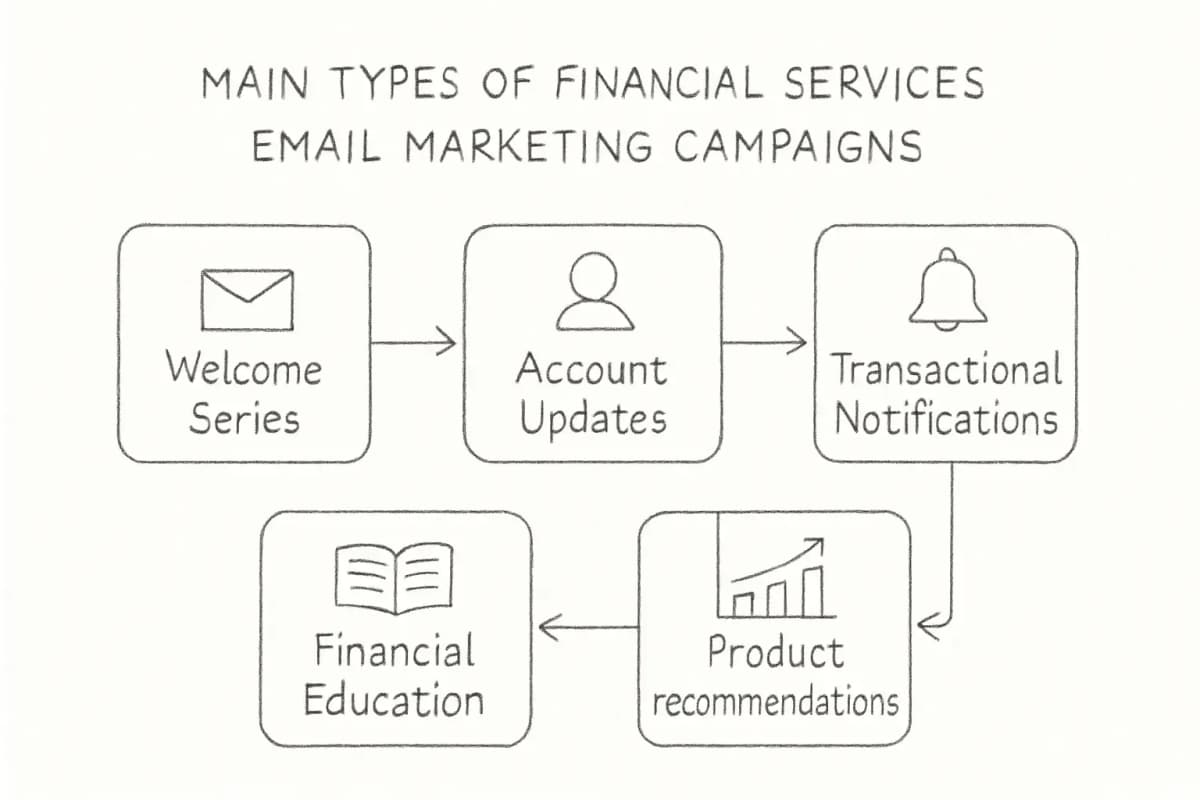
Frequently Asked Questions
What types of emails work best for financial services companies?
The most effective emails in financial services include welcome series, account updates, transactional notifications, financial education content, and product recommendations. Triggered emails consistently outperform batch sends because they arrive when relevance is highest.
How do financial services firms stay compliant with email marketing regulations?
Banks and financial institutions must follow GDPR, CAN-SPAM, and CCPA regulations, obtain explicit consent, and implement SPF, DKIM, and DMARC authentication protocols. Compliance is also an ongoing operational process: audit consent records, maintain suppression lists, and document opt-in methods in a format that can withstand regulatory review.
What are realistic open rate benchmarks for financial services email?
Email benchmarks vary significantly across financial sub-verticals. Wealth management firms consistently outperform insurance companies on engagement metrics, while ETF issuers see higher click-through rates on product-focused sends than on thought leadership content. Financial services email open rates typically range from 21% to 25% depending on the sub-vertical. Wealth management and fintech firms trend toward the higher end at 24 to 26%, while insurance and retail banking average 18 to 21%.
How often should financial services companies send marketing emails?
If the frequency of emails is too infrequent, the brand risks fading into the background noise of subscribers' inboxes. Too frequent, and it risks overwhelming and fatiguing the audience, leading to unsubscribes. It is a delicate balance achieved through testing and careful optimization. A practical starting point for most financial services firms is one educational send per month plus automated triggers based on account activity, with frequency adjusted based on engagement data over time.