
HomeBlogAI and Marketing ToolsGenerative AI and Email Marketing: Complete Guide
AI and Marketing Tools

Generative AI and Email Marketing: Complete Guide

Learn how generative AI transforms email marketing. Discover AI tools for copywriting, personalization, and automation to boost your ROI and deliverability.

R

Rachel Torres

July 17, 2026

15 min read
HomeBlogAI and Marketing ToolsGenerative AI and Email Marketing: Complete Guide
AI and Marketing Tools

Generative AI and Email Marketing: Complete Guide

Learn how generative AI transforms email marketing. Discover AI tools for copywriting, personalization, and automation to boost your ROI and deliverability.

R

Rachel Torres

July 17, 2026

15 min read
Share:
Share:
#Generative AI#Email Copywriting#marketing automation#AI Tools
Illustration for generative ai and email marketing

Stay in the loop

Get the latest posts delivered straight to your inbox. No spam, unsubscribe anytime.

Generative AI and email marketing have crossed from experimentation into mainstream practice faster than almost any other technology shift in the industry. According to the Litmus State of Email Report 2026, generative AI (GenAI) tools are now the most impactful AI use case in email marketing, with 76% of marketers now producing and sending emails within three days, compared to 62% of teams who needed two weeks or more in 2024. The productivity shift is dramatic, but speed is only part of the story. Teams that understand both the power and the limits of generative AI in email marketing are the ones pulling measurably ahead on revenue.

This guide covers how generative AI works in email marketing, what it can realistically do, where the risks are, and how to implement it in a way that actually improves results.


Key Takeaways

  • Among companies that have adopted AI technologies, email marketing is the primary application area, with an 87% deployment rate.
  • Advanced AI adopters, meaning teams with AI woven through multiple workflow stages, are 75% more likely to achieve ROIs above 45:1.
  • Email marketing delivers an average return of $36 to $42 per dollar spent in 2026, outperforming paid search ($2), social advertising ($2.80), and display ads ($1.35).
  • AI-generated subject lines outperform human-written subject lines by 26%, with dynamic send-time optimization adding another 14% lift when combined.
  • The primary risks of unchecked AI use are brand voice erosion, accuracy problems from hallucination, and commodity content creation that fails SEO and differentiation tests.

What Generative AI Actually Does in Email Marketing

Generative AI and email marketing became closely linked because the channel is both high-volume and deeply dependent on content variation. AI in email marketing uses machine learning algorithms to personalize content, optimize send times, and segment audiences. While predictive AI provides insights based on historical data, generative AI uses that information to create new, relevant content tailored to specific user needs at speed and scale.

The practical difference between the two matters. Predictive AI analyzes behavioral data to determine when to send, who to send to, and which segment a contact belongs in. Generative AI creates the subject lines, preview text, and body copy. Using both together is where the performance gains compound.

Stay in the loop

Get the latest posts delivered straight to your inbox. No spam, unsubscribe anytime.

Generative AI and email marketing have crossed from experimentation into mainstream practice faster than almost any other technology shift in the industry. According to the Litmus State of Email Report 2026, generative AI (GenAI) tools are now the most impactful AI use case in email marketing, with 76% of marketers now producing and sending emails within three days, compared to 62% of teams who needed two weeks or more in 2024. The productivity shift is dramatic, but speed is only part of the story. Teams that understand both the power and the limits of generative AI in email marketing are the ones pulling measurably ahead on revenue.

This guide covers how generative AI works in email marketing, what it can realistically do, where the risks are, and how to implement it in a way that actually improves results.


Key Takeaways

  • Among companies that have adopted AI technologies, email marketing is the primary application area, with an 87% deployment rate.
  • Advanced AI adopters, meaning teams with AI woven through multiple workflow stages, are 75% more likely to achieve ROIs above 45:1.
  • Email marketing delivers an average return of $36 to $42 per dollar spent in 2026, outperforming paid search ($2), social advertising ($2.80), and display ads ($1.35).
  • AI-generated subject lines outperform human-written subject lines by 26%, with dynamic send-time optimization adding another 14% lift when combined.
  • The primary risks of unchecked AI use are brand voice erosion, accuracy problems from hallucination, and commodity content creation that fails SEO and differentiation tests.

What Generative AI Actually Does in Email Marketing

Generative AI and email marketing became closely linked because the channel is both high-volume and deeply dependent on content variation. AI in email marketing uses machine learning algorithms to personalize content, optimize send times, and segment audiences. While predictive AI provides insights based on historical data, generative AI uses that information to create new, relevant content tailored to specific user needs at speed and scale.

The practical difference between the two matters. Predictive AI analyzes behavioral data to determine when to send, who to send to, and which segment a contact belongs in. Generative AI creates the subject lines, preview text, and body copy. Using both together is where the performance gains compound.

In 2025, 49% of marketers used generative AI for static copy creation, and the number of marketers using AI-powered image generation increased by 340% in the previous year. The adoption curve is steep, but it has not been uniform. 87% of marketing teams use AI for email, but only 6% qualify as high performers. The gap is not the tools; it is the workflow.


Core Use Cases: Where Generative AI Adds Real Value

Subject Line Generation and Testing

Open rate is determined almost entirely by the subject line, and open rate determines everything downstream. AI can generate fifty subject line variants for any email in seconds, giving you enough material to run meaningful A/B tests simultaneously across multiple segments. When you have real performance data on fifty variants rather than two, the winning subject line is statistically far more likely to be your actual best-performing option.

The performance lift is measurable. Organizations using AI to generate and optimize subject lines see a 26% increase in open rates compared to manually written alternatives, and the advantage compounds with dynamic send-time optimization, which adds another 14% lift when combined.

For a deeper look at subject line strategy, the email subject line best practices guide covers the data behind what actually drives opens.

Personalization at Scale

True personalization is not a first-name merge tag. With AI, you can move beyond using a subscriber's first name to deliver targeted subject lines, tailored product recommendations, and dynamic content that adapts to each individual's interests and behaviors.

Marketers implementing AI-powered personalization report substantial performance improvements, with revenue increasing by 41% and click-through rates rising 13.44% compared to non-personalized campaigns. These gains stem from AI's ability to analyze individual user behavior patterns and dynamically adjust content, timing, and offers to match each recipient's preferences and likelihood to engage.

One-to-one personalization at list scale has historically required either enormous manual effort or simplified merge-tag approaches that feel mechanical. The dual-engine model enables genuine content personalization at scale by using generative AI to produce segment-level content variations automatically, and dynamic content blocks to assemble individualized emails from pre-approved component libraries. The result is each subscriber receiving a message that feels written for their context without a human writing each version individually.

For implementation tactics that go beyond the basics, the AI email marketing personalization techniques guide covers specific approaches by audience type and lifecycle stage.

Automated Sequence Creation

In 2025, 49% of marketers used generative AI for static copy creation, and the number of marketers using AI-powered image generation increased by 340% in the previous year. The adoption curve is steep, but it has not been uniform. 87% of marketing teams use AI for email, but only 6% qualify as high performers. The gap is not the tools; it is the workflow.


Core Use Cases: Where Generative AI Adds Real Value

Subject Line Generation and Testing

Open rate is determined almost entirely by the subject line, and open rate determines everything downstream. AI can generate fifty subject line variants for any email in seconds, giving you enough material to run meaningful A/B tests simultaneously across multiple segments. When you have real performance data on fifty variants rather than two, the winning subject line is statistically far more likely to be your actual best-performing option.

The performance lift is measurable. Organizations using AI to generate and optimize subject lines see a 26% increase in open rates compared to manually written alternatives, and the advantage compounds with dynamic send-time optimization, which adds another 14% lift when combined.

For a deeper look at subject line strategy, the email subject line best practices guide covers the data behind what actually drives opens.

Personalization at Scale

True personalization is not a first-name merge tag. With AI, you can move beyond using a subscriber's first name to deliver targeted subject lines, tailored product recommendations, and dynamic content that adapts to each individual's interests and behaviors.

Marketers implementing AI-powered personalization report substantial performance improvements, with revenue increasing by 41% and click-through rates rising 13.44% compared to non-personalized campaigns. These gains stem from AI's ability to analyze individual user behavior patterns and dynamically adjust content, timing, and offers to match each recipient's preferences and likelihood to engage.

One-to-one personalization at list scale has historically required either enormous manual effort or simplified merge-tag approaches that feel mechanical. The dual-engine model enables genuine content personalization at scale by using generative AI to produce segment-level content variations automatically, and dynamic content blocks to assemble individualized emails from pre-approved component libraries. The result is each subscriber receiving a message that feels written for their context without a human writing each version individually.

For implementation tactics that go beyond the basics, the AI email marketing personalization techniques guide covers specific approaches by audience type and lifecycle stage.

Automated Sequence Creation

Welcome series, onboarding drips, re-engagement campaigns, and win-back sequences are needed by every email program, and most are written hastily and rarely updated. AI enables full programs to be drafted in a day and updated quickly when the product or offer changes. More importantly, AI can write these sequences in a voice that reads as warm and human rather than automated and corporate.

Automated emails generate 320% more revenue than non-automated campaigns, with 31% of all email orders originating from automated flows. The welcome email sequence best practices article shows how to structure the sequences that matter most.

Send-Time Optimization

With its ability to analyze historical customer engagement patterns such as open rates, click-through rates, and conversion rates, predictive AI can identify the best moments to send emails to individual recipients.

Send-time optimization alone lifts open rates 20 to 30 percent. Sending to each subscriber at their personal optimal time, rather than a fixed batch time, consistently produces these improvements across industries.

A/B Testing and Campaign Optimization

One marketer reported how their A/B testing improved 10x using generative AI in email marketing. "Instead of testing only subject lines, I can also test user behavior, allowing me to be more strategic with every send," they said.

95% of marketers who use generative AI for email creation rate it "effective," with 54% rating it "very effective."


The Performance Case: What the Data Shows

According to McKinsey, companies that invest in AI are seeing a revenue uplift of 3 to 15% and a sales ROI uplift of 10 to 20%. Email-specific results are stronger.

Email marketing programs that adopted AI in 2025 and early 2026 reported revenue increases averaging 41% compared to non-AI programs in the same sector. The mechanism is straightforward: better targeting reduces waste, better subject lines increase opens, and better personalization increases conversion.

More than one-quarter of marketers believe advanced AI-driven content generation and analytics will drive the most significant changes in email marketing in 2025, while 70% predict up to half of their email operations will be AI-driven by 2026.

The data on segmentation reinforces why the personalization layer matters so much. Segmented email campaigns generate 760% more revenue than non-segmented broadcasts. The email list segmentation strategies guide covers how to build and maintain the segments that make AI personalization effective.


Risks and Limitations You Need to Understand

The performance numbers attract attention, but the risks in generative AI and email marketing are frequently underestimated by teams rushing to adopt.

Brand Voice Erosion

AI tools default to generic, statistically average language, which erodes brand voice, creates commodity content that fails SEO differentiation tests, and introduces accuracy risks from hallucination. Without structured human oversight, AI-assisted content can actively harm brand credibility and search visibility rather than support them.

Before anything goes live, check AI-generated copy against your brand voice, your audience, and the specific campaign context. Read it out loud. If it sounds like it could have come from any of your competitors, rewrite it until it does not.

Hallucination and Accuracy Problems

Welcome series, onboarding drips, re-engagement campaigns, and win-back sequences are needed by every email program, and most are written hastily and rarely updated. AI enables full programs to be drafted in a day and updated quickly when the product or offer changes. More importantly, AI can write these sequences in a voice that reads as warm and human rather than automated and corporate.

Automated emails generate 320% more revenue than non-automated campaigns, with 31% of all email orders originating from automated flows. The welcome email sequence best practices article shows how to structure the sequences that matter most.

Send-Time Optimization

With its ability to analyze historical customer engagement patterns such as open rates, click-through rates, and conversion rates, predictive AI can identify the best moments to send emails to individual recipients.

Send-time optimization alone lifts open rates 20 to 30 percent. Sending to each subscriber at their personal optimal time, rather than a fixed batch time, consistently produces these improvements across industries.

A/B Testing and Campaign Optimization

One marketer reported how their A/B testing improved 10x using generative AI in email marketing. "Instead of testing only subject lines, I can also test user behavior, allowing me to be more strategic with every send," they said.

95% of marketers who use generative AI for email creation rate it "effective," with 54% rating it "very effective."


The Performance Case: What the Data Shows

According to McKinsey, companies that invest in AI are seeing a revenue uplift of 3 to 15% and a sales ROI uplift of 10 to 20%. Email-specific results are stronger.

Email marketing programs that adopted AI in 2025 and early 2026 reported revenue increases averaging 41% compared to non-AI programs in the same sector. The mechanism is straightforward: better targeting reduces waste, better subject lines increase opens, and better personalization increases conversion.

More than one-quarter of marketers believe advanced AI-driven content generation and analytics will drive the most significant changes in email marketing in 2025, while 70% predict up to half of their email operations will be AI-driven by 2026.

The data on segmentation reinforces why the personalization layer matters so much. Segmented email campaigns generate 760% more revenue than non-segmented broadcasts. The email list segmentation strategies guide covers how to build and maintain the segments that make AI personalization effective.


Risks and Limitations You Need to Understand

The performance numbers attract attention, but the risks in generative AI and email marketing are frequently underestimated by teams rushing to adopt.

Brand Voice Erosion

AI tools default to generic, statistically average language, which erodes brand voice, creates commodity content that fails SEO differentiation tests, and introduces accuracy risks from hallucination. Without structured human oversight, AI-assisted content can actively harm brand credibility and search visibility rather than support them.

Before anything goes live, check AI-generated copy against your brand voice, your audience, and the specific campaign context. Read it out loud. If it sounds like it could have come from any of your competitors, rewrite it until it does not.

Hallucination and Accuracy Problems

The primary risks include hallucinations (AI producing false but plausible claims), bias in generated text and images, exposure of proprietary or customer data to third-party model providers, and unresolved intellectual property ownership of AI-generated assets.

Without strong controls and human oversight, AI-generated messages could spread inaccurate information about your products or services. They could also make commitments that the brand cannot fulfill.

Misleading subject lines now carry real legal risk, with multiple class action lawsuits already filed. AI makes it easier to generate attention-grabbing subject lines at scale, but it can also overpromise with incorrect wording or even fabricated promotions.

Deliverability Impact

There is a direct deliverability impact affecting inbox placement across the board. Validity's 2026 Deliverability Benchmark Report documents how AI has made it easier for spammers to flood inboxes, making mailbox providers' filters more sophisticated and harder for all senders to navigate.

The biggest mistake is treating AI as a content factory. Generating more emails faster is not a strategy; it is a way to bury your subscribers and your sender reputation simultaneously.

Bias in AI-Generated Imagery

Email marketers should be careful when using generative AI for imagery. Researchers found that early AI image systems showed "a strong tendency towards generating images of mostly white men by default, overly sexualized portrayals of women, and reinforcing racial stereotypes." Although improvements have been made, it remains an imperfect work in progress.


How to Implement Generative AI in Email Marketing

The following steps reflect what high-performing teams are doing in practice, not just in theory.

The primary risks include hallucinations (AI producing false but plausible claims), bias in generated text and images, exposure of proprietary or customer data to third-party model providers, and unresolved intellectual property ownership of AI-generated assets.

Without strong controls and human oversight, AI-generated messages could spread inaccurate information about your products or services. They could also make commitments that the brand cannot fulfill.

Misleading subject lines now carry real legal risk, with multiple class action lawsuits already filed. AI makes it easier to generate attention-grabbing subject lines at scale, but it can also overpromise with incorrect wording or even fabricated promotions.

Deliverability Impact

There is a direct deliverability impact affecting inbox placement across the board. Validity's 2026 Deliverability Benchmark Report documents how AI has made it easier for spammers to flood inboxes, making mailbox providers' filters more sophisticated and harder for all senders to navigate.

The biggest mistake is treating AI as a content factory. Generating more emails faster is not a strategy; it is a way to bury your subscribers and your sender reputation simultaneously.

Bias in AI-Generated Imagery

Email marketers should be careful when using generative AI for imagery. Researchers found that early AI image systems showed "a strong tendency towards generating images of mostly white men by default, overly sexualized portrayals of women, and reinforcing racial stereotypes." Although improvements have been made, it remains an imperfect work in progress.


How to Implement Generative AI in Email Marketing

The following steps reflect what high-performing teams are doing in practice, not just in theory.

  1. Audit your data quality first. Both predictive and generative AI components depend on accurate behavioral data. Fragmented customer records, inconsistent event tracking, and siloed channel data produce degraded predictions and irrelevant generated content. Data infrastructure investment is the prerequisite for AI email performance.
  2. Start with subject line generation. It is the highest-impact, lowest-risk starting point. AI can produce dozens of variants quickly, and A/B testing reveals which psychological levers work for your specific audience.
  3. Build a brand voice document before prompting. Feed AI tools your style guidelines, tone examples, and off-limit phrases. When models are grounded or fine-tuned on approved messaging and style guides, marketers can start with AI-generated drafts that reflect brand voice and campaign goals, then refine them through human review.
  4. Require human review at every stage before send. AI-generated subject lines perform well on average but occasionally produce off-brand, misleading, or tone-inappropriate outputs. Every production deployment of generative email content must include a human review step before send, particularly for high-stakes campaigns to large segments.
  5. Add send-time optimization. Once content quality is consistent, layer in per-subscriber send-time prediction. The two work together: better content delivered at the optimal moment compounds the open rate lift.
  6. Close the performance loop. Modern AI email tools analyze which types of messages are driving opens, clicks, and conversions for each segment, then use those insights to guide the next generation cycle. This feedback-driven approach compounds over time, with each month's emails performing better than the last.
  7. Monitor your sender reputation. Best practices include starting with clear goals, ensuring data quality, iterating based on AI-driven insights, and maintaining human oversight to ensure brand consistency and compliance. Authentication (SPF, DKIM, DMARC), complaint rate monitoring, and list hygiene remain non-negotiable regardless of what AI is generating.
  1. Audit your data quality first. Both predictive and generative AI components depend on accurate behavioral data. Fragmented customer records, inconsistent event tracking, and siloed channel data produce degraded predictions and irrelevant generated content. Data infrastructure investment is the prerequisite for AI email performance.
  2. Start with subject line generation. It is the highest-impact, lowest-risk starting point. AI can produce dozens of variants quickly, and A/B testing reveals which psychological levers work for your specific audience.
  3. Build a brand voice document before prompting. Feed AI tools your style guidelines, tone examples, and off-limit phrases. When models are grounded or fine-tuned on approved messaging and style guides, marketers can start with AI-generated drafts that reflect brand voice and campaign goals, then refine them through human review.
  4. Require human review at every stage before send. AI-generated subject lines perform well on average but occasionally produce off-brand, misleading, or tone-inappropriate outputs. Every production deployment of generative email content must include a human review step before send, particularly for high-stakes campaigns to large segments.
  5. Add send-time optimization. Once content quality is consistent, layer in per-subscriber send-time prediction. The two work together: better content delivered at the optimal moment compounds the open rate lift.
  6. Close the performance loop. Modern AI email tools analyze which types of messages are driving opens, clicks, and conversions for each segment, then use those insights to guide the next generation cycle. This feedback-driven approach compounds over time, with each month's emails performing better than the last.
  7. Monitor your sender reputation. Best practices include starting with clear goals, ensuring data quality, iterating based on AI-driven insights, and maintaining human oversight to ensure brand consistency and compliance. Authentication (SPF, DKIM, DMARC), complaint rate monitoring, and list hygiene remain non-negotiable regardless of what AI is generating.

Generative AI and Email: What to Measure

With Apple Mail Privacy Protection affecting 50% of email recipients, open rates are increasingly unreliable as a standalone indicator. Revenue per recipient, click-through rate, and conversion rate per send are the metrics that actually correlate with business outcomes.

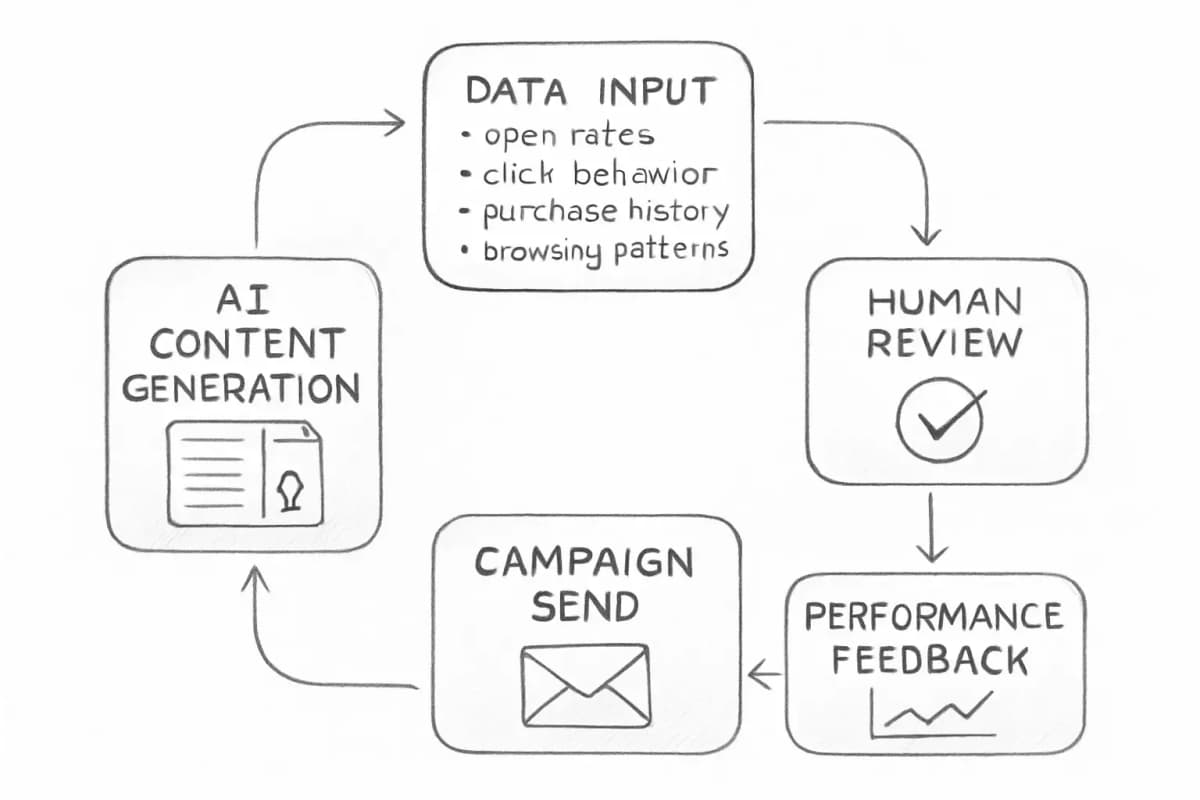
Track performance at the segment level, not just across your full list. AI systems can process vast amounts of information such as open rates, click behavior, purchase history, and browsing patterns, and uncover trends that humans might miss. These insights allow you to make smarter decisions, identify what resonates with different audiences, and fine-tune campaigns for higher conversions and retention. A circular workflow diagram showing the AI email marketing process with five connected steps: Data Input (showing metrics like open rates, click behavior, purchase history, browsing patterns), AI Content Generation (showing text and creative output), Human Review (showing quality check and approval), Campaign Send (showing delivery), and Performance Feedback Loop (showing analytics feeding back to data input). Arrows connect each step in sequence, with the feedback loop returning to the start. Use a modern tech aesthetic with blue and teal colors.

Frequently Asked Questions

What is generative AI in email marketing?

Generative AI refers to artificial intelligence systems that create new content, including text, images, video, code, and audio, from patterns learned during training on large datasets. In email marketing, this means generating subject lines, body copy, calls to action, and visual assets. While predictive AI provides insights based on historical data, generative AI uses that information to create new, relevant content tailored to specific user needs at speed and scale.

Does generative AI actually improve email open rates?

Yes, when used correctly. Organizations using AI to generate and optimize subject lines see a 26% increase in open rates compared to manually written alternatives. However, the gains depend on the quality of your prompts, your brand voice guidelines, and continuous testing. AI generates better variations faster; it does not guarantee results without human oversight and data-driven iteration.

What are the biggest risks of using AI for email marketing?

The primary risks are brand voice erosion (AI defaults to generic language without explicit direction), accuracy problems (AI tools can hallucinate statistics and source attributions), and commodity content creation that lacks the original perspective required for strong performance. There is also a deliverability risk: using AI to send higher volumes without improving relevance can damage your sender reputation and inbox placement rates.

How do I start using generative AI in email marketing without hurting deliverability?


Generative AI and Email: What to Measure

With Apple Mail Privacy Protection affecting 50% of email recipients, open rates are increasingly unreliable as a standalone indicator. Revenue per recipient, click-through rate, and conversion rate per send are the metrics that actually correlate with business outcomes.

Track performance at the segment level, not just across your full list. AI systems can process vast amounts of information such as open rates, click behavior, purchase history, and browsing patterns, and uncover trends that humans might miss. These insights allow you to make smarter decisions, identify what resonates with different audiences, and fine-tune campaigns for higher conversions and retention. A circular workflow diagram showing the AI email marketing process with five connected steps: Data Input (showing metrics like open rates, click behavior, purchase history, browsing patterns), AI Content Generation (showing text and creative output), Human Review (showing quality check and approval), Campaign Send (showing delivery), and Performance Feedback Loop (showing analytics feeding back to data input). Arrows connect each step in sequence, with the feedback loop returning to the start. Use a modern tech aesthetic with blue and teal colors.


Frequently Asked Questions

What is generative AI in email marketing?

Generative AI refers to artificial intelligence systems that create new content, including text, images, video, code, and audio, from patterns learned during training on large datasets. In email marketing, this means generating subject lines, body copy, calls to action, and visual assets. While predictive AI provides insights based on historical data, generative AI uses that information to create new, relevant content tailored to specific user needs at speed and scale.

Does generative AI actually improve email open rates?

Yes, when used correctly. Organizations using AI to generate and optimize subject lines see a 26% increase in open rates compared to manually written alternatives. However, the gains depend on the quality of your prompts, your brand voice guidelines, and continuous testing. AI generates better variations faster; it does not guarantee results without human oversight and data-driven iteration.

What are the biggest risks of using AI for email marketing?

The primary risks are brand voice erosion (AI defaults to generic language without explicit direction), accuracy problems (AI tools can hallucinate statistics and source attributions), and commodity content creation that lacks the original perspective required for strong performance. There is also a deliverability risk: using AI to send higher volumes without improving relevance can damage your sender reputation and inbox placement rates.

How do I start using generative AI in email marketing without hurting deliverability?

Start with AI for content drafts and subject line variants, not volume increases. Keep your existing send cadence while you build AI-assisted quality into each campaign. Set up SPF, DKIM, and DMARC at enforcement. Add one-click unsubscribe via List-Unsubscribe headers. Suppress bounces and sunset inactive subscribers. Watch your complaint rate. Deliverability is the foundation; AI only helps when your emails are reaching the inbox in the first place.

Start with AI for content drafts and subject line variants, not volume increases. Keep your existing send cadence while you build AI-assisted quality into each campaign. Set up SPF, DKIM, and DMARC at enforcement. Add one-click unsubscribe via List-Unsubscribe headers. Suppress bounces and sunset inactive subscribers. Watch your complaint rate. Deliverability is the foundation; AI only helps when your emails are reaching the inbox in the first place.

No comments yet. Be the first!

Leave a comment

Comments are reviewed before publishing.

No comments yet. Be the first!

Leave a comment

Comments are reviewed before publishing.