
Picking the right email marketing software is one of the most consequential decisions you can make for your marketing program. The average ROI for email marketing is $36 for every $1 spent, equating to a 3,500% return. But that figure assumes the platform you choose can actually support the strategies that drive it. The wrong tool caps your results at a low ceiling regardless of how good your content is.
This guide walks through the specific criteria that separate a platform that will grow your results from one that will hold them back.
Key Takeaways
- Email delivers an average ROI of $36 per $1 spent, but the platform you choose directly determines whether you can access the features that drive those returns.
- In 2024, automated emails drove 37% of all email-generated sales despite accounting for just 2% of email volume. Automation capability must be a core criterion.
- The average email deliverability rate across all platforms is only 83.1%, meaning roughly 1 in 6 legitimate emails never reaches an inbox. Deliverability tools are not a bonus feature; they are essential.
- Small businesses may prioritize ease of use and cost-effectiveness, while enterprises require advanced segmentation and integration capabilities. Match the platform to your actual stage.
- Pricing models vary widely. Contact-based, volume-based, and feature-tiered pricing structures all suit different business types. Know your list size and growth trajectory before committing.
Start with Your Goals, Not the Feature List
The first mistake most buyers make is browsing feature lists before defining what they need. Selecting the right email marketing platform requires careful consideration of your business needs and future growth. Before choosing a platform, define your email marketing objectives. Are you focused on lead nurturing, e-commerce sales, customer retention, or brand awareness? Clarifying your goals will help you identify the features and capabilities that matter most.
A SaaS company running a SaaS email marketing strategy focused on trial-to-paid conversion needs deep behavioral automation. An e-commerce brand running abandoned cart and post-purchase sequences needs strong platform integrations and revenue attribution. A nonprofit with a small team needs affordability and simplicity.
Write down your primary use case before comparing tools. It filters out 60% of the noise immediately.
The 6 Features That Actually Move the Needle
1. Automation Depth
Automated emails triggered by specific user actions, like sign-ups or cart abandonment, can generate 320% more revenue than standard campaigns. That number only holds if your platform can actually execute behavioral triggers, not just basic autoresponders.
When comparing email marketing platforms, test these automation features: prebuilt workflows for welcome emails, reengagement, and cart recovery; behavioral triggers that send emails based on customer actions like purchases or site visits; dynamic content that automatically updates with a user's name or purchase history; visual automation builders with drag-and-drop editors; and send-time optimization using AI to deliver emails when contacts are most likely to open them.
Entry-level platforms cover the basics. Mid-tier platforms handle multi-step conditional logic. Enterprise platforms add predictive orchestration and real-time behavioral scoring.
2. Segmentation and Personalization
90% of email marketing professionals report that using subscriber segmentation to deliver targeted messages increases performance for marketing emails. Segmentation is not optional at any serious send volume.
Segmented email campaigns generate 30% more opens and 50% more click-throughs than non-segmented campaigns. Your platform needs to support list segmentation by behavior, purchase history, demographics, and engagement level at minimum. If it only supports static lists, your personalization ceiling is low.
For a deeper look at how segmentation drives measurable returns, see our guide to email list segmentation strategies that boost ROI by 760%.
3. Deliverability Infrastructure
1 in 6 marketing emails failed to reach recipients' inboxes in 2024. That makes deliverability a defining variable in your campaign performance, not a background concern.
When evaluating a platform, ask directly about its deliverability infrastructure. Does the platform support email authentication like SPF, DKIM, and DMARC? Does the platform offer dedicated IPs, shared IPs, or both? These are not technical questions to defer to your IT team. They determine whether your campaigns land in the inbox or in spam.
78.5% of email marketing specialists rate the importance of deliverability 8 out of 10. Strong platforms provide inbox placement monitoring, spam filter testing tools, and proactive alerts when your sender reputation degrades.
4. Analytics and Reporting
Brands that use Litmus Email Analytics achieve a 43% higher ROI than those that don't. Visibility into what is working is as important as having the right tools to execute.
Look for platforms that track opens, clicks, conversions, revenue per email, unsubscribes, and bounce rates at the campaign and automation level. You can only improve the effectiveness of your email campaigns if you understand what works and what doesn't.
For advanced guidance on using data to improve performance, see our post on email marketing analytics best practices.
5. Integrations with Your Existing Stack
Email marketing software should integrate with customer relationship management (CRM) systems, e-commerce platforms, and other tools. A platform that sits isolated from your CRM, store, or customer data produces generic campaigns by default.
E-commerce businesses need strong integration with online store platforms, while B2B companies may prioritize lead generation and CRM connectivity. Before signing up for any platform, verify it has a native integration or a reliable API connection to the tools your team uses daily. Zapier-dependent integrations work but add latency and fragility to your workflows.
6. Email Design and Template Quality
A user-friendly drag-and-drop email builder with a variety of customizable templates is essential for creating visually appealing emails. The tool should allow you to add text, images, buttons, and other elements easily.
Most platforms include drag-and-drop editors now. What separates good from adequate is template responsiveness across devices, render testing across email clients, and how fast your team can build and iterate without needing a developer.
How to Match Platform to Business Size
Small businesses may prioritize ease of use and cost-effectiveness, while enterprises require advanced segmentation and integration capabilities. That distinction shapes nearly every purchasing decision.
Small businesses and startups: Look for generous free plans, simple automation builders, and low starting prices. Email marketing platforms start from as little as $9 per month, with many offering generous free plans. Today's affordable email marketing tools include advanced features like automation, AI assistants, and detailed analytics that were once reserved for enterprise solutions. MailerLite, Brevo, and Moosend are commonly cited in this tier.
Mid-market teams: Prioritize behavioral automation, CRM integration, and A/B testing across campaigns and flows. ActiveCampaign is frequently recommended for this segment because it combines advanced marketing automation with a built-in CRM, giving full control over the entire customer journey.
Enterprise: Require high-volume sending without performance degradation, advanced compliance tools, multi-user permissions, and dedicated support. Scalable email marketing platforms should support high-volume email sending without performance issues, advanced customization options to accommodate diverse campaign strategies, and enterprise-level security and compliance features. 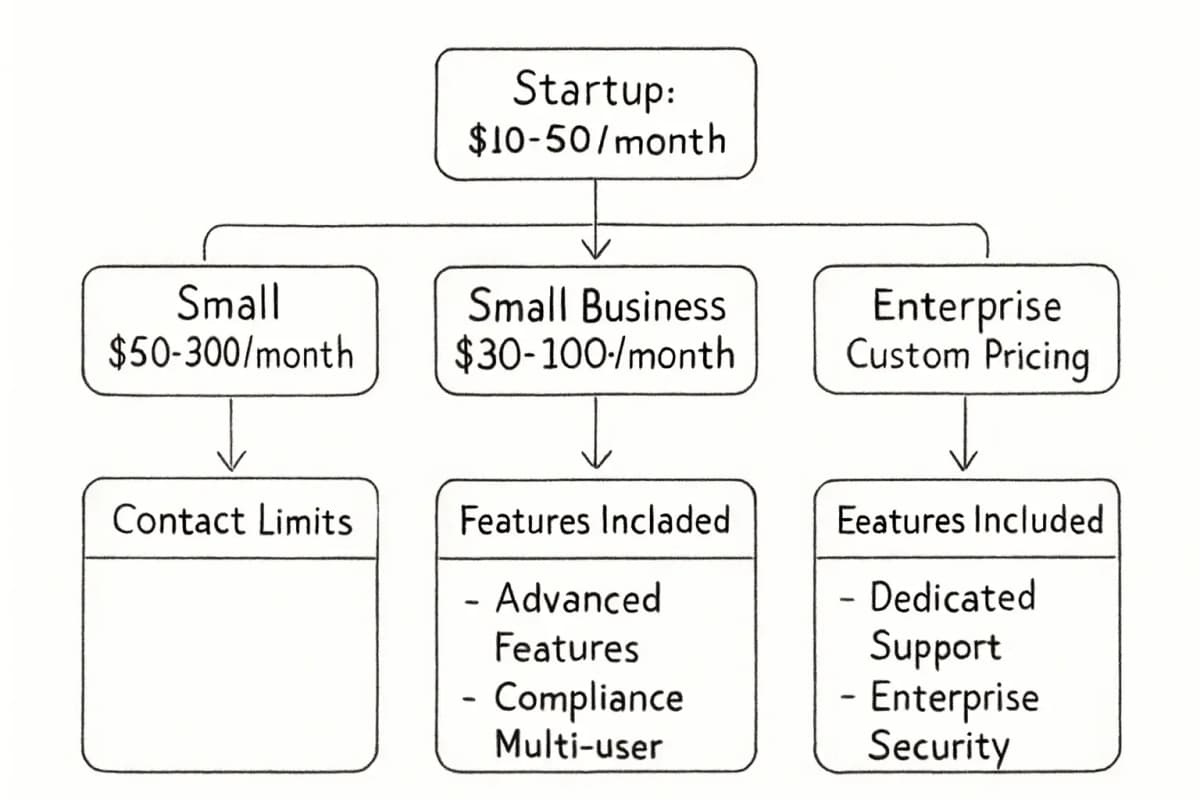
Understanding Pricing Models
Many factors affect how much you might pay for email marketing software. Typically, providers charge a monthly fee based on the number of contacts you have and how many emails you intend to send. Prices vary widely, from an average of $10 a month for 500 contacts to $4,000 a month for 1 million contacts.
There are three primary pricing structures:
- Contact-based pricing: You pay based on the size of your subscriber list, regardless of send volume. Common with Mailchimp, Klaviyo, and ActiveCampaign. Costs rise quickly as your list grows.
- Volume-based pricing: You pay based on emails sent per month, not list size. Mailjet uses volume-based pricing instead of charging by contacts. Paid plans from $17 per month include unlimited contacts. This makes it more affordable for businesses with large lists and moderate sending volumes.
- Feature-tiered pricing: Pricing tiers may be determined by the features and level of support included, with higher-priced plans unlocking advanced automation, segmentation, and analytics capabilities.
The biggest pricing mistake is choosing a platform based on today's list size without projecting 12 months forward. If your list doubles, will the cost stay within your budget? Map out price points at 2x and 5x your current list size before committing.
Compliance and Data Privacy
Stringent data protection regulations, such as GDPR and the California Consumer Privacy Act (CCPA), have necessitated greater emphasis on data security and compliance within email marketing practices. Email marketing software providers are increasingly focusing on offering features that ensure data privacy and enable marketers to adhere to these regulations.
Any platform you choose should provide double opt-in support, easy unsubscribe management, consent logging, and data processing agreements. This is especially critical for businesses serving European audiences or any regulated industry.
How to Make Your Final Decision
Once you have a shortlist of two to four platforms that match your goals, budget, and technical requirements, test them before committing.
Use this process to guide you: shortlist two to four tools that match your primary goal and must-have features; test drive using a free plan or trial by testing your primary workflow; then decide by choosing the tool that feels easiest to run consistently and supports growth without forcing early upgrades.
The workflow you should test is the one most critical to your business. For an e-commerce brand, that is the abandoned cart flow and a basic welcome series. For a B2B company, that might be a lead nurture sequence triggered by a form fill. If the platform makes that workflow difficult or inflexible during the trial, it will make it difficult in production.
For more actionable guidance once you have selected your platform, our email marketing strategy template gives you a structured framework to build your first campaigns, and the email marketing campaign checklist helps you validate every send before it goes out.
Frequently Asked Questions
What is the most important feature to look for in email marketing software?
Automation capability is the most important feature for most businesses. Automated emails drove 37% of all email-generated sales in 2024 despite accounting for just 2% of email volume. A platform that cannot execute behavioral triggers, conditional logic, and multi-step sequences will limit your results regardless of how strong your content is.
How much should I expect to pay for email marketing software?
Providers typically charge a monthly fee based on the number of contacts you have and how many emails you intend to send. Prices vary widely, from an average of $10 a month for 500 contacts to $4,000 a month for 1 million contacts. Many platforms offer free tiers for small lists, which are appropriate for testing a workflow before scaling. Budget for where your list will be in 12 months, not where it is today.
How do I know if an email marketing platform has good deliverability?
Ask the platform directly about SPF, DKIM, and DMARC support, dedicated IP options, and whether they offer inbox placement monitoring tools. 78.5% of email marketing specialists rate deliverability at 8 out of 10 in importance. Beyond self-reported claims, look for independent deliverability benchmark reports from firms like Validity or Litmus that test inbox placement rates across major platforms.
What is the difference between contact-based and volume-based pricing?
Contact-based pricing charges you based on the total number of subscribers in your list, regardless of how often you send. Volume-based pricing charges based on emails sent per month and often allows unlimited contacts. Volume-based pricing makes platforms more affordable for businesses with large lists and moderate sending volumes. If you have a large list but send infrequently, volume-based pricing will usually be cheaper. If you have a small, highly engaged list and send often, contact-based pricing may work in your favor.
Should I switch platforms if my current one is "good enough"?
Switch if your platform blocks growth, automation, monetization, or reporting. Stick if the pain is minor and you can solve it with better processes. The cost of migrating a list and rebuilding automation workflows is real. But staying on a platform that prevents you from running behavioral campaigns, limits your segmentation, or produces poor deliverability will cost you more in the long run.