
HomeNewsMailgun Report: 18% of Emails Missing the Inbox
Email Deliverability

Mailgun Report: 18% of Emails Missing the Inbox

Sinch Mailgun's 2026 Email Impact Report reveals 18% of emails fail to reach inboxes due to deliverability gaps and limited AI optimization. What this means for your revenue.

S

Sarah Mitchell

April 8, 2026

5 min read
HomeNewsMailgun Report: 18% of Emails Missing the Inbox
Email Deliverability

Mailgun Report: 18% of Emails Missing the Inbox

Sinch Mailgun's 2026 Email Impact Report reveals 18% of emails fail to reach inboxes due to deliverability gaps and limited AI optimization. What this means for your revenue.

S

Sarah Mitchell

April 8, 2026

5 min read
Share:
Share:
#Mailgun#Email Deliverability#Inbox Placement#Email Strategy
Illustration for report: Mailgun Report: 18% of Emails Missing the Inbox

Stay in the loop

Get the latest posts delivered straight to your inbox. No spam, unsubscribe anytime.

One in five emails never reaches the inbox. That is the core finding from the Sinch Mailgun 2026 Email Impact Report, published on April 8, 2026. Drawing on data from more than 400 billion emails sent in 2025 and a global survey of over 1,200 email senders, the report concludes that nearly 18% of emails fail to reach the inbox, putting up to a fifth of potential ROI at risk for many organizations.

For marketers and growth teams who treat email as a primary revenue channel, that figure is not a rounding error. It is a measurable, addressable performance gap.

What the Data Actually Shows

Despite 78% of survey respondents saying email is critical to business success, the research highlights a growing disconnect between performance and execution, driven by gaps in measurement, deliverability practices, and AI application.

The report introduces new industry benchmarks across 10 high-volume sending sectors, giving businesses a concrete baseline to measure their own inbox placement rates against for the first time at this scale.

The 18% miss rate is not an outlier finding. According to Validity's 2025 Benchmark Report, the global average inbox placement rate sits at 83.5%, meaning roughly 1 in 6 legitimate marketing emails is never seen. The Mailgun figure aligns closely with that broader industry pattern, and both point to a persistent structural problem, not a temporary spike.

In the US and Canada specifically, more than 20% of commercial emails do not reach subscribers' inboxes.

The AI Gap: Adoption Without Impact

One of the more telling findings in the 2026 report concerns AI use. AI adoption is widespread, but its impact remains uneven. Many teams focus on basic use cases such as content generation, while higher-impact applications such as optimization, segmentation, and deliverability remain underutilized. Organizations that use AI more effectively are significantly more likely to report improved email performance.

Kate Nowrouzi, VP of Deliverability at Sinch, put it plainly:

Stay in the loop

Get the latest posts delivered straight to your inbox. No spam, unsubscribe anytime.

One in five emails never reaches the inbox. That is the core finding from the Sinch Mailgun 2026 Email Impact Report, published on April 8, 2026. Drawing on data from more than 400 billion emails sent in 2025 and a global survey of over 1,200 email senders, the report concludes that nearly 18% of emails fail to reach the inbox, putting up to a fifth of potential ROI at risk for many organizations.

For marketers and growth teams who treat email as a primary revenue channel, that figure is not a rounding error. It is a measurable, addressable performance gap.

What the Data Actually Shows

Despite 78% of survey respondents saying email is critical to business success, the research highlights a growing disconnect between performance and execution, driven by gaps in measurement, deliverability practices, and AI application.

The report introduces new industry benchmarks across 10 high-volume sending sectors, giving businesses a concrete baseline to measure their own inbox placement rates against for the first time at this scale.

The 18% miss rate is not an outlier finding. According to Validity's 2025 Benchmark Report, the global average inbox placement rate sits at 83.5%, meaning roughly 1 in 6 legitimate marketing emails is never seen. The Mailgun figure aligns closely with that broader industry pattern, and both point to a persistent structural problem, not a temporary spike.

In the US and Canada specifically, more than 20% of commercial emails do not reach subscribers' inboxes.

The AI Gap: Adoption Without Impact

One of the more telling findings in the 2026 report concerns AI use. AI adoption is widespread, but its impact remains uneven. Many teams focus on basic use cases such as content generation, while higher-impact applications such as optimization, segmentation, and deliverability remain underutilized. Organizations that use AI more effectively are significantly more likely to report improved email performance.

Kate Nowrouzi, VP of Deliverability at Sinch, put it plainly:

"Using AI to generate content is a good starting point, but it's not where the biggest impact happens. Organizations that apply AI to optimization, segmentation and deliverability are seeing stronger results."

This distinction matters for any team currently using AI primarily to write subject lines or body copy. The lever with the most measurable effect is applying AI to who receives an email, when they receive it, and whether it is routed correctly through the inbox.

Measurement Gaps Compound the Problem

According to Kate Nowrouzi, "Email delivers exceptional returns, but many organizations are not set up to capture its full value. The gap between performance and execution is where most are losing out."

Part of that execution gap is a measurement problem. Delivery refers to whether a message is accepted by the receiving mail server, while deliverability measures where that message actually lands in the inbox. Many senders track delivery rates and assume their campaigns are performing. They are not measuring inbox placement, which is a different and more consequential metric.

According to Mailgun's 2025 State of Email Deliverability survey, 48% of users say their biggest challenge is avoiding the spam folder. That challenge is compounded when teams lack the tooling to know where messages actually land.

Authentication Is Still an Open Issue

Authentication gaps continue to hurt inbox placement across the industry. Only around 33.4% of top 1 million domains publish valid DMARC records, and roughly 85.7% do not enforce it with a quarantine or reject policy.

Google and Yahoo made DMARC a requirement for bulk senders in February 2024, and Gmail tightened enforcement further in November 2025. Despite those mandates, a large share of senders remain out of compliance, which directly affects their sender reputation and inbox placement rates.

Fully authenticated domains using DMARC are 2.7 times more likely to reach the recipient's inbox compared to unauthenticated domains.
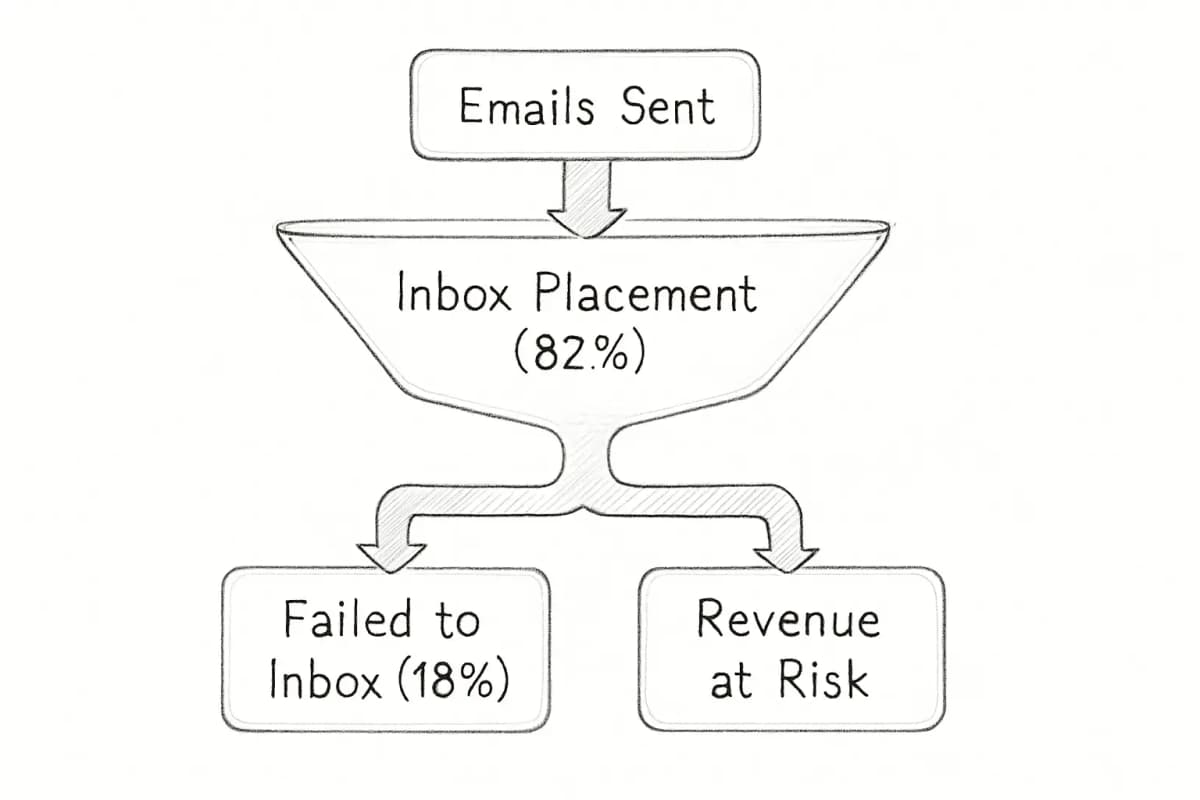
Email deliverability funnel visualization showing the flow of emails from sent to inbox placement versus spam placement. The funnel should display two diverging paths: the top path showing emails that reach the inbox (approximately 82% based on the 18% failure rate mentioned), and the bottom path showing emails that fail to reach the inbox or land in spam (approximately 18%). Include percentage labels on each section to illustrate the inbox placement rate versus the failure/spam placement rate. The visualization should use a clear color contrast (green for successful inbox delivery, red for failed/spam placement) to emphasize the revenue impact of deliverability issues.

What This Means for Senders Right Now

The Mailgun report frames the deliverability problem as a revenue problem, not just a technical one. Nearly 18% of emails fail to reach the inbox, putting up to a fifth of potential ROI at risk for many organizations. For a business sending 500,000 emails per month, that is 90,000 messages that never had a chance to convert.

"Using AI to generate content is a good starting point, but it's not where the biggest impact happens. Organizations that apply AI to optimization, segmentation and deliverability are seeing stronger results."

This distinction matters for any team currently using AI primarily to write subject lines or body copy. The lever with the most measurable effect is applying AI to who receives an email, when they receive it, and whether it is routed correctly through the inbox.

Measurement Gaps Compound the Problem

According to Kate Nowrouzi, "Email delivers exceptional returns, but many organizations are not set up to capture its full value. The gap between performance and execution is where most are losing out."

Part of that execution gap is a measurement problem. Delivery refers to whether a message is accepted by the receiving mail server, while deliverability measures where that message actually lands in the inbox. Many senders track delivery rates and assume their campaigns are performing. They are not measuring inbox placement, which is a different and more consequential metric.

According to Mailgun's 2025 State of Email Deliverability survey, 48% of users say their biggest challenge is avoiding the spam folder. That challenge is compounded when teams lack the tooling to know where messages actually land.

Authentication Is Still an Open Issue

Authentication gaps continue to hurt inbox placement across the industry. Only around 33.4% of top 1 million domains publish valid DMARC records, and roughly 85.7% do not enforce it with a quarantine or reject policy.

Google and Yahoo made DMARC a requirement for bulk senders in February 2024, and Gmail tightened enforcement further in November 2025. Despite those mandates, a large share of senders remain out of compliance, which directly affects their sender reputation and inbox placement rates.

Fully authenticated domains using DMARC are 2.7 times more likely to reach the recipient's inbox compared to unauthenticated domains.

Email deliverability funnel visualization showing the flow of emails from sent to inbox placement versus spam placement. The funnel should display two diverging paths: the top path showing emails that reach the inbox (approximately 82% based on the 18% failure rate mentioned), and the bottom path showing emails that fail to reach the inbox or land in spam (approximately 18%). Include percentage labels on each section to illustrate the inbox placement rate versus the failure/spam placement rate. The visualization should use a clear color contrast (green for successful inbox delivery, red for failed/spam placement) to emphasize the revenue impact of deliverability issues.

What This Means for Senders Right Now

The Mailgun report frames the deliverability problem as a revenue problem, not just a technical one. Nearly 18% of emails fail to reach the inbox, putting up to a fifth of potential ROI at risk for many organizations. For a business sending 500,000 emails per month, that is 90,000 messages that never had a chance to convert.

The practical priorities that follow from the data are clear:

  • Authentication first. Confirm SPF, DKIM, and DMARC are correctly configured and that DMARC is set to at least a quarantine policy.
  • Measure inbox placement, not just delivery rate. A 99% delivery rate can coexist with a 20% spam placement rate. Track where emails actually land.
  • Apply AI where it moves the needle. Segmentation, send-time optimization, and deliverability monitoring produce stronger returns than AI-generated copy alone.
  • Clean your list regularly. Nearly 60% of all email senders are already cleaning their lists, largely to remove invalid email addresses, minimize duplication, and comply with privacy laws. If you are not in that group, start there.

The survey included users of Sinch email brands including Mailgun, Mailjet, and Email on Acid, as well as a custom panel of high-volume senders in the US, UK, France, Germany, and Spain, giving the findings cross-market relevance for teams operating across multiple regions.

The 2026 Email Impact Report is available in full via Sinch Mailgun.

No comments yet. Be the first!

Leave a comment

Comments are reviewed before publishing.

The practical priorities that follow from the data are clear:

  • Authentication first. Confirm SPF, DKIM, and DMARC are correctly configured and that DMARC is set to at least a quarantine policy.
  • Measure inbox placement, not just delivery rate. A 99% delivery rate can coexist with a 20% spam placement rate. Track where emails actually land.
  • Apply AI where it moves the needle. Segmentation, send-time optimization, and deliverability monitoring produce stronger returns than AI-generated copy alone.
  • Clean your list regularly. Nearly 60% of all email senders are already cleaning their lists, largely to remove invalid email addresses, minimize duplication, and comply with privacy laws. If you are not in that group, start there.

The survey included users of Sinch email brands including Mailgun, Mailjet, and Email on Acid, as well as a custom panel of high-volume senders in the US, UK, France, Germany, and Spain, giving the findings cross-market relevance for teams operating across multiple regions.

The 2026 Email Impact Report is available in full via Sinch Mailgun.

No comments yet. Be the first!

Leave a comment

Comments are reviewed before publishing.

Breaking

Related news

Illustration for new_technology: Gmail's New RETVec AI Boosts Spam Detection by 38%
Email DeliverabilityMay 22, 2026 6 min

Gmail's New RETVec AI Boosts Spam Detection by 38%

Google deployed RETVec, an AI spam filter that detects obfuscated spam, improving detection 38% while reducing false positives 19.4%. Here's what email marketers need to know.

Breaking

Related news

Illustration for new_technology: Gmail's New RETVec AI Boosts Spam Detection by 38%
Email DeliverabilityMay 22, 2026 6 min

Gmail's New RETVec AI Boosts Spam Detection by 38%

Google deployed RETVec, an AI spam filter that detects obfuscated spam, improving detection 38% while reducing false positives 19.4%. Here's what email marketers need to know.

R
Rachel Torres
R
Rachel Torres
Illustration for new_technology: IETF Publishes RFC 9989 DMARC Standard in May 2026
Email DeliverabilityMay 22, 2026 6 min

IETF Publishes RFC 9989 DMARC Standard in May 2026

IETF officially published RFC 9989 in May 2026, upgrading DMARC to Proposed Standard status. The update improves spoofing prevention and email authentication with clarified terminology and stronger subdomain protection.

JJames Chen
Illustration for new_technology: IETF Publishes RFC 9989 DMARC Standard in May 2026
Email DeliverabilityMay 22, 2026 6 min

IETF Publishes RFC 9989 DMARC Standard in May 2026

IETF officially published RFC 9989 in May 2026, upgrading DMARC to Proposed Standard status. The update improves spoofing prevention and email authentication with clarified terminology and stronger subdomain protection.

JJames Chen
Illustration for industry_trend: Gmail Spam Filter Collapse Jams 1.8B Inboxes
Email DeliverabilityMay 22, 2026 6 min

Gmail Spam Filter Collapse Jams 1.8B Inboxes

Gmail's spam filters collapsed on Saturday, flooding 1.8 billion inboxes with promotions while blocking legitimate mail. Here's what happened.

RRachel Torres
Illustration for industry_trend: Gmail Spam Filter Collapse Jams 1.8B Inboxes
Email DeliverabilityMay 22, 2026 6 min

Gmail Spam Filter Collapse Jams 1.8B Inboxes

Gmail's spam filters collapsed on Saturday, flooding 1.8 billion inboxes with promotions while blocking legitimate mail. Here's what happened.

RRachel Torres