Email Marketing Tutorial for Beginners: A Step-by-Step Guide
Learn email marketing from scratch with this beginner's guide. Master list building, campaign setup, and ROI tracking with actionable steps and best practices.
Email Marketing Tutorial for Beginners: A Step-by-Step Guide
Learn email marketing from scratch with this beginner's guide. Master list building, campaign setup, and ROI tracking with actionable steps and best practices.
Email marketing delivers results that few other channels can match. Businesses earn $36 for every dollar they spend on email marketing, an average ROI of 36 times. Despite that, many new marketers still treat it as an afterthought: a vague newsletter, an occasional promotion, and a hope that something sticks. This email marketing tutorial for beginners is different. It walks you through the actual mechanics, from picking a platform to measuring what matters, so you can build a program that compounds over time.
Key Takeaways
For every $1 spent on email marketing, businesses see a return of $36, a 3,600% ROI.
Automated messages represent only 2% of email volume yet generated 37% of all email-attributed sales in 2024.
Marketers report a 760% increase in email revenue from segmented campaigns, according to the DMA.
Welcome emails achieve an average open rate of 83.63% and a click-through rate of 16.60%.
As of 2024, all senders must have email authentication protocols in place to reach major services like Gmail, Yahoo Mail, and Outlook.
Step 1: Define Your Goals and Know Your Audience
Before you write a single word or choose a platform, clarity on purpose matters more than anything else.
Before building anything, you need clarity on two fundamental questions: what do you want to achieve, and who are you trying to reach? Email marketing can serve multiple purposes, so start by defining your primary goals.
Common goal types include:
Driving sales through promotional campaigns and product launches
Nurturing leads through educational content and drip sequences
Retaining customers through newsletters, updates, and loyalty programs
Building brand authority through consistent, high-value content
If you want to reach customers through email, the first step is understanding who they are, because knowing your customers allows you to create relevant content for your emails. Define their demographics, pain points, goals, and where they are in the buyer journey before you craft a single message.
Email marketing delivers results that few other channels can match. Businesses earn $36 for every dollar they spend on email marketing, an average ROI of 36 times. Despite that, many new marketers still treat it as an afterthought: a vague newsletter, an occasional promotion, and a hope that something sticks. This email marketing tutorial for beginners is different. It walks you through the actual mechanics, from picking a platform to measuring what matters, so you can build a program that compounds over time.
Key Takeaways
For every $1 spent on email marketing, businesses see a return of $36, a 3,600% ROI.
Automated messages represent only 2% of email volume yet generated 37% of all email-attributed sales in 2024.
Marketers report a 760% increase in email revenue from segmented campaigns, according to the DMA.
Welcome emails achieve an average open rate of 83.63% and a click-through rate of 16.60%.
As of 2024, all senders must have email authentication protocols in place to reach major services like Gmail, Yahoo Mail, and Outlook.
Step 1: Define Your Goals and Know Your Audience
Before you write a single word or choose a platform, clarity on purpose matters more than anything else.
Before building anything, you need clarity on two fundamental questions: what do you want to achieve, and who are you trying to reach? Email marketing can serve multiple purposes, so start by defining your primary goals.
Common goal types include:
Driving sales through promotional campaigns and product launches
Nurturing leads through educational content and drip sequences
Retaining customers through newsletters, updates, and loyalty programs
Building brand authority through consistent, high-value content
If you want to reach customers through email, the first step is understanding who they are, because knowing your customers allows you to create relevant content for your emails. Define their demographics, pain points, goals, and where they are in the buyer journey before you craft a single message.
Set goals that are specific and measurable. Instead of "grow the email list," aim for "generate 200 new subscribers per month from the product page opt-in."
Step 2: Choose the Right Email Marketing Platform
Your email service provider (ESP) handles sending, list management, automation, and analytics. Choosing the wrong one early creates migration headaches later.
Look for these core features when evaluating platforms:
Automation workflows for welcome sequences, drip campaigns, and behavioral triggers
Segmentation tools to divide your list by behavior, demographics, or purchase history
Deliverability reputation and authentication support (SPF, DKIM, DMARC)
A/B testing for subject lines, content, and send times
Integrations with your CRM, e-commerce platform, or CMS
Email marketing software can make it significantly easier to run and measure the results of your campaigns, though it varies widely in features and impact. Popular options for beginners include Mailchimp, Klaviyo (strong for e-commerce), ActiveCampaign (strong for automation), and Brevo (formerly Sendinblue).
A healthy email list is one of the most valuable business assets you can own. The key word is healthy: built with consent, maintained with care, and grown with relevance.
Use Lead Magnets to Accelerate Growth
Lead magnets transform email acquisition from average 1.95% conversion rates into robust 6.5% subscriber capture mechanisms by offering immediate value exchanges, such as eBooks, webinars, calculators, or checklists, that prospects actually want rather than generic newsletter promises.
High-converting lead magnet formats include:
PDF checklists and cheat sheets
Free templates or swipe files
Mini-courses or email challenges
Webinars or video workshops
Quizzes that deliver personalized results
An effective lead magnet must attract your ideal customer by solving a specific problem they have, and it must not require much effort to consume.
Place Opt-in Forms Strategically
Set goals that are specific and measurable. Instead of "grow the email list," aim for "generate 200 new subscribers per month from the product page opt-in."
Step 2: Choose the Right Email Marketing Platform
Your email service provider (ESP) handles sending, list management, automation, and analytics. Choosing the wrong one early creates migration headaches later.
Look for these core features when evaluating platforms:
Automation workflows for welcome sequences, drip campaigns, and behavioral triggers
Segmentation tools to divide your list by behavior, demographics, or purchase history
Deliverability reputation and authentication support (SPF, DKIM, DMARC)
A/B testing for subject lines, content, and send times
Integrations with your CRM, e-commerce platform, or CMS
Email marketing software can make it significantly easier to run and measure the results of your campaigns, though it varies widely in features and impact. Popular options for beginners include Mailchimp, Klaviyo (strong for e-commerce), ActiveCampaign (strong for automation), and Brevo (formerly Sendinblue).
A healthy email list is one of the most valuable business assets you can own. The key word is healthy: built with consent, maintained with care, and grown with relevance.
Use Lead Magnets to Accelerate Growth
Lead magnets transform email acquisition from average 1.95% conversion rates into robust 6.5% subscriber capture mechanisms by offering immediate value exchanges, such as eBooks, webinars, calculators, or checklists, that prospects actually want rather than generic newsletter promises.
High-converting lead magnet formats include:
PDF checklists and cheat sheets
Free templates or swipe files
Mini-courses or email challenges
Webinars or video workshops
Quizzes that deliver personalized results
An effective lead magnet must attract your ideal customer by solving a specific problem they have, and it must not require much effort to consume.
Place Opt-in Forms Strategically
Use multiple capture points rather than relying on a single form. Strategies include embedded opt-in forms placed statically on a page, in your sidebar, your header, or after every piece of content, so the form is there whenever a visitor decides to subscribe. Add dedicated landing pages for lead magnets, exit-intent popups, and checkout opt-ins.
Never Buy an Email List
Purchased lists damage your sender reputation, generate spam complaints, and often violate regulations like GDPR and CAN-SPAM. Always use opt-in list building. For more on growing a quality list, explore these lead gathering tools for email lists.
Step 4: Set Up Your Welcome Email Sequence
The welcome sequence is the highest-leverage automation you can build. Welcome emails have the highest open rates of any email type because subscribers are most engaged immediately after opting in, so use them to make a strong first impression, deliver on promises, and guide subscribers to their next action.
According to the latest benchmarks, welcome emails achieve an impressive average open rate of 83.63% and a click-through rate of 16.60%, with a click-to-open rate of 19.85%. That engagement window is narrow. Use it.
A solid welcome sequence for beginners includes:
Email 1 (immediate): Deliver the lead magnet, introduce your brand, set expectations
Email 2 (day 2-3): Share your best content or a core brand story
Email 3 (day 5-7): Provide value and introduce a relevant offer or next step
Email 4 (day 10-14): Ask a question or invite a reply to build engagement signals
For a more complete breakdown of how to structure this sequence, read Welcome Email Sequence Best Practices: 7 Proven Strategies.
Step 5: Write Emails That Get Read and Drive Action
Good email copy is direct, personal, and focused on one goal per send. Most beginners make their emails too long, too promotional, or too generic.
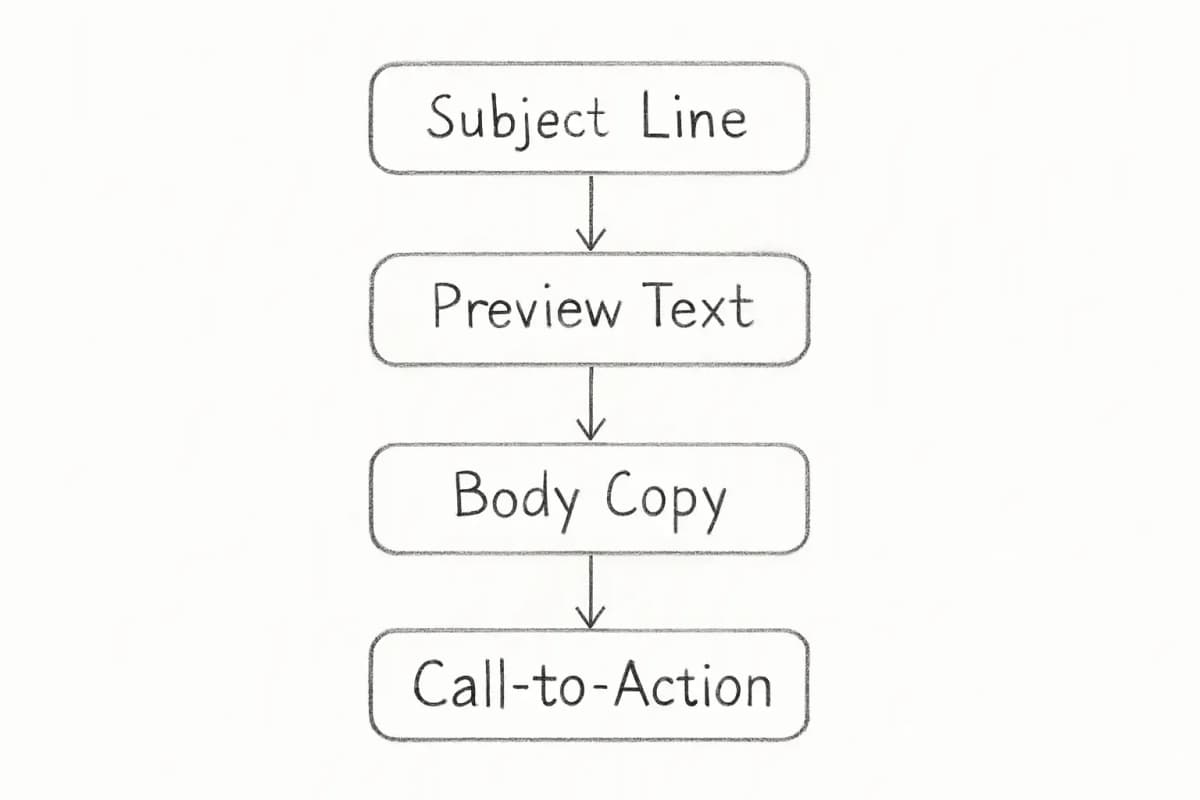
Subject Lines Determine Whether Your Email Gets Opened
The subject line is the single most important piece of copy in any email. A weak subject line kills even the best email. Segmented emails drive 30% more opens and 50% more clickthroughs than unsegmented ones. That means sending the right subject line to the right person matters as much as the words themselves.
Principles that consistently work:
Keep subject lines under 50 characters for mobile visibility
Use specificity over vague promises ("3 pricing mistakes costing you clients" beats "tips to improve your business")
Test curiosity against clarity, but never sacrifice clarity for clever
Emails with the word "update" in their subject lines have the highest average open rate at 42.84%, followed by "events" at 42.76%.
Use multiple capture points rather than relying on a single form. Strategies include embedded opt-in forms placed statically on a page, in your sidebar, your header, or after every piece of content, so the form is there whenever a visitor decides to subscribe. Add dedicated landing pages for lead magnets, exit-intent popups, and checkout opt-ins.
Never Buy an Email List
Purchased lists damage your sender reputation, generate spam complaints, and often violate regulations like GDPR and CAN-SPAM. Always use opt-in list building. For more on growing a quality list, explore these lead gathering tools for email lists.
Step 4: Set Up Your Welcome Email Sequence
The welcome sequence is the highest-leverage automation you can build. Welcome emails have the highest open rates of any email type because subscribers are most engaged immediately after opting in, so use them to make a strong first impression, deliver on promises, and guide subscribers to their next action.
According to the latest benchmarks, welcome emails achieve an impressive average open rate of 83.63% and a click-through rate of 16.60%, with a click-to-open rate of 19.85%. That engagement window is narrow. Use it.
A solid welcome sequence for beginners includes:
Email 1 (immediate): Deliver the lead magnet, introduce your brand, set expectations
Email 2 (day 2-3): Share your best content or a core brand story
Email 3 (day 5-7): Provide value and introduce a relevant offer or next step
Email 4 (day 10-14): Ask a question or invite a reply to build engagement signals
For a more complete breakdown of how to structure this sequence, read Welcome Email Sequence Best Practices: 7 Proven Strategies.
Step 5: Write Emails That Get Read and Drive Action
Good email copy is direct, personal, and focused on one goal per send. Most beginners make their emails too long, too promotional, or too generic.
Subject Lines Determine Whether Your Email Gets Opened
The subject line is the single most important piece of copy in any email. A weak subject line kills even the best email. Segmented emails drive 30% more opens and 50% more clickthroughs than unsegmented ones. That means sending the right subject line to the right person matters as much as the words themselves.
Principles that consistently work:
Keep subject lines under 50 characters for mobile visibility
Use specificity over vague promises ("3 pricing mistakes costing you clients" beats "tips to improve your business")
Test curiosity against clarity, but never sacrifice clarity for clever
Emails with the word "update" in their subject lines have the highest average open rate at 42.84%, followed by "events" at 42.76%.
Structure Every Email for Scanning
Most subscribers scan before they read. Use short paragraphs, one clear call-to-action (CTA), and a logical flow from problem to solution to action.
The most important component of any marketing email is the call to action (CTA), which encourages readers to engage and take the next step. Keep it singular. One email, one action.
Step 6: Segment and Personalize Your Campaigns
Segmentation is where the economics of email marketing get truly compelling.
According to the DMA, marketers have found a 760% increase in email revenue from segmented campaigns. That is not a marginal improvement. It reflects the fundamental difference between sending one message to everyone versus sending the right message to the right person.
Basic segmentation variables to start with:
Signup source (which lead magnet or page they came from)
Engagement level (active, dormant, or at-risk subscribers)
Purchase behavior (buyers vs. non-buyers, product category)
Geographic location (for time-zone send optimization or regional offers)
Personalized emails have been shown to deliver six times more transactions than generic, non-personalized ones, and data shows that companies that invest in personalizing email outreach earn 40% more than their competitors.
Personalization goes beyond using a first name in the subject line. Dynamic content blocks, product recommendations based on browse history, and behavioral triggers all fall under personalization. For a tactical breakdown, see Email List Segmentation Strategies That Boost ROI by 760%.
Step 7: Set Up Automation Beyond the Welcome Sequence
Email automations deliver 30 times more revenue per recipient than one-off promotional campaigns, with the average return per recipient for campaigns sitting at $0.11, while automated flows earn $1.94 per recipient.
Structure Every Email for Scanning
Most subscribers scan before they read. Use short paragraphs, one clear call-to-action (CTA), and a logical flow from problem to solution to action.
The most important component of any marketing email is the call to action (CTA), which encourages readers to engage and take the next step. Keep it singular. One email, one action.
Step 6: Segment and Personalize Your Campaigns
Segmentation is where the economics of email marketing get truly compelling.
According to the DMA, marketers have found a 760% increase in email revenue from segmented campaigns. That is not a marginal improvement. It reflects the fundamental difference between sending one message to everyone versus sending the right message to the right person.
Basic segmentation variables to start with:
Signup source (which lead magnet or page they came from)
Engagement level (active, dormant, or at-risk subscribers)
Purchase behavior (buyers vs. non-buyers, product category)
Geographic location (for time-zone send optimization or regional offers)
Personalized emails have been shown to deliver six times more transactions than generic, non-personalized ones, and data shows that companies that invest in personalizing email outreach earn 40% more than their competitors.
Personalization goes beyond using a first name in the subject line. Dynamic content blocks, product recommendations based on browse history, and behavioral triggers all fall under personalization. For a tactical breakdown, see Email List Segmentation Strategies That Boost ROI by 760%.
Step 7: Set Up Automation Beyond the Welcome Sequence
Email automations deliver 30 times more revenue per recipient than one-off promotional campaigns, with the average return per recipient for campaigns sitting at $0.11, while automated flows earn $1.94 per recipient.
Automation is not just about convenience. It is the structural reason email marketing compounds in value over time. Core automation workflows to build after the welcome series:
Cart abandonment emails (e-commerce): Sending 3 abandoned cart emails results in 69% more orders than just one email.
Post-purchase sequences: Cross-sell, review requests, and loyalty onboarding
Re-engagement campaigns: Win back dormant subscribers before they churn
Birthday or anniversary emails: High-conversion, low-effort relationship builders
Lead nurture drips: Education-focused sequences that move prospects toward a decision
Automated campaigns demonstrate 2,361% higher conversion rates than traditional campaigns. The time investment in building these sequences pays back repeatedly without ongoing effort.
Step 8: Protect Your Deliverability
Writing great emails means nothing if they land in spam. Deliverability is the technical foundation of your entire program.
One in six legitimate marketing emails never reaches the inbox, getting filtered to spam or blocked outright.
Authenticate Your Sending Domain
As of 2024, all senders must have email authentication protocols in place to reach major services like Gmail, Yahoo Mail, and Outlook. The three protocols you need:
SPF (Sender Policy Framework): Specifies which servers can send on behalf of your domain
DKIM (DomainKeys Identified Mail): Adds a digital signature that verifies your identity
DMARC: Tells receiving servers what to do when SPF or DKIM fail, and sends you reports
Companies properly implementing DMARC see a 10-20% improvement in inbox placement rates, directly impacting campaign performance.
Maintain List Hygiene
Only 25% of senders maintained spam complaint rates below the 0.1% best-practice threshold, and 38.7% of senders rarely or never practice email list hygiene.
Practical hygiene steps:
Remove hard bounces immediately
Suppress unsubscribes and spam complaints automatically
Run re-engagement campaigns before removing chronically inactive subscribers
Use double opt-in to improve list quality from the start
Step 9: Measure What Actually Matters
Bot-driven phantom engagement has made open rates unreliable, pushing high-performing teams toward revenue per email, list churn, and lifetime value as the metrics that matter.
Focus on these metrics as a beginner:
Automation is not just about convenience. It is the structural reason email marketing compounds in value over time. Core automation workflows to build after the welcome series:
Cart abandonment emails (e-commerce): Sending 3 abandoned cart emails results in 69% more orders than just one email.
Post-purchase sequences: Cross-sell, review requests, and loyalty onboarding
Re-engagement campaigns: Win back dormant subscribers before they churn
Birthday or anniversary emails: High-conversion, low-effort relationship builders
Lead nurture drips: Education-focused sequences that move prospects toward a decision
Automated campaigns demonstrate 2,361% higher conversion rates than traditional campaigns. The time investment in building these sequences pays back repeatedly without ongoing effort.
Step 8: Protect Your Deliverability
Writing great emails means nothing if they land in spam. Deliverability is the technical foundation of your entire program.
One in six legitimate marketing emails never reaches the inbox, getting filtered to spam or blocked outright.
Authenticate Your Sending Domain
As of 2024, all senders must have email authentication protocols in place to reach major services like Gmail, Yahoo Mail, and Outlook. The three protocols you need:
SPF (Sender Policy Framework): Specifies which servers can send on behalf of your domain
DKIM (DomainKeys Identified Mail): Adds a digital signature that verifies your identity
DMARC: Tells receiving servers what to do when SPF or DKIM fail, and sends you reports
Companies properly implementing DMARC see a 10-20% improvement in inbox placement rates, directly impacting campaign performance.
Maintain List Hygiene
Only 25% of senders maintained spam complaint rates below the 0.1% best-practice threshold, and 38.7% of senders rarely or never practice email list hygiene.
Practical hygiene steps:
Remove hard bounces immediately
Suppress unsubscribes and spam complaints automatically
Run re-engagement campaigns before removing chronically inactive subscribers
Use double opt-in to improve list quality from the start
Step 9: Measure What Actually Matters
Bot-driven phantom engagement has made open rates unreliable, pushing high-performing teams toward revenue per email, list churn, and lifetime value as the metrics that matter.
Focus on these metrics as a beginner:
Metric
What It Tells You
Click-through rate (CTR)
Whether your content drives action
Conversion rate
Whether clicks turn into outcomes
Revenue per email
The direct business value of each send
Unsubscribe rate
Audience relevance and list health
Deliverability rate
Whether your emails reach inboxes
Brands that regularly A/B test their emails achieve 83% higher ROI than those that never test. Start testing one variable per send: subject line, send time, CTA text, or content format. Accumulate learnings over time rather than optimizing based on single campaigns.
How long does it take to see results from email marketing?
Most businesses see meaningful engagement data within 30 to 60 days of launching their first campaigns. Revenue results from automation (like cart abandonment or welcome sequences) can appear within the first week. Compounding results from a healthy, growing list typically take 3 to 6 months to become significant.
How often should I send marketing emails?
Start conservatively and let engagement data guide you. Send emails at a consistent frequency without overwhelming subscribers, and start with once a week or bi-weekly, adjusting the timing and number of emails based on feedback and engagement metrics. Sending too infrequently means subscribers forget you. Sending too frequently without value increases unsubscribes and spam complaints.
What is a good email open rate for beginners?
In 2024, the average open rate was 26.6%. However, this figure is inflated by Apple's Mail Privacy Protection, which pre-loads open tracking pixels. Focus on click-through rate and conversion rate as more reliable benchmarks for your actual performance. A strong CTR is 2-5%, depending on your industry and campaign type.
Do I need a large list to start getting results from email marketing?
No. A highly engaged list of 1,000 subscribers can be far more valuable than a disengaged list of 10,000. Quality and relevance drive results, not raw size. Focus on building a permission-based, niche-relevant list and engaging it consistently before scaling volume.
What laws do I need to know about email marketing?
Metric
What It Tells You
Click-through rate (CTR)
Whether your content drives action
Conversion rate
Whether clicks turn into outcomes
Revenue per email
The direct business value of each send
Unsubscribe rate
Audience relevance and list health
Deliverability rate
Whether your emails reach inboxes
Brands that regularly A/B test their emails achieve 83% higher ROI than those that never test. Start testing one variable per send: subject line, send time, CTA text, or content format. Accumulate learnings over time rather than optimizing based on single campaigns.
How long does it take to see results from email marketing?
Most businesses see meaningful engagement data within 30 to 60 days of launching their first campaigns. Revenue results from automation (like cart abandonment or welcome sequences) can appear within the first week. Compounding results from a healthy, growing list typically take 3 to 6 months to become significant.
How often should I send marketing emails?
Start conservatively and let engagement data guide you. Send emails at a consistent frequency without overwhelming subscribers, and start with once a week or bi-weekly, adjusting the timing and number of emails based on feedback and engagement metrics. Sending too infrequently means subscribers forget you. Sending too frequently without value increases unsubscribes and spam complaints.
What is a good email open rate for beginners?
In 2024, the average open rate was 26.6%. However, this figure is inflated by Apple's Mail Privacy Protection, which pre-loads open tracking pixels. Focus on click-through rate and conversion rate as more reliable benchmarks for your actual performance. A strong CTR is 2-5%, depending on your industry and campaign type.
Do I need a large list to start getting results from email marketing?
No. A highly engaged list of 1,000 subscribers can be far more valuable than a disengaged list of 10,000. Quality and relevance drive results, not raw size. Focus on building a permission-based, niche-relevant list and engaging it consistently before scaling volume.
What laws do I need to know about email marketing?
The three regulations most likely to apply to you are CAN-SPAM (US), GDPR (EU and UK), and CASL (Canada). Key requirements include a clear sender identity, a functioning unsubscribe mechanism, no deceptive subject lines, and handling data lawfully. Always consult a legal professional for compliance specific to your situation. Marketing messages and subscribed messages must support one-click unsubscribe and include a clearly visible unsubscribe link in the message body, per Google's sender guidelines.
No comments yet. Be the first!
The three regulations most likely to apply to you are CAN-SPAM (US), GDPR (EU and UK), and CASL (Canada). Key requirements include a clear sender identity, a functioning unsubscribe mechanism, no deceptive subject lines, and handling data lawfully. Always consult a legal professional for compliance specific to your situation. Marketing messages and subscribed messages must support one-click unsubscribe and include a clearly visible unsubscribe link in the message body, per Google's sender guidelines.