
Email
Email

A modern blog built with Payload CMS, Next.js, and shadcn/ui.

RSS FeedSitemap

Explore

  • Blog
  • News
  • Statistics
  • Authors

Categories

  • Hiring & Team Building
  • Email Campaign Strategy
  • Email Design & Templates
  • Email Compliance & Legal
  • Email Deliverability & Best Practices
  • Career Development
  • Email Strategy for Finance & Professional Services
  • Email Marketing Metrics

Latest articles

  • How to Hire an Email Marketing SpecialistJul 22, 2026
  • Email Marketing Campaigns Template: Ready-to-UseJul 22, 2026
  • Canva Email Marketing Templates: Design Fast, Convert MoreJul 22, 2026
  • Email Marketing Templates for FranchisesJul 22, 2026

Popular topics

  • #Specialist Skills
  • #Team Building
  • #Templates
  • #Canva
  • #Advanced Strategies
  • #multi-location businesses
  • #Marketing Regulations
  • #Lead Follow-Up
  • #iCloud Email
  • #Marketing Management
  • #Product Launch
  • #Electrician Marketing
  • #statistics
  • #Budget-Friendly
  • #Free Resources
  • #Miami businesses

Stay in the loop

Join 2,000+ readers. Unsubscribe anytime.

Subscribe
Email

© 2026 Email. All rights reserved.

SitemapRSS
HomeBlogEmail Marketing FundamentalsBasic Email Marketing Tips: 7 Strategies That Drive Results
Email Marketing Fundamentals

Basic Email Marketing Tips: 7 Strategies That Drive Results

Learn 7 foundational email marketing tips to boost open rates, click-through rates, and ROI. Perfect for beginners and growing teams.

P

Priya Kapoor

May 16, 2026

9 min read
Share:
#Email Marketing Strategy#Beginner's Guide#Email Best Practices#Marketing ROI
Illustration for basic email marketing tips

Stay in the loop

Get the latest posts delivered straight to your inbox. No spam, unsubscribe anytime.

Email marketing remains one of the most dependable revenue channels in digital marketing, but only when you get the fundamentals right. Email marketing campaigns have an average ROI of 36 times, meaning businesses earn $36 for every dollar spent. Yet many teams leave significant returns on the table by skipping the basics. If you are looking to build a stronger program from the ground up, these seven basic email marketing tips will give you a clear path forward.

Key Takeaways

  • The average email marketing ROI is 36:1, making it one of the highest-return channels available to marketers.
  • Segmented email campaigns increase revenue by up to 760% compared to non-segmented sends.
  • Emails with personalized subject lines are 26% more likely to be opened.
  • Automated emails drove 37% of all email-generated sales in 2024 while accounting for just 2% of total email volume.
  • Email lists degrade by 20-25% annually, making regular list hygiene essential for deliverability.

1. Build a Permission-Based List From Day One

The quality of your email list determines everything downstream: your deliverability, open rates, engagement, and revenue. A large list of disengaged contacts will consistently underperform a small list of people who genuinely want to hear from you.

Use double opt-in to confirm subscriber intent. Confirmed opt-in reduces bounce rates, spam traps, and complaint risk, which are critical factors on shared sending infrastructure.

Avoid purchased lists entirely. Poor list hygiene leads to hard bounces from invalid addresses, high bounce rates that trigger spam filters, and spam traps that can get you blacklisted.

For practical guidance on building your subscriber base the right way, see our guide to lead gathering tools for email lists.


2. Write Subject Lines That Earn the Open

Your subject line is the first and often only factor that determines whether your email gets read or deleted. 64% of email recipients make the decision to open an email based on the quality of the subject line.

Personalization is the most reliable lever here. Research indicates that emails with personalized subject lines are 26% more likely to be opened. At the same time, the vast majority of senders are not using it: 90.33% of marketing emails still lack subject line personalization.

A few subject line principles that hold up across studies:

  • Keep subject lines under 70 characters for better mobile display and faster comprehension
  • Subject lines framed as questions achieve a 46% open rate, outperforming other formats by sparking curiosity
  • A striking 69% of recipients mark emails as spam based on the subject line alone, so avoid misleading or clickbait-style lines that erode trust

For a deeper breakdown, our post on email subject line best practices covers the data behind what actually moves the needle.


3. Segment Your List to Send More Relevant Emails

Batch-and-blast emails consistently underperform targeted sends. Segmentation is how you close that gap.

Email list segmentation is the process of dividing email contacts into smaller groups based on shared characteristics such as demographics, behavior, purchase history, or engagement patterns, allowing you to deliver personalized content that resonates with each group's unique needs.

The revenue impact is substantial. According to industry research, 77% of email marketing ROI comes from segmented, targeted, and triggered campaigns. Segmented email campaigns can drive 30% more opens and 50% more click-throughs than non-segmented ones.

Common segmentation criteria to start with:

  • Purchase history (what they bought, how recently, how often)
  • Engagement level (active openers vs. subscribers who haven't opened in 90 days)
  • Demographics (location, industry, job title)
  • Behavior (pages visited, links clicked, cart abandoned)

A 2025 study found that segmented emails are twice as likely to convert as non-segmented ones (7.8% vs. 3.4%).

For a full strategic breakdown, see our guide on email list segmentation strategies.


4. Set Up Automated Email Sequences

Manual one-off campaigns have their place, but automation is where email marketing truly scales. The performance difference between automated and standard campaigns is not marginal.

Automated emails have 52% higher open rates, 332% higher click rates, and 2,361% better conversion rates compared to regular scheduled campaigns. Automated emails generate 320% more revenue than non-automated emails.

The automations worth building first:

  1. Welcome series: Welcome emails are the most effective email marketing campaign type, achieving an impressive average open rate of 83.63% and a click-through rate of 16.60%.
  2. Abandoned cart: Abandoned cart email campaigns have an open rate of 50.50%, and businesses earn an average of $3.45 in revenue per abandoned cart email recipient.
  3. Post-purchase: A sequence to confirm the order, cross-sell, and request a review
  4. Re-engagement: Triggered when a subscriber goes inactive for 60 to 90 days

The top 8% of email programs, those hitting 45:1 or higher ROI, most commonly send newsletters and onboarding emails rather than promotional blasts. Relationship-building sequences consistently outperform one-time campaigns.

For a detailed walkthrough of how to structure your first automated sequence, see welcome email sequence best practices.


5. Personalize Beyond the First Name

Personalization in email marketing extends well beyond inserting {{first_name}} in the greeting. That is table stakes. Meaningful personalization responds to what a subscriber has actually done.

71% of consumers expect personalized interactions from brands, and 76% get frustrated when their brand interactions are not personalized to their interests.

Personalization tactics that produce measurable lifts:

  • Dynamic product recommendations based on browse or purchase behavior
  • Triggered emails based on specific actions: marketing emails sent in response to behavioral triggers generate 10 times greater revenue than other marketing email types
  • Birthday and anniversary emails: Birthday emails tend to generate 342% higher revenue per email than standard promotional emails
  • Lifecycle-stage messaging that shifts tone and content based on where the subscriber is in the customer journey

Personalized calls to action result in 42% higher conversion rates than generic CTAs.


6. Maintain Your List and Protect Deliverability

You can write the best email in the world and still see it miss the inbox if your sender reputation is damaged. List hygiene is the unglamorous but essential practice that keeps your deliverability healthy.

Email lists degrade by 20-25% annually, and inbox providers like Gmail prioritize sender reputation, making a clean list no longer optional.

Key hygiene tasks to build into your process:

  • Remove hard bounces immediately after any send
  • Keep your bounce rate below 2%; rates above 5% indicate serious hygiene problems and may trigger scrutiny from email service providers
  • Run re-engagement campaigns for subscribers who have not opened in 60 to 90 days, then suppress those who do not respond
  • Keep spam rates below 0.1%, as rates above this threshold will damage your domain reputation with Gmail and Yahoo

Clean lists achieve 98% inbox placement rates, while lists with poor hygiene often see 30-40% of emails land in spam regardless of content quality.

Also set up proper email authentication: SPF, DKIM, and DMARC records. These are technical configurations that signal to inbox providers that your domain is legitimate and reduce the chance of your emails being filtered or spoofed.


7. Test, Measure, and Improve Systematically

Most basic email marketing tips stop at "A/B test your subject lines." That is a start, but a real testing practice covers more ground and compounds over time.

Brands that regularly A/B test their emails achieve 83% higher ROI than those that never test.

What to test and track:

  • Subject lines (personalization, length, question vs. statement)
  • Send time and day (varies by audience; test your own list rather than relying on generic benchmarks)
  • Call-to-action copy and placement
  • Email length and structure
  • Sender name (person vs. brand name)

Most email A/B tests need at least 1,000 recipients per variation for reliable results. Test one variable at a time so you know exactly what caused the change.

On the metrics side, email marketers now prioritize click-through rates, click-to-open rates, and conversion metrics over open rates when evaluating campaign performance, partly because Apple's Mail Privacy Protection has made open rates less reliable.

Track the metrics that connect directly to revenue: revenue per email, conversion rate, and list lifetime value. These tell you whether your program is actually working.

For a full framework on what to measure and when, see our email marketing analytics best practices guide.
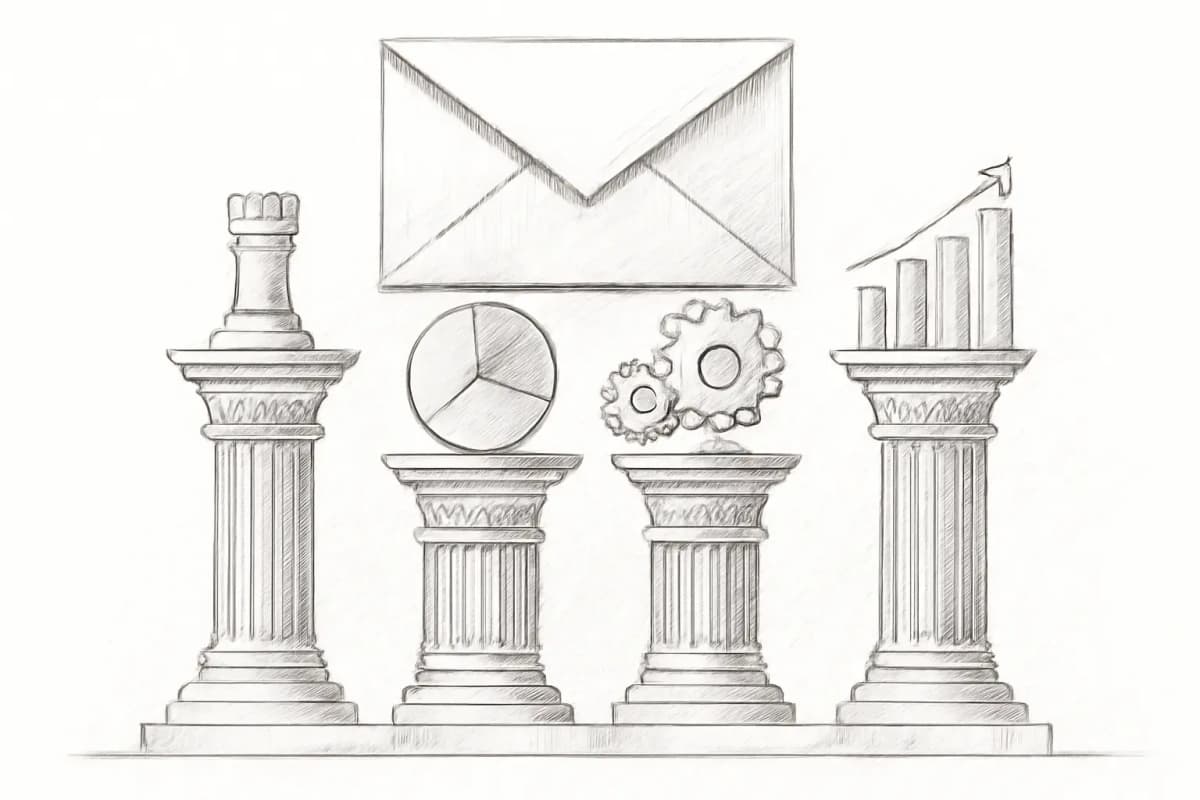

Email marketing tips overview showing strategy, segmentation, automation, and analytics pillars


Pulling It All Together

These seven basic email marketing tips are interdependent. A clean list improves deliverability. Better deliverability means your personalized, segmented emails actually reach the inbox. Automated sequences run on top of that foundation to generate revenue around the clock. A/B testing refines every element over time.

The teams seeing the best returns from email in 2026 are not doing anything magical; they are building a stronger email foundation. Start with these fundamentals, apply them consistently, and the compound effect becomes significant.


Frequently Asked Questions

What are the most important basic email marketing tips for beginners?

Start with three fundamentals: build a permission-based list using double opt-in, set up a welcome email automation, and segment your list by at least one basic criteria such as where subscribers signed up or what they purchased. Welcome emails alone achieve an average open rate of 83.63% and a click-through rate of 16.60%, making them the highest-leverage starting point for any new program.

How often should I send marketing emails?

Frequency depends on your audience and the value of your content. Brands sending 9 to 16 emails monthly achieve an average ROI of 4,600%, the highest of any frequency bracket. Rather than guessing, test different frequencies with different segments and let engagement data guide your cadence. 29% of email recipients stopped using their mailboxes because they received too many marketing messages, so erring toward quality over volume is a reasonable default.

What email metrics should I track?

Track metrics that connect to business outcomes. Click-through rate is a strong engagement north star, while click-to-open rate tells you whether your content is compelling once someone opens. Beyond engagement, track conversion rate, revenue per email, and unsubscribe rate. Bot-driven phantom engagement has made open rates unreliable, pushing high-performing teams toward revenue per email, list churn, and lifetime value as the metrics that matter.

How do I improve email deliverability?

Focus on four areas: list hygiene (remove hard bounces and inactive subscribers regularly), authentication (set up SPF, DKIM, and DMARC), engagement (send relevant, segmented content that people actually open), and sending practices (avoid sudden volume spikes). The acceptable spam rate threshold is 0.1% as a target, with 0.3% as the absolute maximum enforced by major mailbox providers. Staying well below that threshold protects your sender reputation and long-term inbox placement.


No comments yet. Be the first!

Leave a comment

Comments are reviewed before publishing.

More from

Related posts

Illustration for email and marketing automation meaning
Email Marketing FundamentalsJul 20, 2026 11 min

Email and Marketing Automation Meaning: A Guide

Learn what email and marketing automation means, how it works, and why it matters for your business growth. Discover key benefits and real-world applications.

JJames Chen
Illustration for email marketing automation definition
Email Marketing FundamentalsJul 20, 2026 10 min

Email Marketing Automation: Definition and Core Concepts

Email marketing automation definition: software that sends targeted messages based on triggers and subscriber behavior. Learn how it works and why it matters.

PPriya Kapoor
Illustration for what is automated email marketing
Email Marketing FundamentalsJul 15, 2026 10 min

What Is Automated Email Marketing and How Does It Work

Automated email marketing uses workflows to send targeted messages based on customer behavior. Learn how it works, key benefits, and how to get started.

JJames Chen
HomeBlogEmail Marketing FundamentalsBasic Email Marketing Tips: 7 Strategies That Drive Results
Email Marketing Fundamentals

Basic Email Marketing Tips: 7 Strategies That Drive Results

Learn 7 foundational email marketing tips to boost open rates, click-through rates, and ROI. Perfect for beginners and growing teams.

P

Priya Kapoor

May 16, 2026

9 min read
Share:
#Email Marketing Strategy#Beginner's Guide#Email Best Practices#Marketing ROI
Illustration for basic email marketing tips

Stay in the loop

Get the latest posts delivered straight to your inbox. No spam, unsubscribe anytime.

Email marketing remains one of the most dependable revenue channels in digital marketing, but only when you get the fundamentals right. Email marketing campaigns have an average ROI of 36 times, meaning businesses earn $36 for every dollar spent. Yet many teams leave significant returns on the table by skipping the basics. If you are looking to build a stronger program from the ground up, these seven basic email marketing tips will give you a clear path forward.

Key Takeaways

  • The average email marketing ROI is 36:1, making it one of the highest-return channels available to marketers.
  • Segmented email campaigns increase revenue by up to 760% compared to non-segmented sends.
  • Emails with personalized subject lines are 26% more likely to be opened.
  • Automated emails drove 37% of all email-generated sales in 2024 while accounting for just 2% of total email volume.
  • Email lists degrade by 20-25% annually, making regular list hygiene essential for deliverability.

1. Build a Permission-Based List From Day One

The quality of your email list determines everything downstream: your deliverability, open rates, engagement, and revenue. A large list of disengaged contacts will consistently underperform a small list of people who genuinely want to hear from you.

Use double opt-in to confirm subscriber intent. Confirmed opt-in reduces bounce rates, spam traps, and complaint risk, which are critical factors on shared sending infrastructure.

Avoid purchased lists entirely. Poor list hygiene leads to hard bounces from invalid addresses, high bounce rates that trigger spam filters, and spam traps that can get you blacklisted.

For practical guidance on building your subscriber base the right way, see our guide to lead gathering tools for email lists.


2. Write Subject Lines That Earn the Open

Your subject line is the first and often only factor that determines whether your email gets read or deleted. 64% of email recipients make the decision to open an email based on the quality of the subject line.

Personalization is the most reliable lever here. Research indicates that emails with personalized subject lines are 26% more likely to be opened. At the same time, the vast majority of senders are not using it: 90.33% of marketing emails still lack subject line personalization.

A few subject line principles that hold up across studies:

  • Keep subject lines under 70 characters for better mobile display and faster comprehension
  • Subject lines framed as questions achieve a 46% open rate, outperforming other formats by sparking curiosity
  • A striking 69% of recipients mark emails as spam based on the subject line alone, so avoid misleading or clickbait-style lines that erode trust

For a deeper breakdown, our post on email subject line best practices covers the data behind what actually moves the needle.


3. Segment Your List to Send More Relevant Emails

Batch-and-blast emails consistently underperform targeted sends. Segmentation is how you close that gap.

Email list segmentation is the process of dividing email contacts into smaller groups based on shared characteristics such as demographics, behavior, purchase history, or engagement patterns, allowing you to deliver personalized content that resonates with each group's unique needs.

The revenue impact is substantial. According to industry research, 77% of email marketing ROI comes from segmented, targeted, and triggered campaigns. Segmented email campaigns can drive 30% more opens and 50% more click-throughs than non-segmented ones.

Common segmentation criteria to start with:

  • Purchase history (what they bought, how recently, how often)
  • Engagement level (active openers vs. subscribers who haven't opened in 90 days)
  • Demographics (location, industry, job title)
  • Behavior (pages visited, links clicked, cart abandoned)

A 2025 study found that segmented emails are twice as likely to convert as non-segmented ones (7.8% vs. 3.4%).

For a full strategic breakdown, see our guide on email list segmentation strategies.


4. Set Up Automated Email Sequences

Manual one-off campaigns have their place, but automation is where email marketing truly scales. The performance difference between automated and standard campaigns is not marginal.

Automated emails have 52% higher open rates, 332% higher click rates, and 2,361% better conversion rates compared to regular scheduled campaigns. Automated emails generate 320% more revenue than non-automated emails.

The automations worth building first:

  1. Welcome series: Welcome emails are the most effective email marketing campaign type, achieving an impressive average open rate of 83.63% and a click-through rate of 16.60%.
  2. Abandoned cart: Abandoned cart email campaigns have an open rate of 50.50%, and businesses earn an average of $3.45 in revenue per abandoned cart email recipient.
  3. Post-purchase: A sequence to confirm the order, cross-sell, and request a review
  4. Re-engagement: Triggered when a subscriber goes inactive for 60 to 90 days

The top 8% of email programs, those hitting 45:1 or higher ROI, most commonly send newsletters and onboarding emails rather than promotional blasts. Relationship-building sequences consistently outperform one-time campaigns.

For a detailed walkthrough of how to structure your first automated sequence, see welcome email sequence best practices.


5. Personalize Beyond the First Name

Personalization in email marketing extends well beyond inserting {{first_name}} in the greeting. That is table stakes. Meaningful personalization responds to what a subscriber has actually done.

71% of consumers expect personalized interactions from brands, and 76% get frustrated when their brand interactions are not personalized to their interests.

Personalization tactics that produce measurable lifts:

  • Dynamic product recommendations based on browse or purchase behavior
  • Triggered emails based on specific actions: marketing emails sent in response to behavioral triggers generate 10 times greater revenue than other marketing email types
  • Birthday and anniversary emails: Birthday emails tend to generate 342% higher revenue per email than standard promotional emails
  • Lifecycle-stage messaging that shifts tone and content based on where the subscriber is in the customer journey

Personalized calls to action result in 42% higher conversion rates than generic CTAs.


6. Maintain Your List and Protect Deliverability

You can write the best email in the world and still see it miss the inbox if your sender reputation is damaged. List hygiene is the unglamorous but essential practice that keeps your deliverability healthy.

Email lists degrade by 20-25% annually, and inbox providers like Gmail prioritize sender reputation, making a clean list no longer optional.

Key hygiene tasks to build into your process:

  • Remove hard bounces immediately after any send
  • Keep your bounce rate below 2%; rates above 5% indicate serious hygiene problems and may trigger scrutiny from email service providers
  • Run re-engagement campaigns for subscribers who have not opened in 60 to 90 days, then suppress those who do not respond
  • Keep spam rates below 0.1%, as rates above this threshold will damage your domain reputation with Gmail and Yahoo

Clean lists achieve 98% inbox placement rates, while lists with poor hygiene often see 30-40% of emails land in spam regardless of content quality.

Also set up proper email authentication: SPF, DKIM, and DMARC records. These are technical configurations that signal to inbox providers that your domain is legitimate and reduce the chance of your emails being filtered or spoofed.


7. Test, Measure, and Improve Systematically

Most basic email marketing tips stop at "A/B test your subject lines." That is a start, but a real testing practice covers more ground and compounds over time.

Brands that regularly A/B test their emails achieve 83% higher ROI than those that never test.

What to test and track:

  • Subject lines (personalization, length, question vs. statement)
  • Send time and day (varies by audience; test your own list rather than relying on generic benchmarks)
  • Call-to-action copy and placement
  • Email length and structure
  • Sender name (person vs. brand name)

Most email A/B tests need at least 1,000 recipients per variation for reliable results. Test one variable at a time so you know exactly what caused the change.

On the metrics side, email marketers now prioritize click-through rates, click-to-open rates, and conversion metrics over open rates when evaluating campaign performance, partly because Apple's Mail Privacy Protection has made open rates less reliable.

Track the metrics that connect directly to revenue: revenue per email, conversion rate, and list lifetime value. These tell you whether your program is actually working.

For a full framework on what to measure and when, see our email marketing analytics best practices guide.


Email marketing tips overview showing strategy, segmentation, automation, and analytics pillars


Pulling It All Together

These seven basic email marketing tips are interdependent. A clean list improves deliverability. Better deliverability means your personalized, segmented emails actually reach the inbox. Automated sequences run on top of that foundation to generate revenue around the clock. A/B testing refines every element over time.

The teams seeing the best returns from email in 2026 are not doing anything magical; they are building a stronger email foundation. Start with these fundamentals, apply them consistently, and the compound effect becomes significant.


Frequently Asked Questions

What are the most important basic email marketing tips for beginners?

Start with three fundamentals: build a permission-based list using double opt-in, set up a welcome email automation, and segment your list by at least one basic criteria such as where subscribers signed up or what they purchased. Welcome emails alone achieve an average open rate of 83.63% and a click-through rate of 16.60%, making them the highest-leverage starting point for any new program.

How often should I send marketing emails?

Frequency depends on your audience and the value of your content. Brands sending 9 to 16 emails monthly achieve an average ROI of 4,600%, the highest of any frequency bracket. Rather than guessing, test different frequencies with different segments and let engagement data guide your cadence. 29% of email recipients stopped using their mailboxes because they received too many marketing messages, so erring toward quality over volume is a reasonable default.

What email metrics should I track?

Track metrics that connect to business outcomes. Click-through rate is a strong engagement north star, while click-to-open rate tells you whether your content is compelling once someone opens. Beyond engagement, track conversion rate, revenue per email, and unsubscribe rate. Bot-driven phantom engagement has made open rates unreliable, pushing high-performing teams toward revenue per email, list churn, and lifetime value as the metrics that matter.

How do I improve email deliverability?

Focus on four areas: list hygiene (remove hard bounces and inactive subscribers regularly), authentication (set up SPF, DKIM, and DMARC), engagement (send relevant, segmented content that people actually open), and sending practices (avoid sudden volume spikes). The acceptable spam rate threshold is 0.1% as a target, with 0.3% as the absolute maximum enforced by major mailbox providers. Staying well below that threshold protects your sender reputation and long-term inbox placement.
No comments yet. Be the first!

Leave a comment

Comments are reviewed before publishing.

More from

Related posts

Illustration for email and marketing automation meaning
Email Marketing FundamentalsJul 20, 2026 11 min

Email and Marketing Automation Meaning: A Guide

Learn what email and marketing automation means, how it works, and why it matters for your business growth. Discover key benefits and real-world applications.

JJames Chen
Illustration for email marketing automation definition
Email Marketing FundamentalsJul 20, 2026 10 min

Email Marketing Automation: Definition and Core Concepts

Email marketing automation definition: software that sends targeted messages based on triggers and subscriber behavior. Learn how it works and why it matters.

PPriya Kapoor
Illustration for what is automated email marketing
Email Marketing FundamentalsJul 15, 2026 10 min

What Is Automated Email Marketing and How Does It Work

Automated email marketing uses workflows to send targeted messages based on customer behavior. Learn how it works, key benefits, and how to get started.

JJames Chen