Father's Day is one of the most commercially significant dates on the retail calendar, and email is the channel best positioned to capture that spending. Father's Day spending is projected to reach a record $24 billion in 2025, according to the National Retail Federation and Prosper Insights & Analytics, up from $22.4 billion in 2024 and surpassing the previous record of $22.9 billion set in 2023. For email marketers, that number signals a clear opportunity. But competition in the inbox is real, and generic campaigns get ignored. This guide covers what actually works in father's day email marketing: when to send, how to segment, what subject lines move the needle, and how to build a sequence that converts through the full shopping window.
Key Takeaways
Email marketing delivers some of the strongest ROI for Father's Day campaigns, with open rates averaging 12 to 15% higher than usual in the three weeks before the holiday.
When looking for Father's Day gifts, shoppers say it is most important they find a gift that is unique or different (46%) or creates a special memory (37%). Your email content should reflect those priorities.
Father's Day shopping happens in a short window, with nearly 90% of consumers planning to make their purchases within the month leading up to the holiday, and about 25% waiting until the final week.
Segmenting by purchase history, demographics, and behavior consistently improves conversion rates over batch-and-blast sends.
Giving customers the option to opt out of Father's Day emails while staying subscribed to other promotions is now considered a best practice, and Klaviyo data shows leading brands are sending pre-campaign opt-out emails to do exactly that.
Why Father's Day Email Marketing Deserves a Dedicated Strategy
Most brands treat Father's Day as a line item in their promotional calendar. They swap a banner, update the copy, and send the same campaign structure they use for every other holiday. That approach leaves significant revenue on the table.
June is traditionally a flat month for online spending, typically dipping around 30% below the months towards the end of the year, making Father's Day a timely opportunity for marketers to capitalize on consumers' inclination to prioritize red-letter days. In other words, your Father's Day campaign is not competing against peak-season volume; it is competing for attention in a quieter month when a well-crafted email stands out more.
Father's Day is one of the most commercially significant dates on the retail calendar, and email is the channel best positioned to capture that spending. Father's Day spending is projected to reach a record $24 billion in 2025, according to the National Retail Federation and Prosper Insights & Analytics, up from $22.4 billion in 2024 and surpassing the previous record of $22.9 billion set in 2023. For email marketers, that number signals a clear opportunity. But competition in the inbox is real, and generic campaigns get ignored. This guide covers what actually works in father's day email marketing: when to send, how to segment, what subject lines move the needle, and how to build a sequence that converts through the full shopping window.
Key Takeaways
Email marketing delivers some of the strongest ROI for Father's Day campaigns, with open rates averaging 12 to 15% higher than usual in the three weeks before the holiday.
When looking for Father's Day gifts, shoppers say it is most important they find a gift that is unique or different (46%) or creates a special memory (37%). Your email content should reflect those priorities.
Father's Day shopping happens in a short window, with nearly 90% of consumers planning to make their purchases within the month leading up to the holiday, and about 25% waiting until the final week.
Segmenting by purchase history, demographics, and behavior consistently improves conversion rates over batch-and-blast sends.
Giving customers the option to opt out of Father's Day emails while staying subscribed to other promotions is now considered a best practice, and Klaviyo data shows leading brands are sending pre-campaign opt-out emails to do exactly that.
Why Father's Day Email Marketing Deserves a Dedicated Strategy
Most brands treat Father's Day as a line item in their promotional calendar. They swap a banner, update the copy, and send the same campaign structure they use for every other holiday. That approach leaves significant revenue on the table.
June is traditionally a flat month for online spending, typically dipping around 30% below the months towards the end of the year, making Father's Day a timely opportunity for marketers to capitalize on consumers' inclination to prioritize red-letter days. In other words, your Father's Day campaign is not competing against peak-season volume; it is competing for attention in a quieter month when a well-crafted email stands out more.
More than three-quarters of consumers (76%) plan to celebrate Father's Day. They are planning to spend $199.38 on average per person, nearly $10 more than last year. Consumers aged 35 to 44 tend to spend the most, averaging $278.90. That demographic detail matters. If you are not segmenting by age group or targeting the 35–44 bracket with premium product positioning, you are missing your highest-value buyers.
Father's Day campaigns perform significantly higher than general marketing newsletters in terms of conversion rates, confirming that subscribers who click on a Father's Day-related email do so with intent to purchase.
When to Start: Building Your Send Timeline
Timing is the variable most brands get wrong. One of the most common mistakes is sending your campaign too late. Timing is everything, and if your email reaches customers after they've already purchased, you've missed a key opportunity. It is better to start early and build momentum with a series of emails leading up to the holiday.
Generally, you can seldom start too early; launching in April establishes a strong presence from the outset that accommodates both early planners and last-minute shoppers.
A practical Father's Day email sequence looks like this:
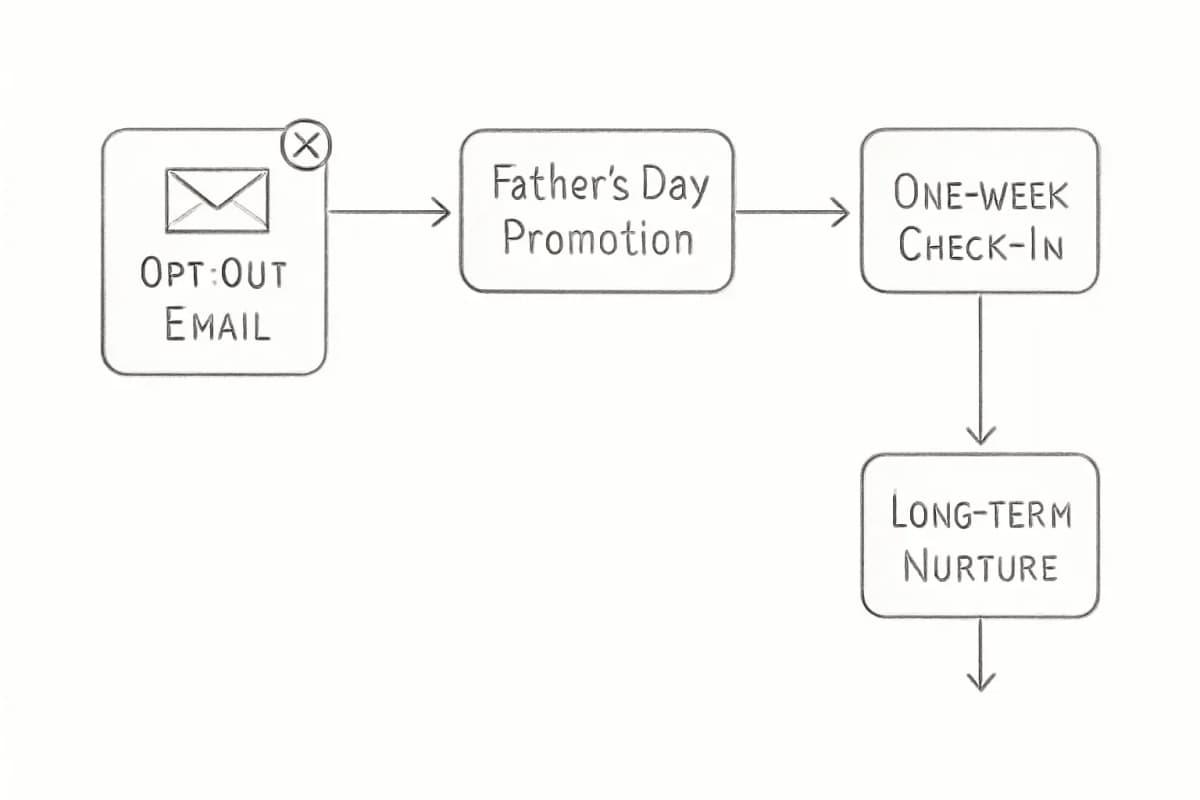
4 to 5 weeks out: Opt-out campaign. Let subscribers choose whether they want to receive Father's Day emails. This protects deliverability and builds goodwill.
3 weeks out: Gift guide launch. Introduce product categories tailored to your audience segments. Use this send to capture browse and cart abandonment signals.
2 weeks out: Promotional email with a clear offer. Emphasize free shipping or a limited-time discount.
2 to 3 days out: Last-minute shoppers. Promote digital gift cards, experience-based gifts, or same-day delivery options.
Day of: A brief emotional send that reinforces your brand without being pushy.
Using a countdown approach that highlights key shipping deadlines creates urgency. Time-sensitive reminder emails are proven to drive strong conversion rates, making them a powerful tool in the final days of Father's Day campaigns.
Segmentation: The Difference Between Average and Exceptional Results
A Father's Day email sent to your entire list will always underperform one sent to a well-defined segment. Ignoring audience segmentation can hurt your results. Not every subscriber is the same, and sending generic emails to your entire list often leads to lower engagement.
For Father's Day specifically, the most useful segments to build are:
More than three-quarters of consumers (76%) plan to celebrate Father's Day. They are planning to spend $199.38 on average per person, nearly $10 more than last year. Consumers aged 35 to 44 tend to spend the most, averaging $278.90. That demographic detail matters. If you are not segmenting by age group or targeting the 35–44 bracket with premium product positioning, you are missing your highest-value buyers.
Father's Day campaigns perform significantly higher than general marketing newsletters in terms of conversion rates, confirming that subscribers who click on a Father's Day-related email do so with intent to purchase.
When to Start: Building Your Send Timeline
Timing is the variable most brands get wrong. One of the most common mistakes is sending your campaign too late. Timing is everything, and if your email reaches customers after they've already purchased, you've missed a key opportunity. It is better to start early and build momentum with a series of emails leading up to the holiday.
Generally, you can seldom start too early; launching in April establishes a strong presence from the outset that accommodates both early planners and last-minute shoppers.
A practical Father's Day email sequence looks like this:
4 to 5 weeks out: Opt-out campaign. Let subscribers choose whether they want to receive Father's Day emails. This protects deliverability and builds goodwill.
3 weeks out: Gift guide launch. Introduce product categories tailored to your audience segments. Use this send to capture browse and cart abandonment signals.
2 weeks out: Promotional email with a clear offer. Emphasize free shipping or a limited-time discount.
2 to 3 days out: Last-minute shoppers. Promote digital gift cards, experience-based gifts, or same-day delivery options.
Day of: A brief emotional send that reinforces your brand without being pushy.
Using a countdown approach that highlights key shipping deadlines creates urgency. Time-sensitive reminder emails are proven to drive strong conversion rates, making them a powerful tool in the final days of Father's Day campaigns.
Segmentation: The Difference Between Average and Exceptional Results
A Father's Day email sent to your entire list will always underperform one sent to a well-defined segment. Ignoring audience segmentation can hurt your results. Not every subscriber is the same, and sending generic emails to your entire list often leads to lower engagement.
For Father's Day specifically, the most useful segments to build are:
Previous Father's Day buyers. Identify customers who have bought Father's Day gifts in previous years. They are likely interested in doing so again, and recurrence is key.
Demographics by age. Target the 35 to 44 group with premium and bundled options; target younger shoppers with personalized and experience-based gifts.
Gender-based gifting. Spouses and partners are one of the most valuable audiences for Father's Day. Women in particular tend to drive household purchasing decisions and are often the ones selecting gifts for their husbands. Brands selling apparel, tech gadgets, or experience-based gifts should prioritize reaching this audience.
Interest and category segments. Segment gift guides into categories such as tech-savvy dads, foodie dads, sporty dads, and so on.
Self-gifting dads. Many dads take the opportunity to buy something special for themselves, whether it's new tools, sports gear, or luxury items. Studies show that self-gifting is a rising trend across all major holidays, including Father's Day.
Previous Father's Day buyers. Identify customers who have bought Father's Day gifts in previous years. They are likely interested in doing so again, and recurrence is key.
Demographics by age. Target the 35 to 44 group with premium and bundled options; target younger shoppers with personalized and experience-based gifts.
Gender-based gifting. Spouses and partners are one of the most valuable audiences for Father's Day. Women in particular tend to drive household purchasing decisions and are often the ones selecting gifts for their husbands. Brands selling apparel, tech gadgets, or experience-based gifts should prioritize reaching this audience.
Interest and category segments. Segment gift guides into categories such as tech-savvy dads, foodie dads, sporty dads, and so on.
Self-gifting dads. Many dads take the opportunity to buy something special for themselves, whether it's new tools, sports gear, or luxury items. Studies show that self-gifting is a rising trend across all major holidays, including Father's Day.
Subject Lines and Personalization That Drive Opens
The subject line is your first conversion point. Personalized email campaigns with optimized send times achieve 29% higher unique open rates and 41% higher click-through rates compared to generic scheduling approaches, according to Omnisend data.
For Father's Day, subject lines that reference emotion, urgency, or a specific dad "type" outperform generic promotional framing. Compare these two approaches:
Generic: "Father's Day Sale — 20% Off"
Specific: "Dad deserves more than a tie this year" or "For the dad who has everything (except this)"
What makes the second type work: it speaks to the shopper's actual pain point (finding a meaningful, non-generic gift), which maps directly to what roughly 46.2% of consumers prioritize: uniqueness, reflecting a shift away from generic purchases like ties and mugs, with personalized or custom-made products winning consumer attention.
Additional subject line tactics that work well for Father's Day:
Humor and dad jokes (used selectively and on-brand)
Shipping deadline urgency ("Last day for guaranteed Father's Day delivery")
Segmented personalization ("For the tech-loving dad in your life")
Gift guide framing ("Not sure what to get Dad? Start here.")
For proven subject line formulas backed by open rate data, see our guide on email subject line best practices that boost open rates by 27%.
Email Content and Campaign Types That Convert
Gift Guide Emails
Gift guides reduce purchase friction. The brand revisits gift guides with a clear purpose: to simplify the often overwhelming process of finding the perfect holiday gift. Recognizing that gift selection can be complex, the brand positions itself as a helpful resource, guiding subscribers toward meaningful choices.
Structure your gift guide by dad persona (sports dad, tech dad, outdoor dad) or by price tier to serve different budget levels. Include a direct CTA beneath each product recommendation.
Urgency and Flash Sale Emails
Conveying a sense of urgency in your email campaign can significantly boost conversions. Flash sale emails that announce time-limited windows let viewers know time is running out. Use countdown timers for last-chance sends in the final 48 to 72 hours.
Subject Lines and Personalization That Drive Opens
The subject line is your first conversion point. Personalized email campaigns with optimized send times achieve 29% higher unique open rates and 41% higher click-through rates compared to generic scheduling approaches, according to Omnisend data.
For Father's Day, subject lines that reference emotion, urgency, or a specific dad "type" outperform generic promotional framing. Compare these two approaches:
Generic: "Father's Day Sale — 20% Off"
Specific: "Dad deserves more than a tie this year" or "For the dad who has everything (except this)"
What makes the second type work: it speaks to the shopper's actual pain point (finding a meaningful, non-generic gift), which maps directly to what roughly 46.2% of consumers prioritize: uniqueness, reflecting a shift away from generic purchases like ties and mugs, with personalized or custom-made products winning consumer attention.
Additional subject line tactics that work well for Father's Day:
Humor and dad jokes (used selectively and on-brand)
Shipping deadline urgency ("Last day for guaranteed Father's Day delivery")
Segmented personalization ("For the tech-loving dad in your life")
Gift guide framing ("Not sure what to get Dad? Start here.")
For proven subject line formulas backed by open rate data, see our guide on email subject line best practices that boost open rates by 27%.
Email Content and Campaign Types That Convert
Gift Guide Emails
Gift guides reduce purchase friction. The brand revisits gift guides with a clear purpose: to simplify the often overwhelming process of finding the perfect holiday gift. Recognizing that gift selection can be complex, the brand positions itself as a helpful resource, guiding subscribers toward meaningful choices.
Structure your gift guide by dad persona (sports dad, tech dad, outdoor dad) or by price tier to serve different budget levels. Include a direct CTA beneath each product recommendation.
Urgency and Flash Sale Emails
Conveying a sense of urgency in your email campaign can significantly boost conversions. Flash sale emails that announce time-limited windows let viewers know time is running out. Use countdown timers for last-chance sends in the final 48 to 72 hours.
Bundle Emails
Offering Father's Day bundles gives customers a chance to give more while spending less, combining fan-favorite products with popular accessories, creating a compelling set that feels like a curated gift. Bundles increase average order value and make purchasing decisions easier for the buyer.
Post-Purchase and Follow-Up Emails
Do not let the relationship end at the transaction. The transaction should not be the end of the conversation. A week after Father's Day, send a simple check-in. This shows you care beyond the sale and helps turn a one-time holiday shopper into a long-term customer.
The Opt-Out Campaign: A Tactic Most Brands Skip
Father's Day is a sensitive occasion for a meaningful portion of your list. People who have lost fathers, estranged from fathers, or who simply do not celebrate may find a heavy promotional push off-putting.
A Father's Day opt-out campaign empowers you to recognize difficult emotions and acknowledge people as people, not just potential sources of revenue for your brand.
This approach uses a sign-up form to collect email addresses specifically for a suppression list. While demonstrating empathy, the brand also gathers high-quality data about their subscribers that can inform future campaigns, making it a win-win on both sides.
The mechanics are straightforward: send an email 3 to 4 weeks before Father's Day offering subscribers the ability to opt out of holiday-themed emails while staying on your main list. Offering opt-out options for holiday-themed marketing emails shows that your business cares about your customers' well-being and respects their circumstances.
This tactic also protects deliverability. Sending to disengaged subscribers during a holiday push can spike spam complaints and suppress your sender reputation for months afterward.
Measuring Your Father's Day Email Performance
Every Father's Day campaign should be tied to measurable outcomes, not just open rates. Click-to-conversion jumped 53% year over year in 2025, rising from 5.9% to 9%, meaning fewer people clicked but those who did were far more likely to buy. That shift means your downstream experience, landing pages, product pages, and checkout, matters as much as your email itself.
Key metrics to track for Father's Day email marketing:
Offering Father's Day bundles gives customers a chance to give more while spending less, combining fan-favorite products with popular accessories, creating a compelling set that feels like a curated gift. Bundles increase average order value and make purchasing decisions easier for the buyer.
Post-Purchase and Follow-Up Emails
Do not let the relationship end at the transaction. The transaction should not be the end of the conversation. A week after Father's Day, send a simple check-in. This shows you care beyond the sale and helps turn a one-time holiday shopper into a long-term customer.
The Opt-Out Campaign: A Tactic Most Brands Skip
Father's Day is a sensitive occasion for a meaningful portion of your list. People who have lost fathers, estranged from fathers, or who simply do not celebrate may find a heavy promotional push off-putting.
A Father's Day opt-out campaign empowers you to recognize difficult emotions and acknowledge people as people, not just potential sources of revenue for your brand.
This approach uses a sign-up form to collect email addresses specifically for a suppression list. While demonstrating empathy, the brand also gathers high-quality data about their subscribers that can inform future campaigns, making it a win-win on both sides.
The mechanics are straightforward: send an email 3 to 4 weeks before Father's Day offering subscribers the ability to opt out of holiday-themed emails while staying on your main list. Offering opt-out options for holiday-themed marketing emails shows that your business cares about your customers' well-being and respects their circumstances.
This tactic also protects deliverability. Sending to disengaged subscribers during a holiday push can spike spam complaints and suppress your sender reputation for months afterward.
Measuring Your Father's Day Email Performance
Every Father's Day campaign should be tied to measurable outcomes, not just open rates. Click-to-conversion jumped 53% year over year in 2025, rising from 5.9% to 9%, meaning fewer people clicked but those who did were far more likely to buy. That shift means your downstream experience, landing pages, product pages, and checkout, matters as much as your email itself.
Key metrics to track for Father's Day email marketing:
Revenue per email sent (not just opens)
Conversion rate by segment (compare gift guide buyers vs. flash sale buyers)
Unsubscribe and spam complaint rates (early indicators of poor segmentation or timing)
Average order value by email type (bundles vs. single-product promotions)
Cart abandonment recovery rate from triggered Father's Day flows
Automations account for just 2% of email sends but drive 30% of revenue, earning 16 times more per send than scheduled campaigns. Build browse abandonment and cart abandonment flows specifically for Father's Day to capture high-intent shoppers who browse but do not immediately purchase.
When should I start my Father's Day email campaign?
The best time to start your Father's Day emails is about three weeks before the big day. Send a mix of early-bird deals for planners and last-minute offers for those who wait. This catches both types of shoppers when they're ready to buy. Brands with larger lists and awareness goals should consider starting even earlier, in late April or early May, to build product familiarity before the buying window opens.
How many emails should I send for Father's Day?
A sequence of 4 to 6 emails across the 3 to 4 weeks leading up to Father's Day is a reasonable benchmark for most e-commerce brands. Send an initial campaign a couple of weeks before the big day to drive action. Send gentle reminders to those that haven't converted, letting them know the clock is ticking. Not too many though, or you might see a spike in your unsubscribe rates and spam complaints. Use engagement data to suppress non-openers from later sends rather than blasting the full list every time.
What types of Father's Day gifts should I highlight in emails?
As in recent years, 58% of Father's Day shoppers plan to purchase a greeting card, followed by clothing (55%), a special outing (53%), and gift cards (50%). Tech accessories, personal care items, and experience-based gifts are also top categories. Match your product emphasis to the interest segments on your list and prioritize unique or personalized options, since nearly half of shoppers say uniqueness is their top purchase criterion.
How do I make my Father's Day emails stand out in a crowded inbox?
Specificity beats generality every time. Use segmented subject lines that speak to a dad "type" or a specific purchase intent. Lead with a clear, singular offer rather than showcasing ten products at once. Include a gift guide with direct CTAs beneath each recommendation. And use email personalization techniques such as first-name personalization, product recommendations based on past browsing, and dynamic content blocks to make each email feel relevant to the individual receiving it, not just the list as a whole.
No comments yet. Be the first!
Revenue per email sent (not just opens)
Conversion rate by segment (compare gift guide buyers vs. flash sale buyers)
Unsubscribe and spam complaint rates (early indicators of poor segmentation or timing)
Average order value by email type (bundles vs. single-product promotions)
Cart abandonment recovery rate from triggered Father's Day flows
Automations account for just 2% of email sends but drive 30% of revenue, earning 16 times more per send than scheduled campaigns. Build browse abandonment and cart abandonment flows specifically for Father's Day to capture high-intent shoppers who browse but do not immediately purchase.
When should I start my Father's Day email campaign?
The best time to start your Father's Day emails is about three weeks before the big day. Send a mix of early-bird deals for planners and last-minute offers for those who wait. This catches both types of shoppers when they're ready to buy. Brands with larger lists and awareness goals should consider starting even earlier, in late April or early May, to build product familiarity before the buying window opens.
How many emails should I send for Father's Day?
A sequence of 4 to 6 emails across the 3 to 4 weeks leading up to Father's Day is a reasonable benchmark for most e-commerce brands. Send an initial campaign a couple of weeks before the big day to drive action. Send gentle reminders to those that haven't converted, letting them know the clock is ticking. Not too many though, or you might see a spike in your unsubscribe rates and spam complaints. Use engagement data to suppress non-openers from later sends rather than blasting the full list every time.
What types of Father's Day gifts should I highlight in emails?
As in recent years, 58% of Father's Day shoppers plan to purchase a greeting card, followed by clothing (55%), a special outing (53%), and gift cards (50%). Tech accessories, personal care items, and experience-based gifts are also top categories. Match your product emphasis to the interest segments on your list and prioritize unique or personalized options, since nearly half of shoppers say uniqueness is their top purchase criterion.
How do I make my Father's Day emails stand out in a crowded inbox?
Specificity beats generality every time. Use segmented subject lines that speak to a dad "type" or a specific purchase intent. Lead with a clear, singular offer rather than showcasing ten products at once. Include a gift guide with direct CTAs beneath each recommendation. And use email personalization techniques such as first-name personalization, product recommendations based on past browsing, and dynamic content blocks to make each email feel relevant to the individual receiving it, not just the list as a whole.